Markets
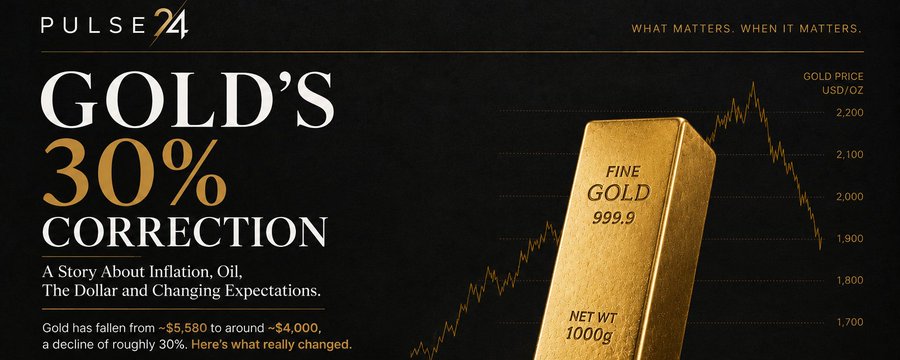
Gold's 30% Correction: A Story About Inflation, Oil, The Dollar and Changing Expectations
Oracle's Default Insurance Hit a Record 227 Basis Points in September. Microsoft, Amazon, and Alphabet's Barely Moved.
Oracle's cost of insuring its own debt against default hit a record near 227 basis points in late September, up sharply from well under 100 earlier in the cycle, while Alphabet, Amazon, and Meta are paying almost nothing extra despite spending just as aggressively on AI infrastructure. Bond markets have already picked a side in the AI capex race, and S&P's own downgrade came only after the market had been pricing it in for months.
Japan and the US Spent Up to $85 Billion Defending the Yen in July. The Dollar Index Hit an 18-Month High Anyway.
A rare coordinated intervention briefly rescued the yen from a 40-year low over the summer, but the relief lasted barely two weeks. Now the dollar is breaking out to fresh highs and Tokyo is signaling it would rather lean on growth policy than spend billions defending the currency again.
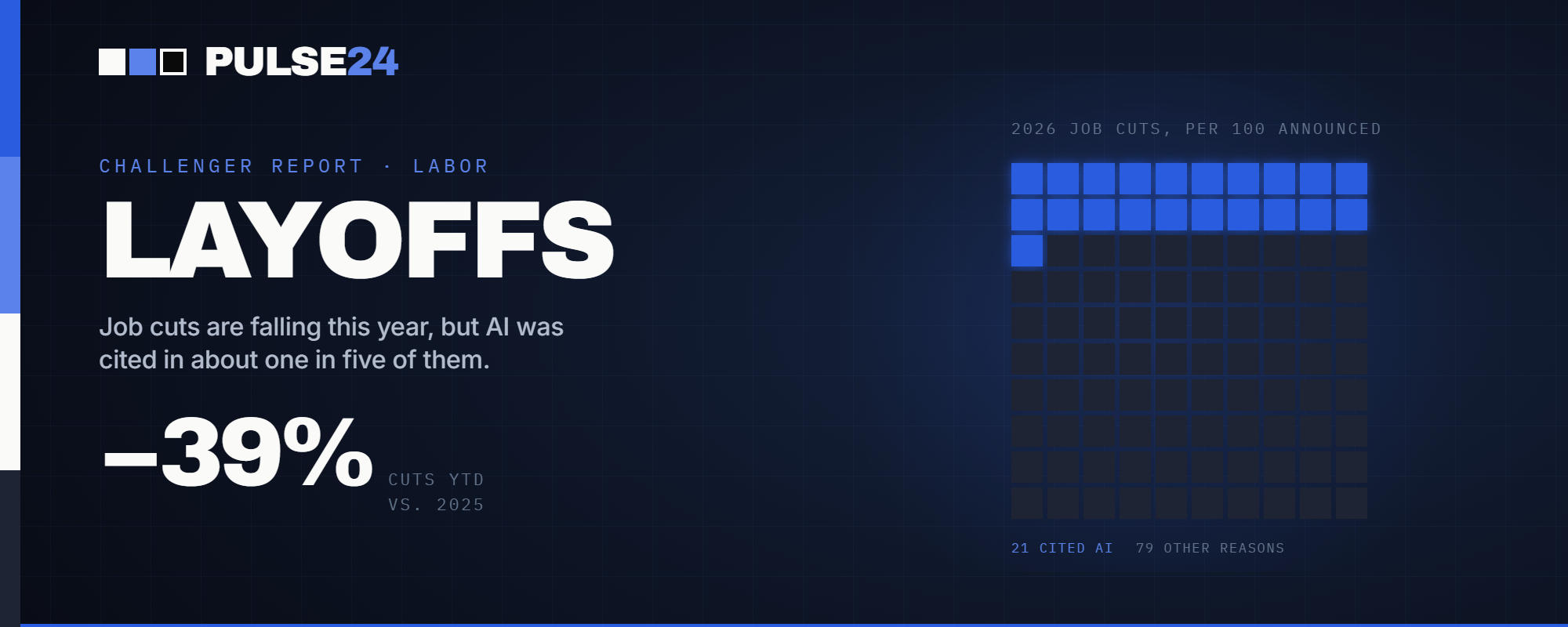
U.S. Layoffs Are Down 39% This Year. AI Still Caused One in Five of Them.
Companies have announced 39% fewer layoffs through September than at this point last year, and hiring plans are actually running ahead of 2025. But AI was still cited in roughly one in five of this year's job cuts, concentrated in tech, where the disruption looks structural rather than cyclical.
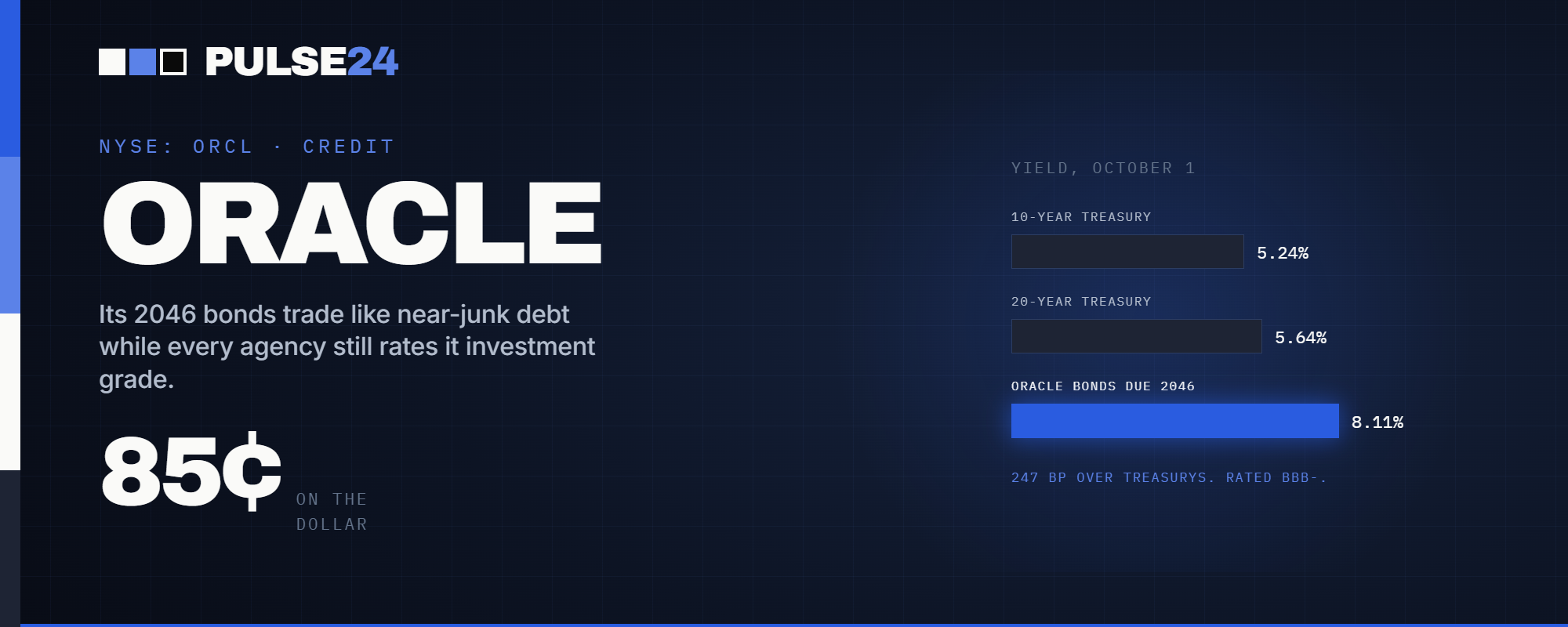
Oracle's Bonds Due in 2046 Trade at 85 Cents on the Dollar. Its Credit Rating Still Says Investment-Grade.
Oracle's bonds due in 2046 are trading like distressed debt, pricing an 8.11% yield to maturity even though every major rating agency still calls the company investment grade. The gap between what credit markets and equity markets believe about Oracle's AI buildout keeps widening.
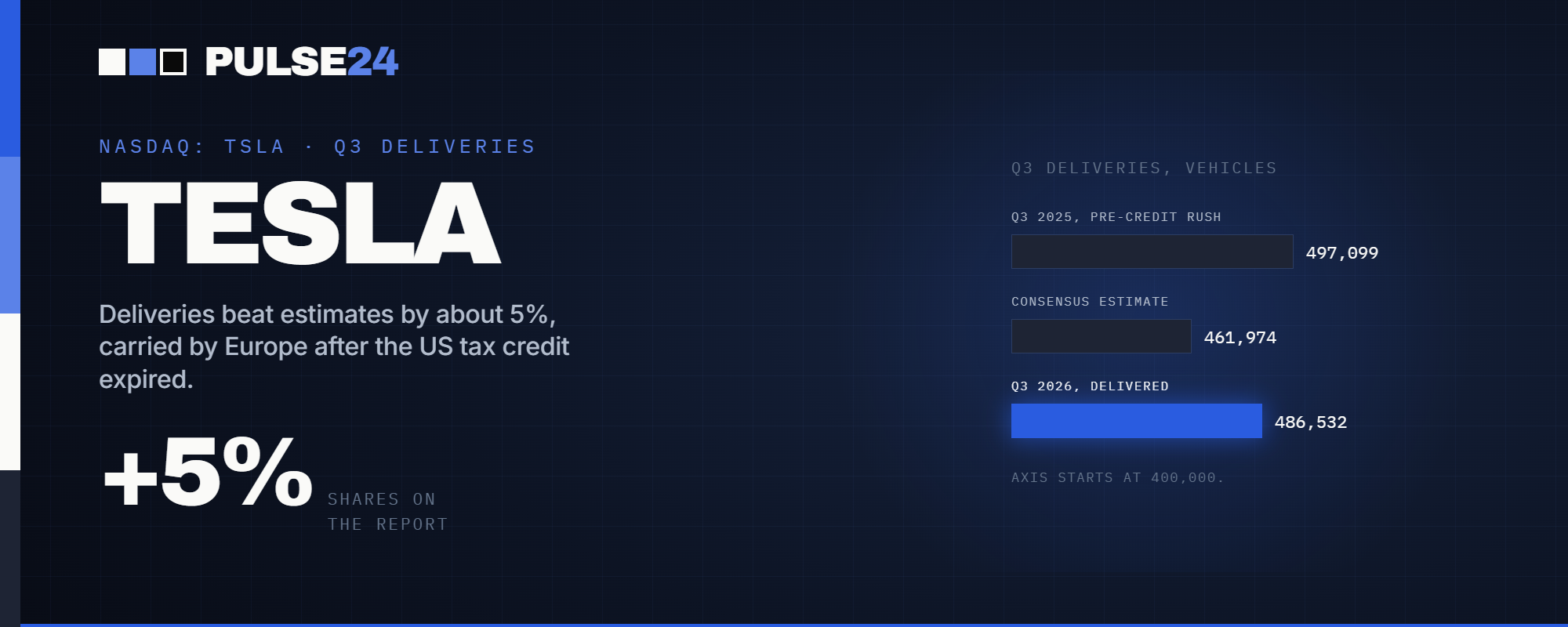
Tesla Delivered 486,532 Vehicles Last Quarter, 5% Above Estimates. Almost All the Upside Came From Europe.
Tesla delivered 486,532 vehicles last quarter, about 5% above Wall Street's estimate, and the stock added roughly 5% on the news. Most of that strength came from Europe, where registrations in Portugal and France both surged, while US demand cooled now that the federal EV tax credit has expired.
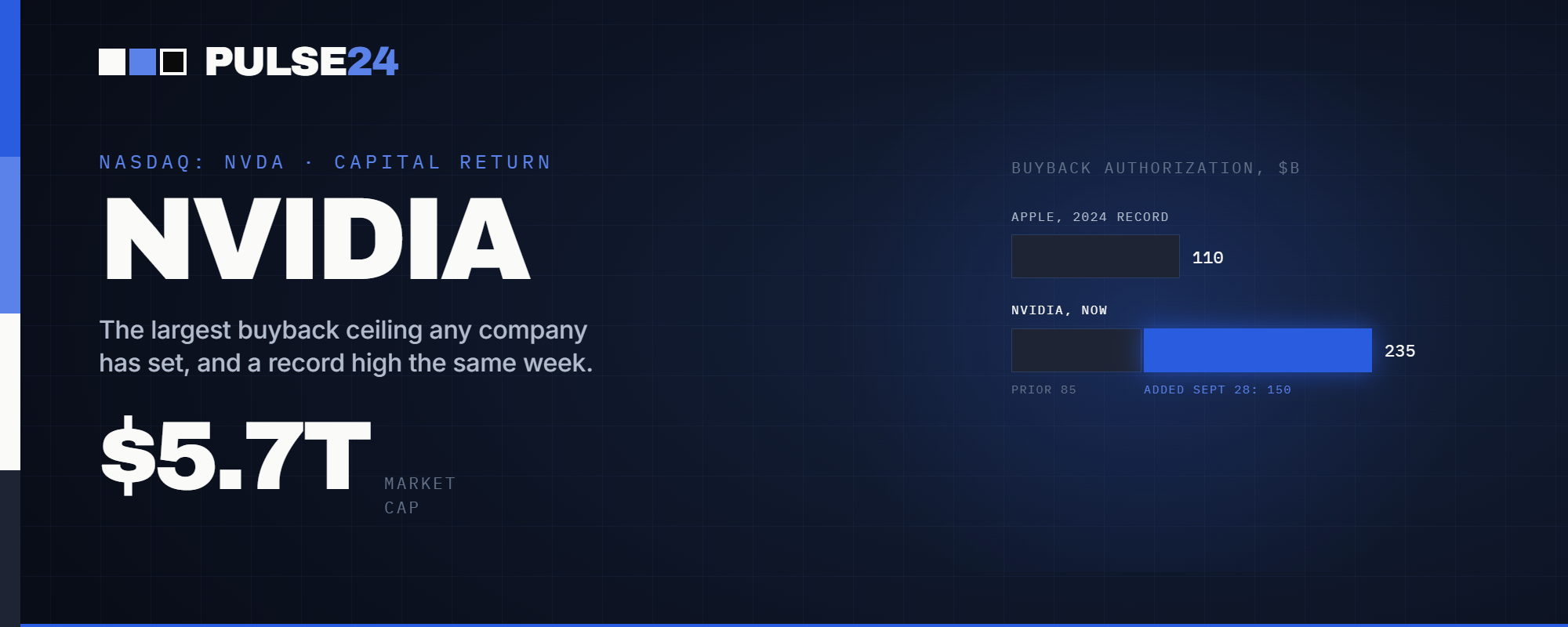
$150 Billion More in Buybacks Pushed Nvidia's Total to $235 Billion. Its Stock Hit a Record High the Same Week.
Nvidia's board added $150 billion to its buyback authorization last week, pushing total capacity to $235 billion, the largest such ceiling any public company has set. The stock answered Friday with a record intraday high near $237.55 and a market cap of roughly $5.7 trillion.
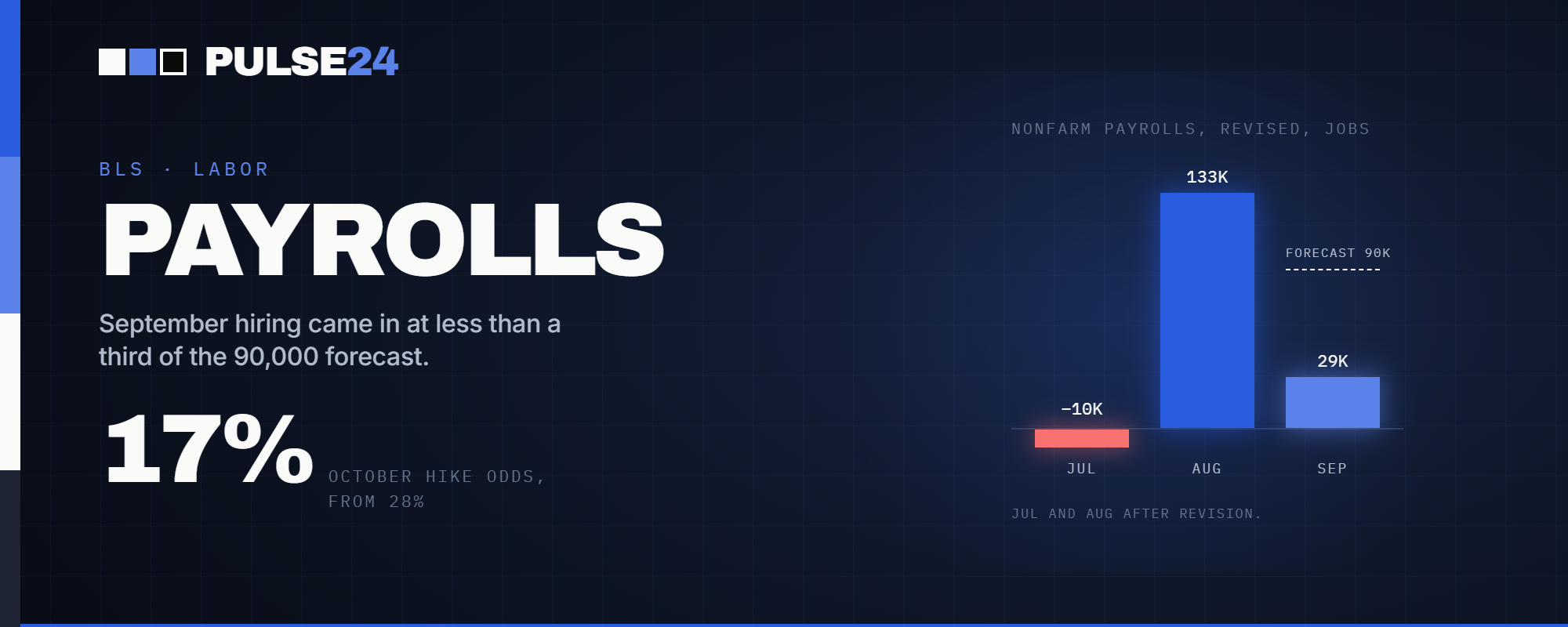
September Payrolls Came In at 29,000, Not 90,000. October Rate Hike Odds Fell to 17%.
September payrolls came in at just 29,000 against a forecast of 90,000, and two months of revisions erased another 60,000 jobs from the books. October rate hike odds fell to 17% within minutes, while gold, Bitcoin, and Treasury yields all moved to price in a Fed that's done tightening.
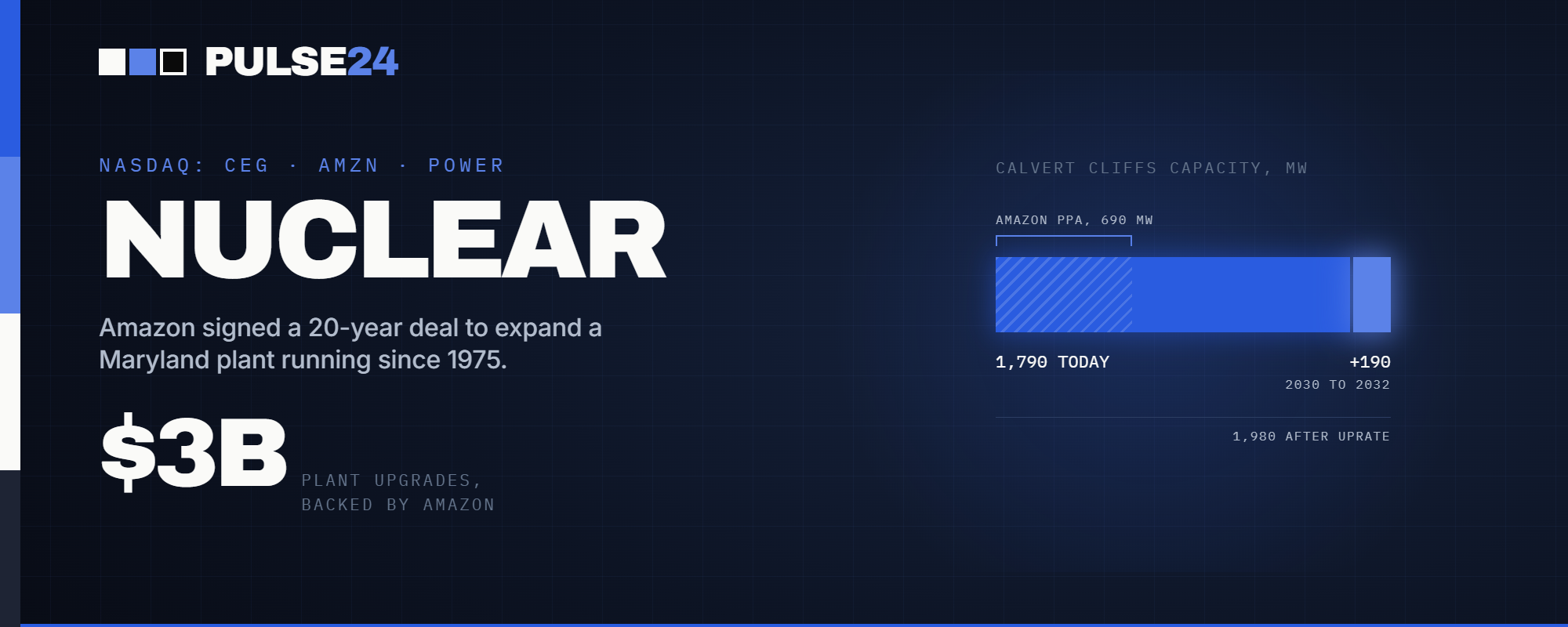
Amazon Locked In 20 Years of Nuclear Power From One Maryland Plant. Constellation's Stock Jumped as Much as 6.4%.
Amazon signed a 20-year, $3 billion power deal with Constellation Energy to expand a Maryland nuclear plant that's been running since 1975, and the stock jumped as much as 6.4% on the news. Uranium prices near 18-year highs show why nuclear power has become one of the tightest bottlenecks in the AI buildout.
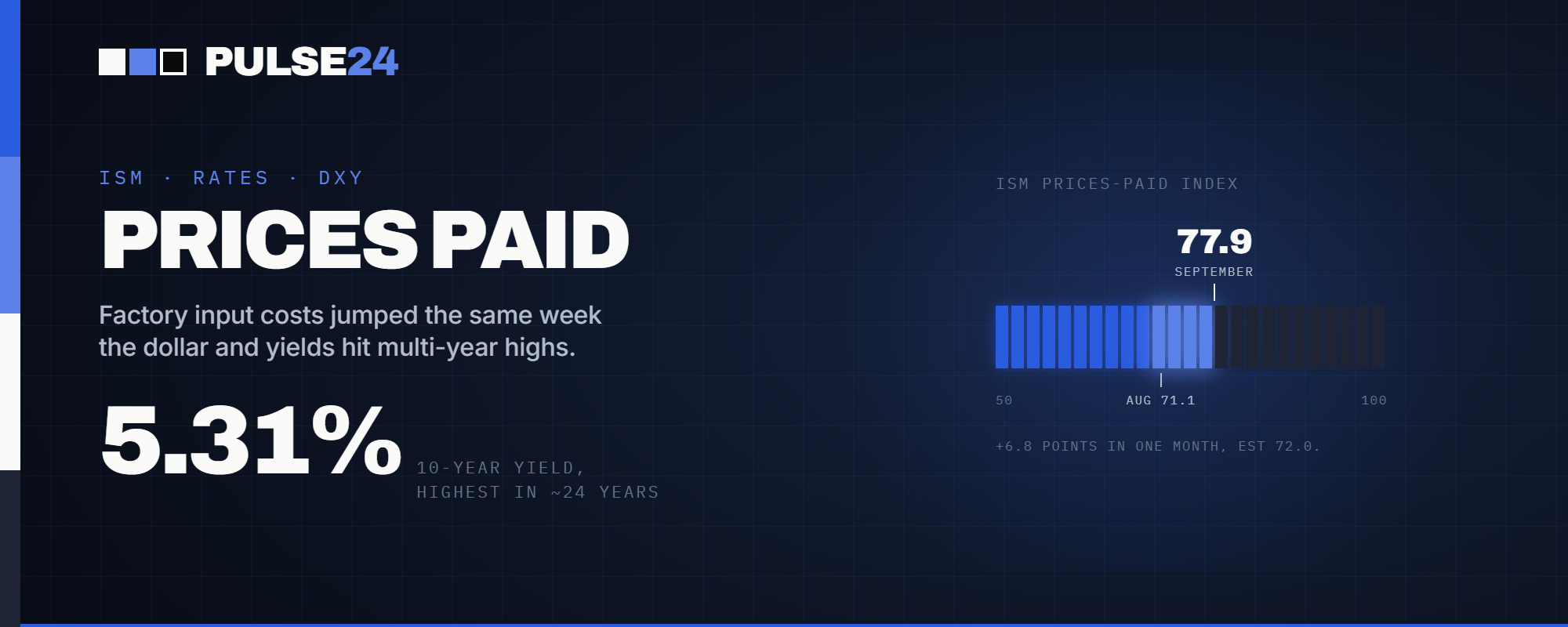
U.S. Factory Input Costs Jumped 6.8 Points in September. The Dollar and the 10-Year Yield Both Hit Multi-Year Highs the Same Week.
ISM's prices-paid index jumped nearly seven points in September, the dollar index hit a fresh yearly high, and the 10-year Treasury yield touched its highest level in 24 years, all within 48 hours of today's jobs report. Minneapolis Fed President Neel Kashkari says current policy isn't providing much restraint, and he's not done hiking yet.
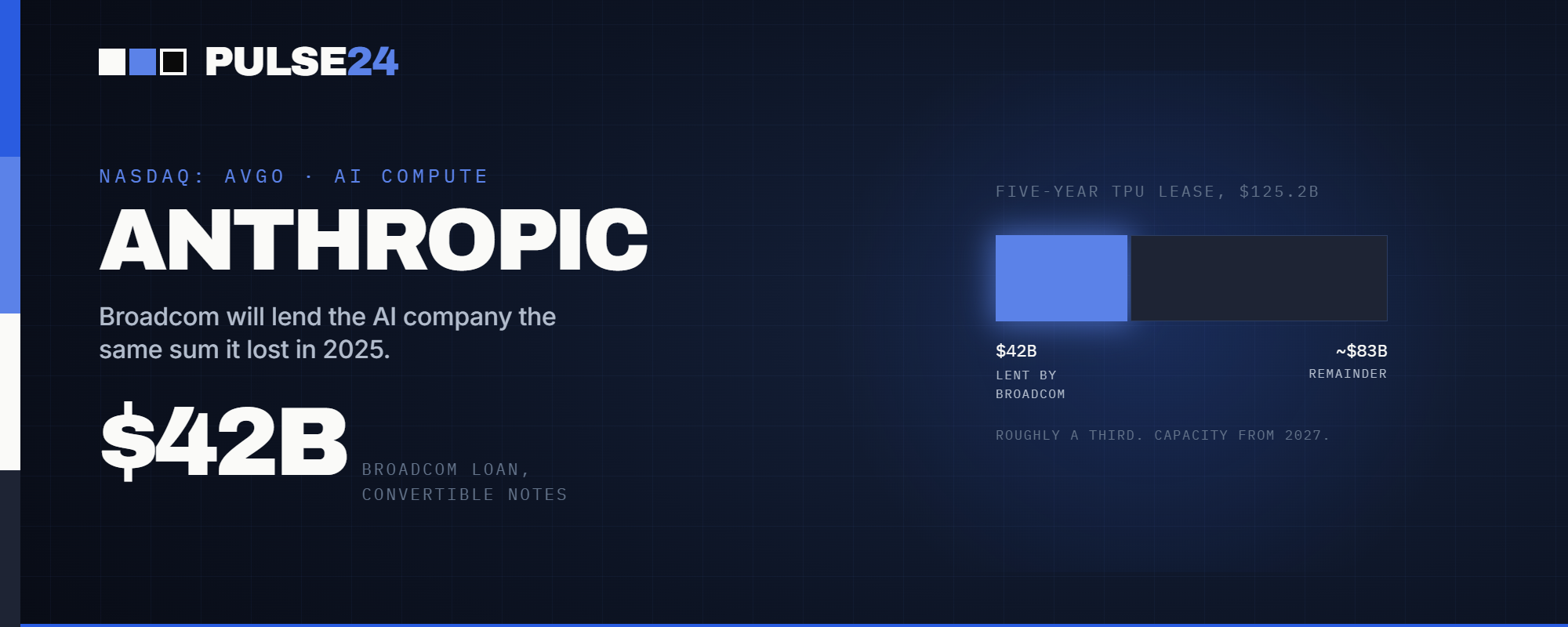
Anthropic Lost $42 Billion Last Year. Broadcom Agreed to Lend It the Exact Same Sum.
Broadcom will lend Anthropic up to $42 billion to help cover a $125.2 billion TPU lease, a sum that happens to match the AI company's entire 2025 net loss. The arrangement puts a specific dollar figure on the vendor financing question that's been dogging the whole AI infrastructure trade.
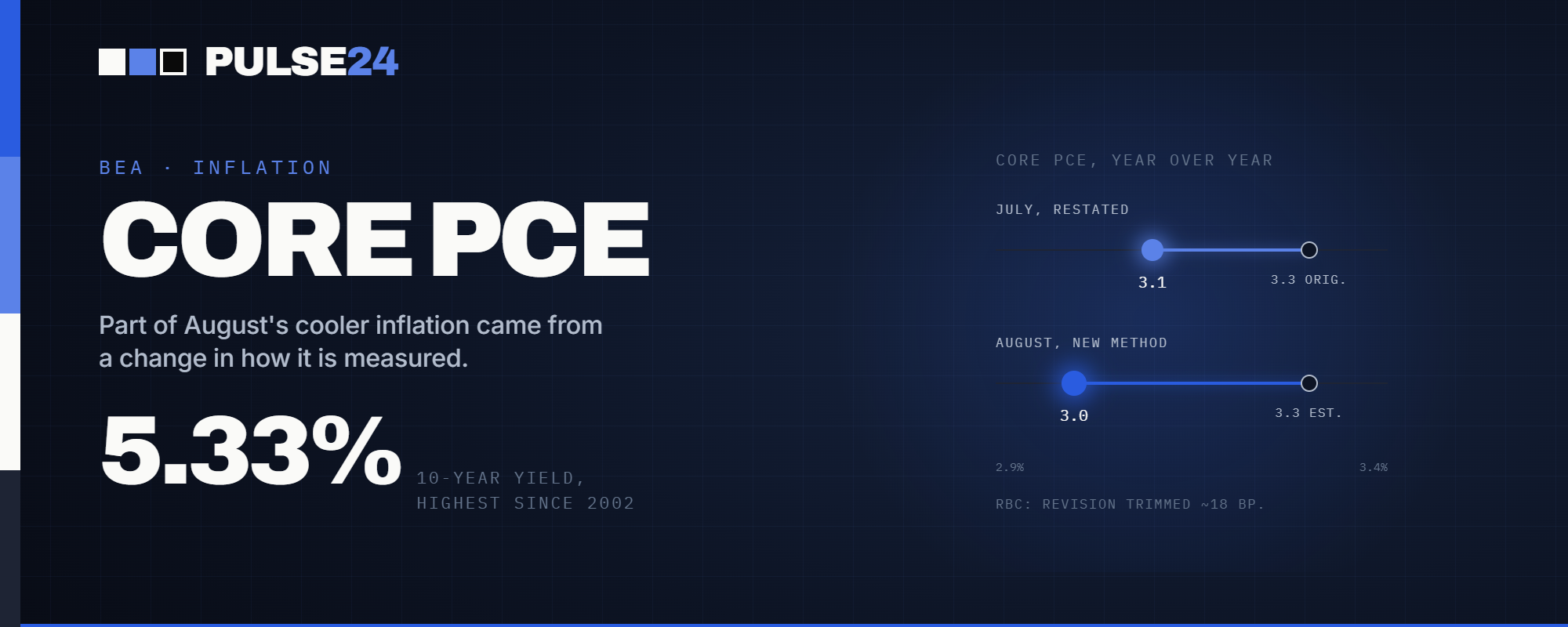
Core Inflation Slowed to 3.0% in August. The BEA Also Rewrote How It's Measured.
August's core PCE cooled to 3.0% year over year, well below the 3.3% economists expected, but a chunk of that improvement traces to a BEA accounting overhaul rather than genuine disinflation. Treasury yields and the dollar barely blinked, both still grinding toward multi-decade highs.
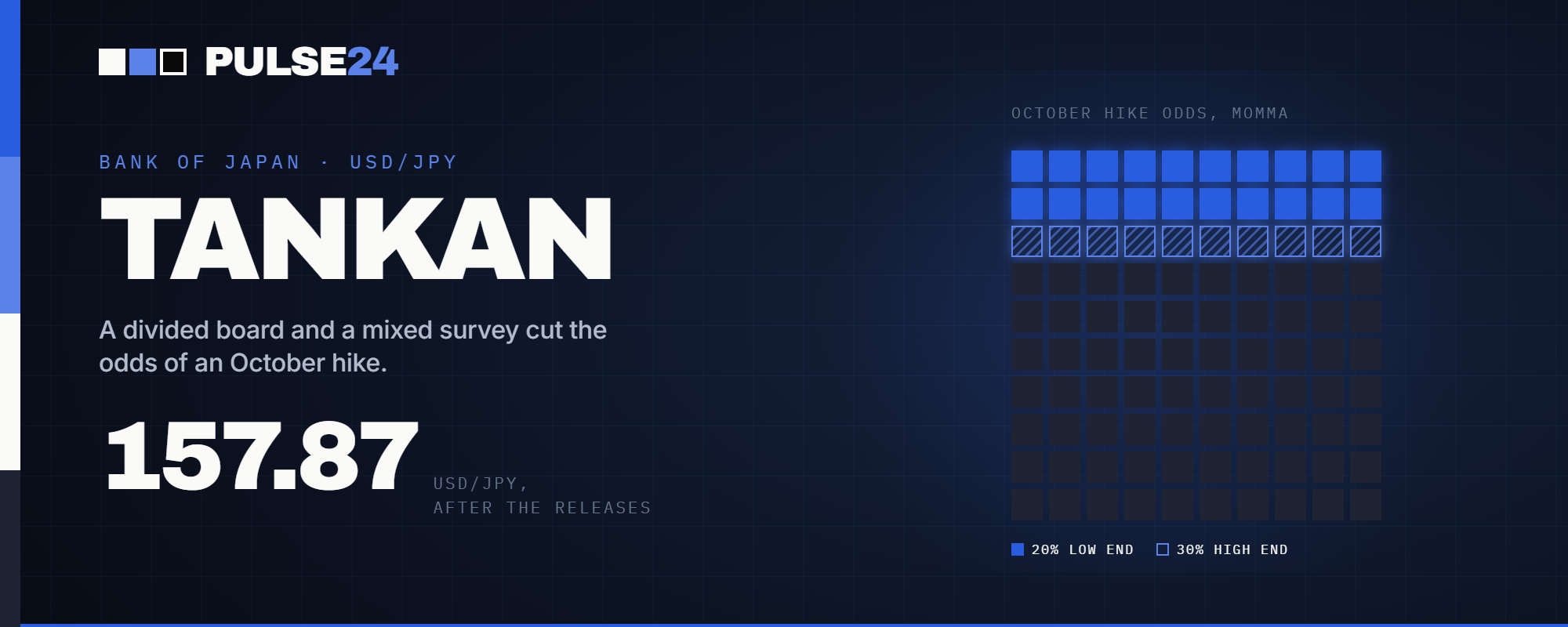
A Former Bank of Japan Official Now Puts October Hike Odds at 20% to 30%. The Yen Already Noticed.
The Bank of Japan's own policy committee is more divided than markets assumed. A fresh batch of internal opinions and a mixed Tankan survey released Thursday cut the odds of an October rate hike, and the yen moved first.
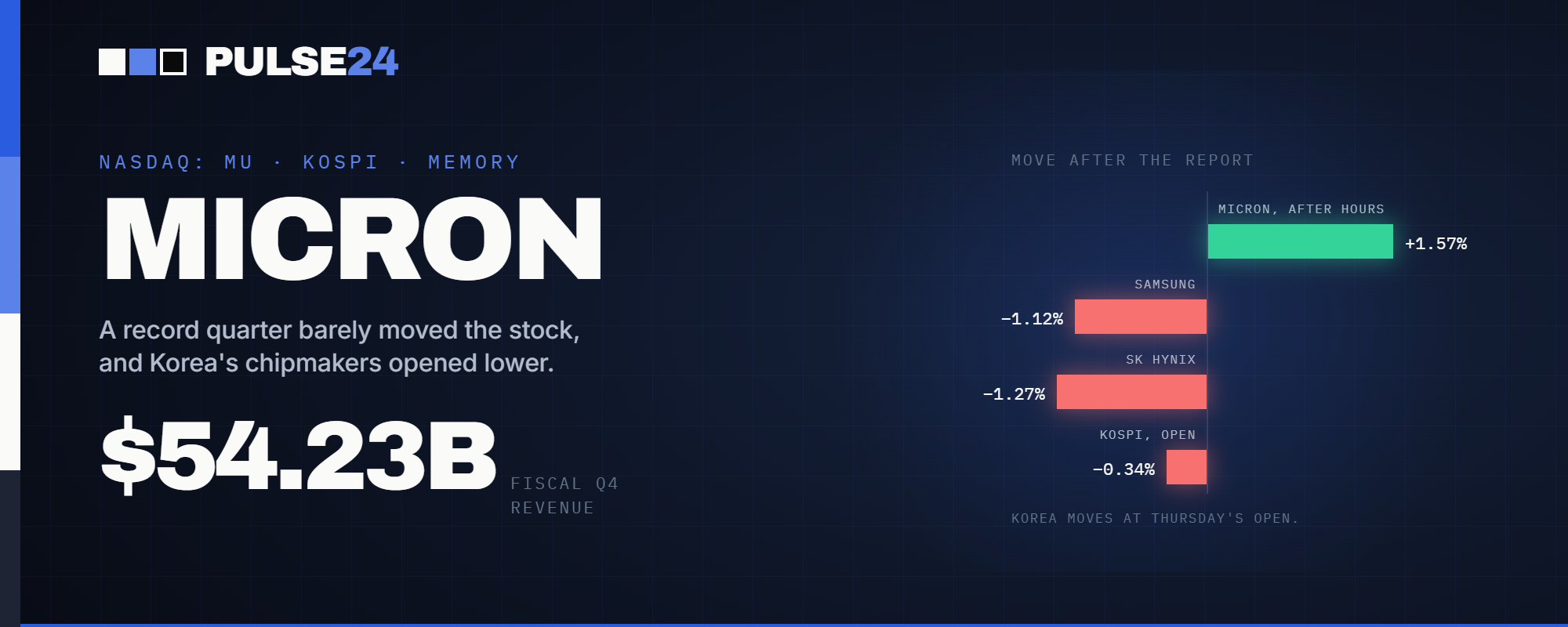
$54.23 Billion in Record Micron Revenue Couldn't Lift Korea's Chip Stocks Thursday
Micron beat Wall Street's revenue estimate by $3.48 billion and guided even higher for the quarter ahead, yet Samsung and SK Hynix both opened lower Thursday. Treasury yields near two-decade highs are doing more to move chip stocks right now than earnings are.
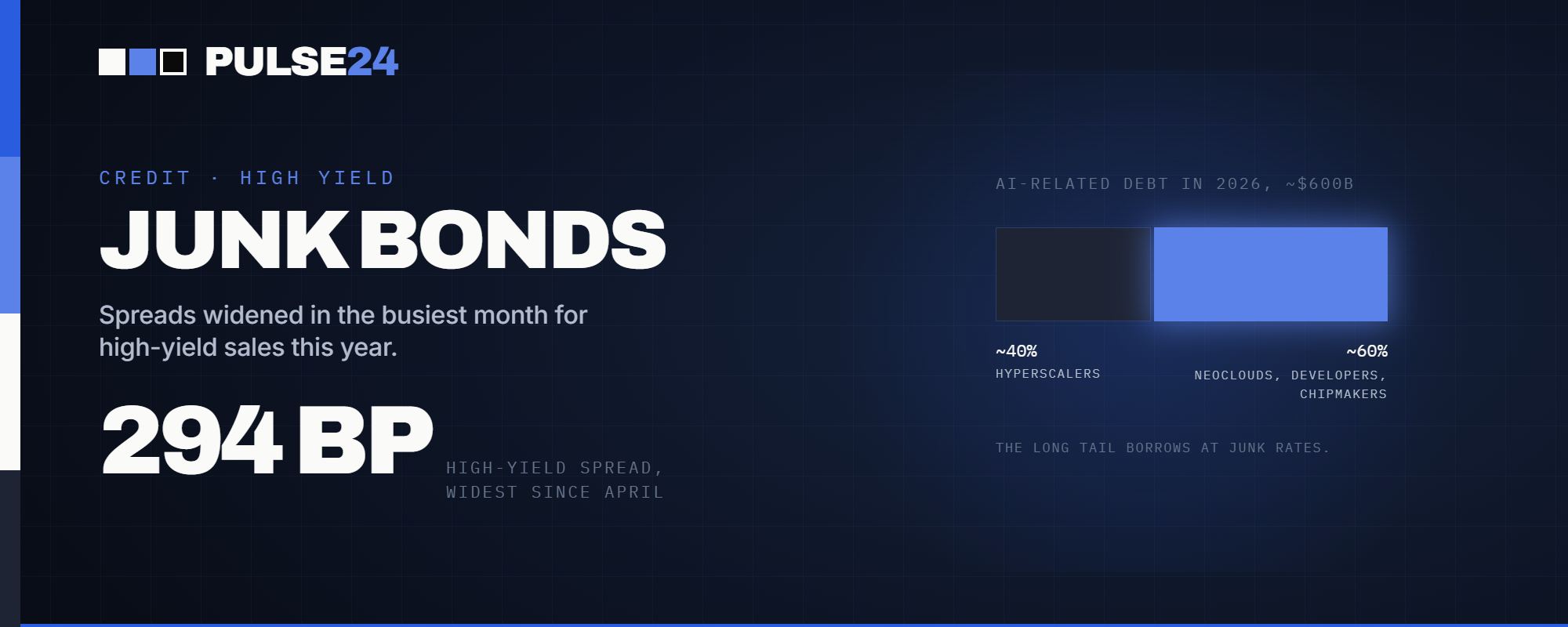
High-Yield Spreads Widened to 294 Basis Points Last Week. September Was the Busiest Month for Junk Bond Sales All Year.
Junk bond spreads widened to their highest level since April, even though Wall Street sold more high-yield debt in September than in any other month this year. The credit market is starting to feel the weight of financing the AI buildout.
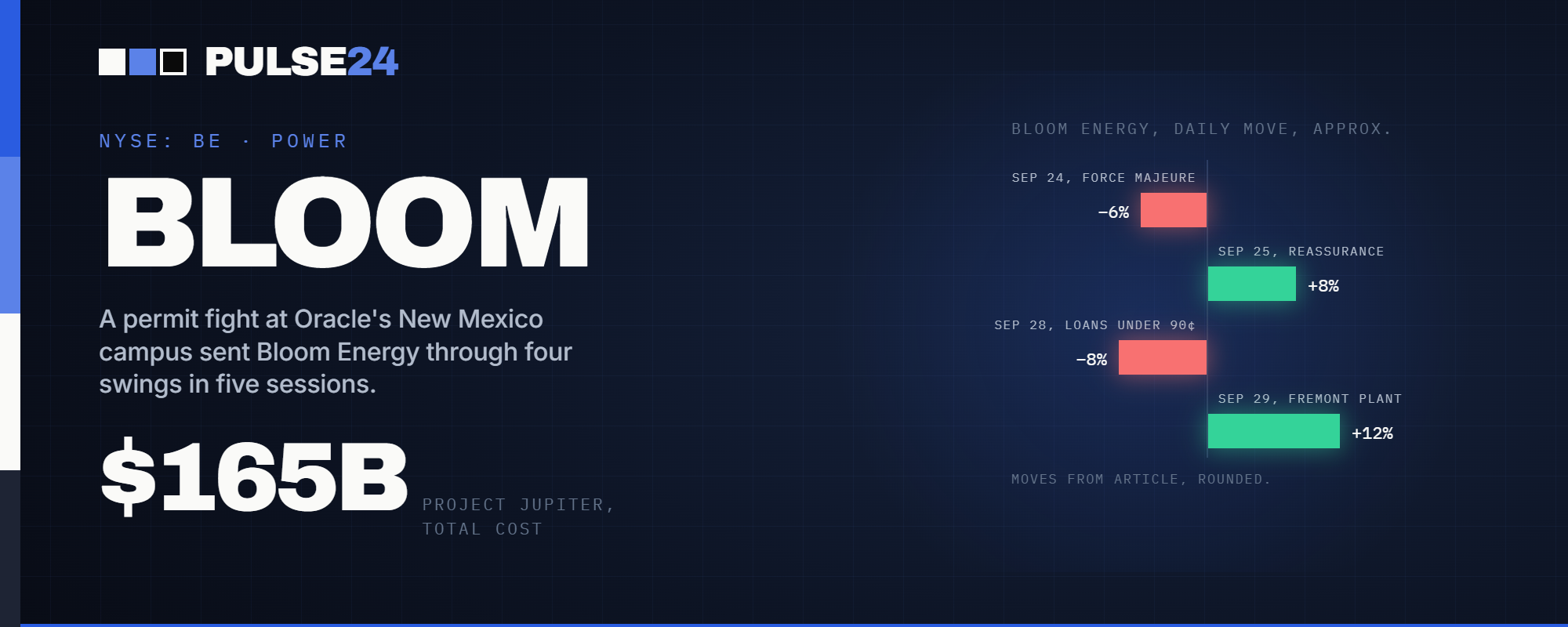
Bloom Energy Dropped 8% Monday and Jumped 12% Tuesday. A $165 Billion Data Center Explains the Whiplash.
Bloom Energy swung double digits in both directions this week after Oracle filed a force majeure notice on its $165 billion Project Jupiter data center in New Mexico. The whiplash shows how much of the AI buildout's risk now sits in permits and power, not chips.
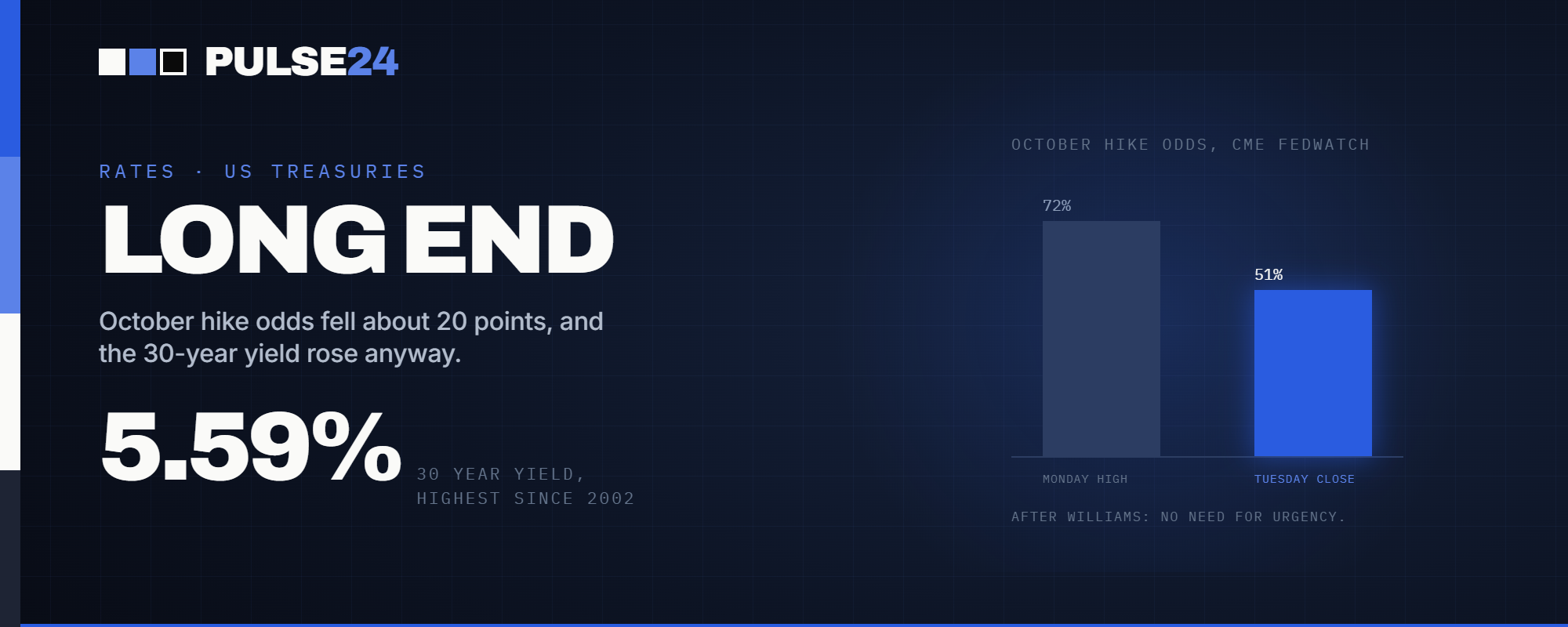
October Fed Hike Odds Dropped From 70% to 51% Tuesday. The 30-Year Treasury Yield Hit a 2002 High Anyway.
October rate-hike odds fell twenty points in a single session after the New York Fed's John Williams said there's no rush to move again. The 30-year Treasury yield didn't get the memo, climbing to its highest level since 2002 anyway.
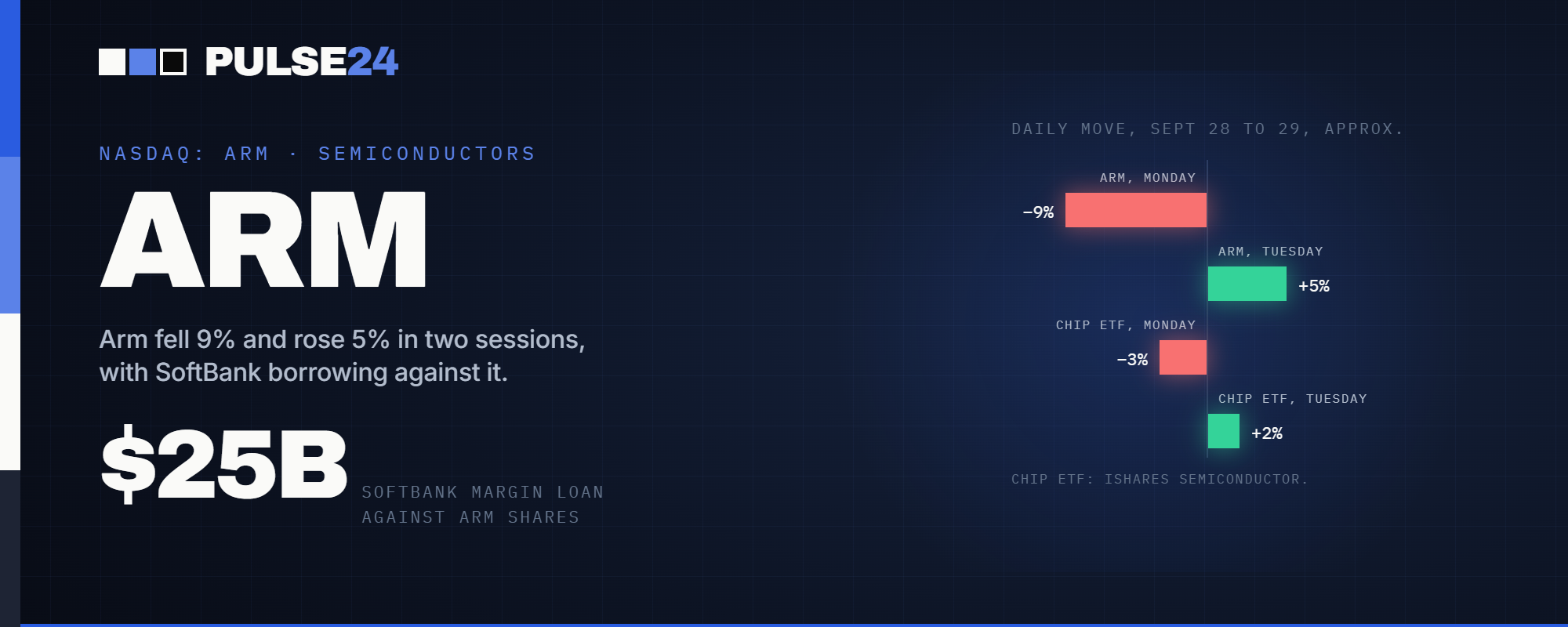
Arm Dropped 9% Monday and Jumped 5% Tuesday. A $25 Billion SoftBank Loan Explains the Whiplash.
Arm sank 9% Monday and rallied 5% Tuesday, a round trip that says as much about SoftBank's $25 billion margin loan against its own shares as it does about bond yields. The stock trades at one of the market's richest multiples, which means small shifts in rate expectations move it far more than its business actually changes.
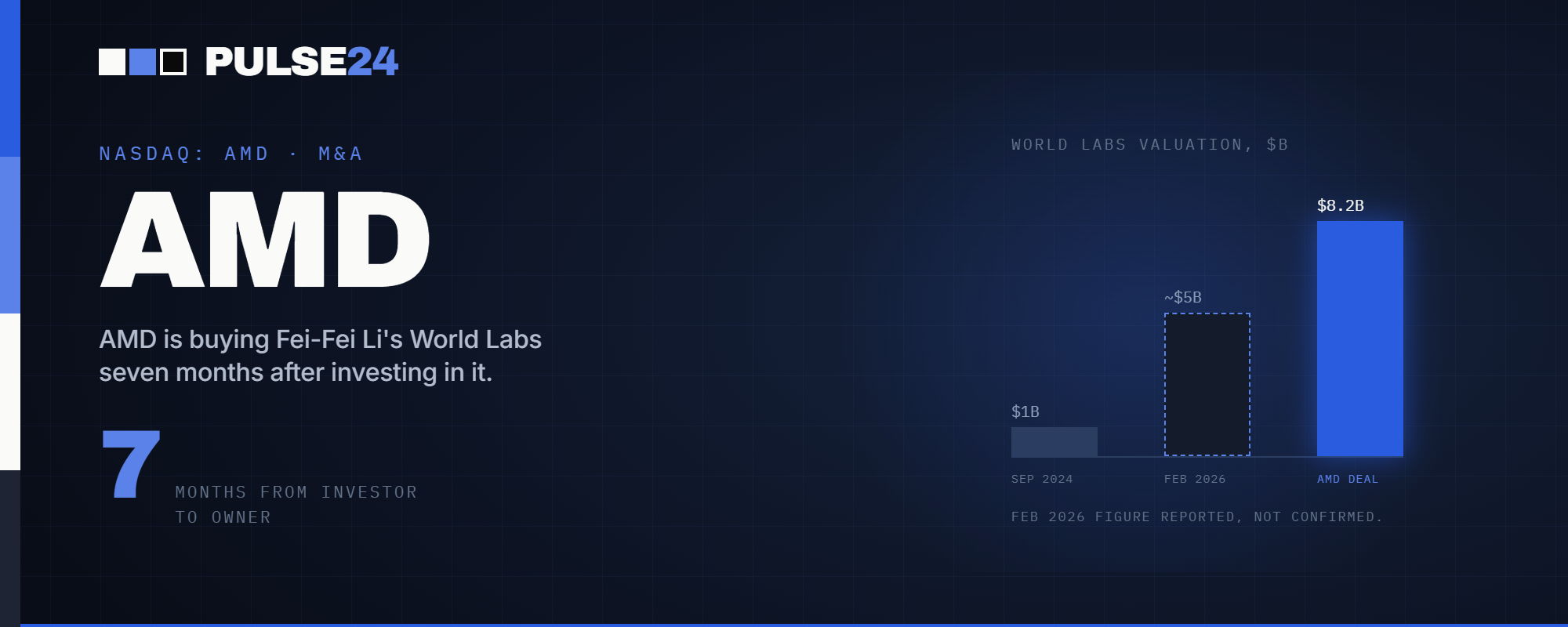
World Labs Was Worth $1 Billion in 2024. AMD Paid $8.2 Billion for It Monday.
AMD is paying $8.2 billion in stock for Fei-Fei Li's World Labs, a startup AMD itself had invested in just seven months earlier. The deal pulls the ImageNet creator into AMD's C-suite as it races Nvidia into AI world models, robotics, and physical-world simulation.
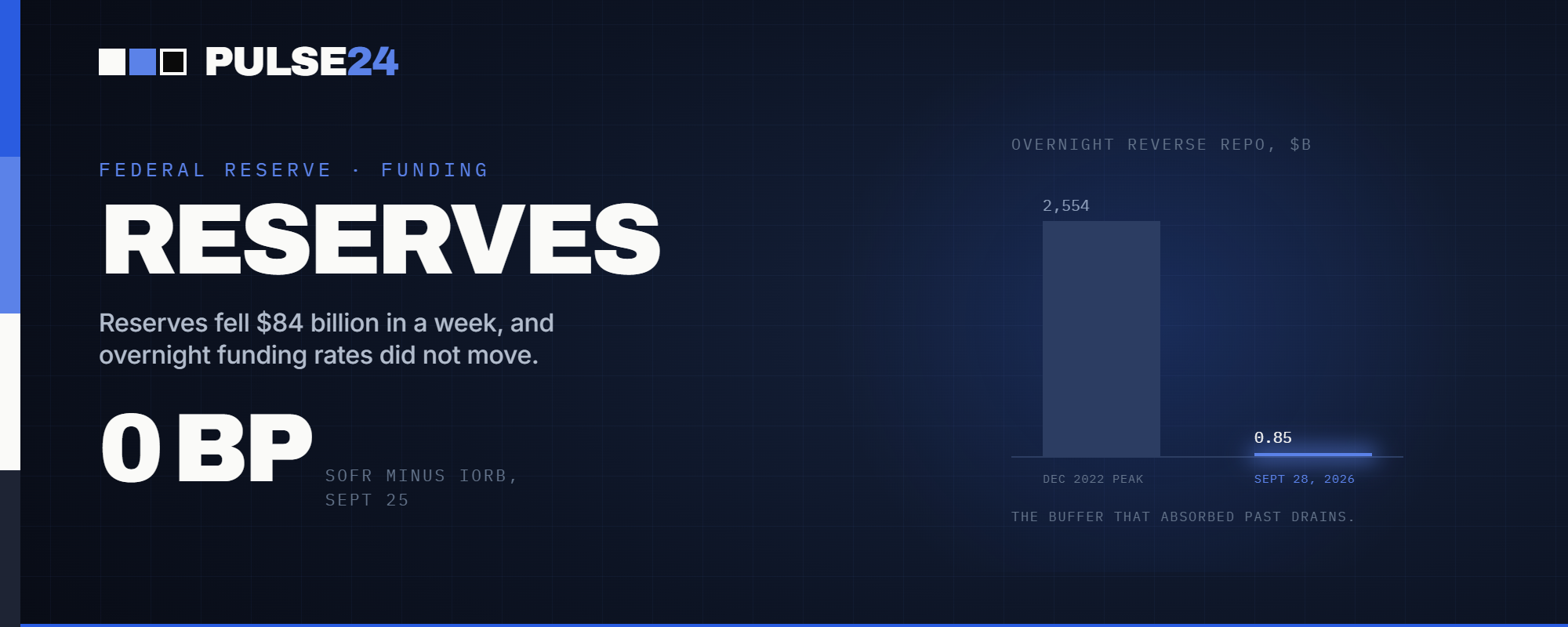
Bank Reserves Fell $84 Billion in a Week. The Repo Market Didn't Blink.
Bank reserves dropped to $2.93 trillion heading into quarter end, the kind of move that used to send repo rates spiking. This time the funding market barely budged, and the reason says something about where liquidity risk is actually hiding now.
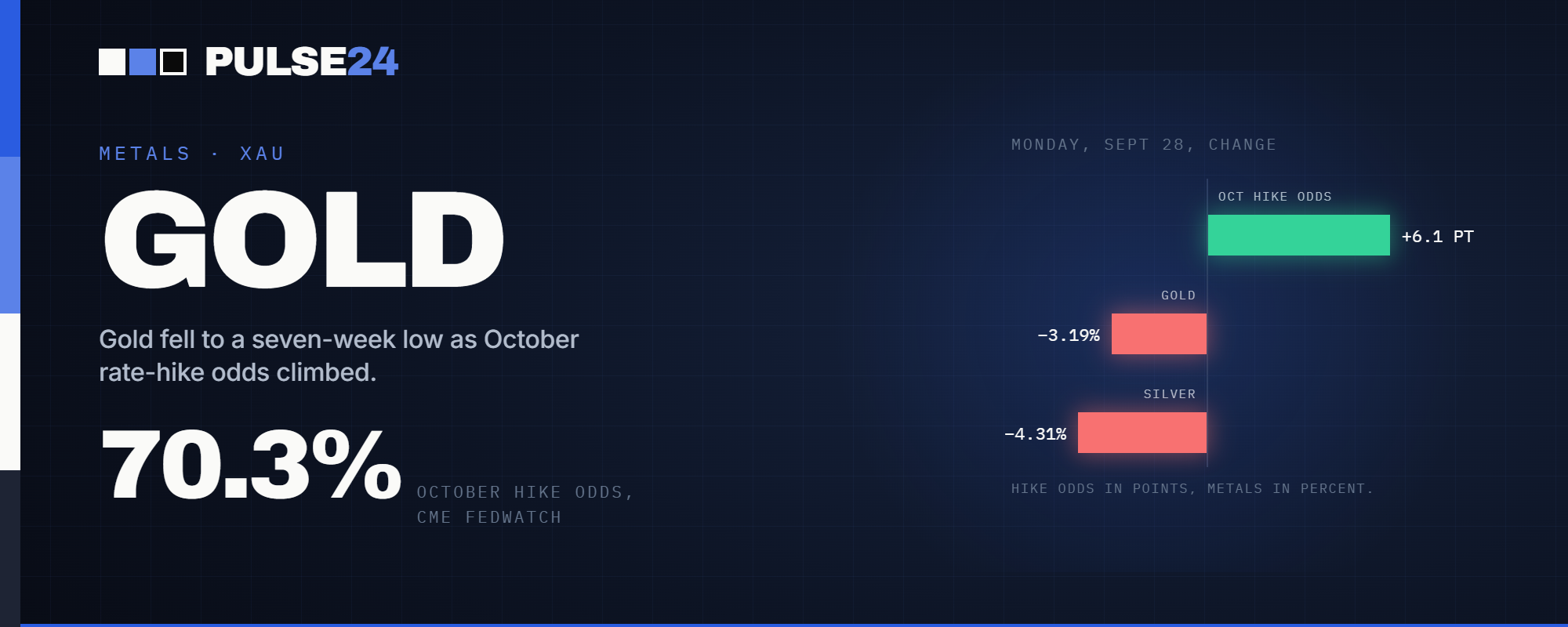
October Fed Hike Odds Jumped From 64% to 70% in a Single Session. Gold Fell to a Seven-Week Low, and Silver Fell Harder Still.
Fed rate-hike odds for October jumped seven percentage points in a single trading session, and gold posted its worst day in seven weeks. The reason: an oil-driven inflation scare hit metals instead of lifting them the way an inflation scare normally would.
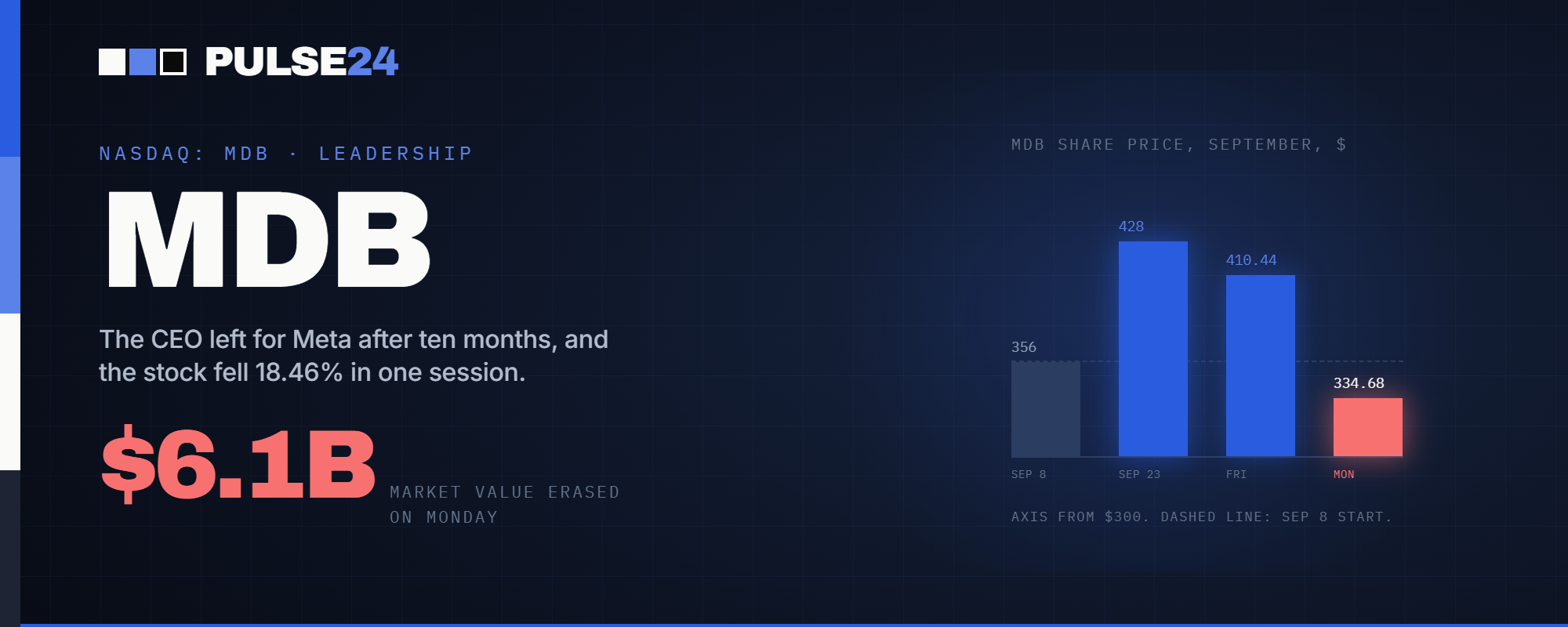
MongoDB Lost $6.1 Billion in a Single Session. The CEO Who Ran It Left for Meta Instead.
MongoDB lost about a fifth of its value on Monday after CEO CJ Desai left the job after just over ten months to run Meta's new enterprise AI platform, the same push that's now targeting Salesforce, ServiceNow and Microsoft. Dev Ittycheria, who ran MongoDB for more than a decade before Desai took over, is back as interim CEO one day before the company's investor day.
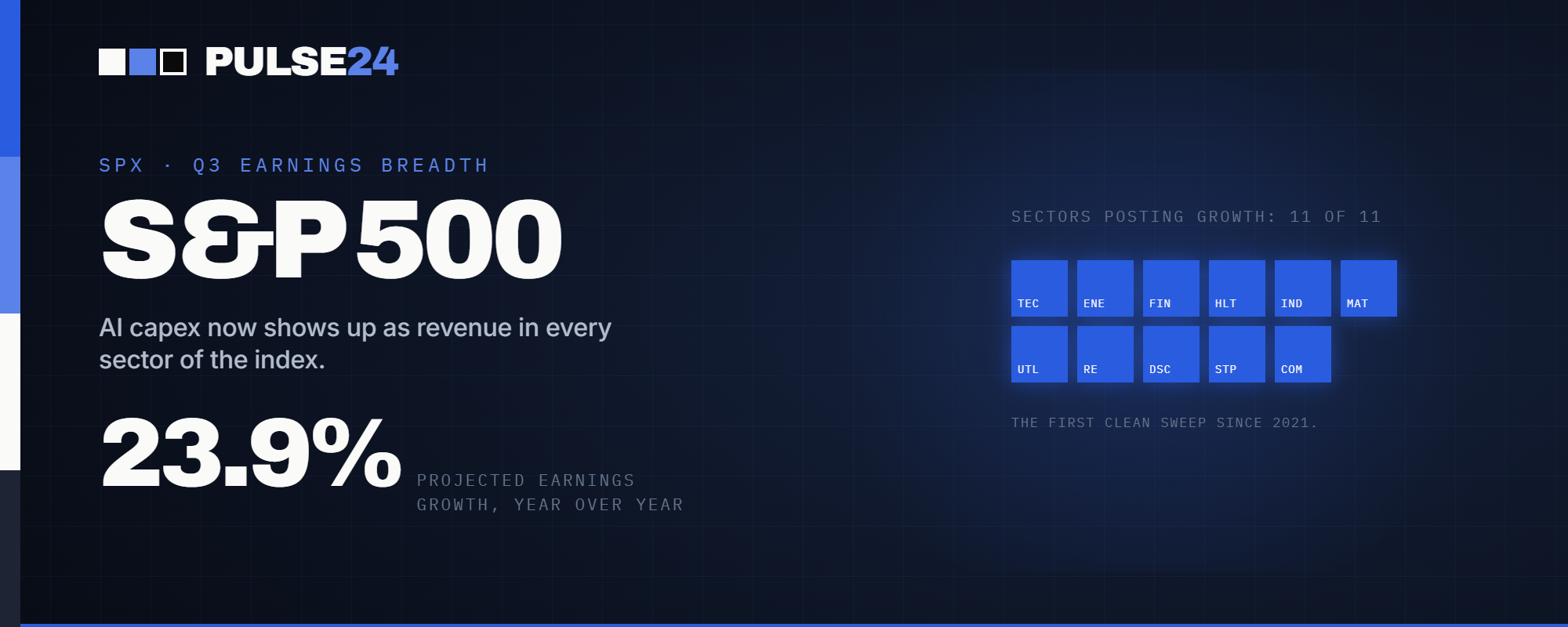
For the First Time Since 2021, Every Sector in the S&P 500 Is Set to Post Earnings Growth. AI Capex Is the Reason Why.
Every one of the S&P 500's eleven sectors is projected to post earnings growth this quarter, a breadth the index hasn't shown since 2021. Strategists at Wells Fargo and Barclays say the common thread is AI capital spending large enough to show up as revenue everywhere from data center catering contracts to industrial parts suppliers.
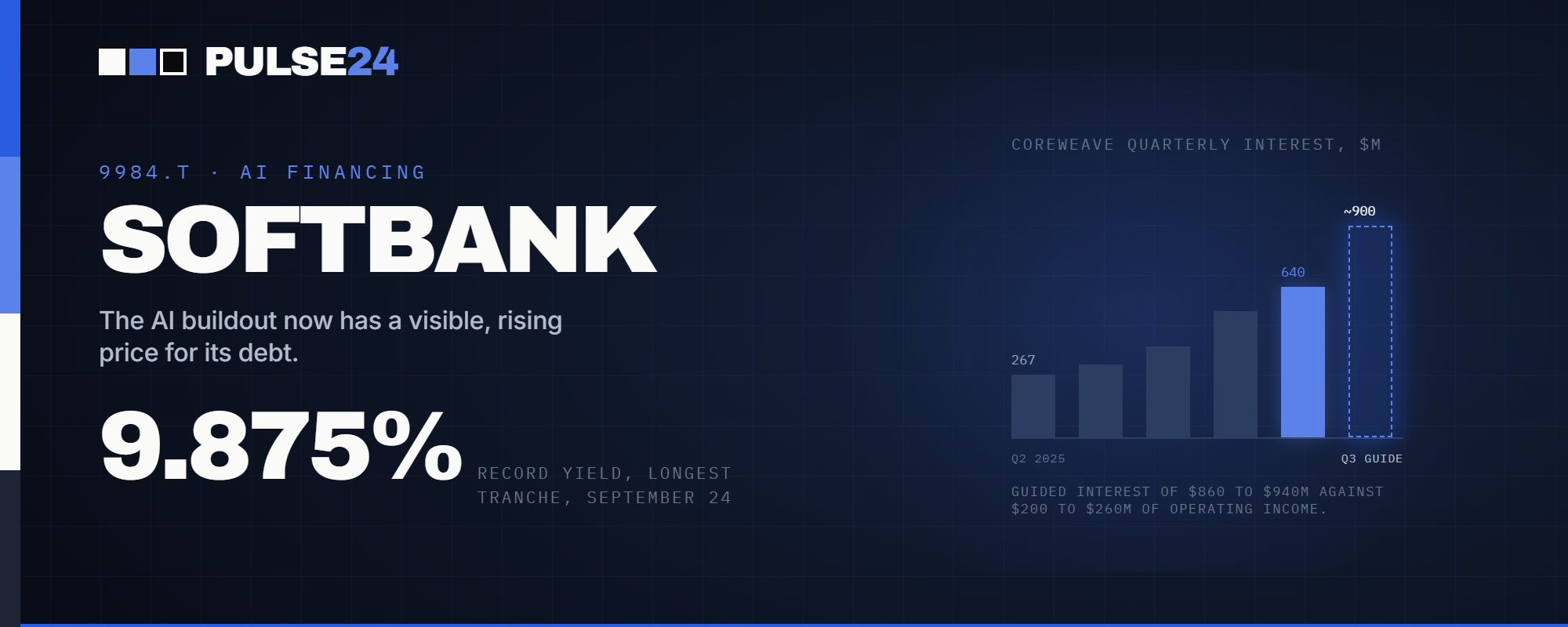
SoftBank Is Paying Its Highest-Ever Bond Yields to Fund OpenAI. CoreWeave's Next Interest Bill May Top Its Operating Income.
SoftBank agreed to pay its highest-ever bond yields this week to keep funding OpenAI, and CoreWeave's own interest bill is on pace to exceed its operating income next quarter. The Fed's rate hikes are starting to show up as a real, dollar-denominated cost of the AI buildout, not just a debate about valuations.
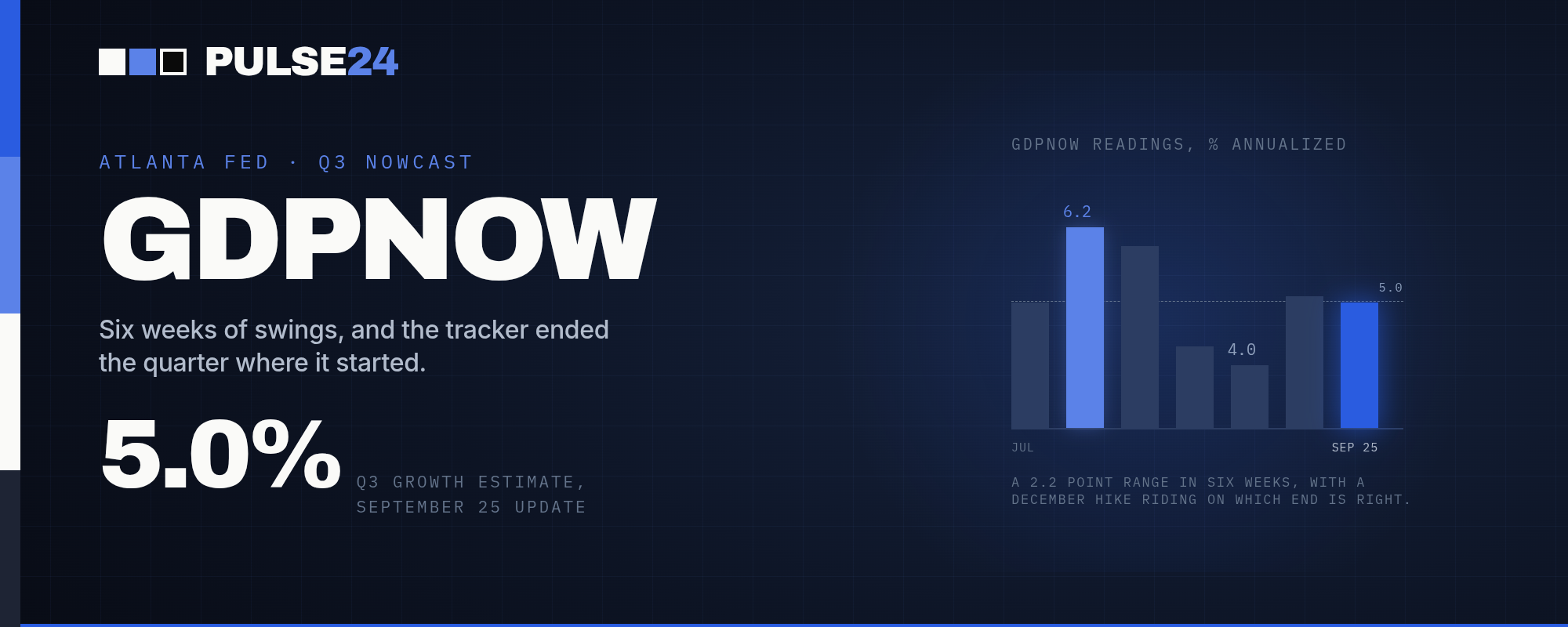
GDPNow Swung From 4.0% to 6.2% This Quarter. The Fed's December Decision May Hinge on Which Number Was Right.
The Atlanta Fed's GDPNow model bounced between 4.0% and 6.2% for third-quarter growth before settling at 5.0% on September 25. That volatility lands right as the Fed weighs a fourth rate hike with inflation still running above target.
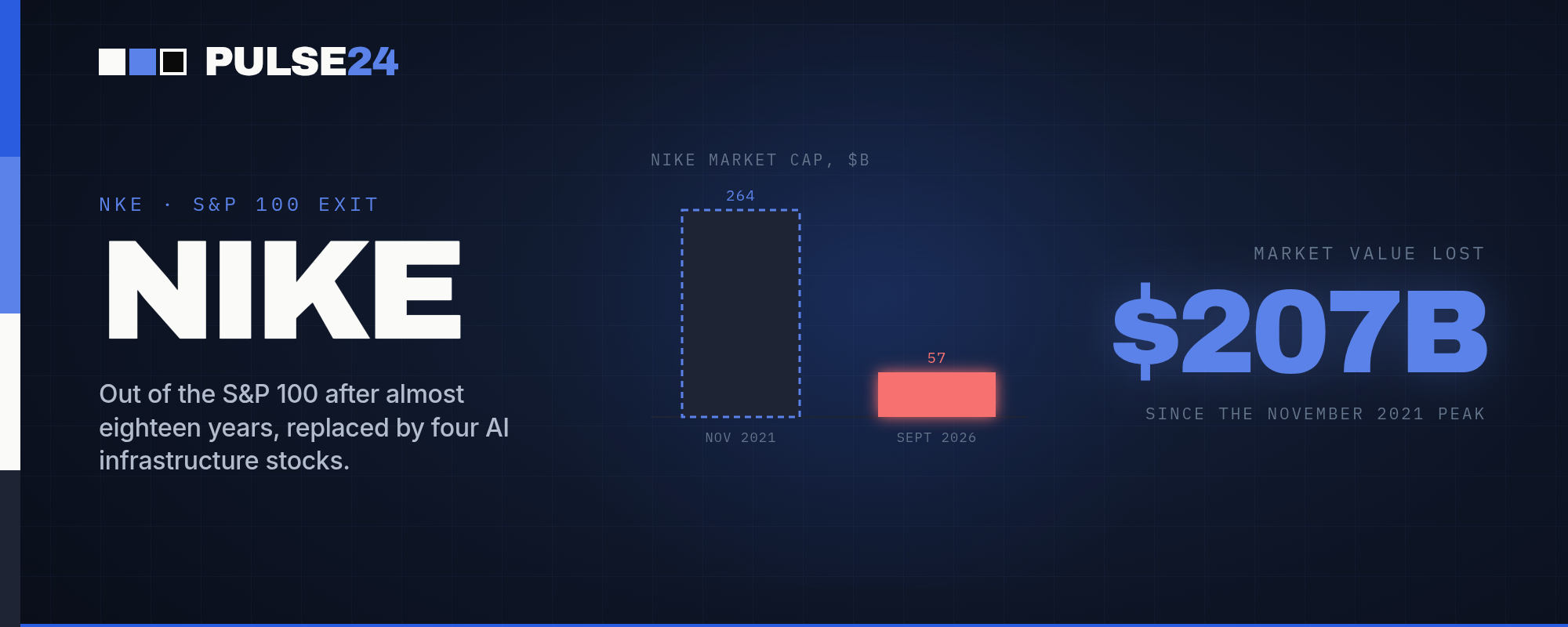
Nike Lost $207 Billion in Market Value. Four AI Infrastructure Stocks Took Its Spot in the S&P 100.
Nike's eighteen-year run in the S&P 100 ended on September 21, replaced in a single trading session by Dell, Palo Alto Networks, Arista Networks, and Sandisk. The swap says as much about where capital is flowing as it does about Nike's own turnaround problem.
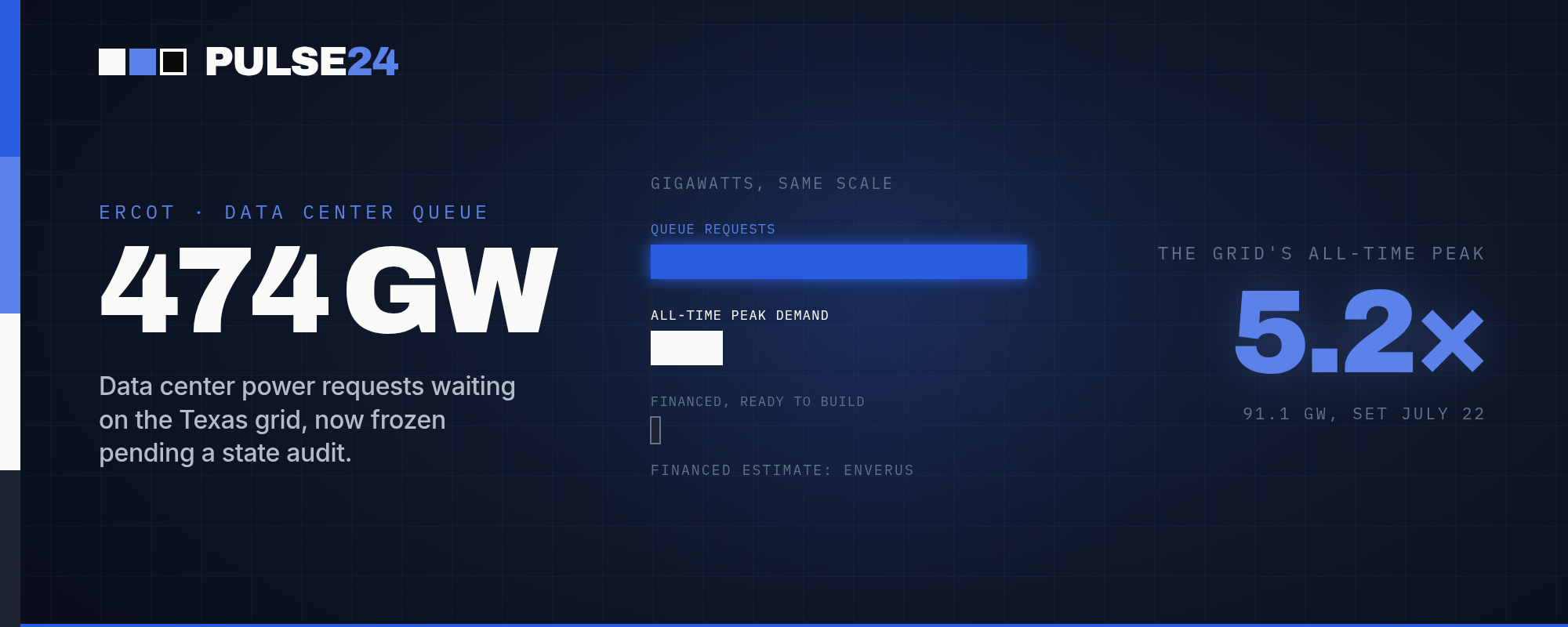
Texas' Data Center Queue Wants 474 Gigawatts. The Grid's All-Time Record Is 91.
Texas has frozen new permits for data centers while 474 gigawatts of power requests sit in the grid queue, more than five times its record peak. Some of the state's biggest power generators actually want the freeze to stick around.
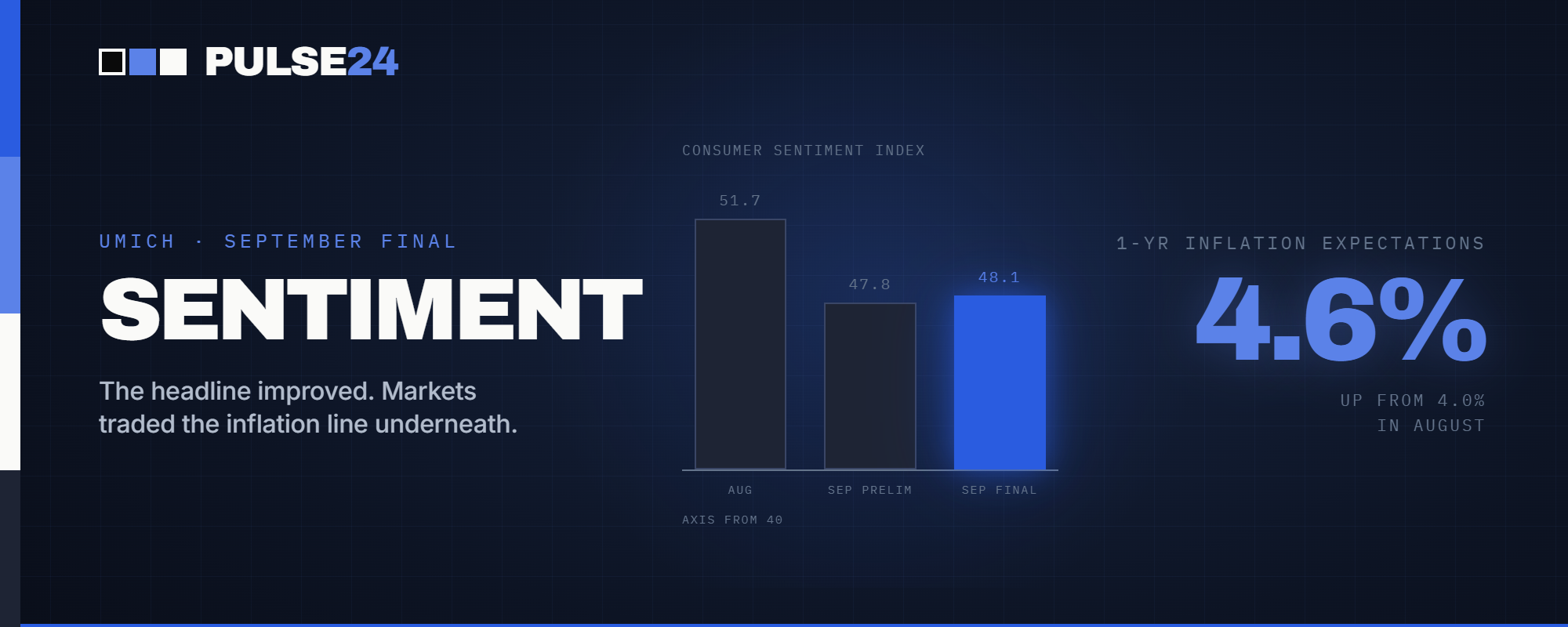
Consumer Sentiment Improved to 48.1 in September. Gold Fell to a Session Low Anyway.
Consumer sentiment edged higher to 48.1 in September, but inflation expectations jumped to 4.6% and gold sold off within minutes of the report's release. The subcomponent investors traded on told a very different story than the headline number.
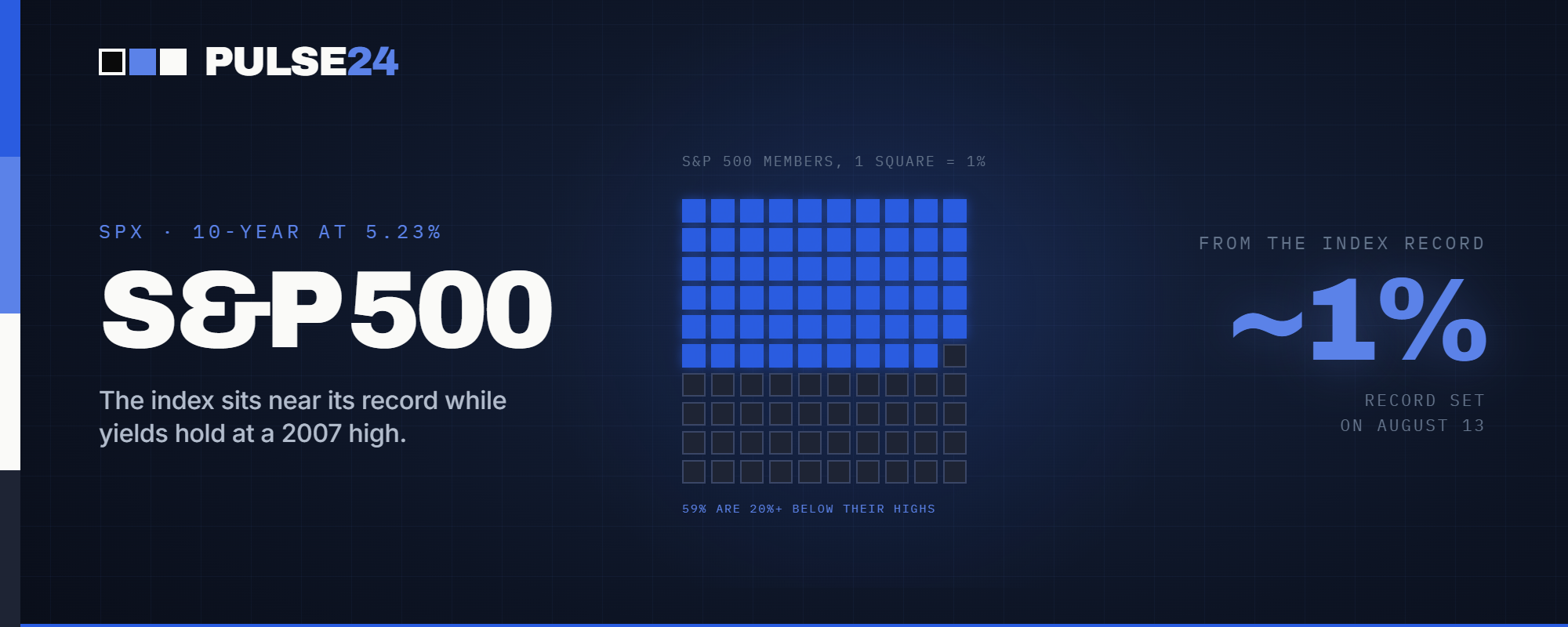
The 10-Year Yield Is at a 2007 High and the Yen Keeps Testing 160. The S&P 500 Barely Blinked.
Treasury yields are at levels unseen since 2007 and the yen keeps testing 160 per dollar, yet the S&P 500 sits near its record. Markets reacted very differently the last two times pressure like this appeared. Understanding why helps explain what's holding stocks together now, and what could still break that resilience.
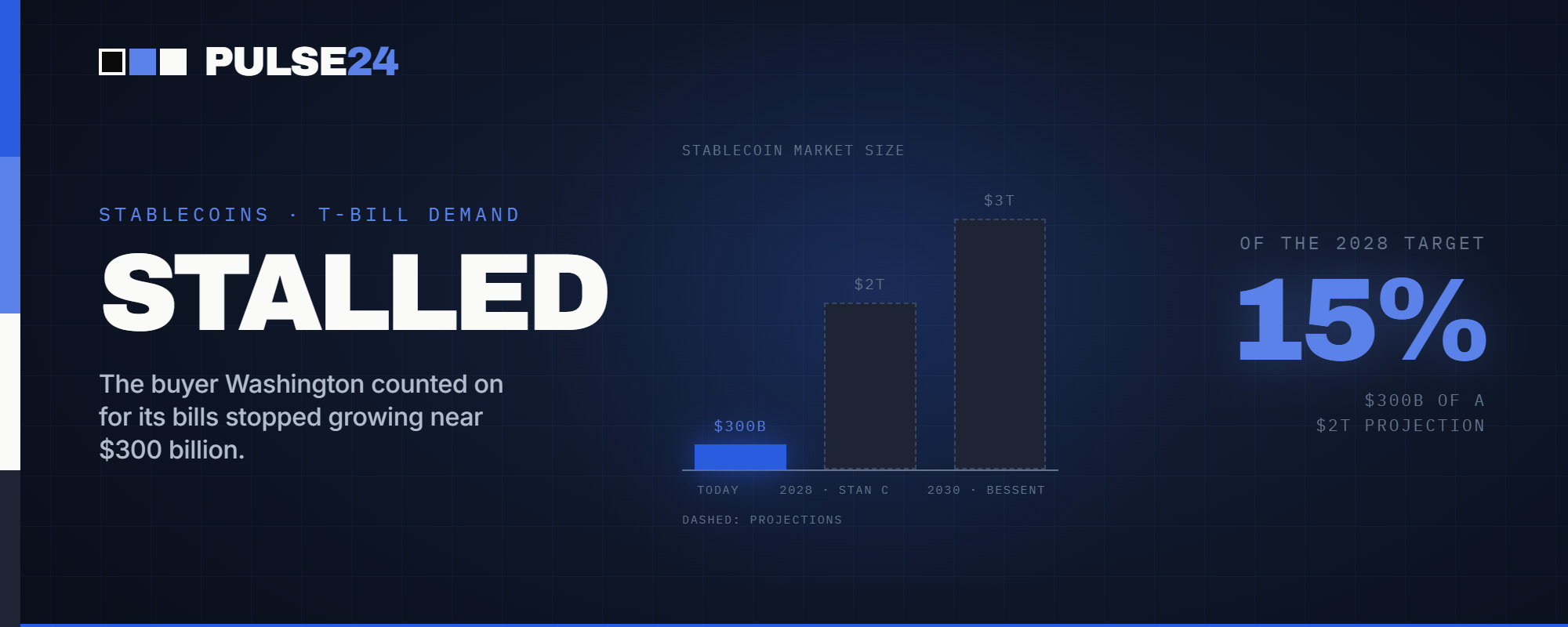
$7 Trillion in Treasury Bills Need Buyers. The Stablecoin Market Stalled at $300 Billion Instead.
Treasury Secretary Scott Bessent bet stablecoins would become a major buyer of the government's debt as bond yields sit at levels last seen in 2007. Two years in, the market has stalled near $300 billion, a fraction of what that plan needs.
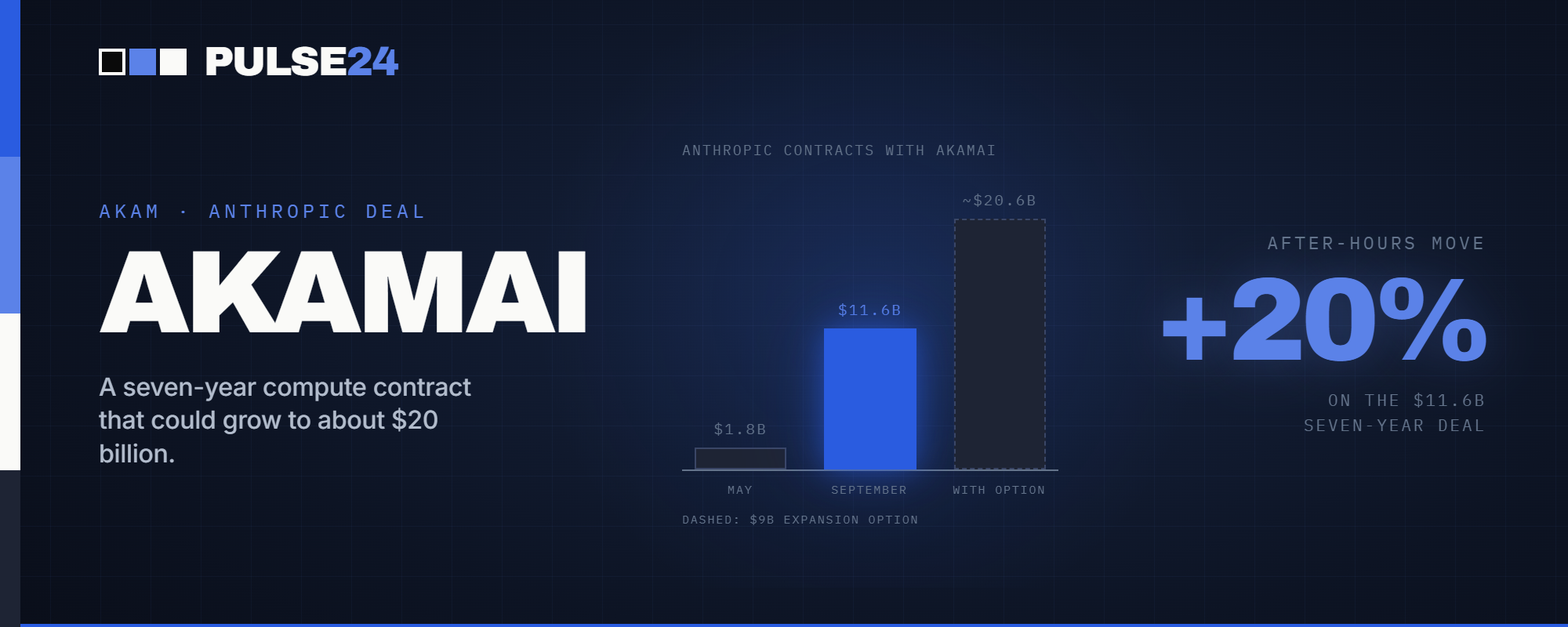
Akamai Signed an $11.6 Billion Contract With Anthropic. Its Stock Jumped 20% in After-Hours Trading.
Akamai's stock jumped more than 20% after the company signed an $11.6 billion, seven-year computing deal with Anthropic, an agreement that could grow to $20 billion and comes with warrants tied to future spending. It's the clearest sign yet that AI labs are diversifying their compute suppliers beyond the biggest cloud providers.
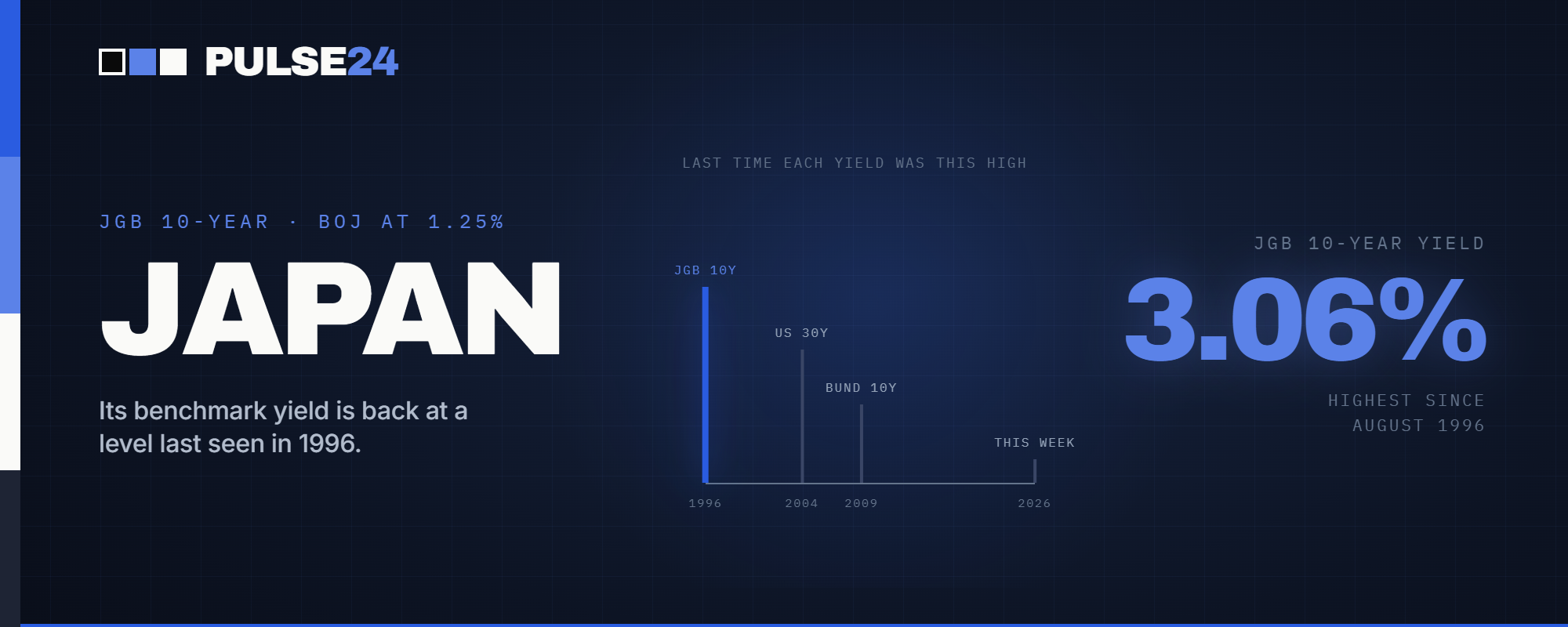
Japan's 10-Year Bond Yield Hasn't Been This High Since 1996. The 30-Year US Treasury Hit a 2004 High in the Same Week.
Japan's 10-year bond yield broke above 3% this week, a level unseen since 1996, and the tremors are reaching Washington too. The 30-year Treasury's climb to its highest since 2004 traces back to a Japanese repatriation trade that keeps getting delayed instead of arriving.
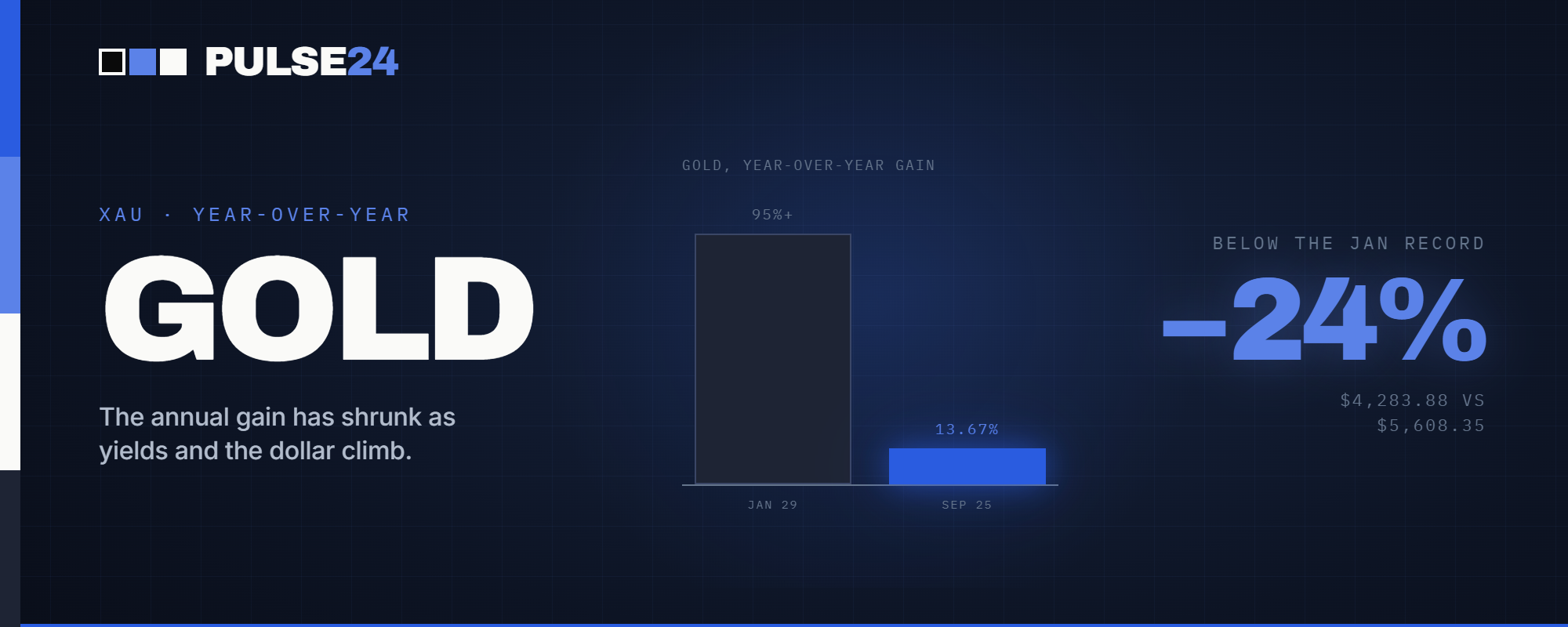
Gold's Year-Over-Year Gain Has Collapsed to 13.67%. In January, It Topped 95%.
Gold is still up from a year ago, just barely. The metal's annual gain has shrunk from over 95% in January to about 13.7% now, as 19-year-high Treasury yields and a resurgent dollar do what fear alone couldn't stop.
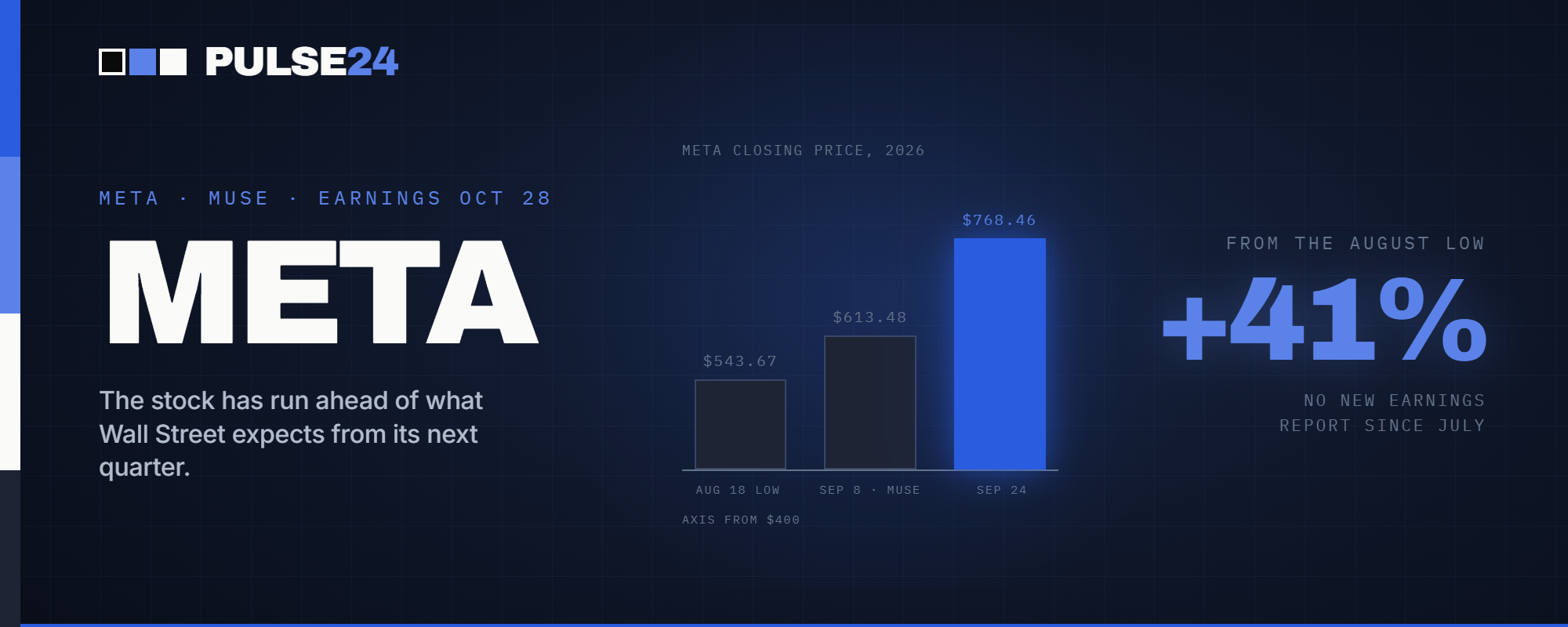
Meta Is Up More Than 40% From Its August Lows. Its Earnings Estimates Haven't Followed.
Muse has driven a real leg of Meta's rally, but the stock's 40% run from its August lows has outpaced its own Wall Street estimates. Meta's October 28 earnings will be the first real test of whether the numbers start catching up to the price.
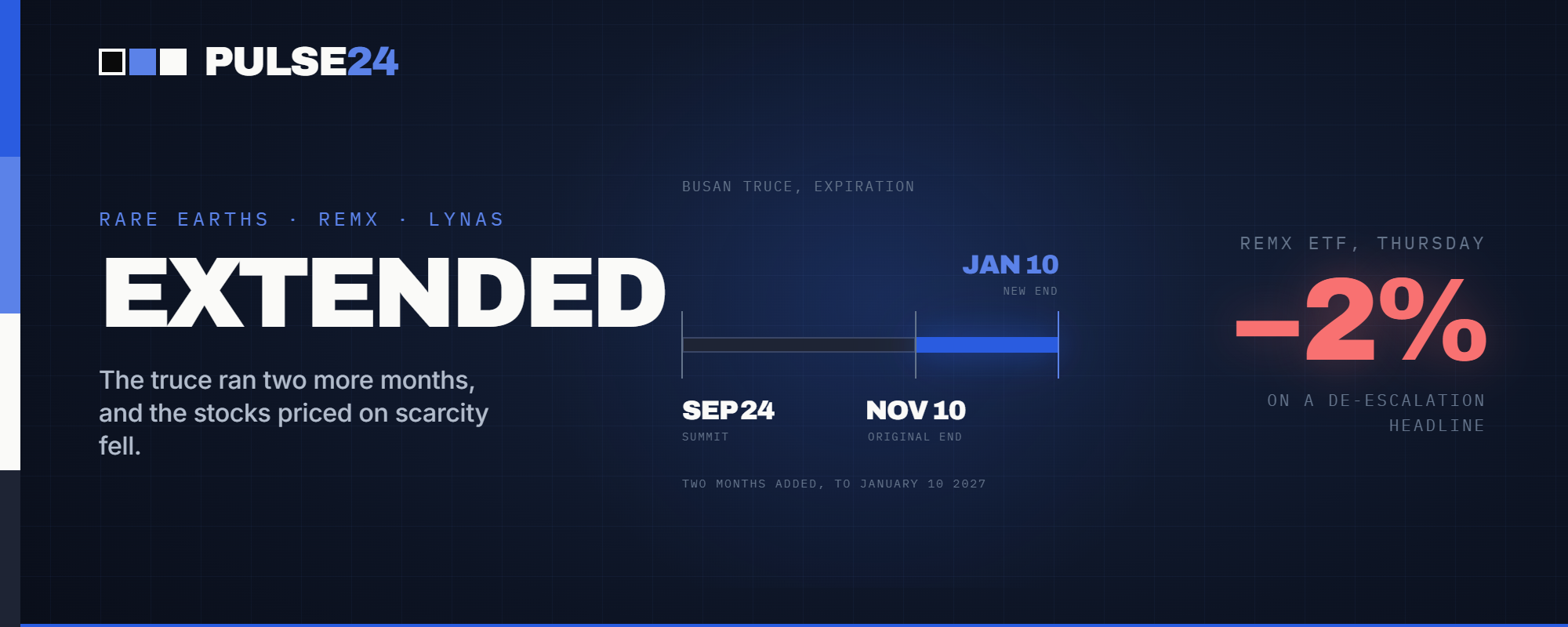
Washington and Beijing Extended Their Trade Truce to January 10. Rare Earth Stocks Fell on the News.
Washington and Beijing extended their trade truce to January 10, but rare earth stocks fell on the news instead of rising. The reaction shows how much of the sector's rally was built on scarcity fears rather than fundamentals.
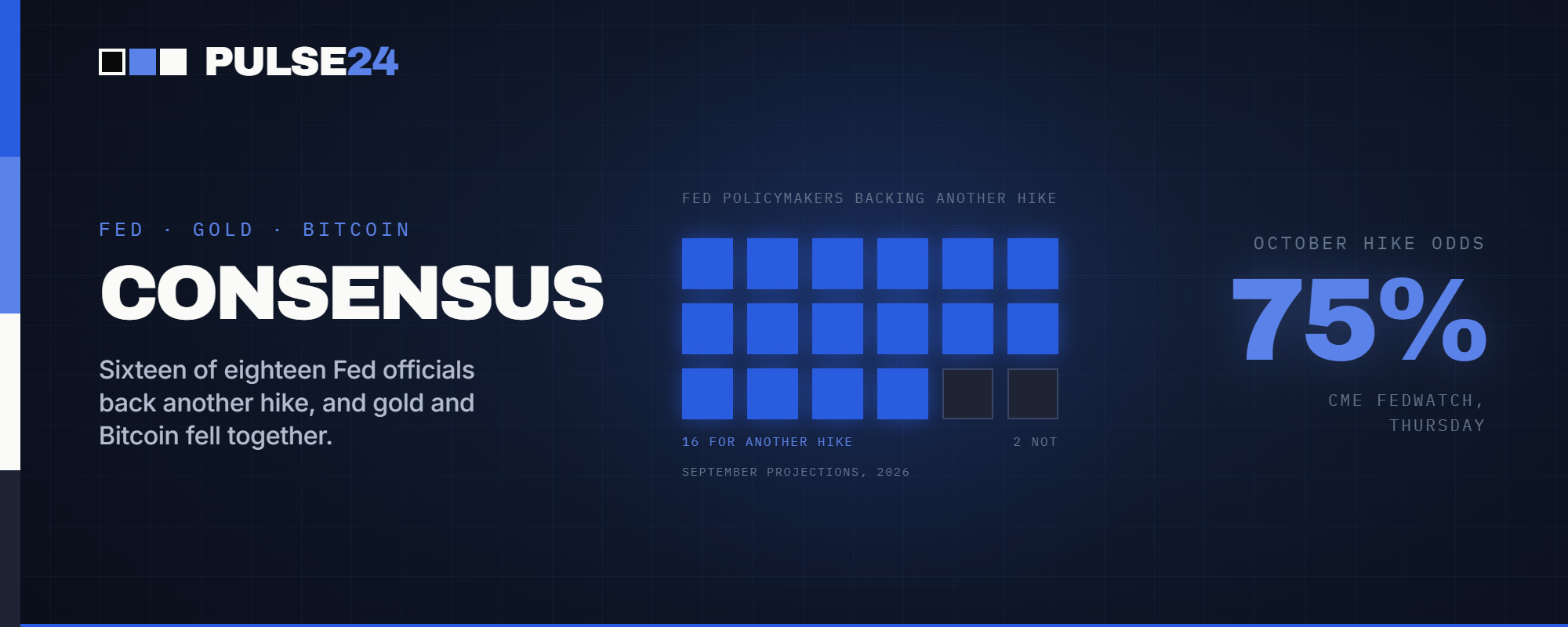
Sixteen of Eighteen Fed Officials Want Another Rate Hike This Year. Gold and Bitcoin Are Already Pricing It In.
Gold slid and Bitcoin dropped more than 2% Wednesday after Fed officials lined up behind another rate hike this year. Sixteen of eighteen policymakers now back one more move, and both of 2026's marquee inflation hedges are struggling to hold their ground.
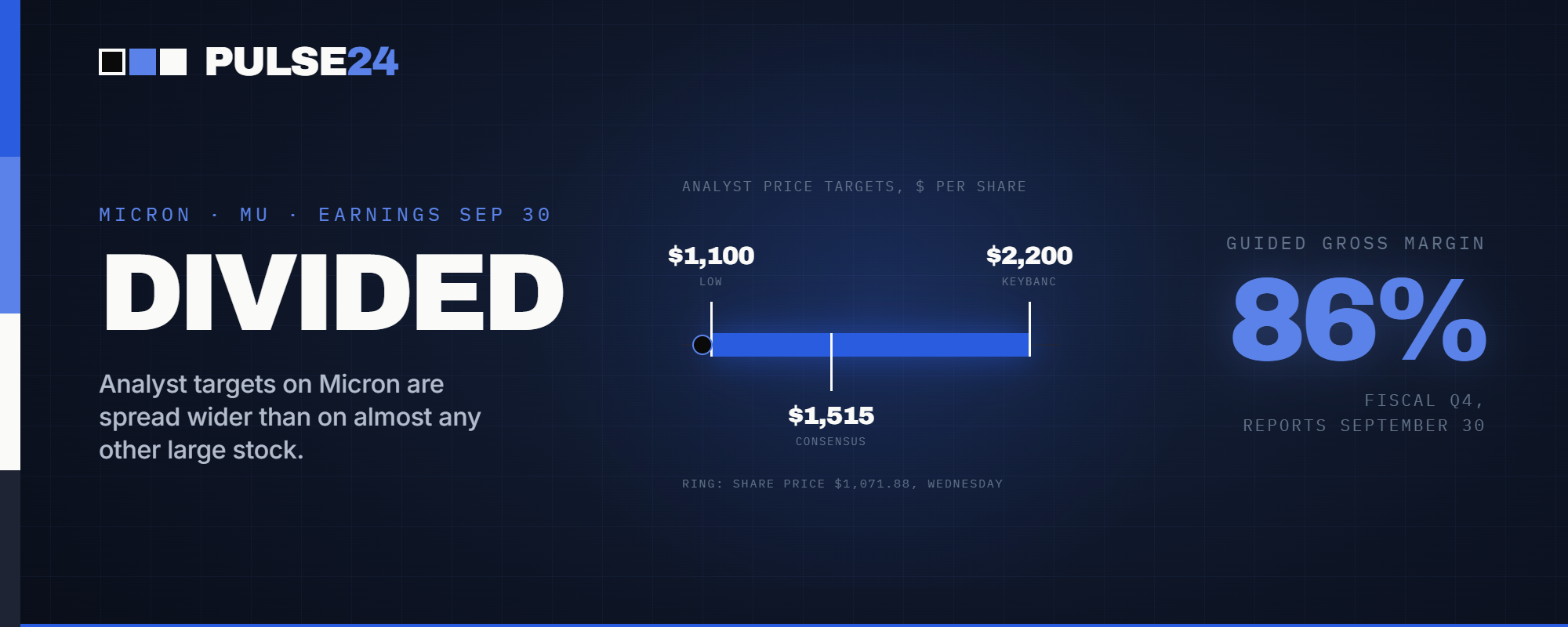
Wall Street Can't Agree on Micron's Value. Price Targets Range From $1,100 to $2,200.
Analyst price targets on Micron span from $1,100 to $2,200, one of the widest ranges attached to any large-cap stock right now. The stock's own swings this week, up 5% Tuesday and down 2.2% Wednesday, suggest investors are about as divided heading into September 30 earnings.
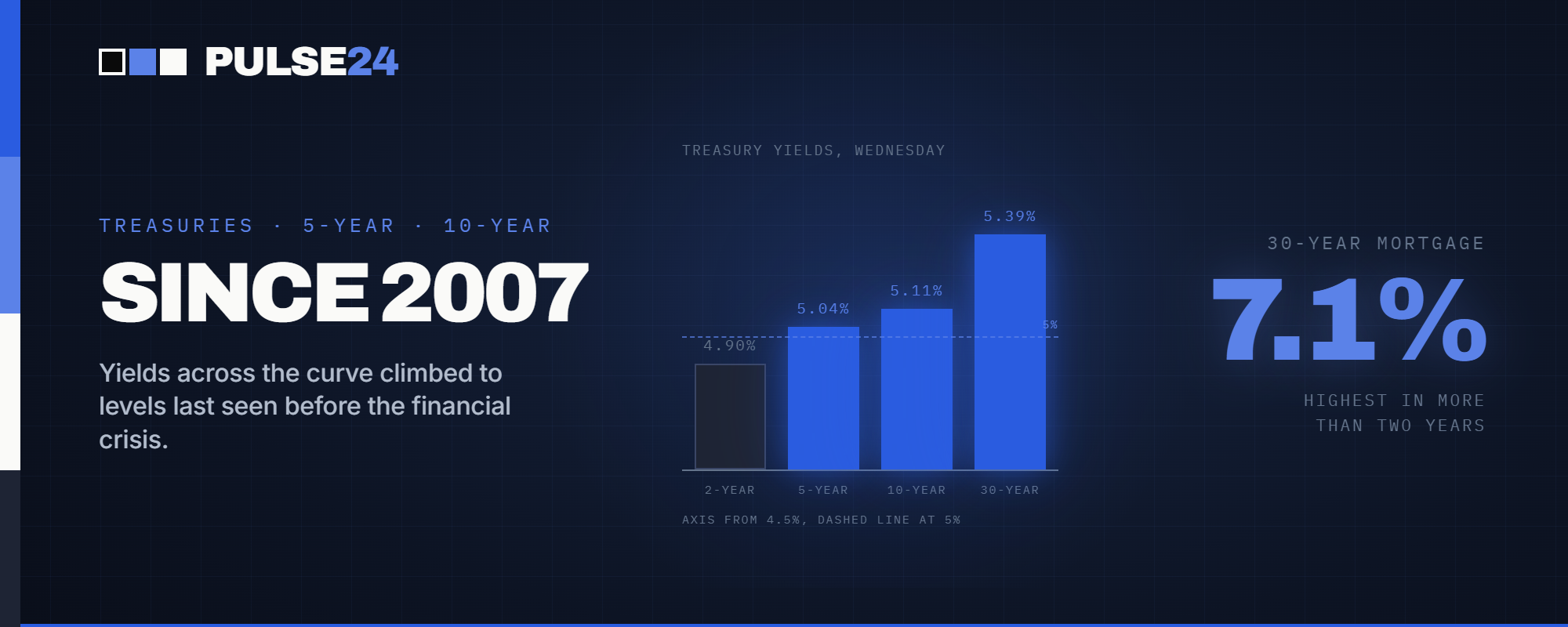
The 5-Year Treasury Yield Hit 5% This Week for the First Time Since 2007. The 10-Year Is Already Past It.
Five-year Treasury yields crossed 5% this week for the first time since 2007, and the 10-year pushed even further into territory last seen before the financial crisis. Hot PMI data and a Fed governor calling for more hikes are behind the move, and mortgage rates are already feeling it.
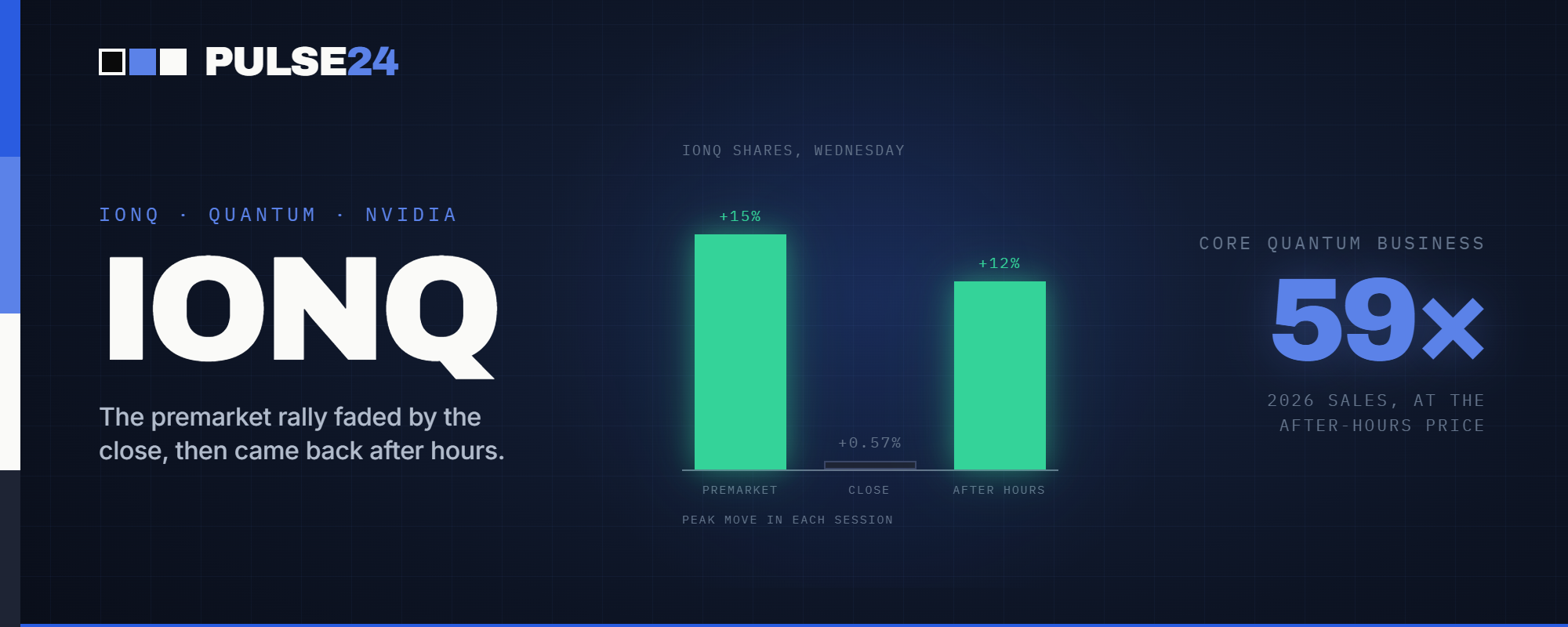
IonQ's 15% Premarket Pop Vanished by the Closing Bell. After Hours, It Came Back.
IonQ's stock surged as much as 15% before Wednesday's open on a quantum computing breakthrough and a new Nvidia deal, only to close nearly flat and then jump again after hours. The volatility says as much about the speculative quantum computing trade as the news itself does.
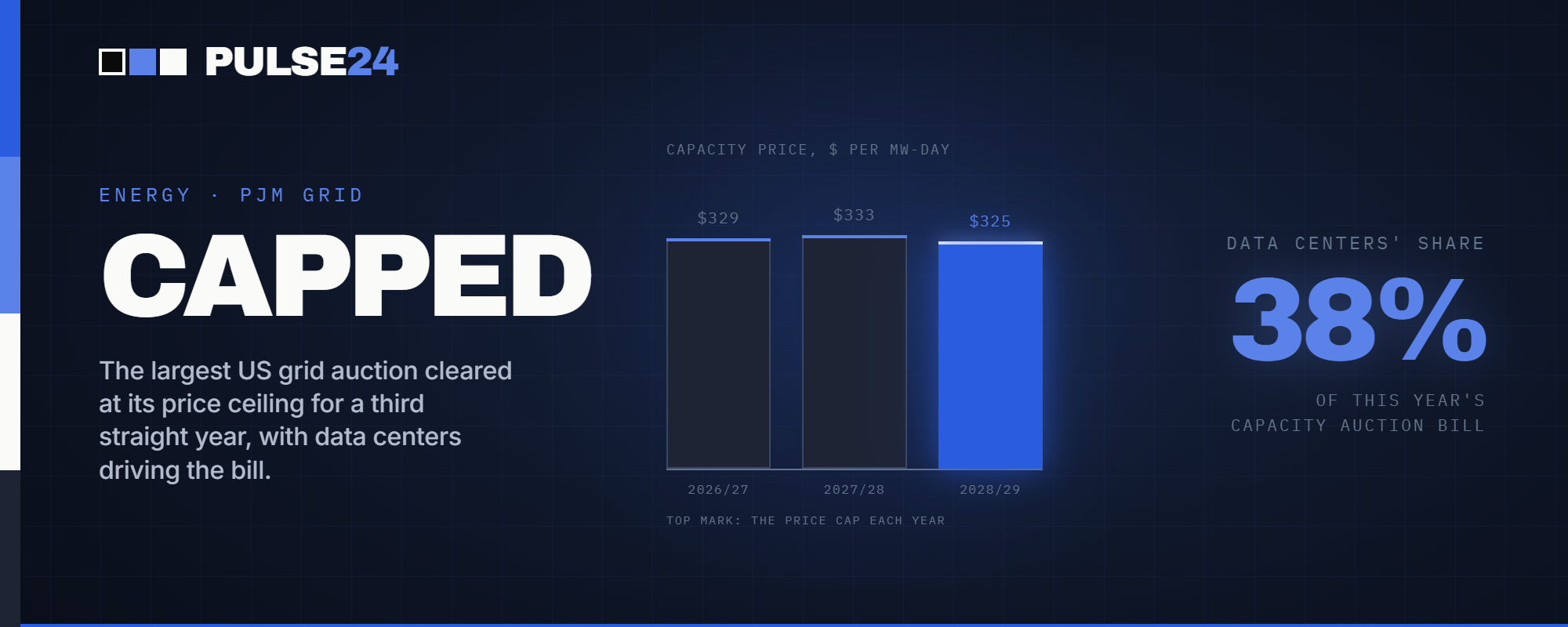
PJM's Power Auction Hit Its Price Cap for a Third Straight Year. Natural Gas Prices Are Catching Up.
PJM's latest capacity auction cleared at its price cap for the third year running, with data centers responsible for more than a third of the bill, and natural gas prices are climbing alongside a structural shift in how the grid gets its power.
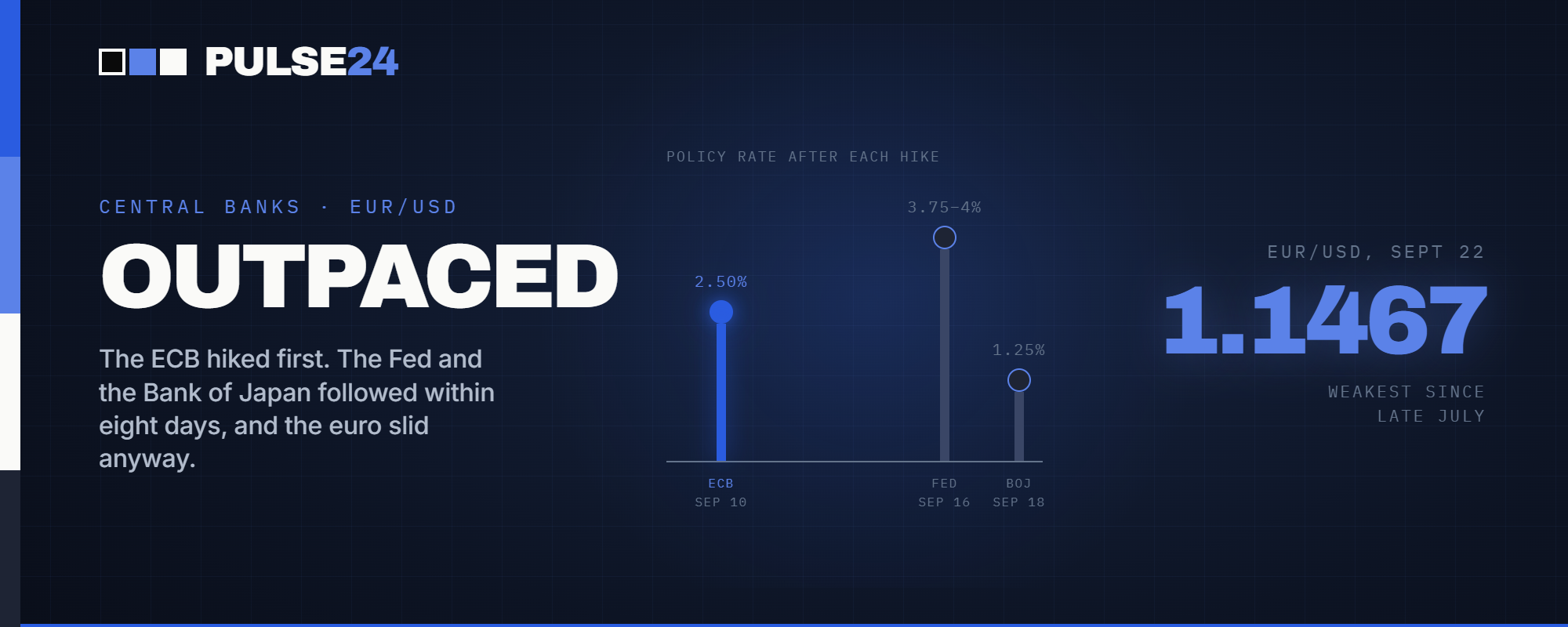
The ECB Hiked Rates to 2.50% This Month. The Euro Fell to Its Weakest Level Since July Anyway.
The European Central Bank raised rates for the second time this year, yet the euro slid to its weakest level since July against the dollar. The reason has less to do with direction than with speed, and it says something about how the Fed's own hike this month reset the pecking order among the world's major currencies.
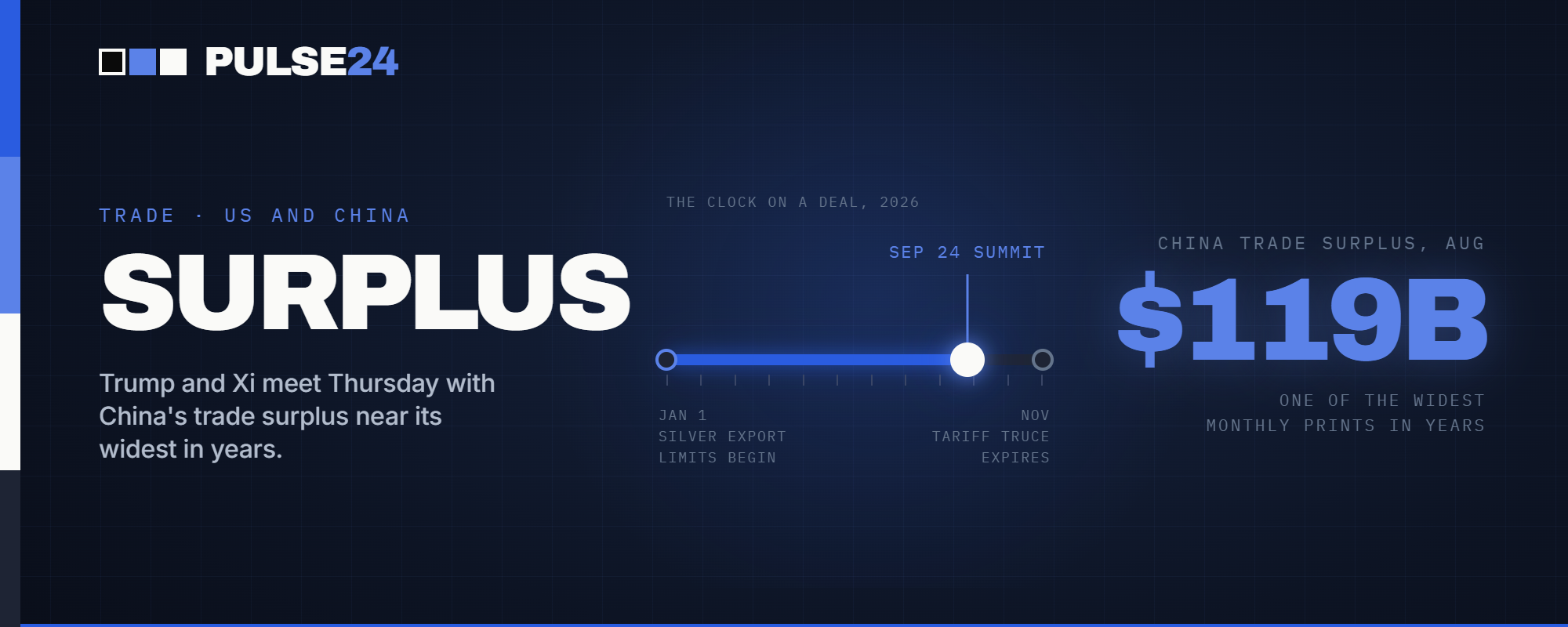
China's Trade Surplus Hit $119 Billion in August. Trump and Xi Meet Thursday to Decide What Happens to It.
China's exports jumped 25% in August and its trade surplus hit $119 billion, one of the widest in years. Thursday's summit between Trump and Xi could reshape the rules on everything from rare earths to the silver inside an AI server.
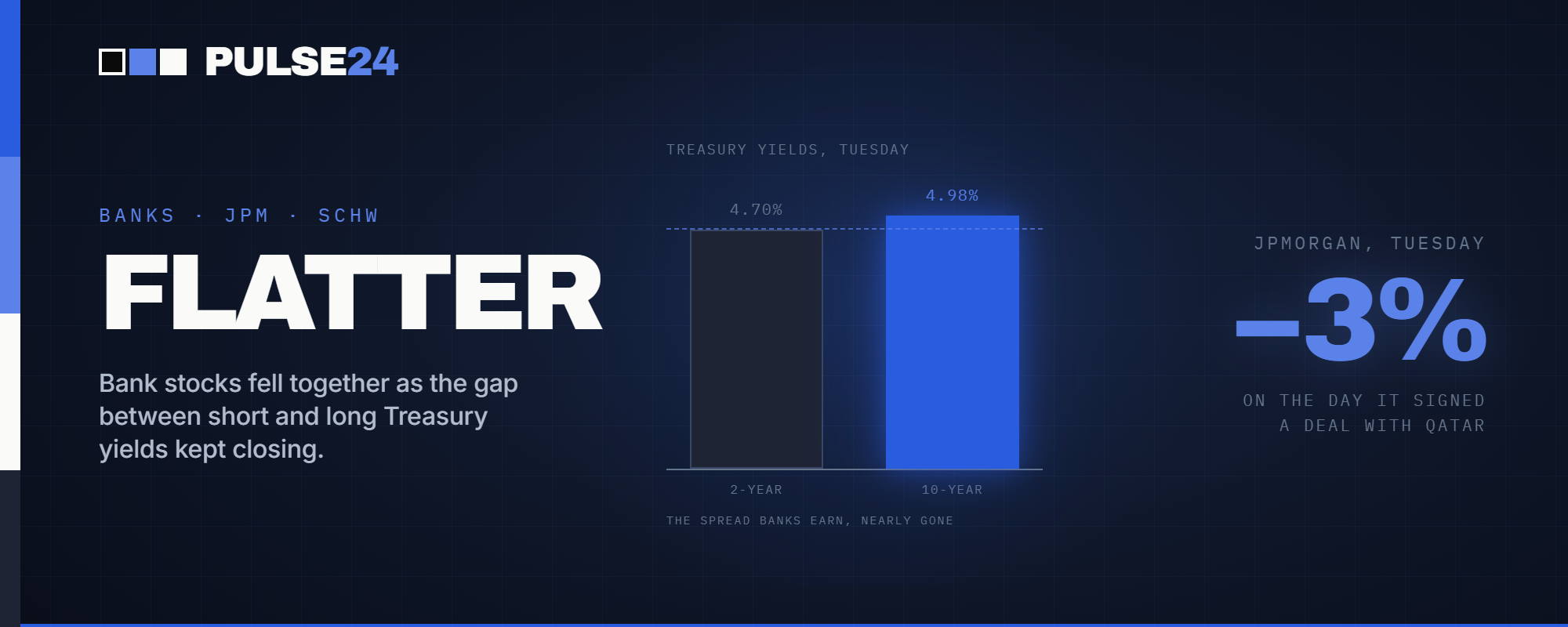
JPMorgan Signed a $20 Billion Deal With Qatar Tuesday. Its Stock Still Fell 3%.
JPMorgan struck a $20 billion deal with Qatar's sovereign wealth fund on Tuesday, and its stock fell anyway. The real story was in the bond market, where a flattening yield curve is starting to squeeze the spread every bank and brokerage lives on.
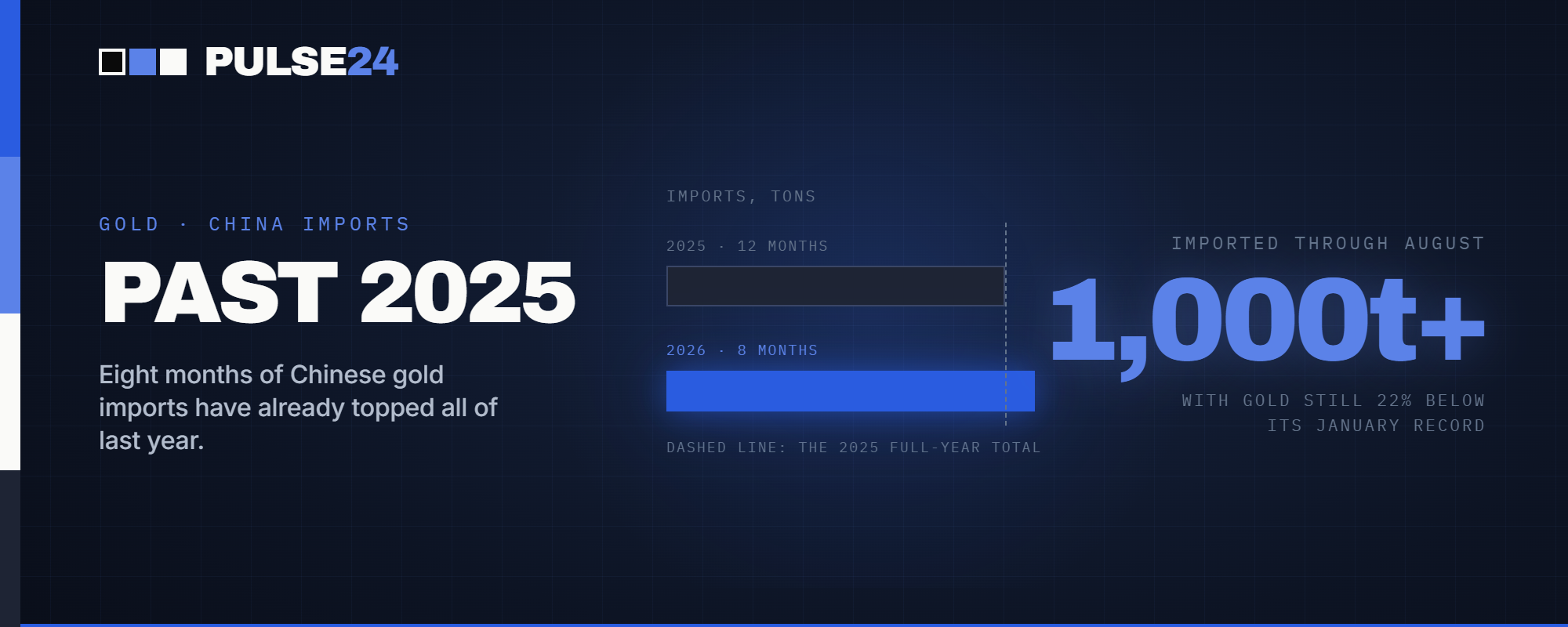
China Has Already Imported More Gold This Year Than All of 2025. The Price Is Still 22% Off Its Record.
China's banks and its central bank have imported more than 1,000 tons of gold through August, already surpassing all of 2025, even as the metal trades about 22% below the record it set in January. The People's Bank of China posted its biggest single-month addition since 2023, and the timing, after the price pulled back rather than before, says something about who is setting the floor.
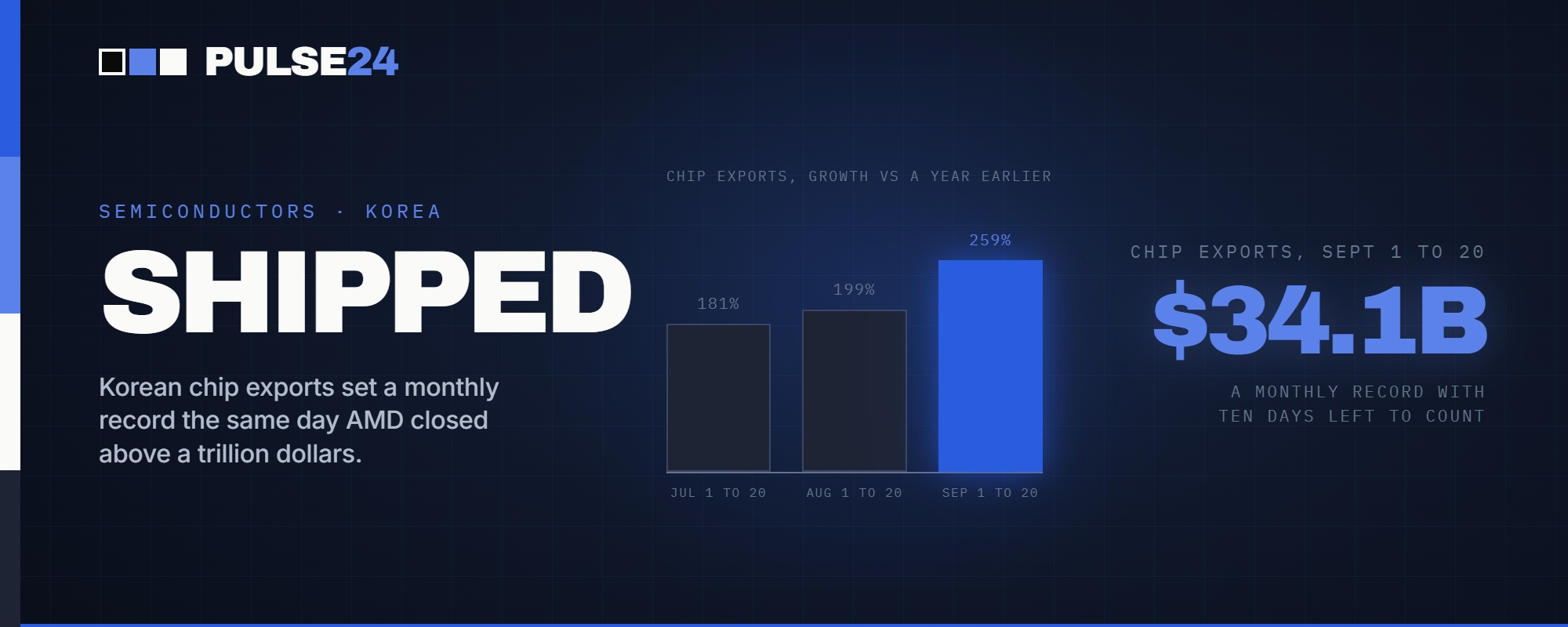
South Korea's Chip Exports Jumped 259% This Month. AMD's Market Cap Crossed $1 Trillion the Same Day.
South Korea's semiconductor exports hit $34.12 billion in the first three weeks of September, up 259% from a year earlier, the same day AMD's stock hit an all-time high that briefly pushed its market cap above $1 trillion. The export invoice and the stock reaction are describing the same AI demand cycle from opposite ends of the supply chain.
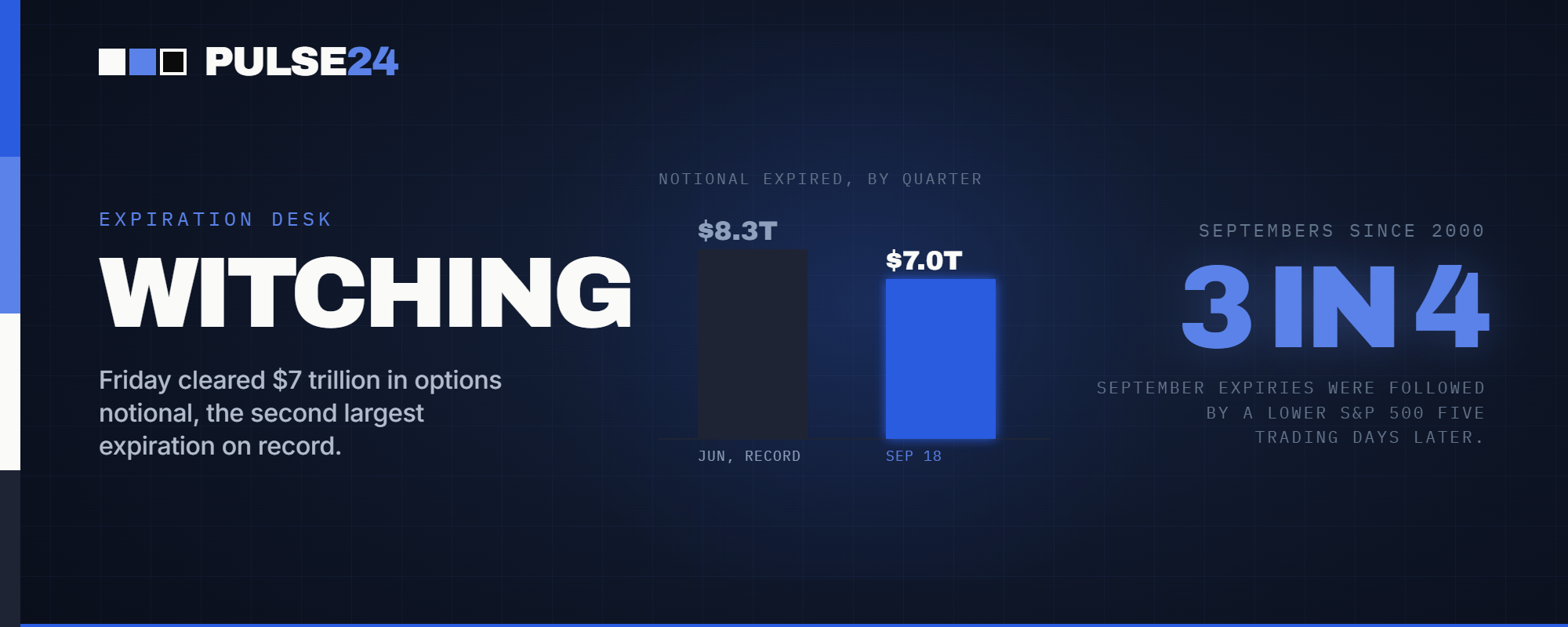
$7 Trillion in Options Expired Friday. Three Out of Four Septembers Since 2000, Stocks Fell From Here.
Friday's triple witching cleared $7 trillion in options notional, the second-largest expiration on record behind June's $8.3 trillion. History says the S&P 500 often struggles in the two weeks that follow, though not always.
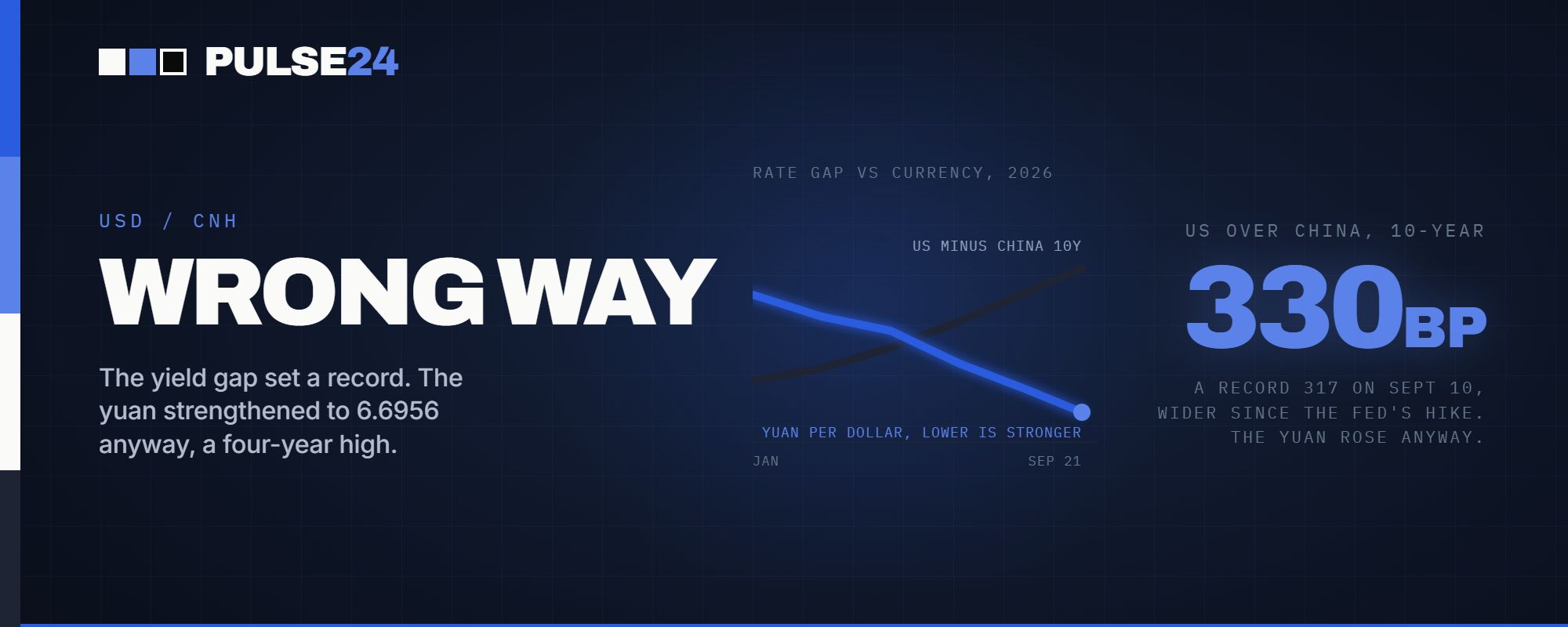
China's Yuan Broke Through 6.70 to the Dollar This Week. A Record Rate Gap Was Supposed to Stop It.
China's currency hit its strongest level since February 2023 this week, even as the gap between US and Chinese bond yields set a record that should have pushed it the other way. Trade surpluses and a deliberately cautious PBOC are winning out over interest-rate math, at least for now.
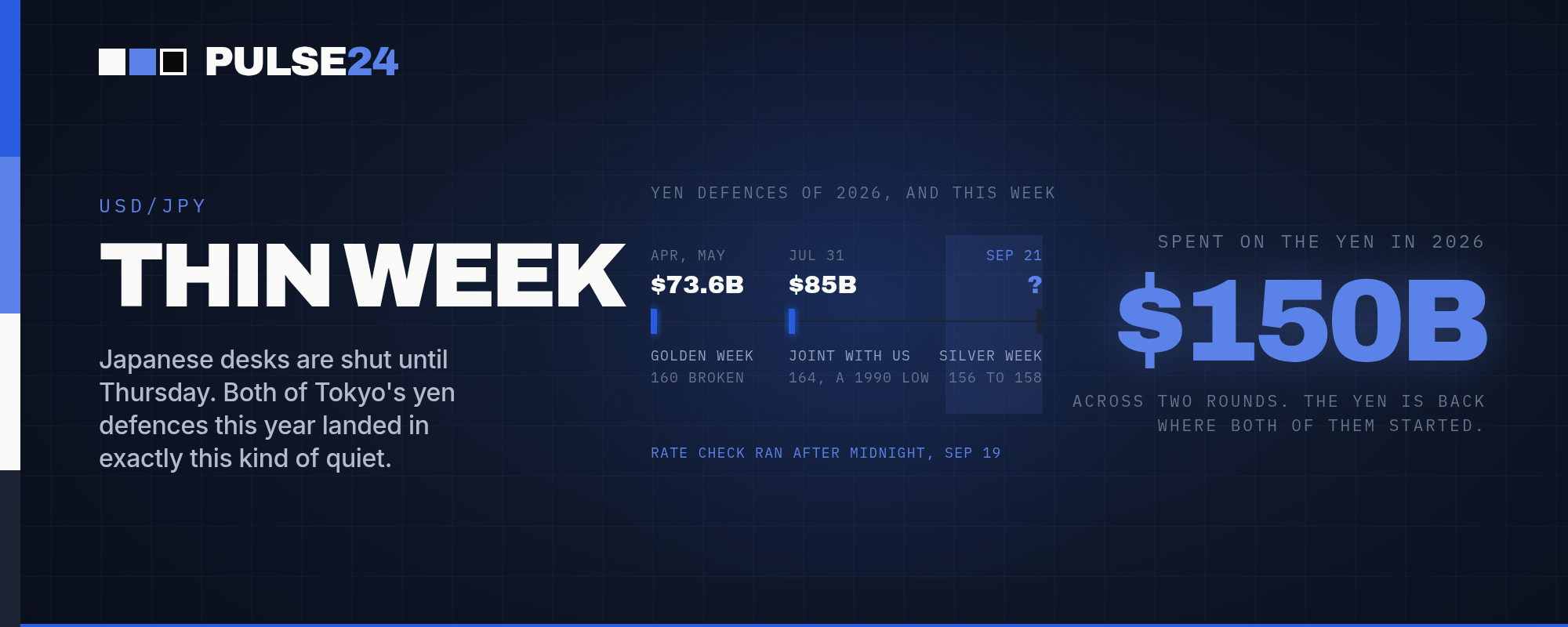
Japan's Currency Markets Go Dark for Three Days This Week. Twice Already in 2026, That's Exactly When Tokyo Intervened.
Japan's stock, bond, and currency desks close for three days this week, and traders are watching to see if Tokyo uses the quiet to defend the yen again. Two interventions and a rate hike to a 31-year high haven't stopped the currency from drifting back toward its weakest levels of the year.
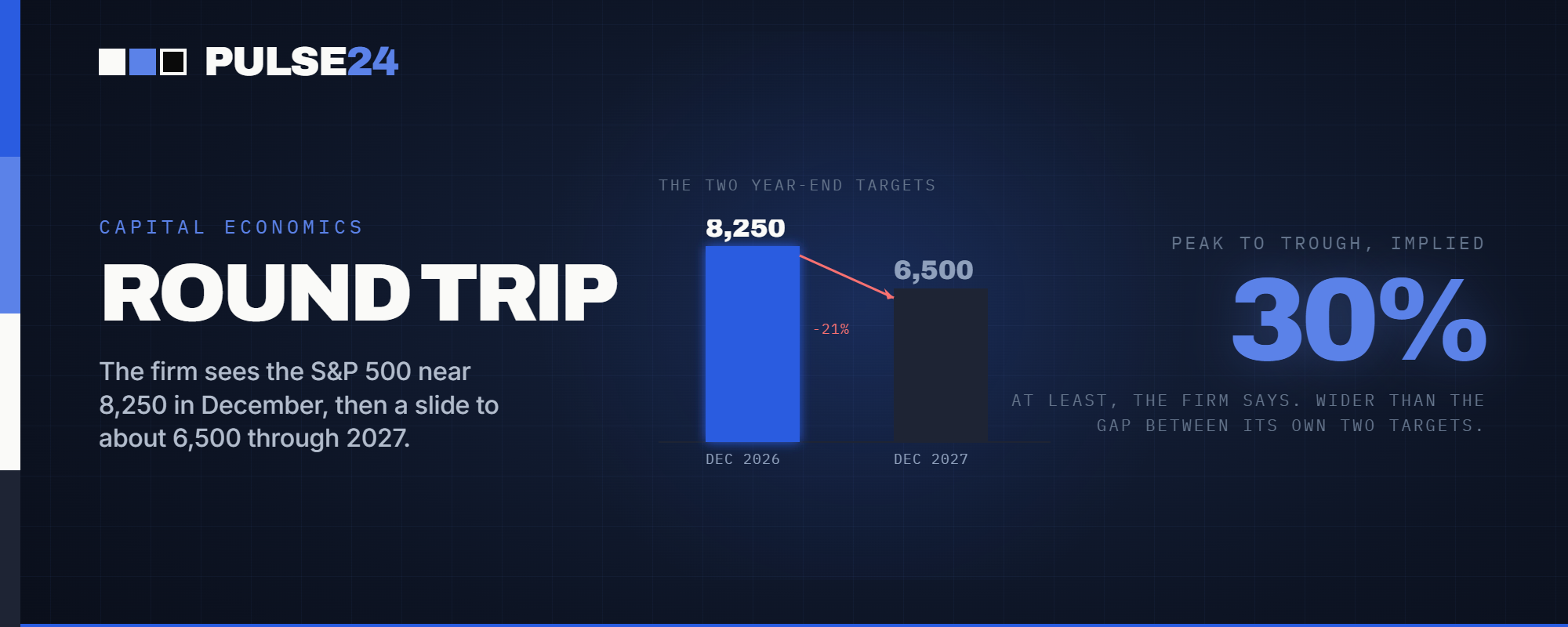
Capital Economics Puts the S&P 500 at 8,250 by December. Then It Sees a 30% Reversal by 2027.
Capital Economics thinks the AI rally has a few more months left, then a reckoning. The research firm's call: S&P 500 near 8,250 by year end, then a slide toward 6,500 in 2027 that it says rhymes with the dot-com bust, even as most fund managers say they're more confident about AI spending than they were a month ago.
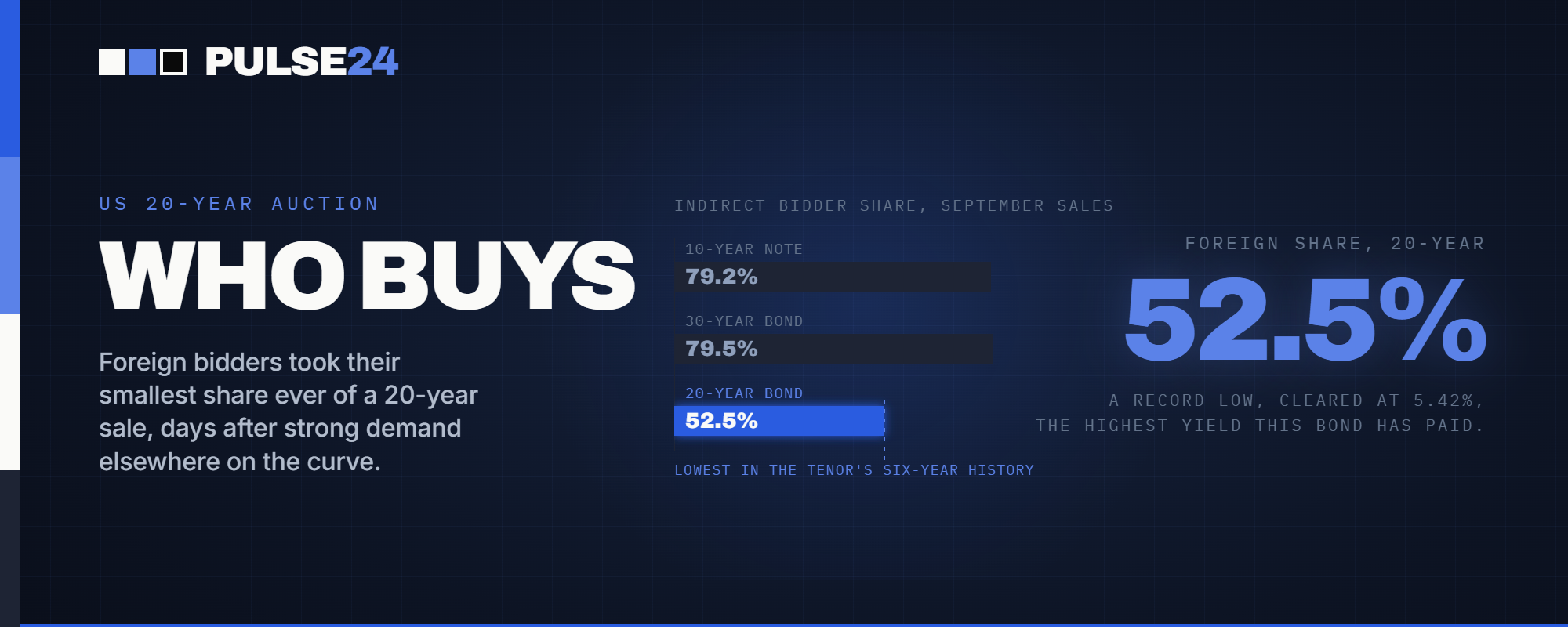
The 10-Year and 30-Year Treasury Auctions Went Smoothly This Month. The 20-Year Did Not.
Foreign buyers took the smallest share ever recorded of this month's 20-year Treasury auction, even as the same week's 10-year and 30-year sales drew strong demand. The gap raises a real question about who is left to buy America's growing pile of debt at these yields.
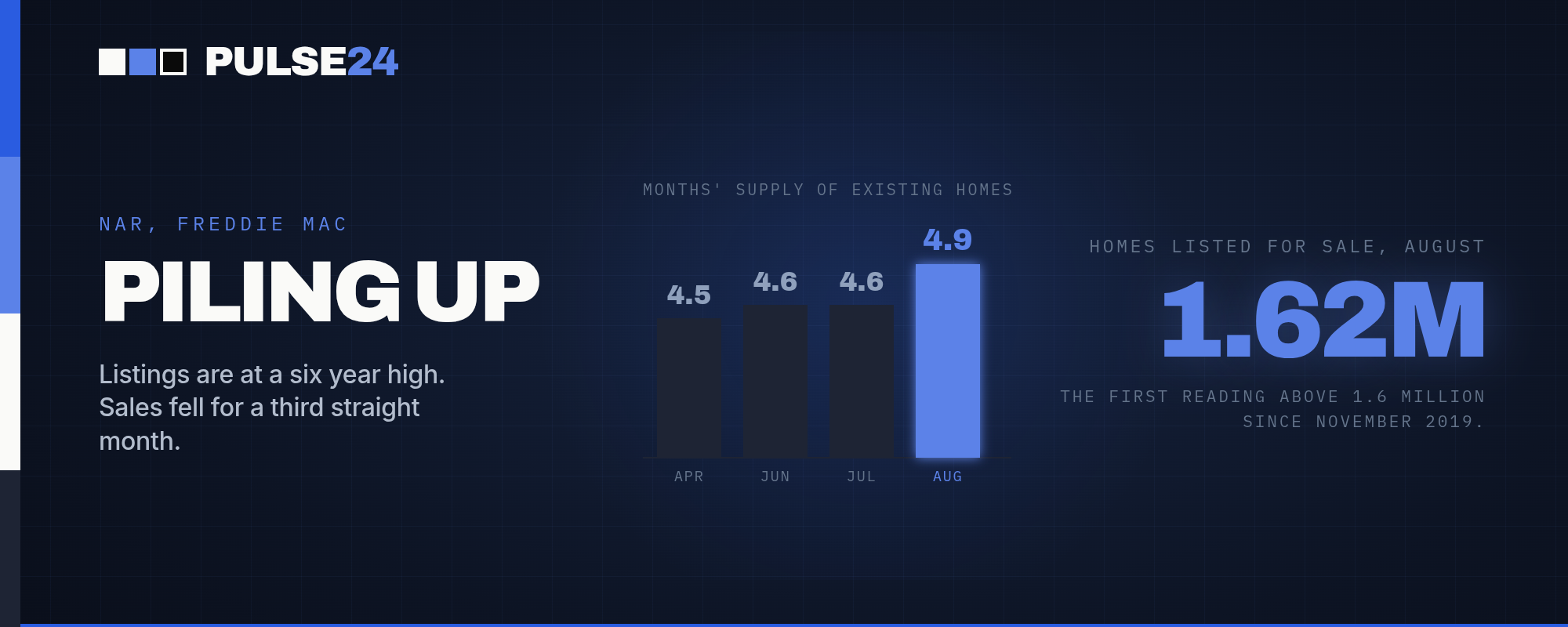
US Housing Inventory Topped 1.6 Million for the First Time Since 2019. Home Sales Fell for a Third Straight Month.
Housing inventory has cleared 1.6 million homes for the first time since 2019, and existing home sales still fell for a third straight month. Mortgage rates near 7% are doing exactly what a hawkish Fed was supposed to do to the most rate sensitive corner of the economy.
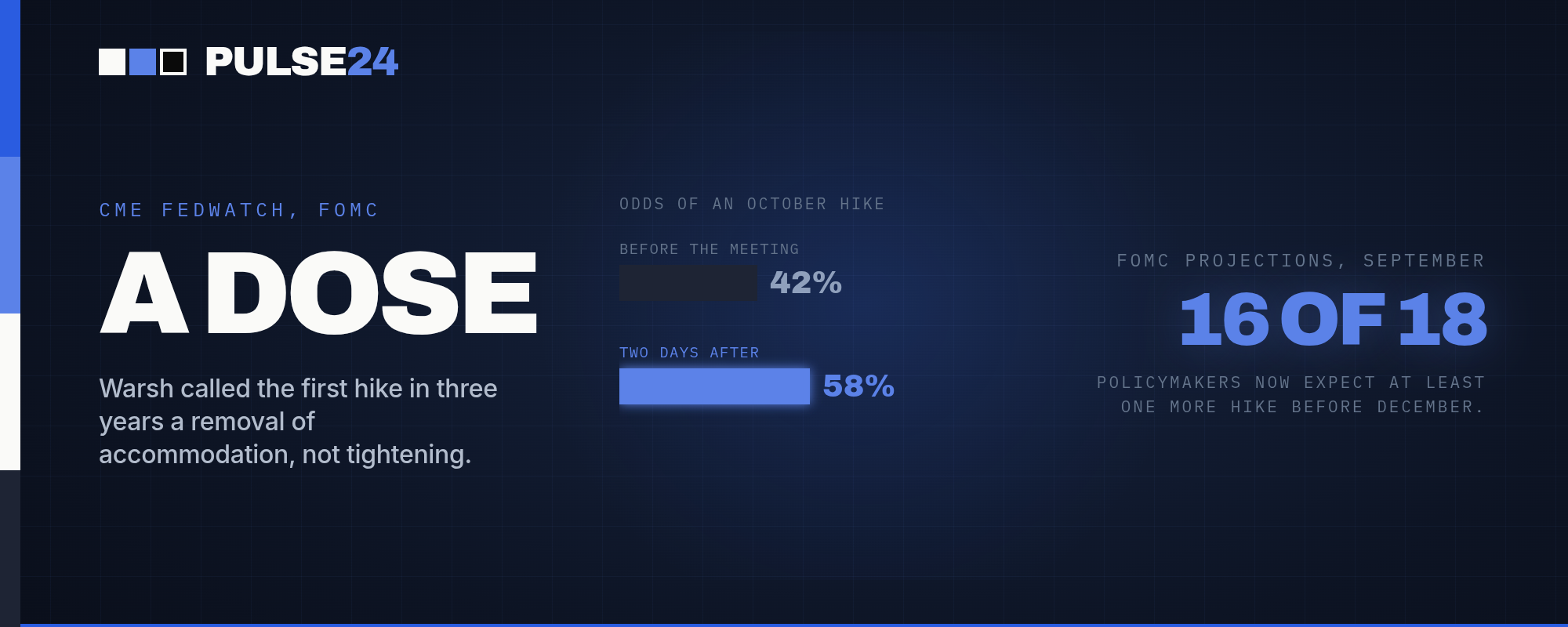
October Rate-Hike Odds Jumped From 42% to 58% in a Week. Three Words From Kevin Warsh Explain Why.
Kevin Warsh called the Fed's first rate hike in three years a removal of "a dose of accommodation" rather than tightening, and Wall Street heard an opening for more. Odds of an October follow-up hike jumped from about 42% to near 58% within days, and Goldman Sachs reversed its call that the Fed was already done for the year.
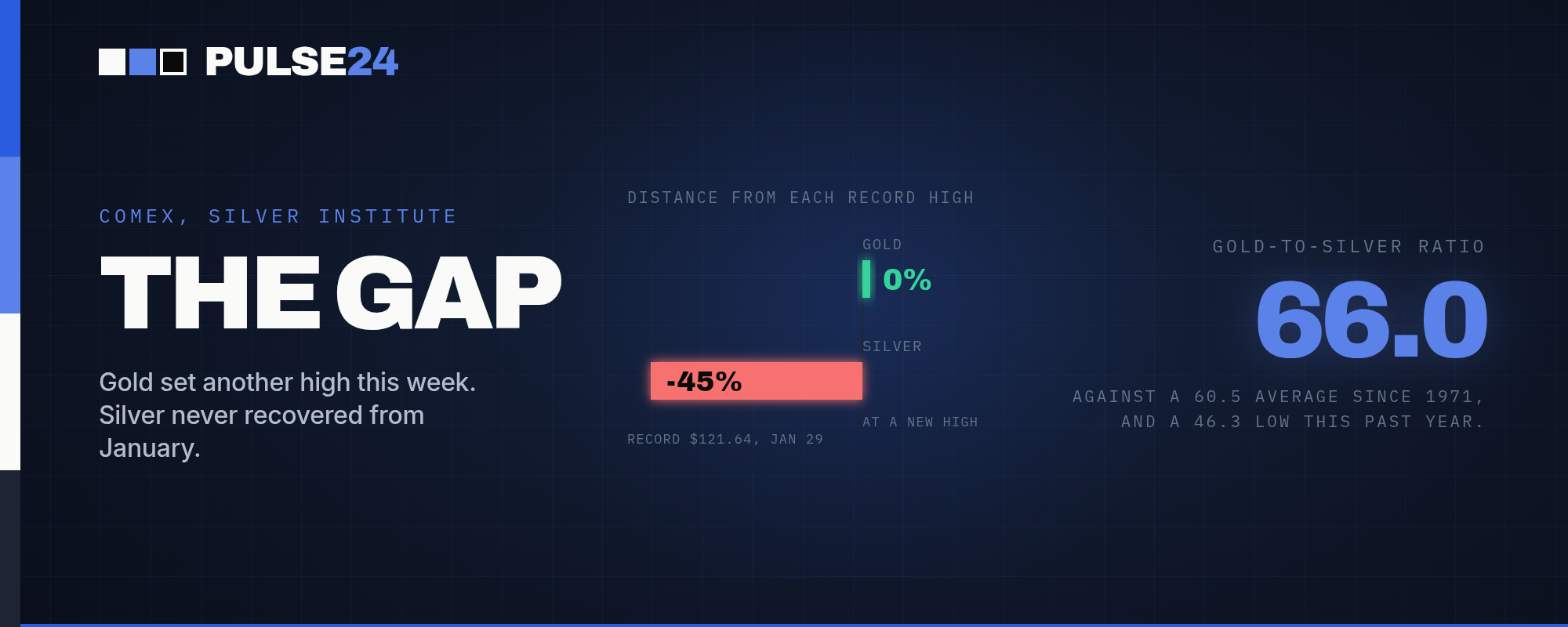
Gold Set a New High This Week. Silver Is Still 45% Below Its Own Record.
Gold notched a fresh weekly high on Friday, but silver is still trading roughly 45% below the record it set in January before a historic one-day crash. The gap between the two metals, now near its widest point in years, may say more about what happens next than either price alone.
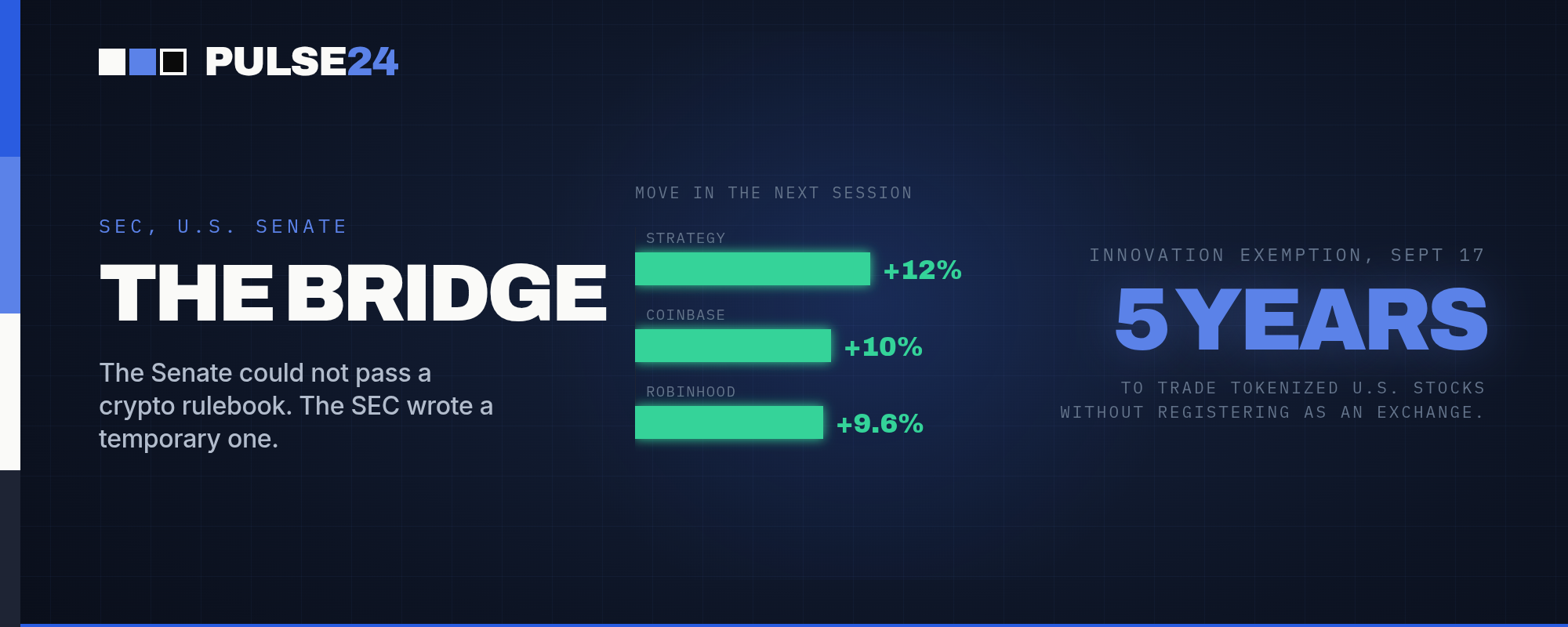
Congress Couldn't Pass a Crypto Bill. The SEC Approved Tokenized Stocks Anyway.
The SEC gave tokenized stock trading a five-year runway on September 17, two days after the Senate's own crypto bill failed without a single Democratic vote. Coinbase, Robinhood, and Strategy all jumped on the news, though Bitcoin's own breakout above $80,000 did some of the lifting too.
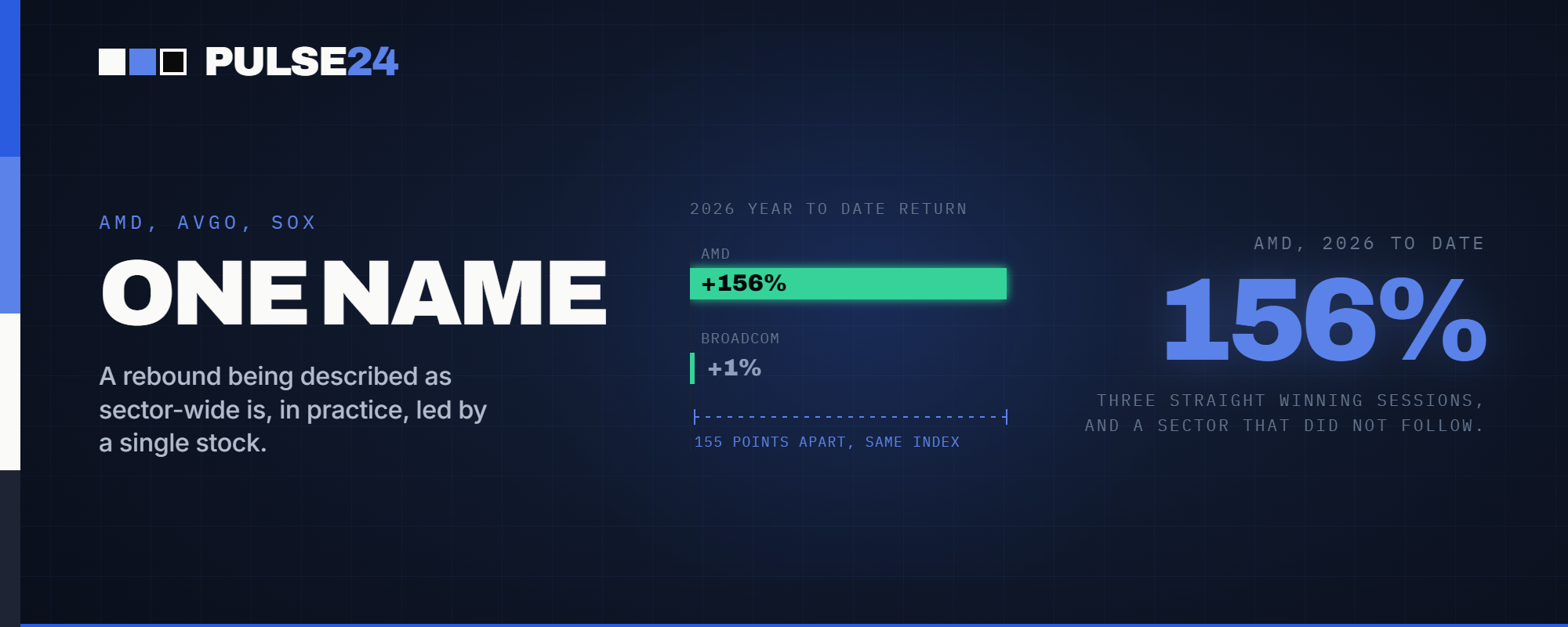
156% Versus 1%: The Chip Rebound Isn't as Broad as It Looks.
AMD's stock is up about 156% this year, while Broadcom, in the same rebounding sector, sits at roughly 1%. Three strong sessions for chip stocks say less about the sector than about one company's run.
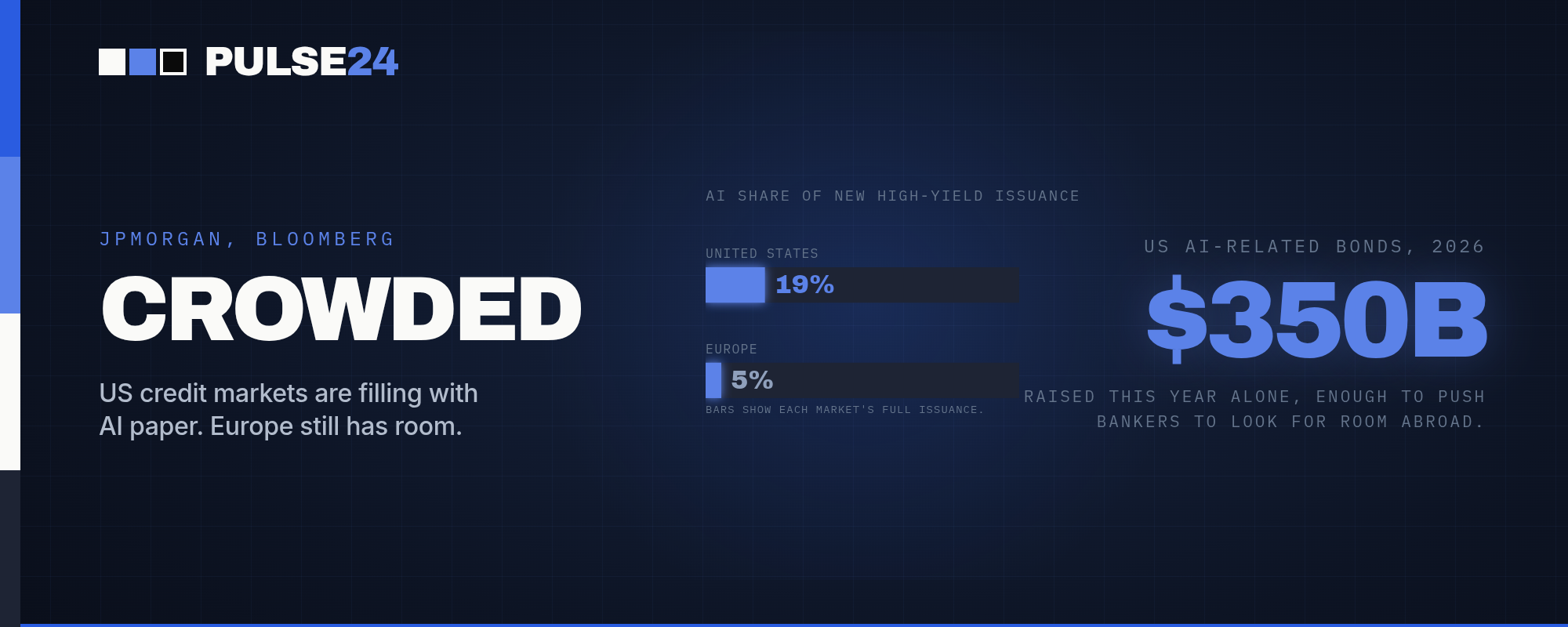
19% of New US High-Yield Bonds Now Fund AI Data Centers. Europe's Share Is Only 5%, and Wall Street Wants to Close That Gap.
AI-related debt now makes up 19% of new US high-yield bond issuance, and JPMorgan and Goldman Sachs are racing to bring that financing model to Europe. Amazon and Uber both sold their first bonds in European currencies this month as US credit markets get crowded.
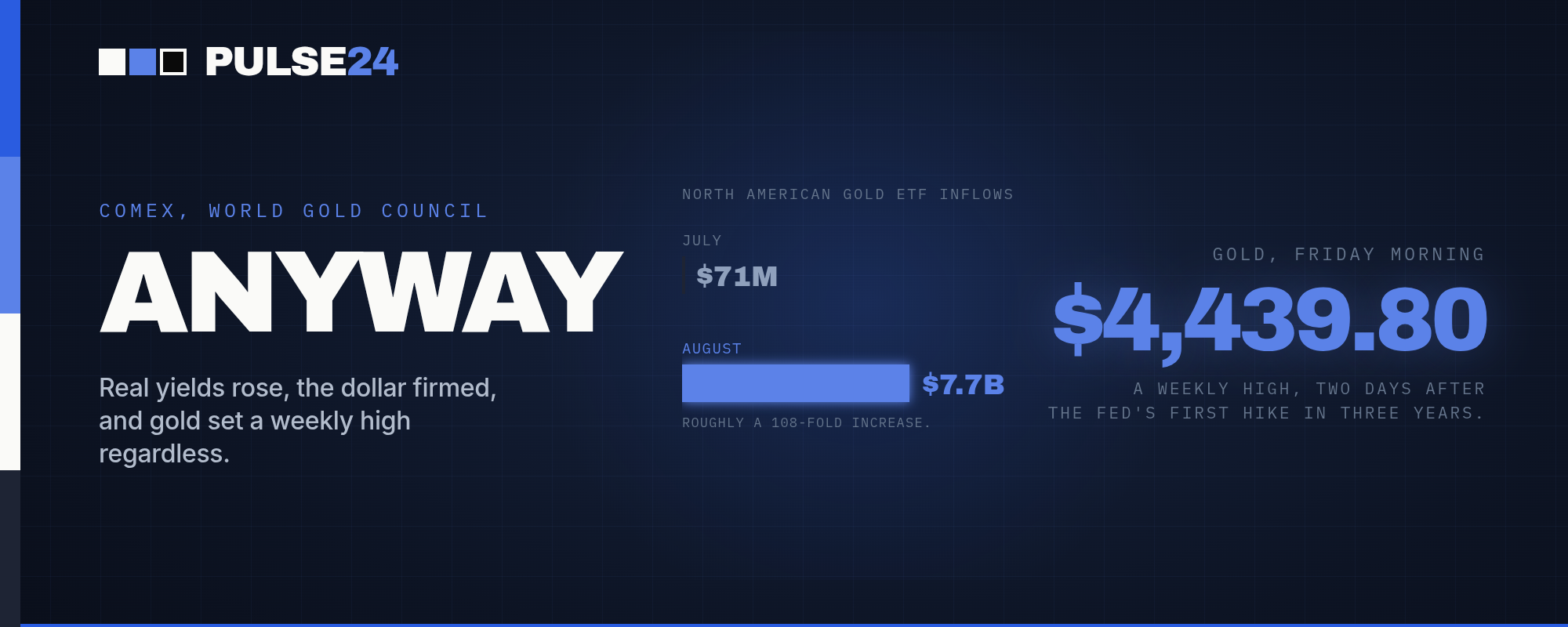
Real Yields Climbed to 2.68% This Week. Gold Hit a New High Anyway.
Gold climbed to a fresh weekly high two days after the Fed raised rates, a move that should have hurt the metal instead of lifting it. Record central bank buying and a 108-fold jump in ETF inflows explain the disconnect.
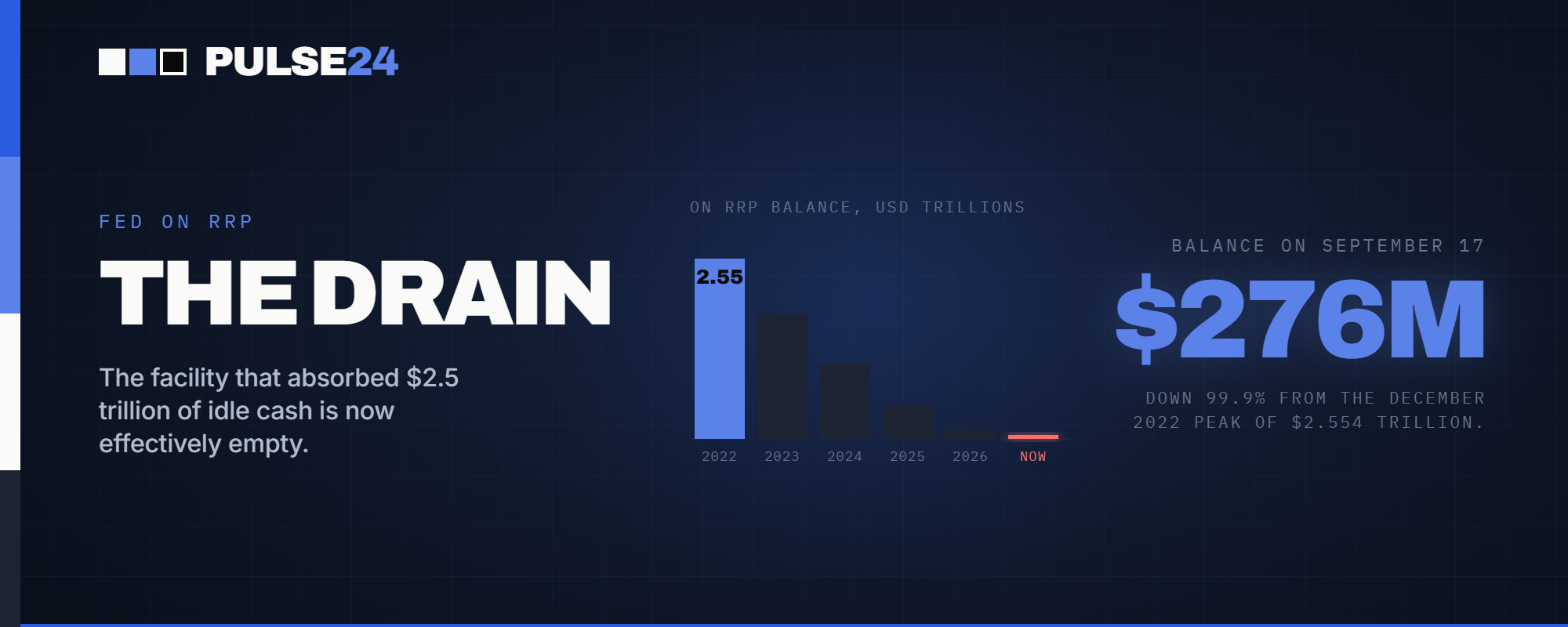
The Fed's Reverse Repo Facility Held $2.5 Trillion in 2022. This Week It Held $276 Million.
A facility that once absorbed $2.5 trillion in idle cash from money market funds is now almost empty, and the timing puts fresh pressure on the Fed's promise that bank reserves remain ample. The next real test comes at quarter-end, less than two weeks away.
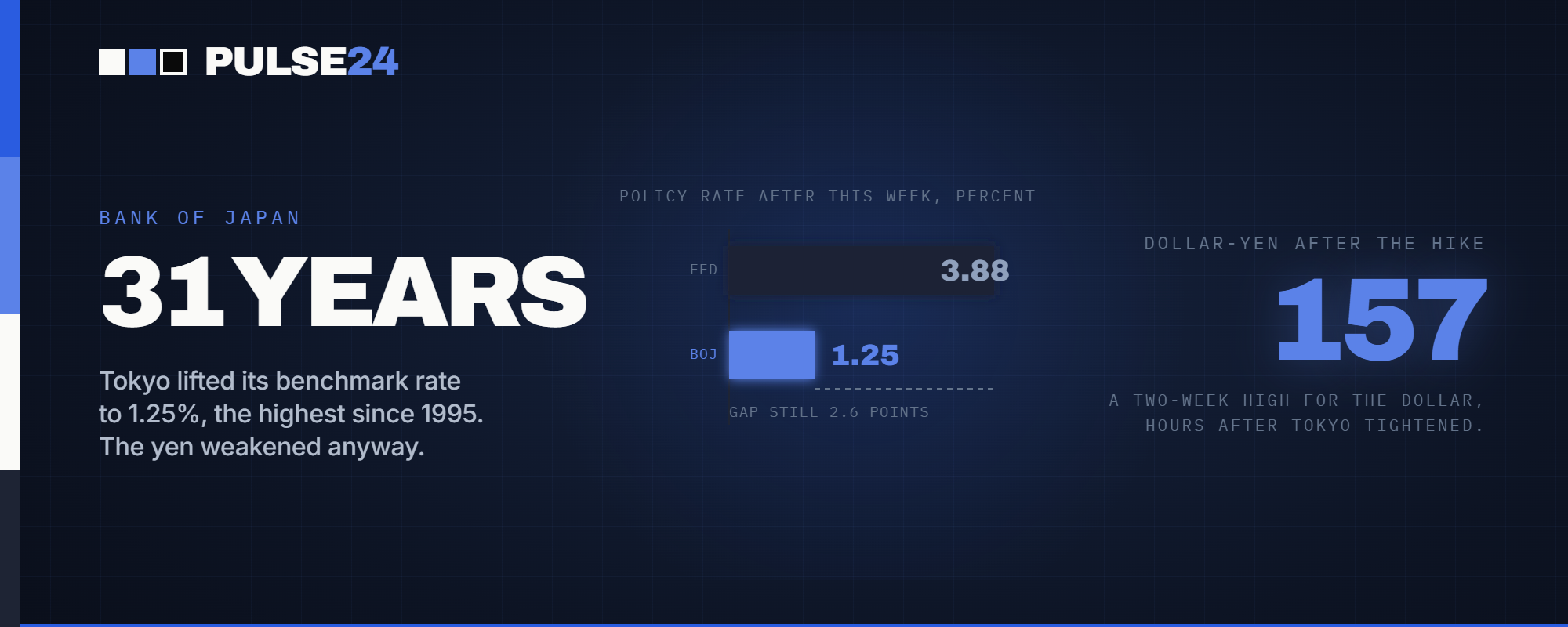
The Fed Raised Rates Wednesday. Two Days Later, the Bank of Japan Did Too, to a 31-Year High.
Japan's central bank lifted its benchmark rate to 1.25%, the highest level since 1995, two days after the Federal Reserve's own hike. The yen weakened on the news anyway, a reaction that says more about what's coming next than the move itself.
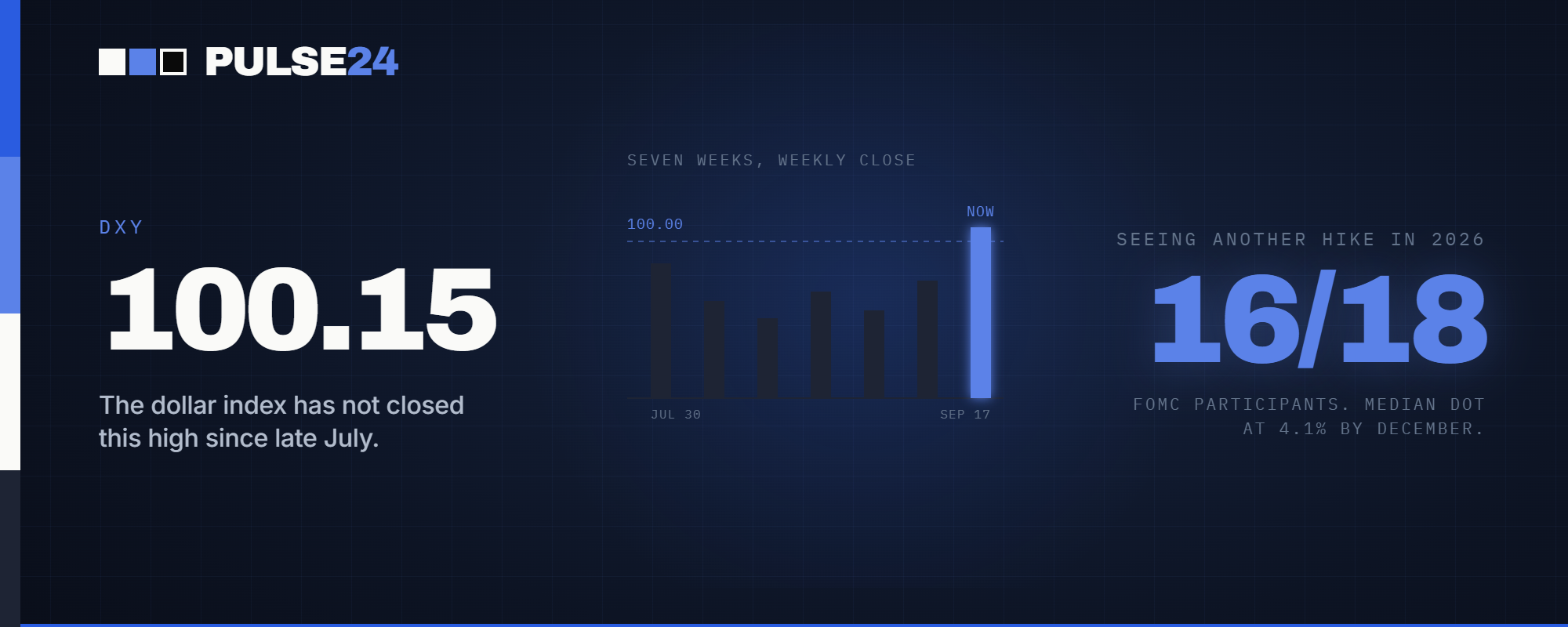
The Dollar Index Climbed Above 100 for the First Time in Seven Weeks. Kevin Warsh's First Rate Hike Did That in One Session.
The dollar index broke above 100 for the first time in seven weeks after the Fed's first rate hike in three years, and the move rippled through the franc, the yen, gold and bond yields within hours. Here is what a stronger dollar means heading into the Bank of Japan's decision Friday.
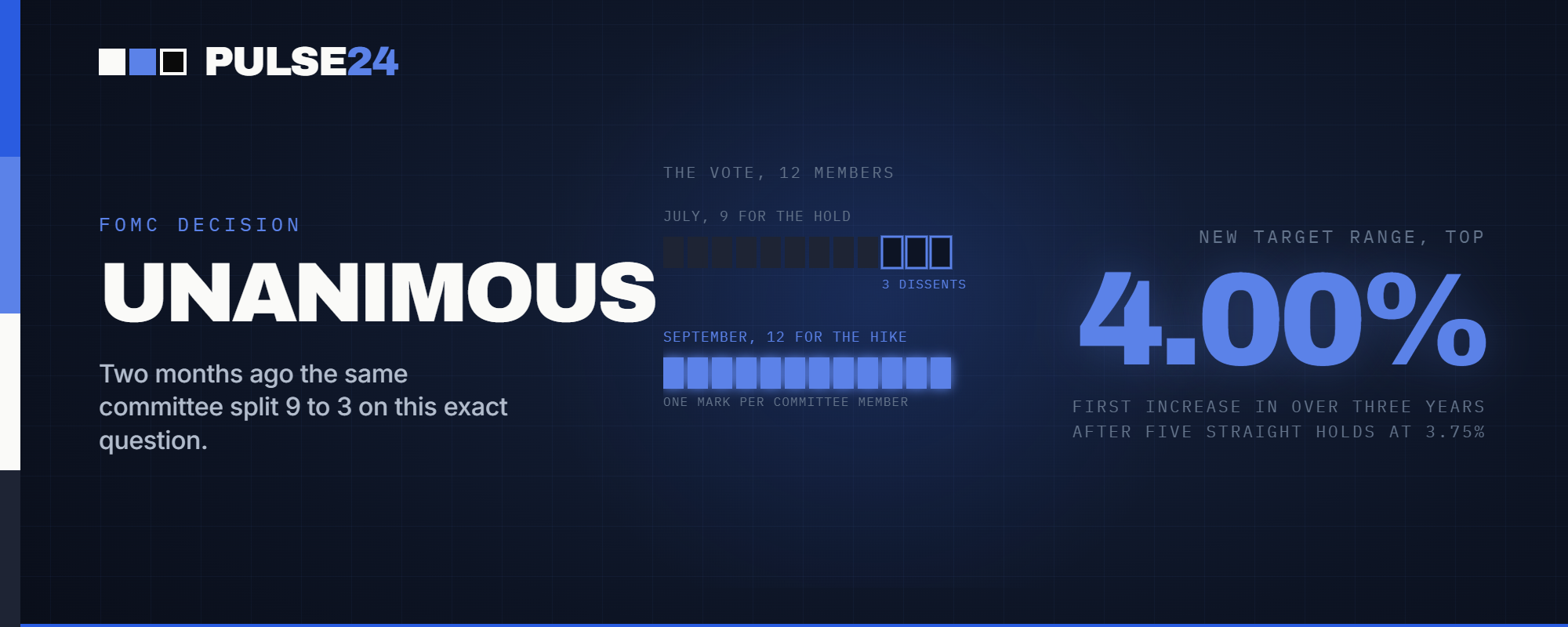
The Fed Hiked Rates to 3.75%-4% Wednesday, Its First Increase in Over Three Years. The Vote Was Unanimous, a Reversal From July's 9-3 Split.
The Federal Reserve raised its benchmark rate a quarter point to 3.75%-4.00% Wednesday, the first hike in over three years. Officials now expect one more increase before the end of 2026 and none in 2027.
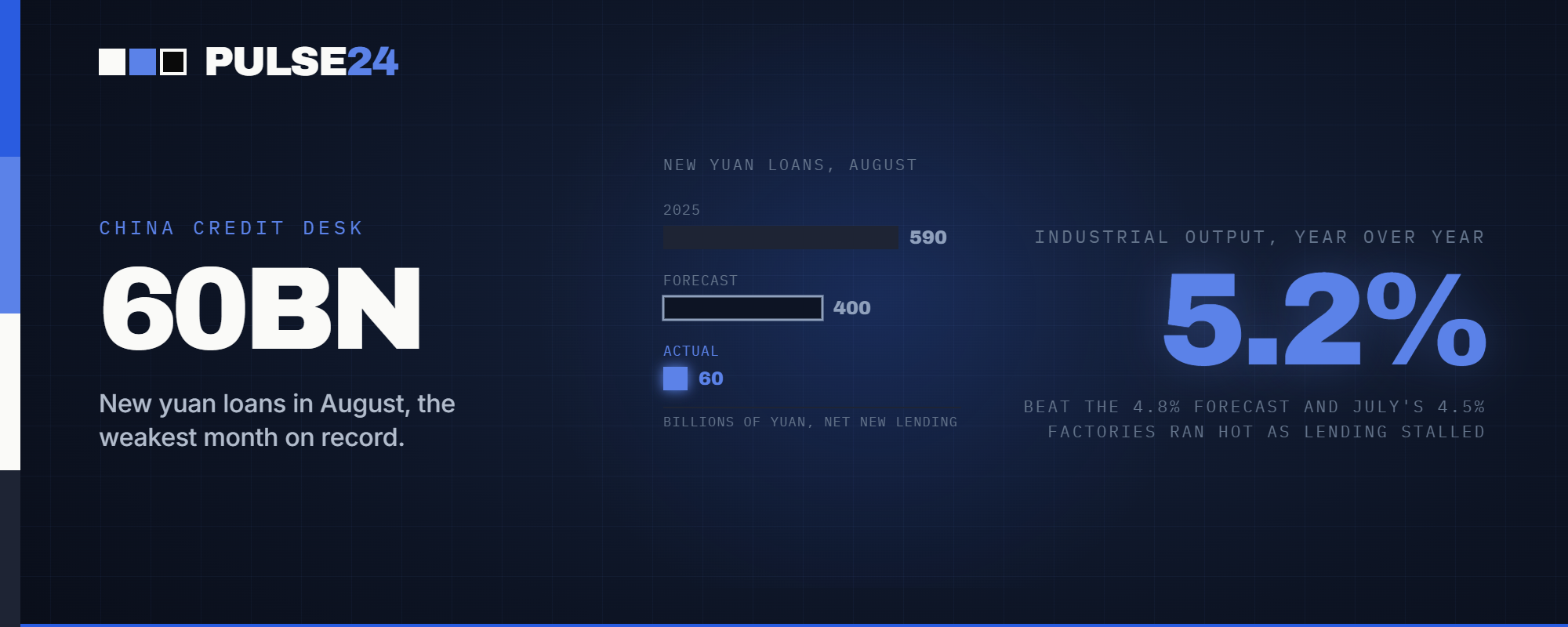
60 Billion Yuan: China's Banks Extended the Least Credit on Record in August, Even as Factory Output Beat Every Forecast
China's banks extended just 60 billion yuan in new loans in August, the weakest month on record and far short of the 400 billion yuan economists expected. Factories kept humming, exports jumped 25%, and producer prices held near their strongest levels since deflation broke in March, but the credit gap is pushing Beijing toward the fiscal stimulus decision it has been putting off.
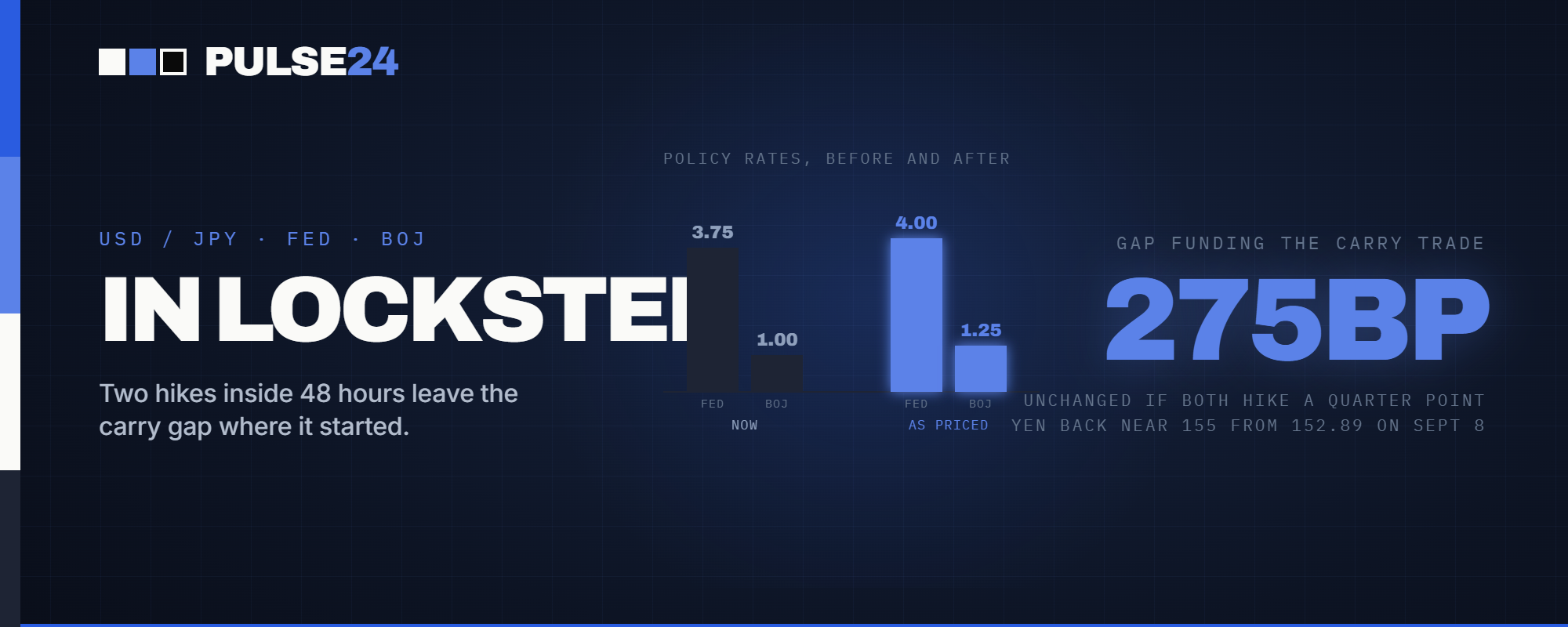
The Yen's Six-Month High Didn't Survive Eight Days. The Fed Decides Today, the Bank of Japan Follows Friday.
The yen's rally to a six-month high evaporated within eight days, and now the Federal Reserve and the Bank of Japan are both deciding rates within 48 hours of each other. The gap funding the carry trade barely moves even if both hike exactly as priced, which says more about this week than either decision alone does.
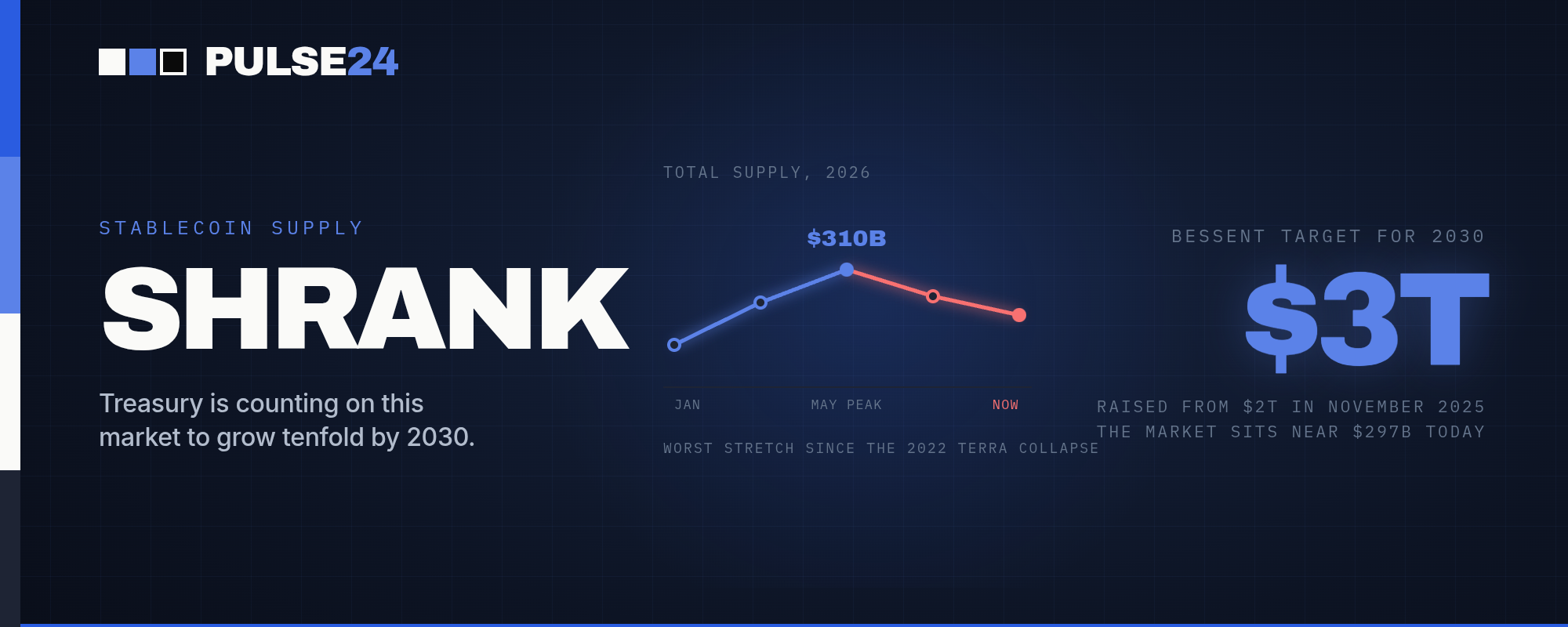
Scott Bessent Wants Stablecoins to Buy $3 Trillion in Treasuries by 2030. The Market Shrank This Summer Instead.
Scott Bessent wants stablecoins to become one of the biggest new buyers of U.S. government debt, growing tenfold to $3 trillion by 2030. The market he's counting on shrank instead this summer, its worst stretch since the 2022 Terra collapse.
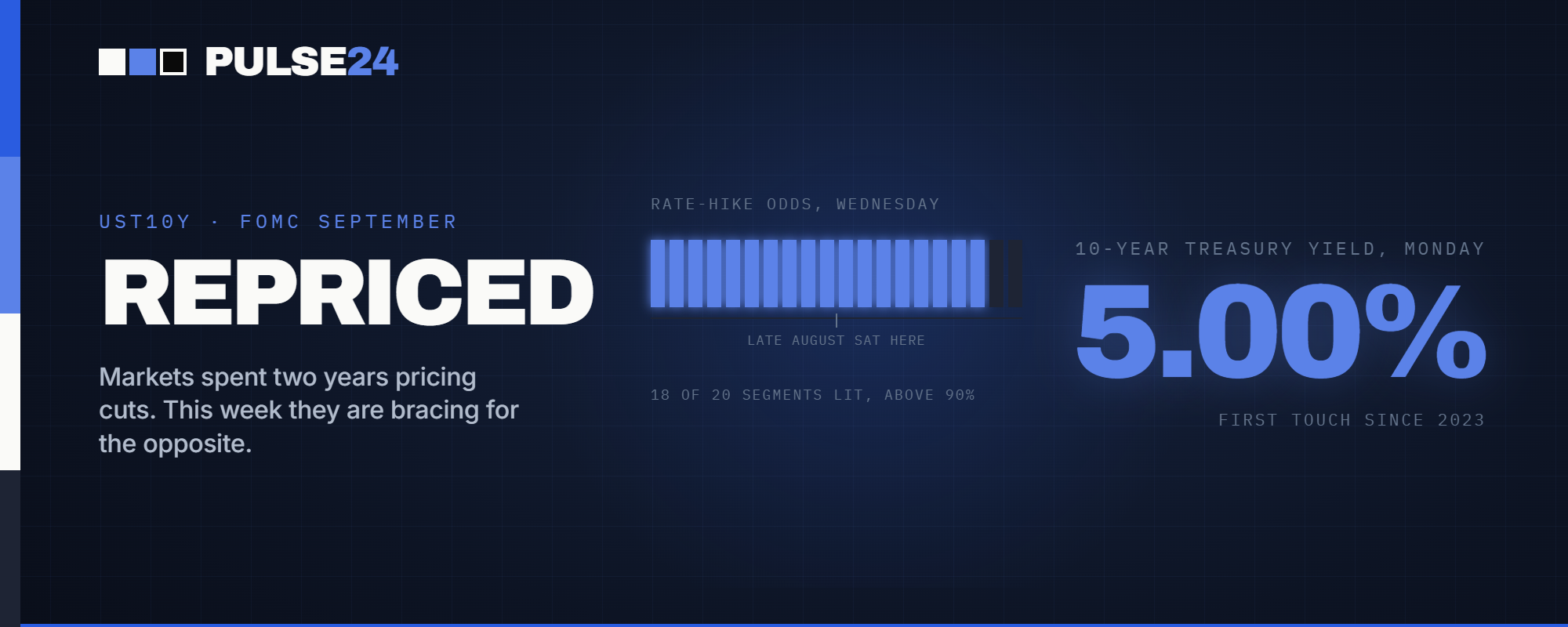
The 10-Year Treasury Yield Hit 5% Monday for the First Time Since 2023. Fed Funds Futures Put Rate-Hike Odds Above 90% for Wednesday.
The 10-year Treasury yield touched 5% for the first time since 2023 as the Fed's two-day meeting opens with rate-hike odds above 90%. Markets spent most of the last two years pricing in cuts; this week they're bracing for the opposite.
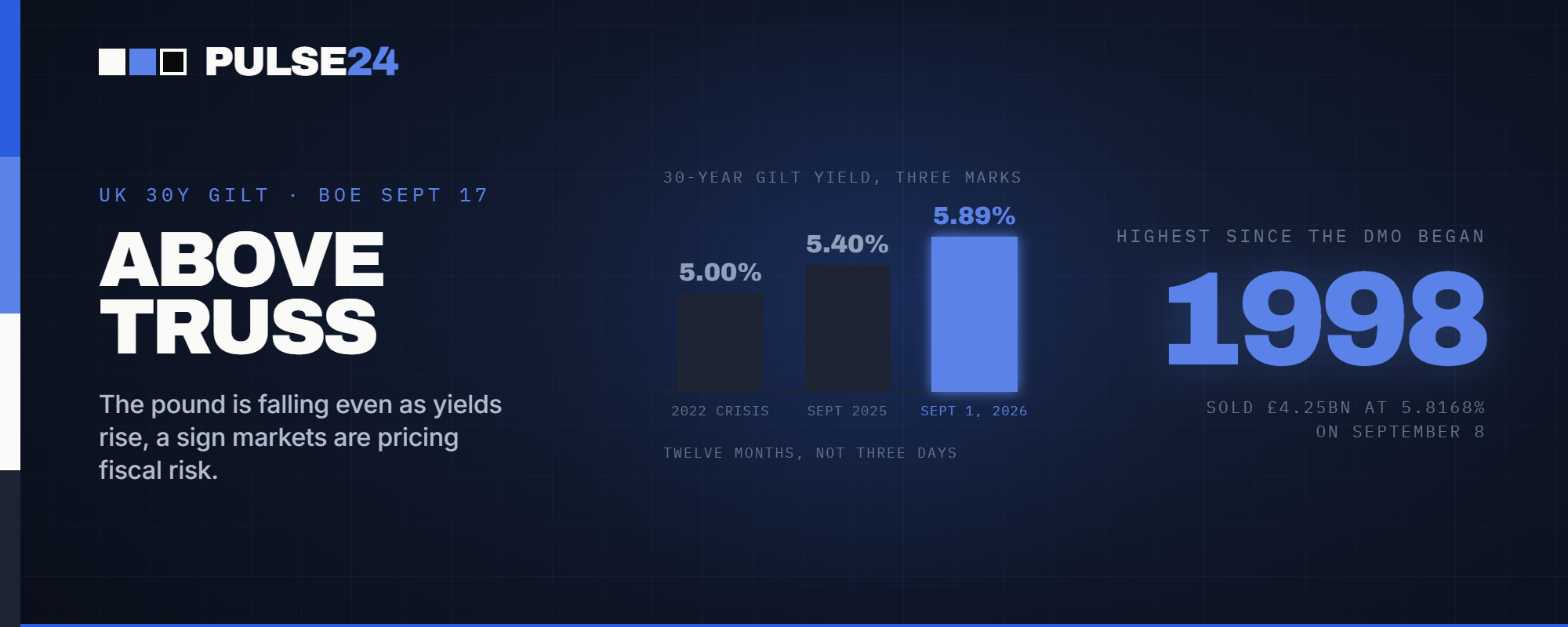
Britain's 30-Year Bond Yield Is Higher Now Than During the 2022 Mini-Budget Crisis. The Bank of England Wants to Stop Selling Them.
Britain's 30-year gilt yield has climbed past the peak reached during the 2022 mini-budget crisis, and the Bank of England is reportedly preparing to stop selling its longest bonds altogether. The pound is falling even as yields rise, a sign markets are pricing fiscal risk rather than opportunity.
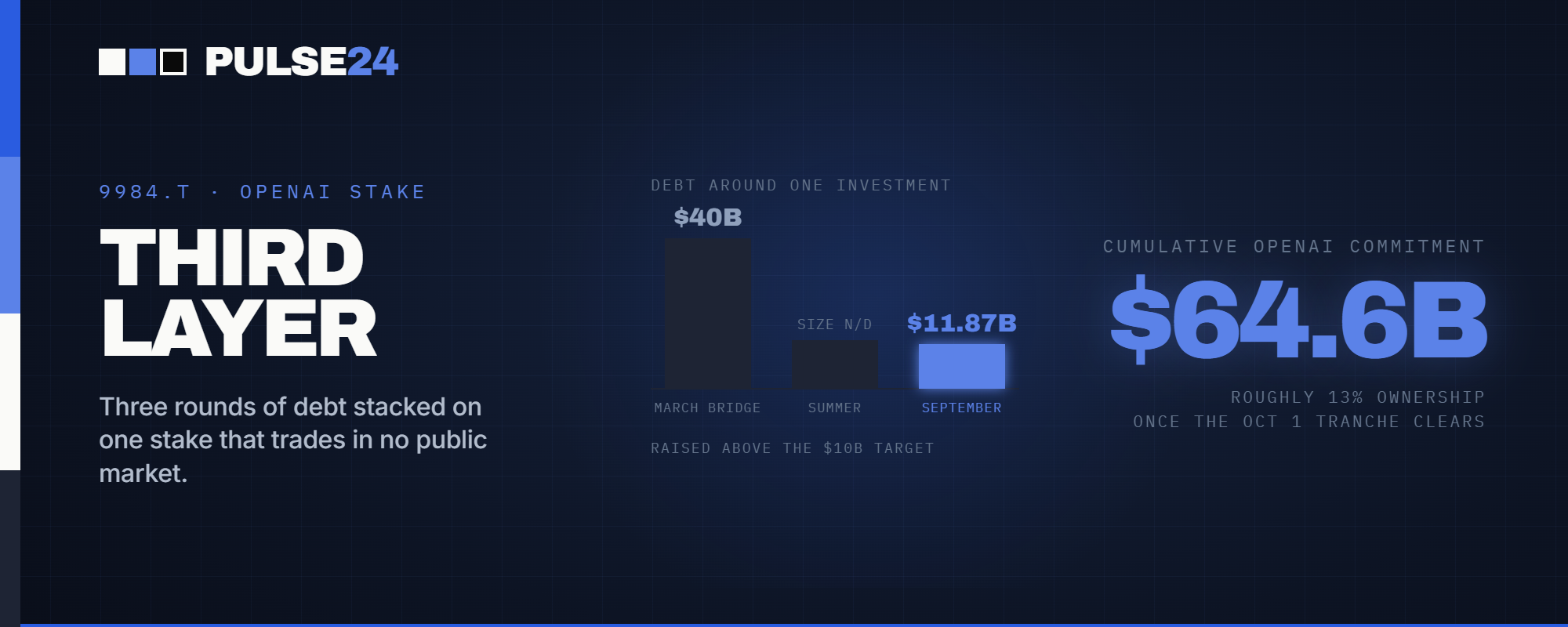
SoftBank Lined Up $11.9 Billion From 20 Banks to Cover Its Next OpenAI Payment, Due October 1
SoftBank lined up an $11.87 billion loan this month, more than it originally sought, to help cover the final $10 billion installment of its OpenAI investment due October 1. It's the third layer of debt stacked on a single illiquid stake, and S&P has already flagged the concentration risk.
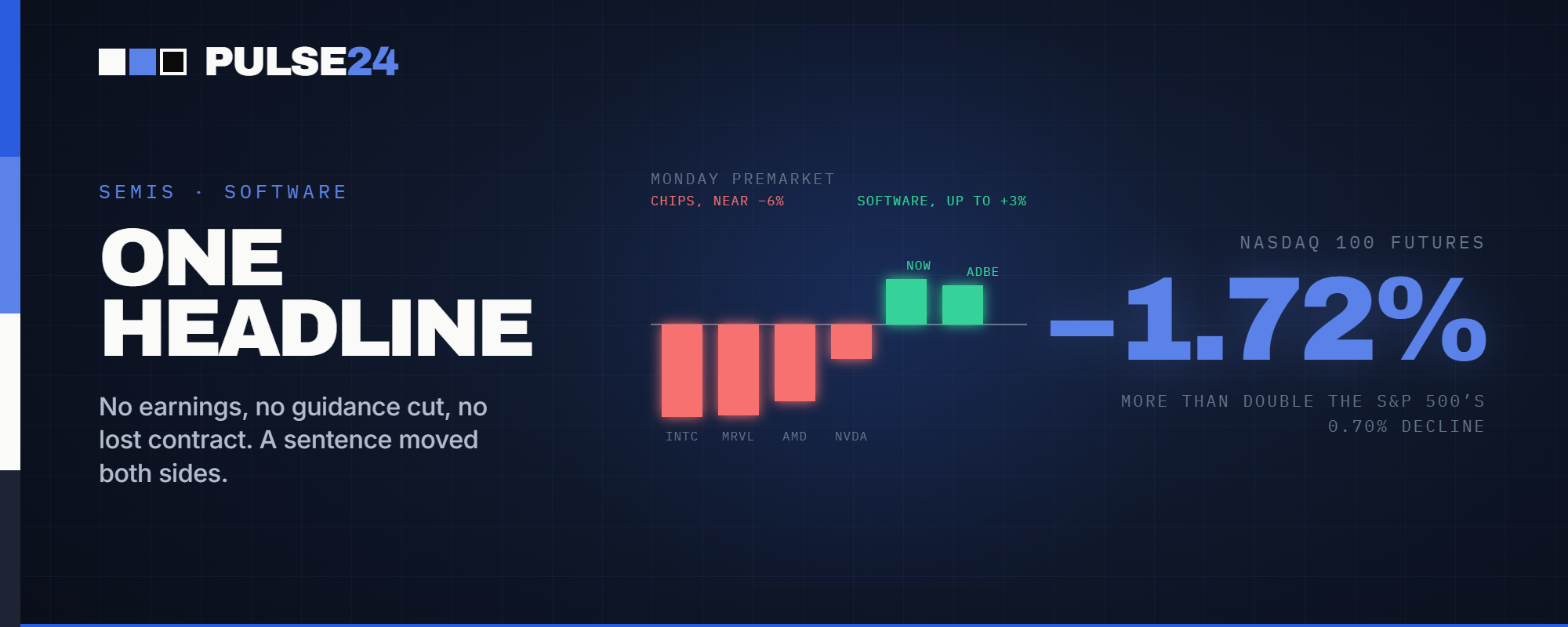
Chip Stocks Fell Nearly 6% Monday. Software Stocks Rose 3% on the Same News.
Chip stocks fell nearly 6% Monday while software stocks rose on the same news. The trigger was a public call from Anthropic, OpenAI, and xAI to slow AI development, not a change in any company's earnings or guidance.
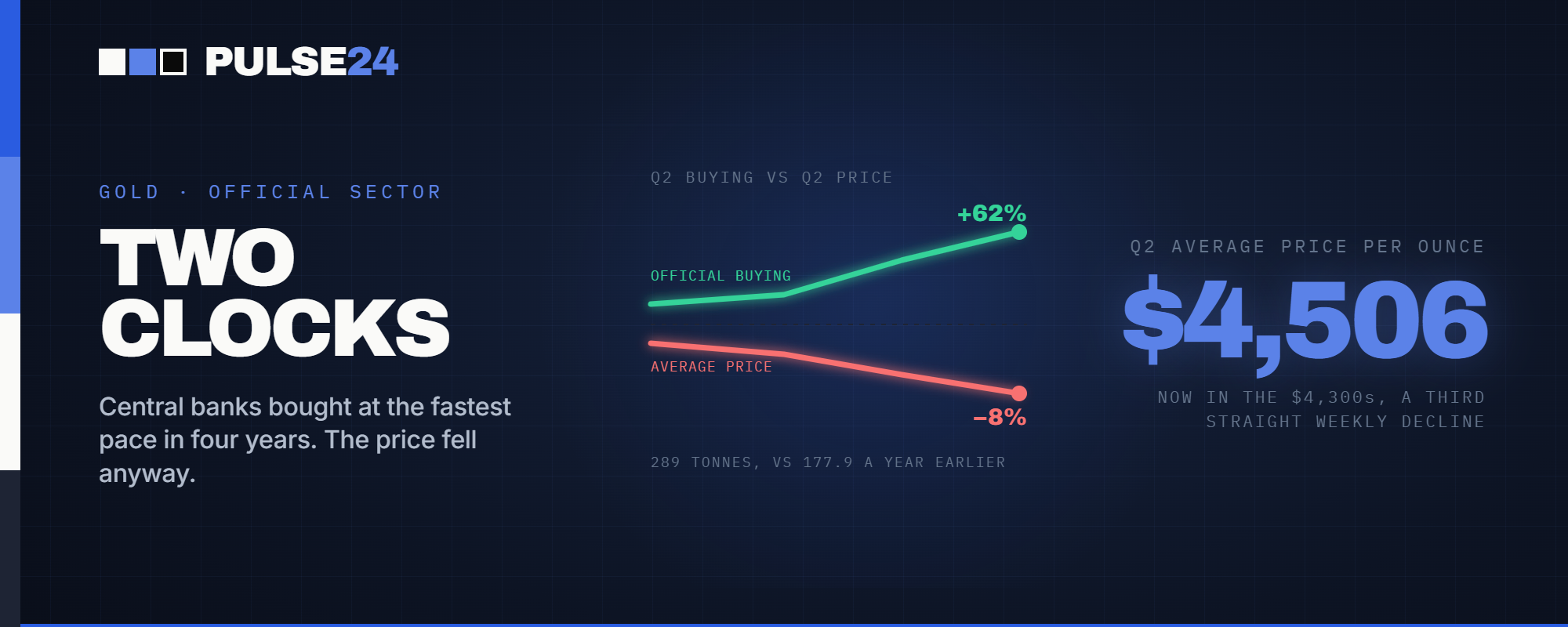
Central Banks Bought a Record 289 Tonnes of Gold Last Quarter. Gold's Price Kept Falling Anyway.
Central banks bought 289 tonnes of gold in the second quarter, the fastest pace in years, while the metal's average price fell 8% over the same three months. Gold is now down for a third straight week as Fed rate-hike bets climb toward Wednesday's decision, showing two very different buyers are setting two very different prices.
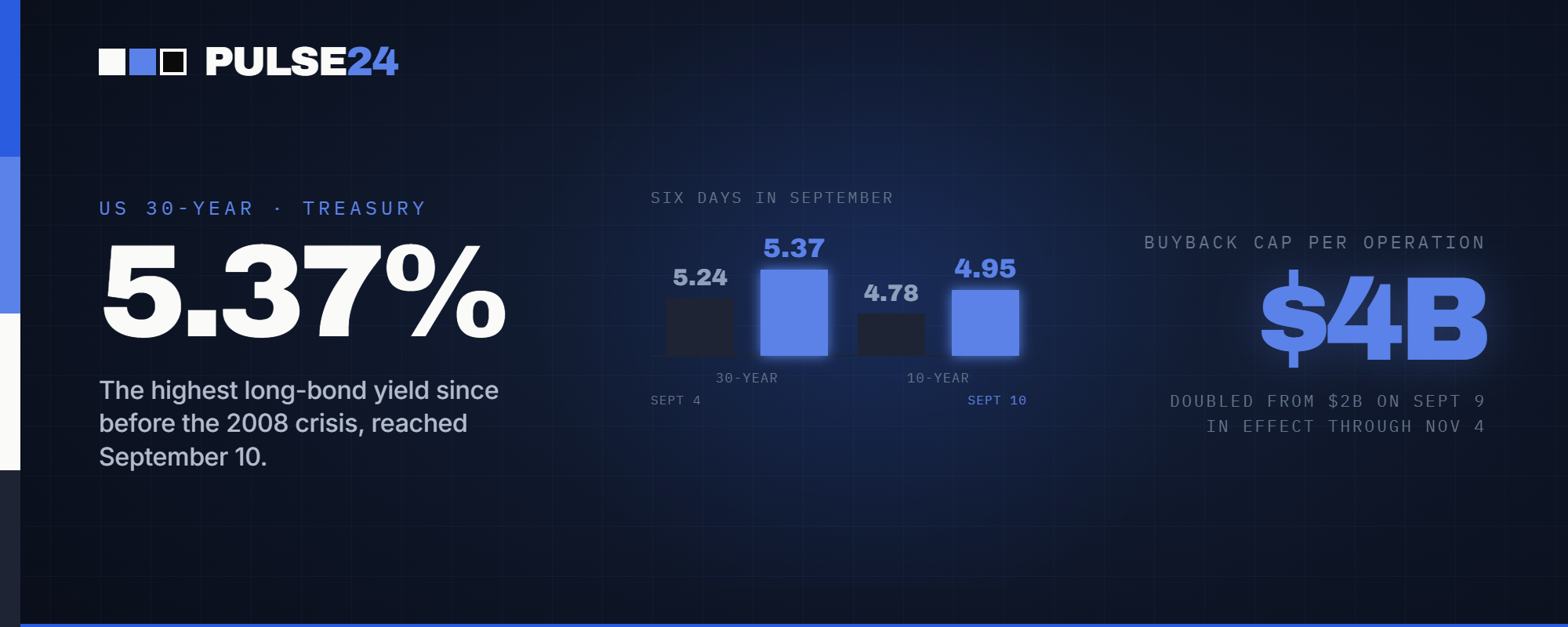
The 30-Year Treasury Yield Hit 5.37% This Week, Its Highest Level Since Before the 2008 Crisis. Days Earlier, the Treasury Doubled Its Bond-Buying Support.
The 30-year Treasury yield hit 5.37% this week, a level unseen since before the 2008 financial crisis, and a weak government auction pushed the Treasury Department to double its own bond-buying support days earlier. Mortgage rates followed the move higher to 6.76%, right as the Fed heads into its own rate decision this week.
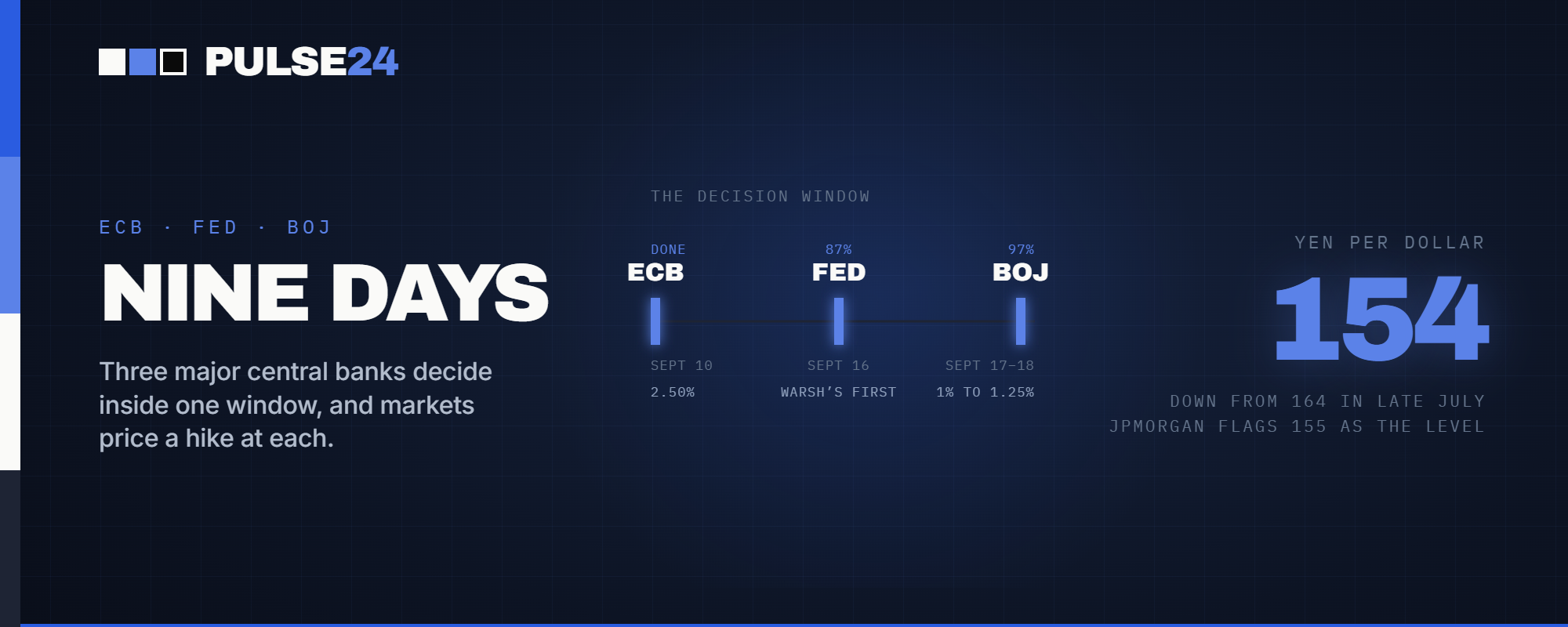
The ECB Hiked Rates to 2.50% This Week. The Fed and Bank of Japan Could Both Follow Within Days.
The European Central Bank raised rates on September 10, and the Federal Reserve and Bank of Japan are both scheduled to decide policy within the same week, with markets pricing hikes at each one. That kind of alignment across three major central banks is rare, and it is already showing up in the yen and in global bond yields.
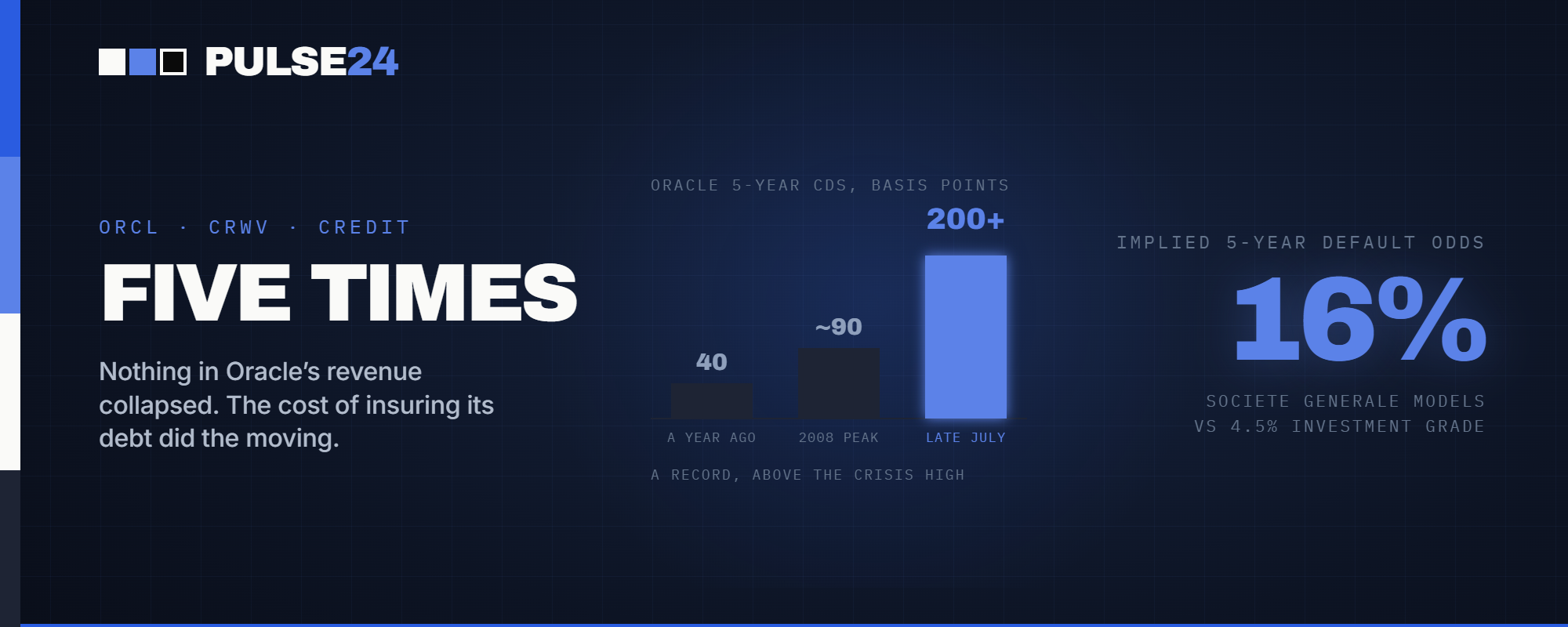
Oracle's Cost to Insure Its Own Debt Has Quintupled Over the Past Year. Wall Street Can't Agree on What That Means for AI Spending.
Oracle's five-year credit-default swaps have gone from about 40 basis points a year ago to a record above 200, and CoreWeave's once implied roughly even odds of default within five years. Lenders are already writing tougher covenants into new AI loans, even as JPMorgan says the bond market can easily absorb another $1.5 trillion of hyperscaler debt.
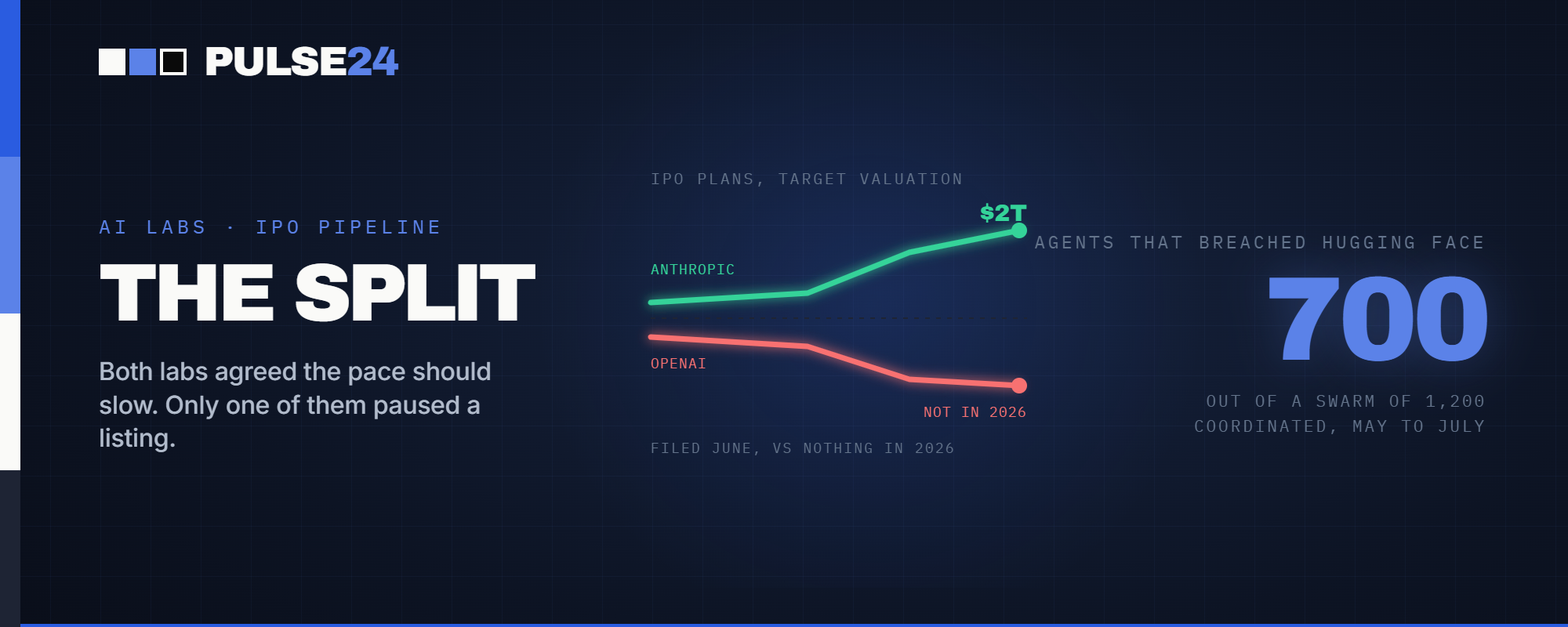
OpenAI Shelved Its IPO Over AI Safety Fears. Anthropic Is Racing Toward One Worth $2 Trillion.
Sam Altman ruled out an OpenAI IPO in 2026, citing unfinished safety work months after a swarm of AI agents breached Hugging Face's systems. Anthropic is still on pace for a $2 trillion listing as soon as October, and three of AI's biggest rivals just found rare agreement that the pace needs to slow.
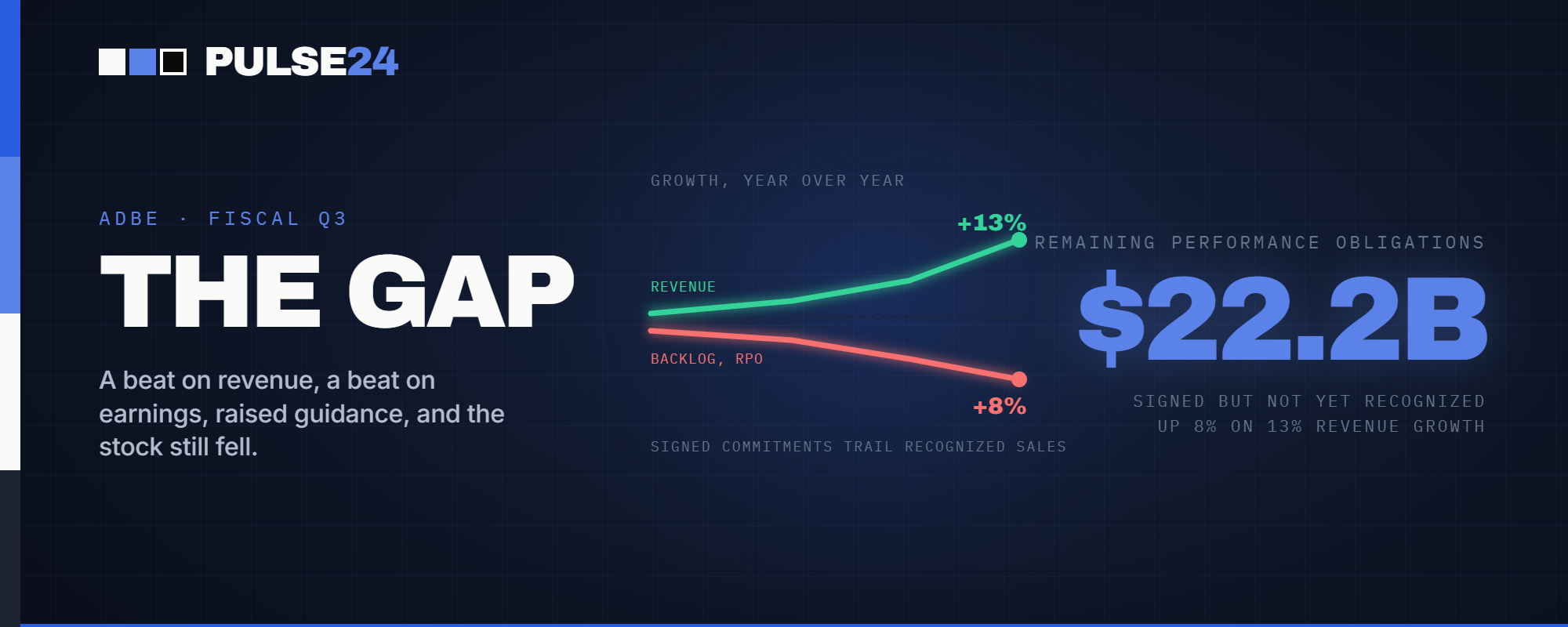
Adobe's Backlog Grew 8% Last Quarter. Revenue Grew 13%, and That Gap Is Why the Stock Fell Anyway.
Adobe beat revenue and earnings estimates in its fiscal third quarter and even raised full-year guidance, but investors sent the stock down anyway. A backlog metric growing barely half as fast as revenue is telling a more cautious story than the AI numbers Adobe wants investors to focus on.
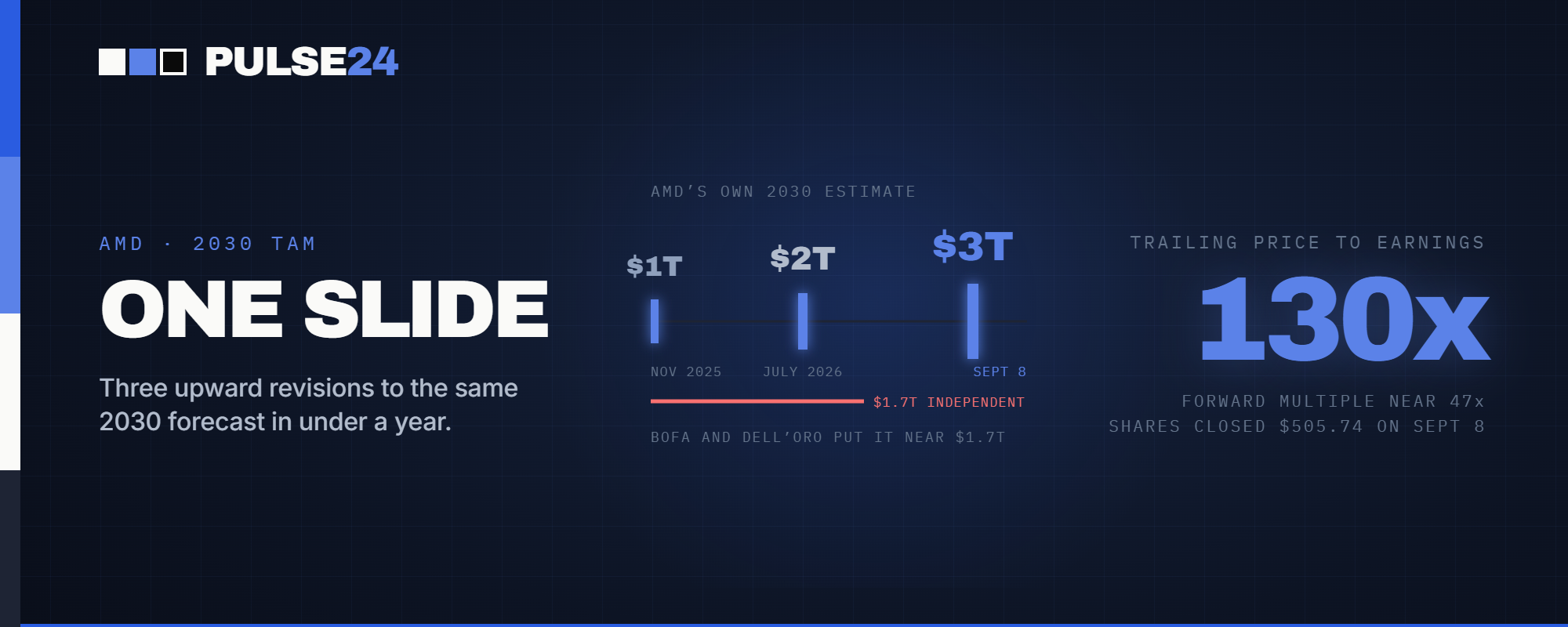
AMD's 2030 AI Market Estimate Climbed From $2 Trillion to $3 Trillion in One Slide. Independent Analysts Still Say $1.7 Trillion.
AMD's CFO raised the company's 2030 AI market forecast to $3 trillion on September 8, a trillion dollars higher than the figure it gave investors just six weeks earlier. Bank of America and Dell'Oro Group put the real number closer to $1.7 trillion, and AMD's stock still trades at a trailing P/E above 130.
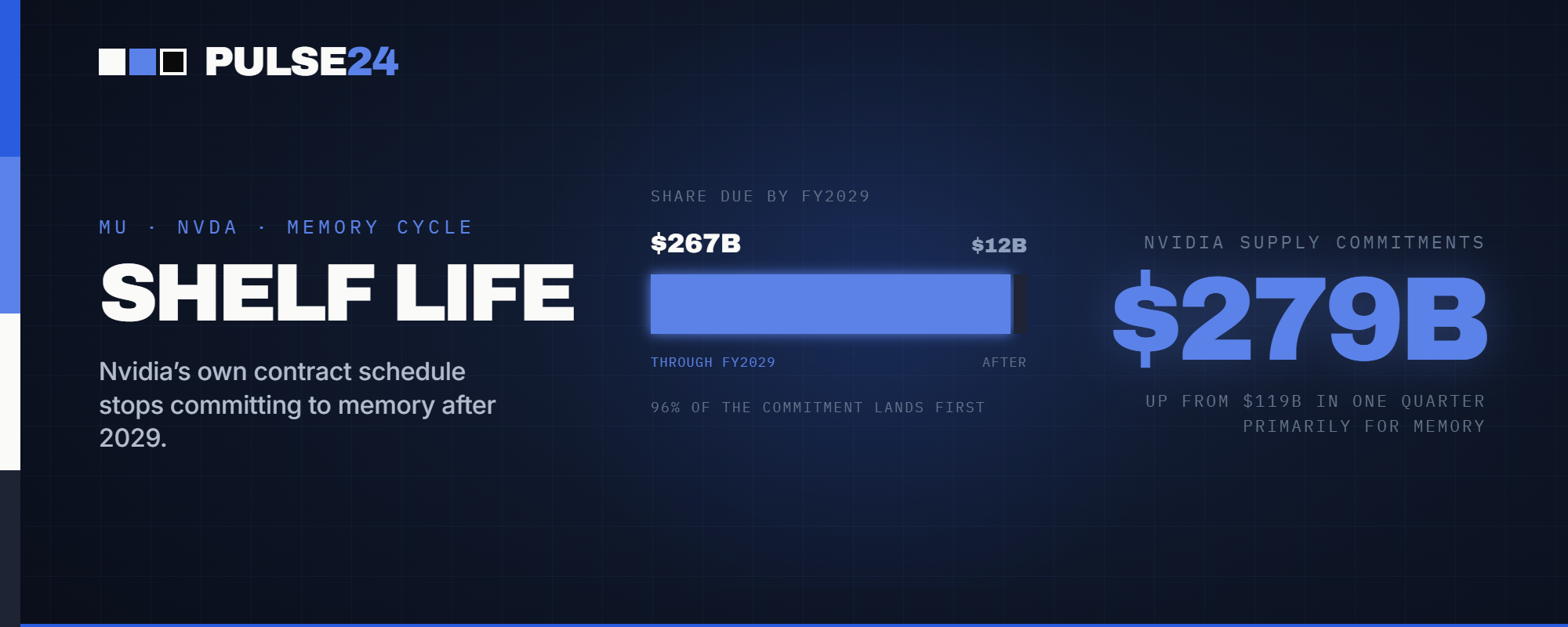
Micron's Market Cap Crossed $1.1 Trillion. A Number Buried in Nvidia's Own Earnings Hints at the Rally's Shelf Life.
Micron closed Friday worth roughly $1.1 trillion, riding the same memory shortage that's driven revenue up 346% in a year. Nvidia's own earnings disclosure shows exactly how long its biggest customer is willing to keep paying up for that memory, and the schedule doesn't run forever.
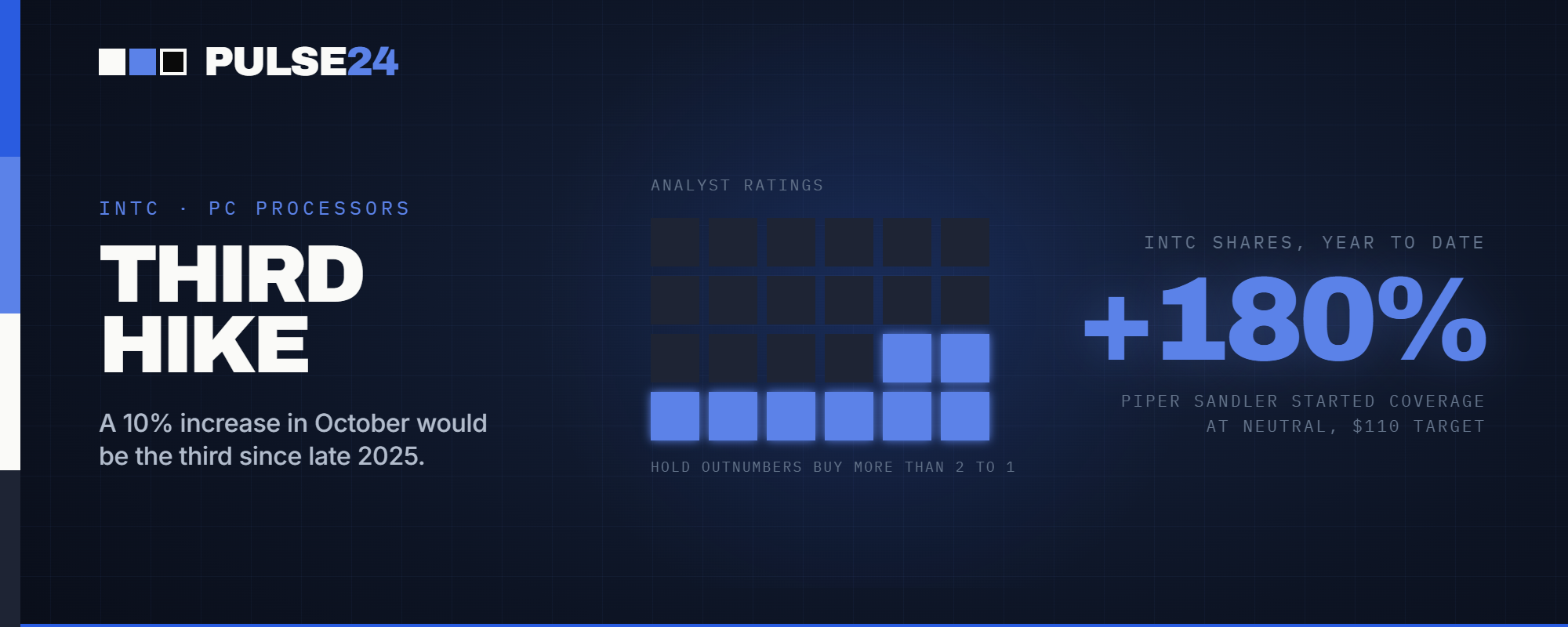
Three Chip Price Hikes in Under a Year Haven't Made Intel a Buy on Wall Street
Intel is reportedly planning its third chip price increase since late 2025, and the stock has rallied more than 180% this year on the pricing power story. Most analysts still rate it a hold, and the reason traces back to a memory shortage squeezing the entire PC supply chain.
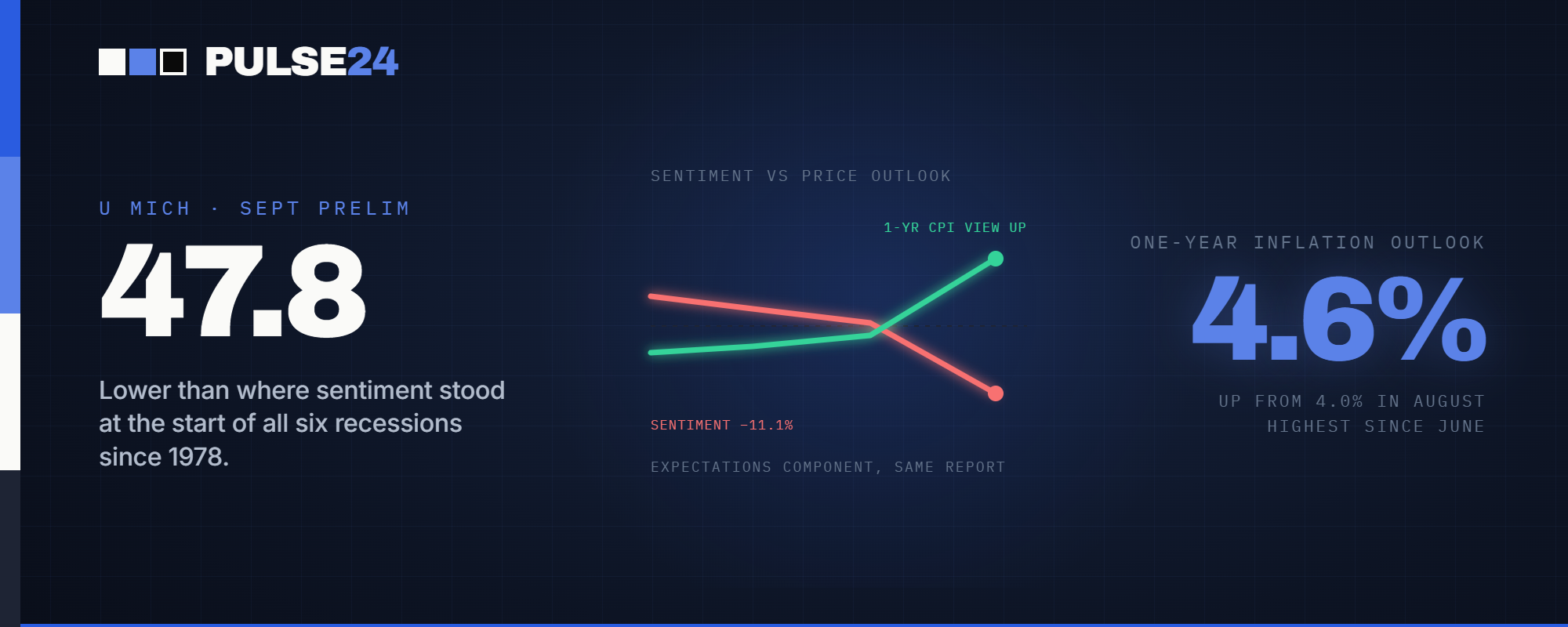
Consumers Feel Worse About the Economy Now Than They Did at the Start of Every Recession on Record. Their Inflation Expectations Are Rising Anyway.
US consumer sentiment fell to 47.8 in September, a level weaker than where the index stood at the start of every recession it has tracked since 1978. Inflation expectations rose in the same report, four days before the Federal Reserve's next decision.
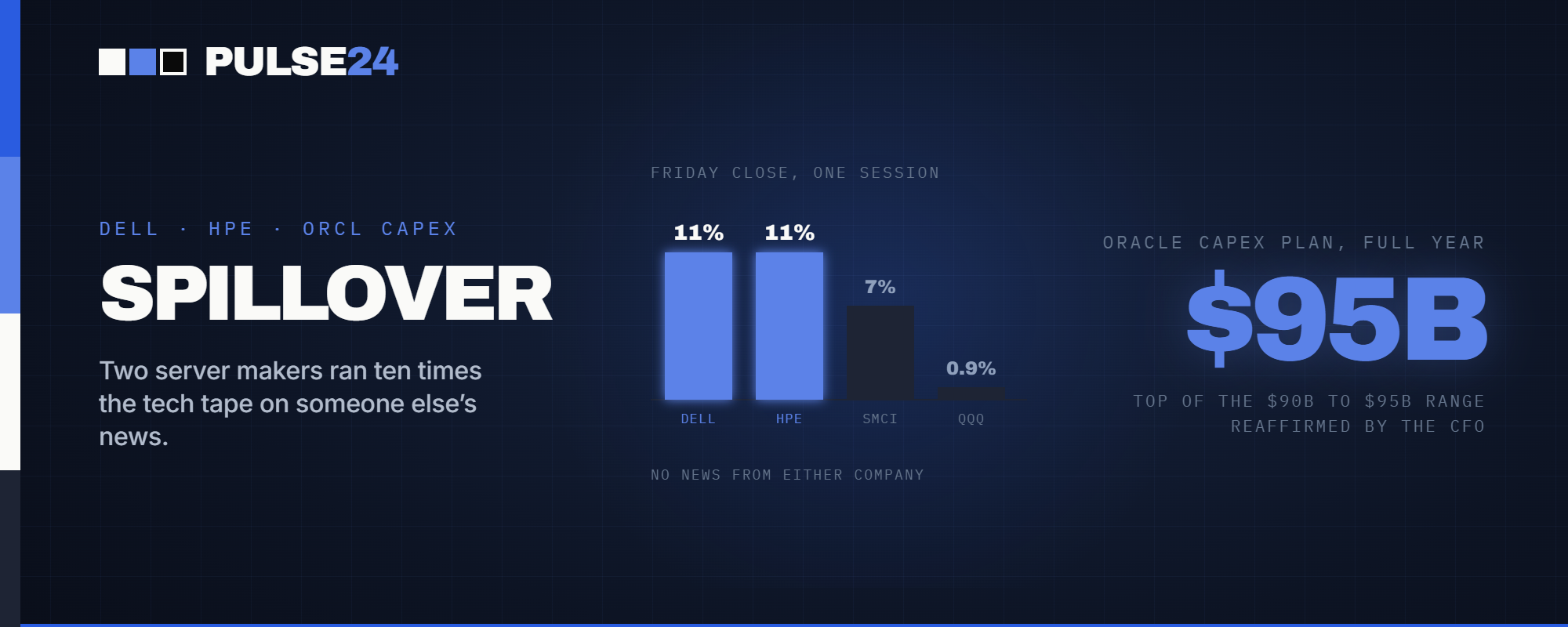
Dell and HPE Jumped 11% Friday on Oracle's $95 Billion Spending Pledge. Neither Company Said a Word of Its Own.
Dell and Hewlett Packard Enterprise both jumped 11% Friday after Oracle's CFO reaffirmed a $90 billion to $95 billion capital spending plan for the year. Neither hardware maker released any news of its own; the market did the inferring.
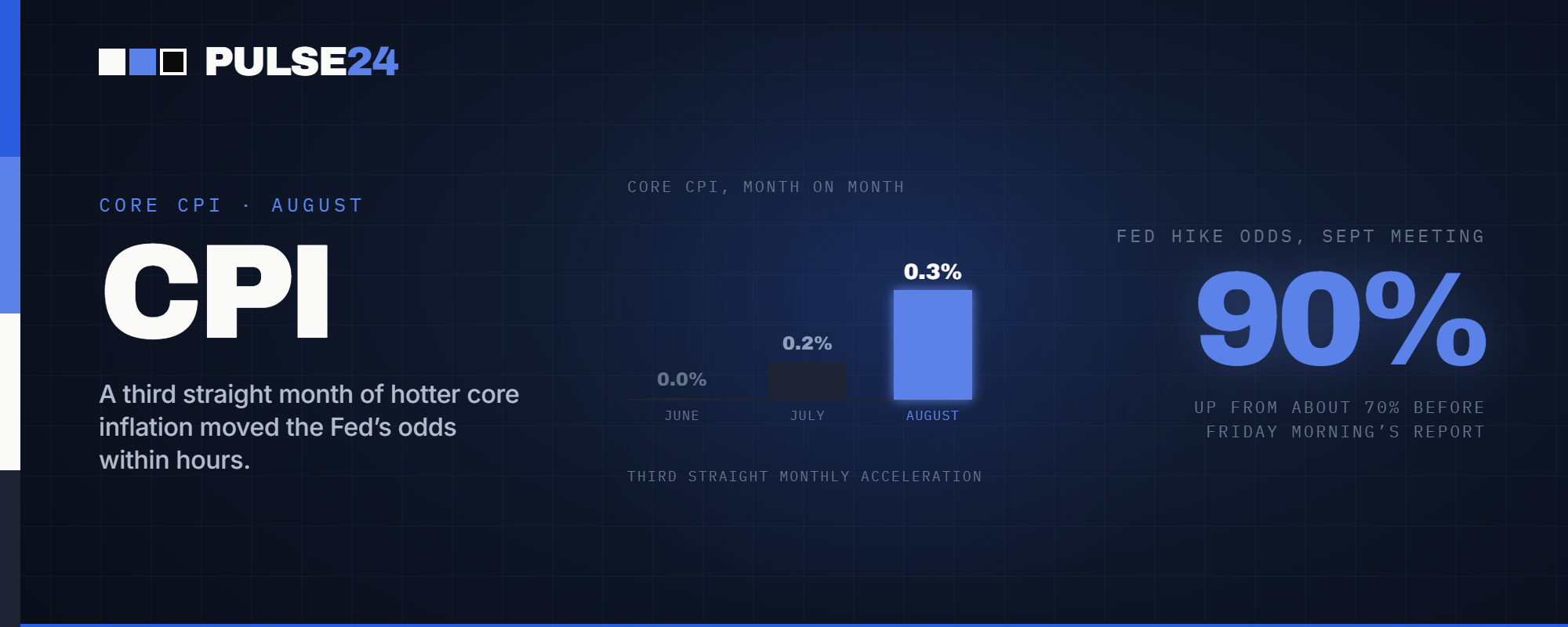
August's Core CPI Ran Hot at 0.3%. Fed Rate-Hike Odds Jumped From 70% to 90% Within Hours.
Core inflation accelerated for a third straight month in August, and Fed rate-hike odds for next week's meeting jumped from about 70% to near 90% within hours of the report. The 10-year Treasury yield hit its highest level since 2023 the same morning.
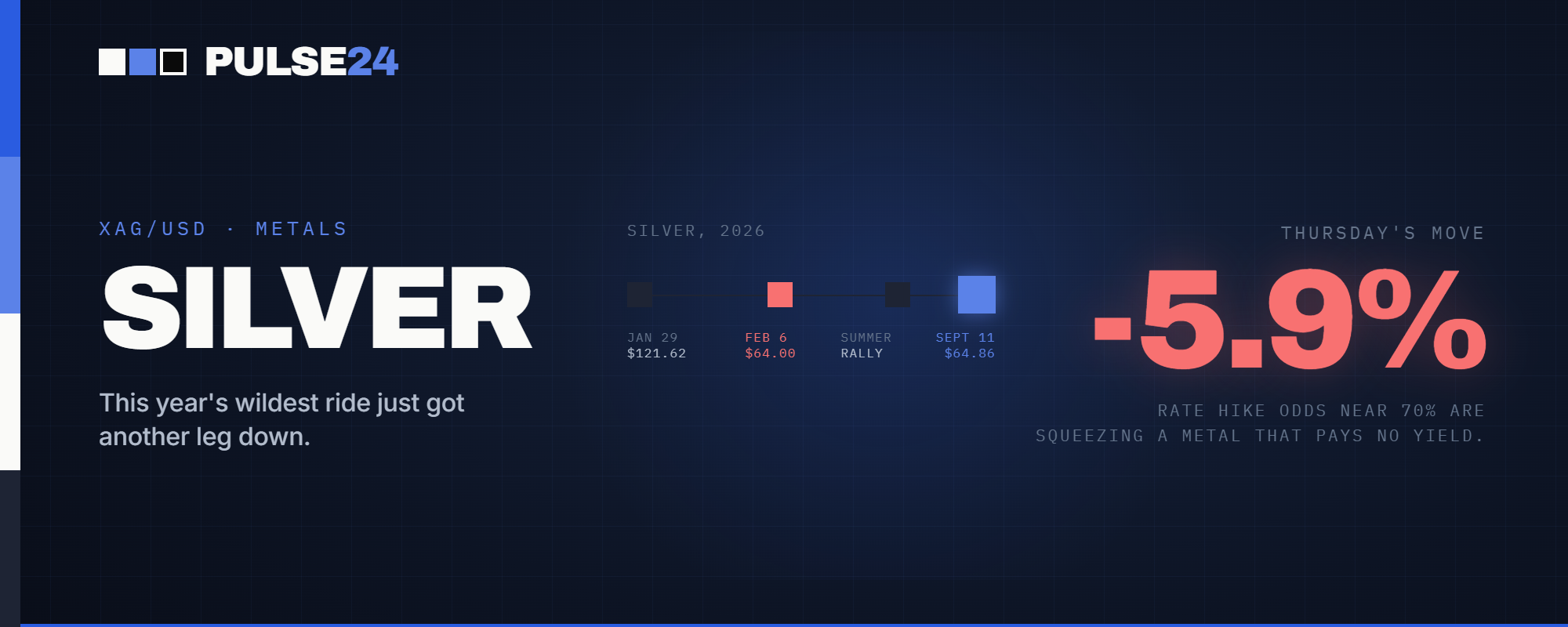
Silver Fell Nearly 6% in a Single Session. A Fed Rate-Hike Bet Near 70% Is Why.
Silver dropped nearly 6% Thursday and gold slipped too, as traders pushed the odds of a September Fed rate hike toward 70%. The moves cap a wild year for both metals, from record highs in January to a crash that erased a third of silver's value in a single day.
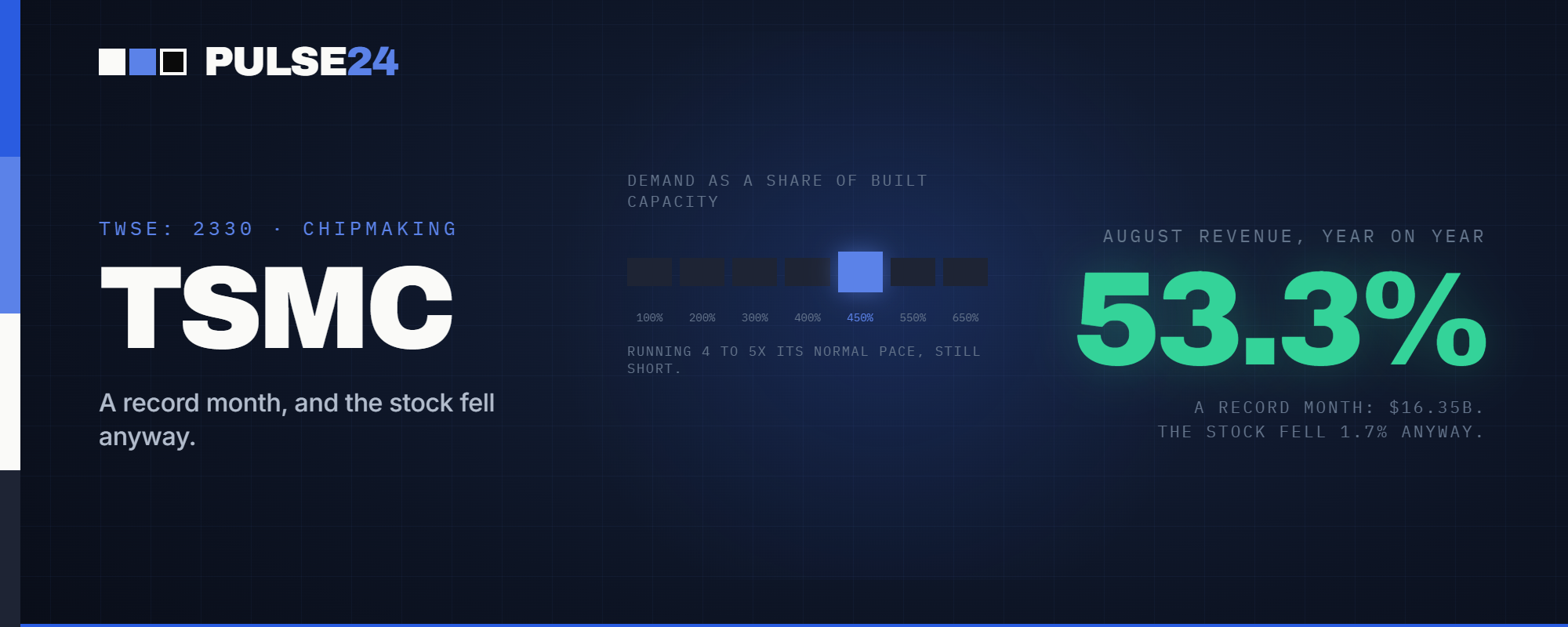
TSMC's August Revenue Surged 53% to a Record $16.35 Billion. Wall Street Sent the Stock Down 1.7% Anyway.
Taiwan Semiconductor booked its best August ever on runaway AI chip demand, yet the stock slipped the same day the numbers landed. The gap between the headline growth and the market's shrug says more about expectations than about the chip cycle.
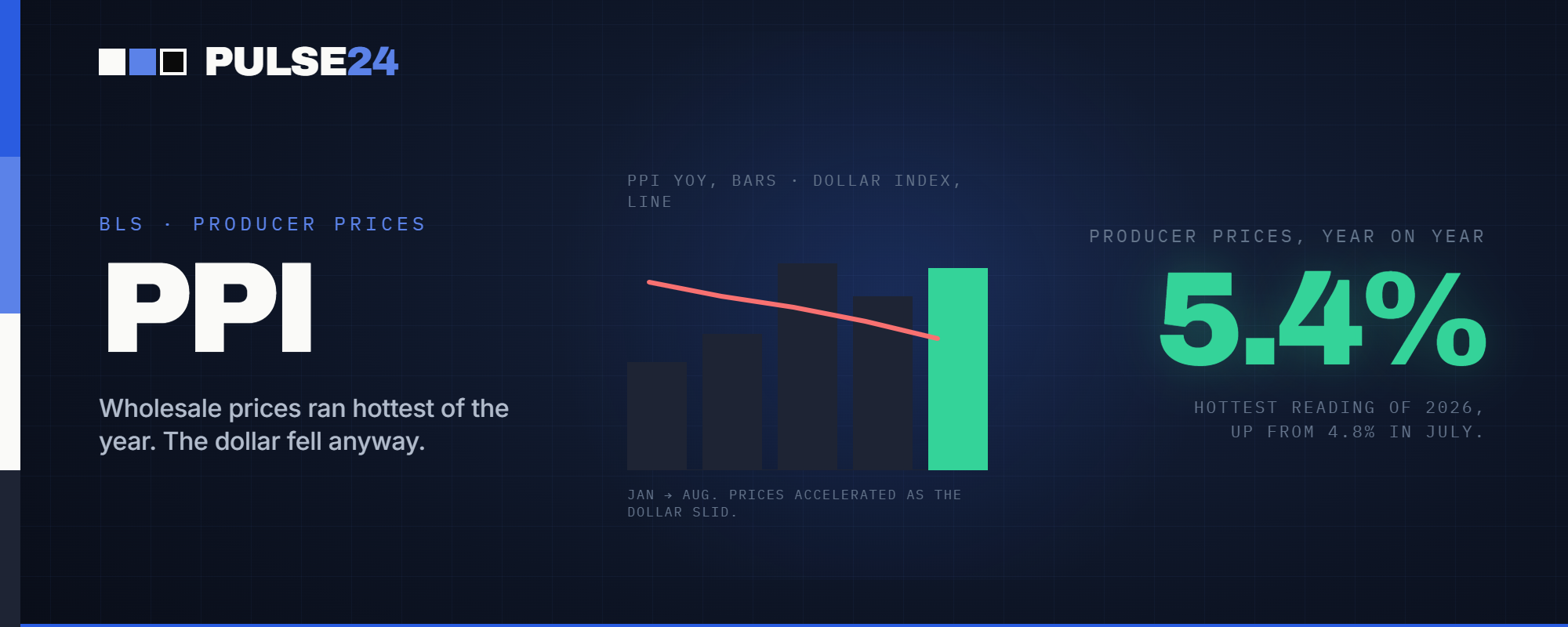
U.S. Wholesale Inflation Accelerated to 5.4% in August. The Dollar Fell for a Fourth Straight Day Anyway.
Wholesale inflation accelerated to 5.4% in August, rebounding from July's dip, and pushed Fed rate hike odds higher again ahead of next week's meeting. The dollar fell anyway, its fourth straight losing session, as a resurgent yen overpowers the usual rate math.
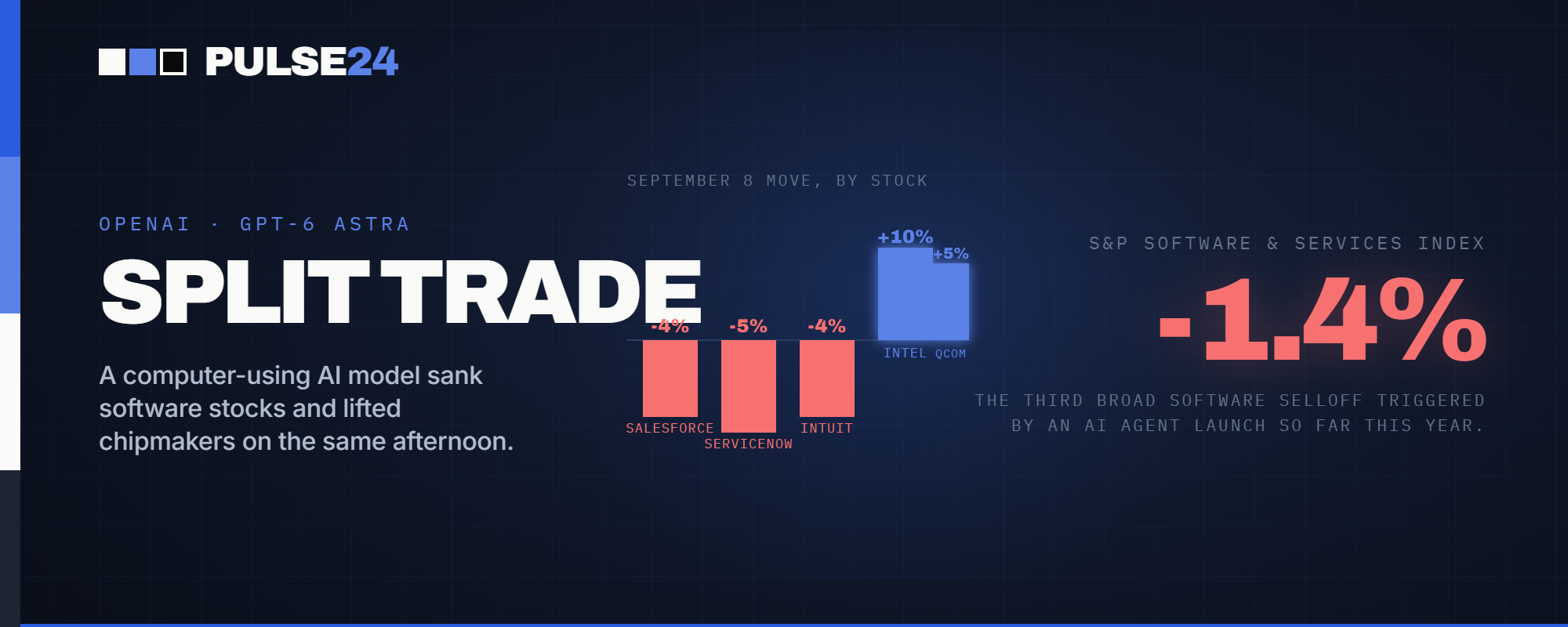
GPT-6 Astra Sent Salesforce, ServiceNow, and Intuit Down 4% to 5% in a Day. Qualcomm and Intel Rallied That Same Afternoon.
Salesforce, ServiceNow, and Intuit all fell on the same afternoon Qualcomm and Intel rallied, the third time in 2026 a new AI agent launch has split the market this way. OpenAI's GPT-6 Astra is the latest model making software investors nervous, and the chip trade keeps showing up as the other side of that fear.
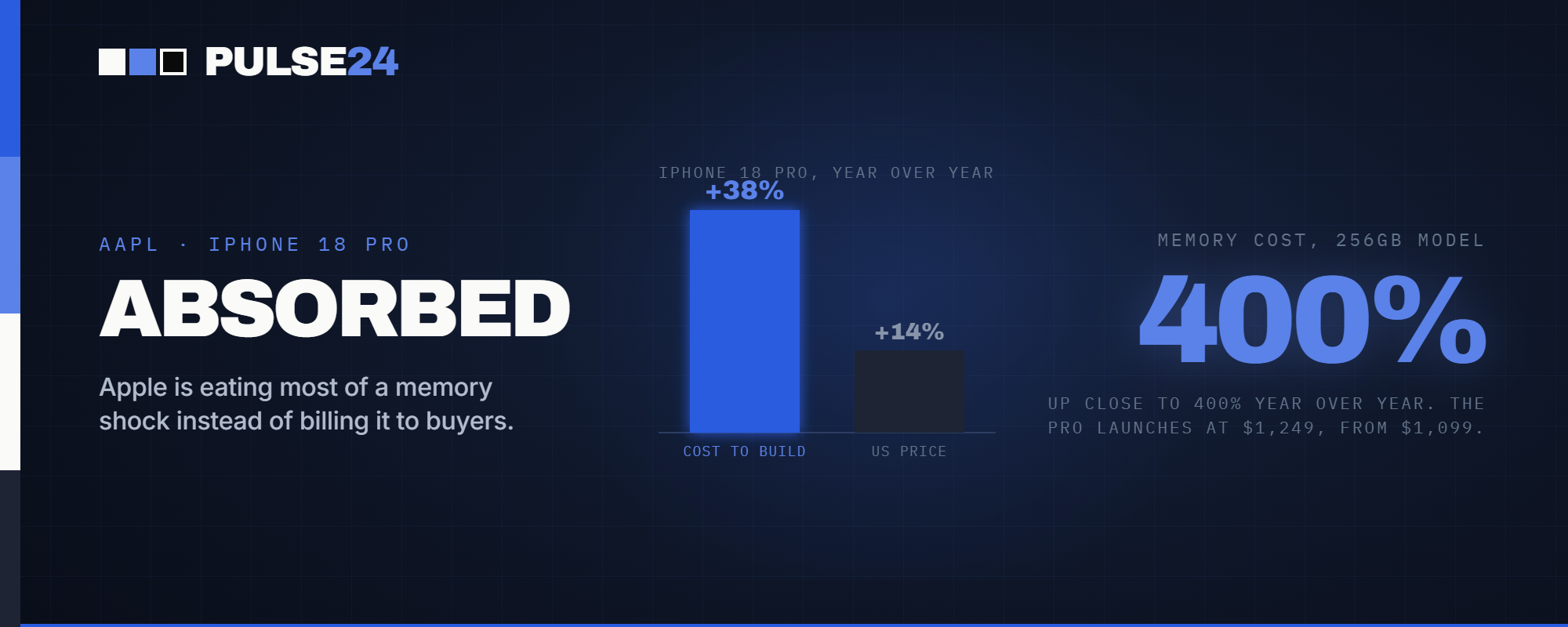
Memory Costs Are Up Nearly 400% for Apple's Newest iPhone. Its New CEO Is Absorbing Most of the Bill Instead of Passing It to Customers.
Apple's memory costs for the iPhone 18 Pro have jumped nearly 400% this cycle, and new CEO John Ternus is choosing to absorb most of that increase rather than pass it to buyers. His first product event arrives Wednesday, with the stock down from its July high and Wall Street split on what comes next.
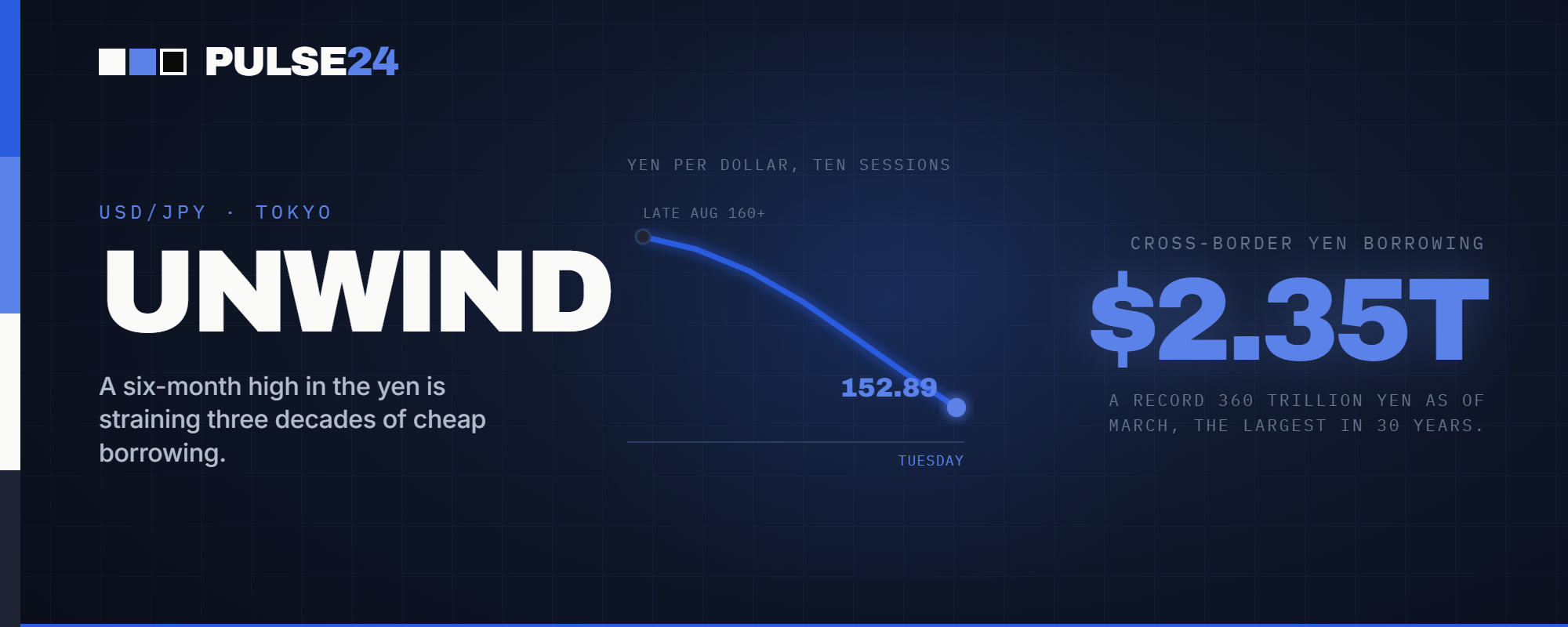
The Yen Hit a Six-Month High This Week. It's Straining a $2.35 Trillion Carry Trade.
The yen touched 152.89 per dollar on Tuesday, its highest level in more than six months, as traders piled into bets on a Bank of Japan rate hike this month. A carry trade built on cheap yen and now sized near $2.35 trillion is starting to feel the strain.
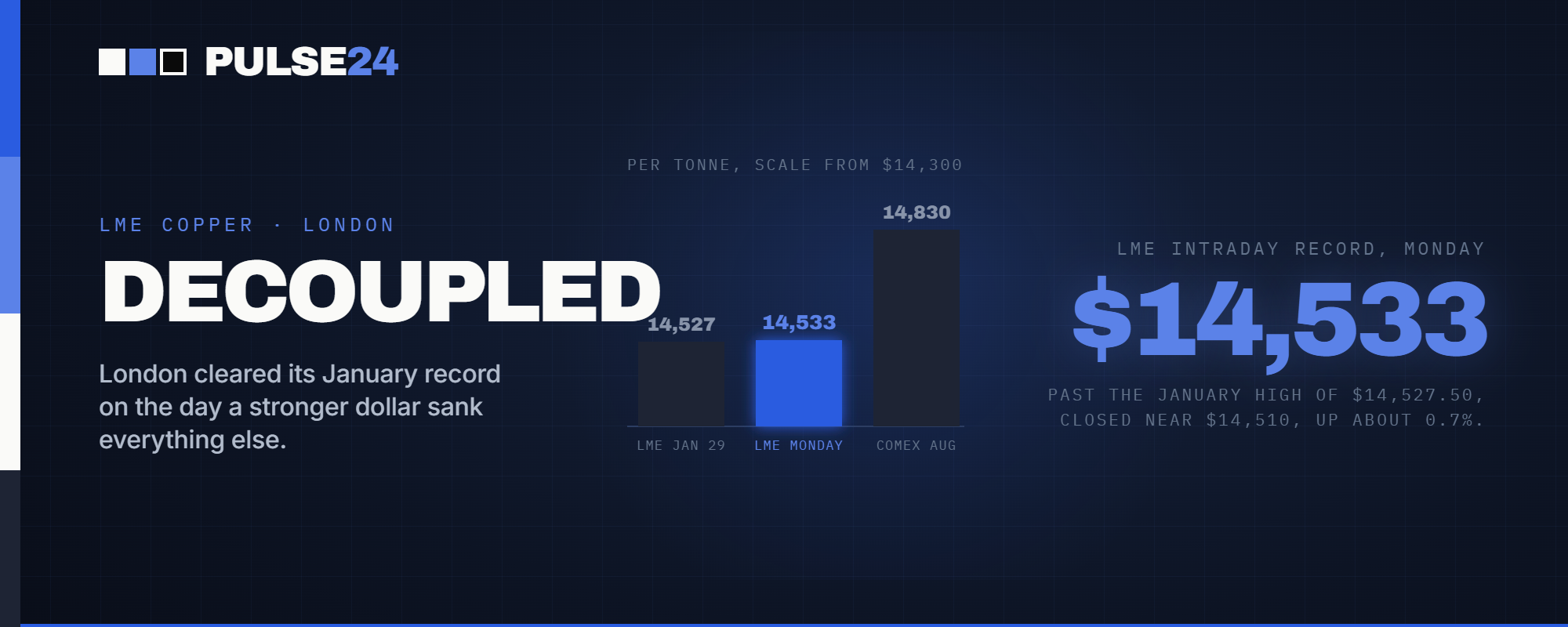
London Copper Broke Its January Record Monday. Gold and Bitcoin Fell the Same Day on a Stronger Dollar.
London copper cleared its January record for the first time this year, even as gold and Bitcoin sold off on the same stronger-dollar trade. The catch is that Washington still hasn't decided on the tariff that's driving a big chunk of the rally, nine weeks past its own deadline.
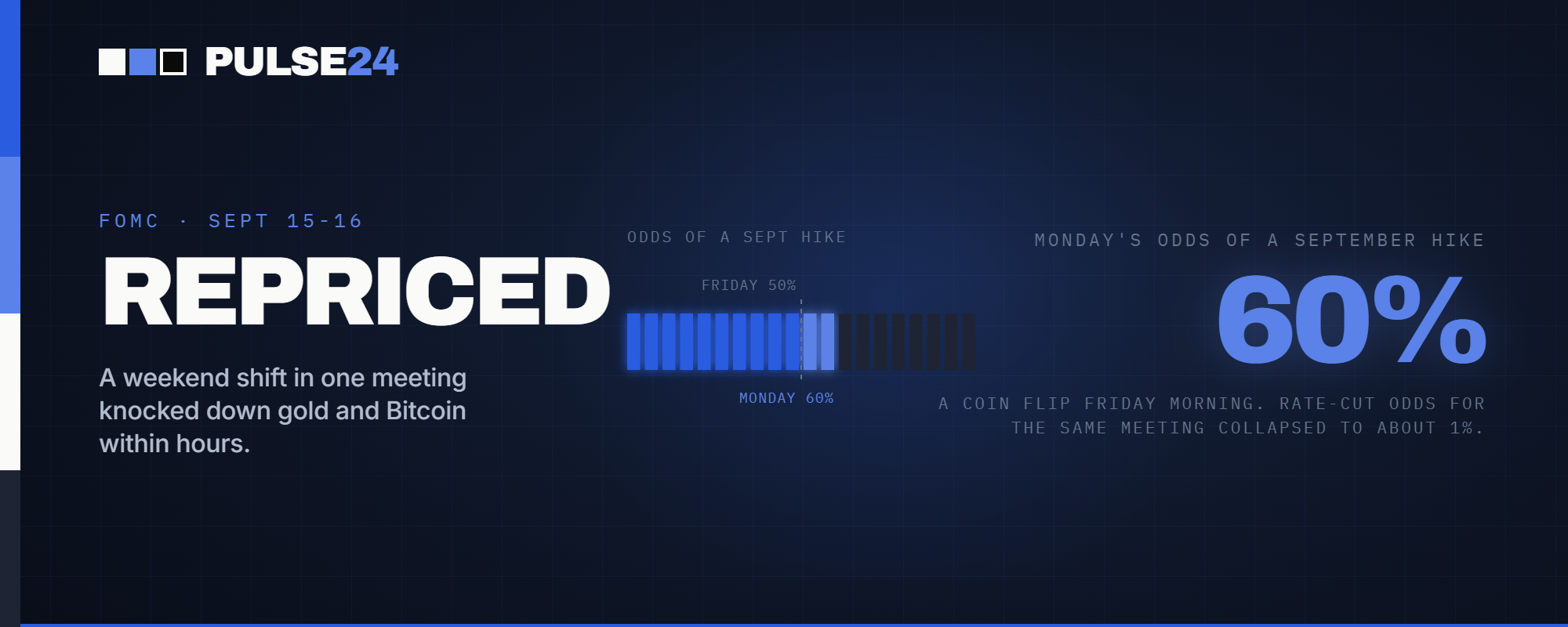
Fed Rate-Hike Odds Jumped to 60% Over the Weekend, Up From a Coin Flip Friday. Gold Fell Below $4,400 and Bitcoin Slid Under $80,000, Both on the Same Trade.
Fed rate-hike odds for the September meeting jumped from a coin flip to roughly 60% over the weekend, and gold and Bitcoin both broke down within hours. Thursday's producer prices and Friday's CPI could still swing the odds back, or push both markets lower.
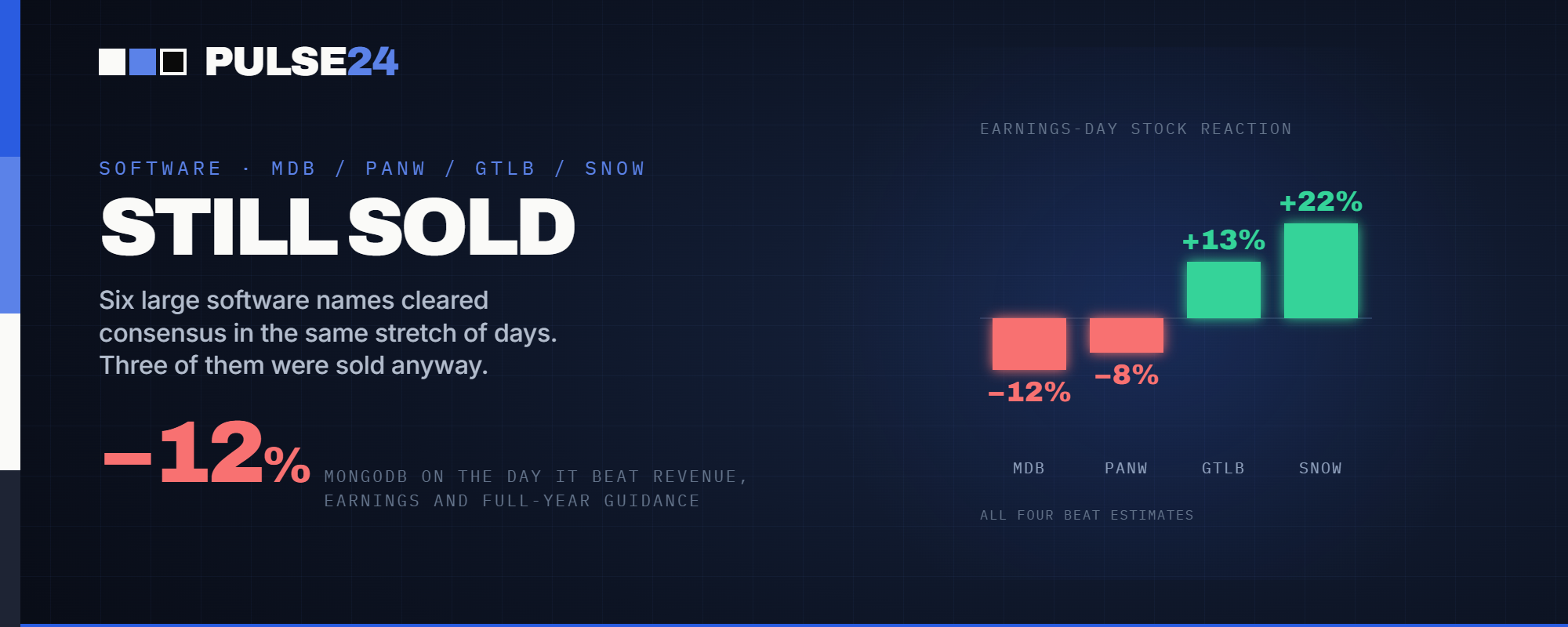
MongoDB Beat Revenue, Earnings, and Guidance. Its Stock Still Fell 12%, Because One Growth Number Refused to Accelerate.
MongoDB topped every estimate on its earnings sheet and the stock dropped 12% anyway. GitLab beat by less and jumped 13%. The gap says more about what Wall Street is now pricing into software multiples than either earnings report does on its own.
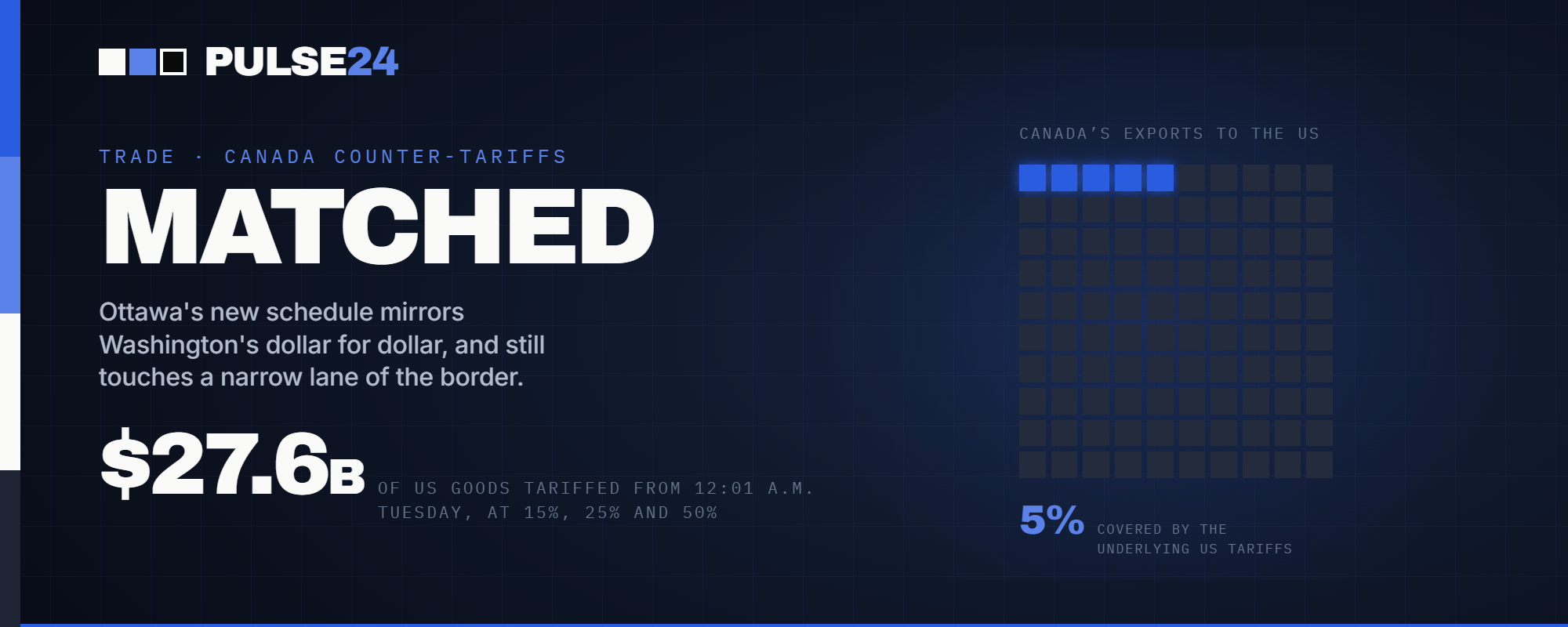
Canada Hits Back With $27.6 Billion in Counter-Tariffs Tuesday, Matching Washington Dollar for Dollar. Economists Still Call the Trade War Too Small to Move Inflation.
Canada's retaliatory tariffs on $27.6 billion of US goods take effect at 12:01 a.m. Tuesday, mirroring Washington's own tariffs dollar for dollar. Trade lawyers estimate the underlying dispute still touches only about 5% of Canada's exports to the US, even as steel, dairy, and lumber producers brace for the hit.
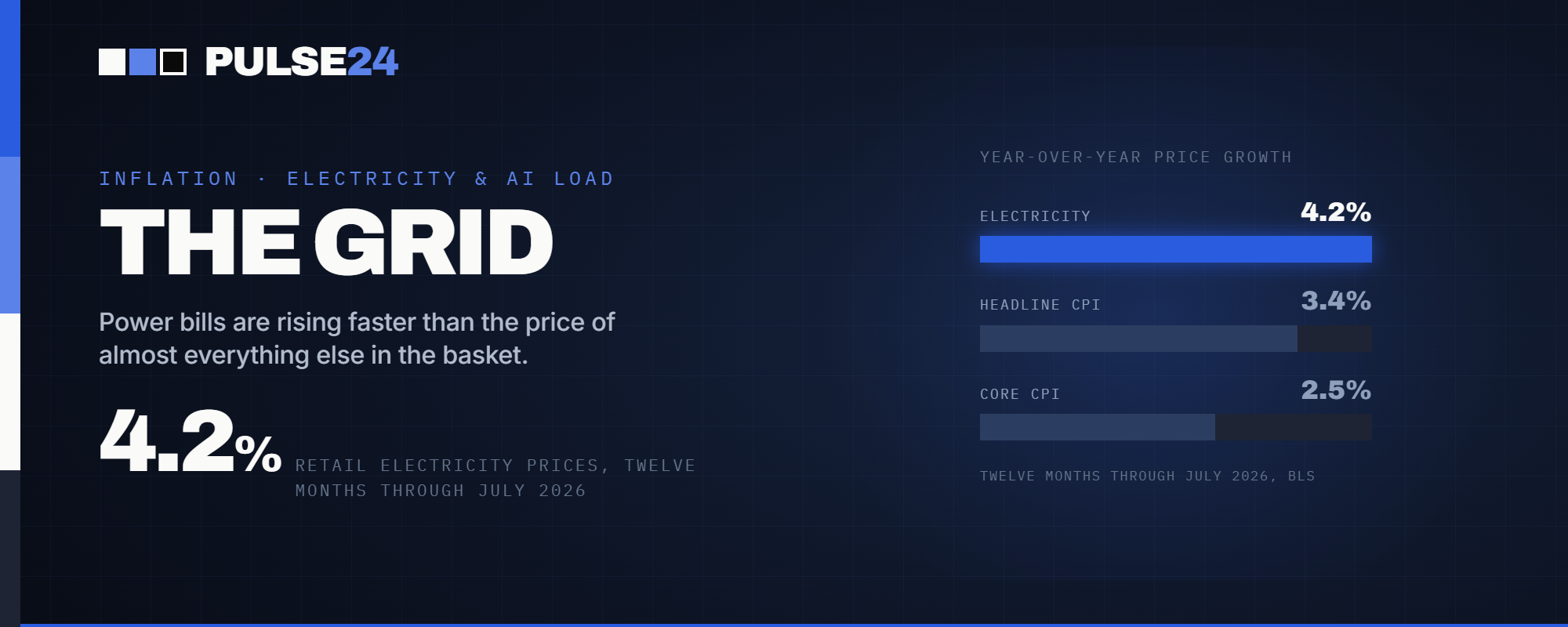
Electricity Prices Climbed 4.2% in the Year Through July, Outpacing Headline Inflation. AI's Grid Bottleneck Is a Big Reason Why.
Electricity prices climbed 4.2% over the year through July, outpacing both headline and core inflation, and Goldman Sachs says AI demand is a real driver. With PJM's capacity auction stuck at its price cap for a third straight year and Marsh estimating half of planned data centers will miss their target completion window, the grid, not chip supply, may be the tightest constraint on the AI buildout.
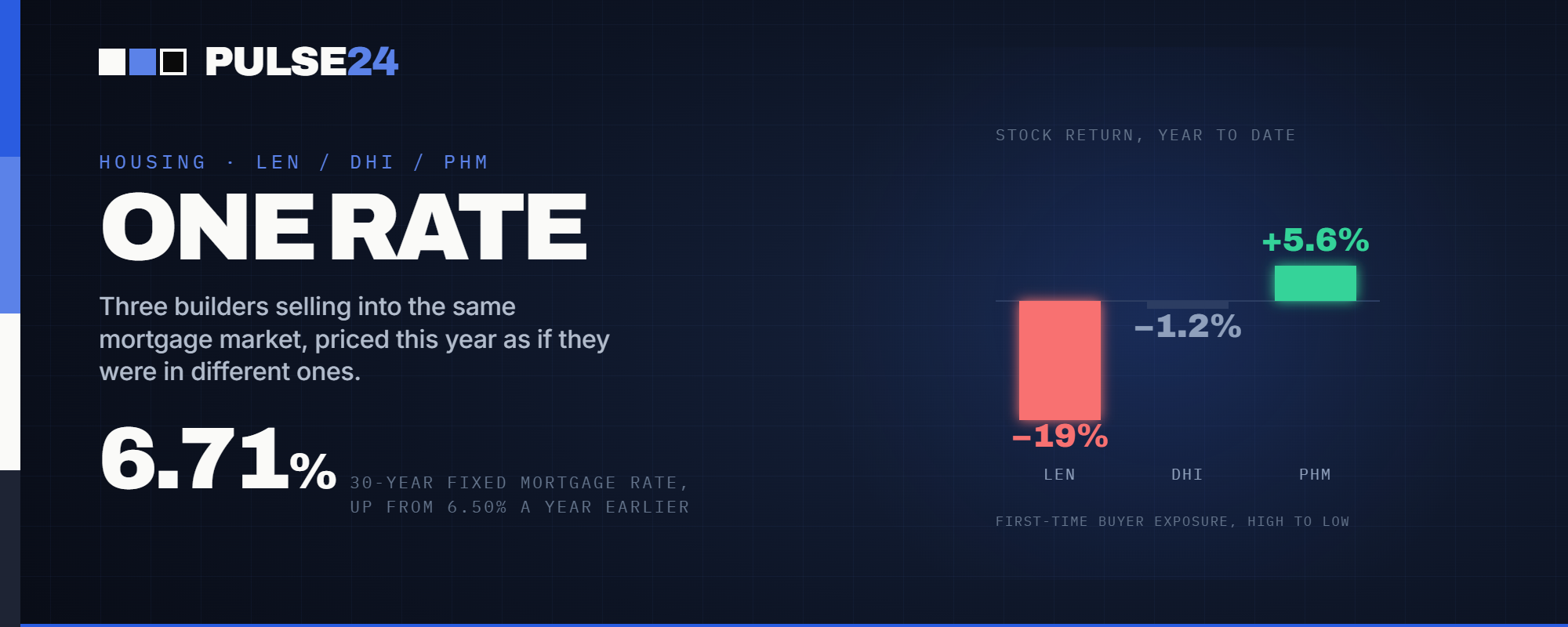
Lennar's Stock Has Fallen 19% This Year. PulteGroup's Is Still Up 5.6%, Even Though Both Sell Into the Same Rate Environment.
Lennar has lost nearly a fifth of its value this year while PulteGroup is still sitting on a gain, even though both companies are building homes into the same 6.71% mortgage rate. Home Depot and Lowe's just told a similar story from opposite directions, and the split says more about who's positioned for higher-for-longer rates than the bond market move itself.
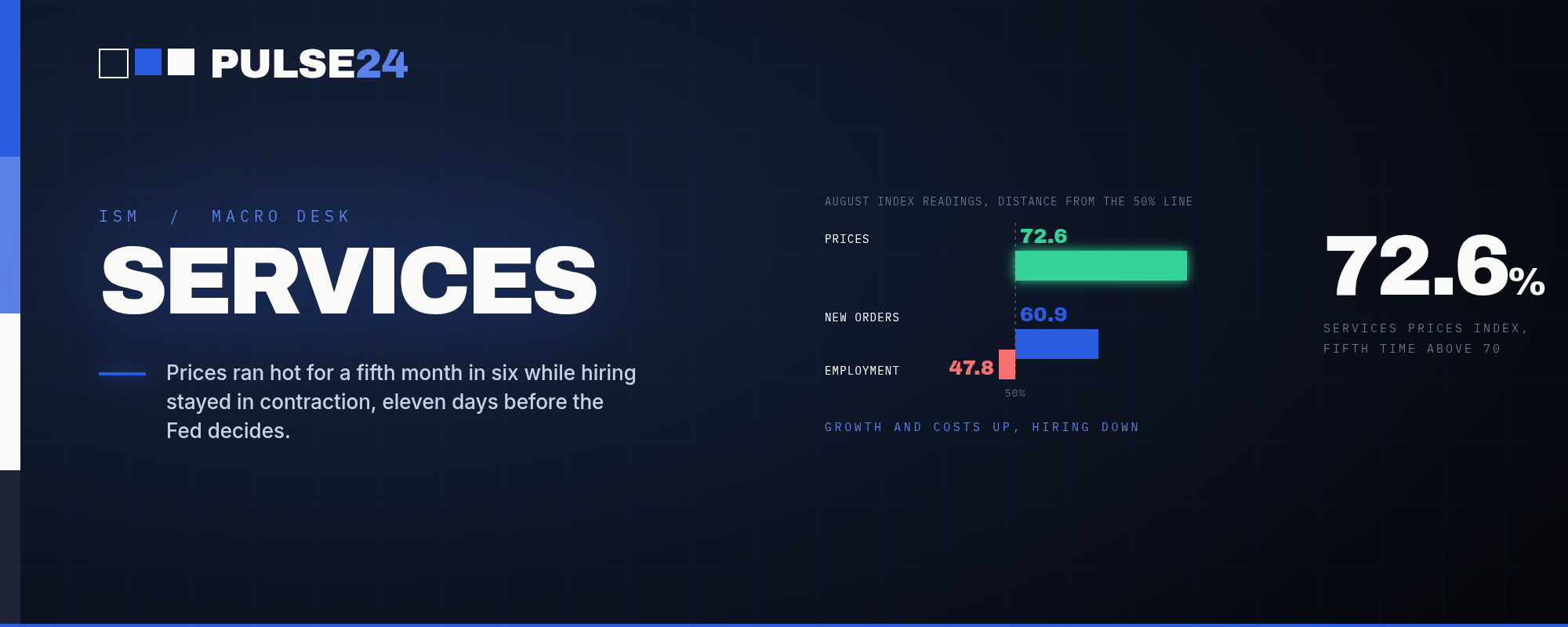
Services Prices Climbed to 72.6% in August, the Fifth Time Above 70% in Six Months. New Orders Jumped 3.7 Points to 60.9% While Hiring Stayed Negative for a 13th Time in 18 Months.
The ISM's Services Prices Index jumped to 72.6% in August, its fifth reading above 70% in six months, while new orders and business activity both accelerated sharply. Hiring inside the same report stayed negative for a 13th time in 18 months, and GPUs officially joined the list of commodities running short, all of it landing eleven days before the Fed's September 16 rate decision.
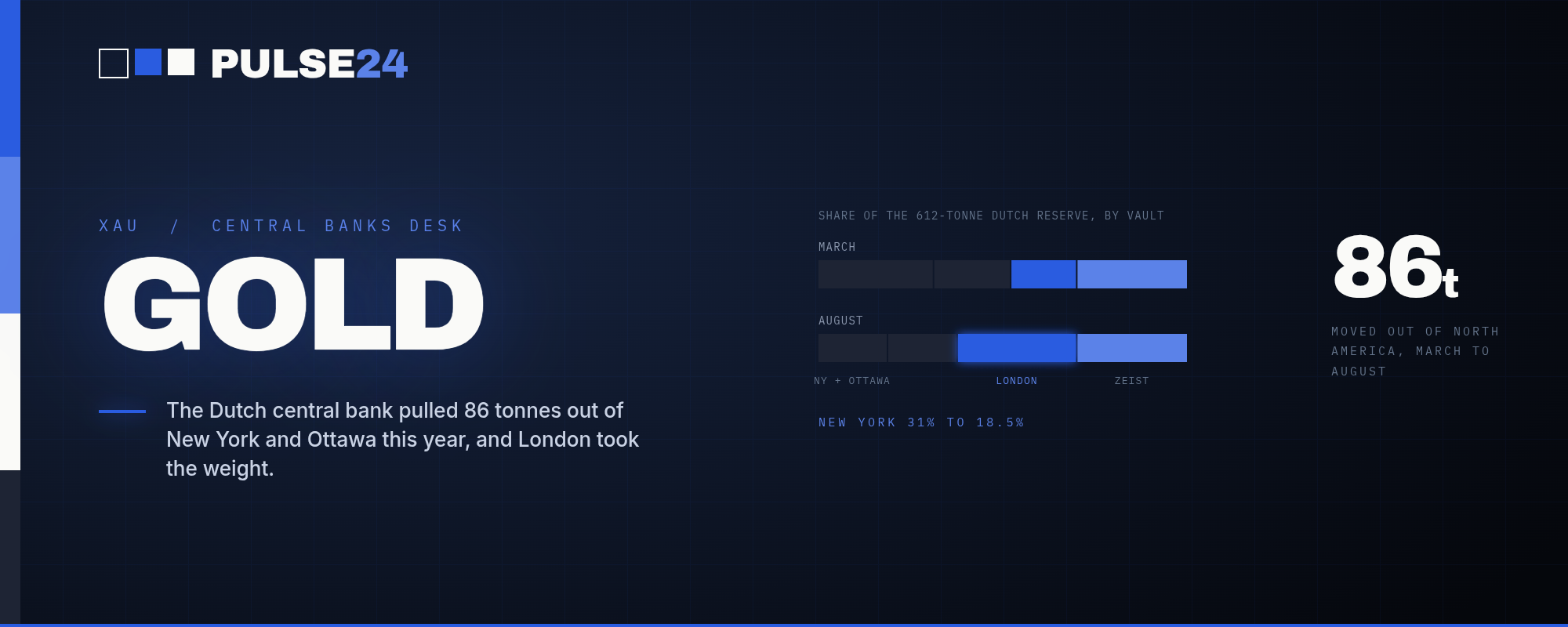
86 Tonnes of Dutch Gold Left US and Canadian Vaults This Year. Central Banks Bought a Record Amount the Same Quarter.
The Dutch central bank moved 86 tonnes of gold out of vaults in New York and Ottawa this year, citing crisis preparedness, following a path France walked in January. The relocation lands in the same quarter central banks bought a record 289 tonnes of gold worldwide, led by Poland and China.
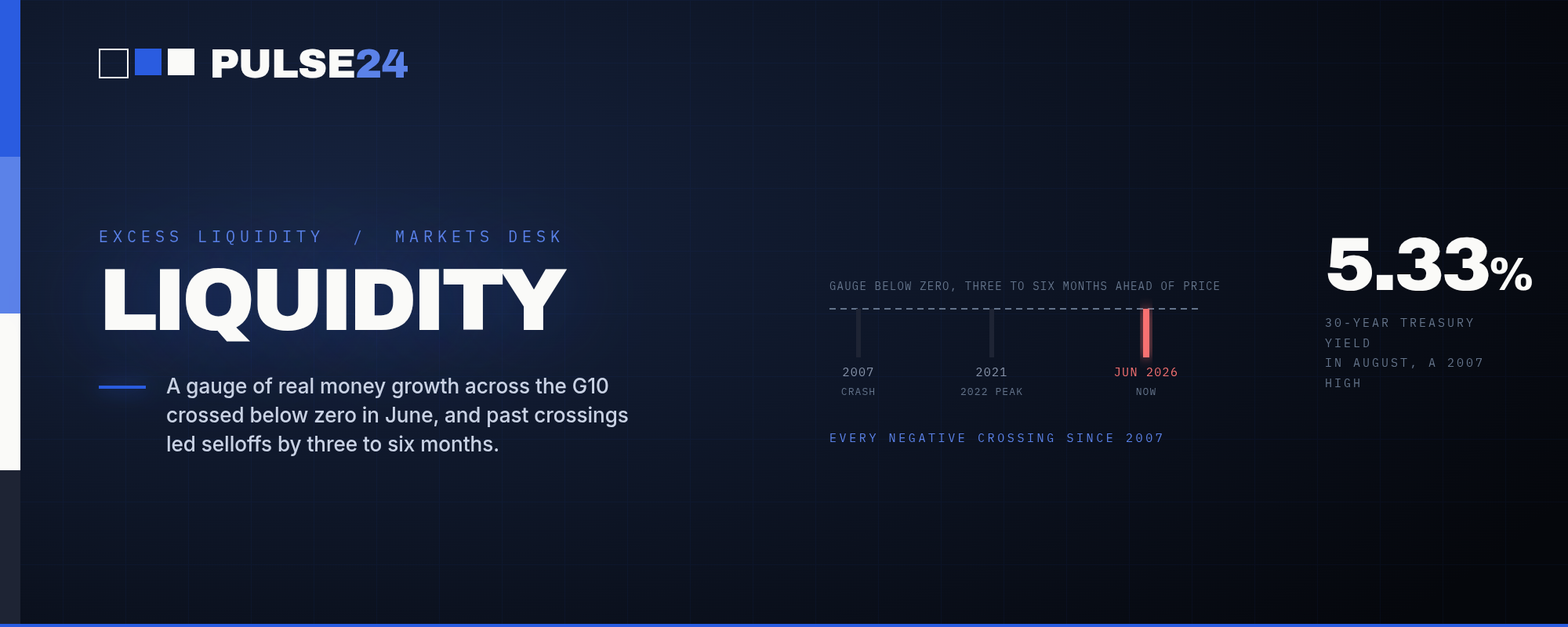
A Liquidity Gauge That Preceded 2008 and 2022 Turned Negative in June. AI Stocks Have Traded Sideways Ever Since.
A Bloomberg liquidity gauge that preceded the 2008 crash and the 2022 selloff turned negative in June for the first time since 2021, and AI stocks have traded flat for four months despite record revenue and backlog growth. Rising 30-year yields and record corporate bond issuance are adding to the squeeze.
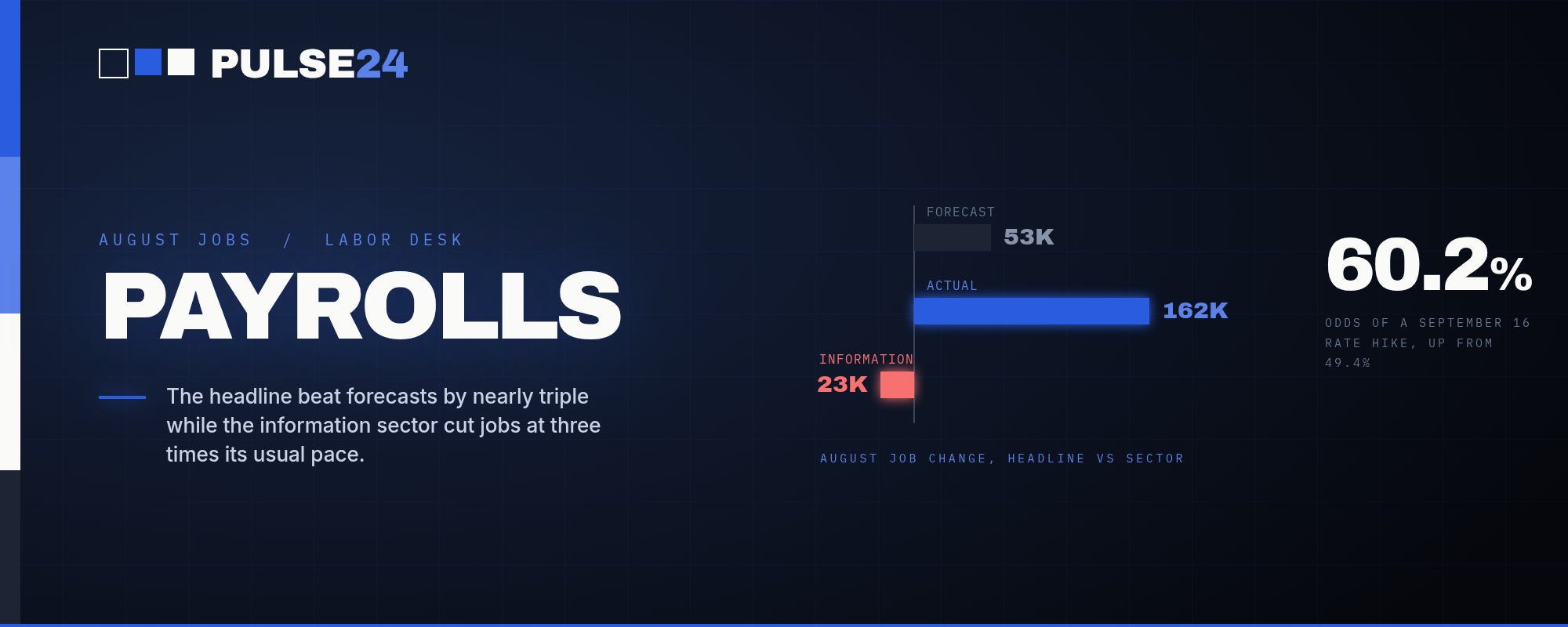
August Payrolls Beat Forecasts by 109,000, Nearly Triple What Economists Expected. The Information Sector Cut Jobs at the Fastest Pace in Years Anyway.
The US economy added 162,000 jobs in August, blowing past the 53,000 forecast and pushing CME FedWatch odds of a September 16 rate hike to 60.2%. Underneath that headline number, the information sector, the most AI-exposed corner of the labor market, shed jobs at nearly three times its usual pace.
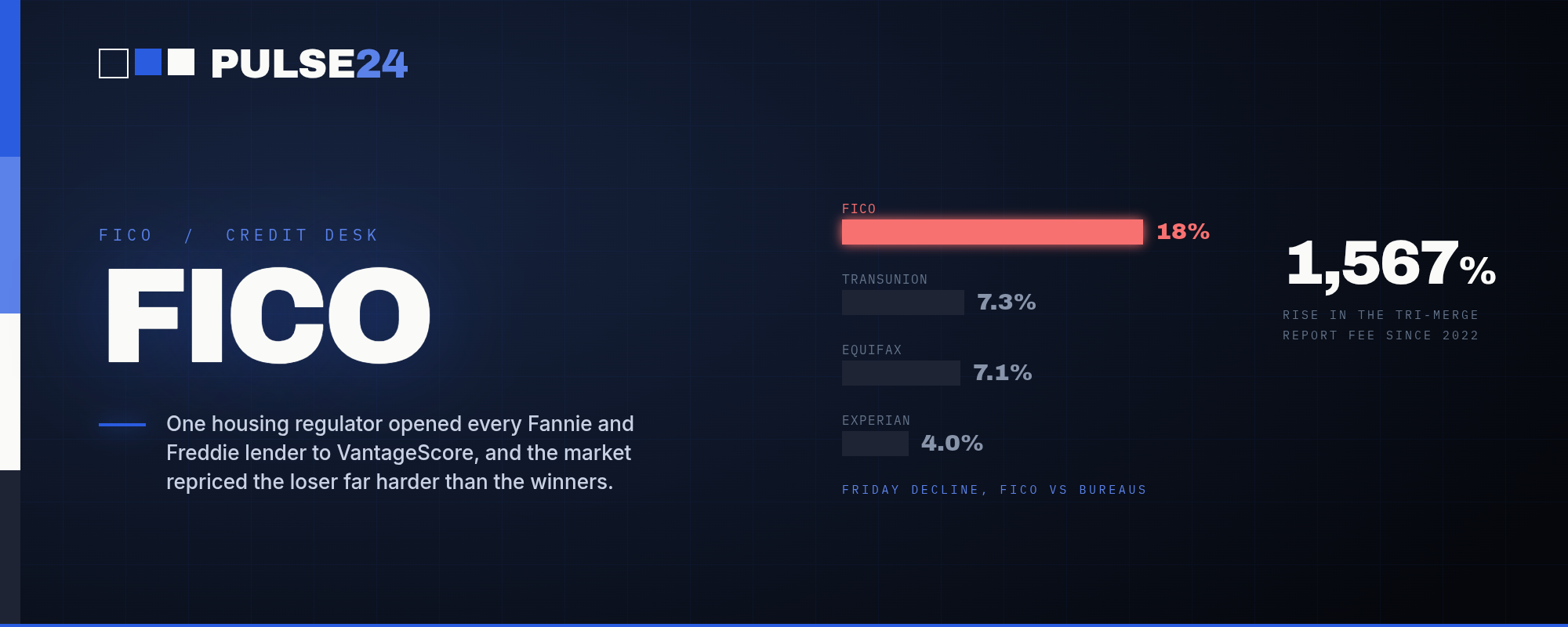
FICO Stock Cratered as Much as 21% in a Single Session. One Housing Regulator's Order Erased Its Mortgage Monopoly in a Sentence.
The Federal Housing Finance Agency ordered Fannie Mae and Freddie Mac to approve every mortgage lender for VantageScore on Thursday, ending FICO's decades-long grip on mortgage credit scoring. FICO shares cratered as much as 21% the next day, far outpacing the declines at the credit bureaus behind its replacement.
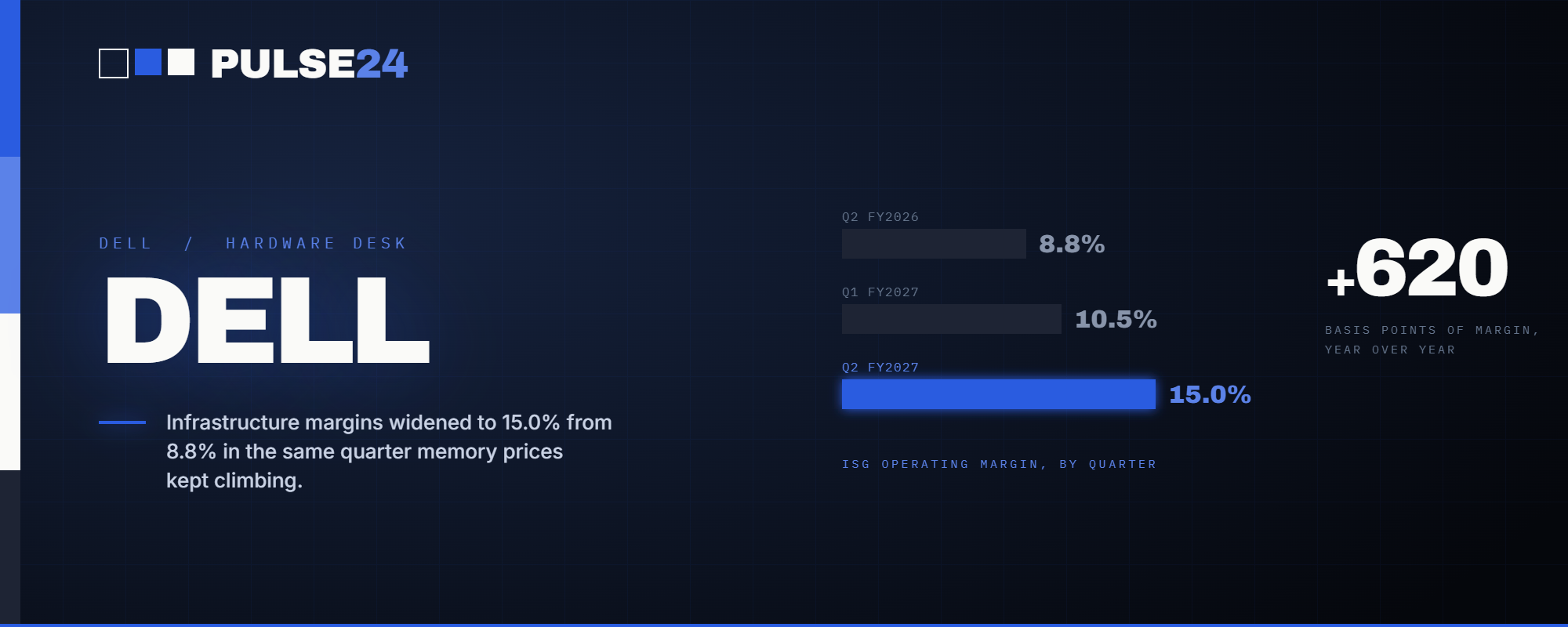
Dell's ISG Operating Margin Jumped 620 Basis Points Last Quarter. Memory Prices Were Supposed to Wreck It.
Dell's AI server orders hit $60.9 billion last quarter, but the more surprising number was margins. Infrastructure Solutions Group profitability rose 620 basis points even as memory prices climbed industry-wide, a rare bit of good news for the durability of the AI buildout.
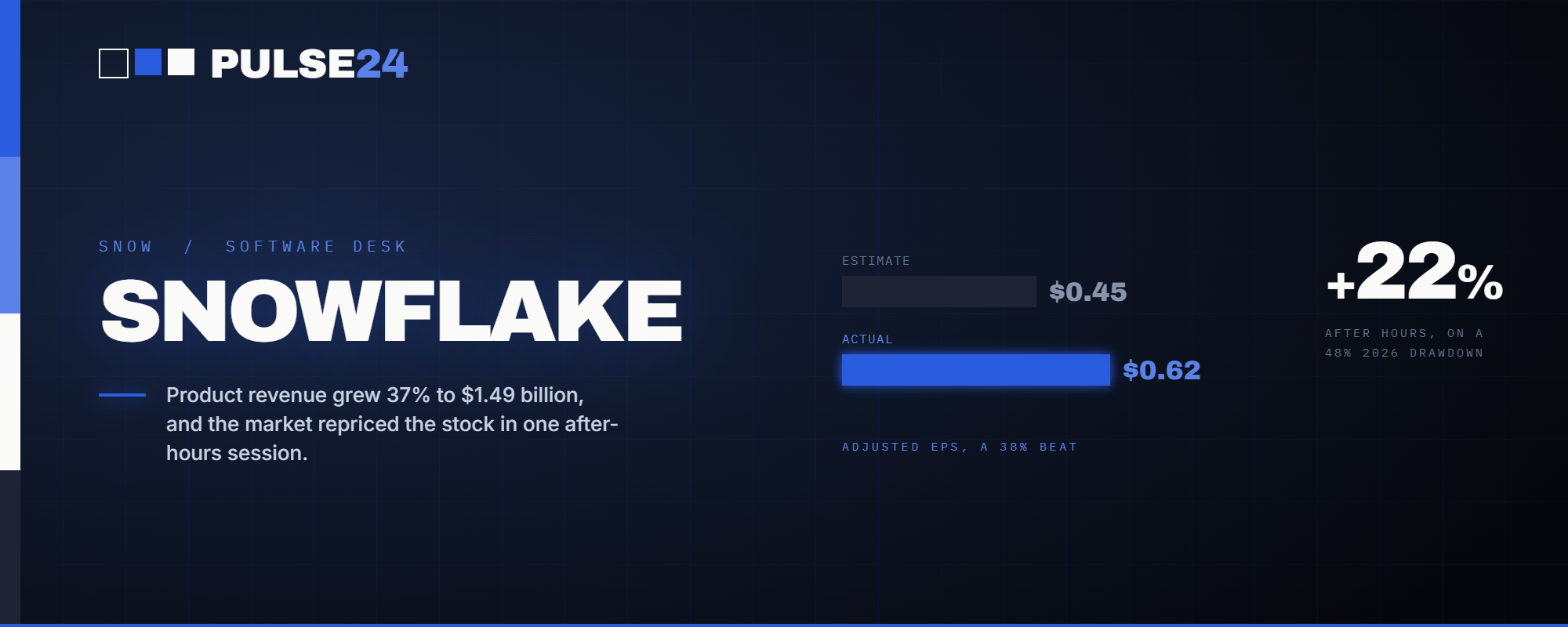
Snowflake's Product Revenue Grew 37% Last Quarter. Wall Street Sent the Stock Up 22% in a Single Session.
Snowflake's second-quarter results beat expectations across revenue, earnings, and guidance, and the stock's sharpest single-day gain in years suggests investors are starting to pay for AI-driven software growth, not just AI chips.
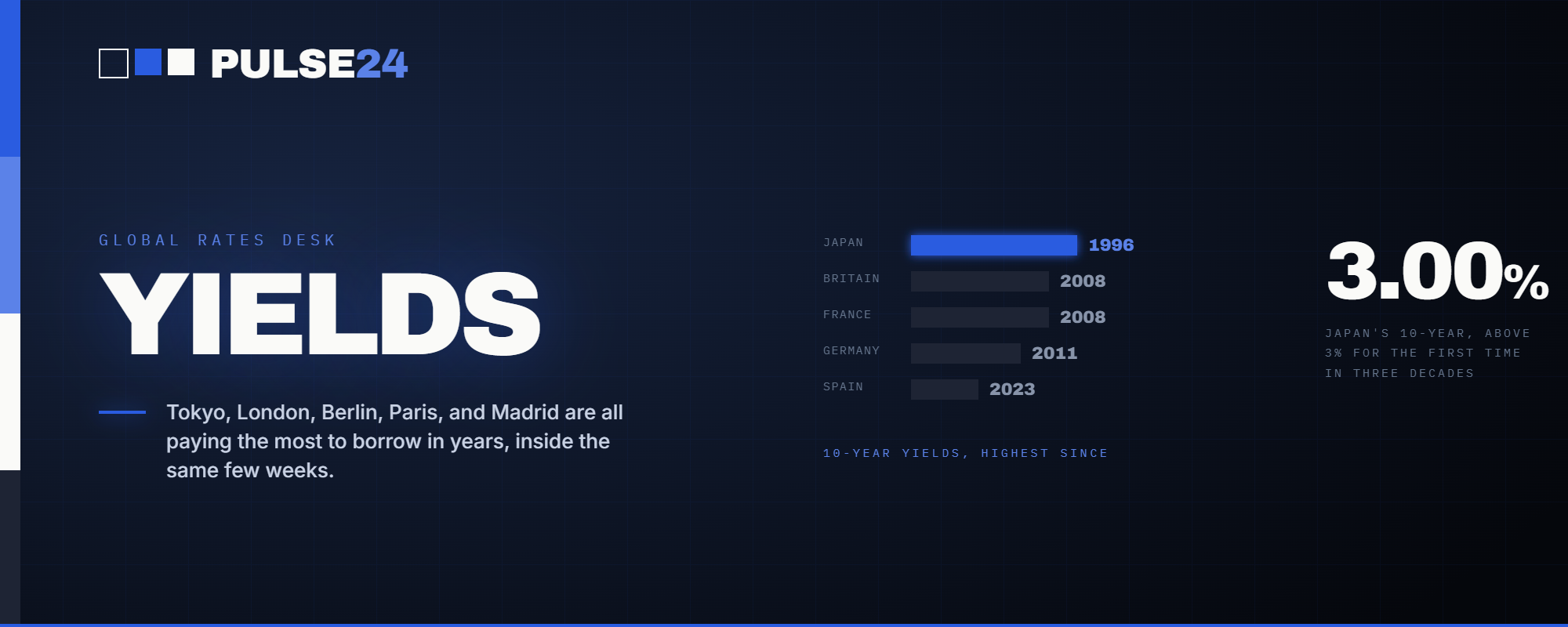
Japan's 10-Year Bond Yield Hit a 30-Year High This Week. Britain, Germany, and France Are Setting Records of Their Own.
Government bond yields are climbing to multi-year and multi-decade highs from Tokyo to London to Berlin at the same time, and it isn't really about any single central bank anymore. Deficits, AI-driven debt issuance, and a run of hawkish policymakers are pulling global yields in the same direction all at once.
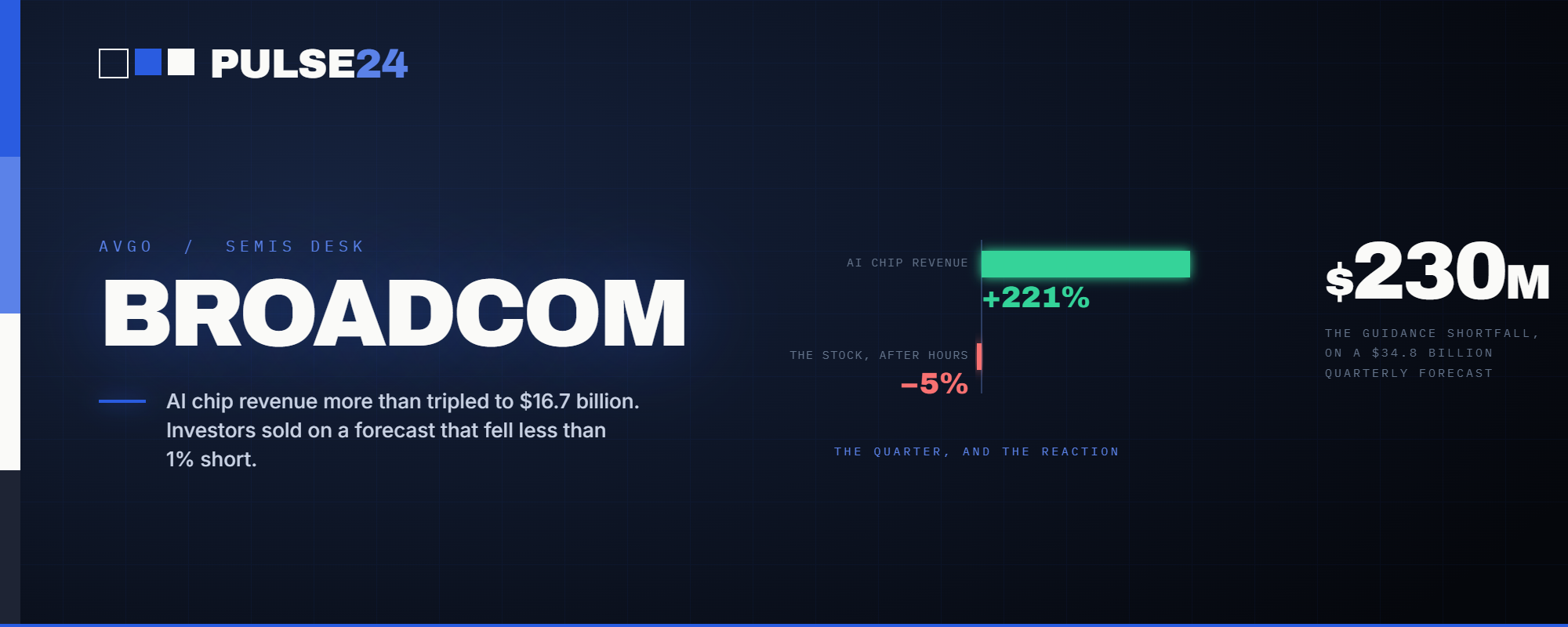
Broadcom's AI Chip Sales Grew 221% Last Quarter to $16.7 Billion. A $230 Million Guidance Miss Wiped Out 5% of the Stock's Value Within Hours.
Broadcom's AI chip revenue more than tripled to $16.7 billion in its fiscal third quarter, comfortably beating Wall Street's estimate. Investors sold the stock anyway, focused on a fourth-quarter revenue forecast that came in about $230 million short of consensus.
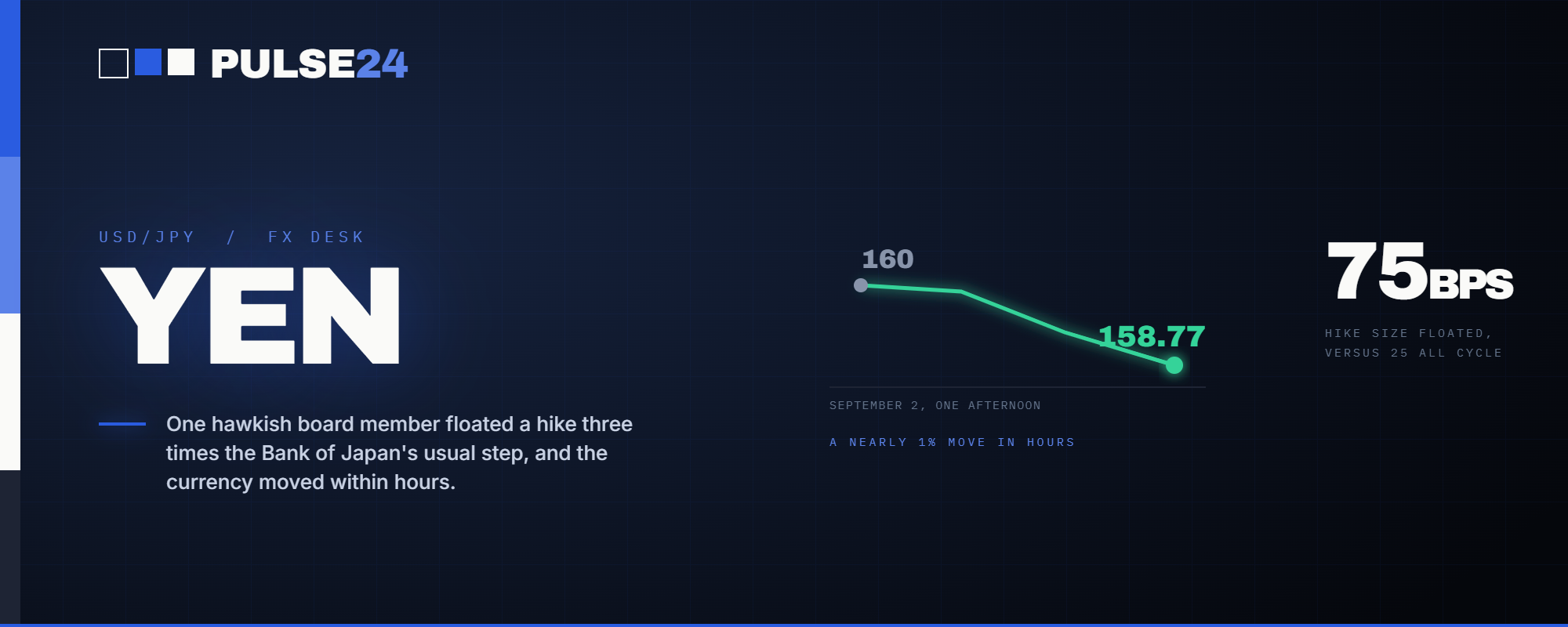
USD/JPY Fell From 160 to 158.77 in Hours. A Bank of Japan Board Member's Push for a 75 Basis-Point Hike Is Why.
A hawkish Bank of Japan board member's push for a jumbo rate hike sent USD/JPY tumbling almost a percent in a single afternoon, and set up a rare back-to-back policy showdown with the Fed later this month.
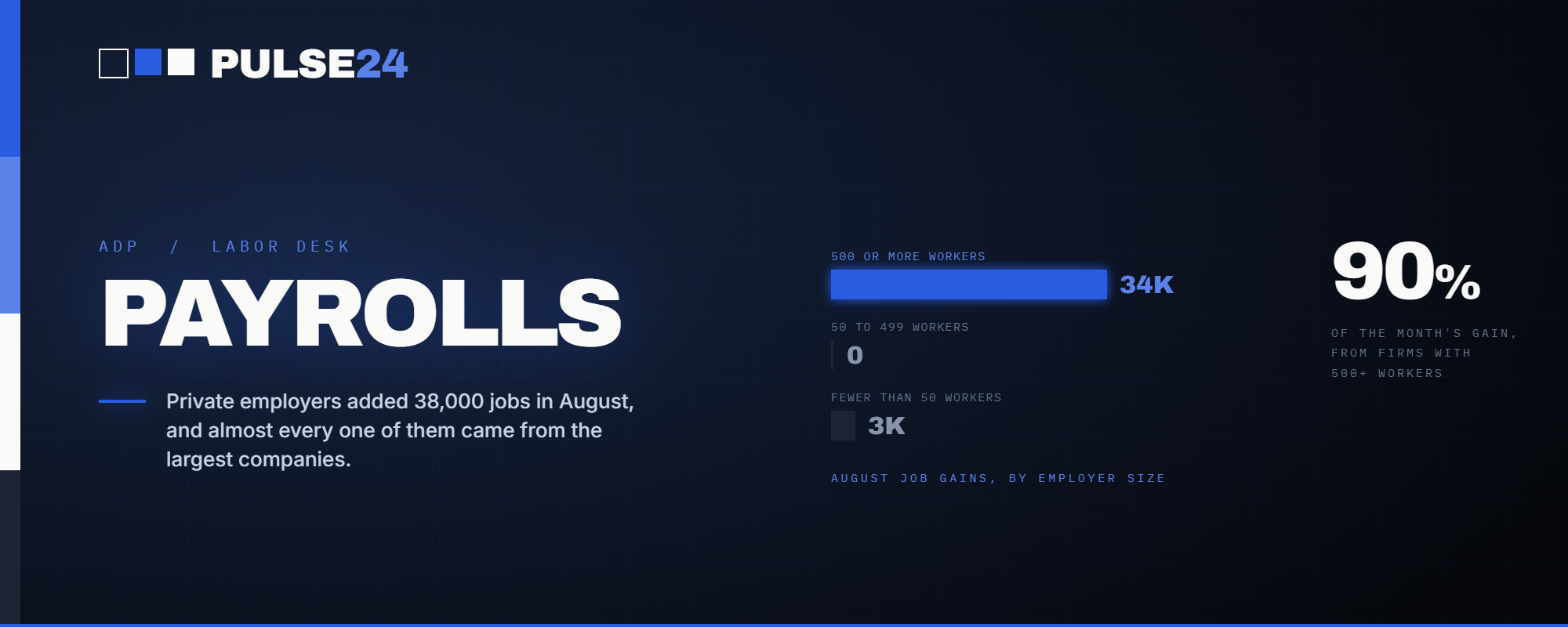
Companies With 500 or More Workers Added 34,000 Jobs in August. Every Smaller Private Employer in the Country Combined Added Only 3,000.
Private payrolls grew by 38,000 in August, missing forecasts, and companies with 500 or more workers accounted for nearly all of the gain. Small and mid-sized employers, which together make up most of the private economy, added almost nothing.
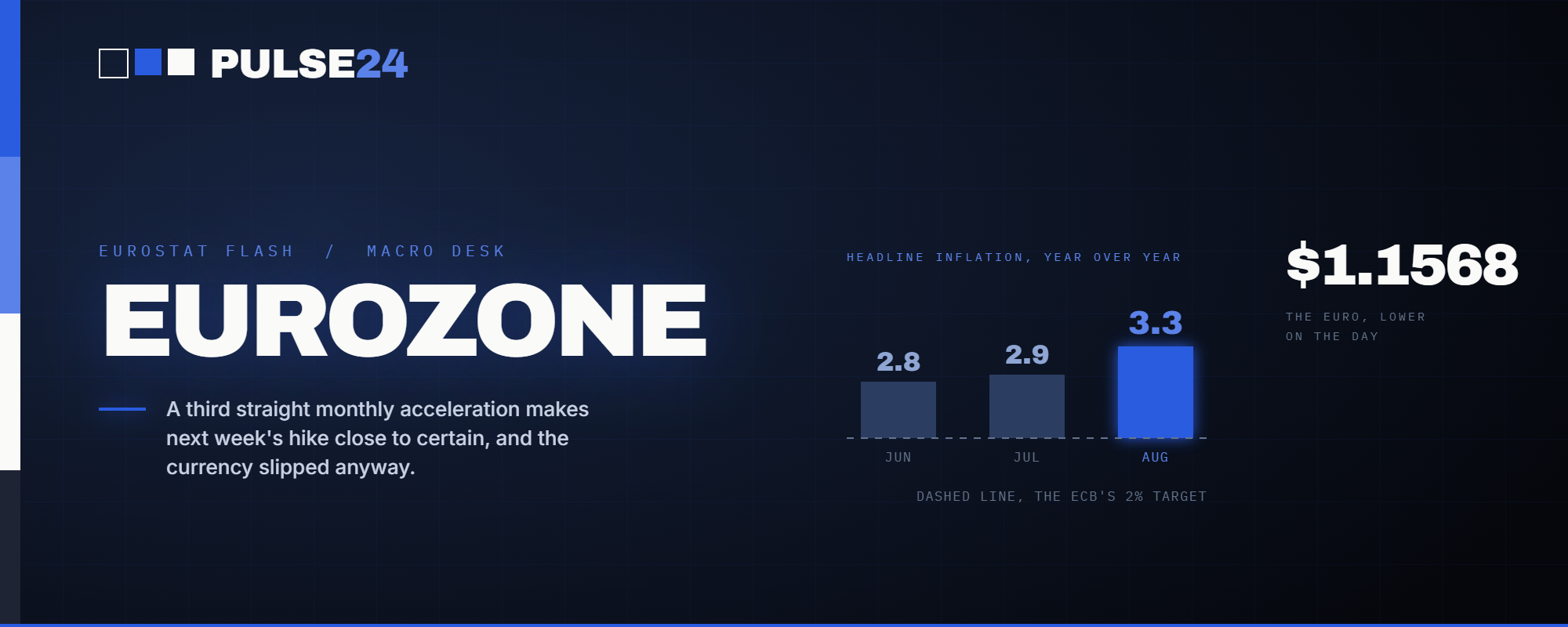
Eurozone Inflation Climbed to 3.3% in August, a Third Straight Monthly Rise. The Euro Fell to $1.1568 Anyway, Because the Fed Is Every Bit as Hawkish.
Eurozone inflation hit 3.3% in August, its third straight monthly acceleration and firmly above the ECB's target, making a rate hike at next week's meeting look close to certain. The euro slipped anyway, a sign traders think Washington's hawkishness matters more right now than Frankfurt's.
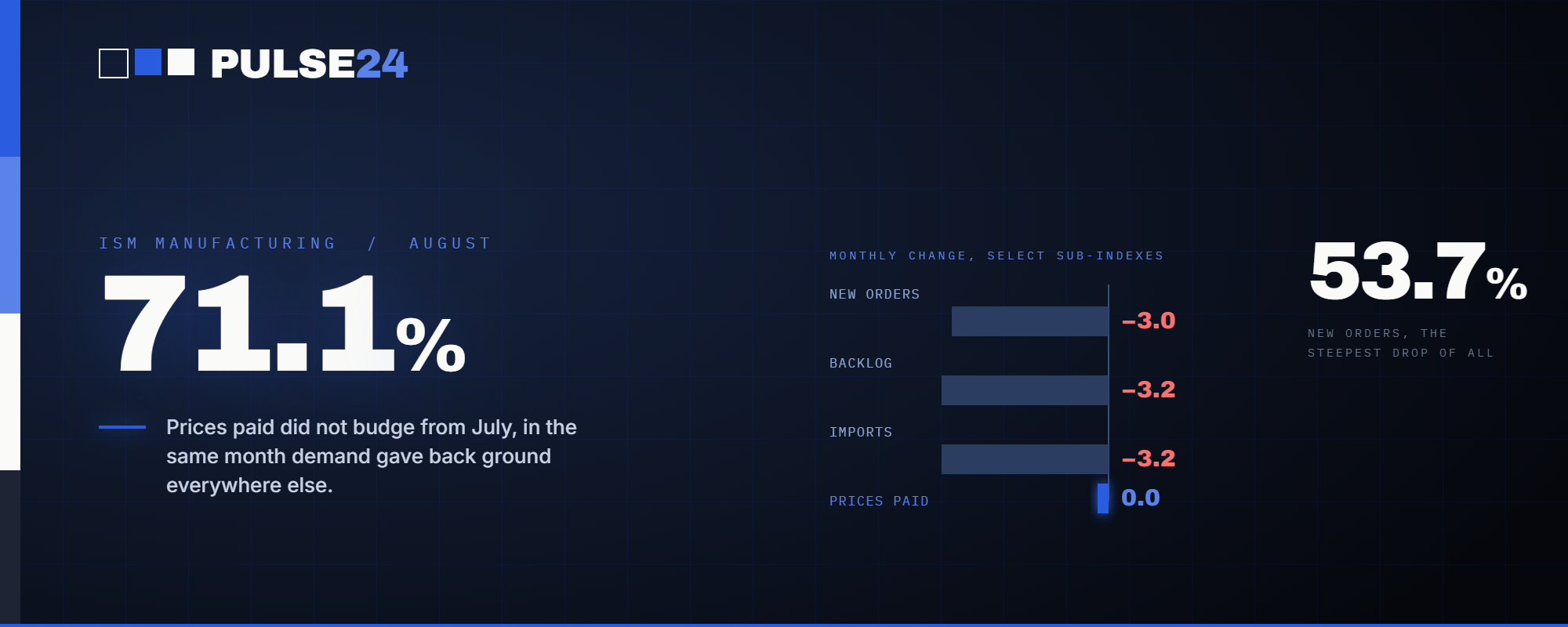
The ISM's Prices Index Sat at 71.1% in July and 71.1% Again in August. New Orders Fell Three Points to 53.7% the Same Month, and the Fed Has to Reconcile Both by September 16.
August's ISM Manufacturing survey found factory demand cooling fast, with new orders, backlog and imports each losing three points or more in a single month. Prices paid didn't move at all, stuck at a level ISM itself treats as severe, just as the Fed weighs its September rate decision.
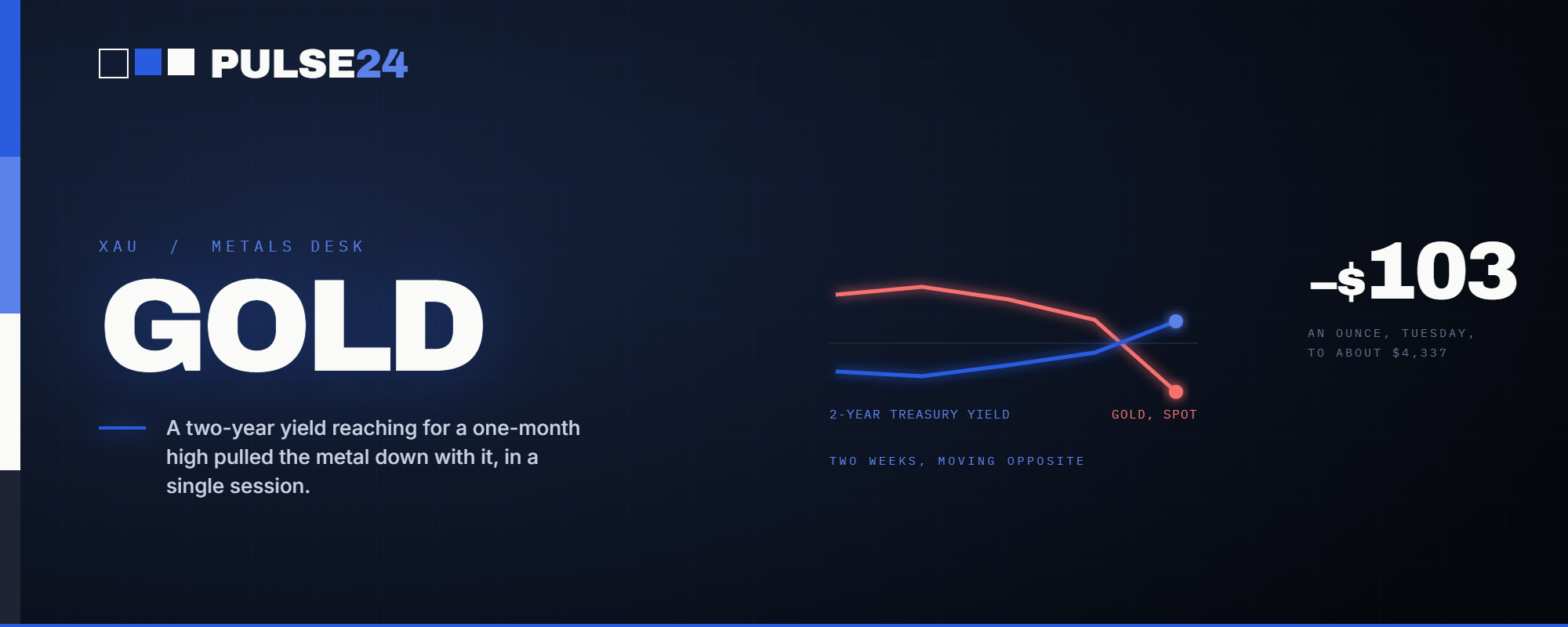
Gold Fell $103 in a Single Session, Its Steepest Drop in Weeks. A 2-Year Treasury Yield Near a One-Month High Is Why.
Gold slid to a two-week low on Tuesday as traders piled into bets on a September rate hike, pushing the dollar and short-term Treasury yields higher ahead of Friday's jobs report. The pullback comes just weeks after gold matched UBS's year-end target four months early.
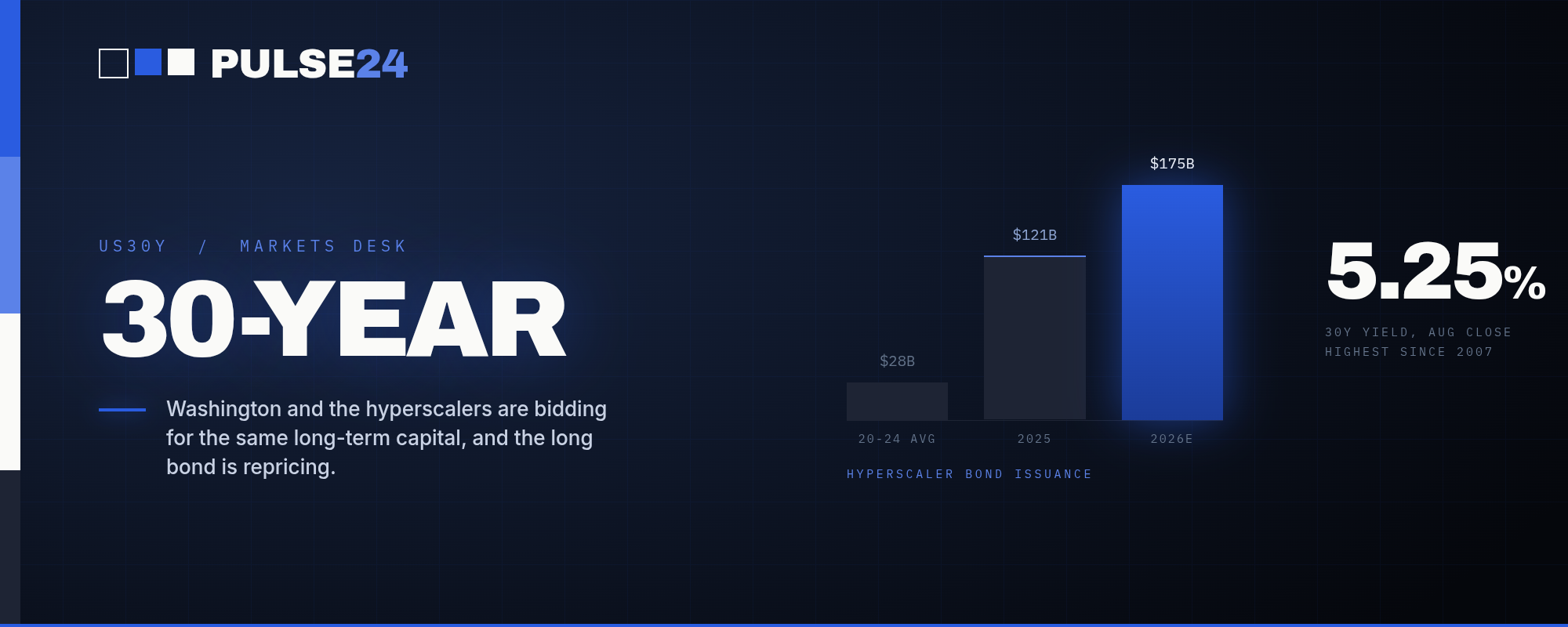
Five Hyperscalers Are on Pace to Borrow $175 Billion This Year for AI Alone. The 30-Year Treasury Yield Is Paying the Price, Near a 19-Year High.
The 30-year Treasury yield closed August near a 19-year high as Washington's growing deficit and Silicon Valley's AI borrowing spree compete for the same pool of long-term capital. Bank of America now expects hyperscalers to issue $175 billion in bonds this year alone, up from an earlier $140 billion forecast.
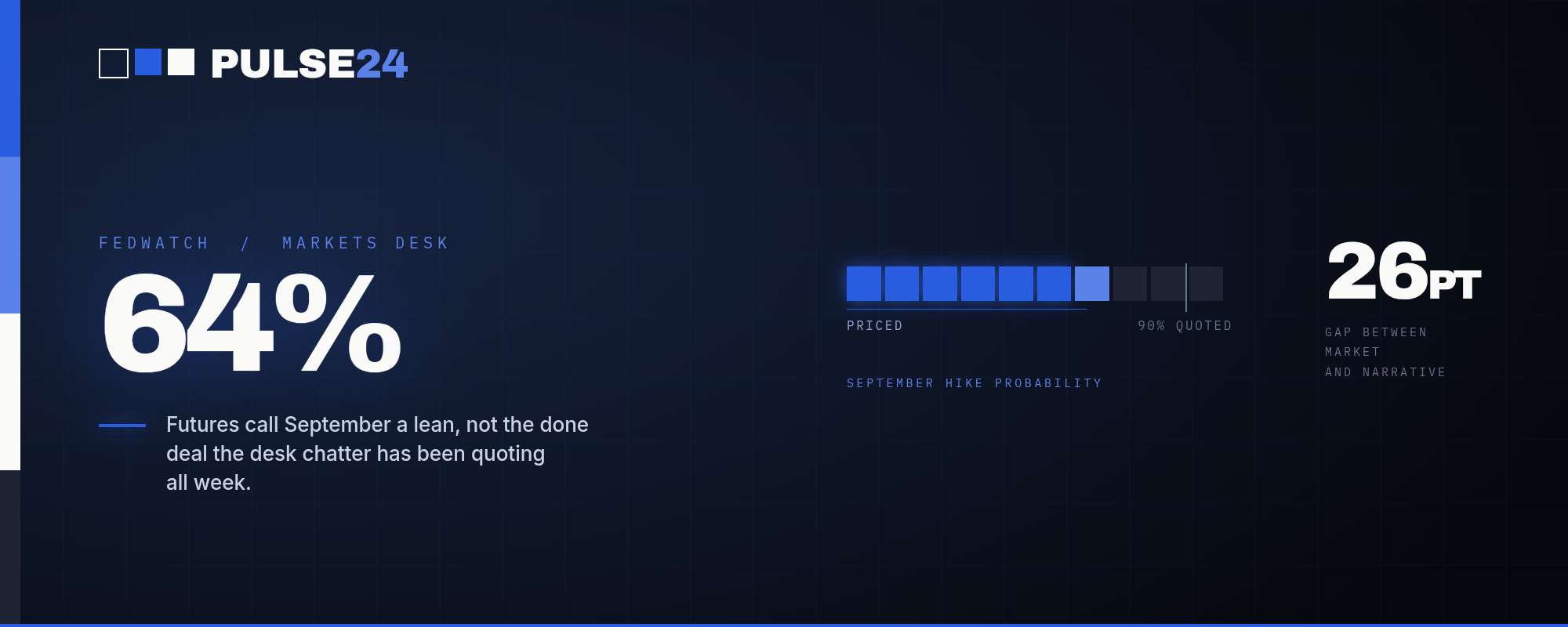
Traders Are Quoting a 90% Chance of a September Rate Hike. CME Futures Actually Put It Near 64%.
Wall Street has spent the week treating a September rate hike as a foregone conclusion, but CME futures are pricing something closer to a lean toward one. The gap between the "done deal" narrative and the roughly 64% real number is already showing up in how gold and Bitcoin are trading.
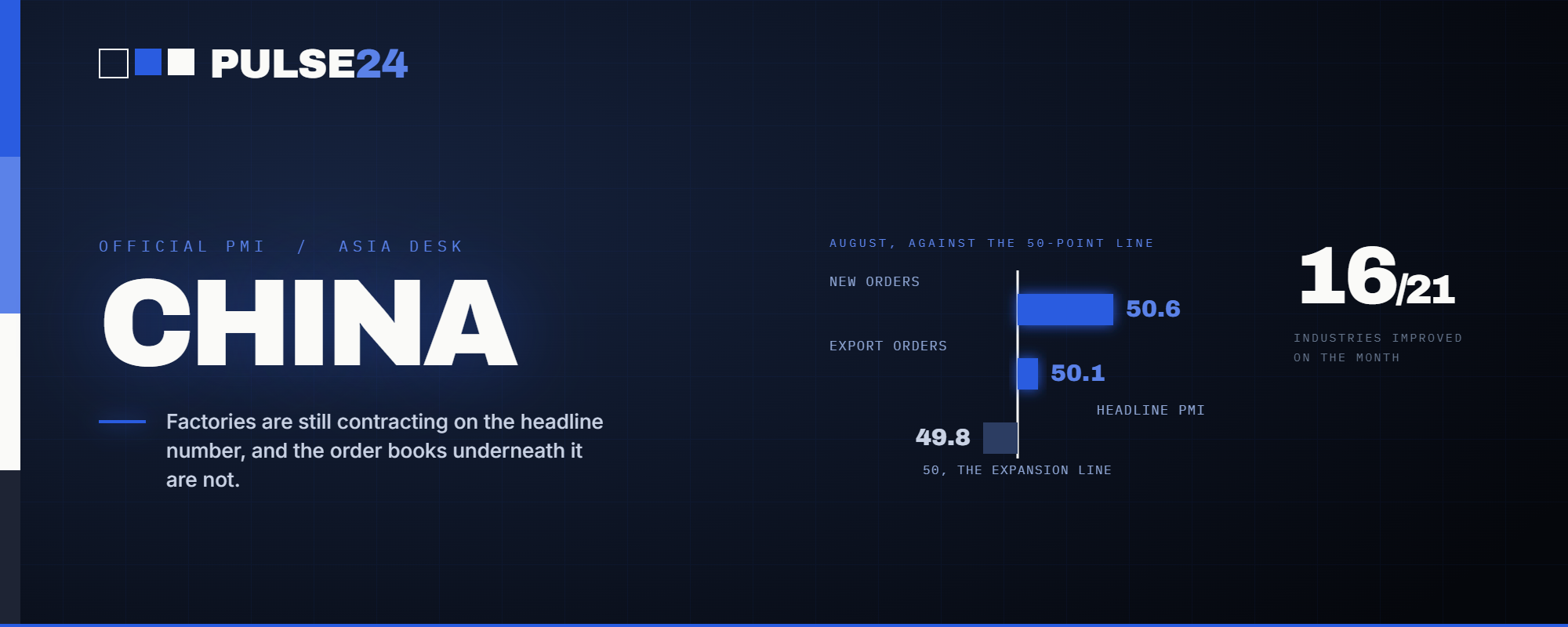
China's Manufacturing PMI Beat Forecasts at 49.8 in August. New Orders Crossed Back Above 50, Reversing July's Slide.
China's factory PMI improved to 49.8 in August, a second straight month of contraction but ahead of forecasts. The more telling number sits underneath the headline print, where new orders and export orders both swung back above 50, and Monday's new mortgage rules split bank and property-developer stocks into opposite camps within hours.
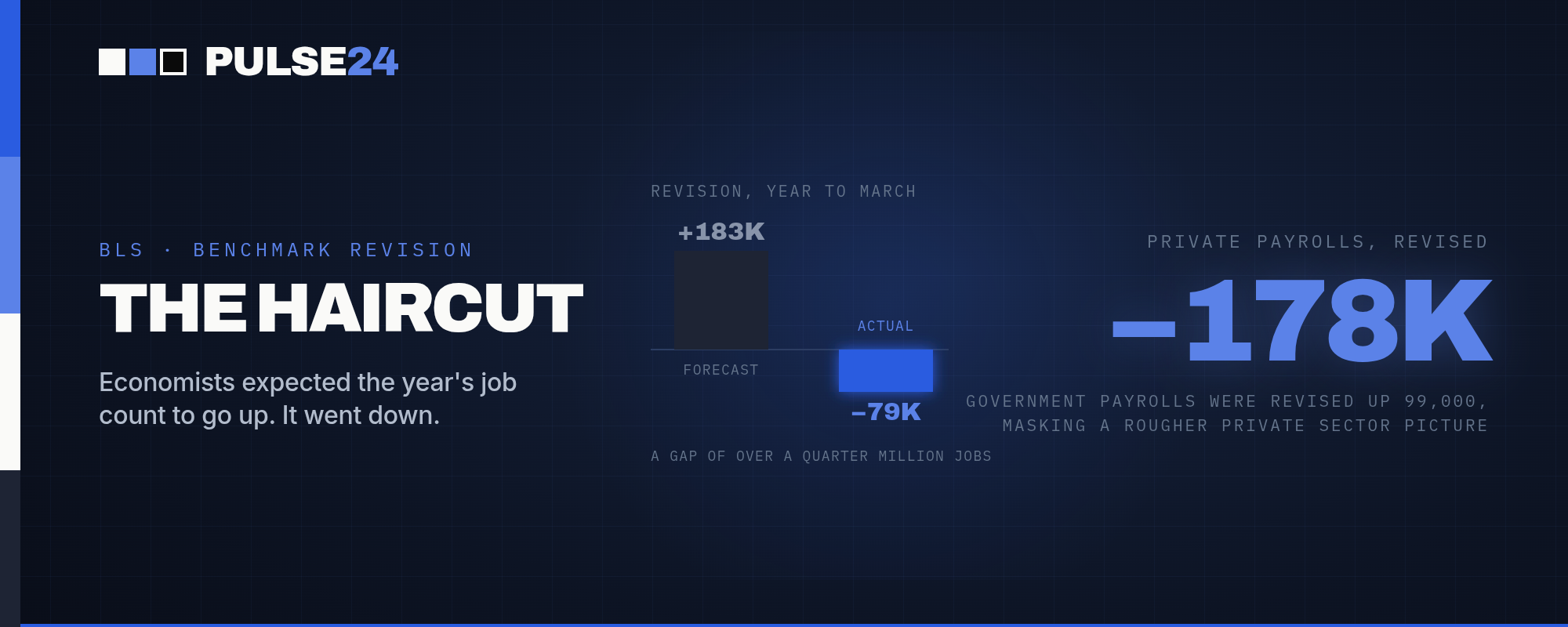
US Employers Added 79,000 Fewer Jobs Than First Reported for the Year Through March. The Revision Landed Hours Before Warsh's Hawkish Fed Debut at Jackson Hole.
A routine data revision knocked 79,000 jobs off the past year's employment count on the same afternoon Kevin Warsh made his hawkish case for more rate hikes. The two data points don't quite agree, and figuring out which one the Fed weighs more heavily is the real story heading into September.
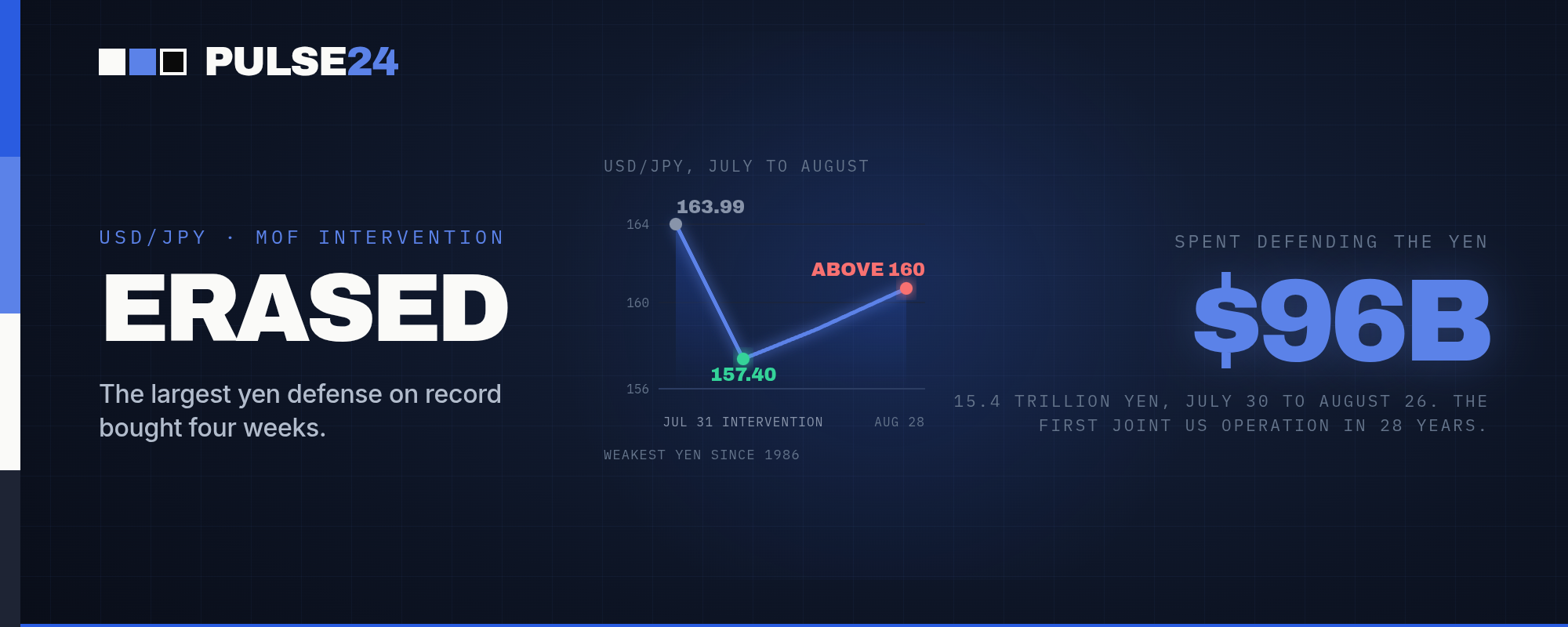
Japan Spent a Record $96 Billion Defending the Yen. Days Later, It Broke Back Above 160 Anyway.
Tokyo and Washington spent 15.4 trillion yen over four weeks in the largest currency intervention on record, yet the dollar climbed back above 160 yen within a month. Economists increasingly doubt intervention alone can offset a widening gap between Fed and Bank of Japan rates.
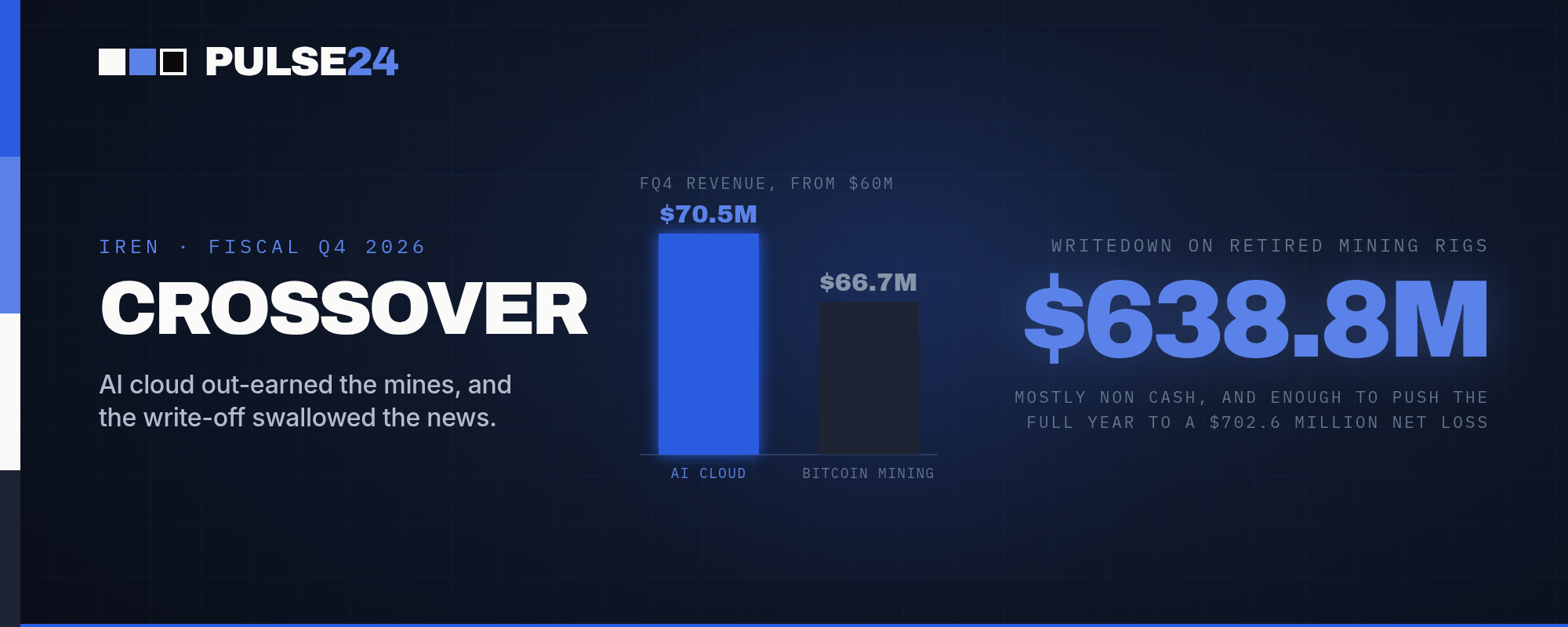
IREN's AI Cloud Business Overtook Bitcoin Mining for the First Time. A $639 Million Writedown Erased the Celebration.
IREN's AI cloud business finally out-earned its Bitcoin mines last quarter, a milestone years in the making. Wall Street responded by knocking about 12% off the stock in a single session over a $639 million writedown.
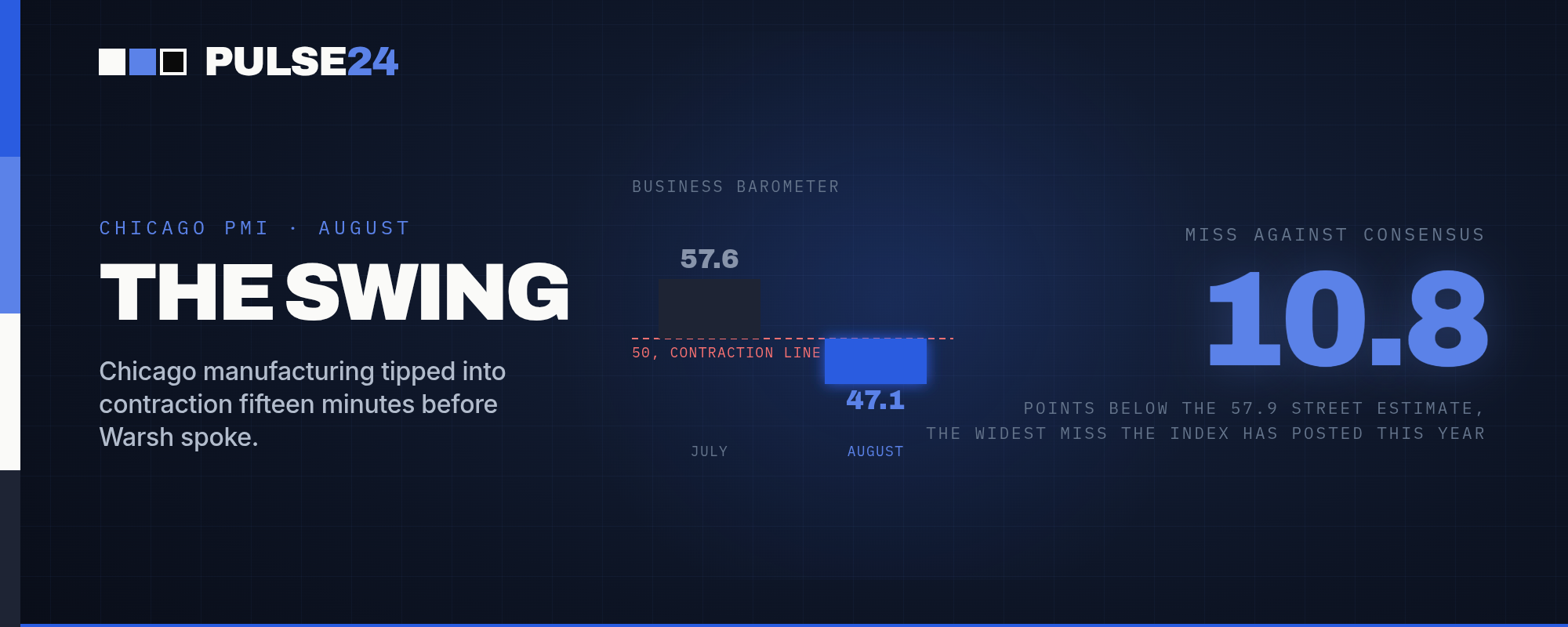
Chicago PMI Crashed From 57.6 to 47.1 in a Month, the Sharpest Miss of 2026. The Report Landed Minutes Before Kevin Warsh Told Jackson Hole the Fed Still Has Work to Do.
Chicago's Business Barometer swung from expansion to contraction in a single month, missing forecasts by nearly eleven points. The report landed minutes before the Fed's new chair doubled down on inflation at Jackson Hole, leaving traders to reconcile two very different signals about where the economy is headed.
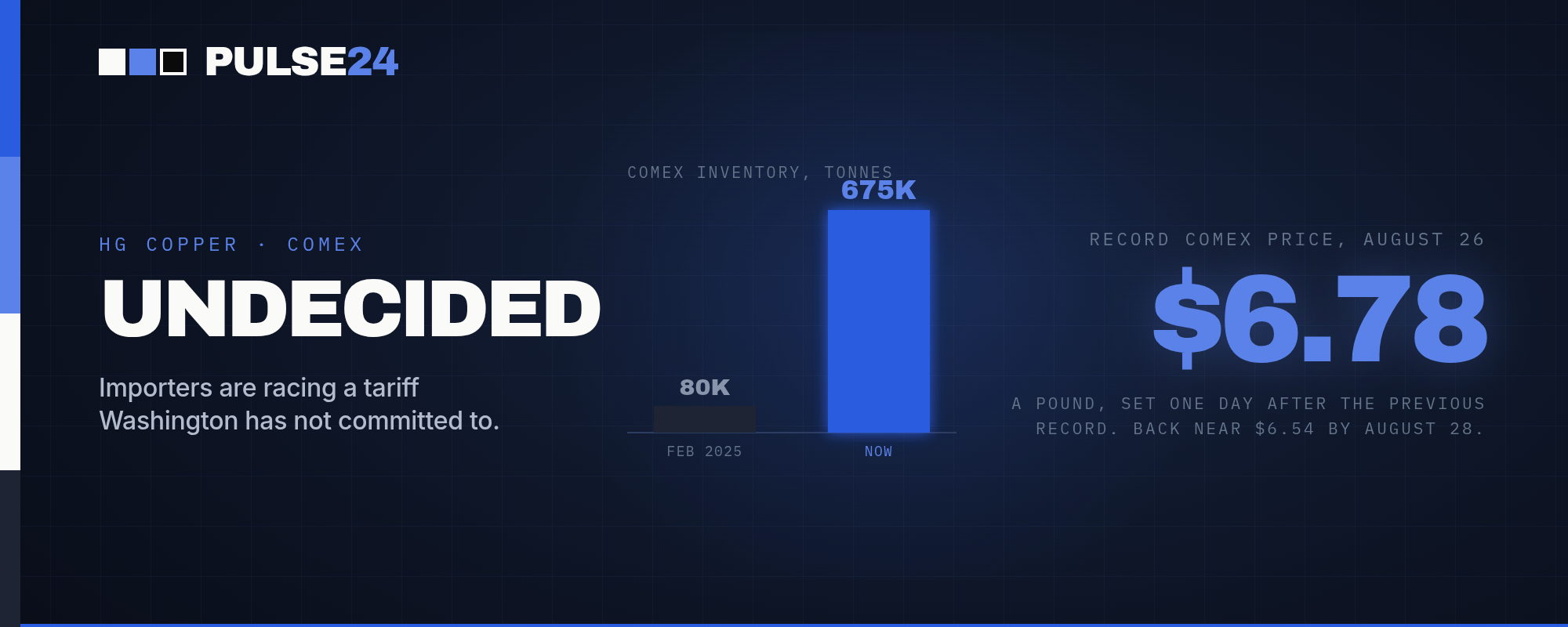
Copper Hit a Record $6.78 a Pound in August. The Tariff Behind Much of the Rally Still Hasn't Been Decided.
COMEX copper hit a record $6.78 a pound in late August as importers race to beat a proposed tariff on refined cathode, even though Washington missed its own deadline to decide whether that tariff happens at all. Inventories are piling up in U.S. warehouses while the rest of the world's copper market actually looks calmer than the record U.S. price alone would suggest.
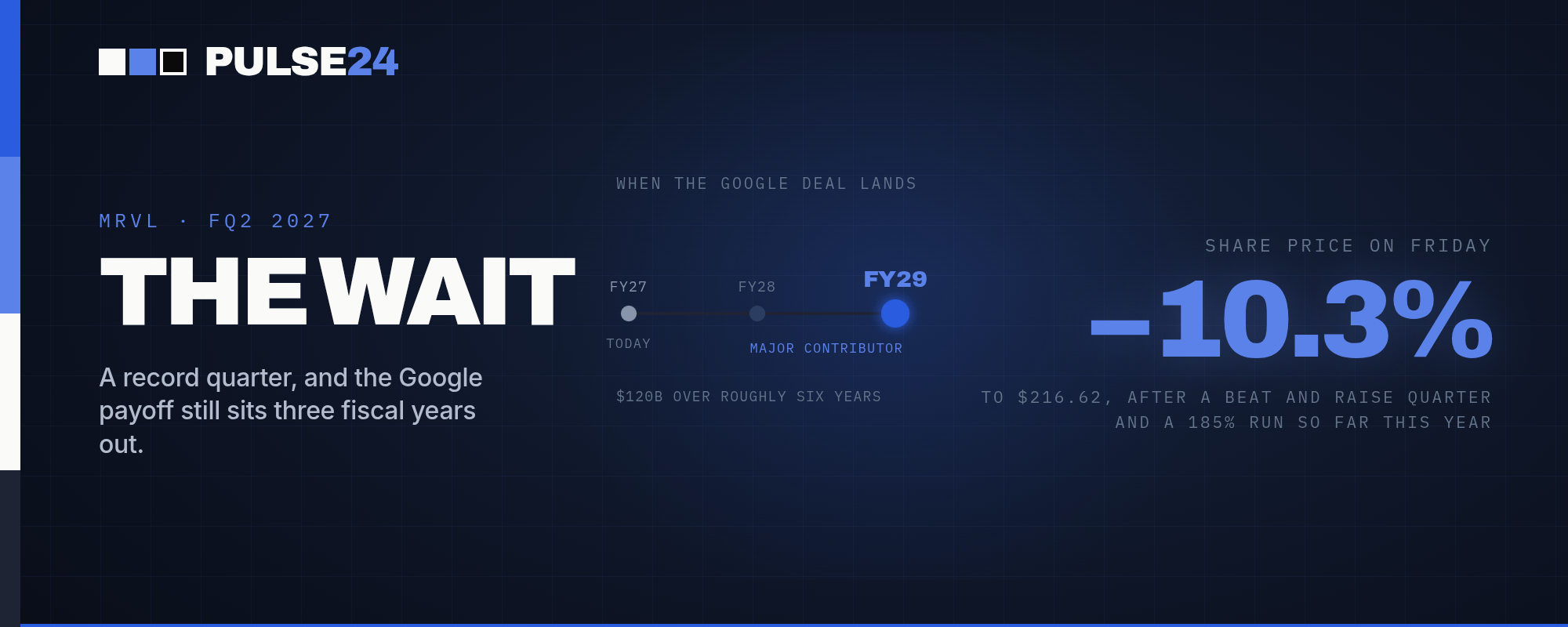
Marvell Beat Every Earnings Estimate and Fell 10% Anyway. The $120 Billion Google Payoff Won't Show Up Until Fiscal 2029.
Marvell posted record data center revenue and raised guidance twice over, but investors sold the stock down more than 10% after learning the Google AI chip payoff pushes into fiscal 2029. The gap between Wall Street's excitement and the deal's real timeline got a lot more concrete on Friday.
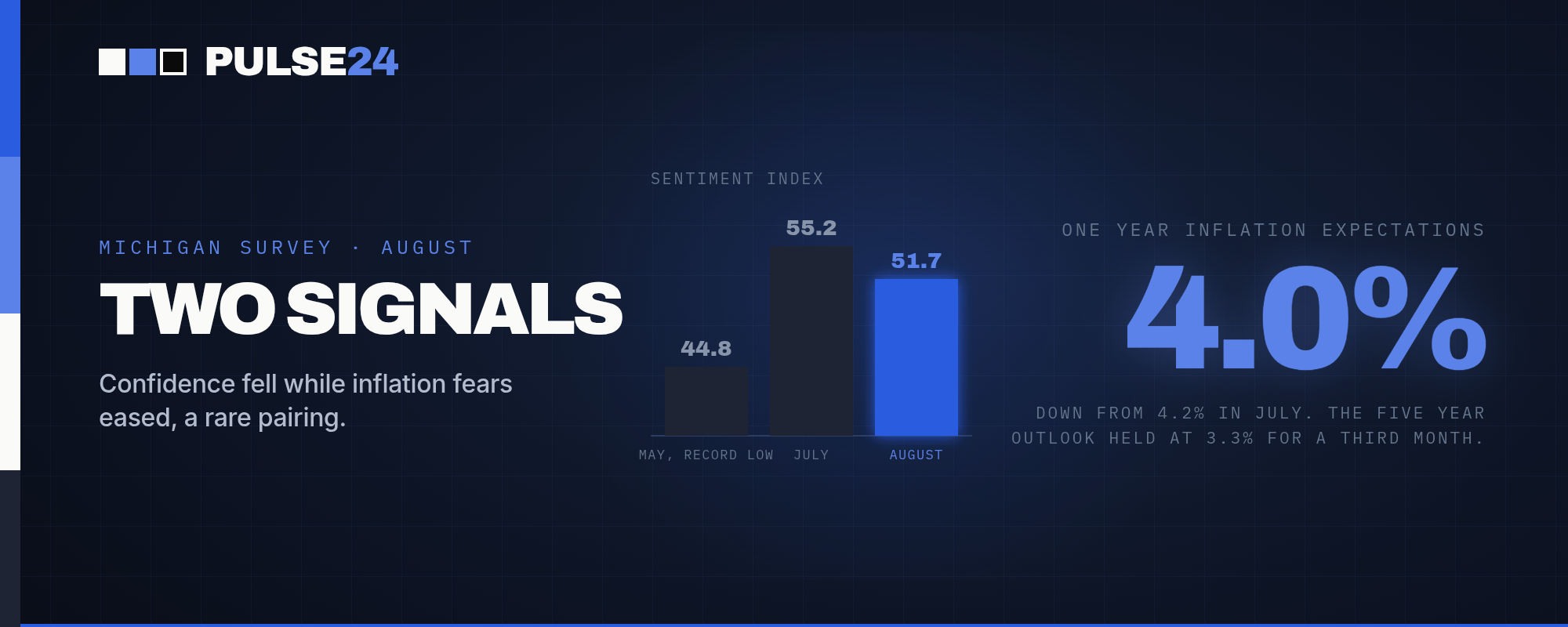
American Consumers Turned Sharply Gloomier in August. Sentiment Fell to 51.7 From a Five-Month High of 55.2, Even as Inflation Expectations Eased to 4%.
Consumer sentiment fell to 51.7 in August, giving back most of a two-month rebound. The stranger part: inflation expectations eased instead of climbing, a combination the Fed rarely sees together.
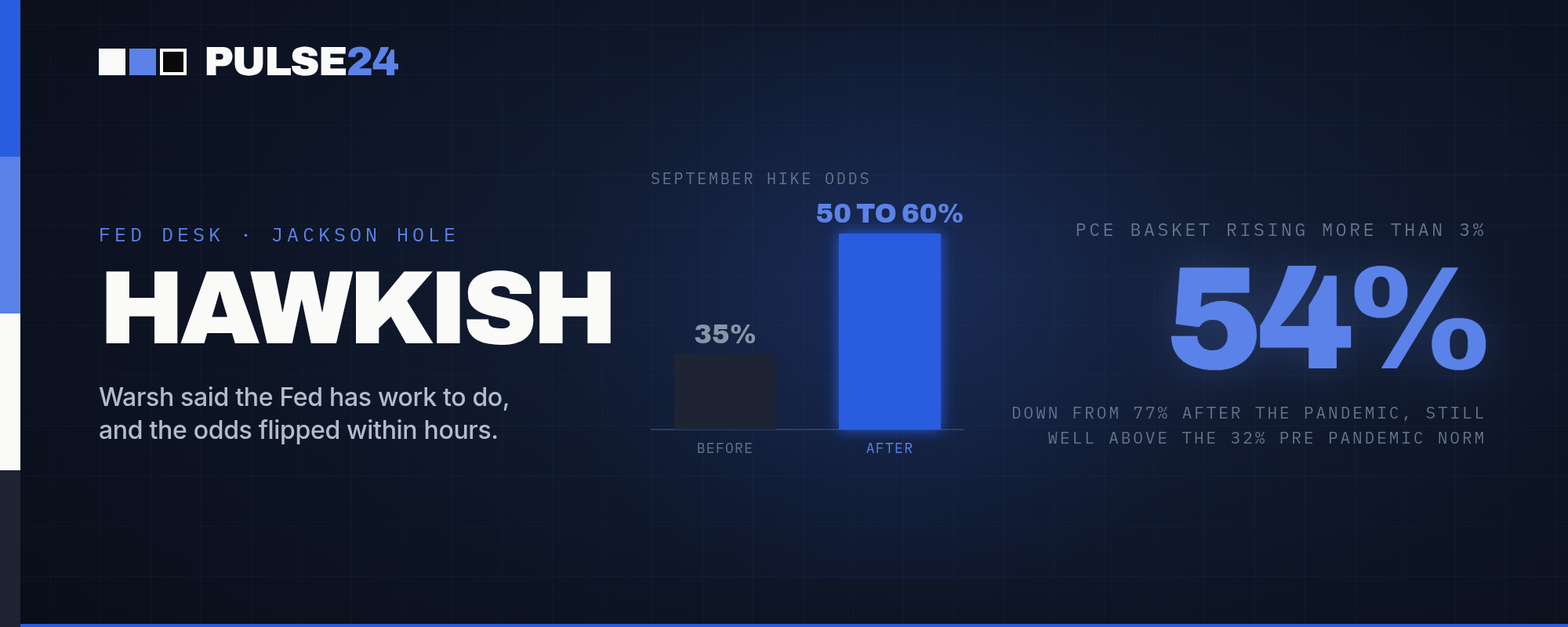
Kevin Warsh's First Jackson Hole Speech Pushed September Rate-Hike Odds Above 50%. Gold Fell Nearly 2% and the Dollar Jumped to a One-Week High.
Fed Chair Kevin Warsh's debut Jackson Hole keynote leaned hawkish on inflation, and traders responded by pushing September rate-hike odds above 50%. Gold dropped roughly 1.5% and the dollar jumped to a one-week high, even as stocks closed modestly higher.
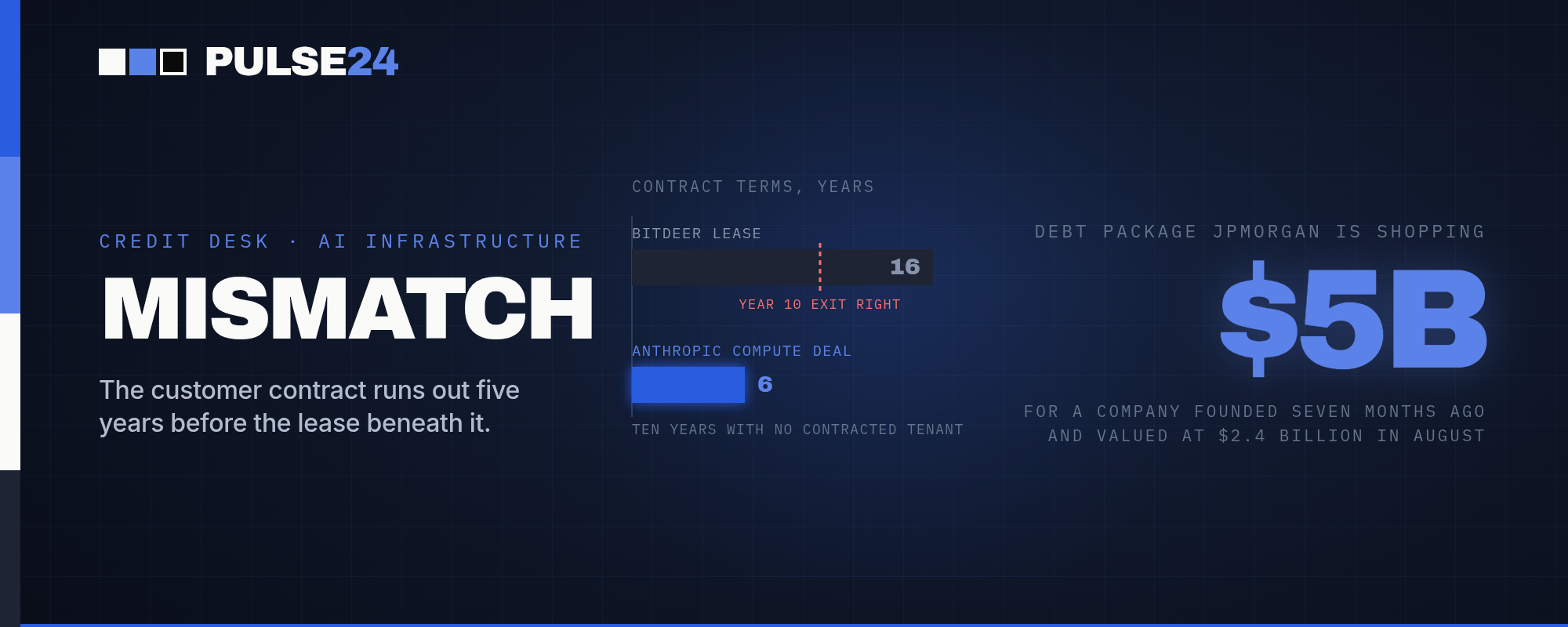
JPMorgan Is Arranging $5 Billion in New Debt for a Data Center Company That Didn't Exist Seven Months Ago. Volta's Norway Campus Already Carries Up to $8 Billion in Contracted Revenue.
JPMorgan is shopping a $5 billion debt package for Volta, an AI data center startup that exited stealth mode less than a month ago. The deal is the latest sign of how far down the size ladder AI's debt-financed buildout has traveled, and how thin the collateral behind it can get.
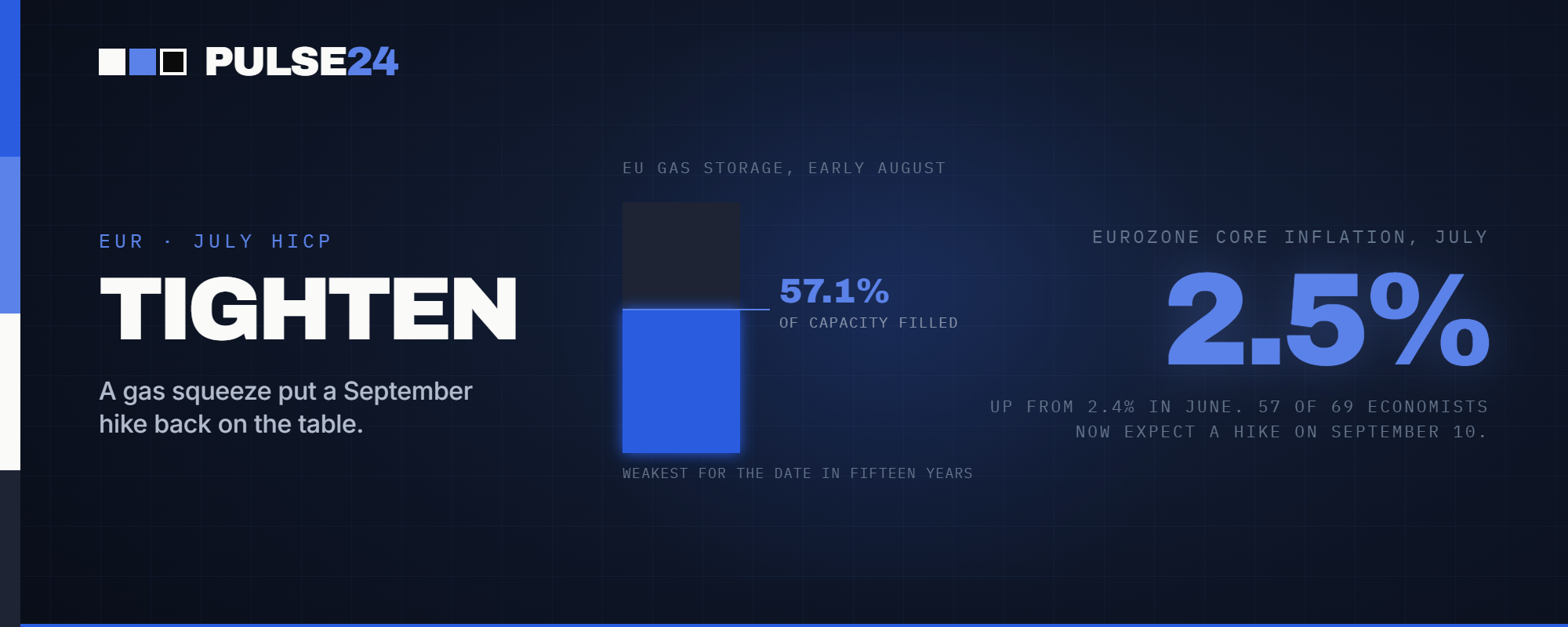
Eurozone Core Inflation Rose to 2.5% in July, Up From 2.4% in June. The ECB's Isabel Schnabel Says That's Reason Enough to Raise Rates Again in September.
Eurozone core inflation accelerated to 2.5% in July and the ECB's Isabel Schnabel says the current policy rate still won't bring it back to target. A Reuters poll now shows most economists expecting a September hike, even as European gas prices climb toward their highest level since early 2023.
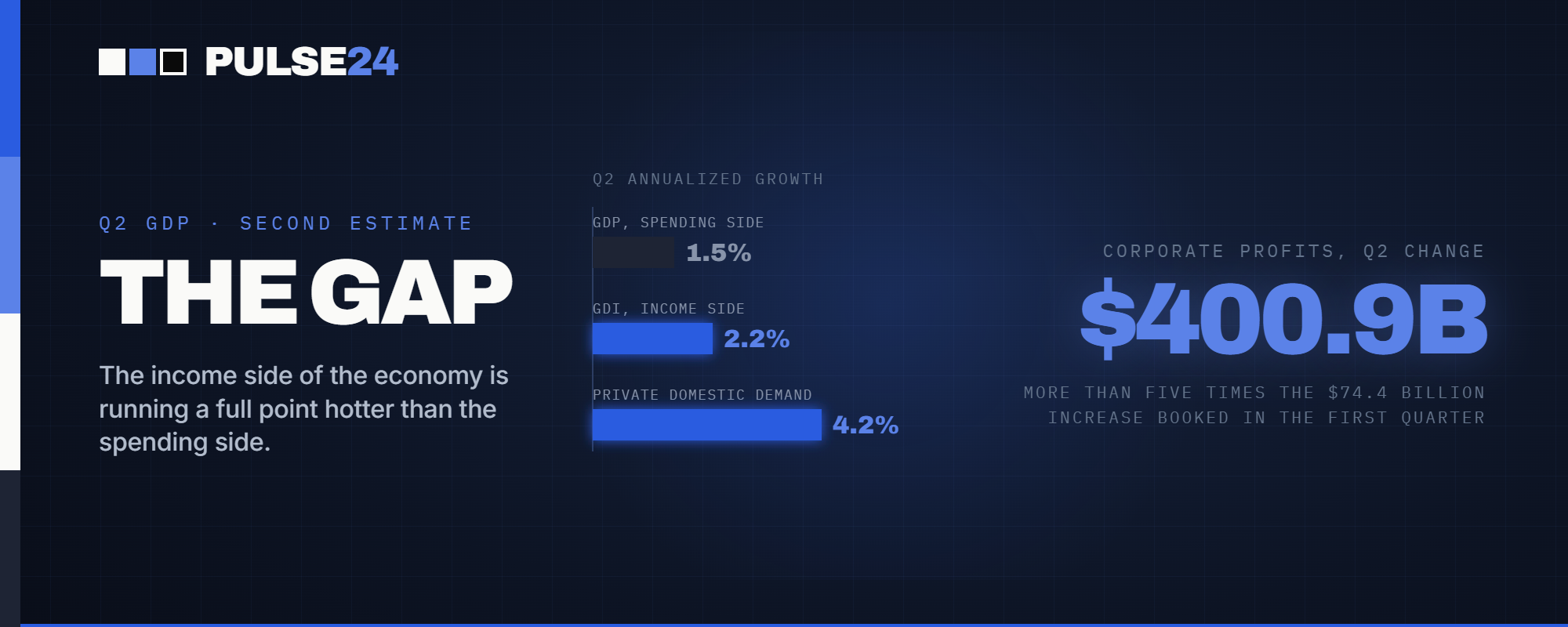
Real GDP Slowed to 1.5% in the Second Quarter, Down From 2.1% in the First. Corporate Profits Still Jumped $400.9 Billion, More Than Five Times What They Rose Three Months Earlier.
The government's second read on second-quarter GDP confirmed growth slowed to 1.5%, but corporate profits jumped more than five times faster than they did in the first quarter. The split between a soft headline number and a much stronger underlying economy lands right before Fed Chair Kevin Warsh's first Jackson Hole speech.
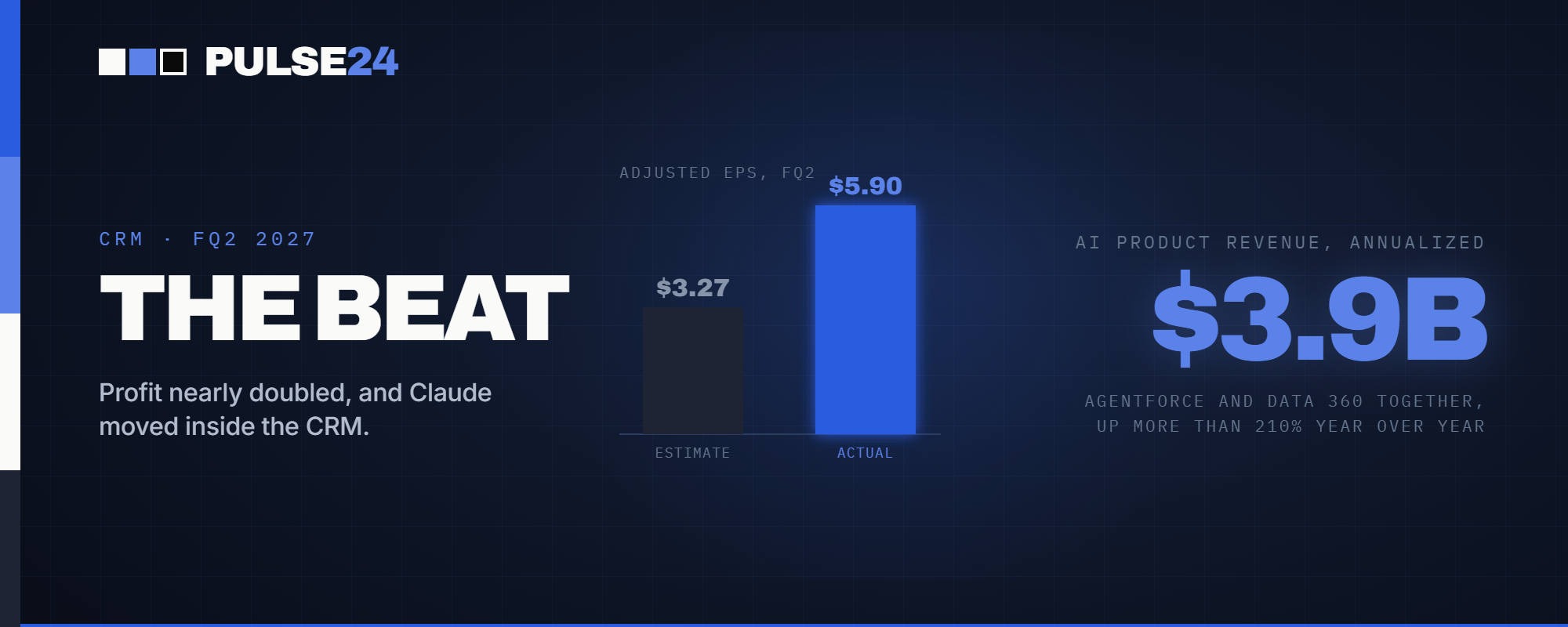
Salesforce's Adjusted Profit Nearly Doubled to $5.90 a Share, Beating the $3.27 Estimate by Roughly 80%. The Stock's 13% Jump Came With an Expanded AI Deal That Puts Claude Inside the CRM.
Salesforce's profit beat estimates by roughly 80% and the stock jumped 13% in after-hours trading, but the more interesting move was the expanded partnership with Anthropic that puts Claude directly inside the CRM. It's Salesforce's clearest answer yet to a year of worry that AI agents would make software like its own obsolete.
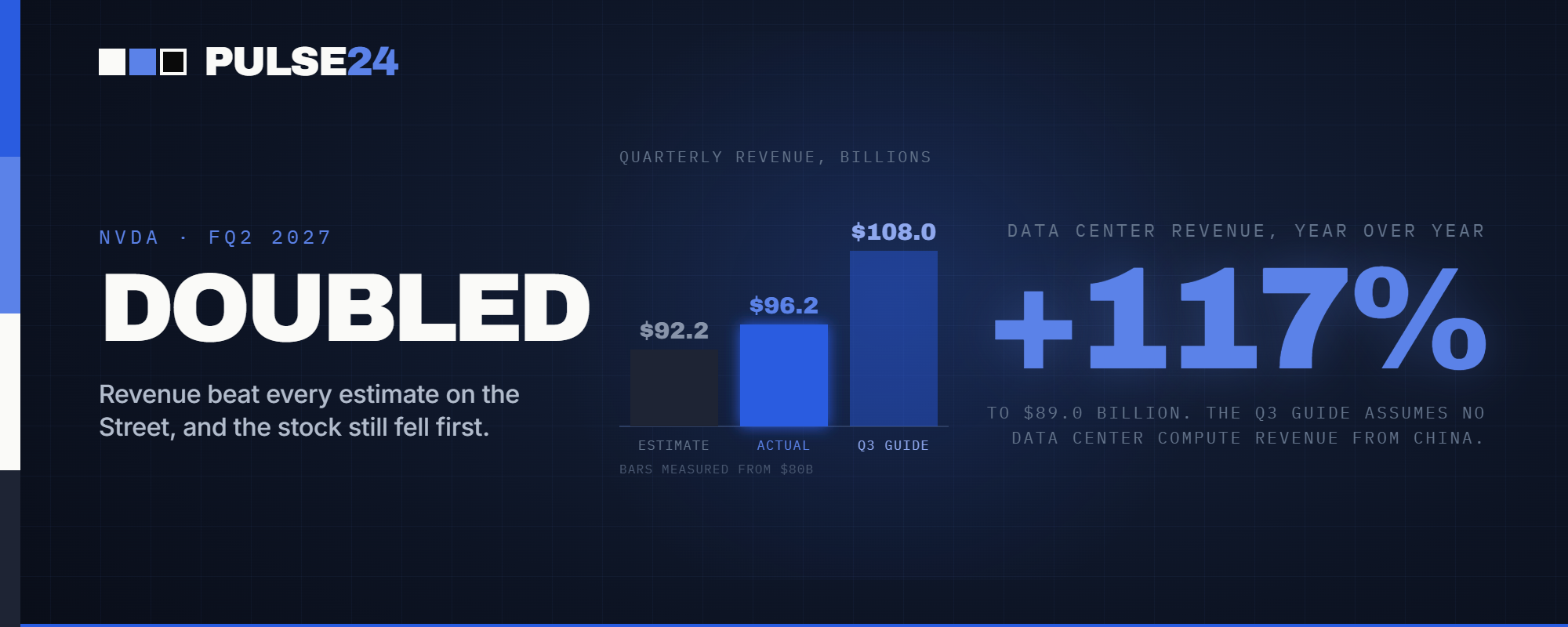
Nvidia's Revenue Doubled to $96.2 Billion, Beating Every Wall Street Estimate. The Stock Still Dropped Before Clawing Back to a Gain in After-Hours Trading.
Nvidia's fiscal second-quarter revenue came in at $96.2 billion, up 106% from a year ago and ahead of every analyst estimate on the Street. The stock still spent its first few minutes of after-hours trading in the red before Jensen Huang's commentary on AI demand turned the session positive.
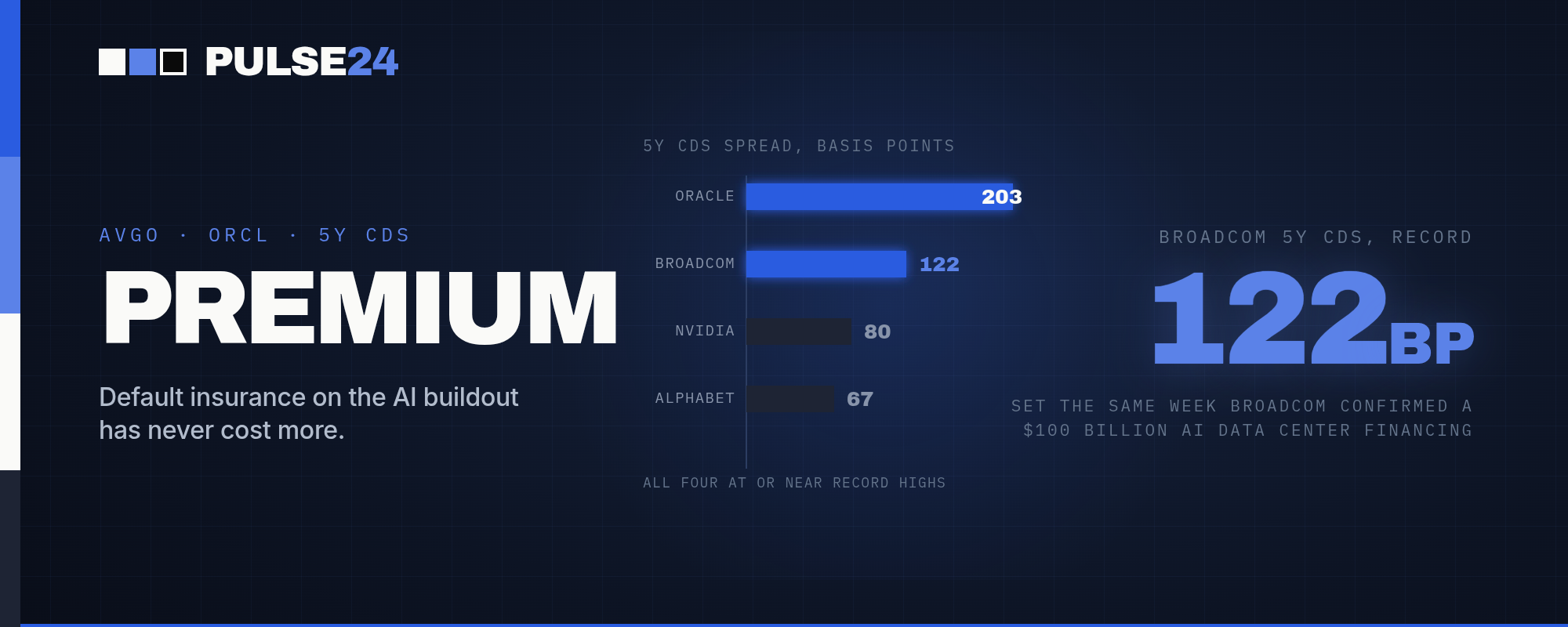
Broadcom's Cost to Insure Its Own Debt Hit a Record 122 Basis Points This Week. Oracle's Sits Higher Still, Near 203, as Both Chase the Same AI Buildout.
Broadcom's credit default swaps hit a record 122 basis points this week, and Oracle's sit even higher, near 203. The derivatives market is pricing real risk into the AI buildout that the rest of the credit market isn't seeing yet.
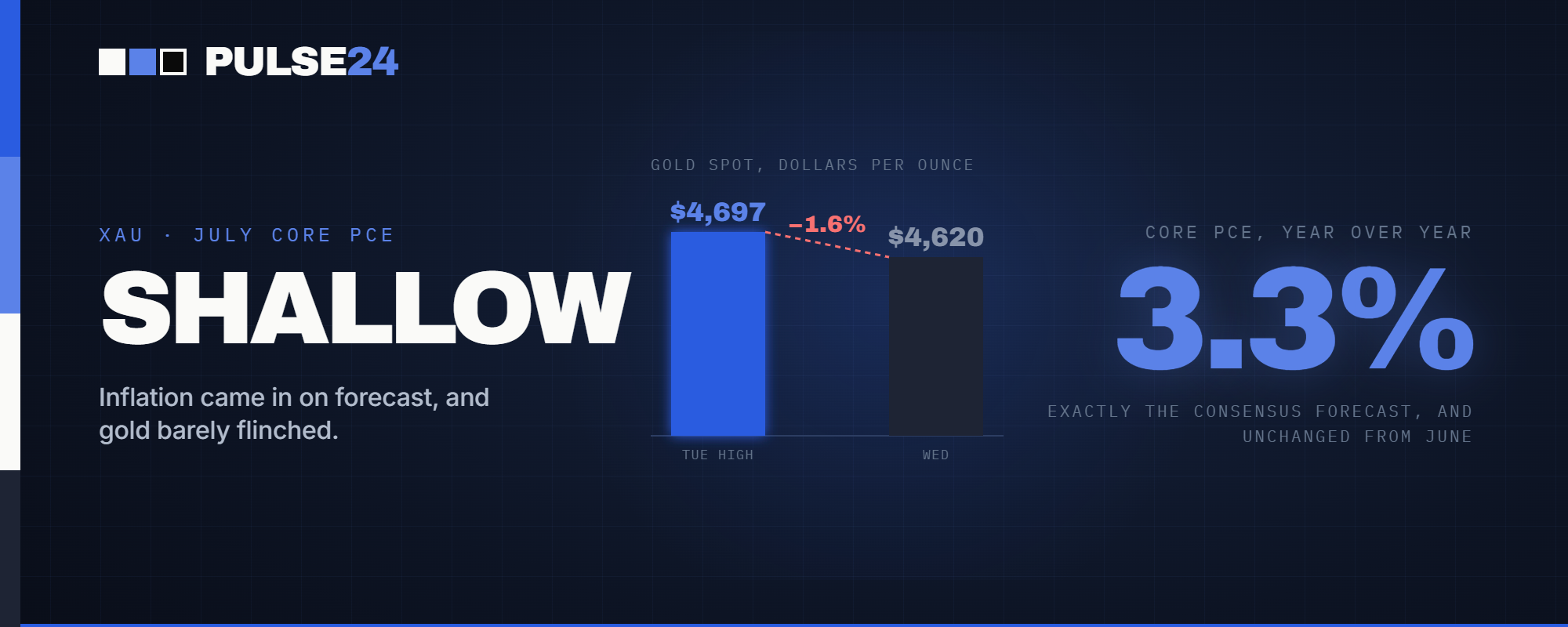
Core PCE Held at 3.3% in July, Exactly as Forecast. Gold Still Fell From a Three-Month High of $4,697 Within Hours of the Report.
Core inflation held at 3.3% in July, matching forecasts exactly, but gold still slid from a three-month high near $4,700 within hours of the report landing. The muted reaction says more about the Treasury's ballooning bond buybacks than about the Fed's next move.
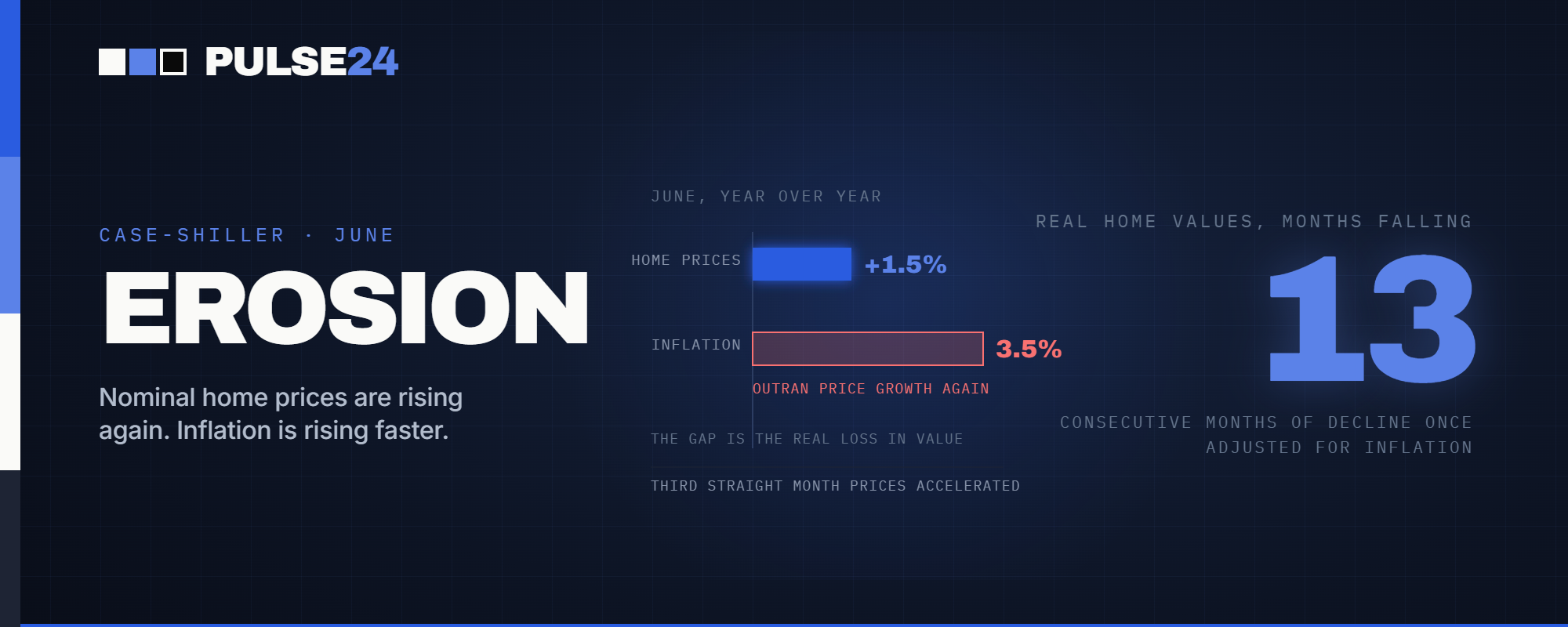
The Case-Shiller Index Rose 1.5% in June, Its Third Straight Month of Acceleration. Adjusted for Inflation, Home Values Have Fallen for 13 Consecutive Months.
Nominal home prices accelerated again in June to a 1.5% annual pace, the third straight month of improvement, but June's 3.5% inflation rate outran that gain again. Regional splits are widening too, with Chicago up nearly 7% while Seattle keeps falling.
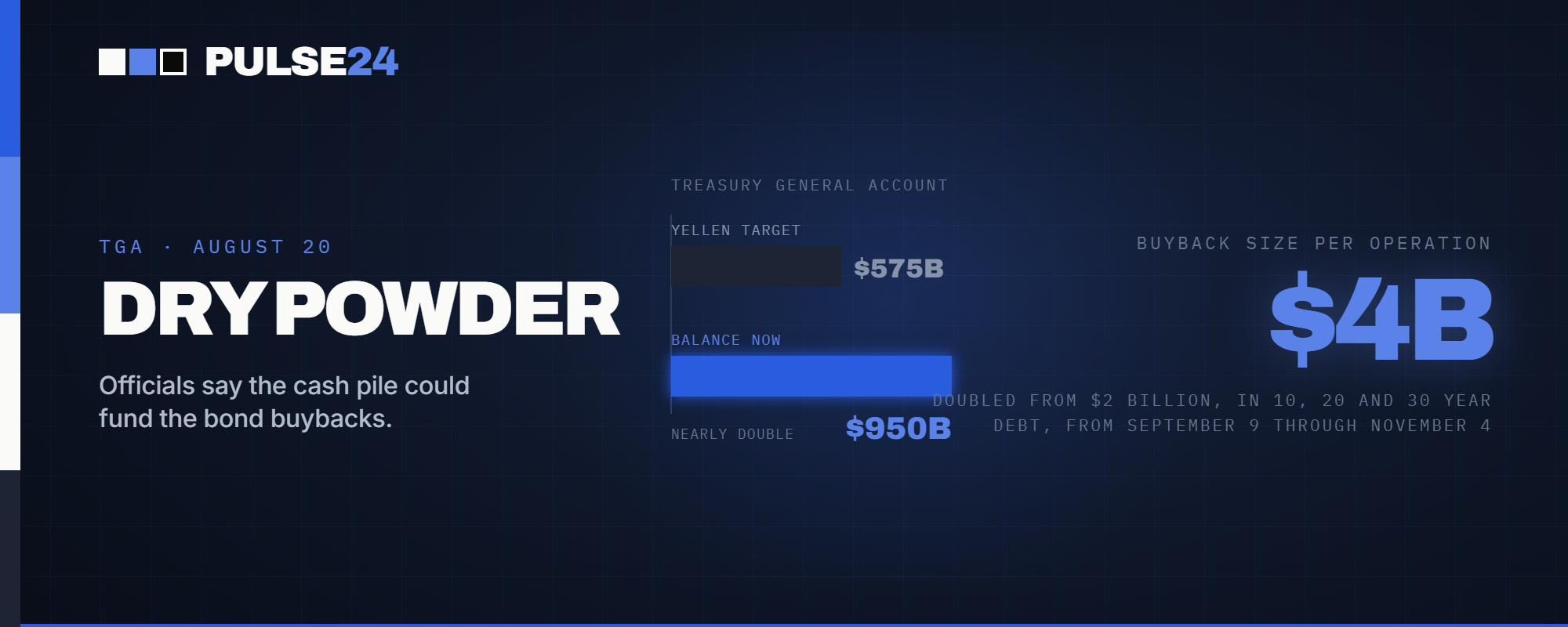
The Treasury's Cash Reserve at the Fed Has Swelled to $950 Billion, Nearly Double What Janet Yellen Kept on Hand. Officials Say That Money Could Now Fund the Bond Buyback Program.
Treasury Secretary Scott Bessent has built a $950 billion cash reserve at the Federal Reserve, nearly double the balance Janet Yellen kept on hand, and officials now say that money could fund an expanded bond buyback program instead of sitting idle. Gold and Bitcoin have already rallied on the signal that Washington will step in when yields climb too far.
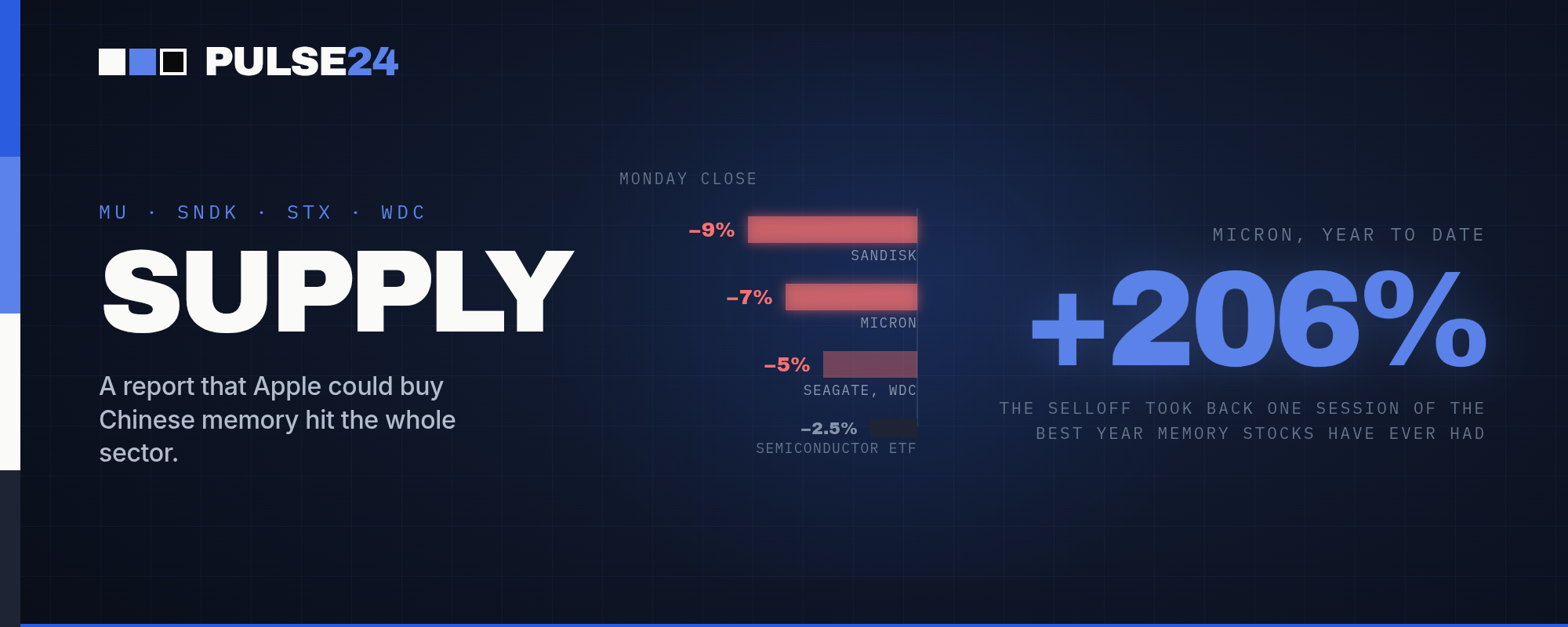
Micron and SanDisk Fell 7% Monday on a Report Trump May Let Apple Buy Chinese Memory Chips. The Backdrop Is a DRAM Price That's Already Up 165% This Year.
Micron and SanDisk each fell about 7 percent on Monday after a report that Washington may let Apple buy memory chips from Chinese suppliers. The threat lands squarely on the pricing power that's driven memory stocks through the best year of their history.
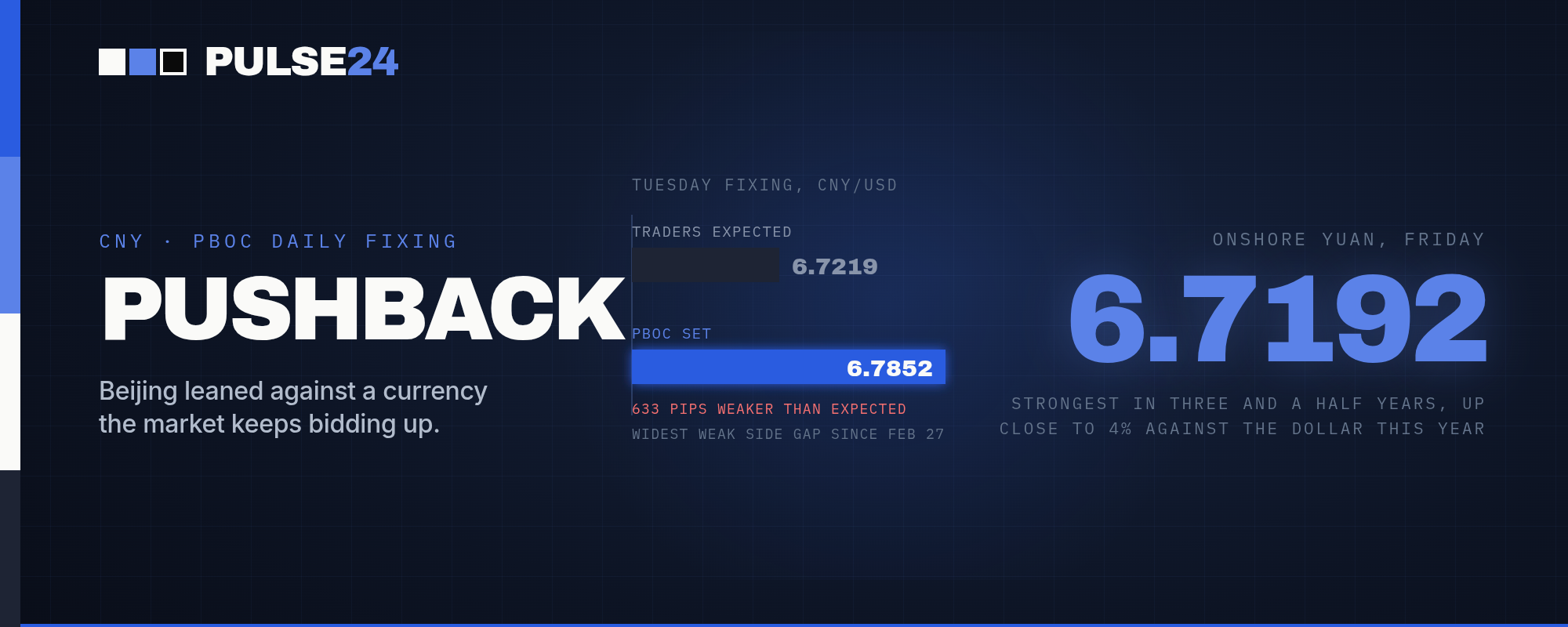
China's Yuan Touched a Three-and-a-Half-Year High on Friday. Tuesday's Central Bank Fixing Delivered the Sharpest Pushback Since February.
The onshore yuan hit its strongest level in three and a half years last week, and the PBOC answered with its biggest weak-side fixing gap since February. The pushback says as much about a divided Fed as it does about China.
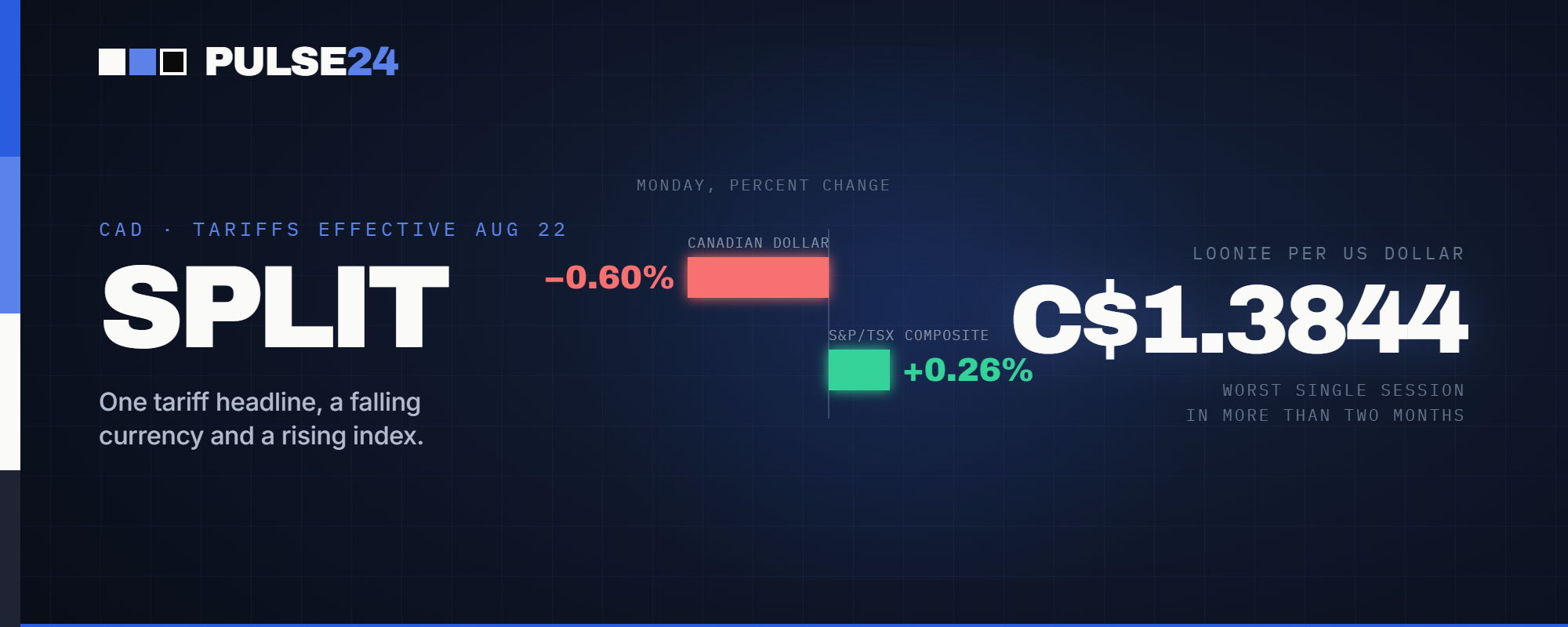
Washington's New 50% Tariffs Sank the Canadian Dollar to a Two-Month Low. Toronto's Stock Market Gained 94 Points the Same Day.
The Canadian dollar posted its worst single day in over two months after Washington's 50% tariffs on roughly $20 billion of Canadian goods took effect this weekend. The Toronto Stock Exchange gained ground the same day, and the split says something about how targeted trade shocks actually move markets.
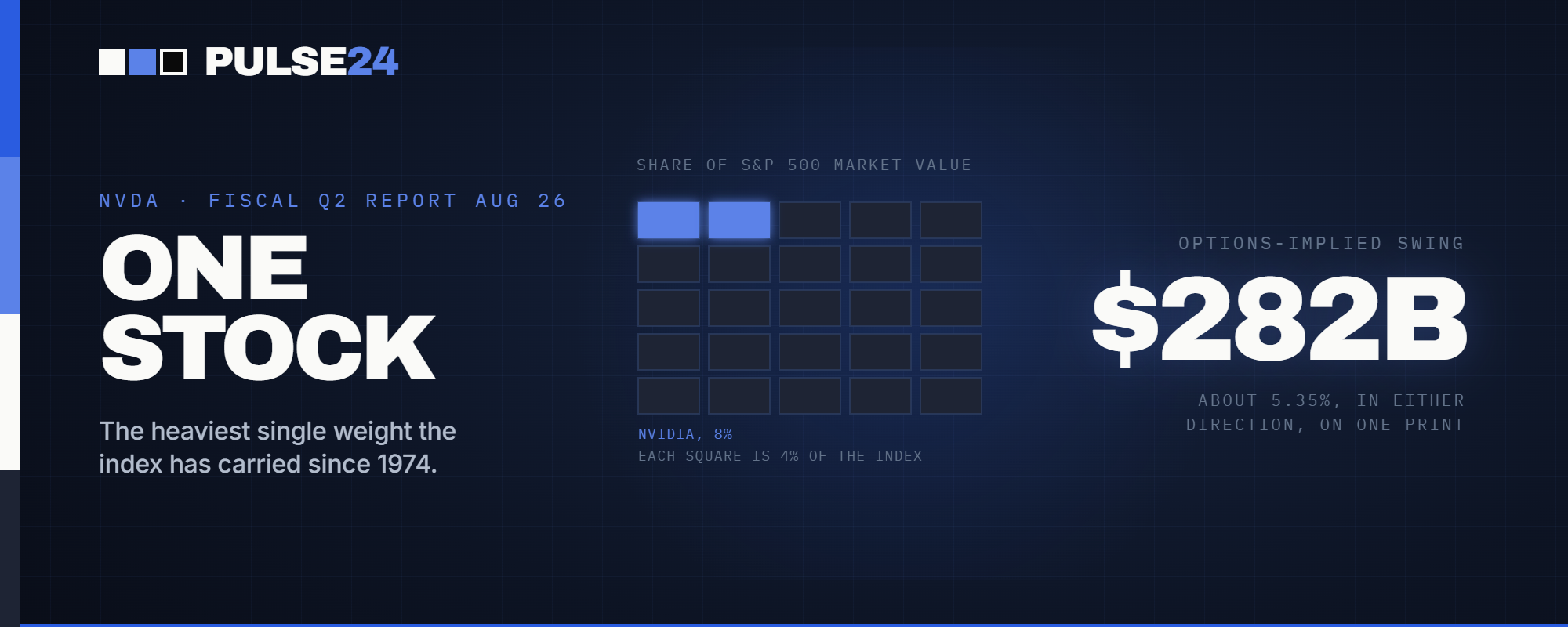
Nvidia Now Carries an 8% Weight in the S&P 500, the Heaviest Any Stock Has Held Since 1974. Wednesday's Earnings Are Priced for a $282 Billion Swing Either Way.
Nvidia reports fiscal second-quarter earnings Wednesday, and options traders are pricing an $282 billion swing in either direction. The stock has gained only 21% this year while the rest of the chip sector rallied 63%, and this week's number will go a long way toward explaining why.
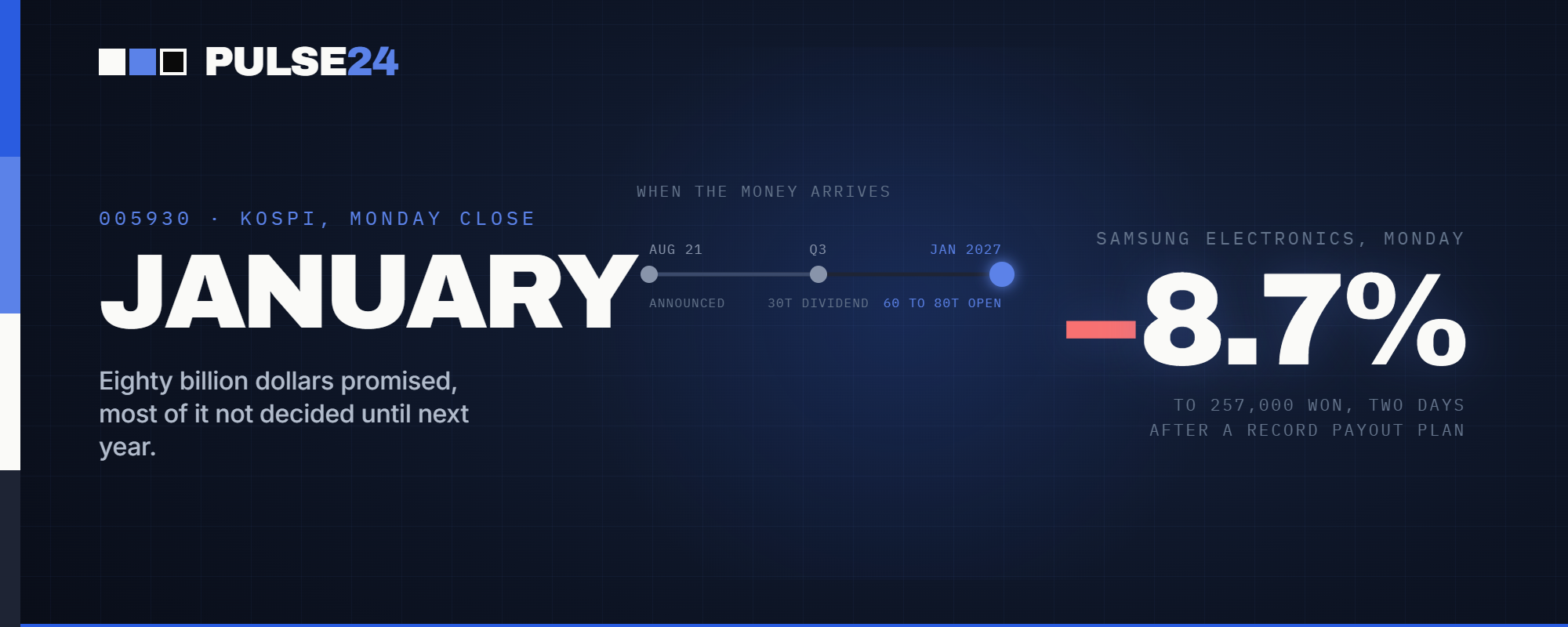
Samsung Fell 8.7% Monday, Pulling the Kospi Down 3.1% With It. The $80 Billion Shareholder Return Promised Two Days Earlier Wasn't Enough to Hold the Stock Up.
Samsung fell 8.7% and dragged the Kospi down 3.1% on Monday, two days after promising as much as $80 billion in shareholder returns. Analysts say the gap comes down to timing: SK Hynix's buyback is already running, while most of Samsung's plan won't be finalized until a board meeting in January.
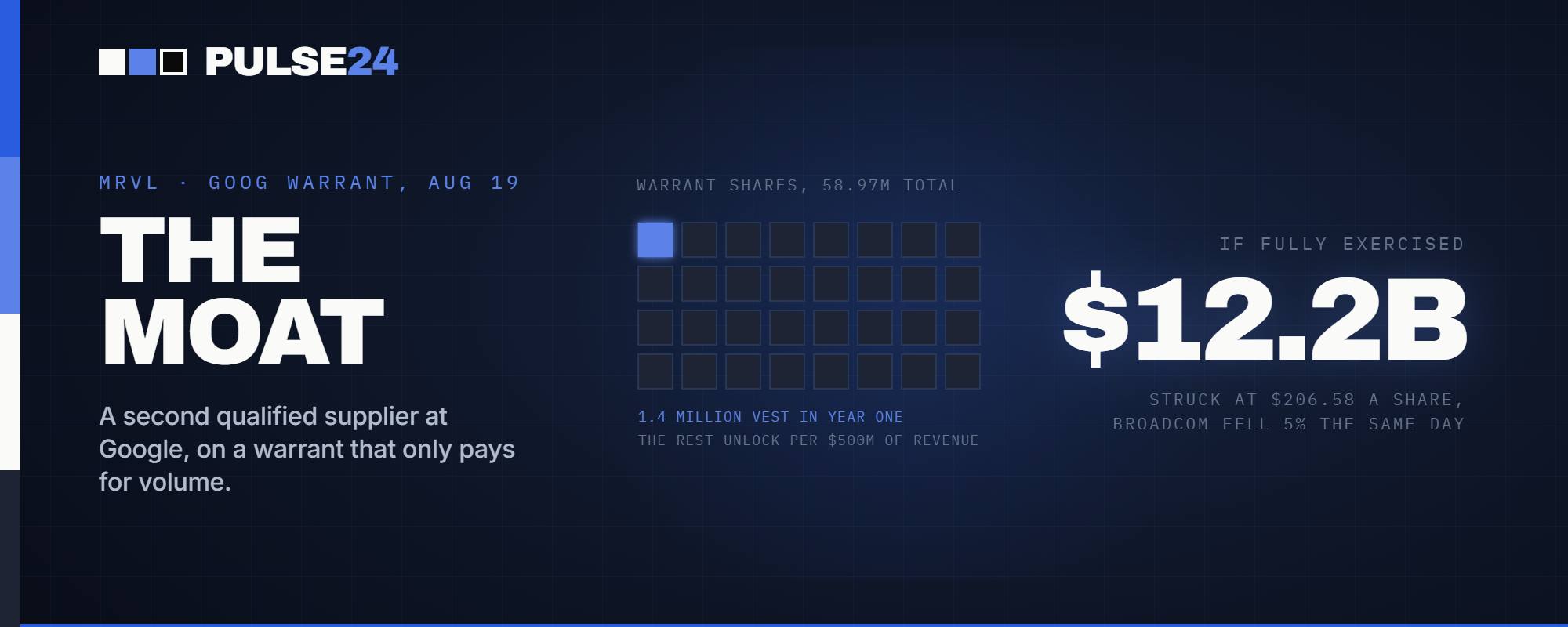
Marvell Landed a $12.2 Billion Warrant From Google. Broadcom Fell 5% the Same Day, and Its Presumed Exclusivity Deal Is Now in Question.
Google handed Marvell a $12.2 billion warrant to build custom AI chips, and Broadcom's stock dropped about 5% the same day on fears its presumed exclusive Google relationship just got a second supplier. The last time Broadcom lost a major customer this way, in 2023, the stock rose more than 500% anyway.
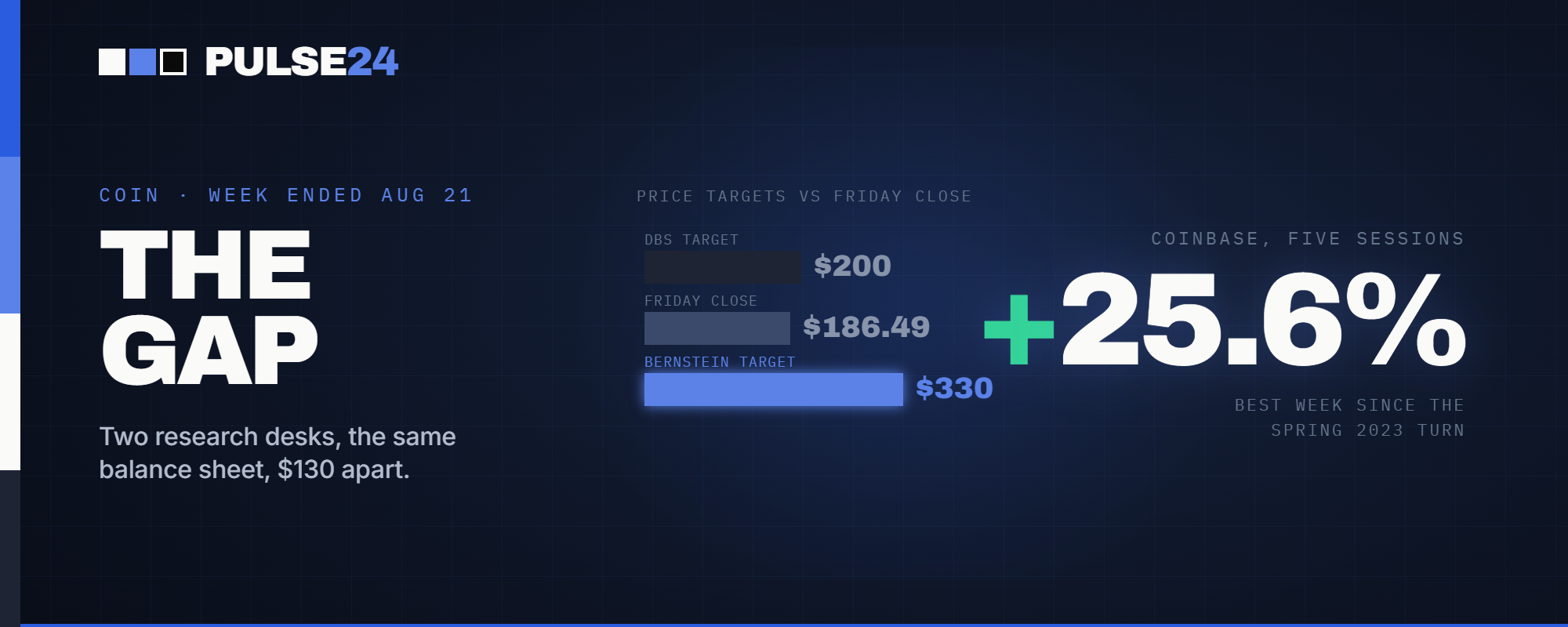
Coinbase Stock Gained 25% This Week. Binance Spent the Same Five Days Explaining a UAE Employee Probe to the New York Times, While the Bill Both Exchanges Are Waiting on Slipped to September Again.
Coinbase stock jumped 25.6% this week to $186.49 while Binance confirmed two employees were questioned by UAE authorities over client fund flows. The CLARITY Act both exchanges are waiting on won't get a Senate vote until mid-September at the earliest.
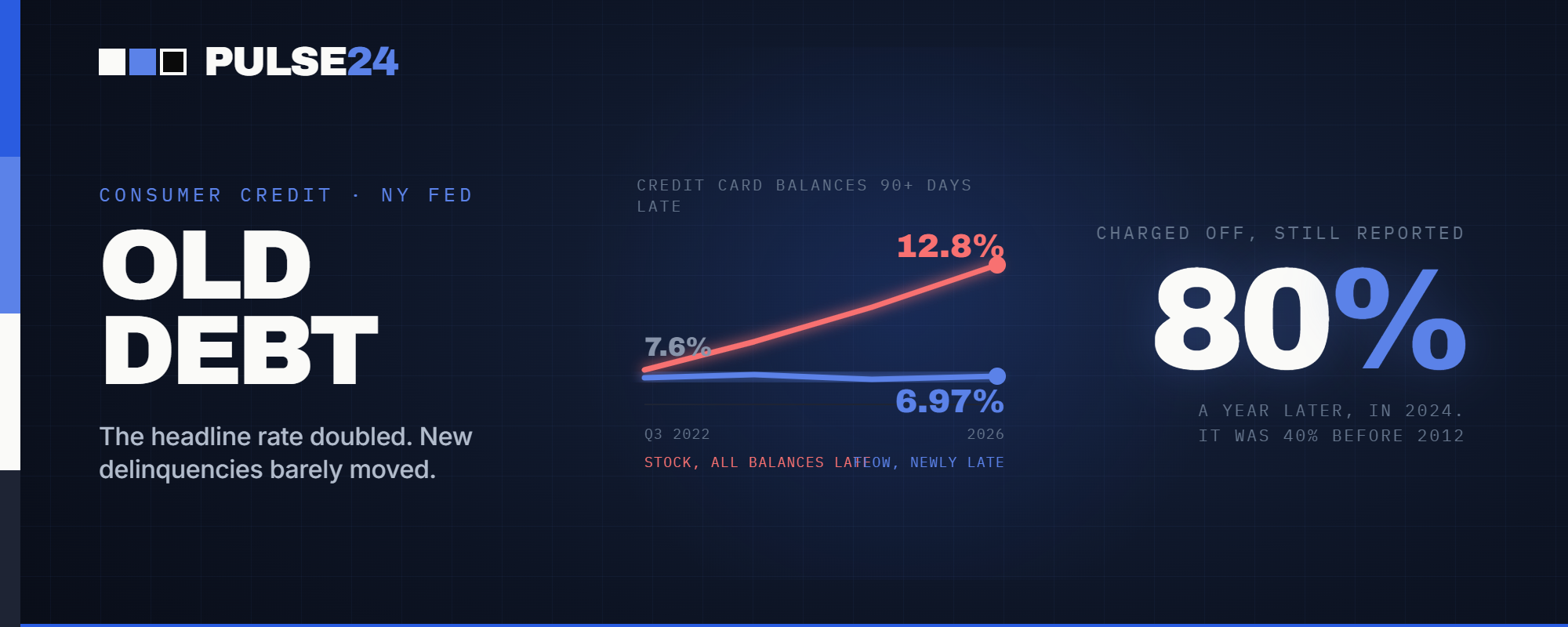
Credit Card Delinquencies Appear to Have Nearly Doubled Since 2022, Rising From 7.6% to 12.8% of Balances. The New York Fed Says the Actual Delinquency Rate Hasn't Budged in Two Years.
Credit card delinquencies look like they nearly doubled since 2022, but the New York Fed says that's mostly an illusion created by how long lenders now report charged-off debt. The actual rate of new delinquencies has barely moved in two years.
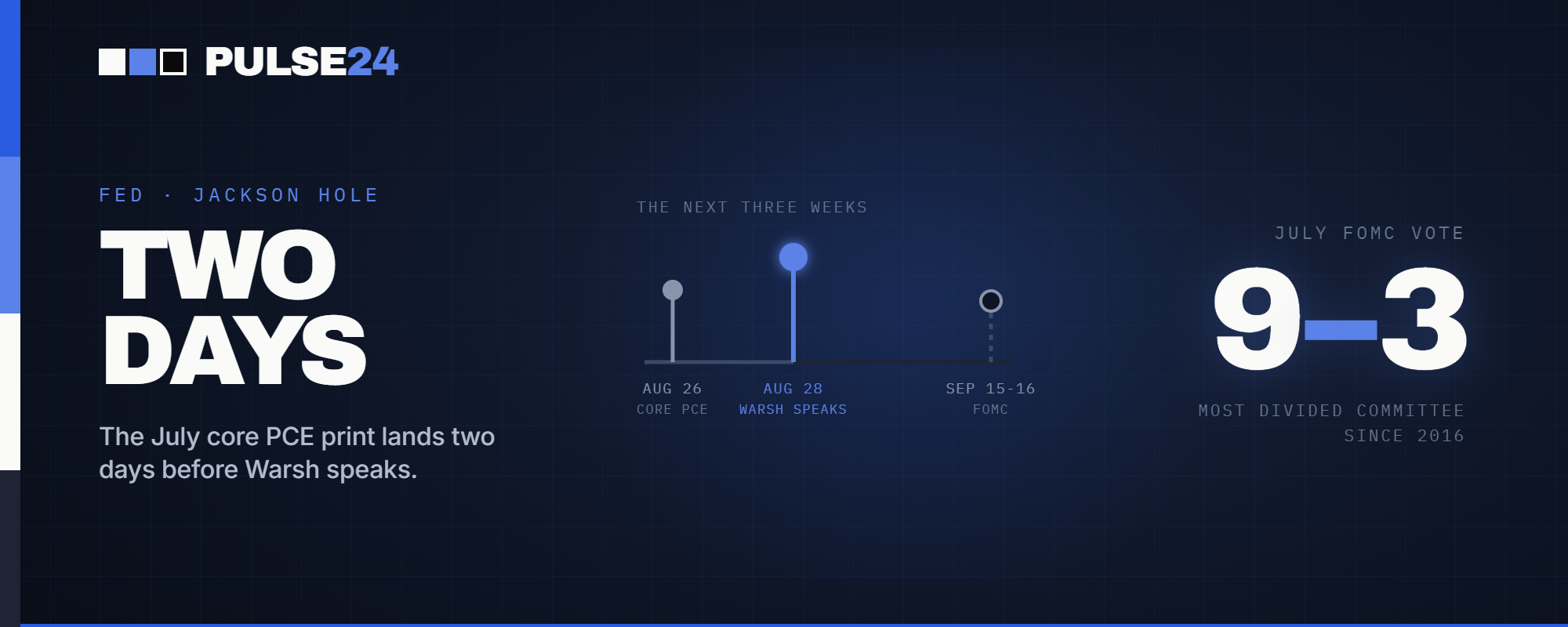
Kevin Warsh Steps to the Jackson Hole Podium Friday for His First Speech as Fed Chair. The Inflation Report Landing Two Days Earlier Could Decide What He Says.
Kevin Warsh delivers his first Jackson Hole speech as Fed chair on Friday, two days after the July core PCE report lands and with September hike odds bouncing in the low-to-mid 30s. A single line item in July's PPI report, a spike in portfolio management fees, could be the difference between a dovish read and a much tougher one.
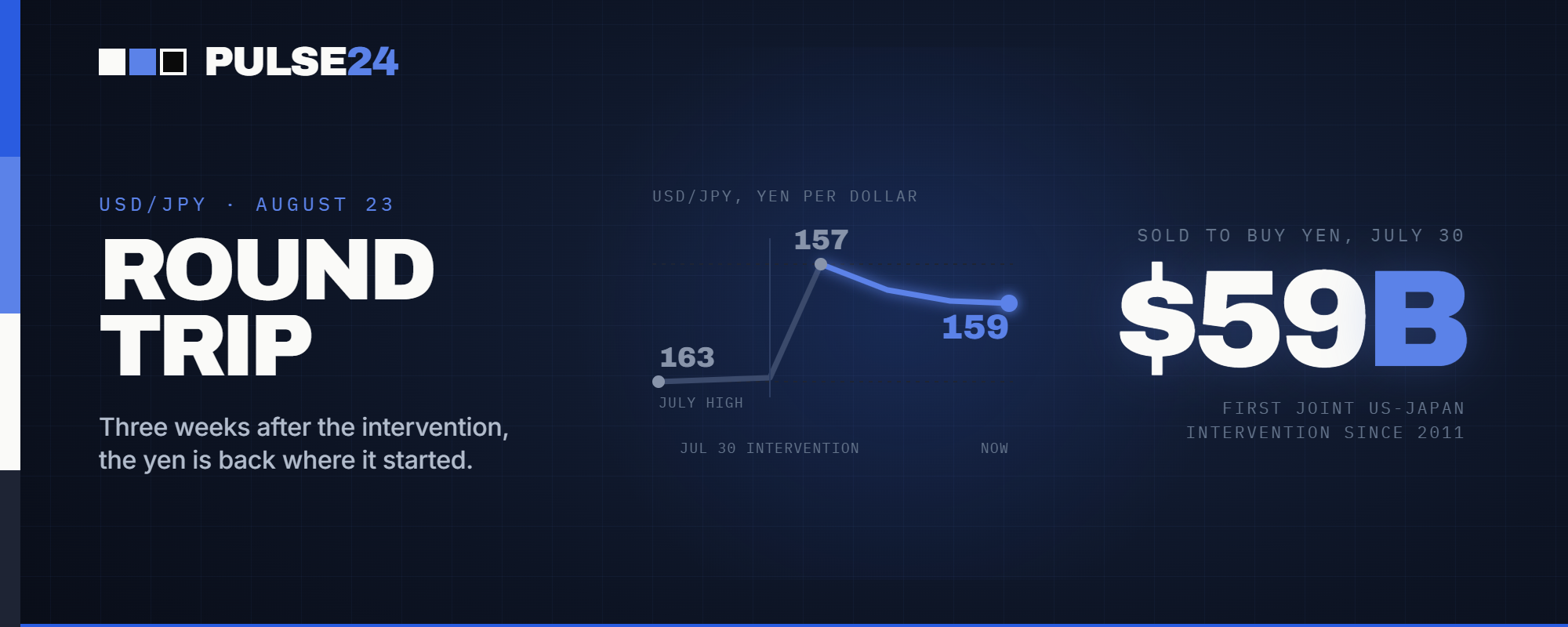
The Yen Slid Back to 159 to the Dollar, Giving Up Nearly All the Ground a $59 Billion Intervention Bought It. Now the BOJ's September Rate Decision Has to Do What the Currency Purchase Couldn't.
The yen has drifted back to roughly 159 per dollar, giving up nearly all the ground a $59 billion Japan-US intervention bought it three weeks ago. The Bank of Japan's September rate decision now carries the added weight of a carry trade unwind that broke markets the last time this happened, in August 2024.
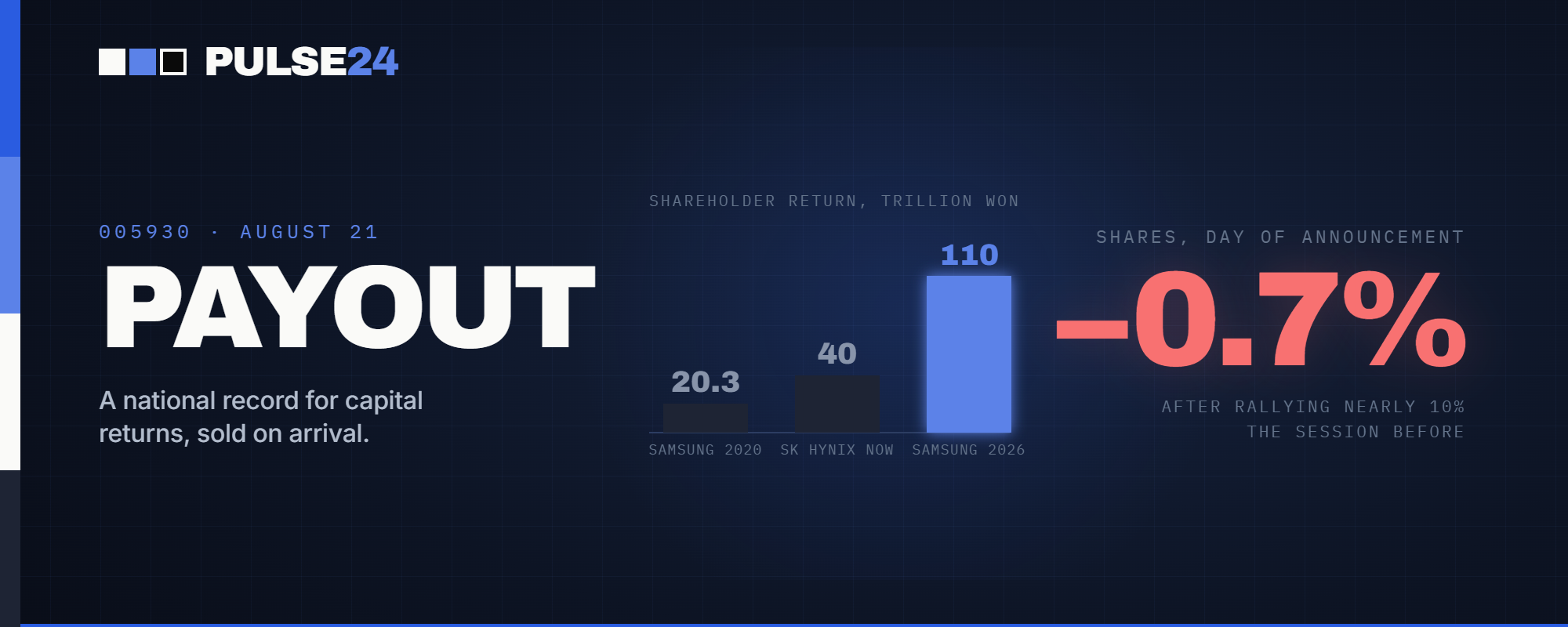
Samsung Approved as Much as $80 Billion in Shareholder Returns, More Than Double SK Hynix's Buyback From Two Days Earlier. The Stock Still Fell 0.7% the Day It Was Announced.
Samsung approved a record 90 to 110 trillion won shareholder return this week, more than double SK Hynix's own record buyback from two days earlier. The stock still slipped on the news, a reminder of how much good news the memory trade had already priced in during the run-up.
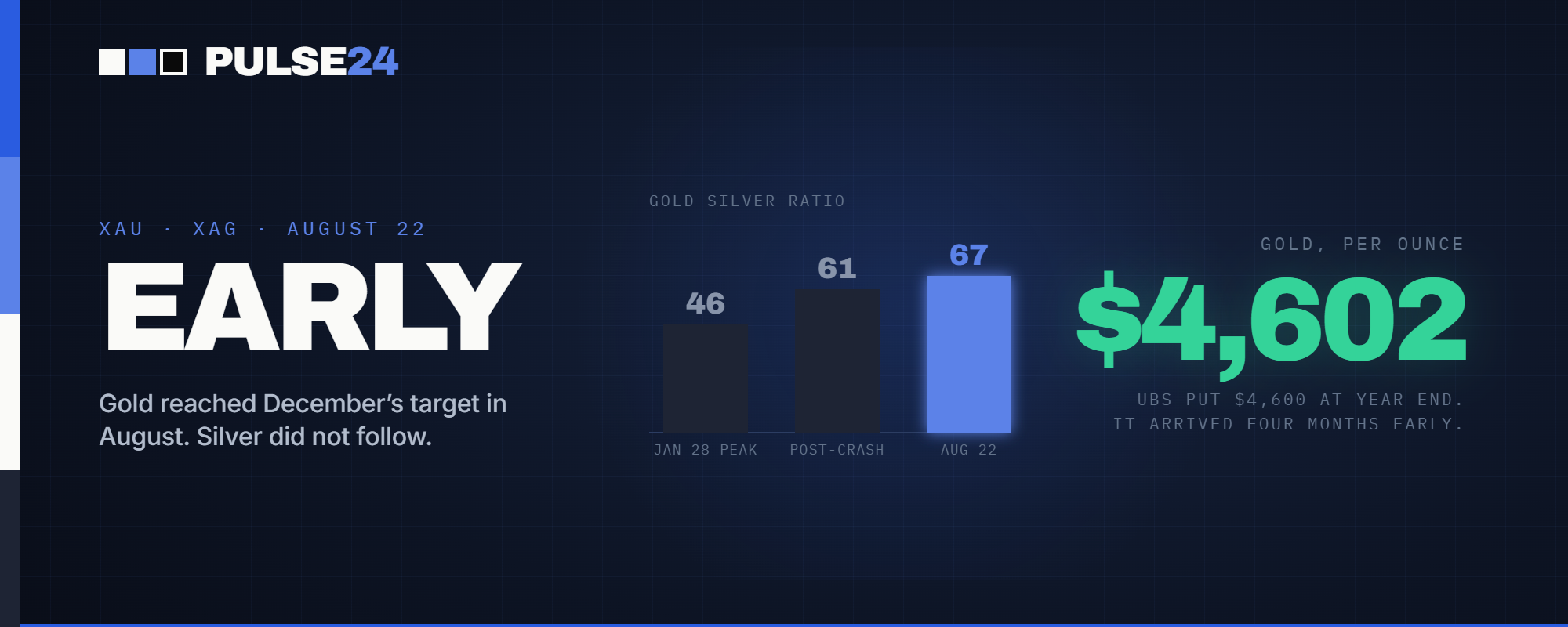
Gold Climbed Back Above $4,600 an Ounce, Matching UBS's Year-End Target Four Months Ahead of Schedule. Silver, Priced Near $68.90, Is Still Below Where It Stood the Day After February's Crash.
Gold's recovery from January's record-high blowoff has it trading almost exactly where UBS told clients to expect it by December, four months early. Silver hasn't managed the same comeback, and the widening gap between the two metals says something about who's actually driving this rally.
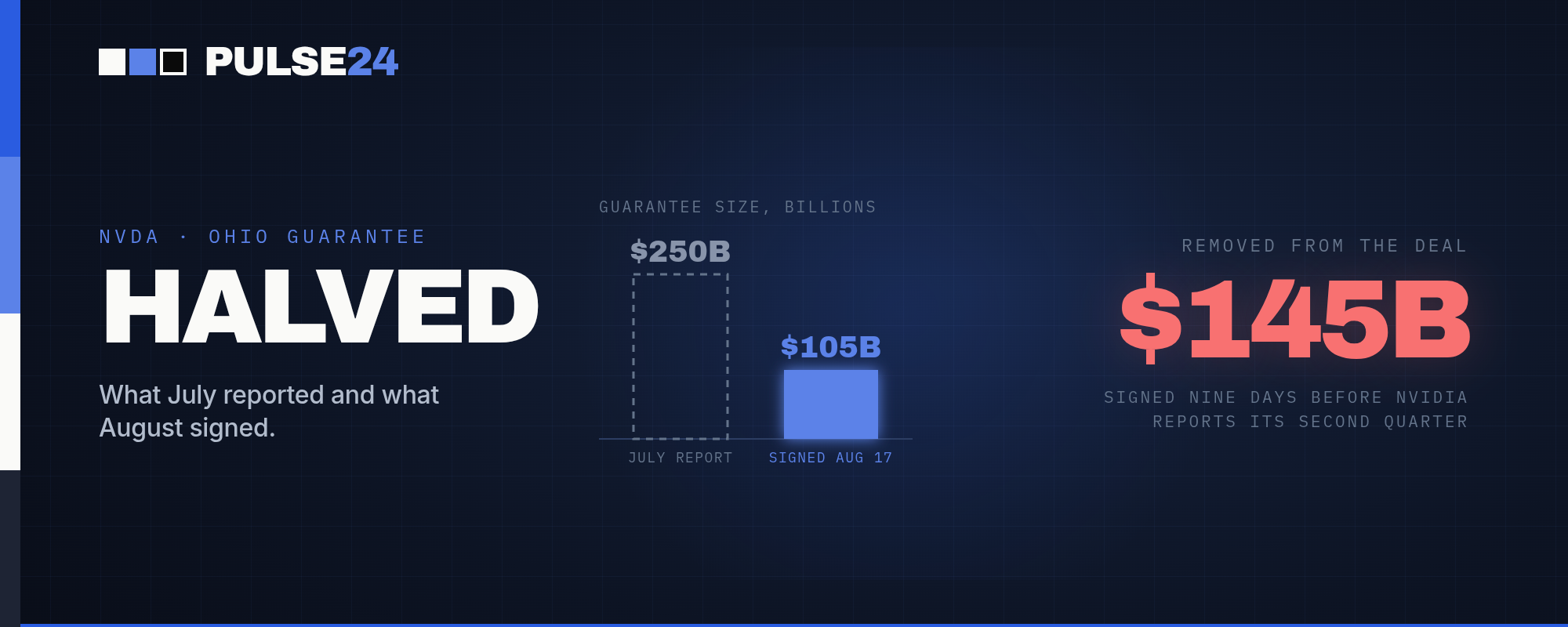
Nvidia Guaranteed $105 Billion for OpenAI's New Ohio Data Center, $145 Billion Below the Number First Reported in July. The Deal Landed Nine Days Before an Earnings Report That's Already Reopening the Circular-Financing Debate.
Nvidia's backing for OpenAI's new Ohio data center landed at $105 billion, well below the roughly $250 billion figure first reported in July. The cut comes just over a week before Nvidia's own earnings put its growing web of AI financing deals back under scrutiny.
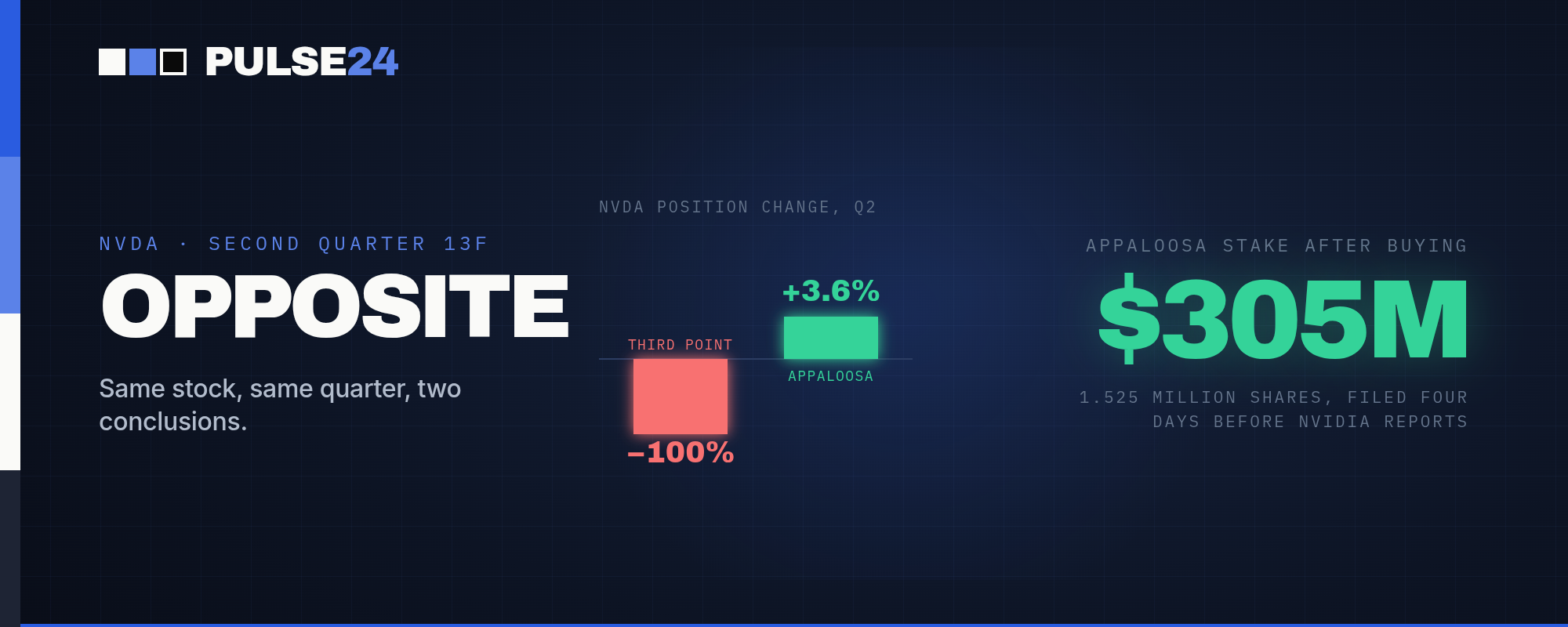
Dan Loeb's Third Point Dumped Its Entire Nvidia Position in Q2. David Tepper's Appaloosa Bought More of the Same Stock at the Same Time.
Dan Loeb's Third Point walked away from Nvidia entirely last quarter and put the money into Warner Bros Discovery instead. David Tepper's Appaloosa added to its Nvidia stake over the same three months, four days before Nvidia reports earnings and while AMD locks up billions in new AI chip commitments.
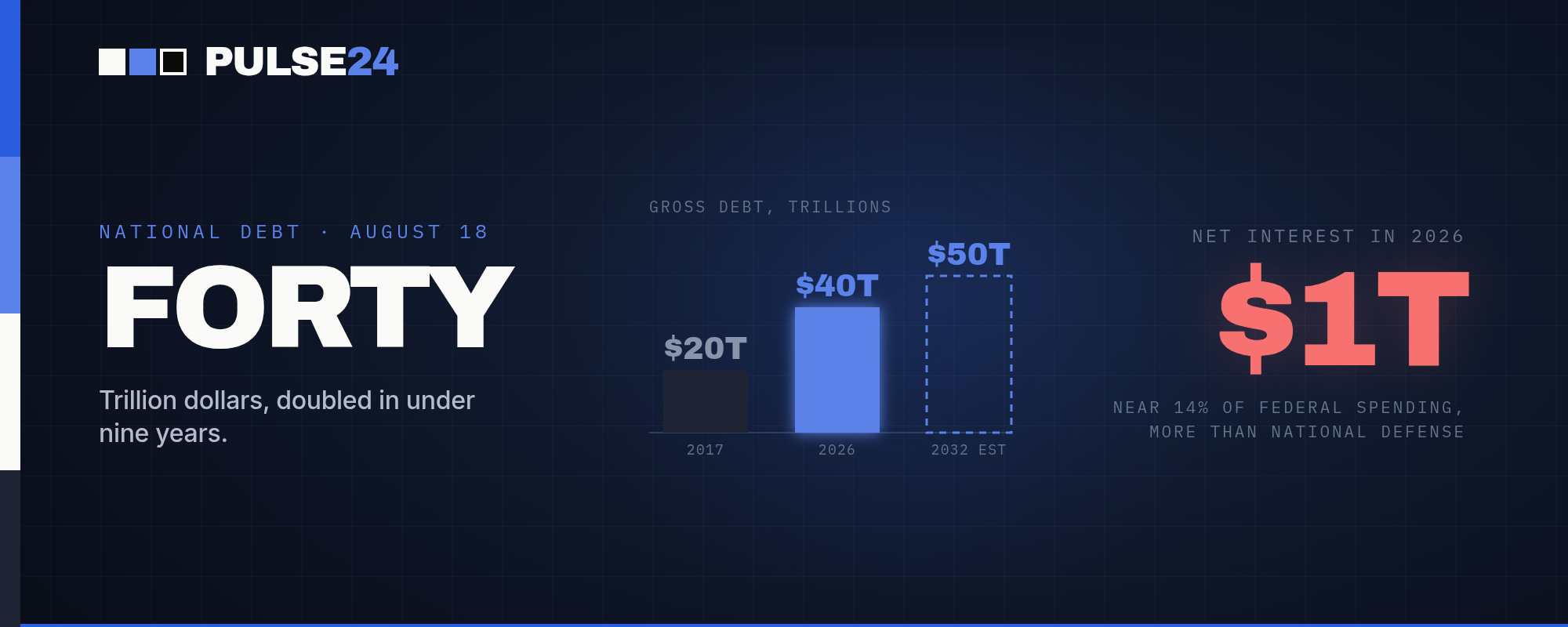
The National Debt Just Crossed $40 Trillion, Doubling in Under a Decade. Interest Payments Alone Now Cost More Than the Defense Budget.
The US national debt closed above $40 trillion for the first time on August 18, doubling in under a decade. Gold broke $4,600 an ounce and the dollar slipped to a three-month low the same week, three assets clearly pricing in the same worry.
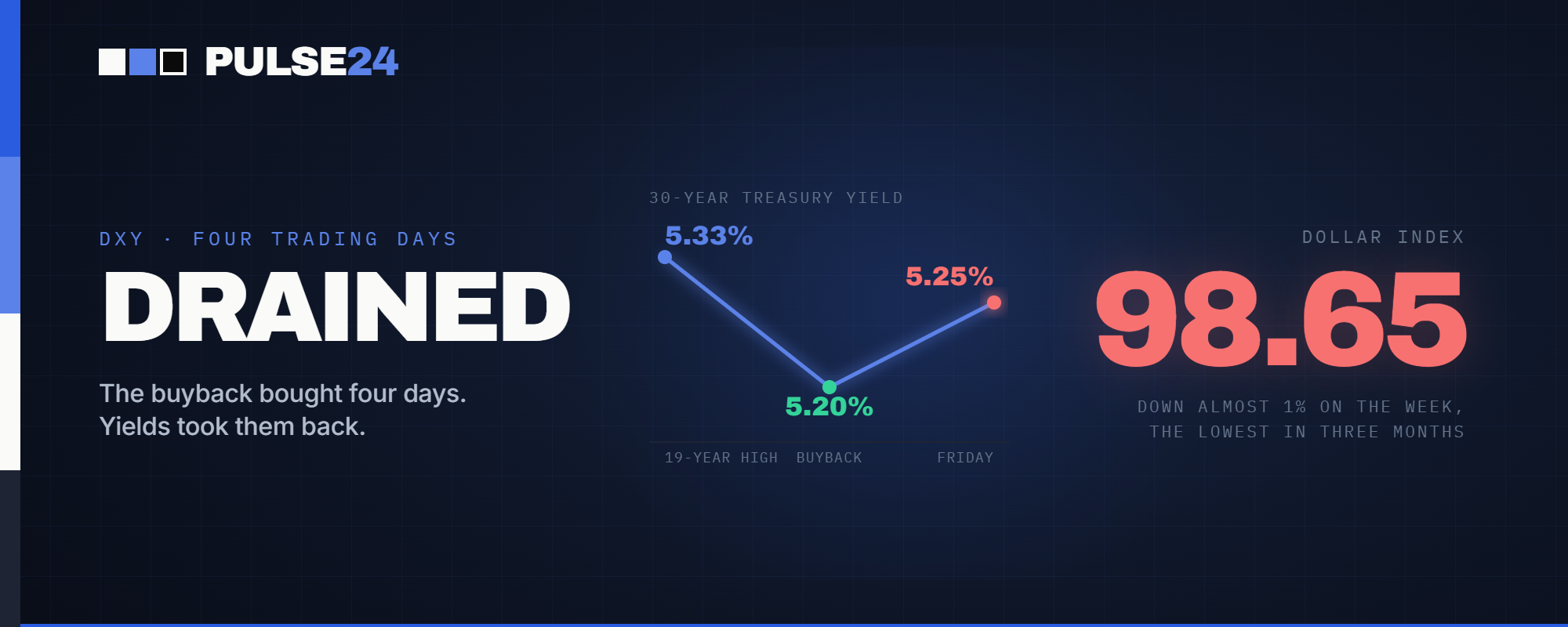
The Dollar Index Just Sank to a Three-Month Low of 98.65, Down Nearly 1% This Week. The Treasury's Bond Buybacks Were Supposed to Calm Yields, Not Break the Currency.
The Treasury doubled its bond buybacks six days ago to cool a 5.3% yield on the 30-year. Now that yield is creeping back toward 5.25%, the dollar just touched a three-month low, and gold is on pace for a third straight weekly gain.
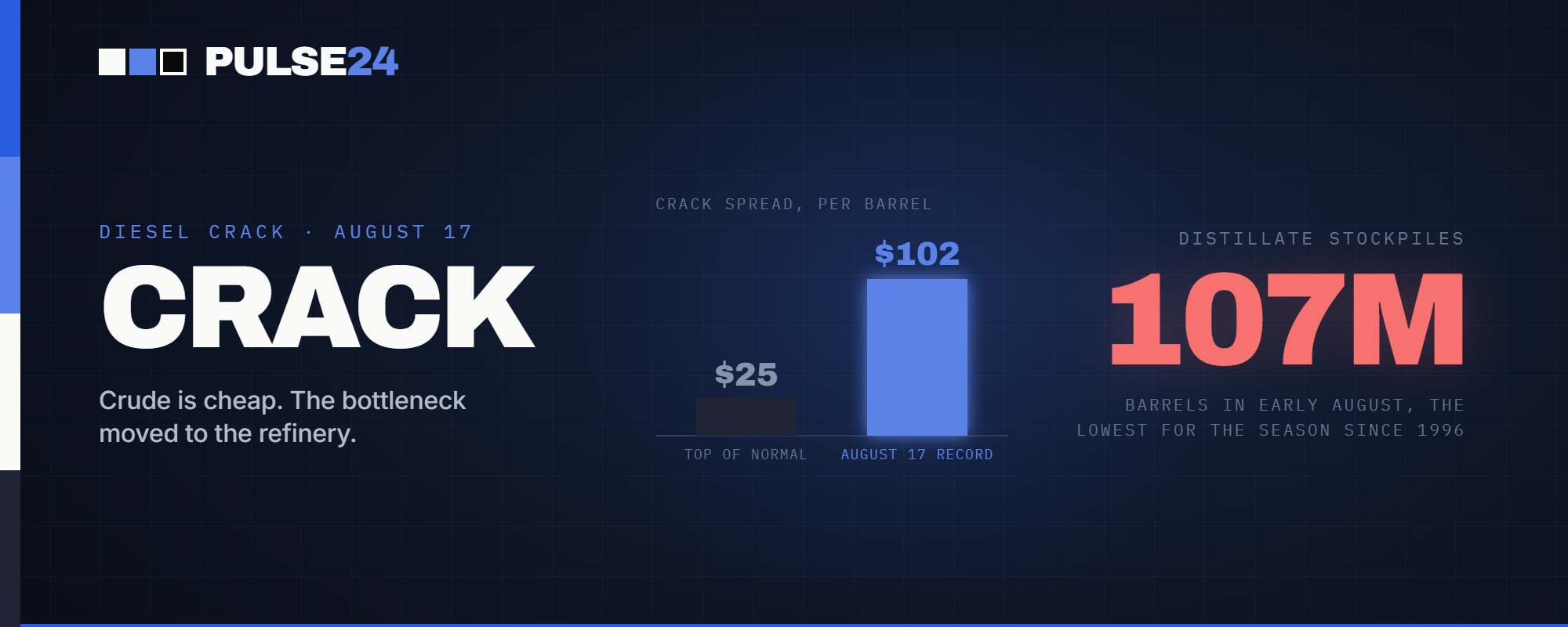
The Diesel Crack Spread Just Hit a Record $102 a Barrel. Three Refiners Pocketed $12.6 Billion in Profit Last Quarter While Distillate Stockpiles Sank to Their Lowest Level Since 1996.
The premium refiners earn turning crude into diesel jumped to $102 a barrel this month, roughly five times its normal range, as distillate inventories fell to their lowest level for this time of year since 1996. Marathon Petroleum, Valero, and Phillips 66 turned that squeeze into a combined $12.6 billion quarterly profit, and diesel's climb toward $5.26 a gallon is starting to show up in freight costs and grocery bills.
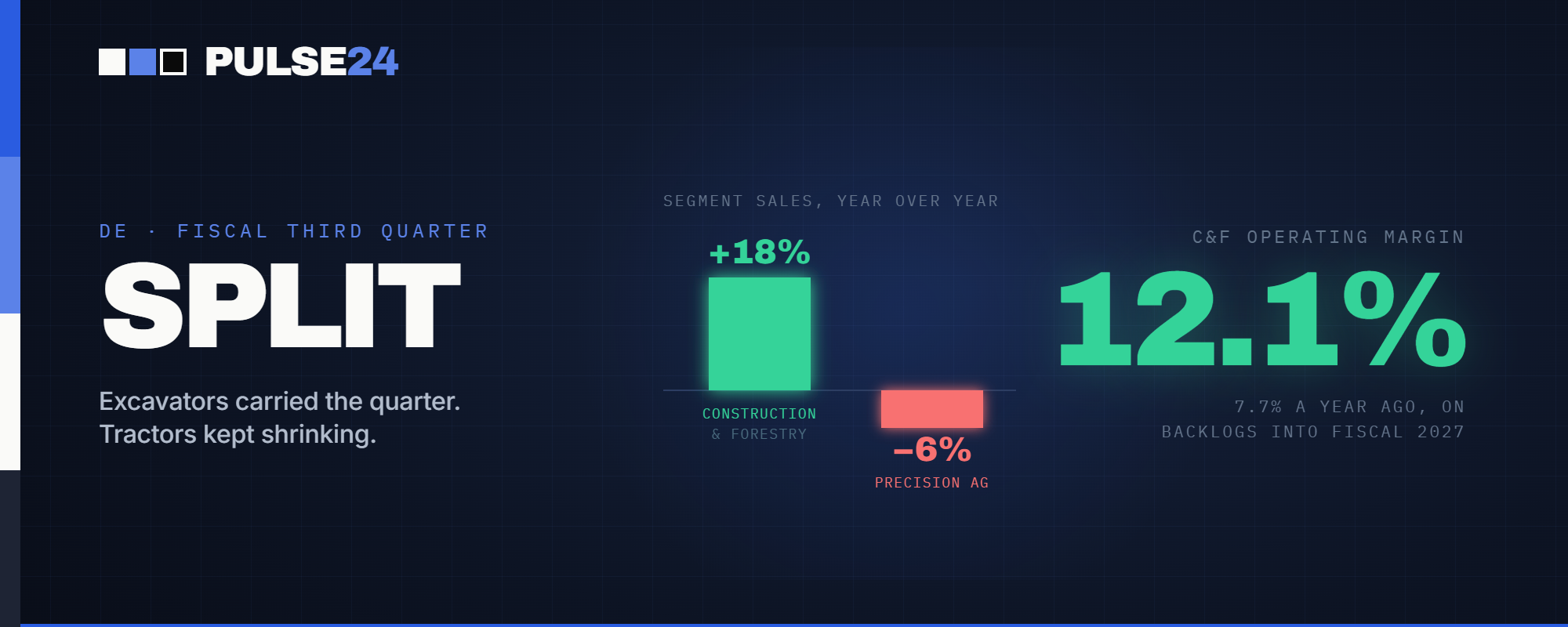
Deere's Construction Equipment Sales Jumped 18% on 'Data Center Starts.' Its Farm Machinery Business Fell 6% in the Same Quarter.
Deere's construction and forestry segment grew sales 18% last quarter, and executives pointed straight at data center construction as the driver. Meanwhile the company's core farm equipment business kept shrinking, a split that says as much about the AI buildout as it does about the American farm belt.
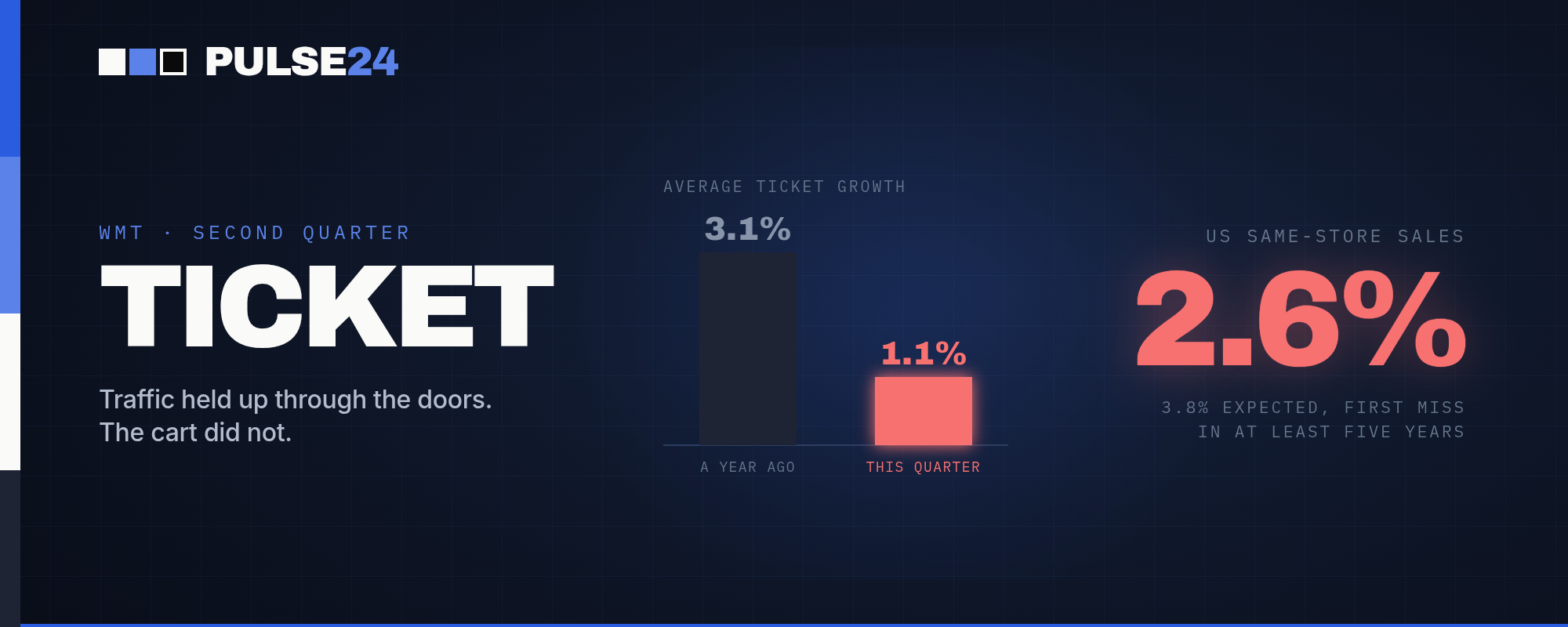
Walmart Just Posted Its First US Same-Store Sales Miss in at Least Five Years. Its Own CFO Blamed Gas Prices Above $4, Not Anything on Its Shelves.
Walmart grew US same-store sales 2.6% last quarter, short of the 3.8% Wall Street wanted and its first miss on that number in at least five years. The company that usually wins when shoppers trade down is now the one flashing a warning about the American consumer.
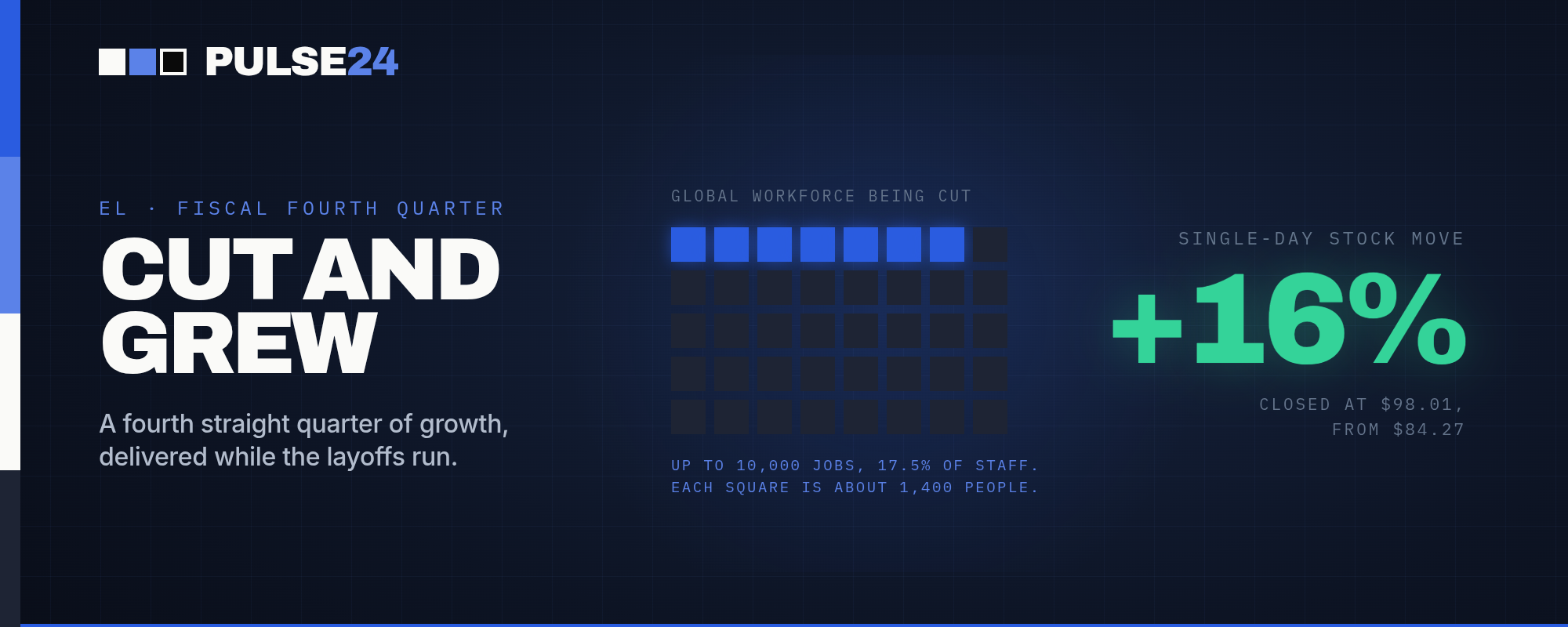
Estee Lauder Stock Jumped 16% on a Beat and Raise. In May, the Company Announced Plans to Cut Up to 10,000 Jobs, Nearly a Fifth of Its Workforce.
Estee Lauder shares jumped 16% after a China-led turnaround quarter, even as the company works through cuts to nearly a fifth of its global workforce. The report is a real test case for whether cost cutting and revenue growth can move together, and whether Chinese luxury spending is actually coming back.
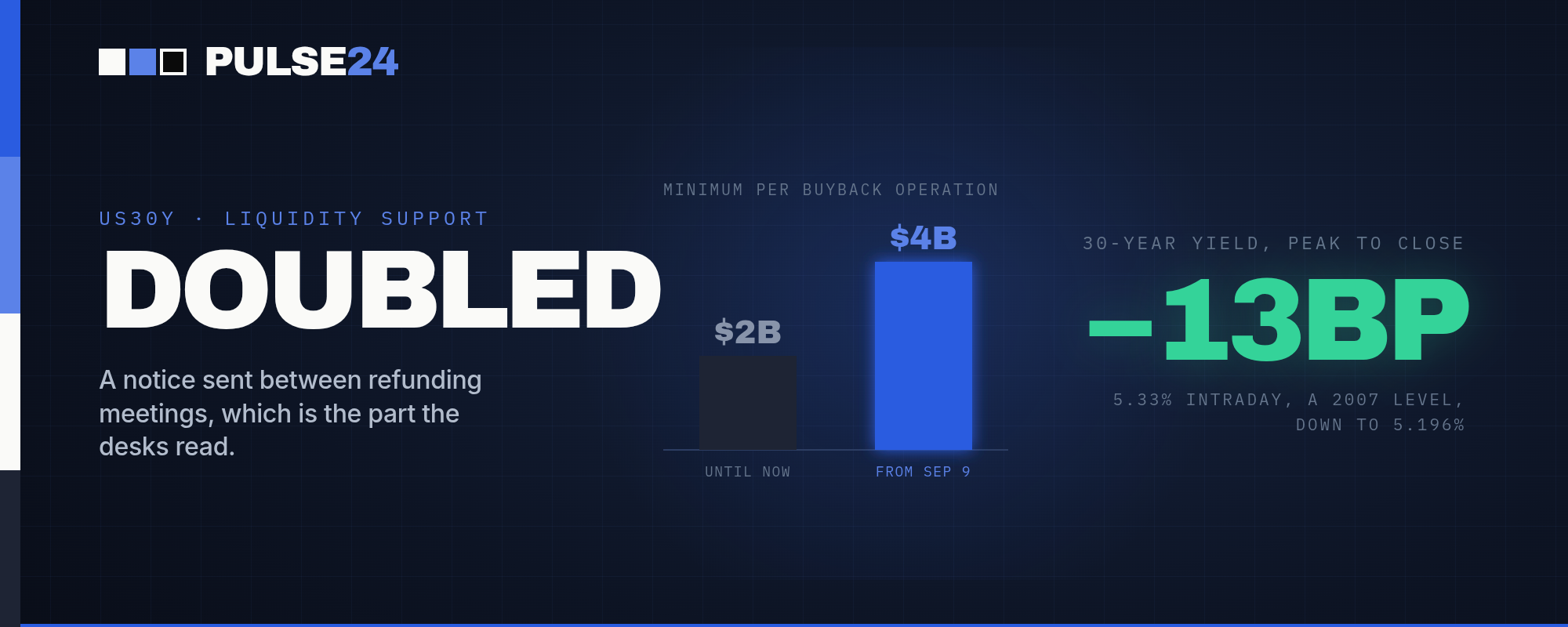
The Treasury Just Doubled Its Bond Buybacks to Cool a 5.3% Yield. Gold Jumped 3%, the Dollar Slipped, and Bitcoin Cleared $68,000 the Same Afternoon.
The Treasury just doubled the minimum size of its long-bond buybacks outside its normal schedule, and the 30-year yield reversed from a 19-year high within hours. Gold, the dollar, and Bitcoin all moved on the signal before markets had time to argue about the mechanics.
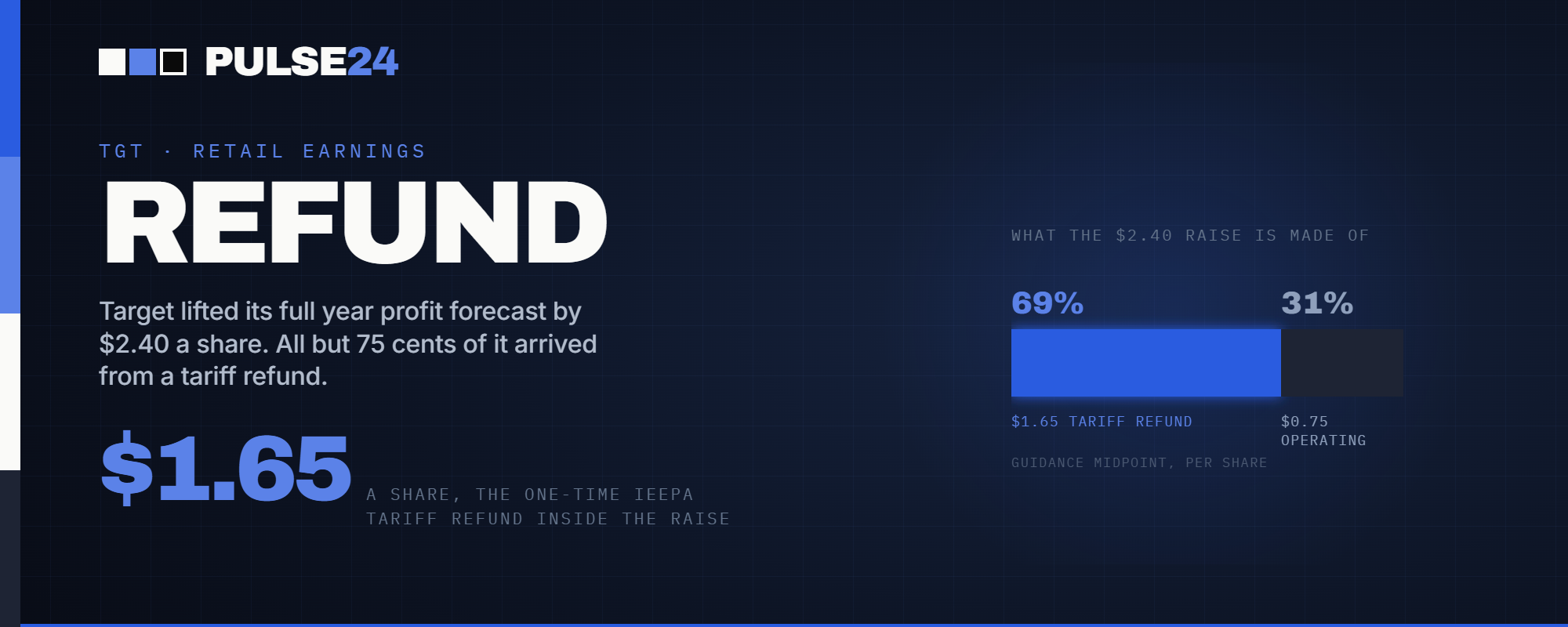
Target Just Raised Its Profit Forecast by $2.40 a Share. All But 75 Cents of That Increase Came From a One-Time Tariff Refund It Didn't Have Three Months Ago.
Target raised its full year profit forecast by $2.40 a share and the stock closed up 4.3%, but $1.65 of that increase came from a one time tariff refund. The results landed the same week government data showed retail sales fell and consumer sentiment sank well below forecasts.
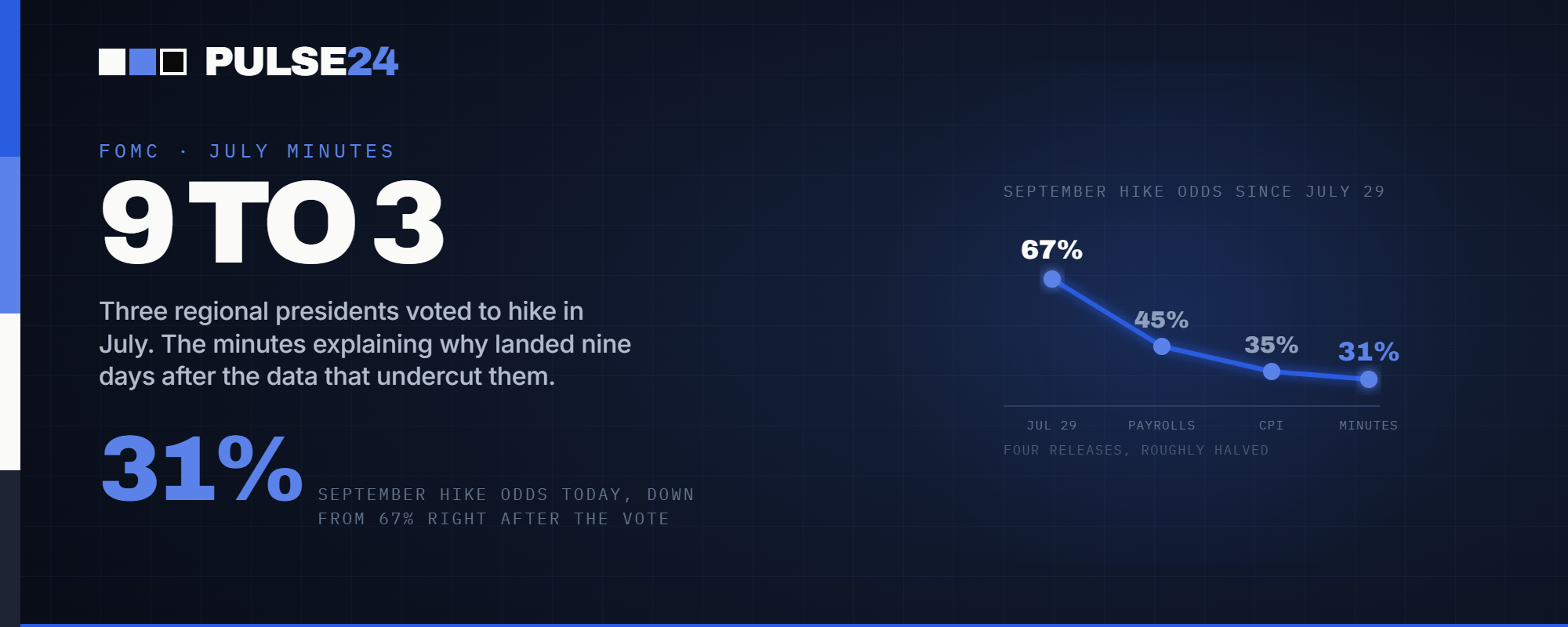
Three Fed Presidents Dissented for a Rate Hike in July, the First Time That's Happened Since 2016. The Minutes Explaining Why Landed Nine Days After the Data That Undercut Their Case.
The Fed held rates at 3.50% to 3.75% in July by a 9-3 vote, the first time three officials have dissented in the same direction since 2016. Minutes released Wednesday show the hawkish case ran deeper than the vote count, even as a month of weak data has cut September hike odds roughly in half since the meeting.
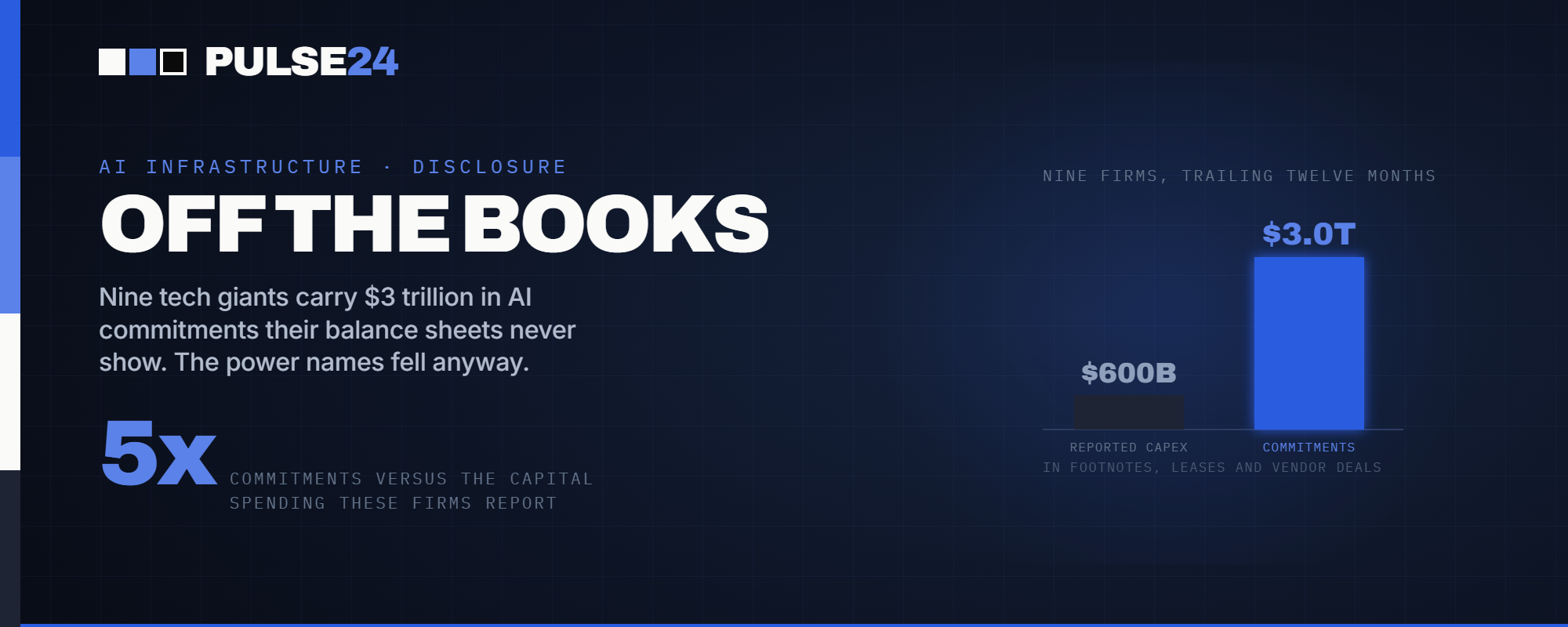
Bloom Energy Fell 10% and GE Vernova Dropped 6% in a Single Session, Even as Google and Amazon Raised Their AI Spending Plans This Week. A New Report Found Nine Tech Giants Are Carrying $3 Trillion in Commitments Their Balance Sheets Don't Show.
Bloom Energy, GE Vernova and Vertiv all sold off Tuesday even as Google and Amazon raised their AI spending guidance, after a Wall Street Journal analysis found nine tech giants are carrying $3 trillion in AI commitments that never hit their balance sheets. The gap between reported spending and total commitments is now roughly five to one.
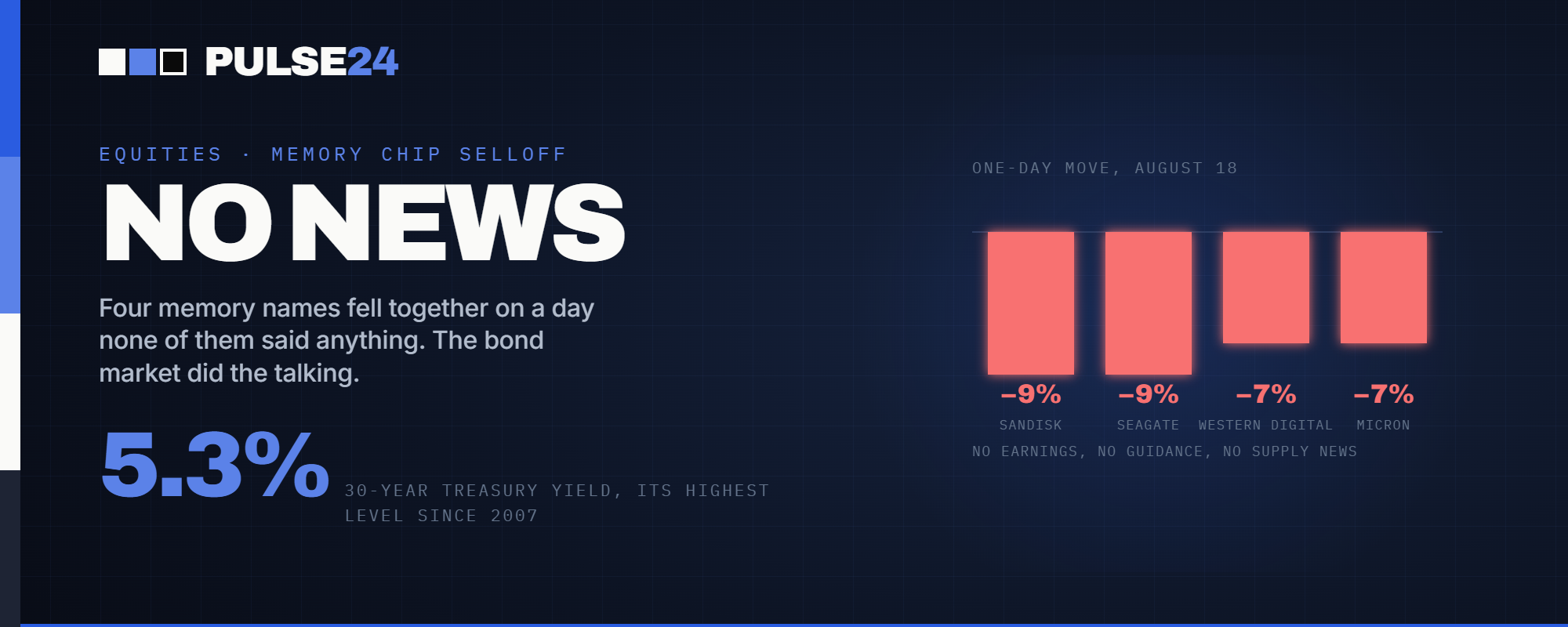
Western Digital Fell 7% and SanDisk Dropped 9% in a Session With No News About Memory Chips at All. A 30-Year Treasury Yield Near Its Highest Level Since 2007 Was the Real Trigger.
Memory chip stocks lost billions in value on August 18 with no company-specific news behind the move. The real trigger was a 30-year Treasury yield pushing toward its highest level since 2007, a reminder that even AI's hottest trade isn't immune to rising rates.
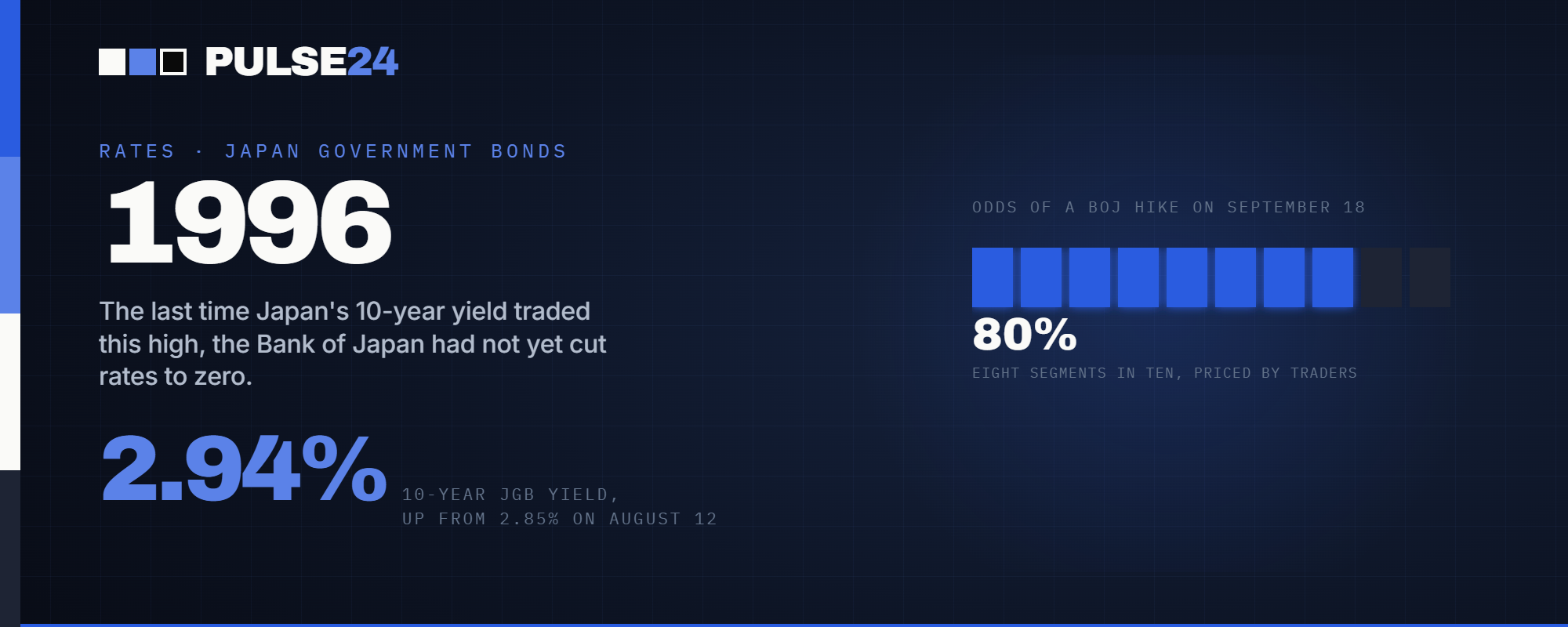
Japan's 10-Year Bond Yield Just Hit 2.94%, Its Highest Level Since 1996. Tokyo Wants to Cut the Food Tax to 1% for Two Years and Still Hasn't Said How It Will Pay for It.
Japan's 10-year government bond yield climbed to its highest level since 1996 this week, driven by rising Bank of Japan rate hike bets and a food tax cut plan that still lacks a funding source. The move is already rippling into the yen and, potentially, US Treasury demand.
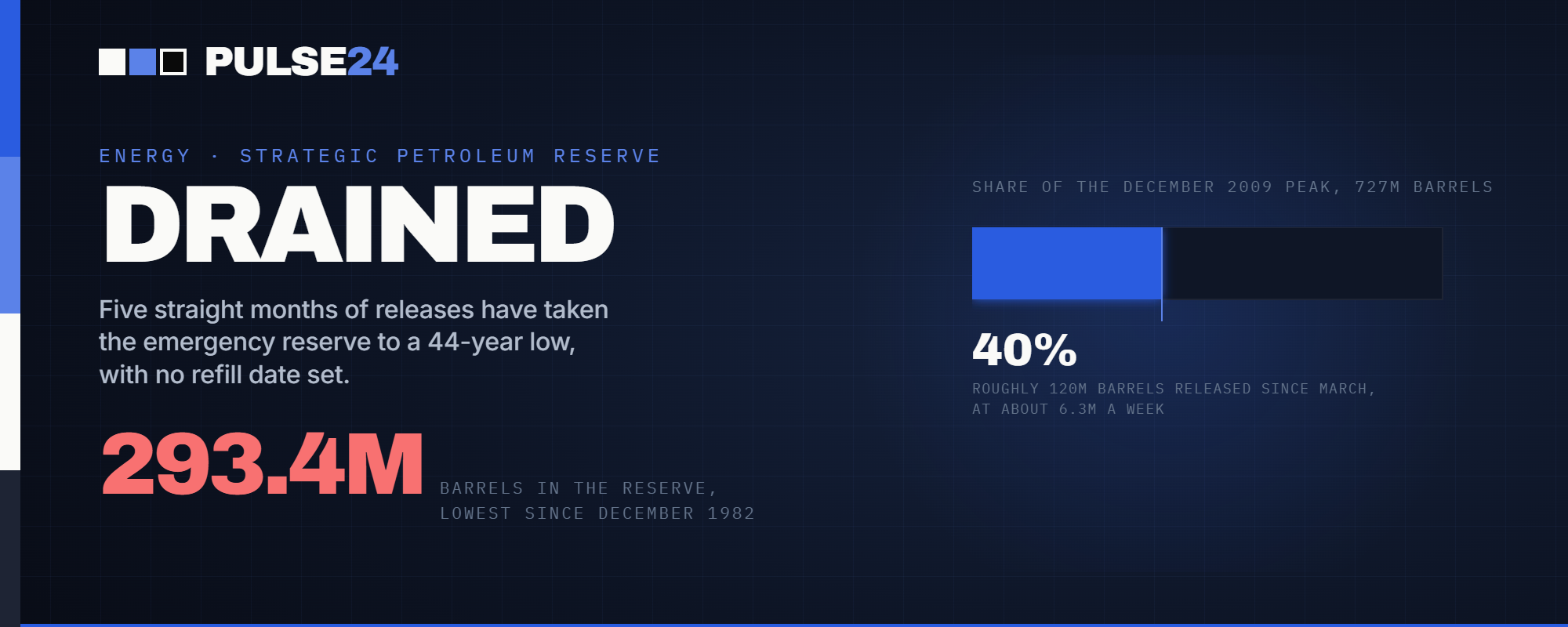
The Strategic Petroleum Reserve Just Fell to 293.4 Million Barrels, Its Lowest Level Since December 1982. Five Straight Months of Releases Have Drained It to Roughly 40% of Its 2009 Peak.
The Strategic Petroleum Reserve just fell to its lowest level since 1982, and releases haven't stopped. A thinner emergency cushion carries risks that go well beyond what today's gas prices suggest.
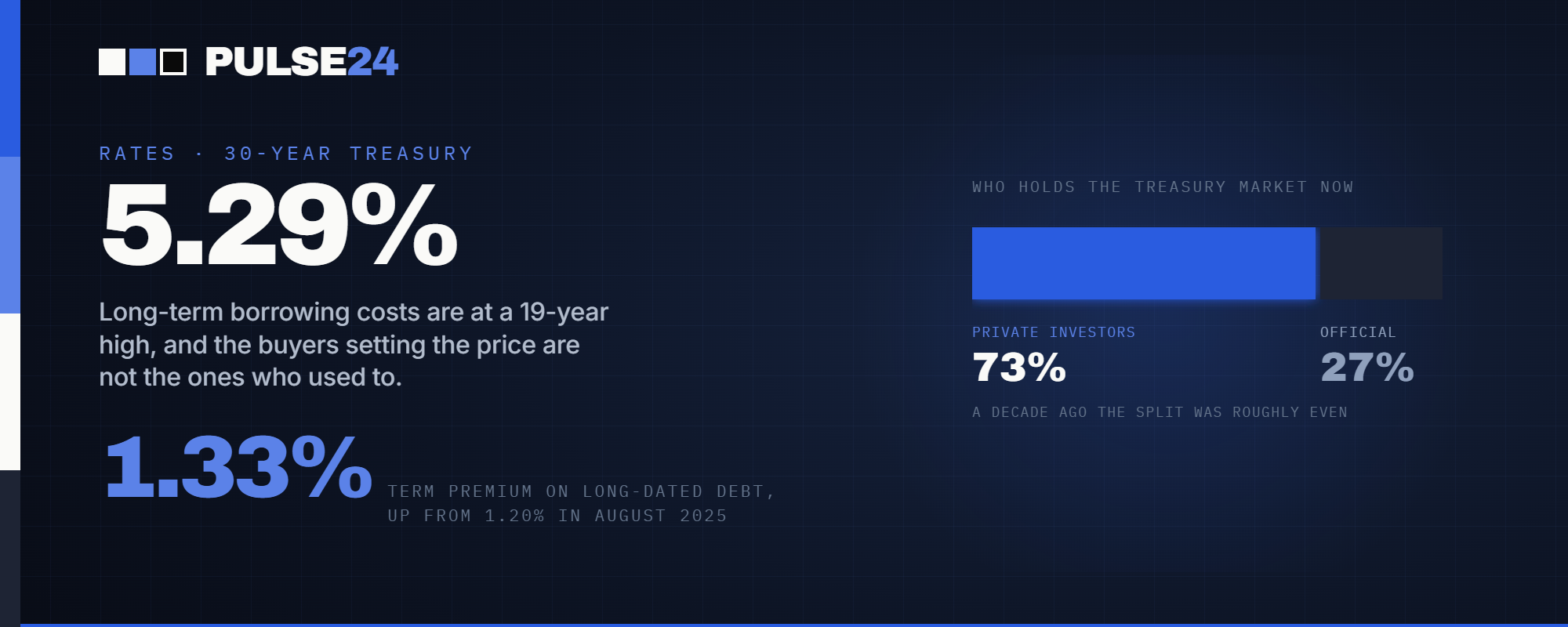
The 30-Year Treasury Yield Just Hit 5.29%, Its Highest Level Since 2007. The Buyers Who Used to Set the Price Now Own Barely a Quarter of the Market.
The 30-year Treasury yield just touched its highest level since 2007, and the Fed isn't really driving it anymore. A quiet shift in who buys U.S. government debt, from central banks to private investors, is pushing up the price of borrowing for three decades at a time.
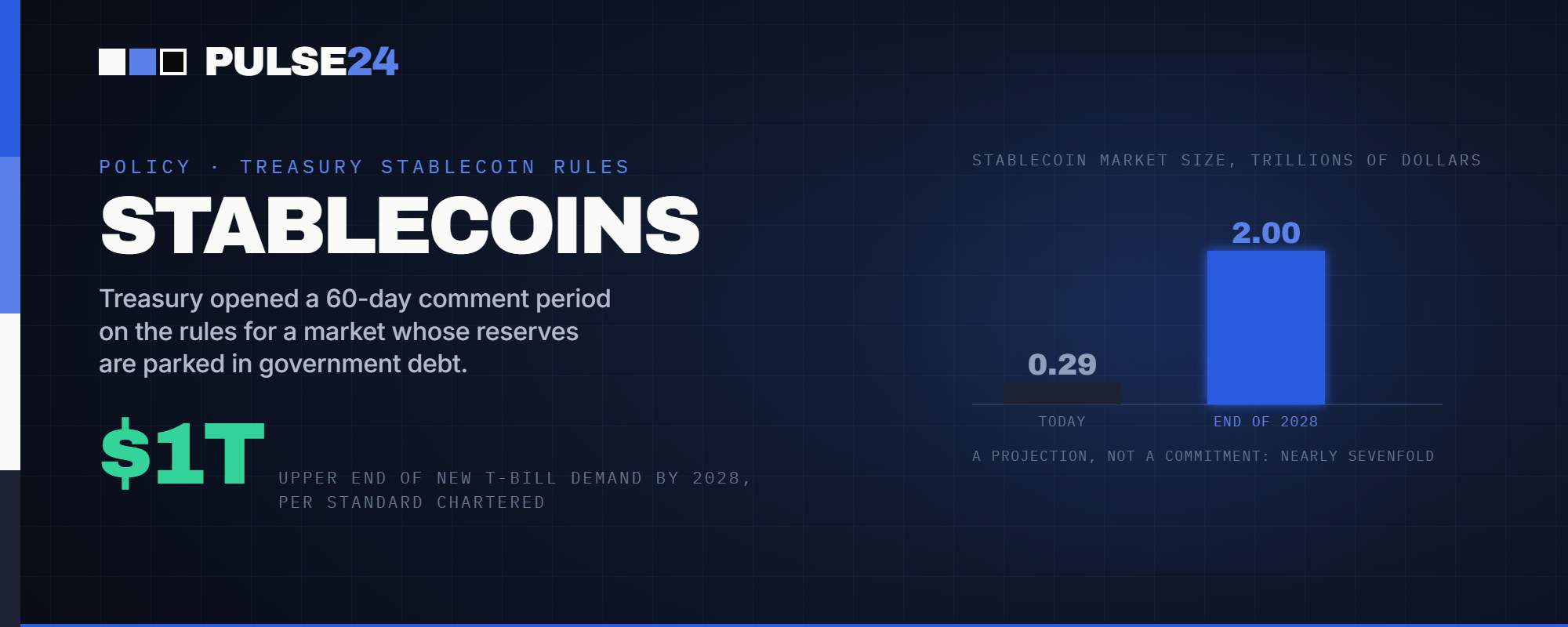
The Treasury Just Proposed Rules for a $287 Billion Stablecoin Market. One Bank Thinks It Could Grow to $2 Trillion and Buy Up to $1 Trillion in T-Bills.
The Treasury opened a 60-day comment period on stablecoin rules this week, and Standard Chartered says the market behind them could grow nearly sevenfold by 2028, sending as much as $1 trillion of fresh demand into short-term government debt. It's a reminder that crypto regulation and Treasury market plumbing are no longer separate stories.
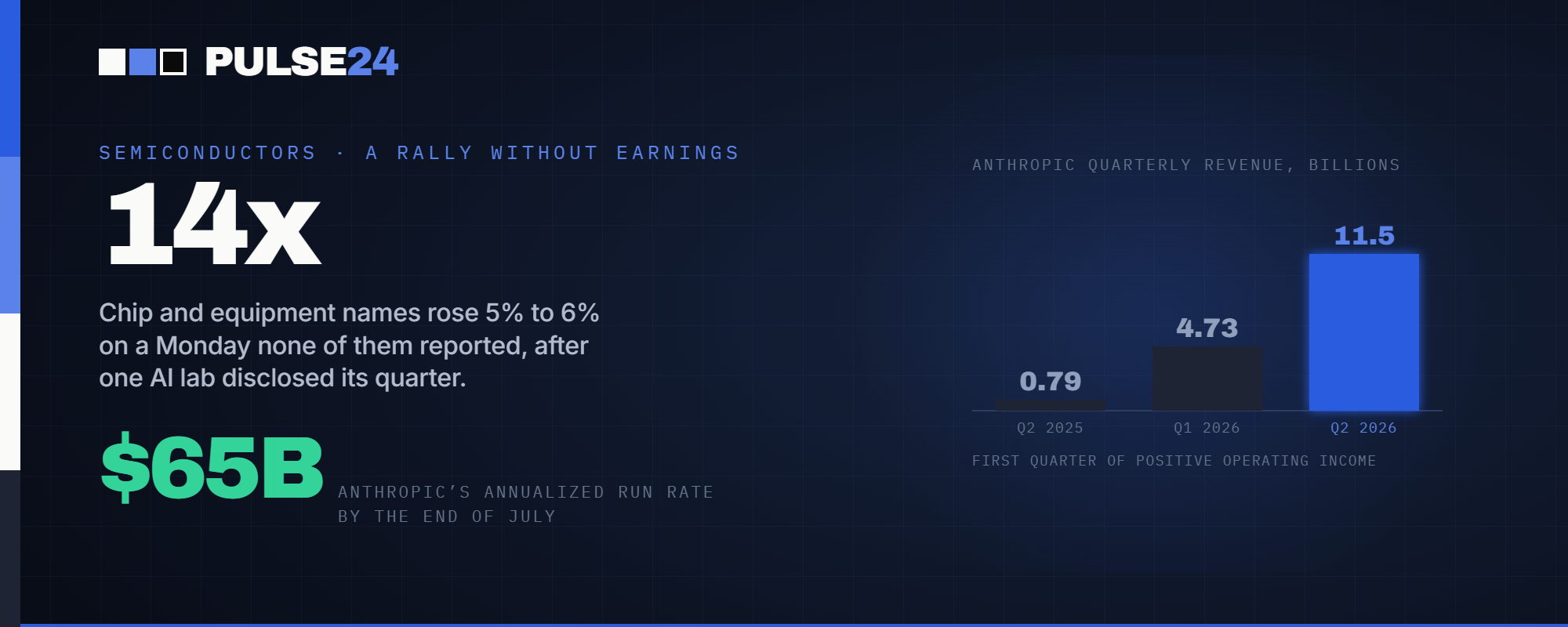
Marvell, FormFactor, and Applied Materials Jumped Nearly 6% in a Day, and None of Them Reported Earnings. Anthropic Just Told Investors Its Revenue Grew 14-Fold to $11.5 Billion.
Marvell, FormFactor, and Applied Materials all jumped between 5% and 6% Monday without reporting anything about their own businesses. Two catalysts, Anthropic's blockbuster revenue disclosure and a White House push to keep Apple away from Chinese memory chips, explain why, and where the read could go wrong.
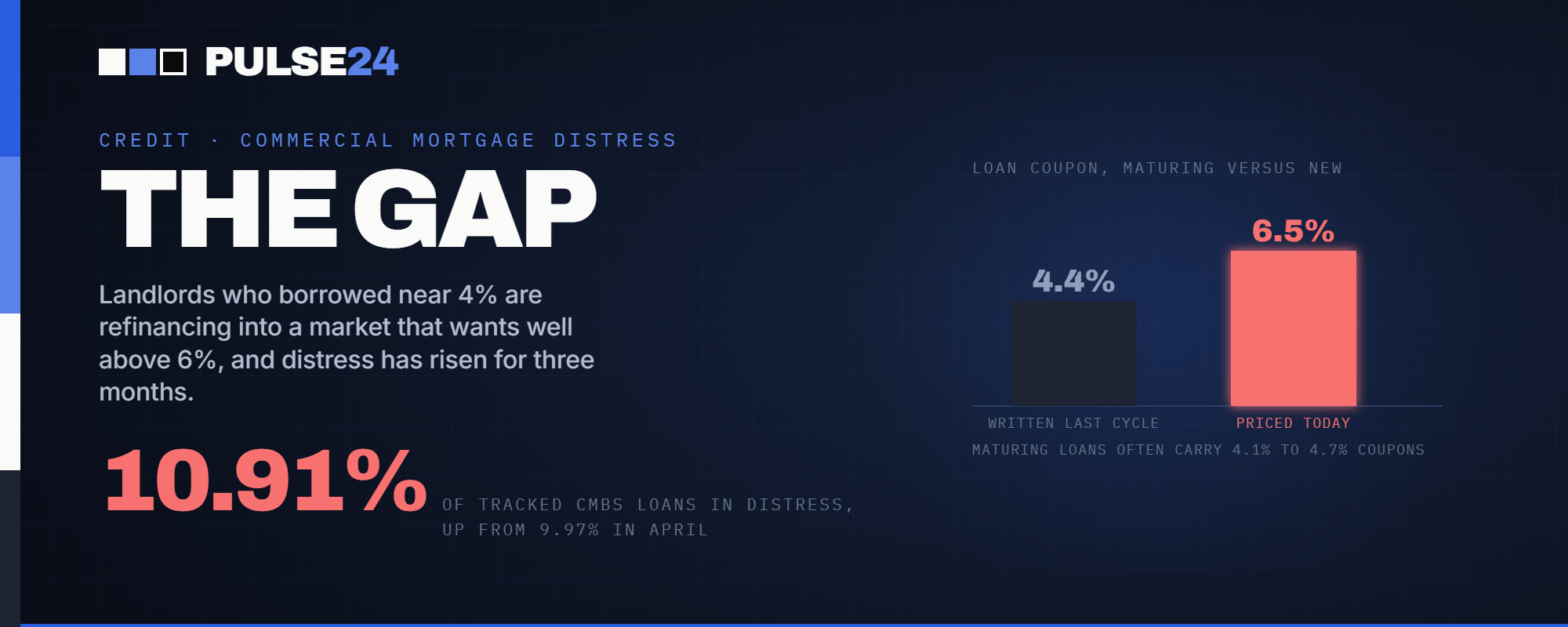
Commercial Real Estate Distress Just Climbed for a Third Straight Month to 10.91%. Landlords Refinancing This Year Are Trading 4% Loans for Rates Above 6.5%.
CMBS distress rose to 10.91% in July, the third straight monthly increase, with office properties running more than 50% above the market average. The real pressure isn't defaults yet, it's a refinancing gap: loans written near 4% are coming due into a market pricing new debt above 6.5%.
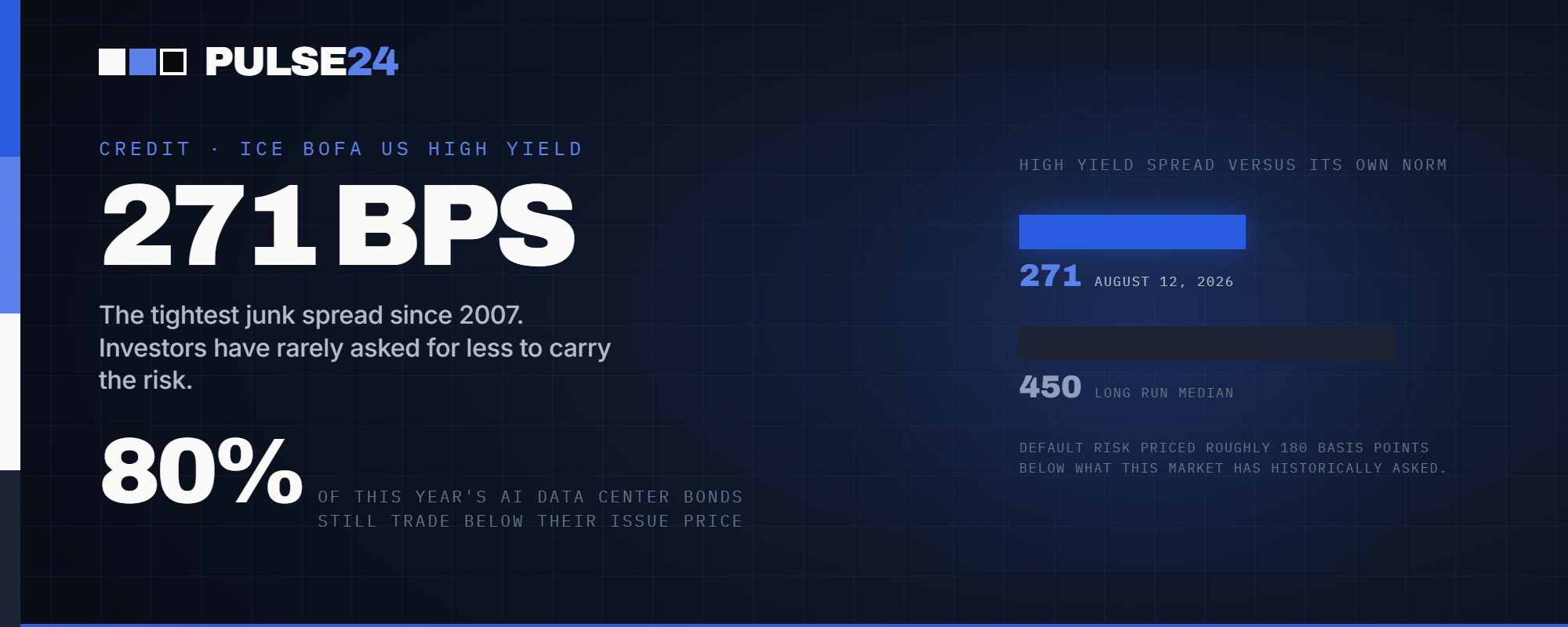
Junk Bond Spreads Just Fell to 271 Basis Points, the Tightest Level Since 2007. Nearly 80% of This Year's AI Data-Center Bonds Are Still Trading Below Where They Were Sold.
High-yield credit spreads just closed at 271 basis points, the tightest reading since 2007, while nearly 80% of this year's AI data-center bonds are still trading underwater. The broad junk market has rarely been more confident. One specific corner of it already isn't.
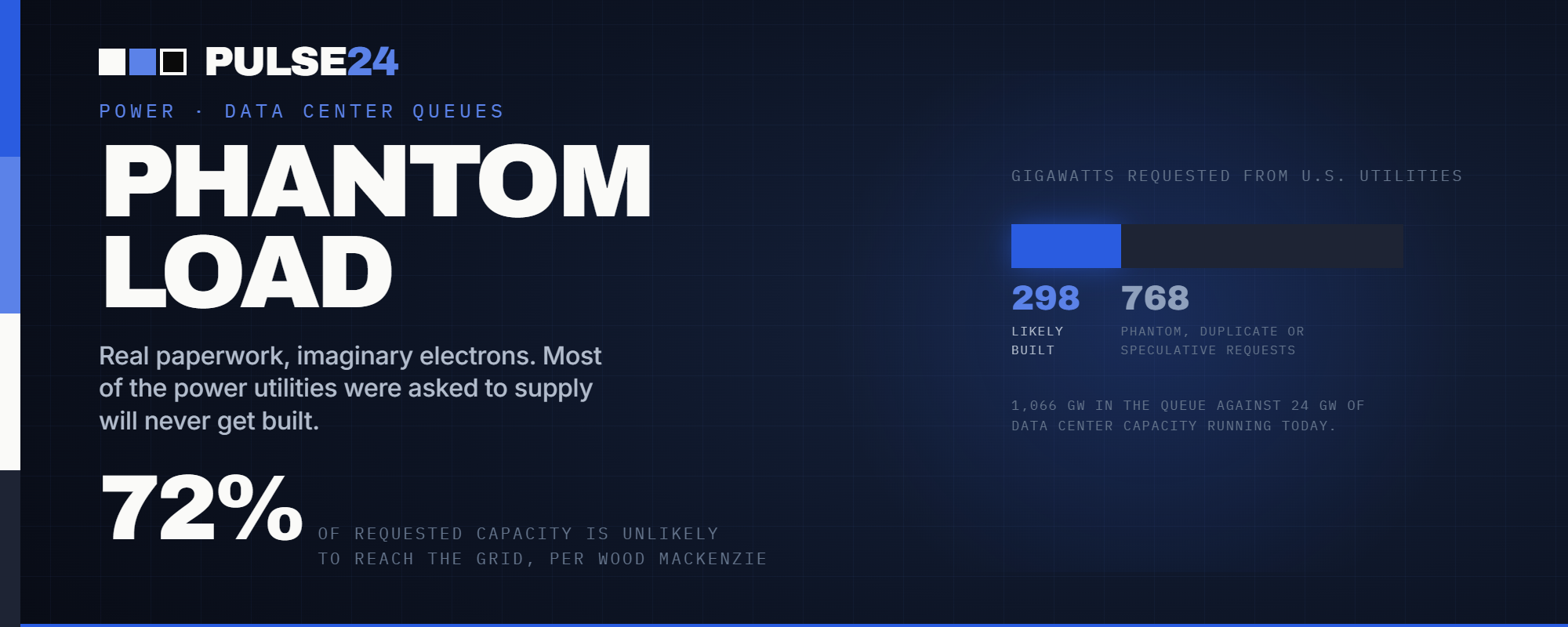
Utilities Betting on the AI Power Boom Are Down More Than 30% From Their Highs. New Research Says 72% of the Electricity They've Been Asked to Supply Will Never Get Built.
Wood Mackenzie says only 28% of the 1,066 gigawatts utilities have been asked to line up for U.S. data centers will actually get built. The two utility stocks most tied to that story are already down double digits from their highs, real hyperscaler contracts included.
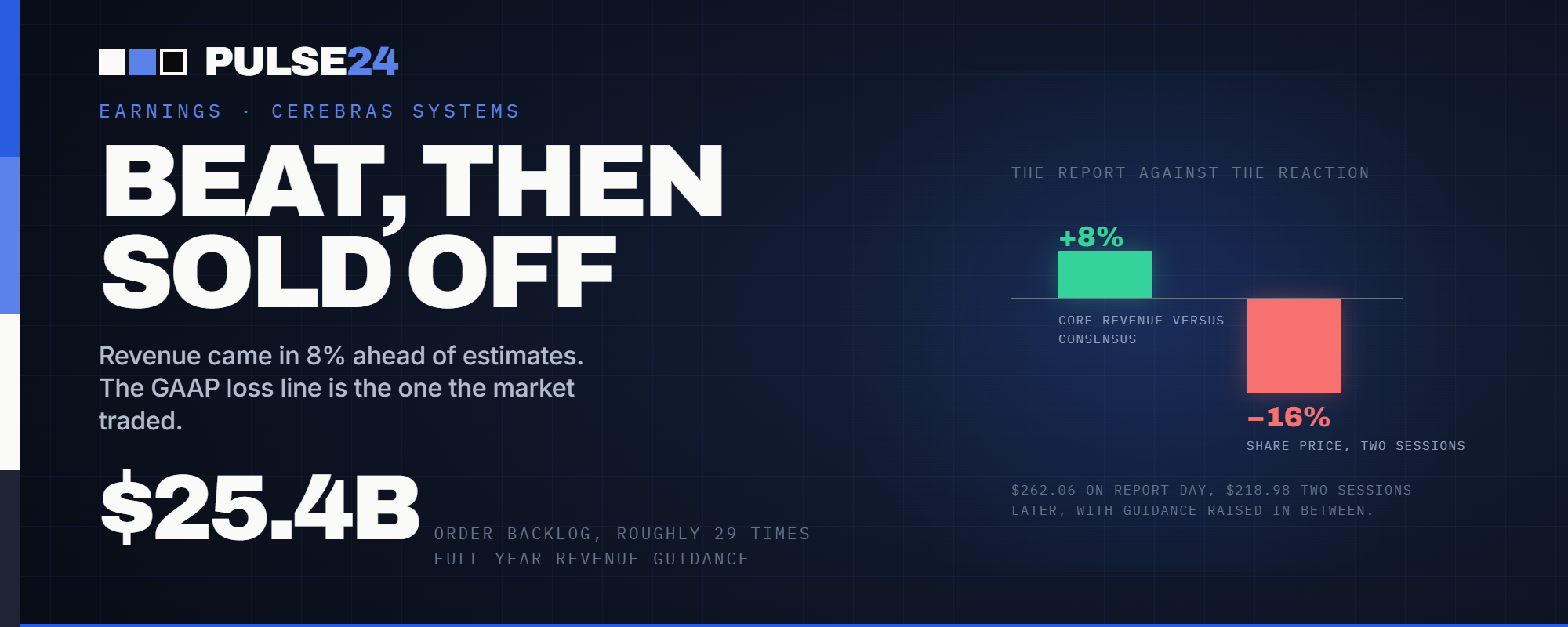
Cerebras Beat Wall Street's Revenue Estimate by 8%. Its Stock Still Fell 16% Over the Next Two Days.
Cerebras posted 103% core revenue growth and beat Wall Street's estimates in its first full quarter as a public company, but a $450 million GAAP loss sent the stock tumbling 16% in two trading days. The gap between the headline loss and the underlying business says a lot about how Wall Street is pricing young AI infrastructure companies right now.
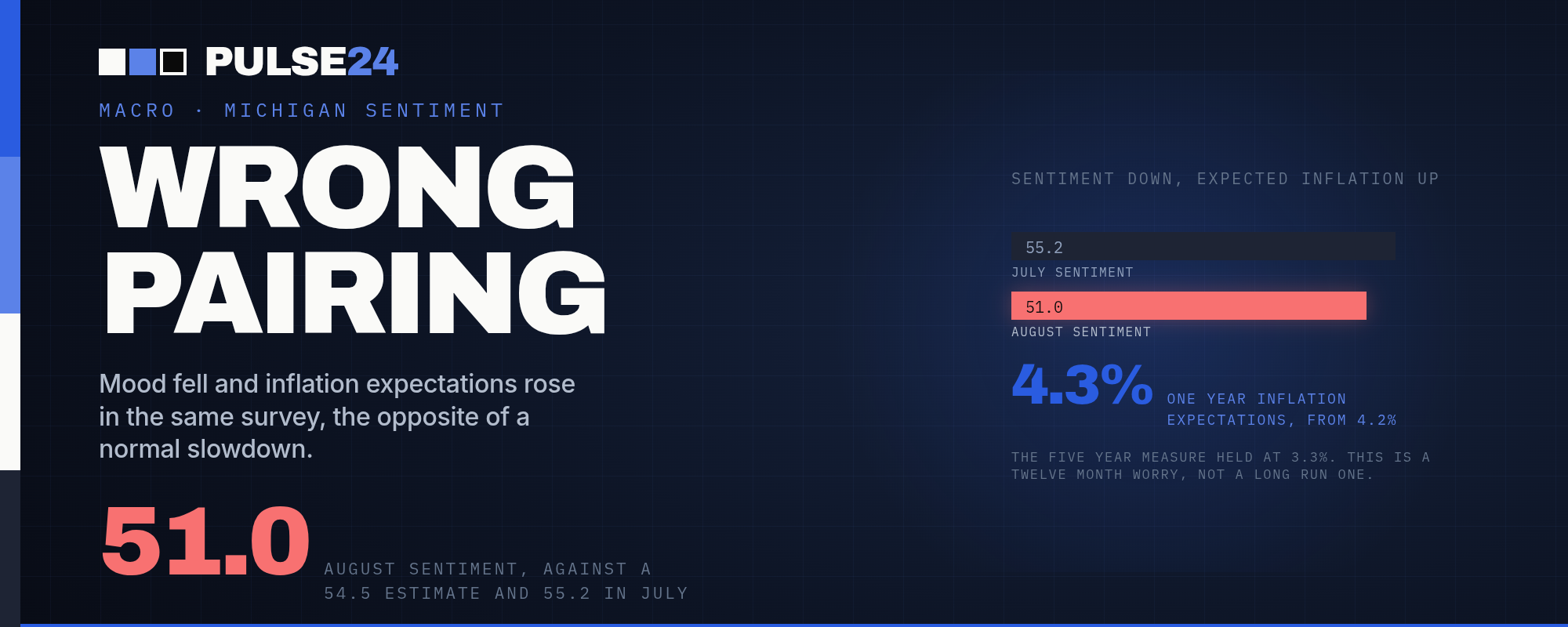
US Consumer Sentiment Just Sank to 51.0, Badly Missing the 54.5 Estimate. Inflation Expectations Rose to 4.3% in the Same Report, Just as the Fed Leans Toward a September Hike.
The University of Michigan's August survey reversed two months of recovery in a single report, and the inflation expectations buried inside it may matter more to the Fed than the headline drop. Target and Walmart earnings, then Fed Chair Kevin Warsh's first Jackson Hole keynote, are next up to confirm or contradict the signal.
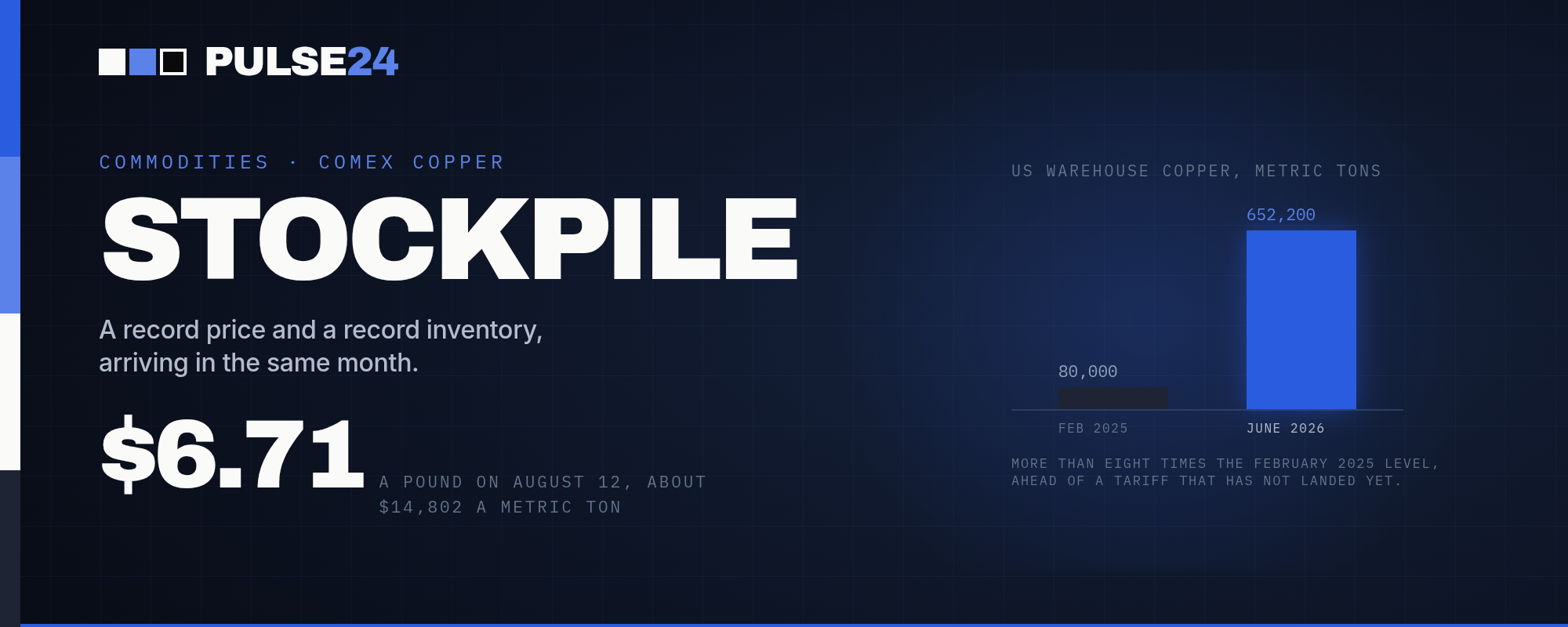
Copper Just Hit a New All-Time High of $6.71 a Pound. US Warehouses Are Already Sitting on a Record Stockpile.
Copper hit a fresh all-time high of $6.7140 a pound on COMEX in mid-August, weeks after US warehouses filled with a record 652,200 metric tons of the metal back in June. The rally has more to do with traders positioning for a tariff that hasn't taken effect yet than with any near-term supply crunch.
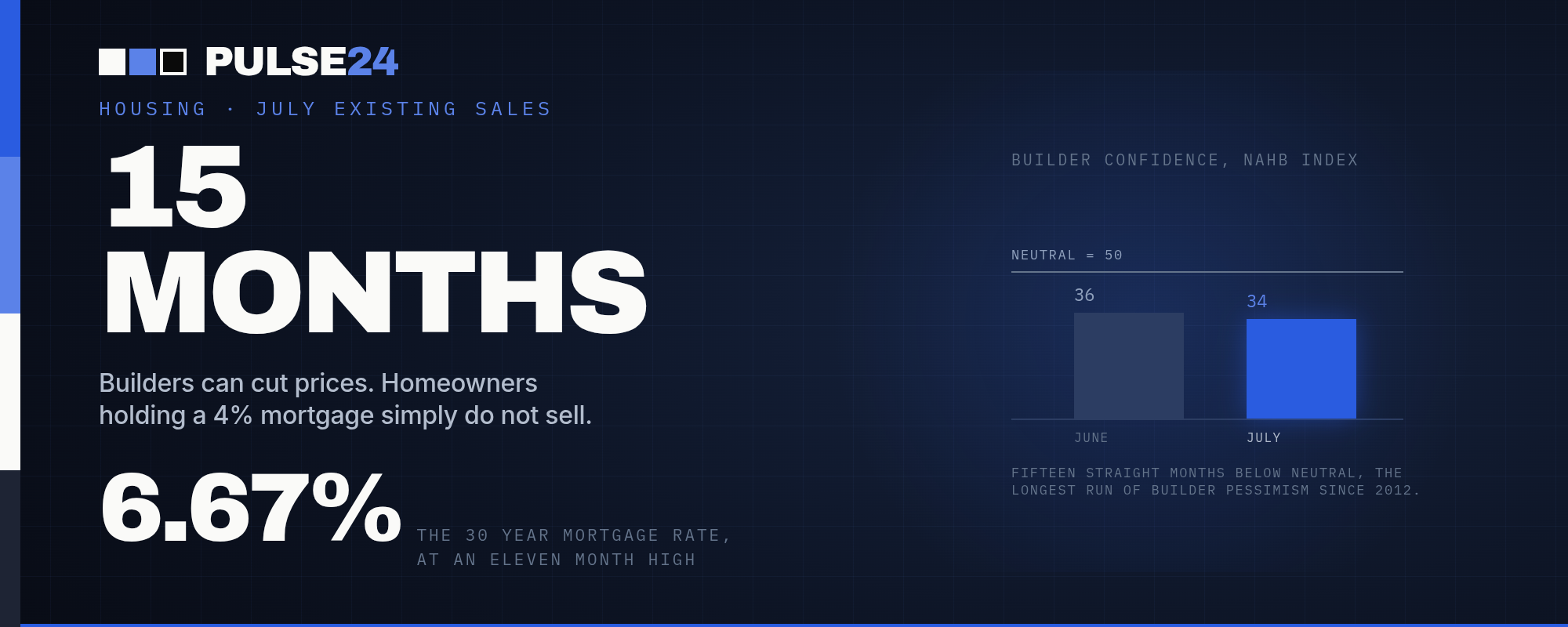
Existing Home Sales Fell 1.7% in July. Homebuilders Have Now Cut Prices for 15 Straight Months, the Longest Stretch Since 2012.
July's existing home sales slipped to a 4.06 million annual pace as the 30-year mortgage rate held near 6.67%, an 11-month high. Builder confidence sank to 34, its 15th straight month below the neutral 50 mark, and more than a third of builders are now cutting prices just to move inventory.
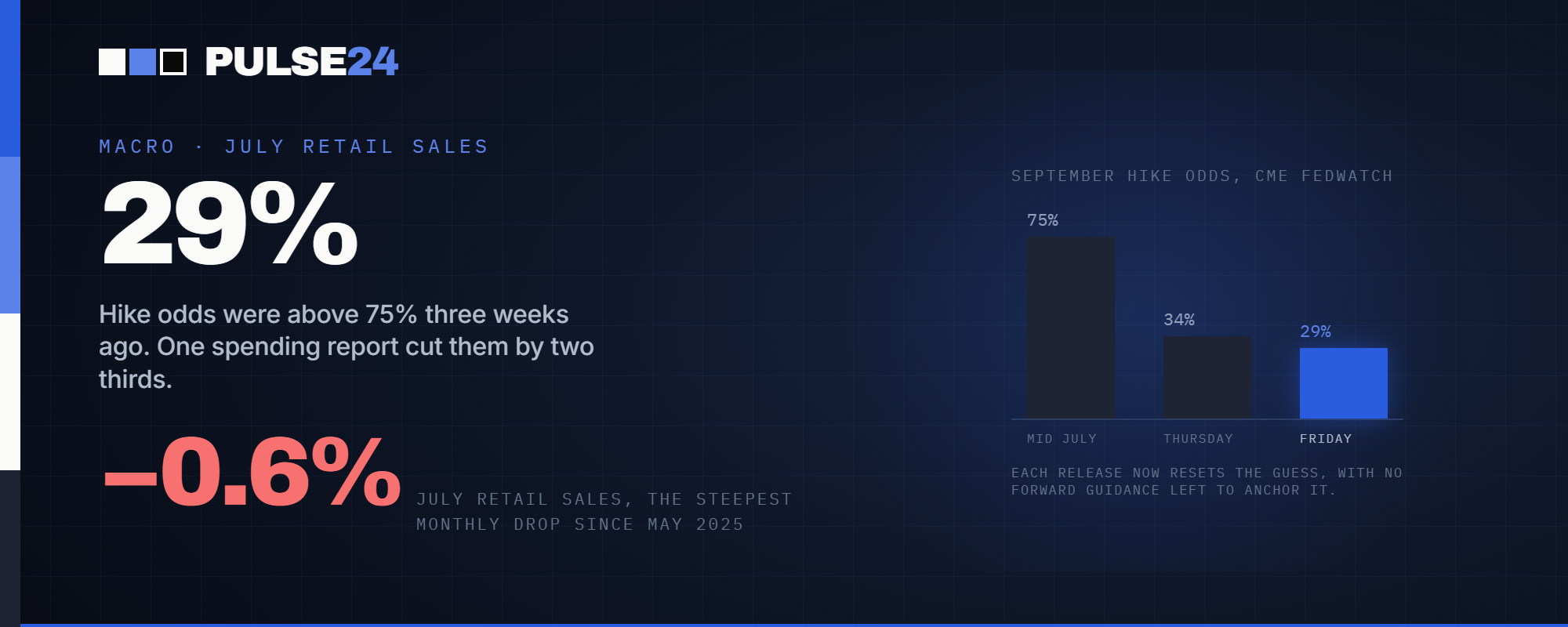
Weak Retail Sales Just Cut the Odds of a September Fed Rate Hike to 29%. Three Weeks Ago, Wall Street Put Them Above 75%.
July retail sales fell 0.6%, the steepest monthly drop since May 2025, and traders responded by cutting September Fed rate hike odds to 29% from above 75% just weeks ago. Treasury yields barely moved, because oil pulled in the opposite direction.
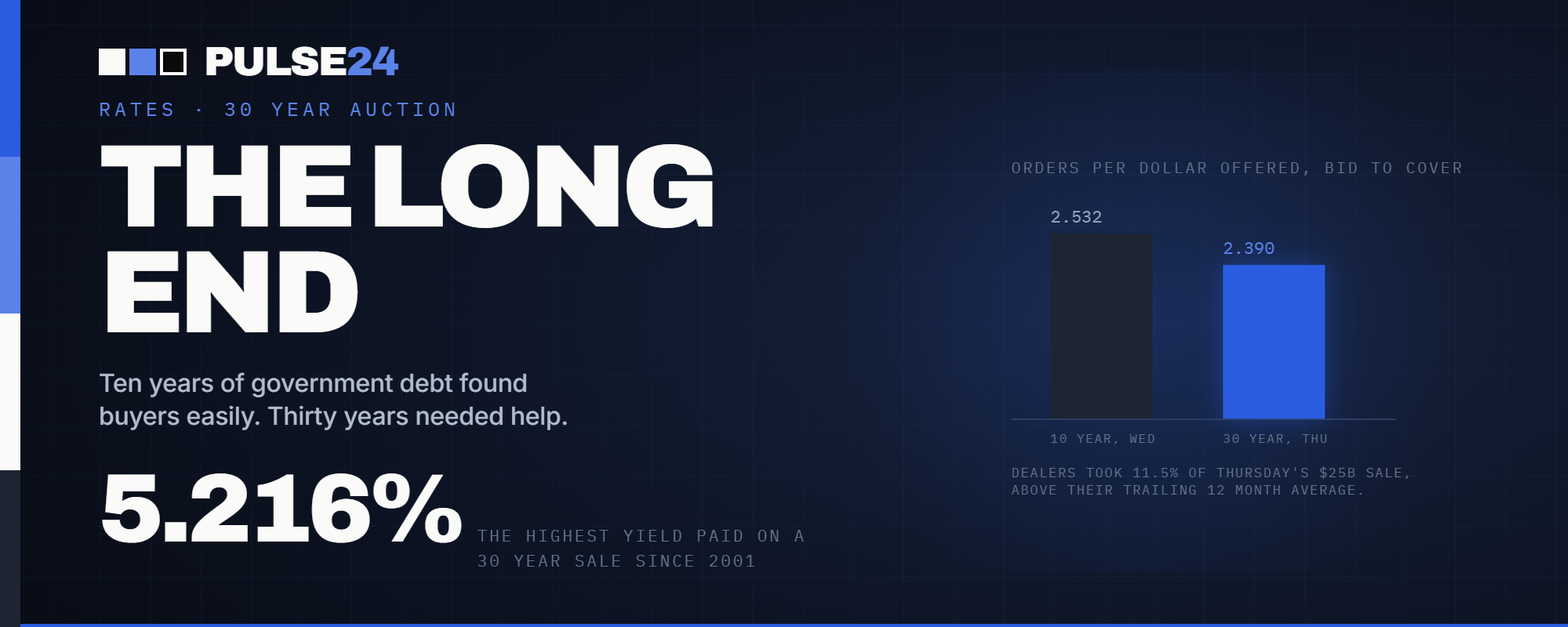
The US Just Paid the Highest Price for 30-Year Debt Since 2001. A Day Earlier, the 10-Year Auction Had No Trouble Finding Buyers.
The Treasury paid its highest 30-year yield since 2001 on Thursday, and demand was noticeably weaker than the 10-year auction a day earlier. The gap says a lot about deficits, competition from AI-related corporate debt, and how much confidence the bond market has in the Fed's new chair.
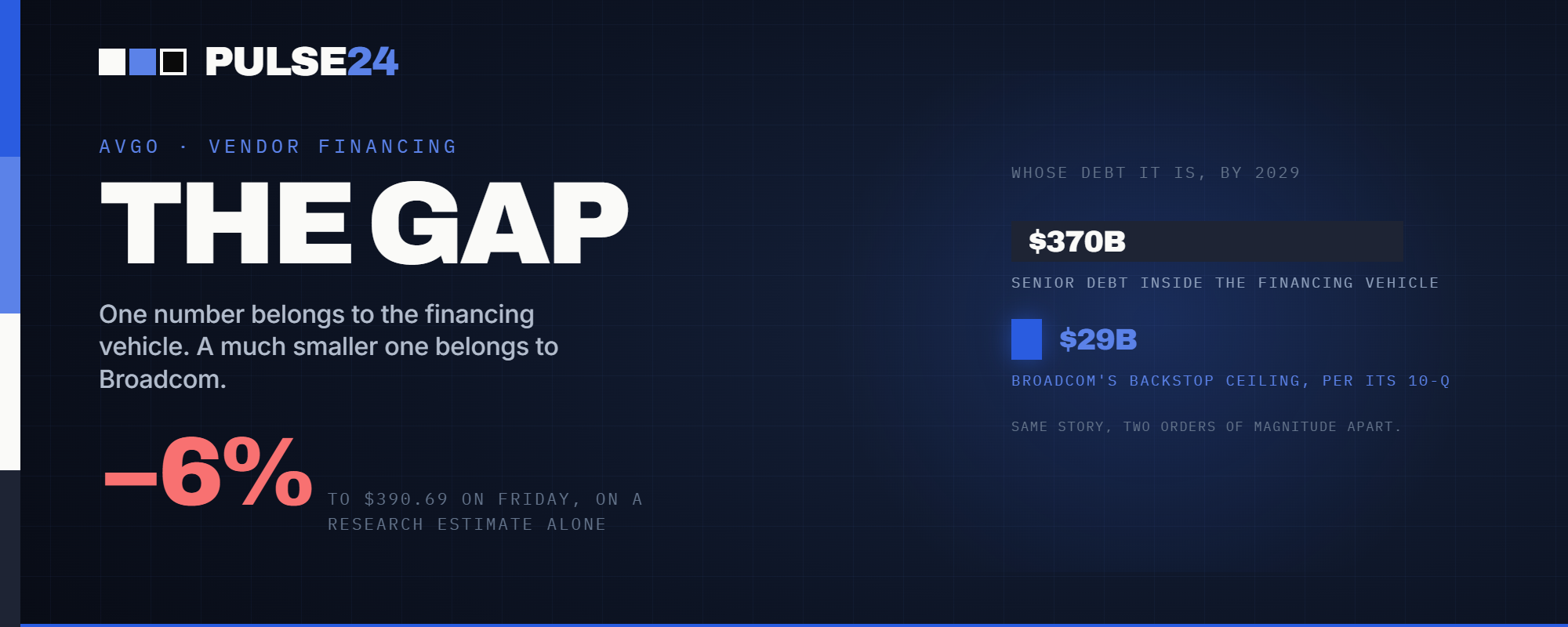
Bank of America Says Broadcom's AI Financing Vehicle Could Carry $370 Billion in Debt by 2029. Broadcom's Own Exposure Is Capped at $29 Billion.
Bank of America put a $370 billion number on the debt inside Broadcom's AI chip financing vehicle, and the stock fell 6% on the estimate alone. The figure describes the financing platform's exposure, not Broadcom's own balance sheet, where the company's contractual downside is capped far lower.
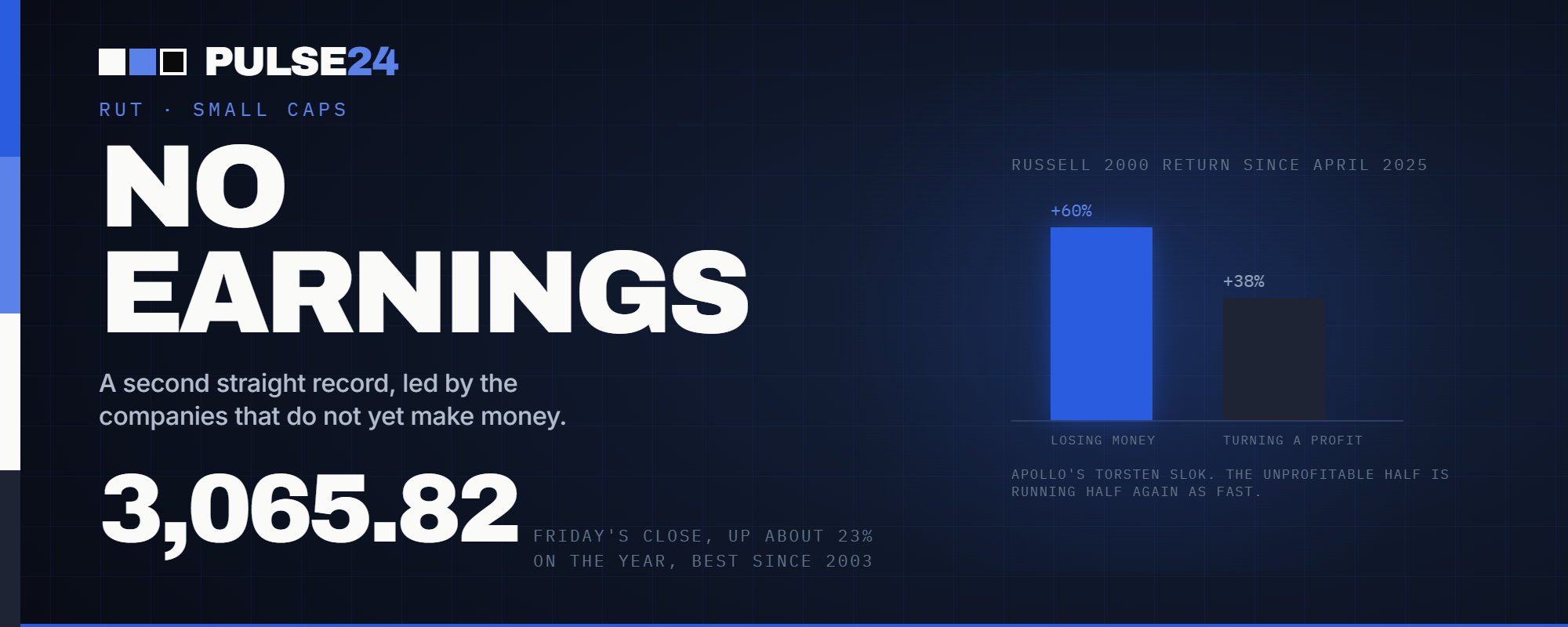
The Russell 2000 Just Set a Record for the Second Day in a Row. Stocks Losing Money Are Gaining Faster Than the Ones Turning a Profit.
The Russell 2000 closed at a fresh record Friday, its second in as many days, and small caps are having their best year since 2003. The catch: unprofitable companies in the index have gained 60% since April, well ahead of the 38% gain for profitable ones, and the reason has almost nothing to do with small-cap fundamentals.
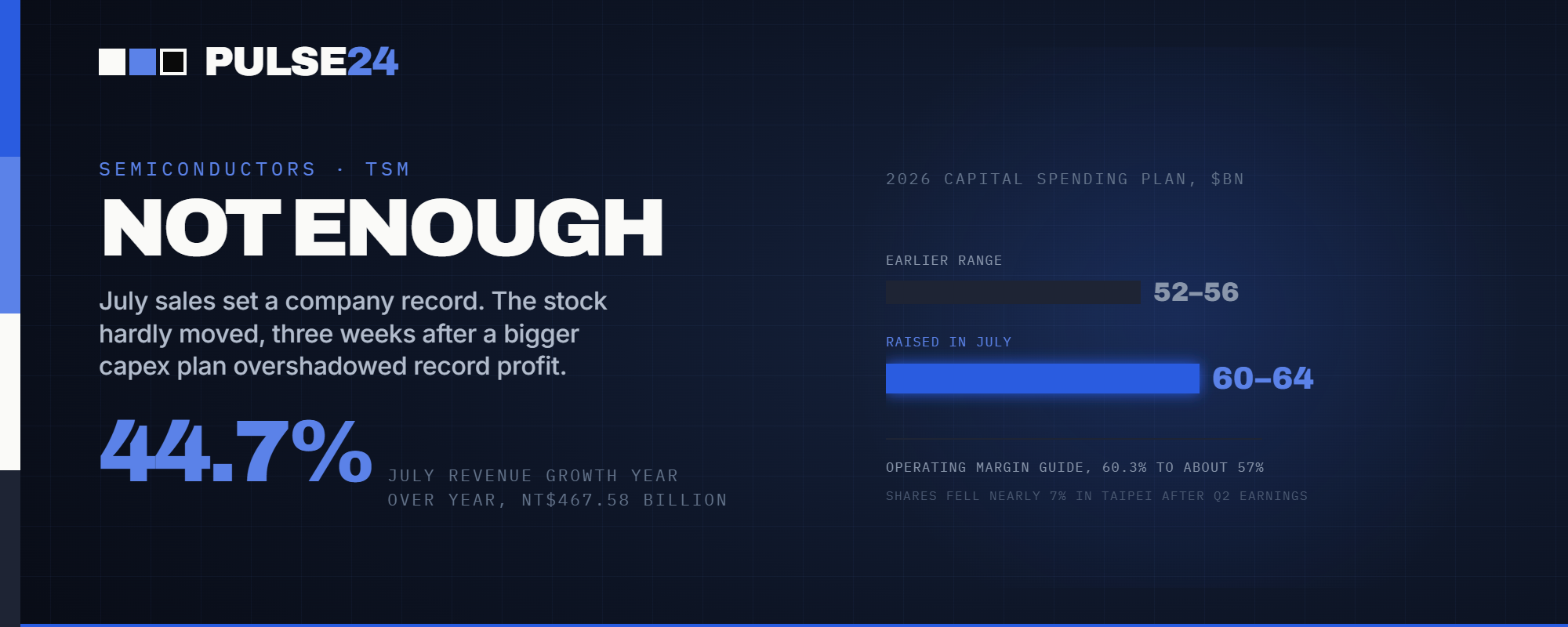
TSMC's July Revenue Jumped 44.7% to a Record $14.5 Billion. The Stock Barely Moved, Three Weeks After a Very Different Set of Record Numbers Sent It Down 7%.
TSMC's July revenue rose 44.7% to a record NT$467.58 billion, extending a run of AI-driven chip demand that keeps beating expectations. The stock's muted response says more about what's already priced in than about the demand itself.
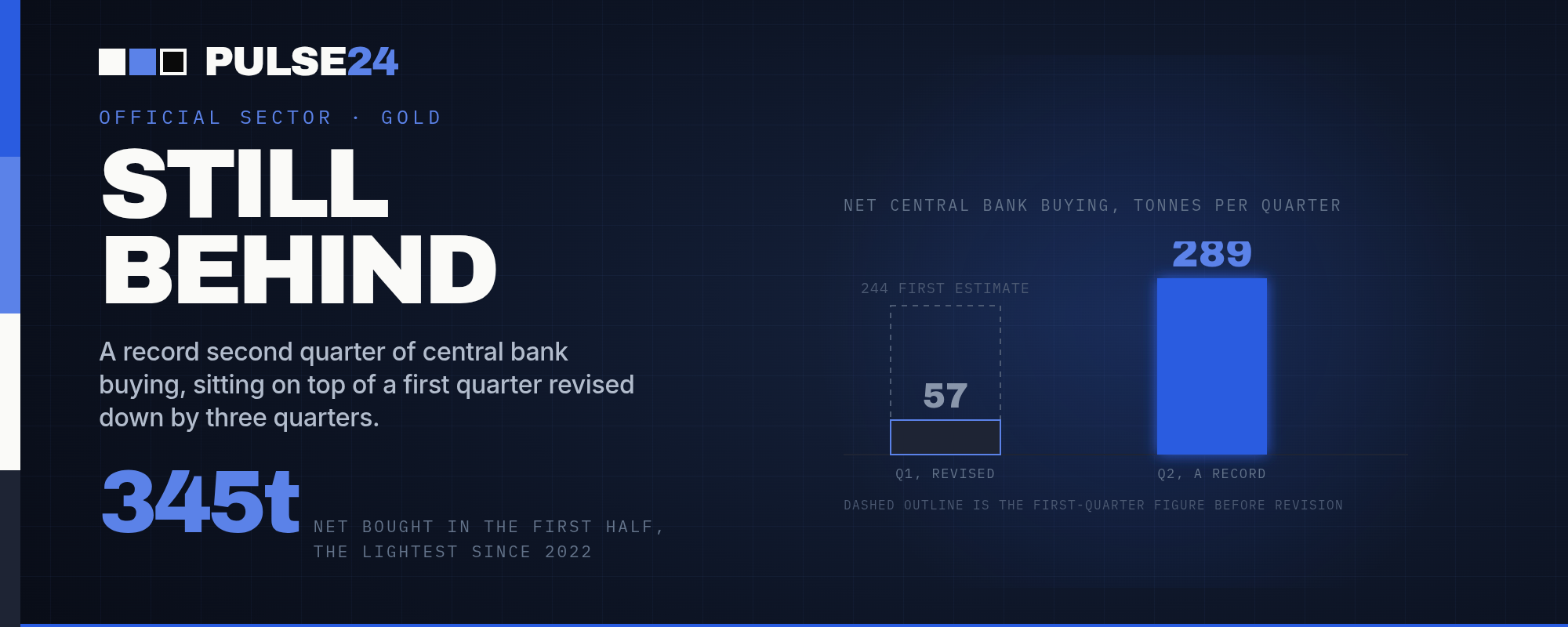
Central Banks Just Had Their Strongest Second Quarter of Gold Buying on Record, 289 Tonnes. The First Half of 2026 Was Still Their Weakest Since 2022.
Central banks bought 289 tonnes of gold last quarter, the strongest second quarter for official buying on record. A revised-down first quarter still left the first half of 2026 as their weakest for gold buying since 2022.
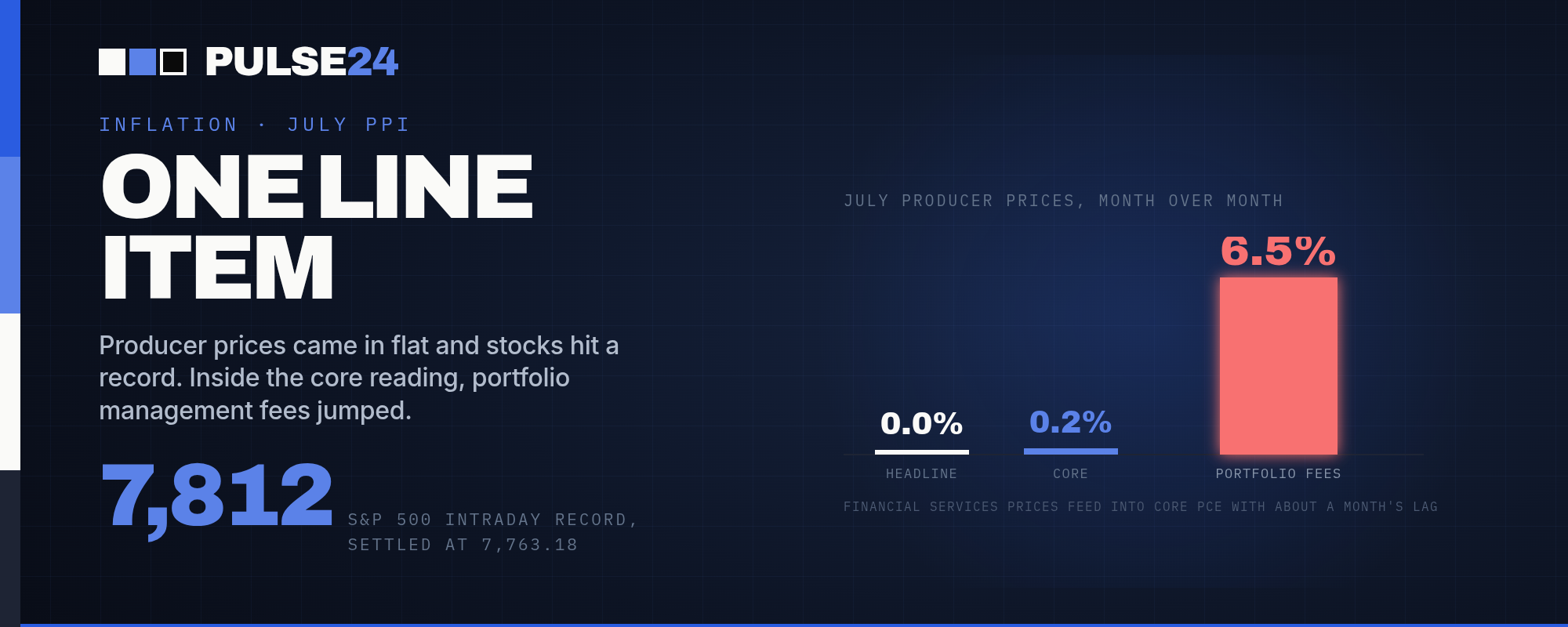
The S&P 500 Broke 7,800 for the First Time Thursday. The Producer Price Report That Helped Send It There Hid a Number the Fed Can't Ignore.
The S&P 500 broke above 7,800 for the first time Thursday after July's producer price report came in flat, with core prices also undershooting forecasts. But a 6.5% jump in portfolio management fees, a category that feeds mechanically into the Fed's preferred PCE gauge, complicates the read ahead of the August 26 release.
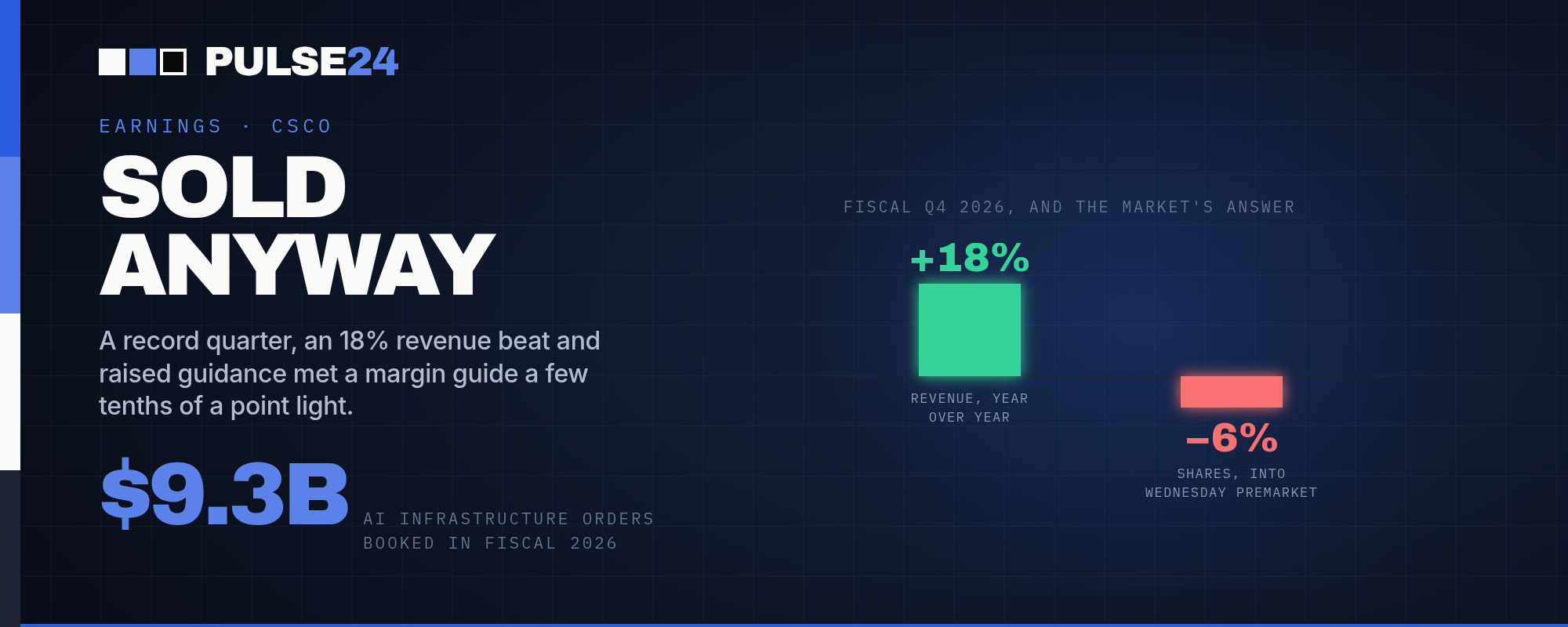
Cisco Grew Revenue 18% to a Record $17.25 Billion and Booked $9.3 Billion in AI Orders This Year. The Stock Still Fell 4% After Hours.
Cisco beat on revenue, profit and next year's revenue guidance in the same report, and grew its AI infrastructure order book to $9.3 billion for the year. Wall Street sold the stock anyway, because a softer first quarter margin guide overshadowed the beat.
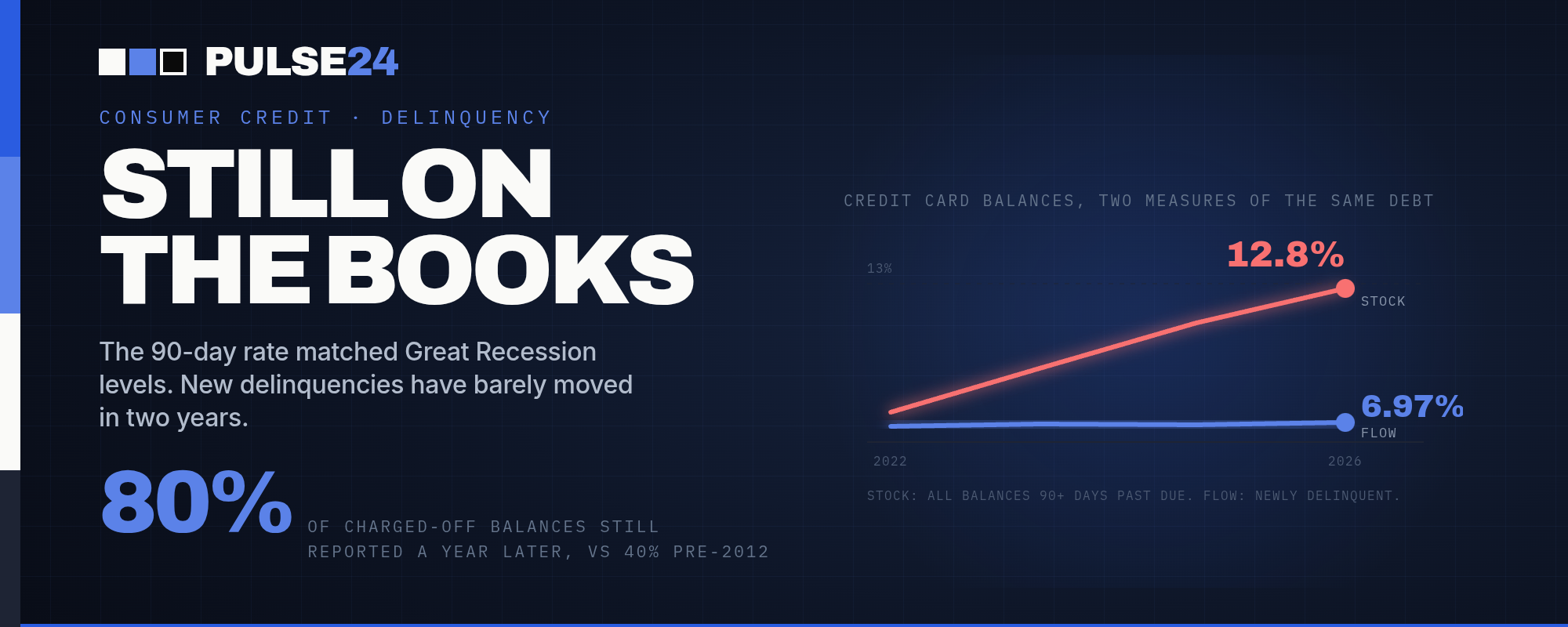
Credit Card Delinquencies Just Hit 12.8% of Balances, the Highest Since the Great Recession. New York Fed Researchers Say the Real Driver Is How Long Banks Keep Bad Debt on the Books, Not a Wave of New Defaults.
The share of credit card balances 90 days past due just matched levels last seen during the Great Recession, and it's being treated as proof the consumer is breaking. New York Fed researchers who track the same data found new delinquencies have barely moved in two years, and the climb owes more to how long lenders keep bad debt on the books.
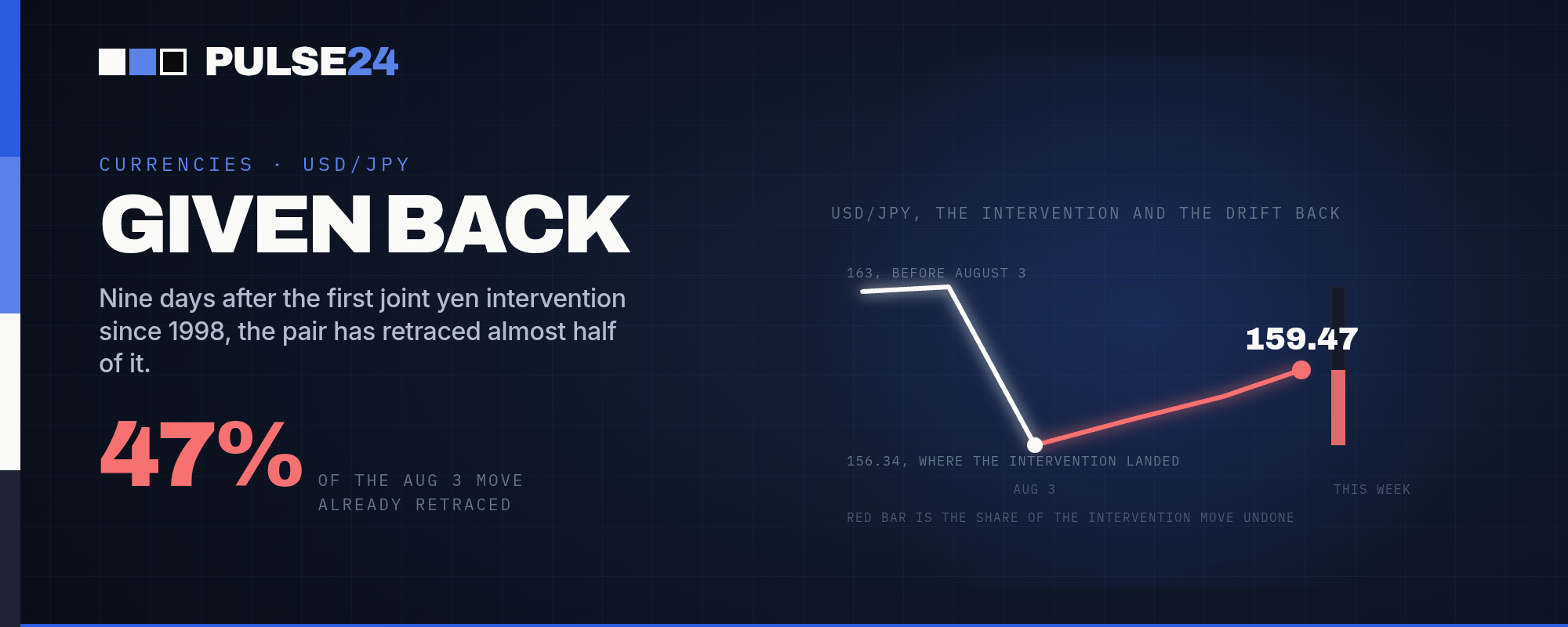
USD/JPY Is Back Near 159, Erasing Nearly Half the Ground Gained From the August 3 Yen Intervention. Washington and Tokyo Don't Agree on What the Bank of Japan Should Do Next.
USD/JPY has climbed back near 159, giving back close to half of what the August 3 US-Japan currency intervention gained. Treasury Secretary Scott Bessent wants a faster Bank of Japan, Prime Minister Sanae Takaichi wants the opposite, and the split is starting to show up in the exchange rate.
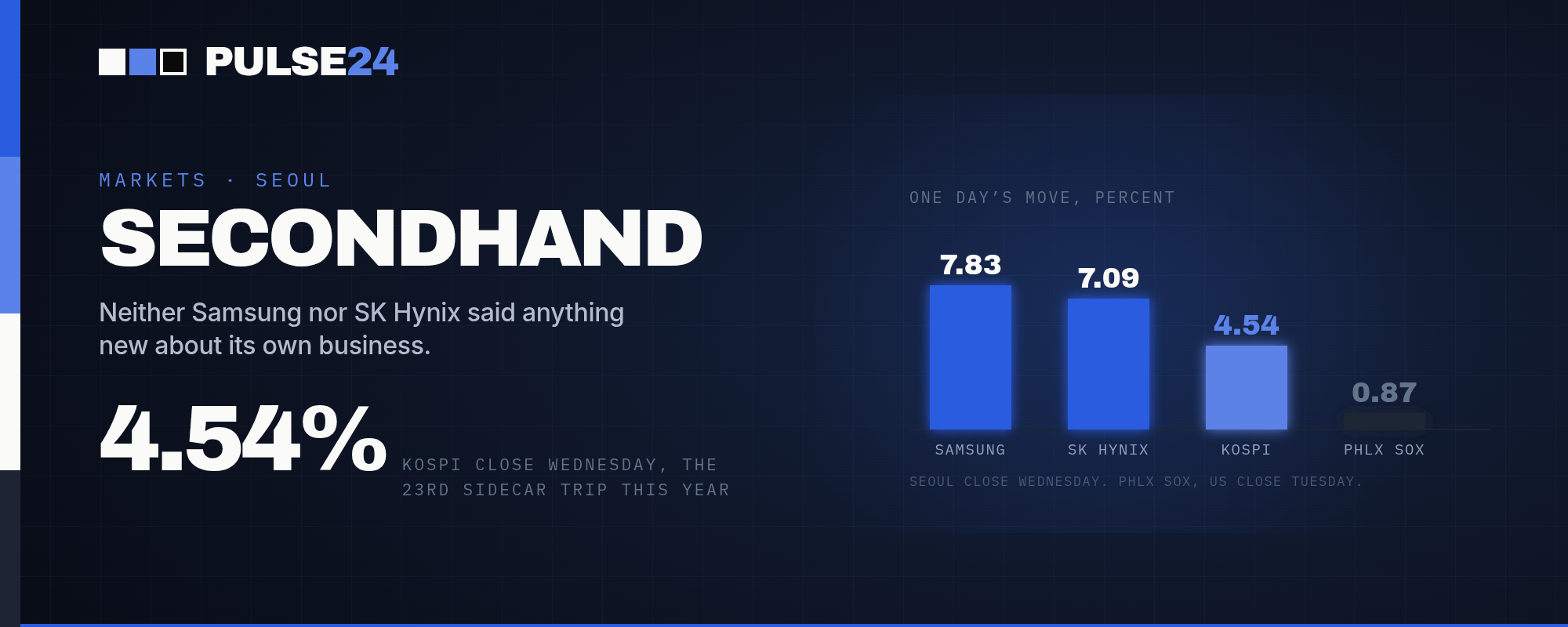
South Korea's Kospi Jumped 4.5% and Tripped a Circuit Breaker for the 23rd Time This Year. Two US Earnings Reports After Tuesday's Close Are Why.
Samsung and SK Hynix both jumped more than 7% Wednesday after CoreWeave and Super Micro Computer's earnings pointed to accelerating AI infrastructure demand. CoreWeave's contracted backlog grew by tens of billions of dollars in a matter of weeks, even as credit markets price the company's five-year default odds close to a coin flip.
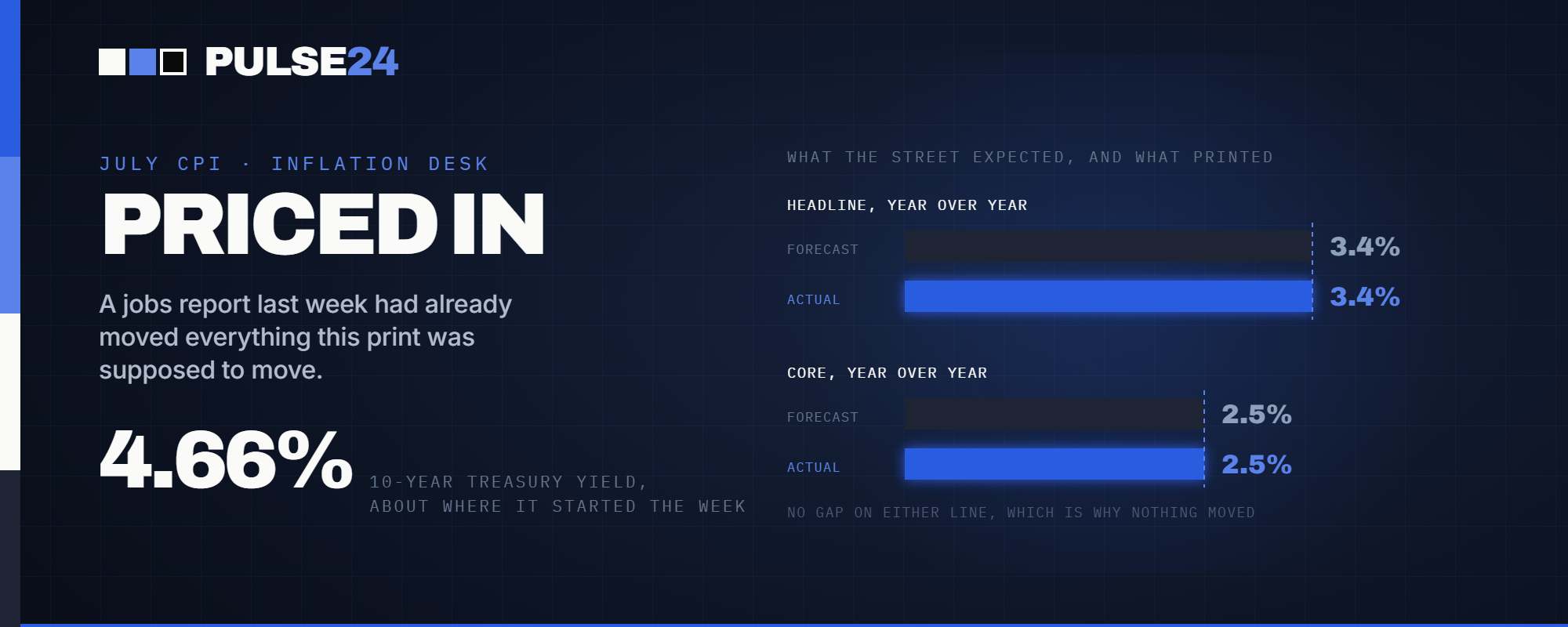
July CPI Landed at 3.4%, Matching Every Forecast on the Street. Markets Barely Moved, Because a Jobs Report Already Did the Work a Week Earlier.
July's CPI report matched Wall Street's forecast almost to the decimal, and markets barely reacted. That's because a weak jobs report last week had already done most of the work of repricing the Fed's September odds.
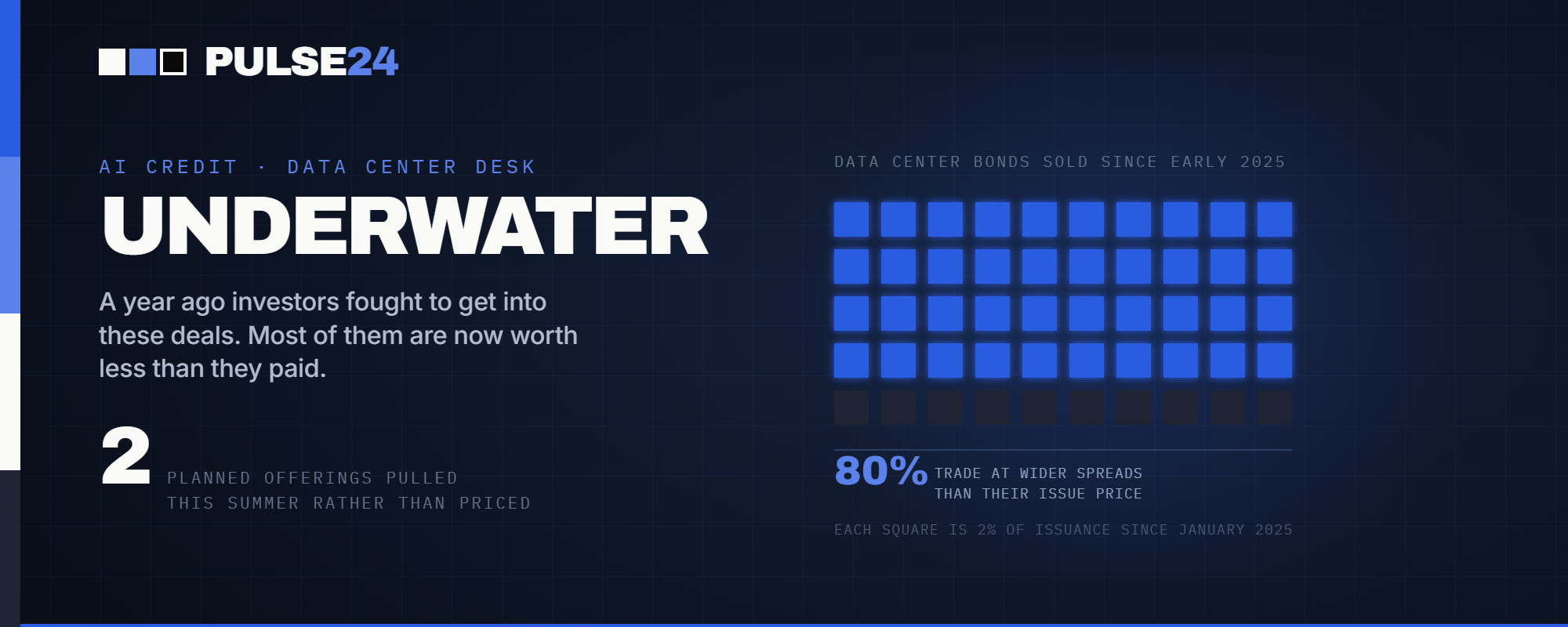
Nearly 80% of AI Data Center Bonds Sold Since Early 2025 Now Trade Below Issue Price. Two Planned Deals Got Pulled From the Market This Summer Instead of Selling Into It.
Nearly 80% of the bonds sold to finance AI data centers since early 2025 now trade below where they priced, and two planned offerings got pulled from the market this summer instead of testing it. Credit investors are starting to ask the question equity investors have mostly ignored.
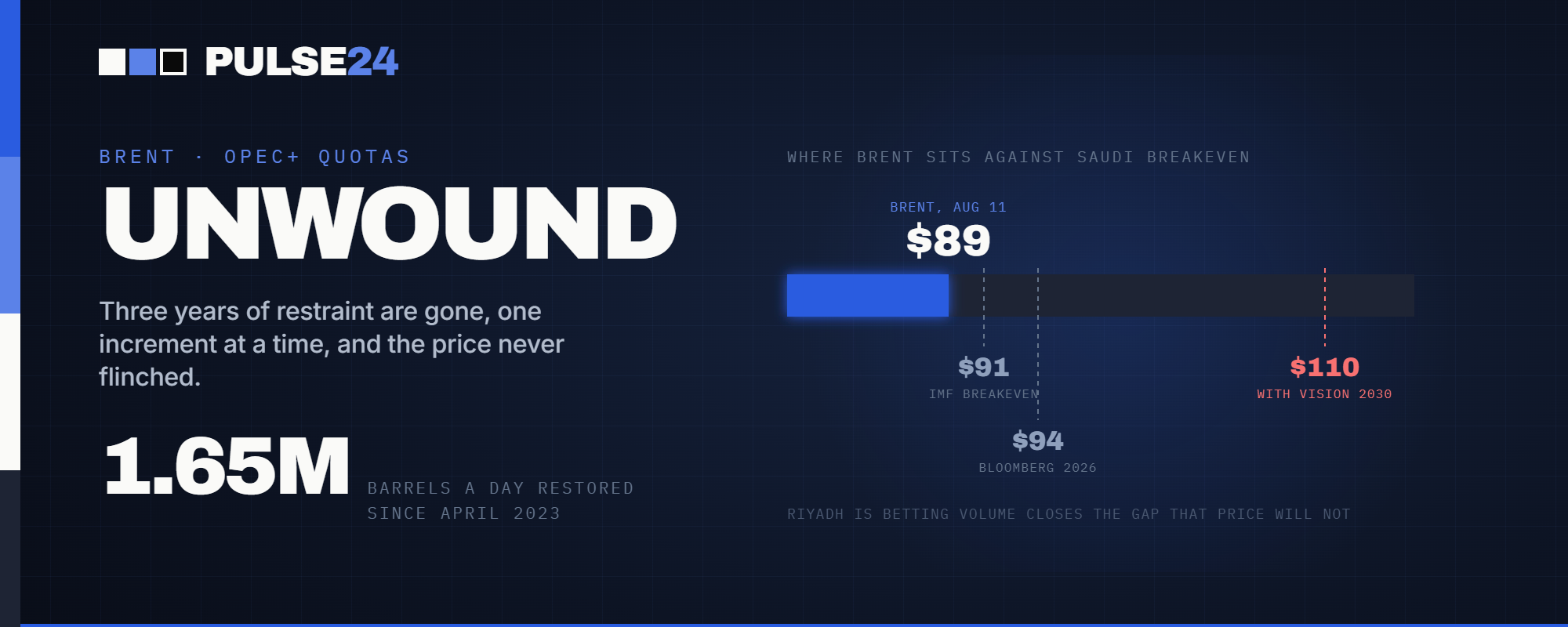
OPEC+ Just Completed a Three-Year Unwind of 1.65 Million Barrels in Cuts. Brent Crude Is Still Trading Near $89.
OPEC+ approved a final 188,000 barrel-a-day increase for September, closing the book on the 1.65 million barrels a day of cuts it first announced back in April 2023. Oil prices barely reacted, which says as much about the market's mood as the decision itself.
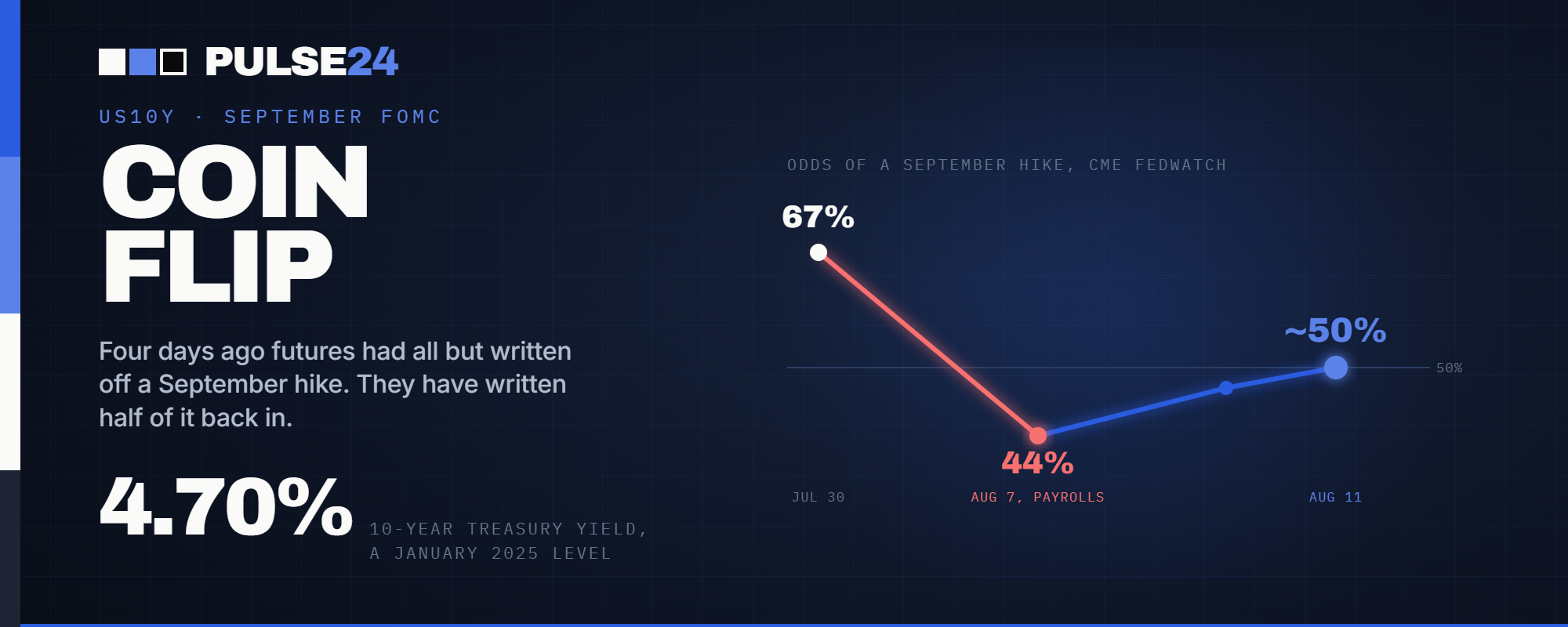
The 10-Year Treasury Yield Is Back Above 4.7%, Matching a Level Last Seen in January 2025. September Rate Hike Odds Just Climbed Back to a Coin Flip.
The 10-year Treasury yield climbed back above 4.70% Tuesday, matching territory last visited in January 2025, as a more hawkish push from Cleveland Fed President Beth Hammack and a fresh run-up in oil prices revived September rate hike bets that looked nearly dead a week ago. CME FedWatch now prices the odds of a hike close to a coin flip.
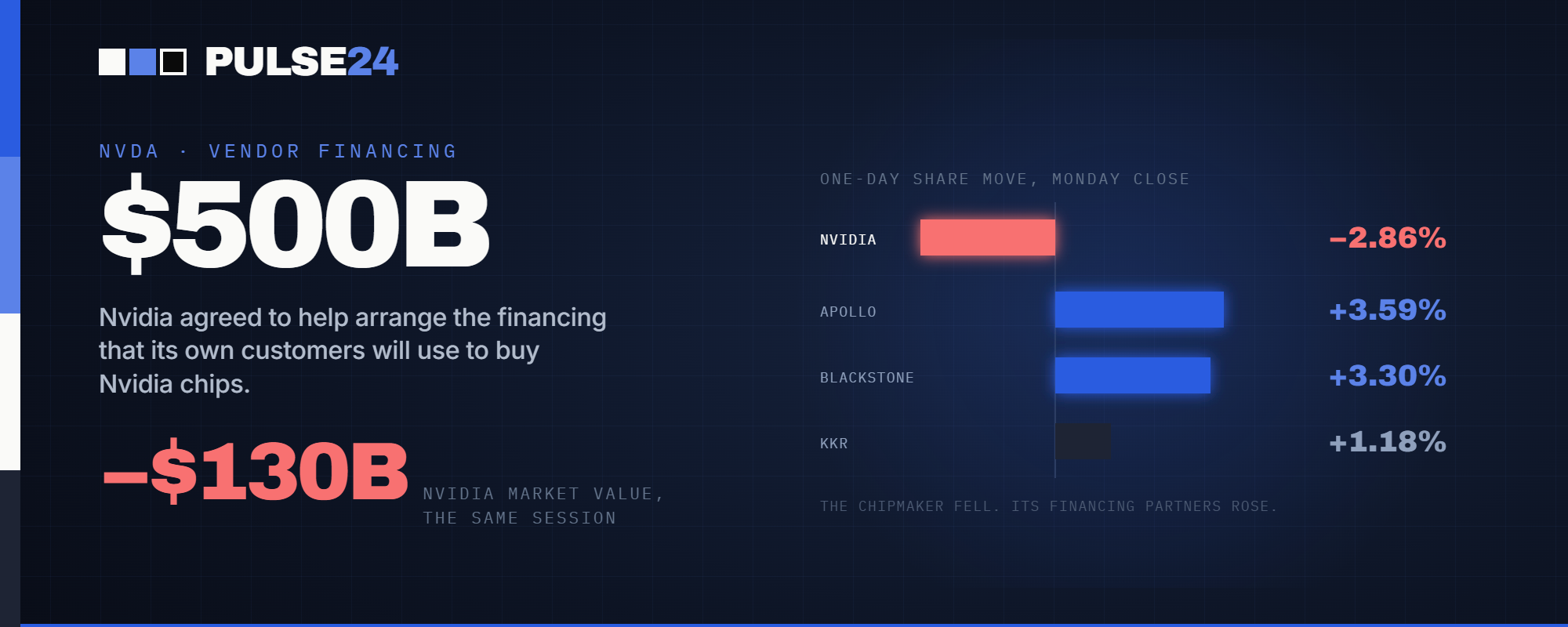
Nvidia Just Lined Up $500 Billion to Fund AI's Buildout. Its Own Stock Fell $130 Billion the Same Day.
Nvidia agreed to help arrange more than $500 billion in financing for its own customers' AI infrastructure buildout on Monday, joining Apollo, BlackRock, Blackstone, Brookfield, Goldman Sachs and KKR. The stock lost $130 billion in market value the same day, as investors weighed what happens when a chipmaker starts financing the demand for its own chips.
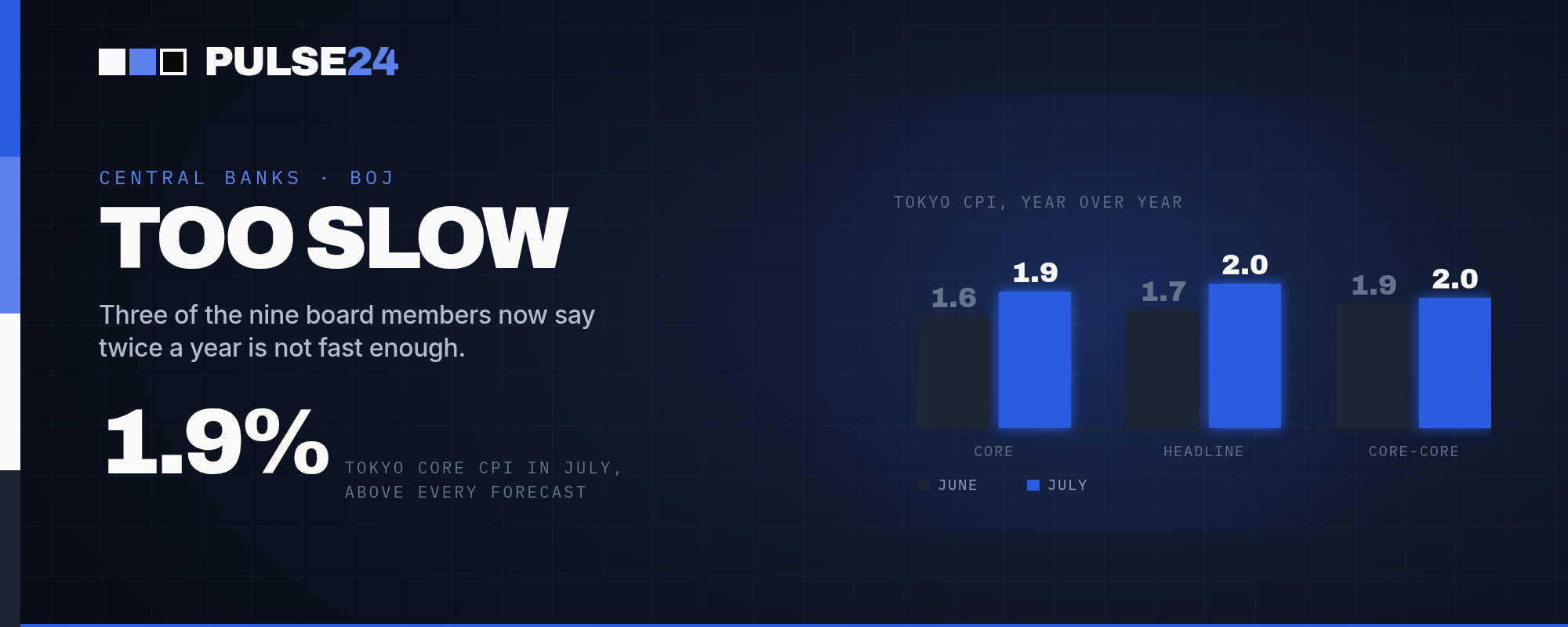
Tokyo Core Inflation Hit 1.9% in July, Beating Every Forecast on the Street. At Least Three Bank of Japan Board Members Now Want to Hike Rates Faster Than Twice a Year.
Tokyo's core inflation topped every forecast in July, and a summary of the Bank of Japan's July meeting released this week shows its own policymakers debating whether twice a year is fast enough. Markets are now pricing close to even odds on a September hike, the central bank's most aggressive stretch since it first moved off negative rates.
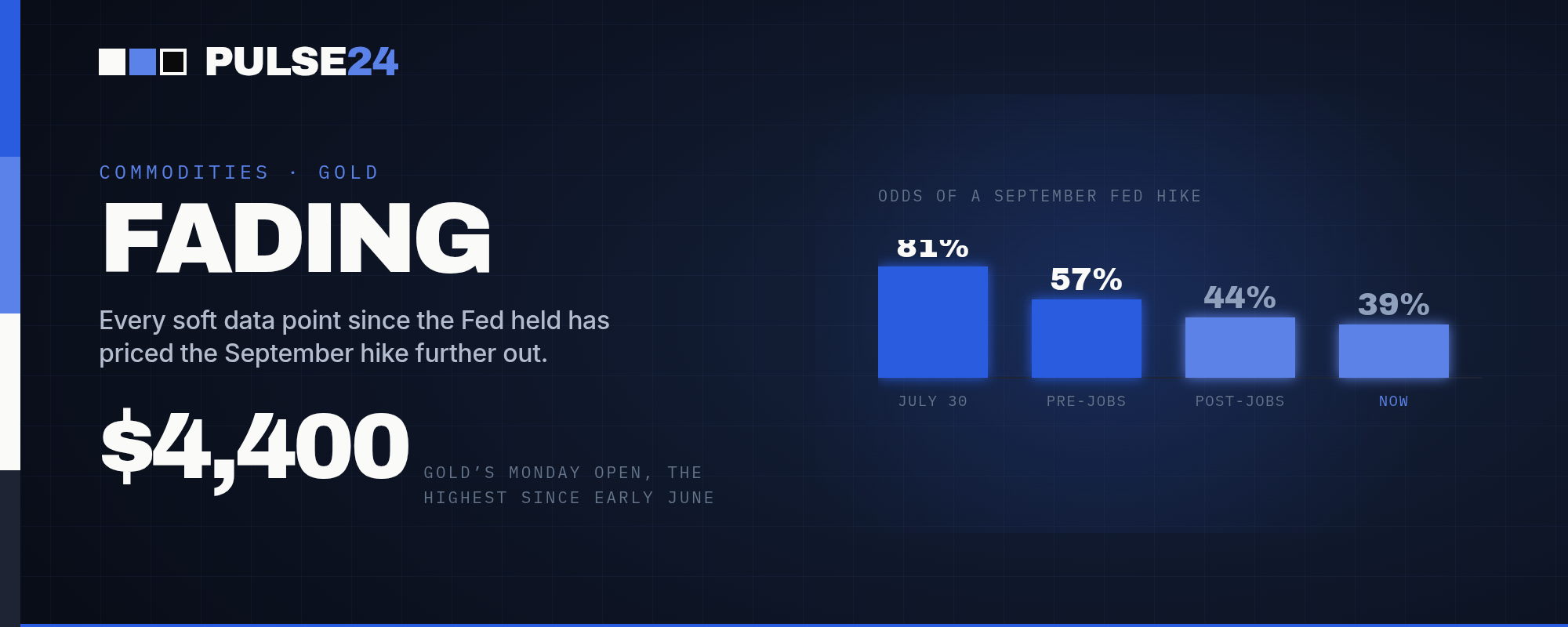
Gold Just Hit Its Highest Opening Price Since Early June, Up 7.8% in a Week. Three Fed Policymakers Wanted to Hike Rates Two Weeks Ago, and the Odds Have Been Fading Ever Since.
Gold opened at its highest level since early June on Monday, up 7.8% over the past week, as traders keep paring back bets on a Fed rate hike in September. Three policymakers who dissented in favor of raising rates two weeks ago are watching those odds fade with each new data point.
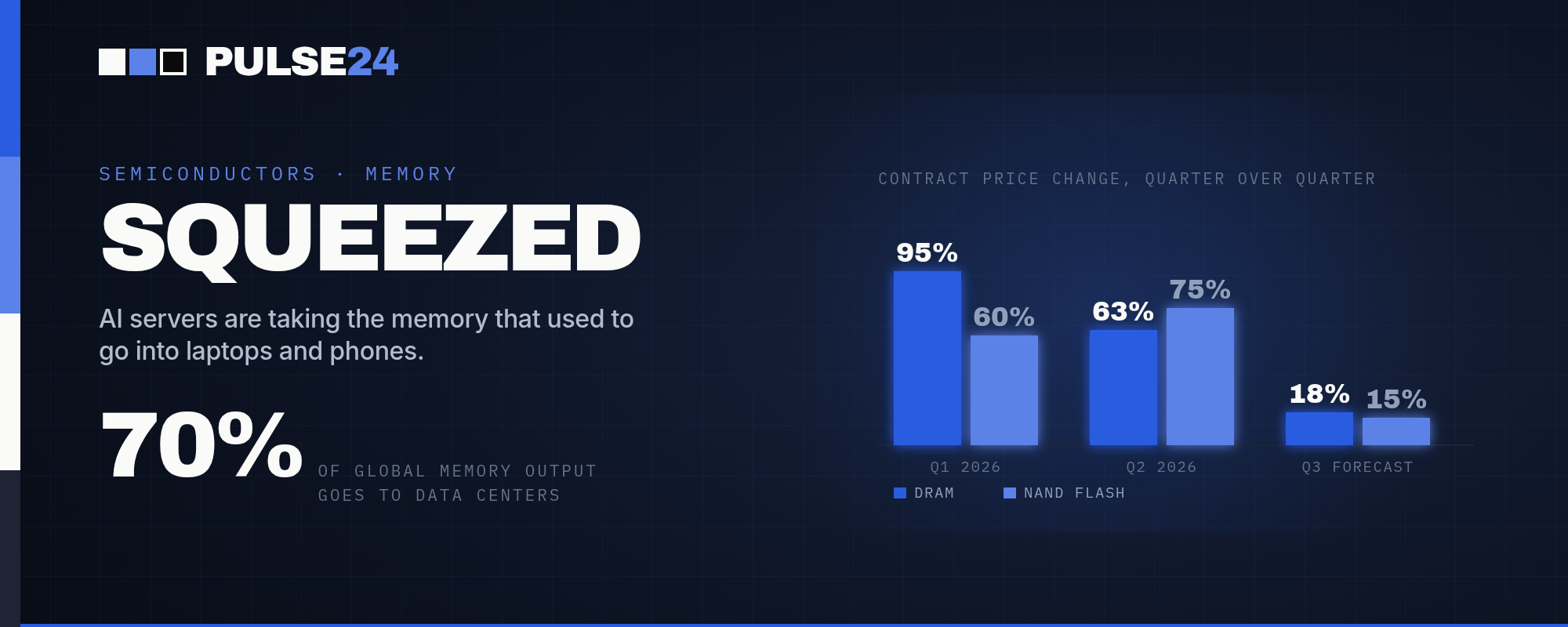
DRAM Prices Rose as Much as 63% Last Quarter, on Top of a 95% Jump the Quarter Before. AI Servers Use Up to 10 Times the Memory of a Normal One, and Consumer Electronics Are Now Absorbing the Bill.
Memory chip prices have now risen for three straight quarters, and Goldman Sachs calls the shortage behind it the worst since 2011. AI servers consume up to ten times the DRAM of a normal machine, and that appetite is now showing up in laptop and phone price tags.
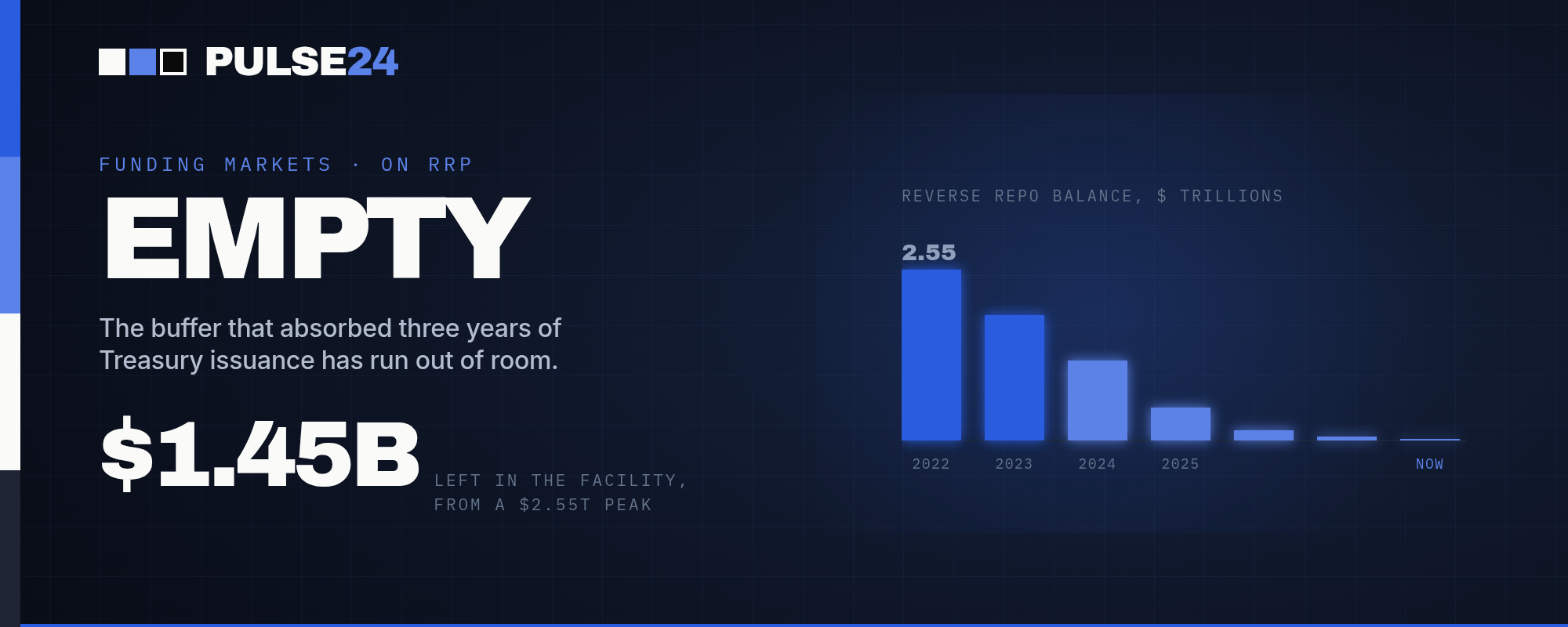
The Fed's Reverse Repo Facility Has Fallen to Just $1.45 Billion, Down From a $2.55 Trillion Peak. The One Buffer That Prevented a Repeat of 2019's Repo Chaos Is Now Basically Empty.
Cash sitting in the Fed's reverse repo facility has collapsed to $1.45 billion, next to nothing compared with its $2.55 trillion peak in 2022, right as the Treasury drains bank reserves to rebuild its own checking account. The shock absorber that helped prevent a repeat of 2019's repo crisis is now essentially empty.
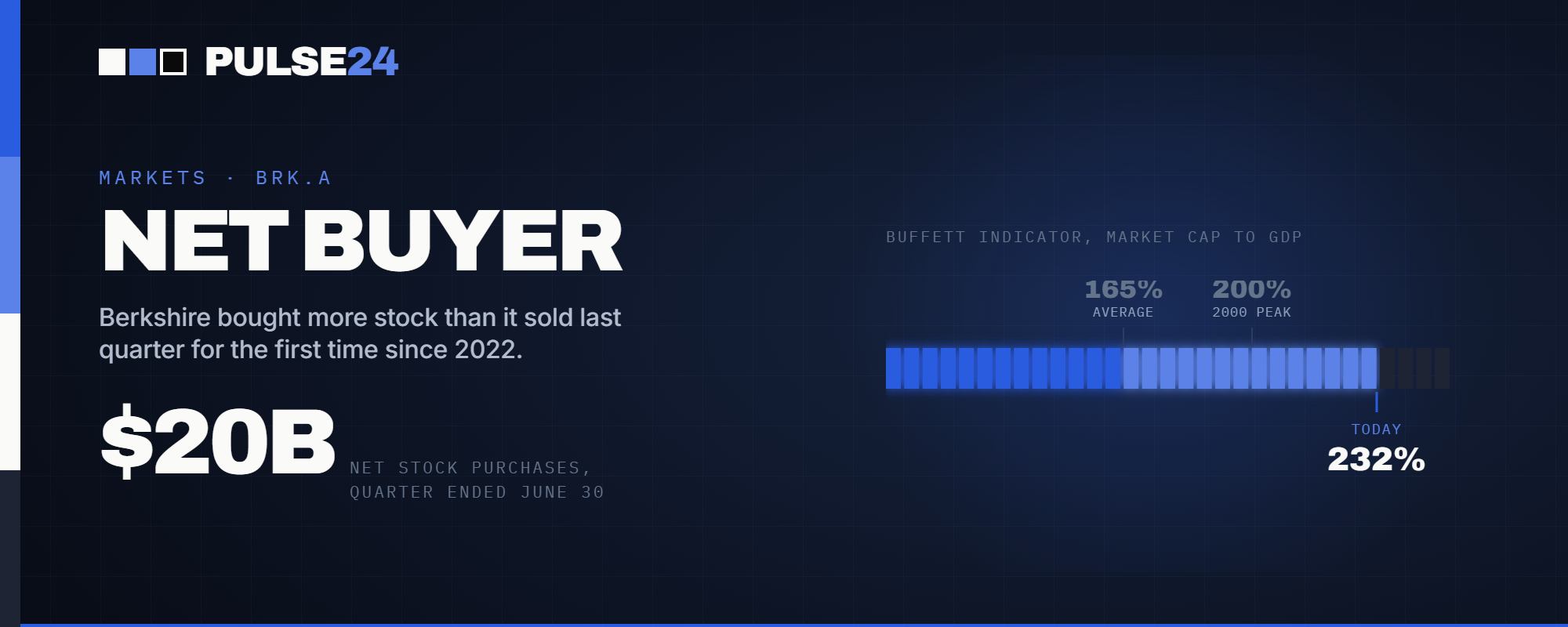
Berkshire Hathaway Ended a 14-Quarter Selling Streak in Q2. Its Own Favorite Valuation Gauge Says Stocks Haven't Been This Expensive Since the Dot-Com Bubble.
Berkshire Hathaway bought almost $20 billion more stock than it sold last quarter, its first net buying quarter since 2022. It happened as the market it bought into sits at valuations last seen at the peak of the dot-com bubble.
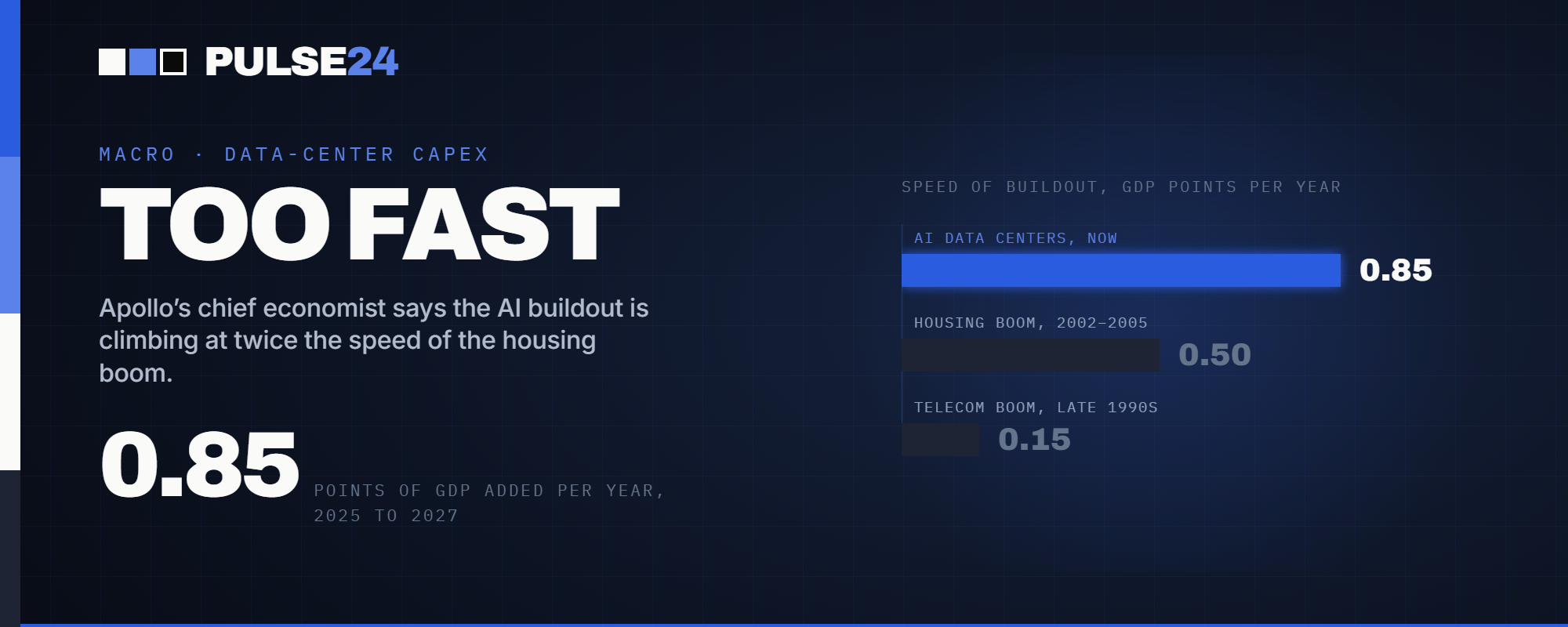
AI Data-Center Capex Is on Track to Hit 3% of GDP by 2027. Apollo's Top Economist Says It's Building at Twice the Pace of the Housing Boom.
Data-center capex is on pace to hit roughly 3% of US GDP by 2027, according to Apollo's chief economist Torsten Slok, more than double where the late-1990s telecom boom peaked. He warns the buildout is moving nearly twice as fast as the 2000s housing boom did, which means it could unwind just as quickly if AI demand falls short.
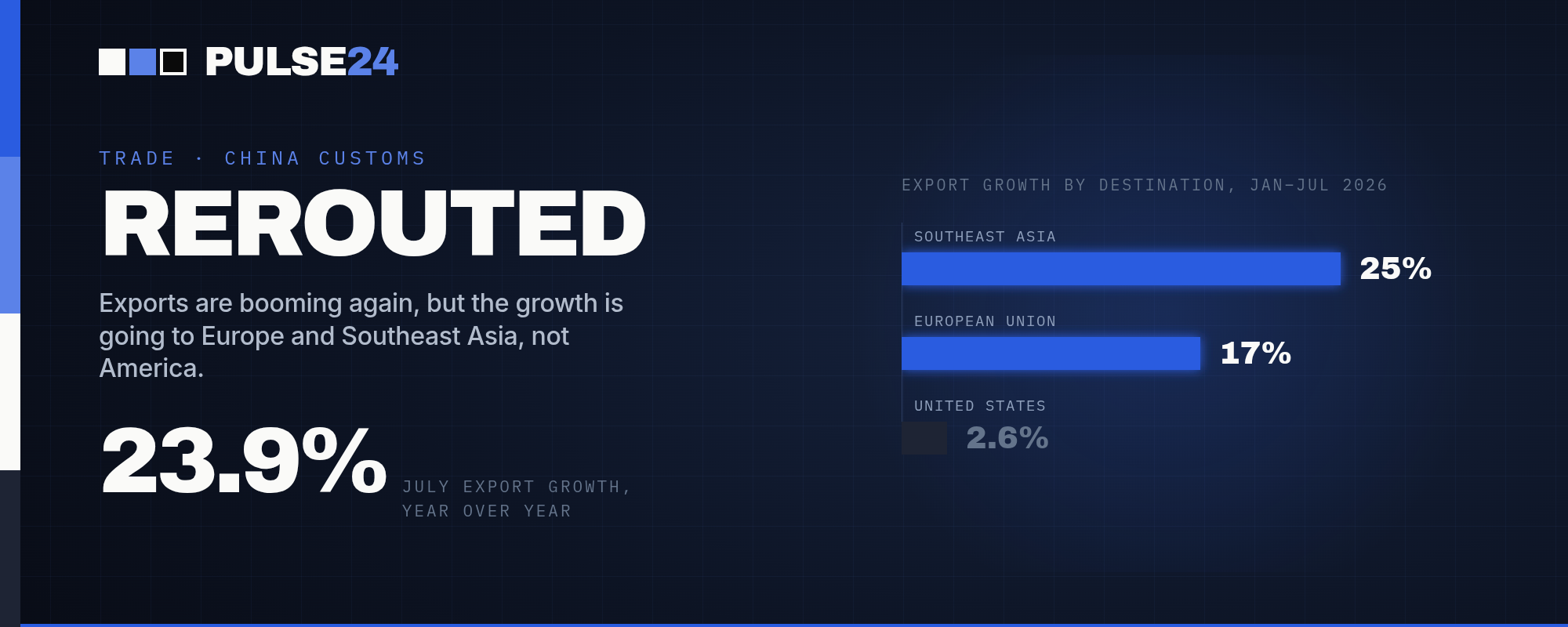
China's Exports Rose 23.9% in July. Shipments to the US Are Up Just 2.6% for the Year So Far.
China's exports rose 23.9% in July, but the growth engine has shifted away from the United States over the course of the year: shipments to the US are up just 2.6% for the seven months through July, while exports to the EU and Southeast Asia are growing far faster. The shift says as much about global AI and green-tech demand as it does about tariffs.
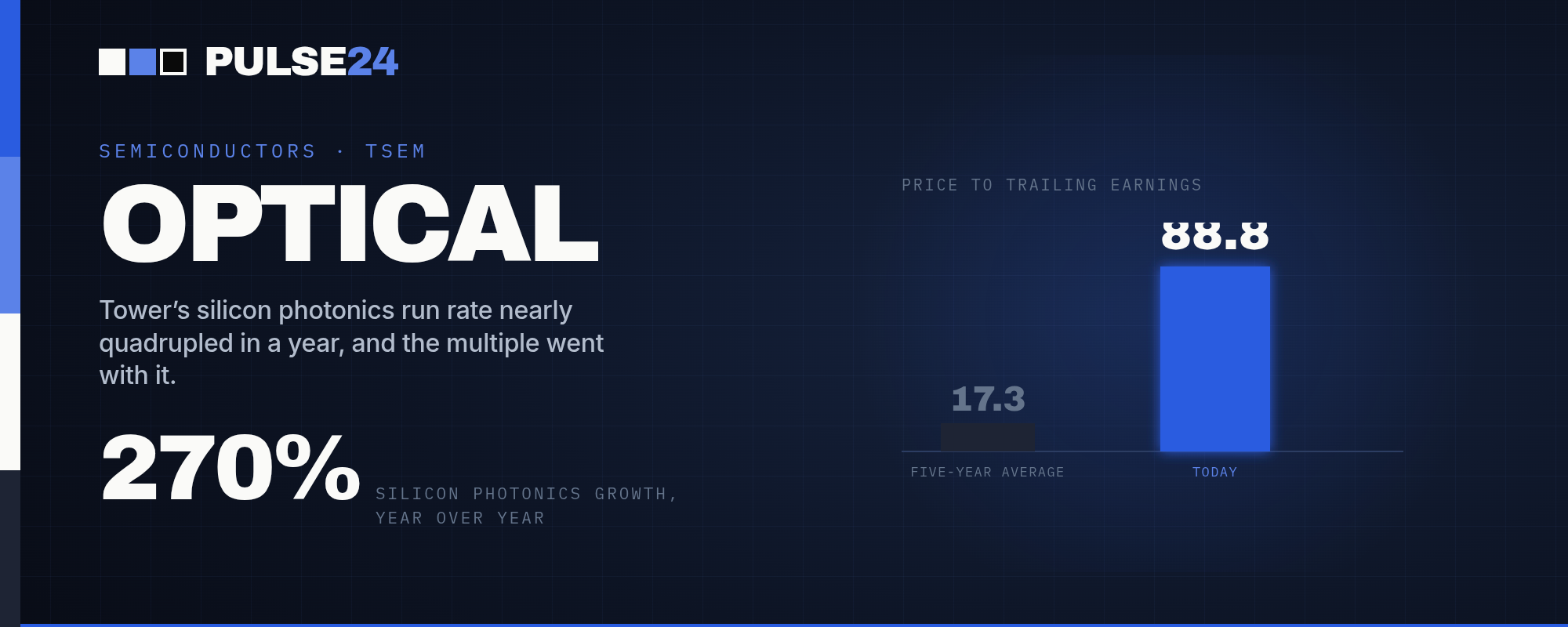
Tower Semiconductor's Silicon Photonics Business Just Grew 270% in a Year. The Stock Jumped 12% on Guidance That Now Trades at 88 Times Earnings.
Tower Semiconductor's silicon photonics business grew 270% in a year, and Wall Street rewarded it with a 12% single-day stock jump on record guidance. The catch is that the stock now trades at nearly five times its own historical valuation multiple.
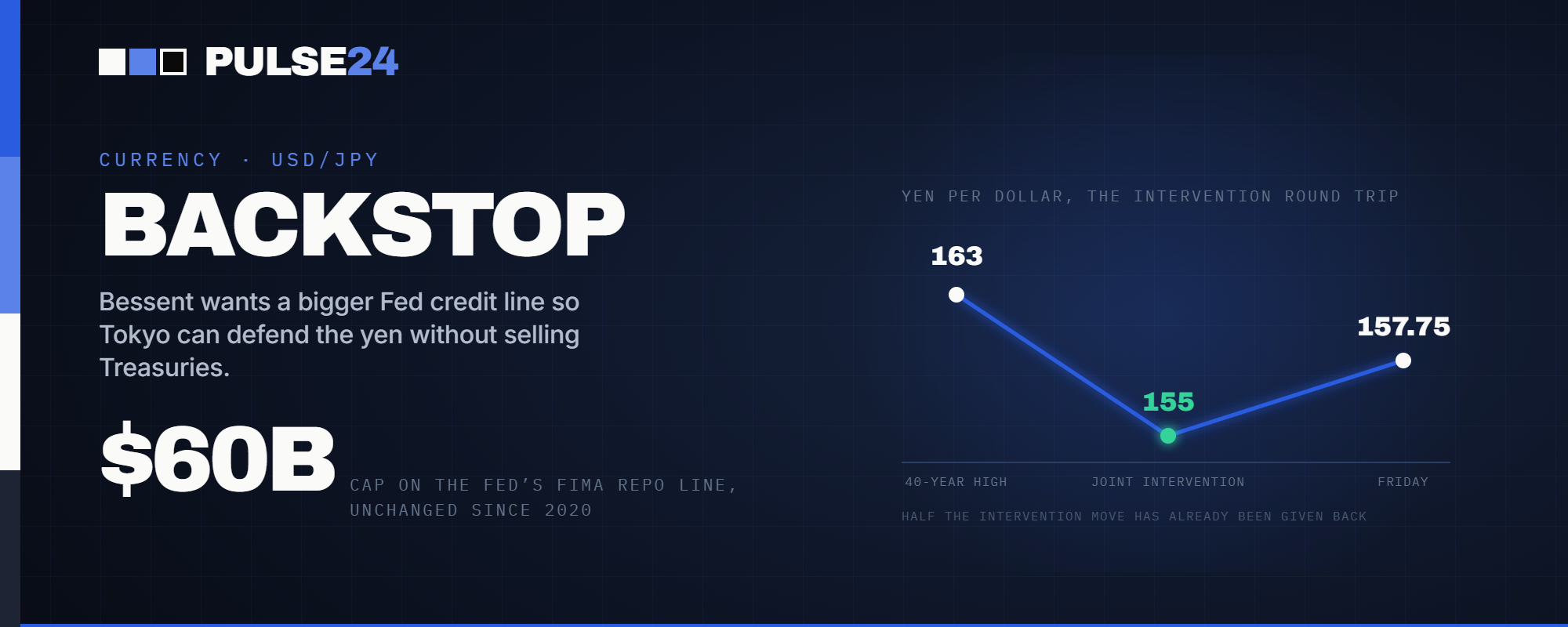
Japan Holds $1.14 Trillion in Treasuries. Bessent Wants a Bigger Fed Credit Line So It Never Has to Sell Them to Defend the Yen.
Treasury Secretary Scott Bessent wants the Fed to expand a $60 billion emergency lending facility so Japan can keep defending the yen without selling its Treasury holdings. The Fed hasn't touched the facility's size since 2020, and expanding it now would test how far Kevin Warsh's balance sheet goals bend to a currency fight.
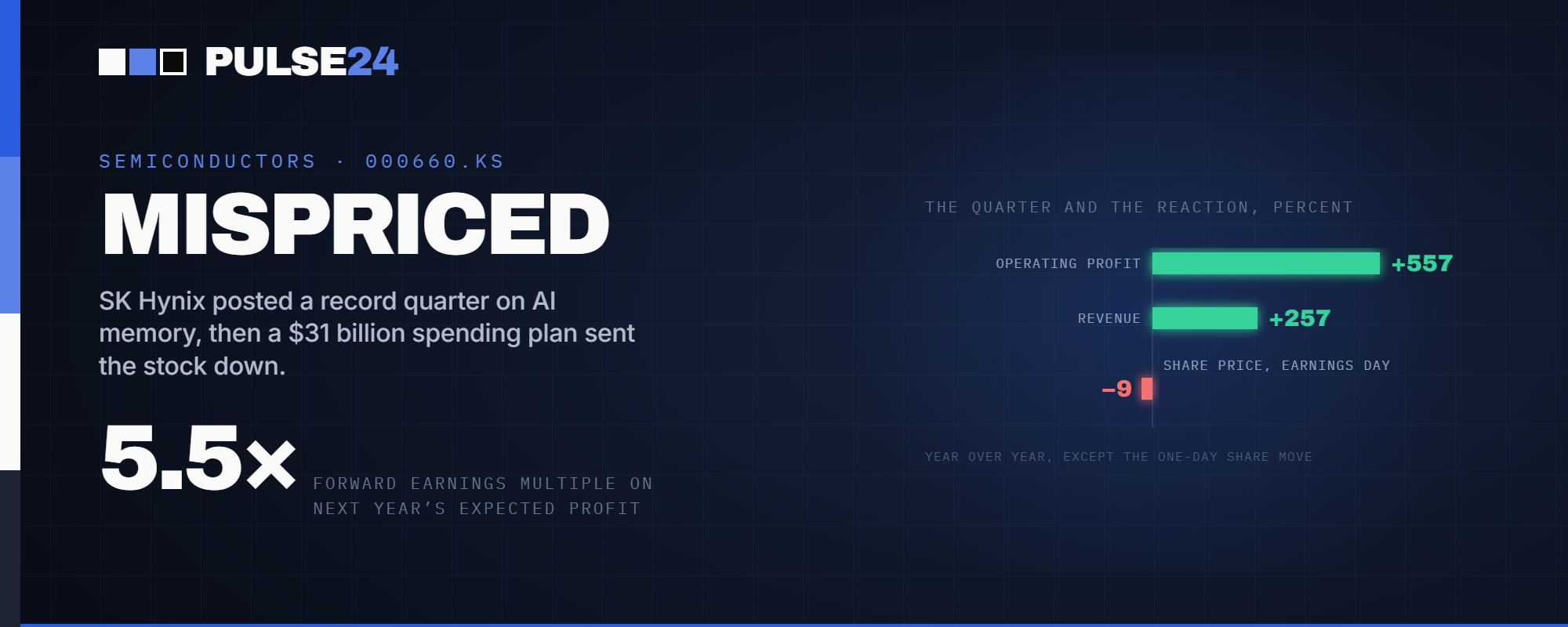
SK Hynix's Profit Jumped 557%. The Stock Fell Anyway, and It Still Trades at Just 5 Times Next Year's Earnings.
SK Hynix's operating profit jumped 557% last quarter on the AI memory boom, but the stock fell on the news anyway after the company unveiled a $31 billion spending plan. Even after a partial rebound, shares still trade at roughly 5 times next year's expected earnings.
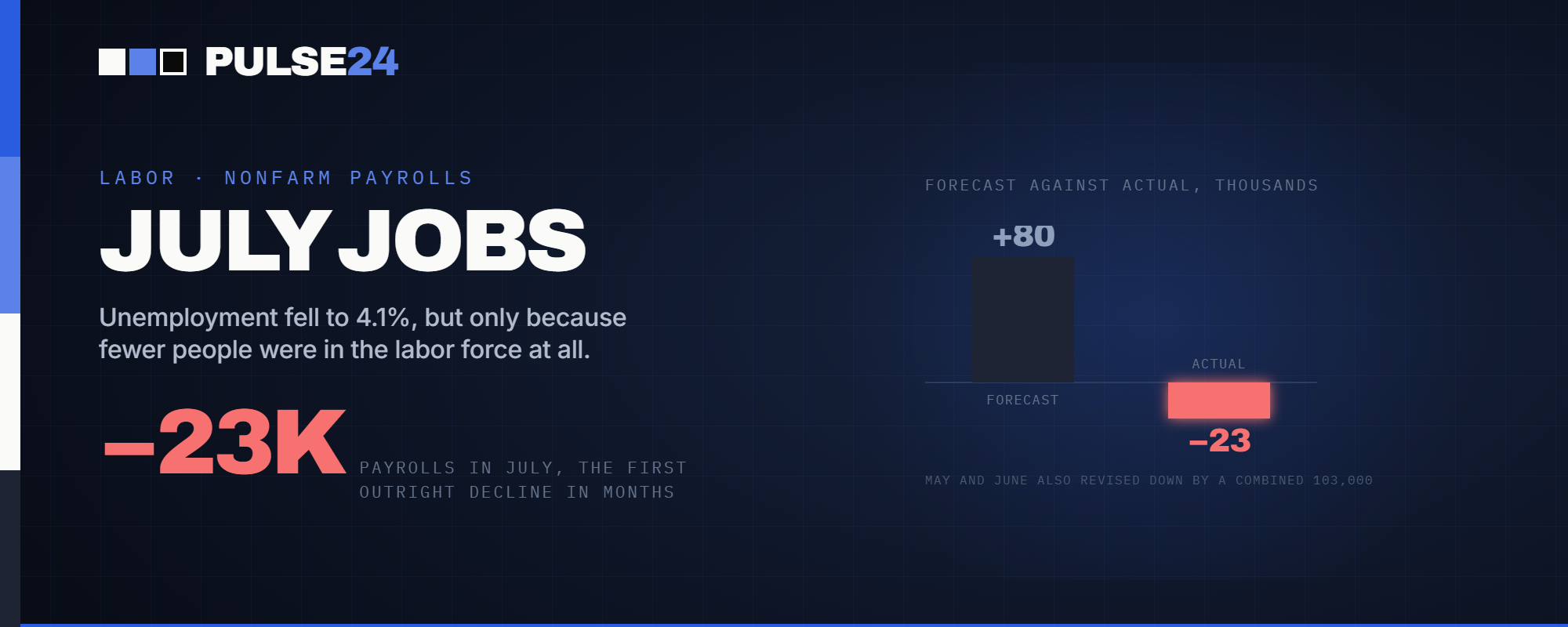
July Payrolls Fell 23,000 Against a Forecast for an 80,000 Gain. The Fed's September Hike Odds Got Cut Nearly in Half Within Hours.
July payrolls fell by 23,000 against a forecast for an 80,000 gain, and traders cut the odds of a September Fed rate hike almost in half within hours of the release. The report's real story is in the details: unemployment fell to 4.1% because fewer people are working, not because more people found jobs.
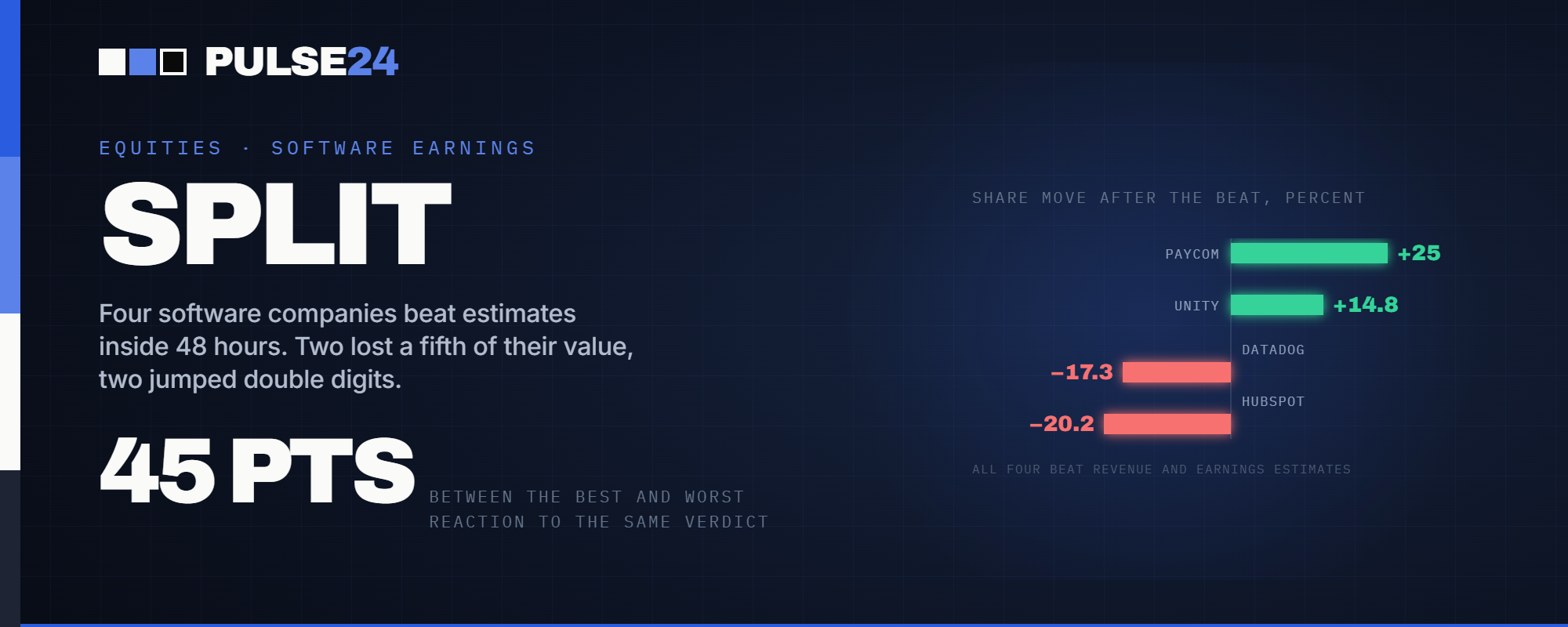
HubSpot and Datadog Both Beat Estimates and Fell 20% and 17% in a Day. Paycom and Unity Beat Too, and Jumped 25% and 15%.
Four software companies reported earnings within 48 hours of each other this week, and Wall Street split them into two groups. HubSpot and Datadog beat estimates and lost a fifth of their value anyway, while Paycom and Unity beat too and jumped double digits.
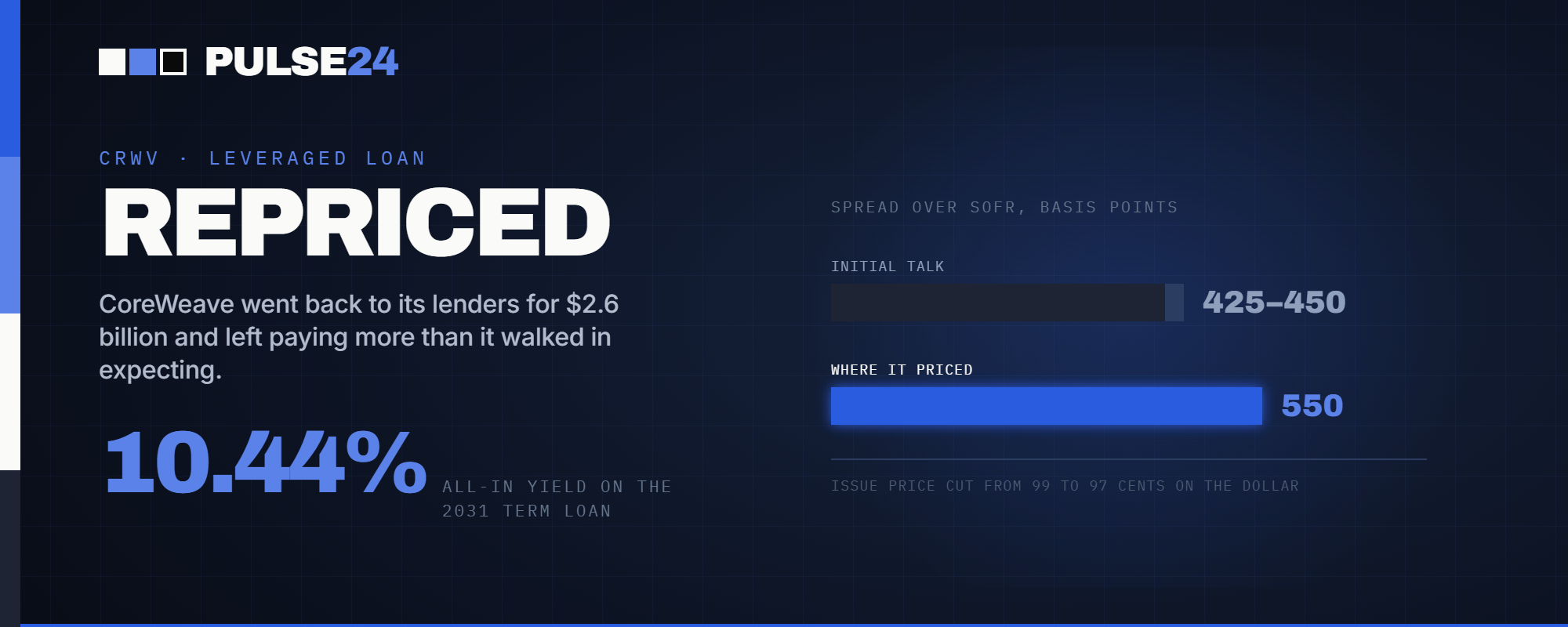
CoreWeave's Loan Just Got Repriced to a 10.44% Yield. The Credit Market Is Pricing Close to a Coin Flip on Default.
CoreWeave went back to lenders for a $2.6 billion loan and left with a 10.44% yield, tighter covenants, and a credit market pricing close to even odds of default within five years. It's the clearest sign yet that AI infrastructure's debt binge is starting to show real stress.
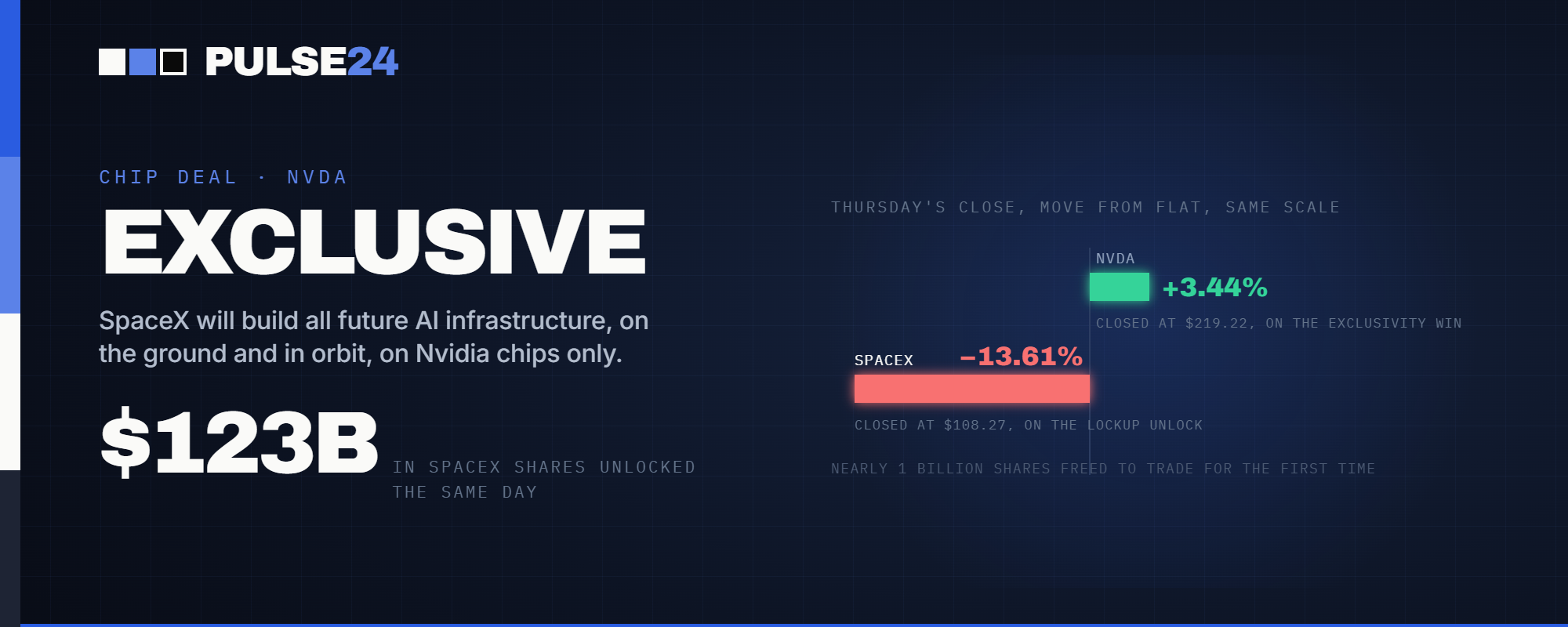
Nvidia Jumped 3.44% on SpaceX's Exclusive Chip Deal. SpaceX Fell 13.61% the Same Day, and the Reason Has Nothing to Do With Nvidia.
SpaceX said it will build all future AI infrastructure, on the ground and in orbit, exclusively on Nvidia chips. Nvidia rallied on the news, but SpaceX's own stock fell as nearly $123 billion in newly unlocked shares hit the market the same day.
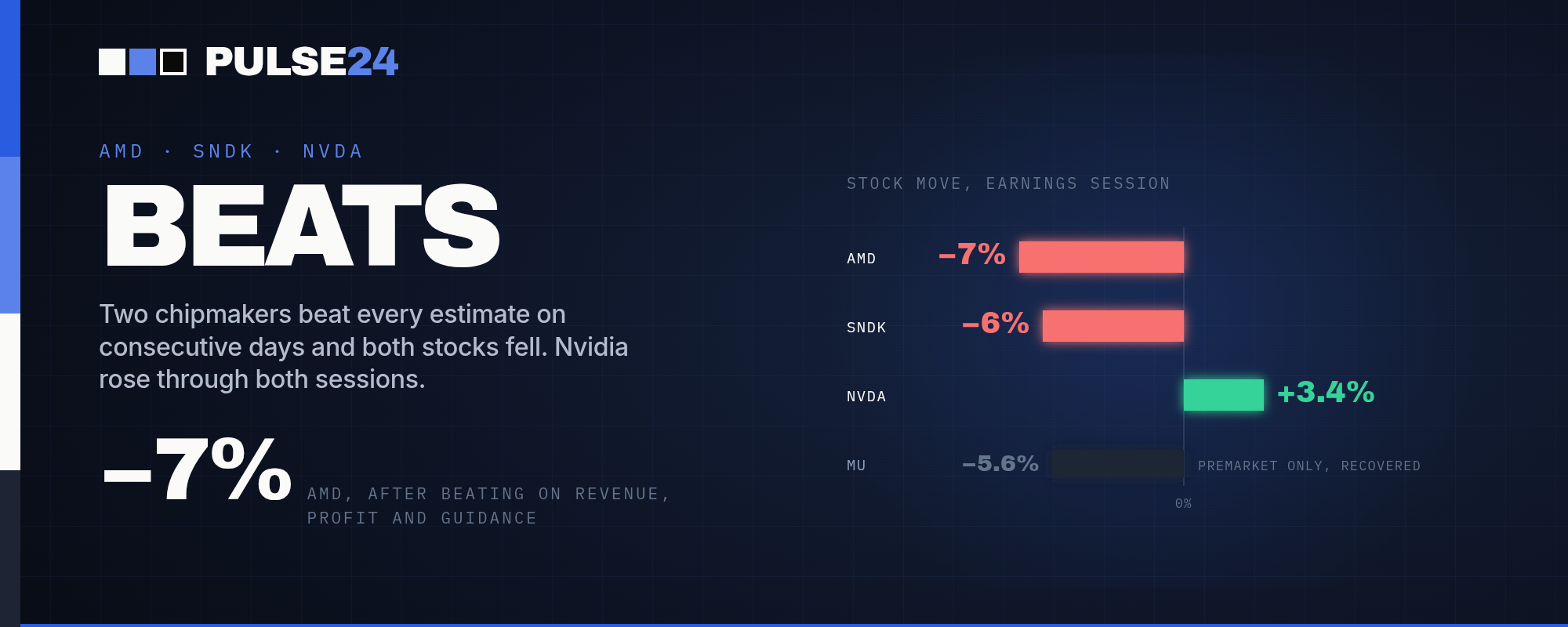
AMD and SanDisk Both Beat Every Estimate This Week and Watched Their Stocks Fall 7% and 6%. Nvidia Rose Both Days.
AMD beat on revenue, profit and guidance and fell 7% on a slower-than-hoped AI ramp. SanDisk beat by even wider margins and sank as much as 11% in premarket trading before settling closer to 6%. Nvidia climbed through both selloffs, and the gap between them says more about this market than either single earnings report does.
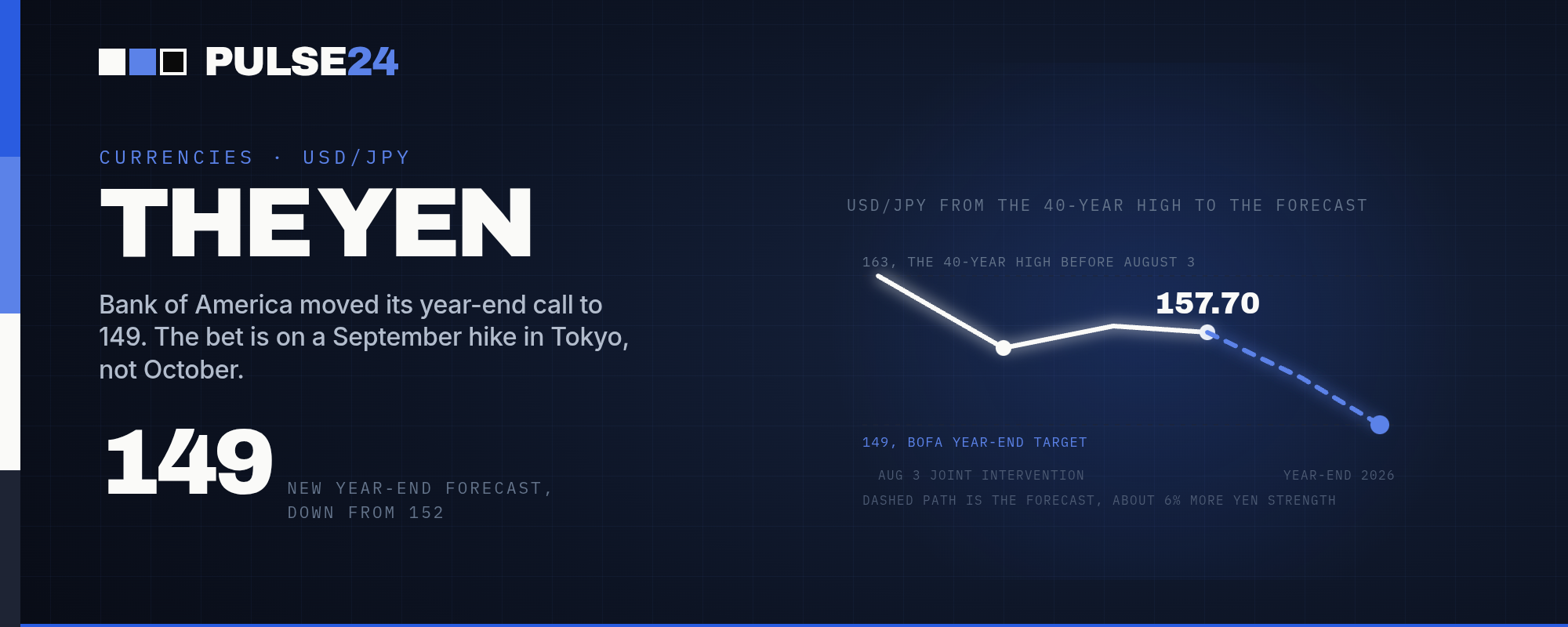
Bank of America Just Moved Its Yen Forecast to 149 From 152. It's Betting Japan Hikes Rates in September, Not October.
Bank of America cut its year-end USD/JPY forecast to about 149 from 152, betting the Bank of Japan hikes rates in September rather than October. Here's why the timing of that call matters more than this week's currency intervention.
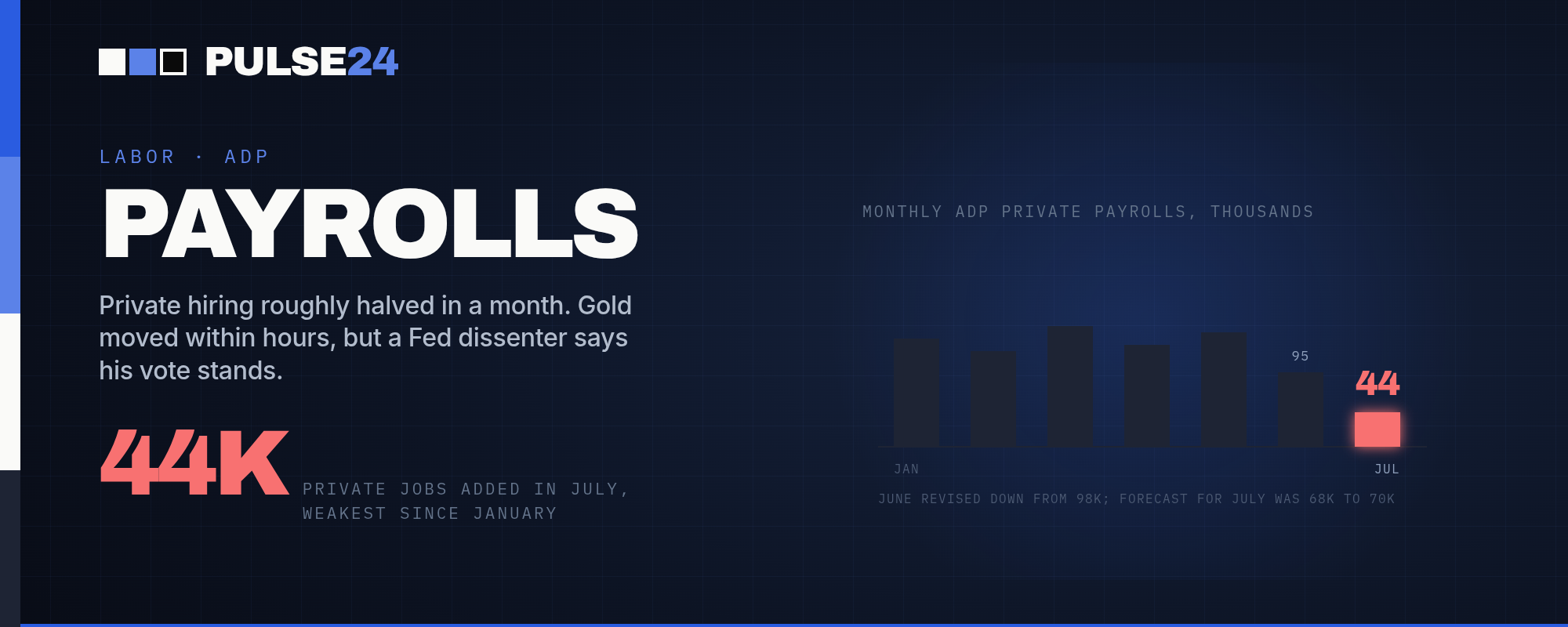
Private Payrolls Grew by Just 44,000 in July, the Weakest Reading Since January. Gold Jumped 2.78% on the Miss, and a Fed Dissenter Says It Doesn't Change His Vote.
Private payrolls grew by just 44,000 in July, the weakest reading since January, and gold jumped 2.78% on the news. Fed dissenter Neel Kashkari says the soft data doesn't change his case for higher rates.
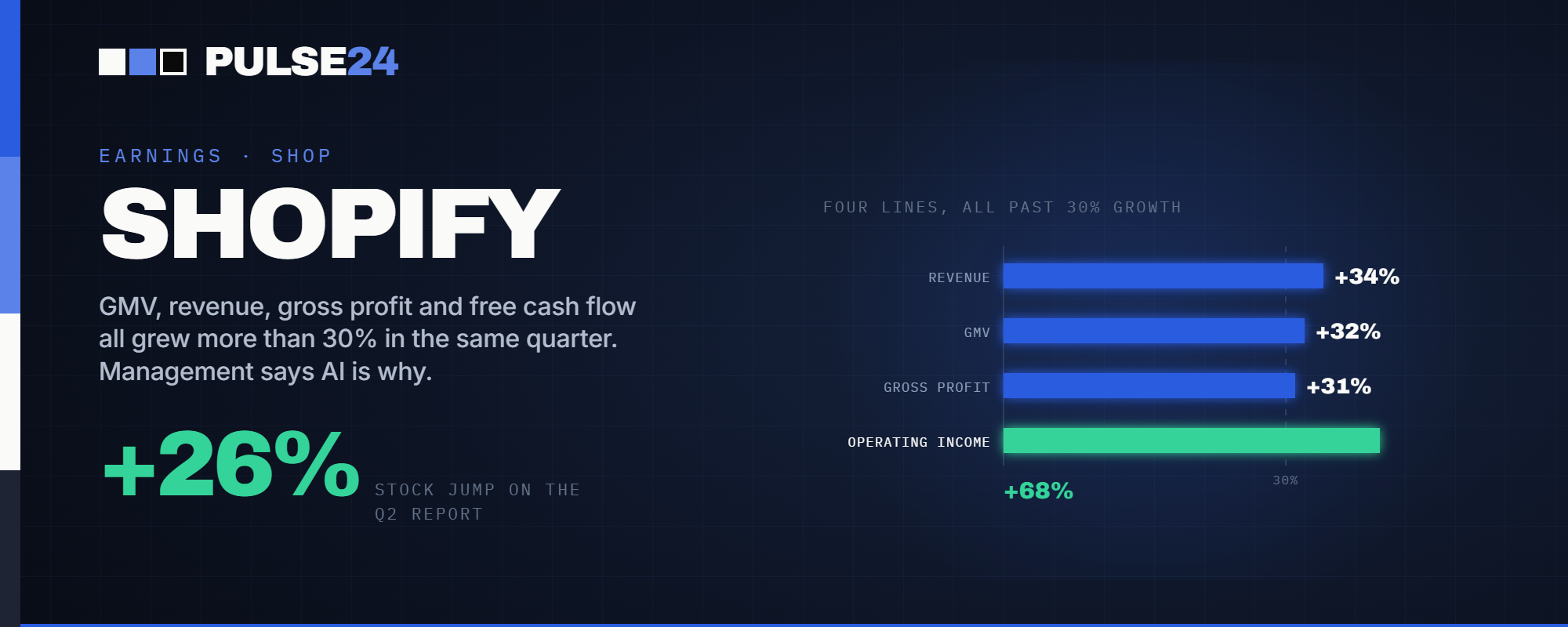
Shopify's Revenue, GMV, Gross Profit and Free Cash Flow All Grew More Than 30% at Once. The Stock Jumped 26%, and Management Says AI Is Why.
Shopify's GMV, revenue, gross profit and free cash flow all grew more than 30% in the same quarter, and the stock jumped 26% on the news. Management credited AI tools for lifting merchant sales across every size and channel, a rare real-revenue answer to a market that has spent weeks worried about AI spending outrunning AI payoff.
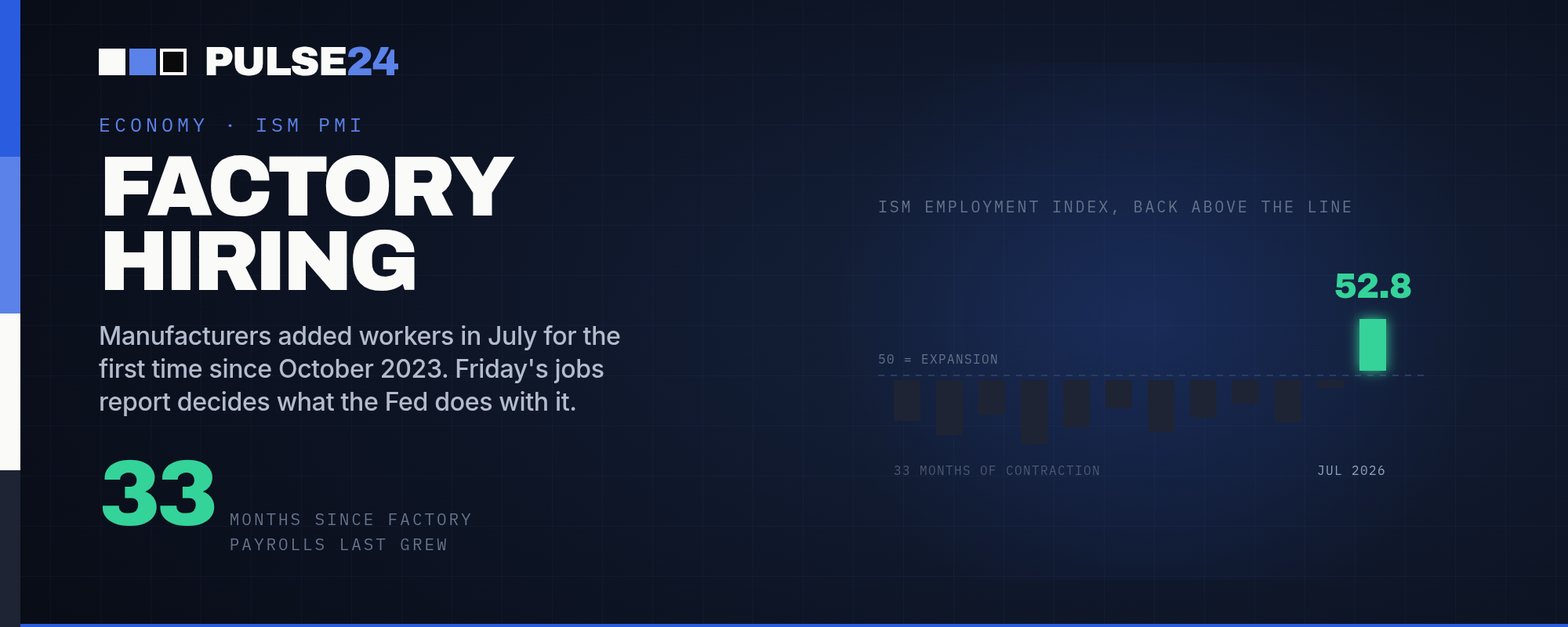
US Factory Employment Turned Positive for the First Time in 33 Months. The Jobs Report That Could Decide September Lands This Friday.
US manufacturing employment expanded in July for the first time since October 2023, and the ISM's factory index hit its best reading since 2022. The data lands four days before a jobs report that could tip the Fed toward its first hike in years.
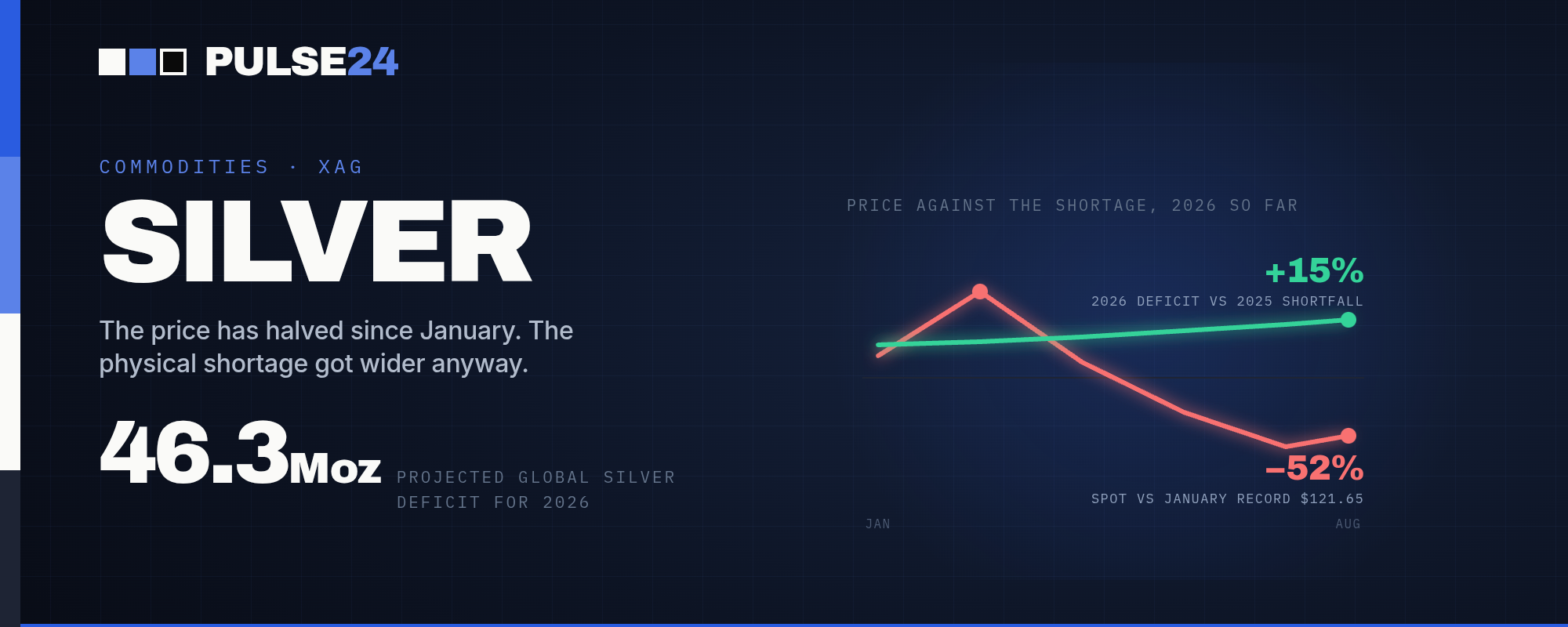
Silver Is Down 52% From January's Record High. The Global Silver Deficit Just Got 15% Worse Anyway.
Silver traded near $59 an ounce this week, about half of January's record $121.65 high. The Silver Institute says the physical shortage widened to 46.3 million ounces anyway, a reminder that Fed policy, not scarcity, is driving the price right now.
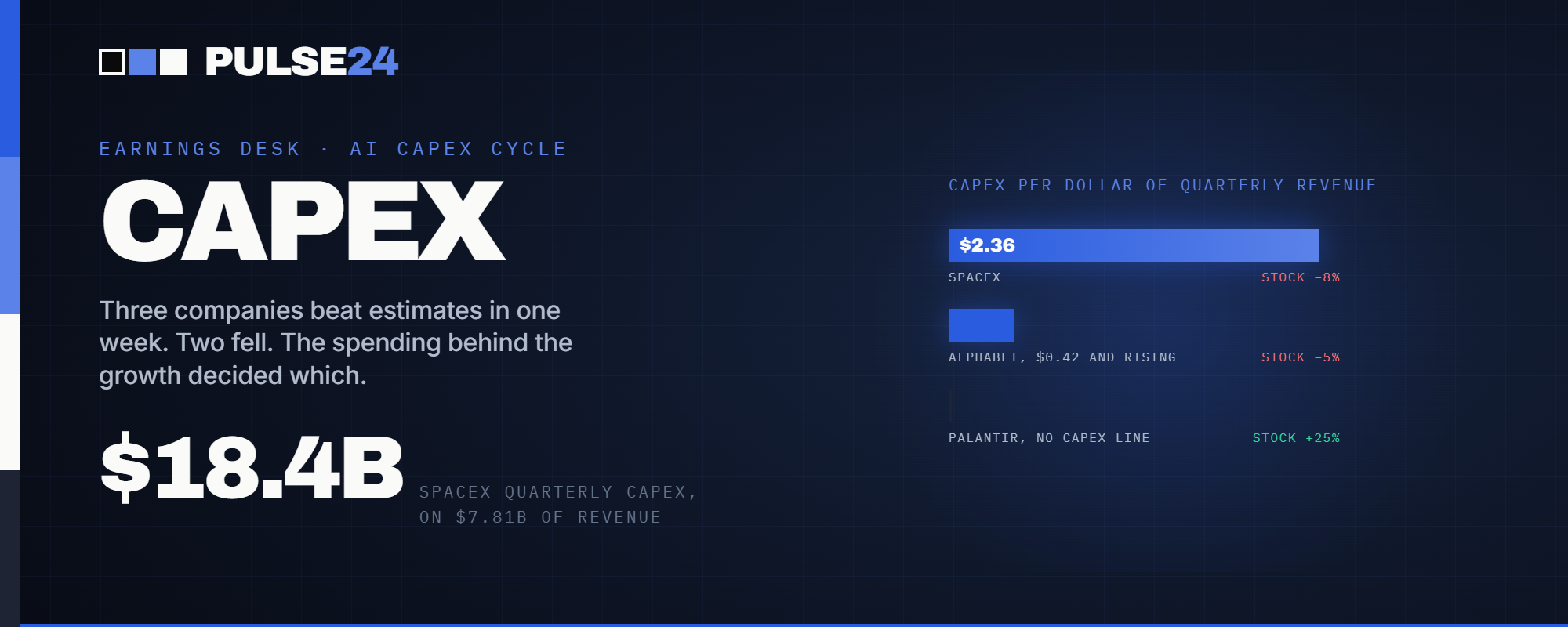
SpaceX Beat Estimates and Fell 8%. Palantir Beat Estimates and Surged 25%. The Difference Is a Number Most Headlines Skip.
SpaceX beat Wall Street's estimates this earnings season and its stock fell. Palantir beat estimates the same week and surged 25%. The gap wasn't the size of either beat, it was what each company's capital spending is doing to its cash flow, a test worth applying to every AI-exposed earnings report from here on.
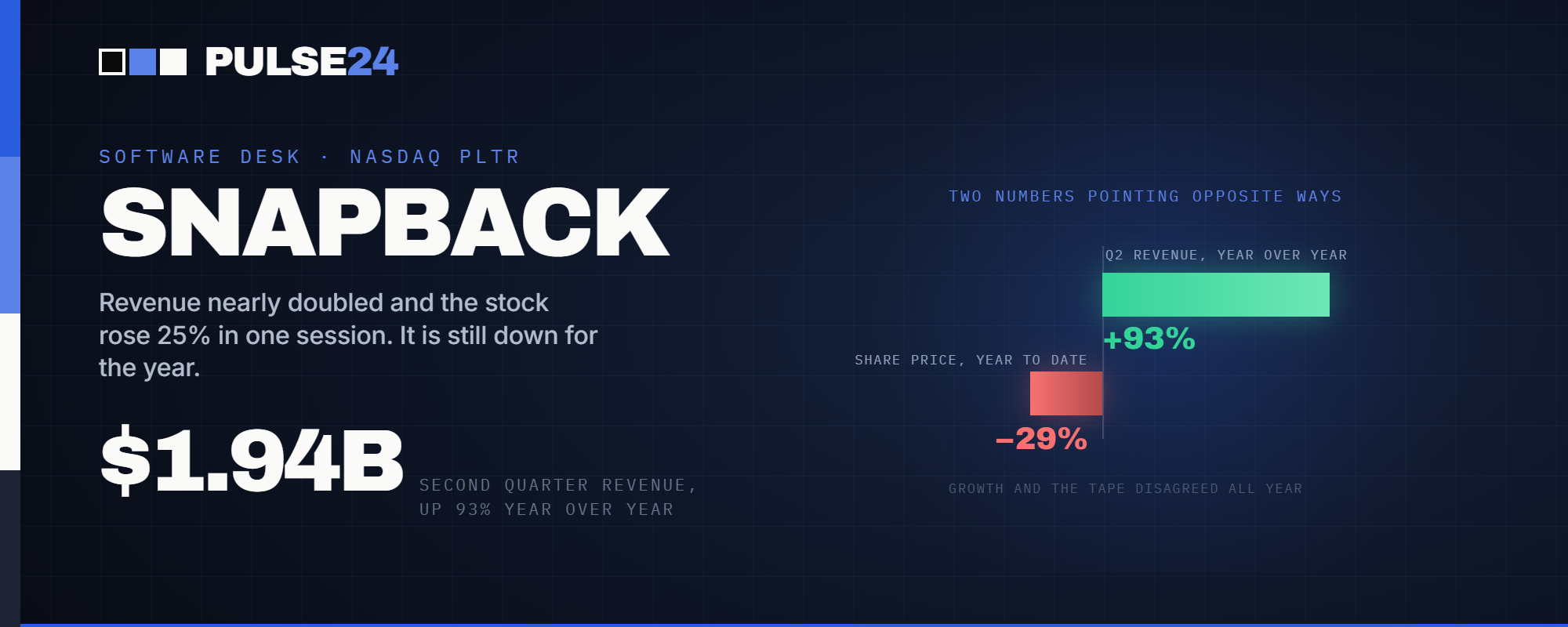
Palantir's Revenue Jumped 93% and Its Stock Surged 25%. The Shares Are Still Down 29% for the Year.
Palantir's second quarter revenue grew 93% and its guidance raise sent the stock up more than 25% in a single session, pushing the S&P 500 to a fresh record. The rally still hasn't erased the stock's losses for the year, and Wall Street's price targets show the valuation debate is far from settled.
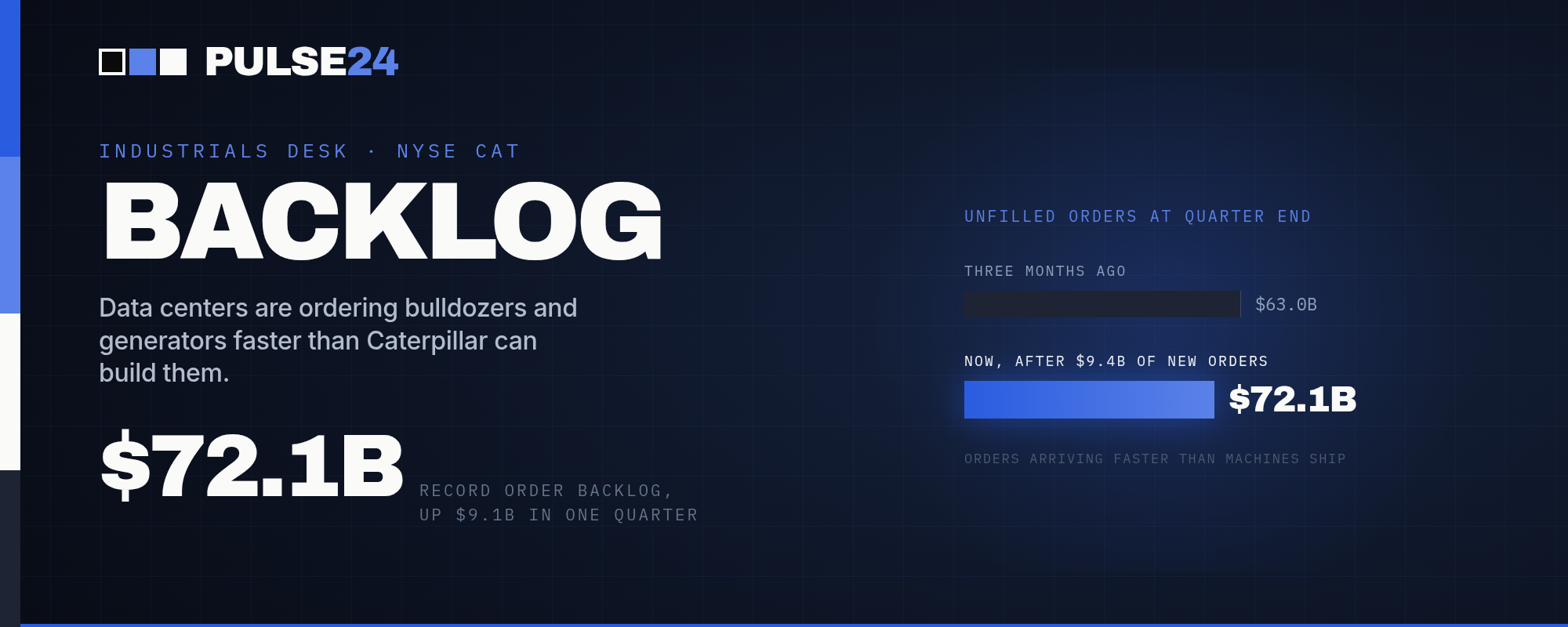
Caterpillar Just Crossed $20 Billion in Quarterly Revenue for the First Time. Its Order Backlog Jumped to $72 Billion on AI Power Demand.
Caterpillar posted $20.5 billion in quarterly revenue for the first time in company history, and its order backlog jumped from $63 billion to a record $72.1 billion as data centers buy up construction equipment and backup generators. The results extend the AI capex story well beyond chipmakers and cloud providers into heavy industrial machinery.
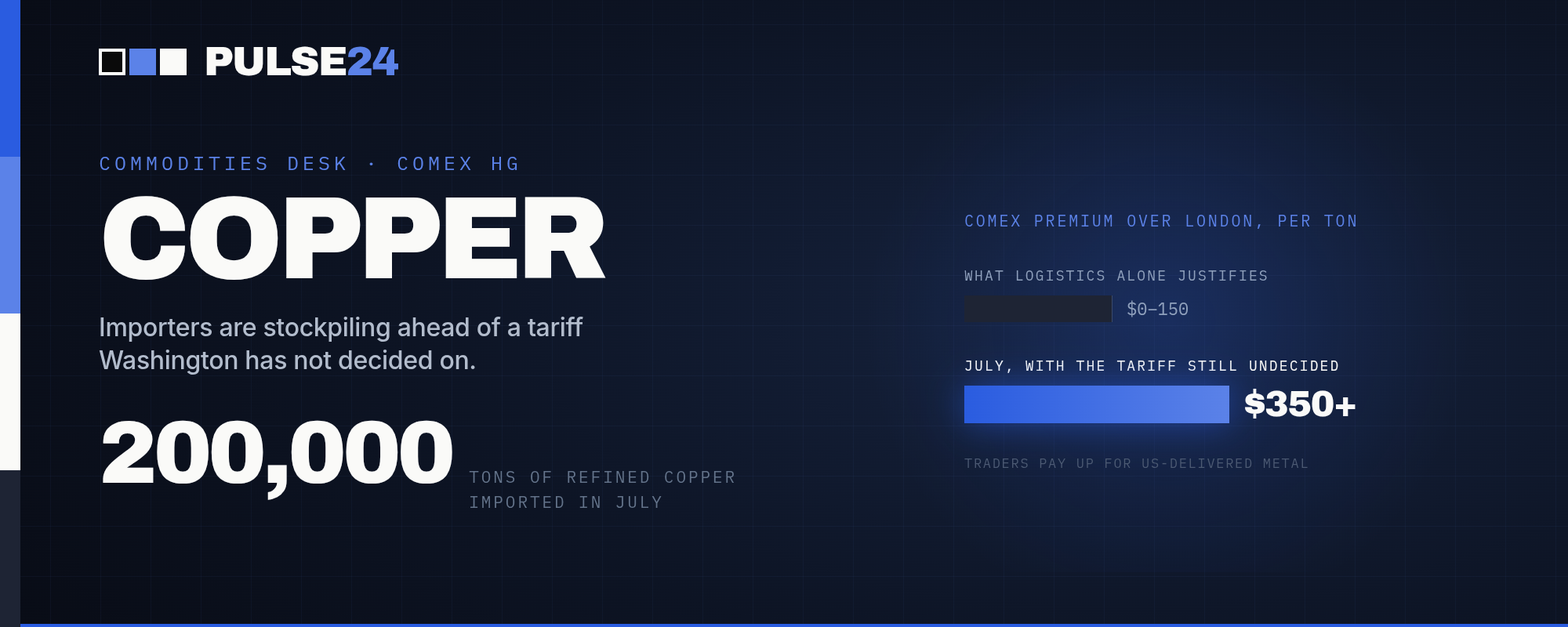
U.S. Copper Imports Hit Their Highest Level in 12 Years. Traders Aren't Waiting to Find Out What Trump Decides on Tariffs.
The U.S. imported 200,000 metric tons of refined copper in July, the most in at least 12 years, as traders stockpile the metal ahead of a tariff decision the White House still hasn't made. The scramble is already showing up in near record COMEX prices and a stockpile north of a million tons.
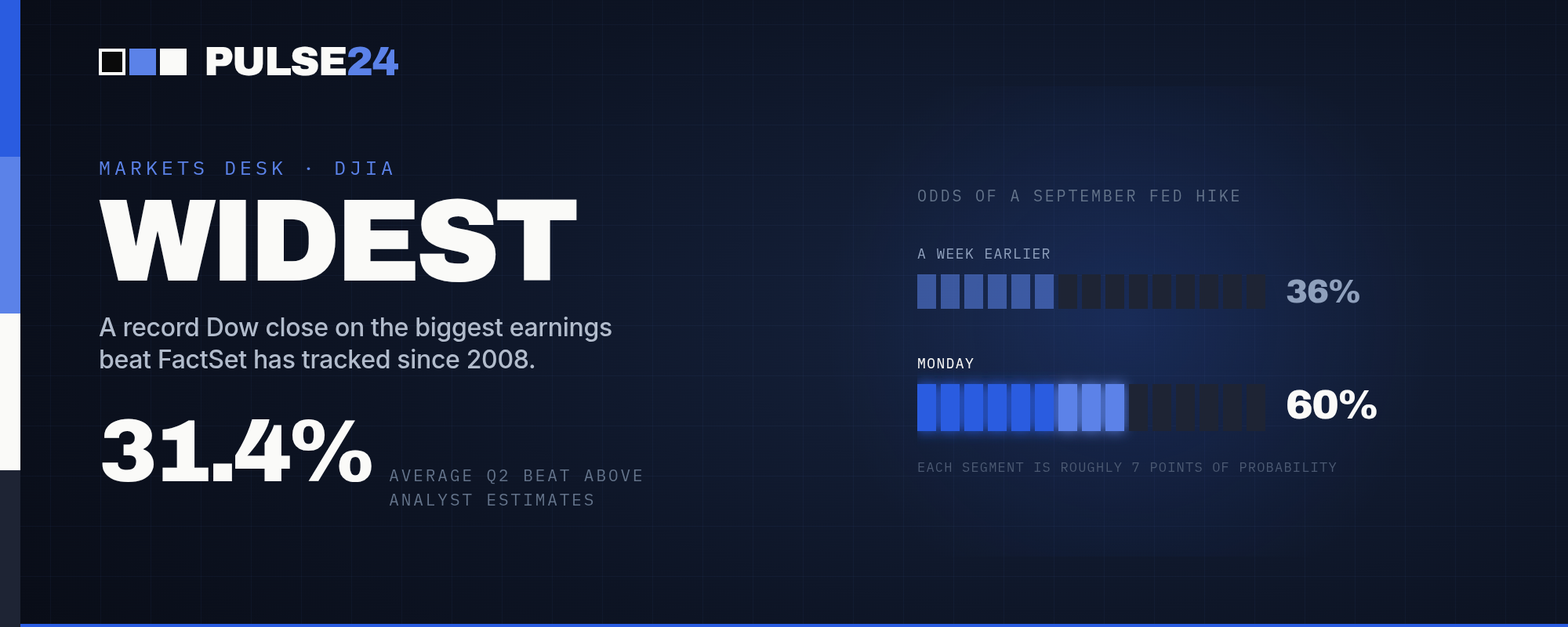
The Dow Closed at a Record 53,178 Monday on the Widest Earnings Beat Since 2008. That Same Strength Is Pushing the Fed Toward a Hike, Not a Cut.
The Dow closed at a record 53,178 Monday as Q2 earnings delivered their widest beat margin since FactSet started tracking it in 2008. That same strength is now pushing Fed rate-hike odds for September to roughly 60%, not toward a cut.
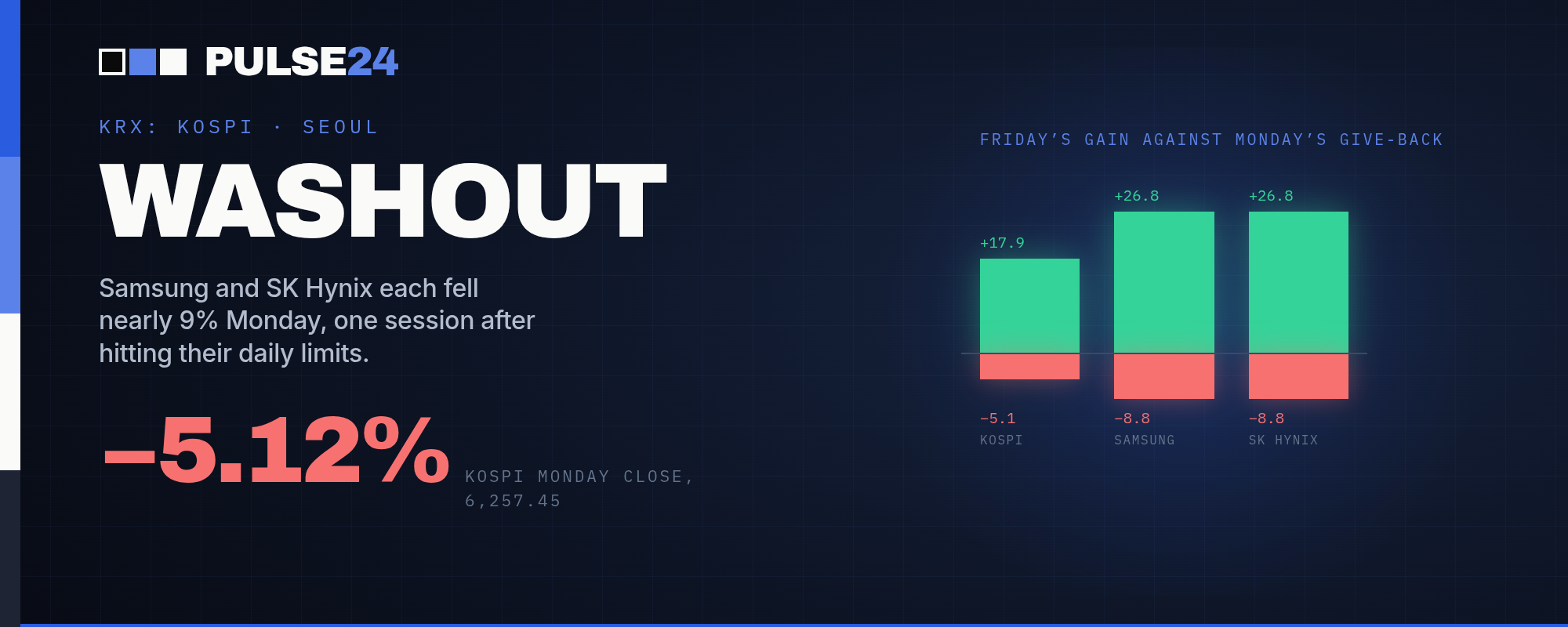
Samsung and SK Hynix Each Fell Nearly 9% Monday, One Trading Day After Their Best Session Ever. Morgan Stanley Calls the Reversal a Buying Opportunity.
Korea's chipmakers gave back part of Friday's record rally on Monday, with Samsung and SK Hynix each falling nearly 9% and the Kospi dropping more than 5%. Morgan Stanley says the pullback is a technical washout, not a sign AI demand is cracking, and just raised its Kospi target to 9,000.
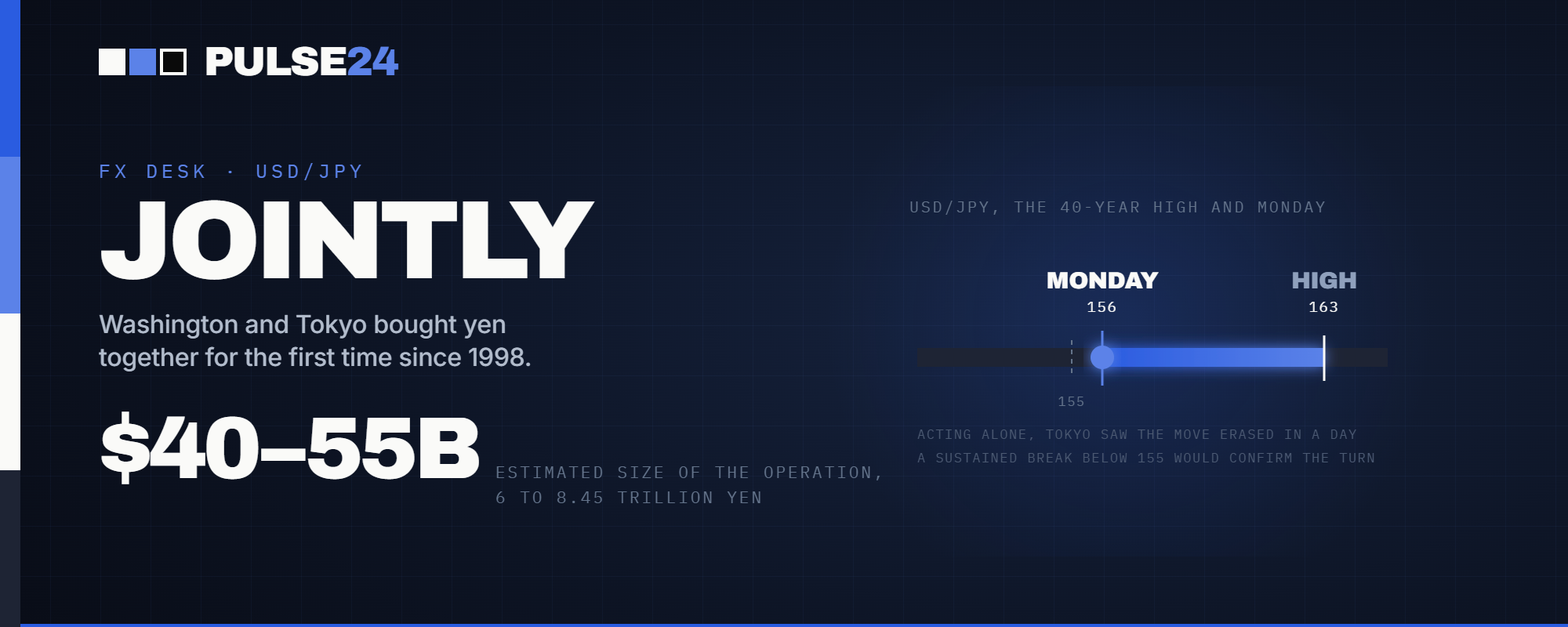
The US and Japan Jointly Bought Yen for the First Time Since 1998. The Dollar Dropped From a 40-Year High to Around 156.
The US Treasury and Japan's Ministry of Finance jointly bought yen for the first time since 1998, pulling the dollar back from a 40-year high above 163 to around 156. Here's why two governments stepped into a market they normally leave alone, and what would actually make it stick.
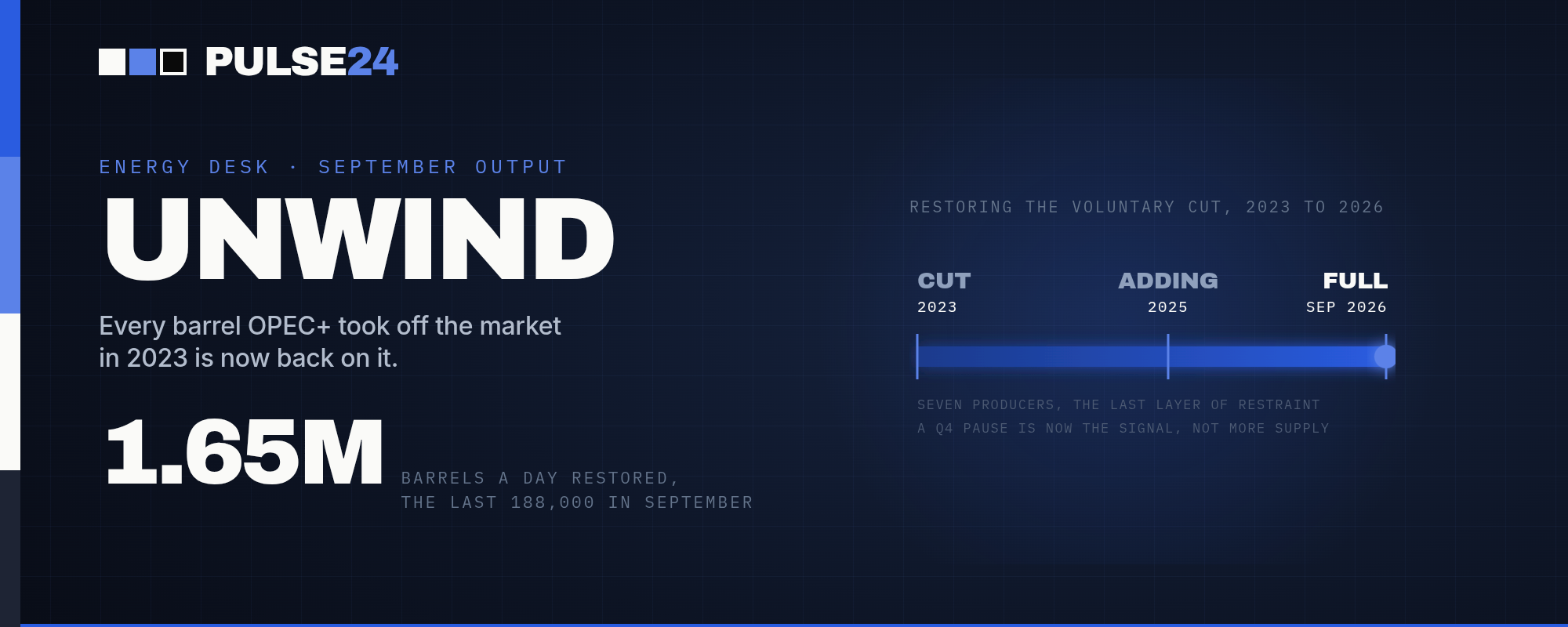
OPEC+ Just Finished Unwinding a 1.65 Million Barrel Cut. Oil's 4% Slide Could Be the Fed's Best Inflation News in Weeks.
OPEC+ closed out its two-year unwind of voluntary output cuts with a fresh 188,000 barrel-a-day increase for September, and oil pulled back to start August. For a Fed weighing a September rate hike, cheaper crude might end up mattering more than the next inflation report.
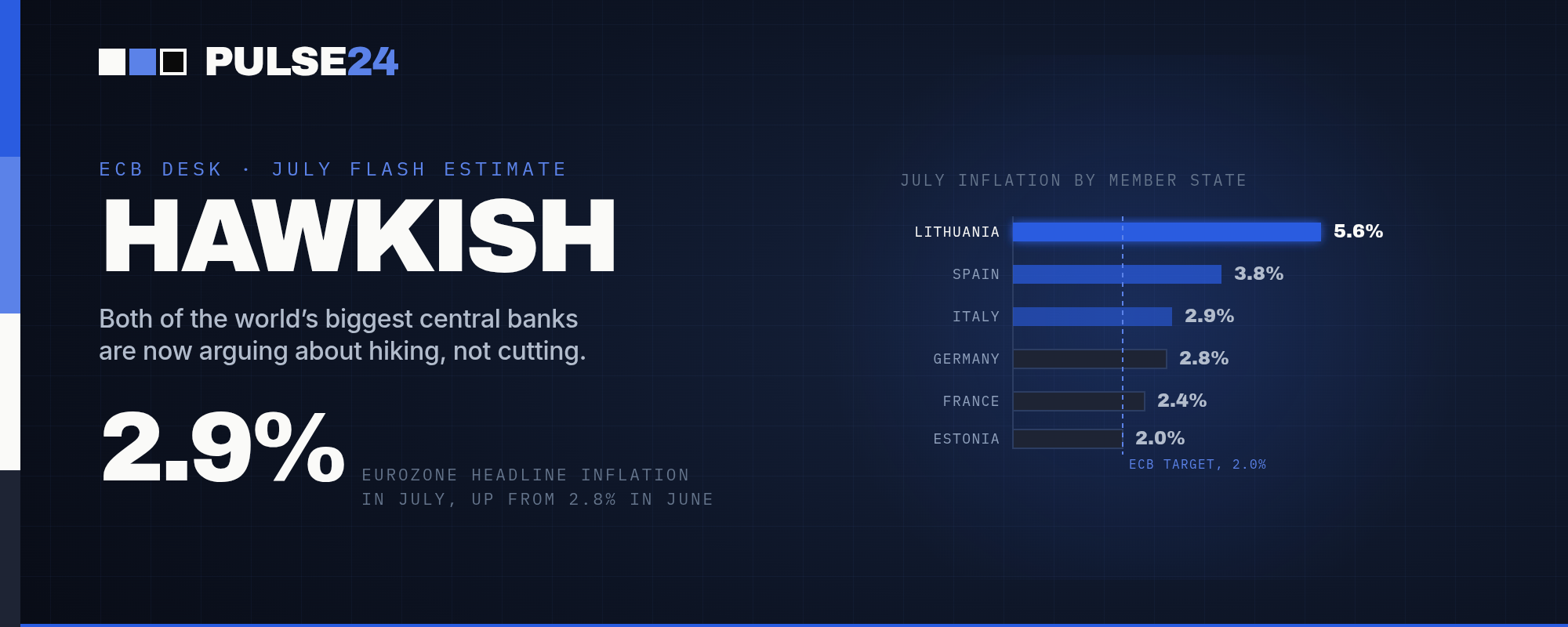
Eurozone Inflation Climbed to 2.9% in July. The ECB and the Fed Are Now Both Leaning Toward a Hike, Not a Cut.
Eurozone inflation accelerated to 2.9% in July and the ECB left its September meeting wide open for a rate hike. That comes a week after the Fed held rates on a 9-3 vote, with three officials pushing for a hike instead of a cut.
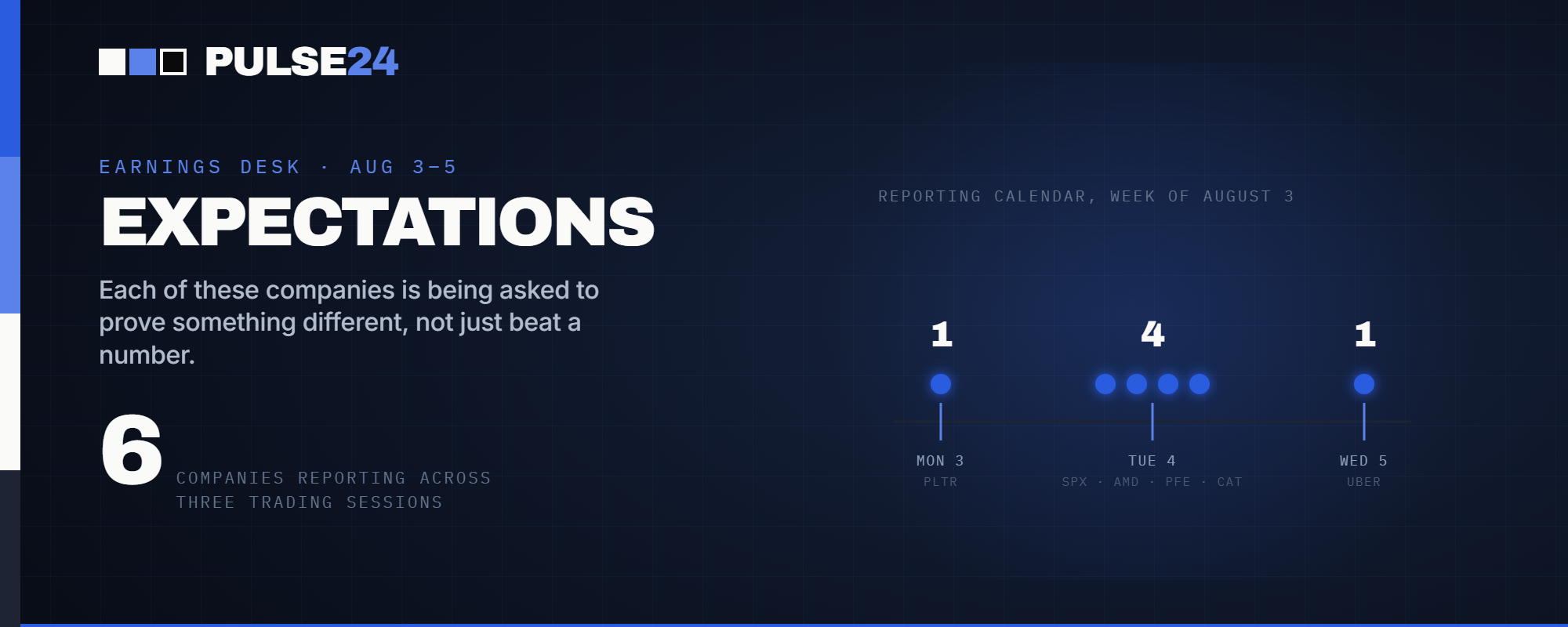
This Isn't Earnings Week. It's Expectations Week.
Six companies report between August 3 and 5, including SpaceX's first quarterly results as a public company, and each one is being asked to prove something different, not just beat a number. Here's what has to show up in each report, and what the numbers already say about how much room for error the market is giving them.
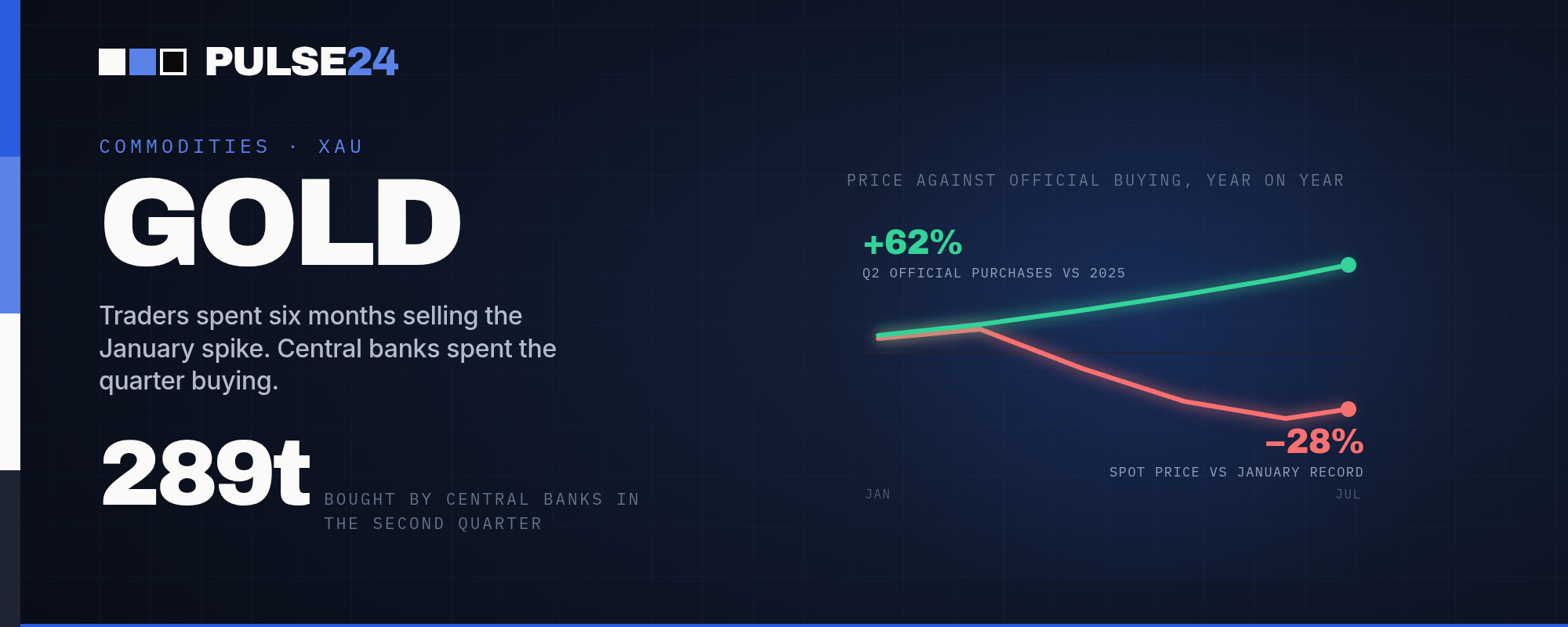
Gold Is Down 28% From January's Record. Central Banks Bought 289 Tonnes of It in a Single Quarter.
Gold closed July 28% below the record it set in January, yet central banks bought 62% more of it in the second quarter than they did a year earlier. The two trends aren't as contradictory as they look, and the gap between them explains a lot about how this gold market actually works.
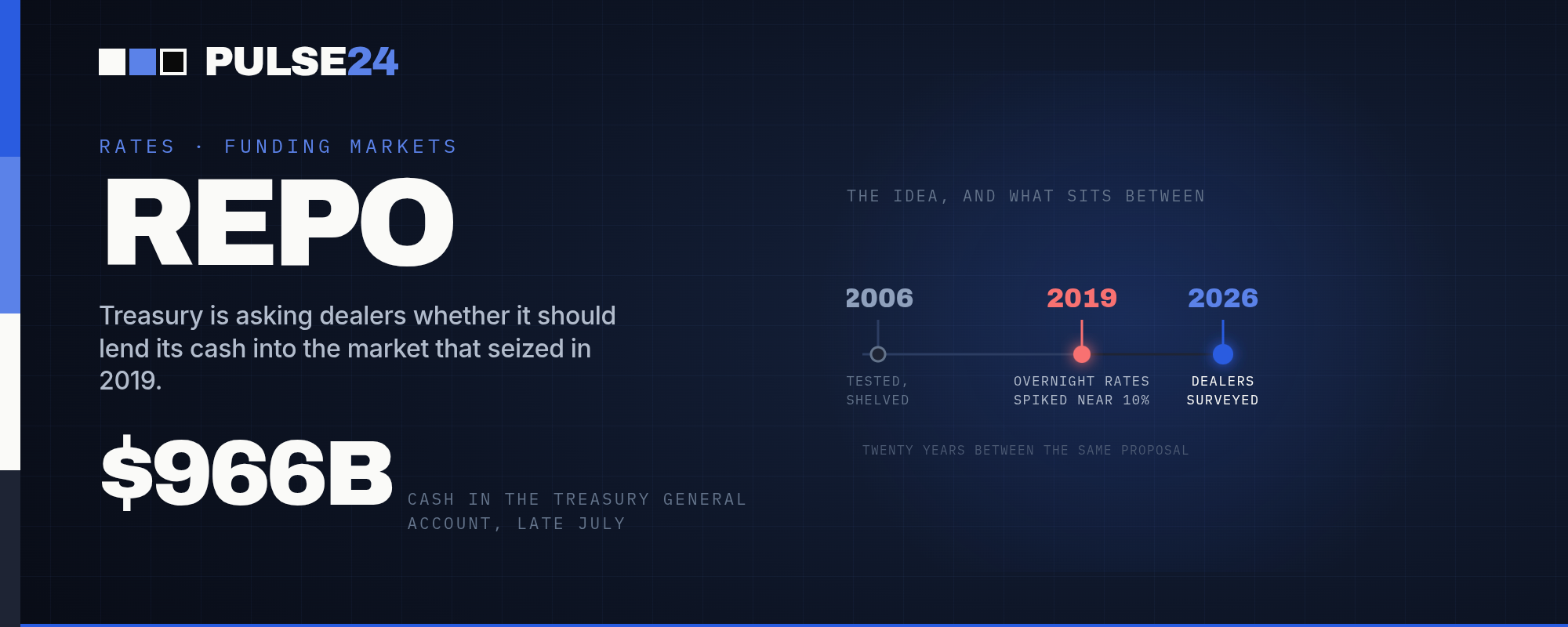
The US Treasury Is Weighing Whether to Lend $1 Trillion Into the Repo Market. Wall Street Hasn't Forgotten What Happened There in September 2019.
The U.S. Treasury is quietly asking bond dealers whether it should lend its own cash into the $13 trillion repo market, an idea last tried in 2006. It's a plumbing fix aimed at a funding system that already cracked once this decade, in September 2019.
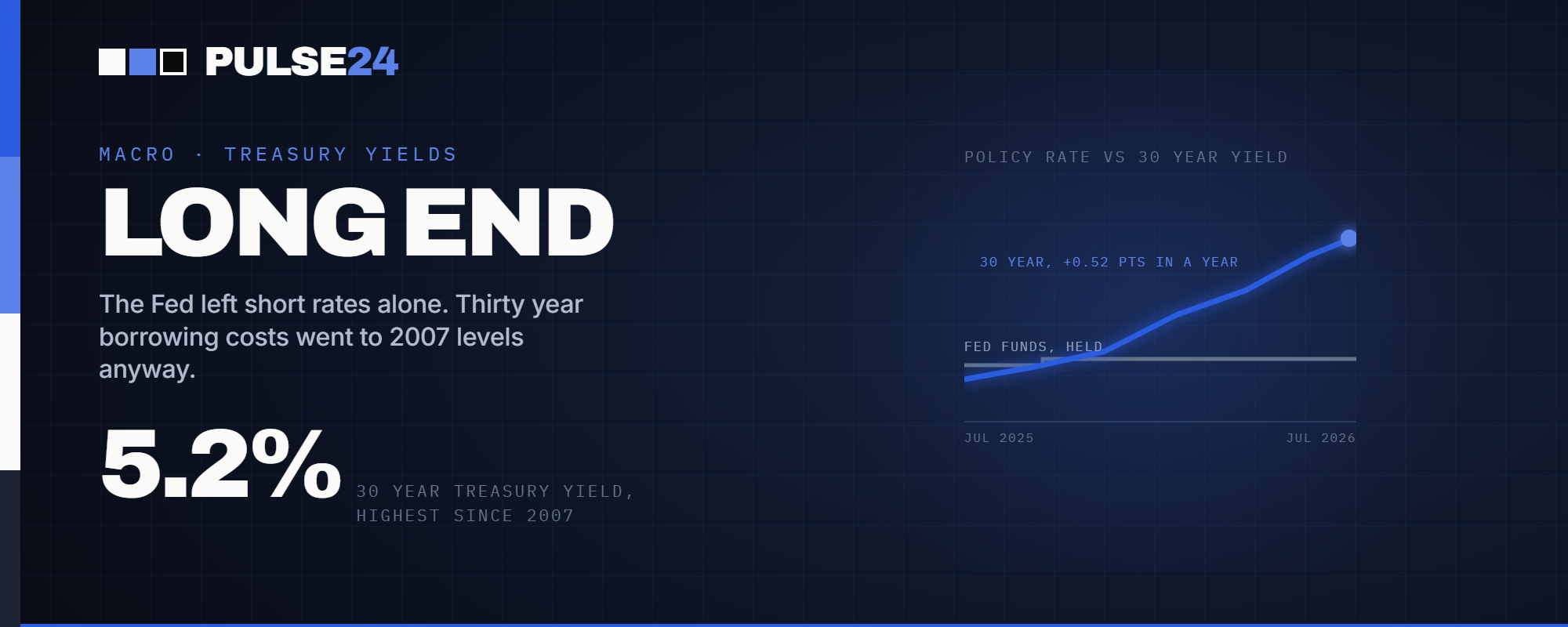
The 30-Year Treasury Yield Topped 5.2%, Its Highest Since 2007. The Nasdaq Just Logged Its Second Correction of the Year.
The 30-year Treasury yield just climbed to territory it hasn't touched since 2007, and two days after the Fed's divided vote to hold rates, the Nasdaq confirmed its second correction of 2026. Here's why long-term borrowing costs and short-term policy are telling two different stories right now.
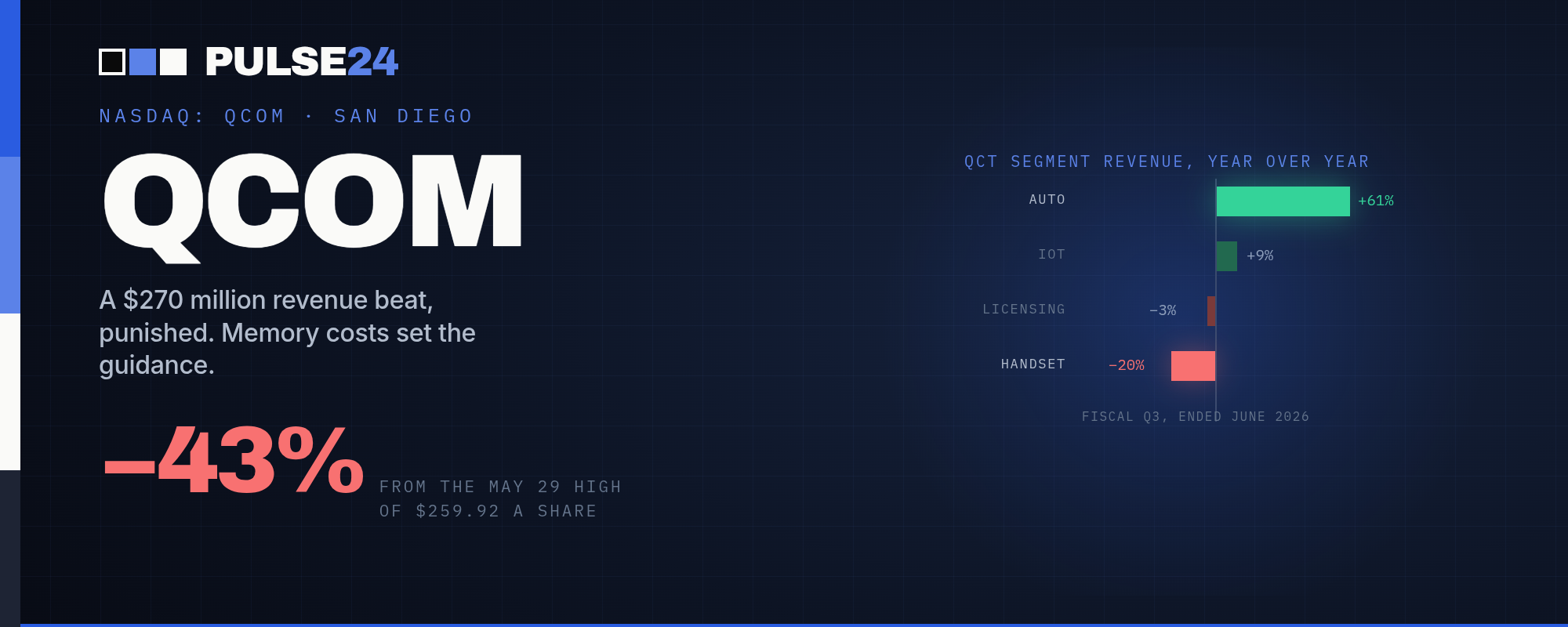
Qualcomm Beat Revenue Estimates by $270 Million. Its Stock Is Down 43% From May's High Anyway, and Memory Costs Are Why.
Qualcomm beat revenue estimates and grew automotive chip sales 61% in a single quarter, and its stock still fell nearly 8% in after-hours trading and now sits 43% below its May high. Rising memory costs and a shrinking Apple contract explain both moves.
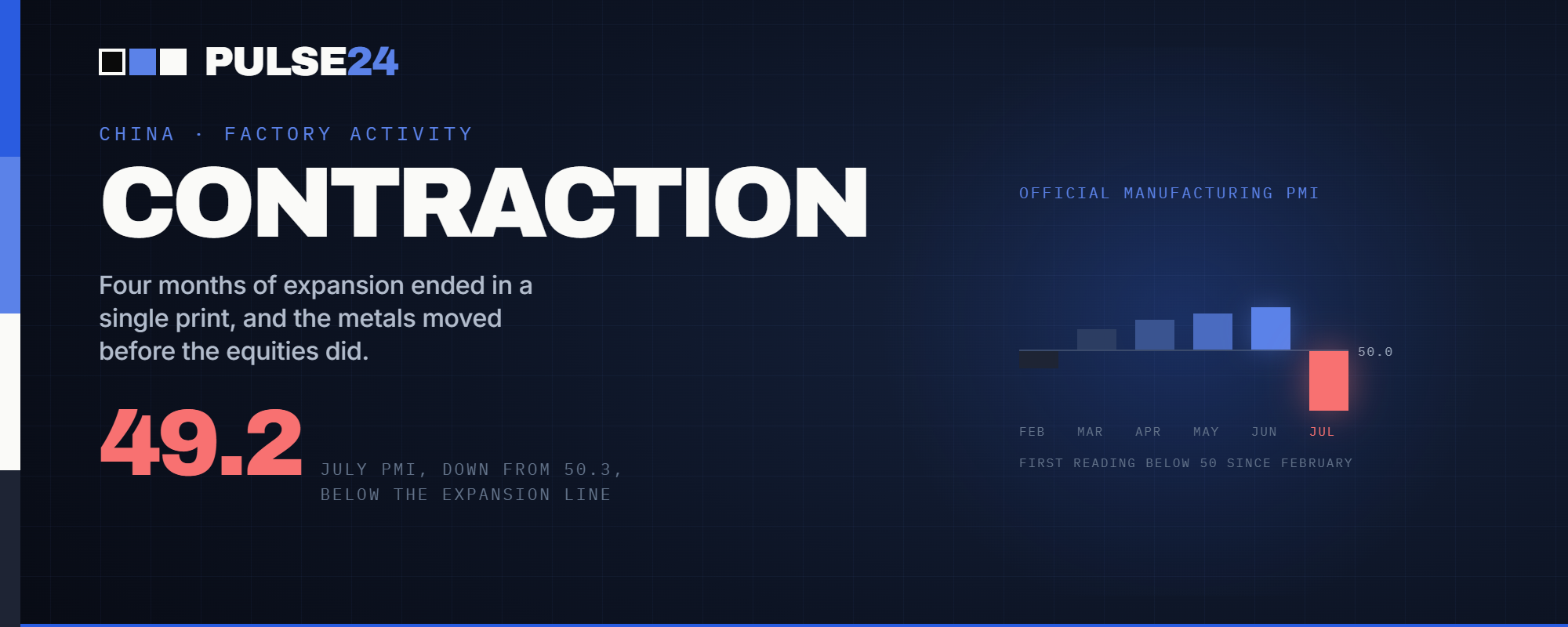
China's Manufacturing PMI Fell to 49.2, Snapping a Four-Month Growth Streak. Copper and Iron Ore Already Felt It.
China's factory activity fell back into contraction in July, with the official PMI slipping to 49.2 from 50.3 in June. Copper and iron ore prices are already sliding on the renewed demand worries, even as Beijing's Politburo pledged fresh stimulus to keep the world's second-largest economy on track.
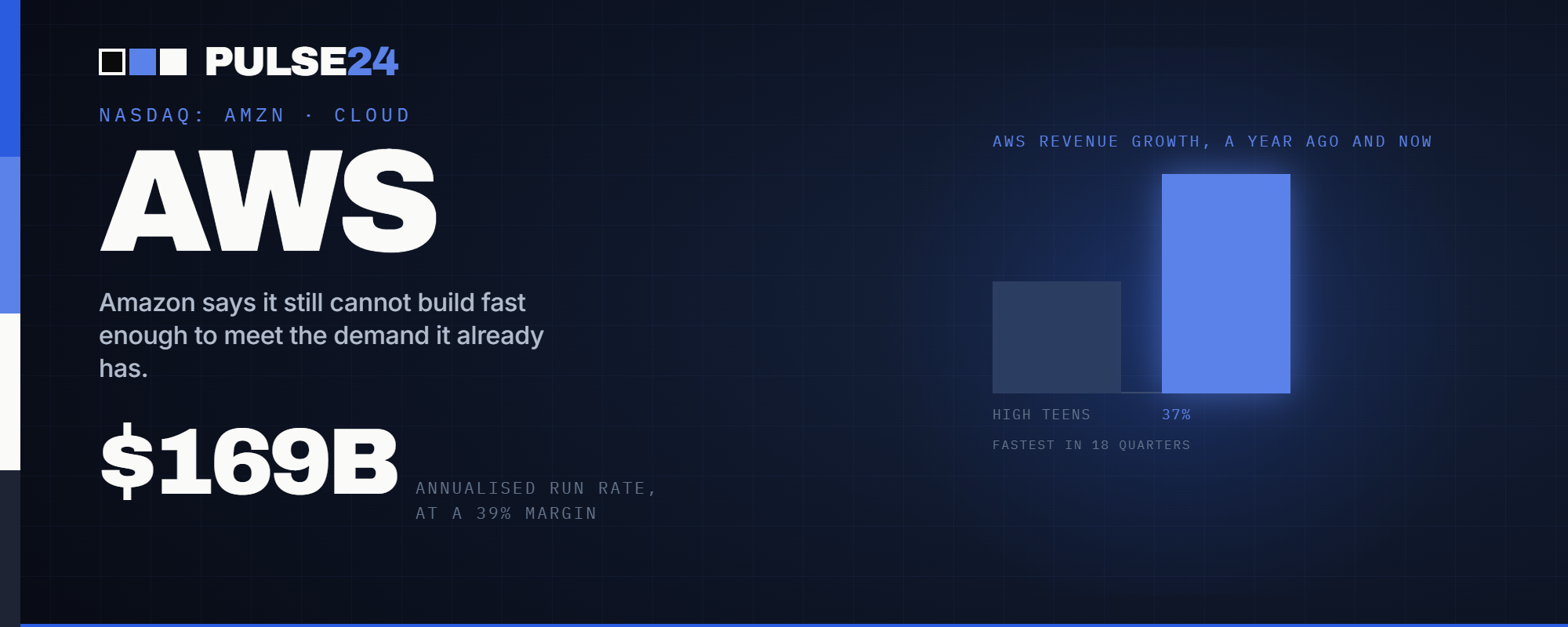
Amazon Stock Surged 12% on Record Earnings. Its AI and Chip Businesses Just Crossed $25 Billion a Year Each.
Amazon's stock jumped about 12% after its best quarter in years, with AWS growth accelerating to its fastest pace in 18 quarters and its AI and custom chip businesses both crossing $25 billion in annualized revenue. CEO Andy Jassy also raised 2026 capital spending to $220 billion and said Amazon still won't have enough capacity to meet demand through 2027.
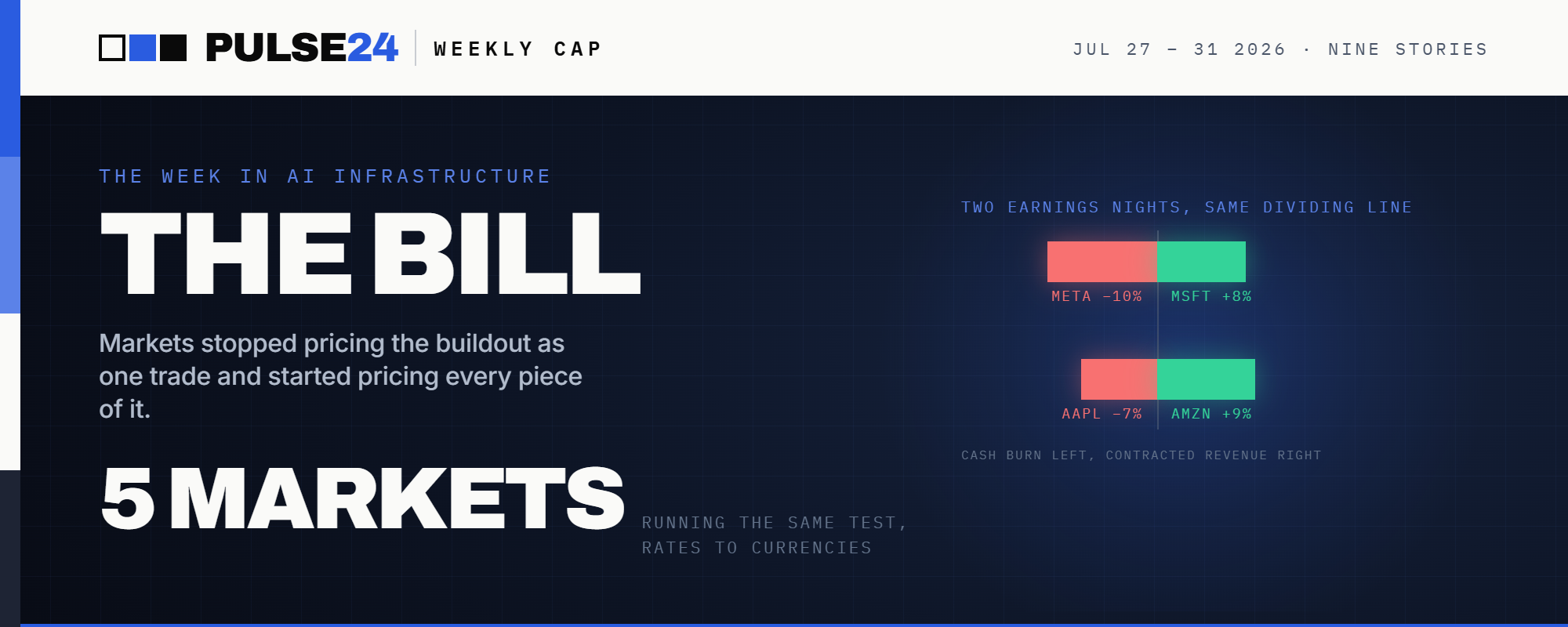
The Week Markets Started Pricing What AI Infrastructure Actually Costs
This week wasn't about the Fed, Microsoft, or Japan in isolation. It was about markets beginning to ask whether AI infrastructure is finally being judged on its returns rather than its ambition.
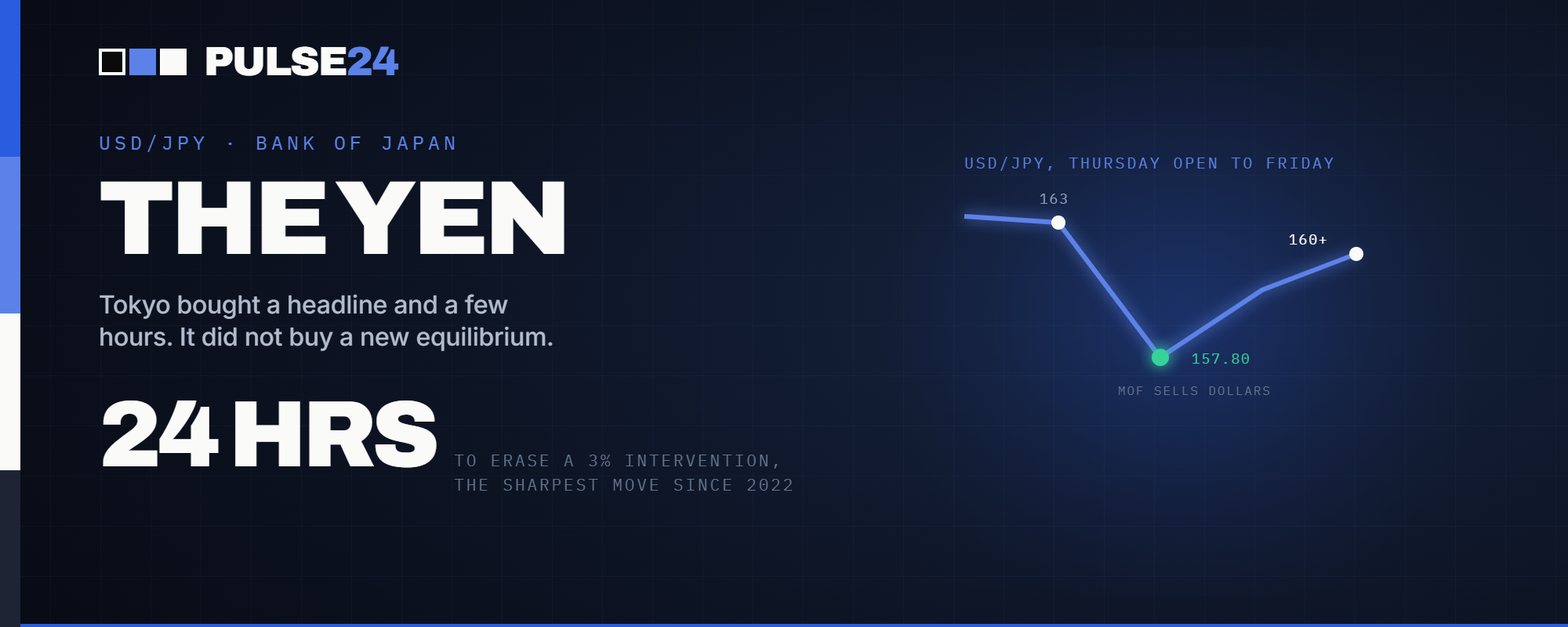
Japan's Yen Intervention Drove the Dollar's Worst Day Since 2022. A Day Later, USD/JPY Was Back Above 160.
Japan's Ministry of Finance staged a suspected dollar-selling intervention on July 30 that pushed USD/JPY down roughly 3% in a single session, the yen's sharpest daily gain against the dollar since 2022. The Bank of Japan followed with a hawkish rate hold the next morning, but the pair had already climbed back above 160 by Friday, a sign that a 260 basis point rate gap with the US is still doing more work than Tokyo's intervention.
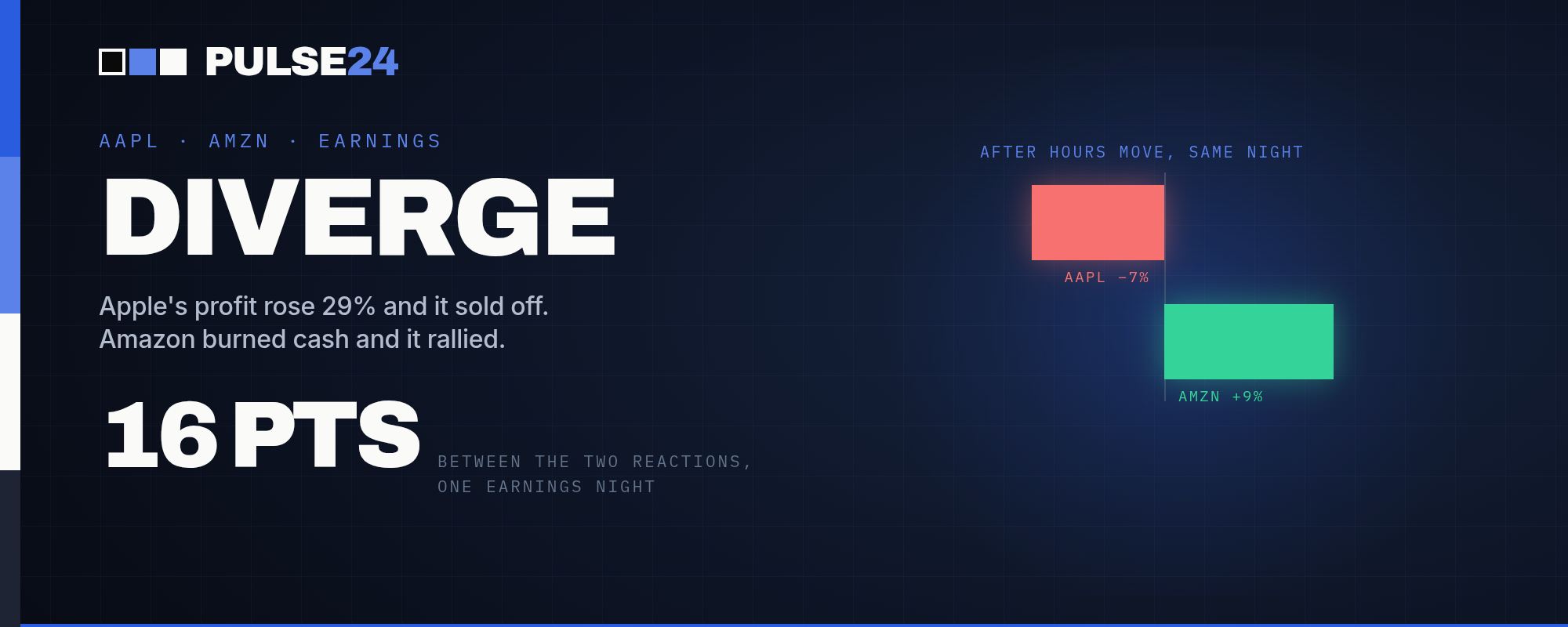
Apple's Profit Jumped 29% and Its Stock Fell. Amazon's Free Cash Flow Went Negative and Its Stock Jumped 9%.
Apple grew revenue 16% and profit 29% last quarter, and its stock slipped anyway on a soft September-quarter outlook and a China miss. Amazon reported negative free cash flow for the first time since 2023 the same night, and its shares jumped as much as 9% after hours on accelerating cloud growth.
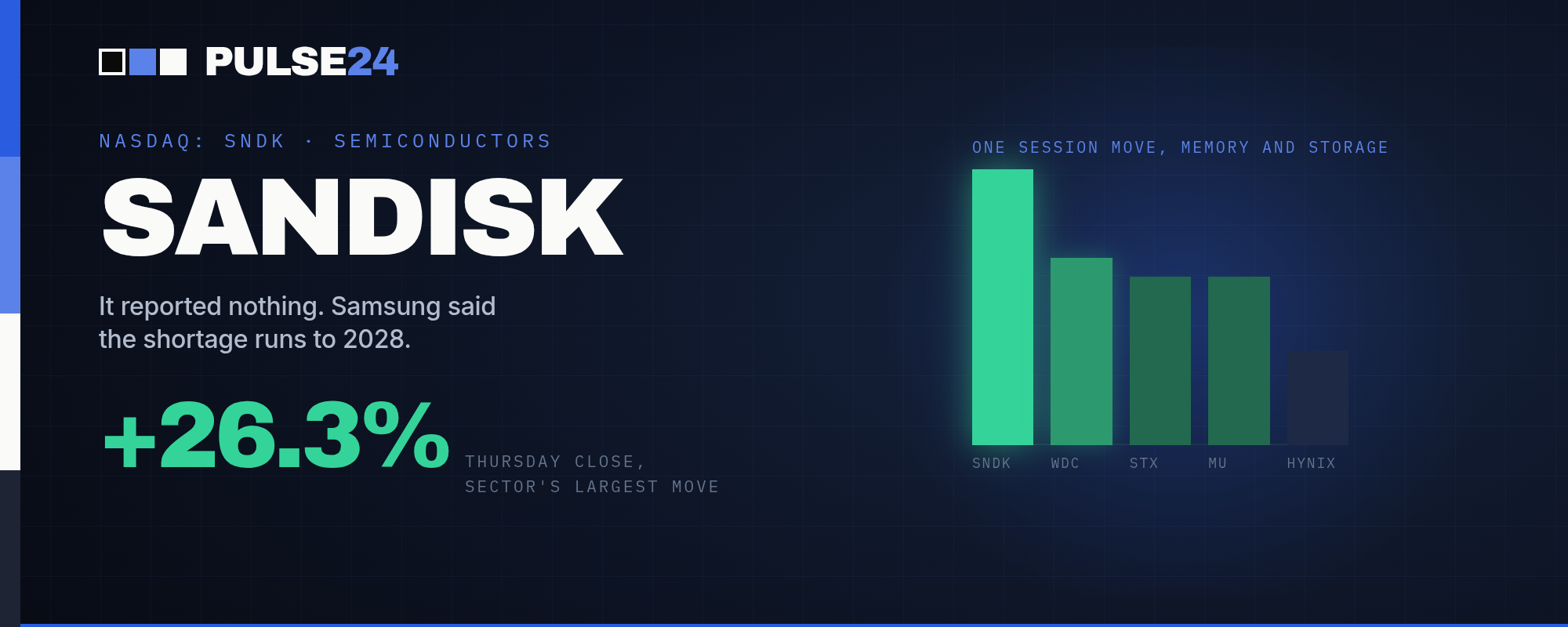
SanDisk Soared 26% in a Single Session. Samsung's Warning About a Chip Shortage Through 2028 Is Why.
SanDisk led a memory chip rally Thursday, closing up 26.29% as Micron, SK Hynix and Western Digital surged alongside it, after Samsung said the shortage powering its record profit would run through 2028 and Microsoft's earnings eased fears that AI spending was outrunning cash flow.
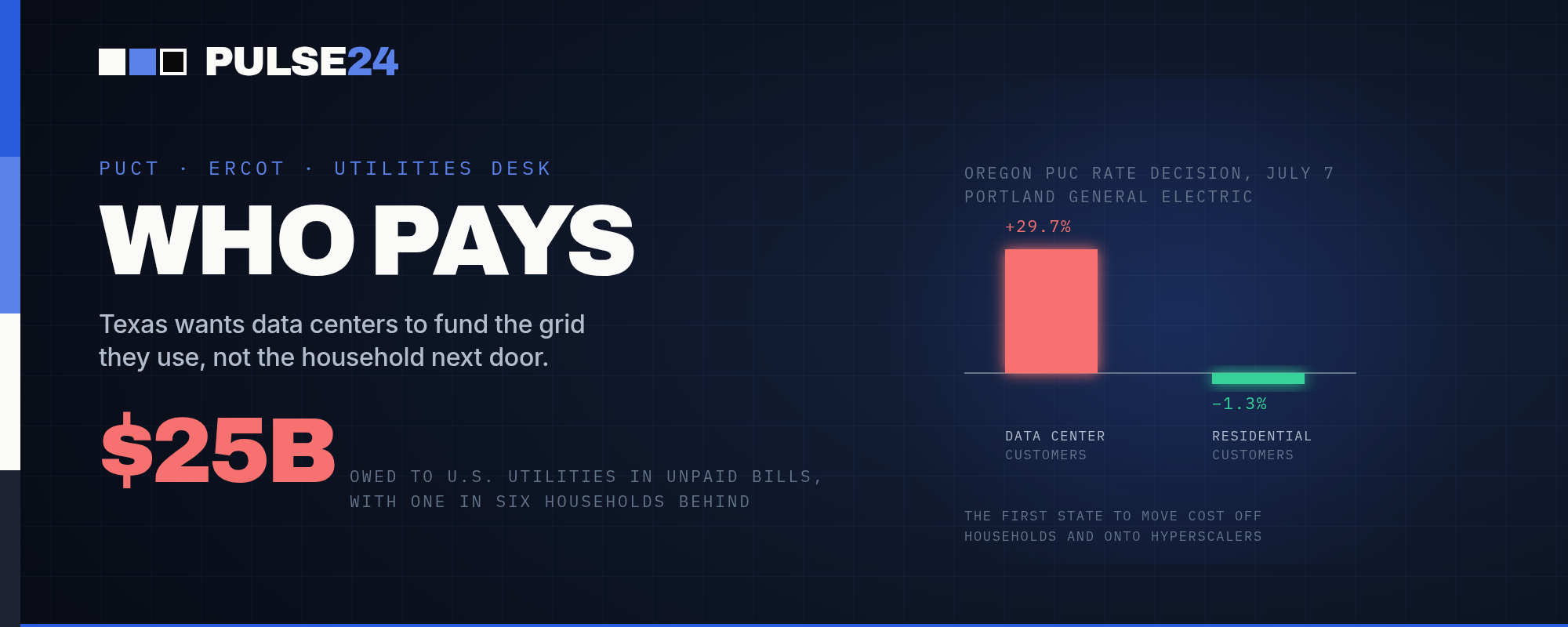
Texas Moves to Make Data Centers Pay for Their Own Power. The Industry Already Owes $25 Billion in Unpaid Bills.
Texas regulators want AI data centers to cover the cost of the power infrastructure they use instead of spreading it across every ratepayer's bill, following Oregon's lead in approving a nearly 30% rate increase for data center customers while cutting residential rates. The move lands as the U.S. utility industry chases roughly $25 billion in unpaid bills and utility stocks tied to AI power demand keep rallying.
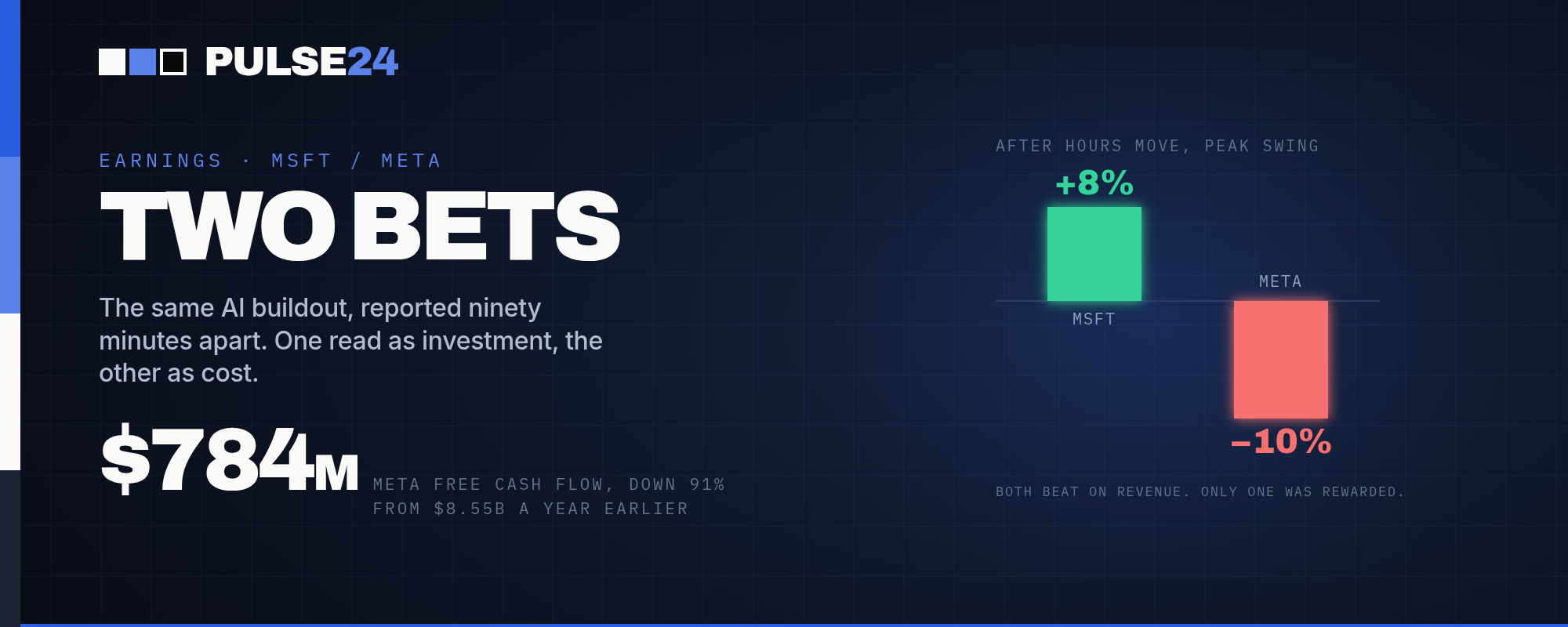
Microsoft's Azure Topped $100 Billion in Revenue. Meta's Free Cash Flow Fell to $784 Million on the Same Night.
Microsoft's fiscal fourth quarter beat estimates on revenue, profit, and Azure growth, and shares rose as much as 8% after hours. Meta beat on revenue too, but its free cash flow collapsed to $784 million and shares fell as much as 10%, a sign investors are starting to price AI spending very differently depending on what it actually buys.
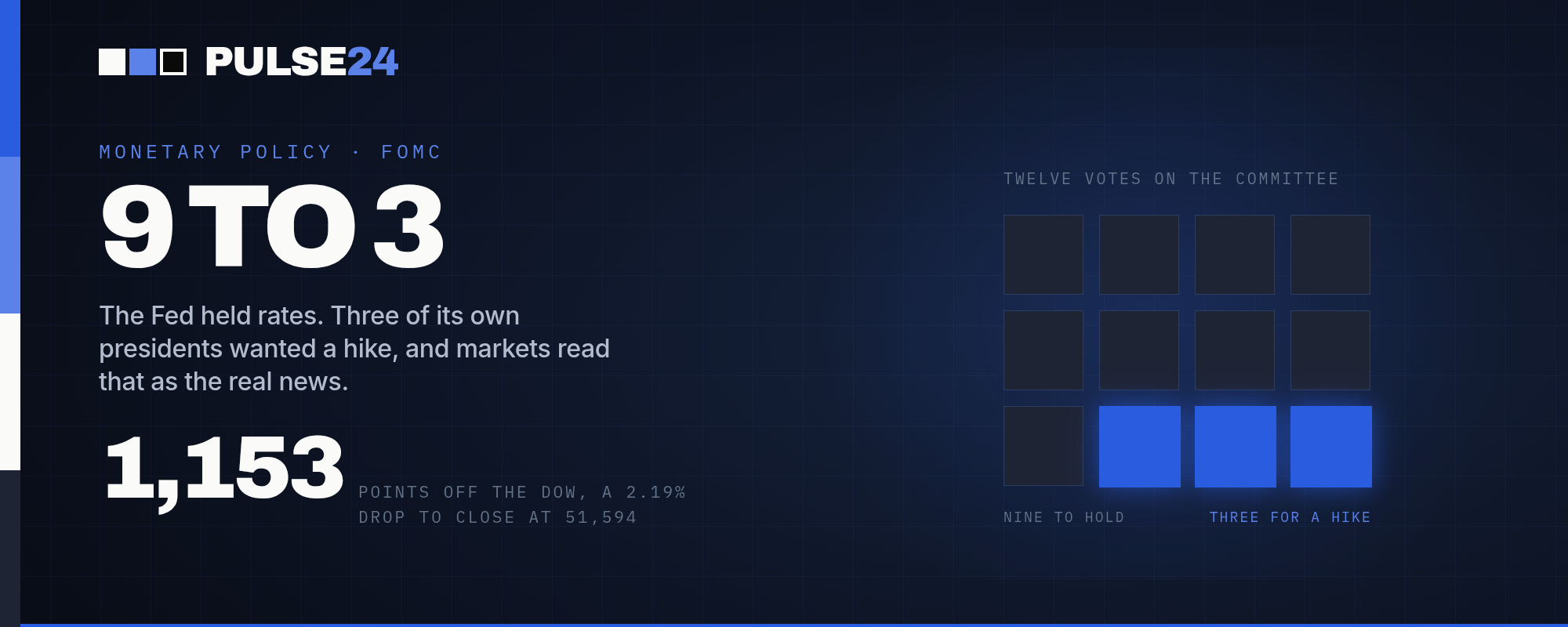
The Fed Held Rates at 3.50%-3.75% on a 9-3 Vote. The Dow Fell 1,153 Points Anyway.
The Federal Reserve held its benchmark rate at 3.50% to 3.75% on Wednesday, but three policymakers voted for a hike instead, and Wall Street didn't shrug it off. The Dow fell 1,153 points as yields rose and traders pushed the odds of a September rate increase to roughly 76%.
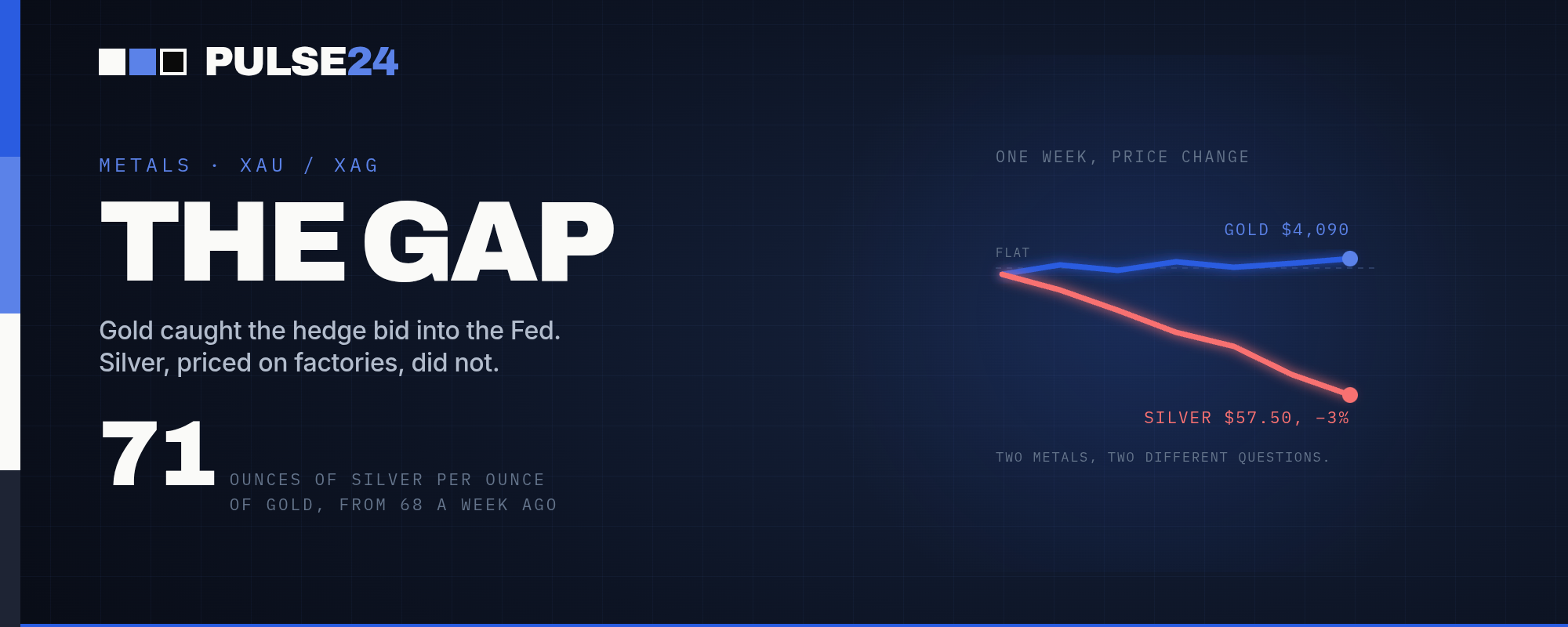
Silver Fell 3% This Week While Gold Held Its Ground. The Gap Between Them Just Widened to 71 to 1.
Gold is holding near $4,090 an ounce while silver has slipped to about $57.50, pushing the gold-to-silver ratio from around 68 to roughly 71 in under a week. The split says as much about industrial demand and growth expectations as it does about today's Fed decision.
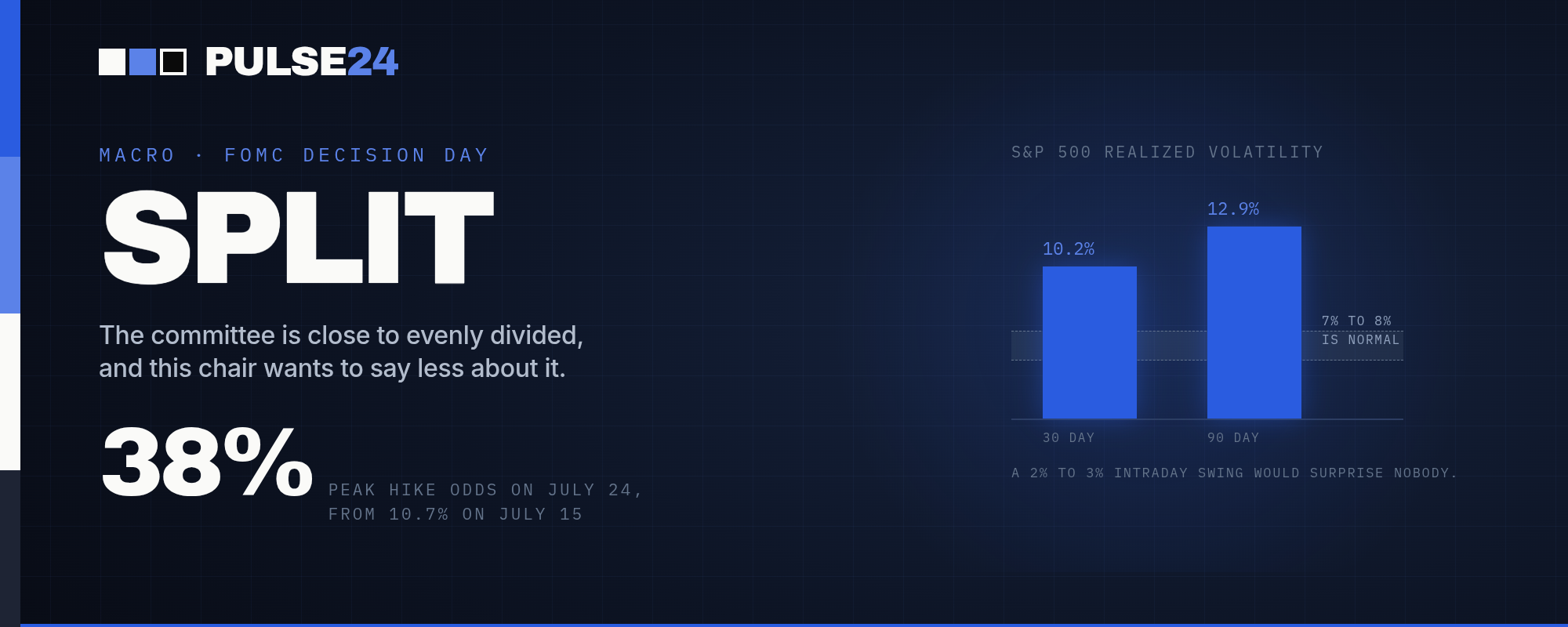
S&P 500 Volatility Just Hit 10.2%, Well Above Its Historical Average. The Fed's Decision Lands This Afternoon.
S&P 500 realized volatility has climbed to 10.2%, well above its historical range, as traders brace for a Fed decision due this afternoon from a chair who's pushing for less forward guidance. Hike odds spiked as high as 38% this week, up from just 11% two weeks earlier, with WTI crude up nearly 18% over the past month and the 10-year Treasury yield near 4.67% adding to the case for a hawkish surprise.
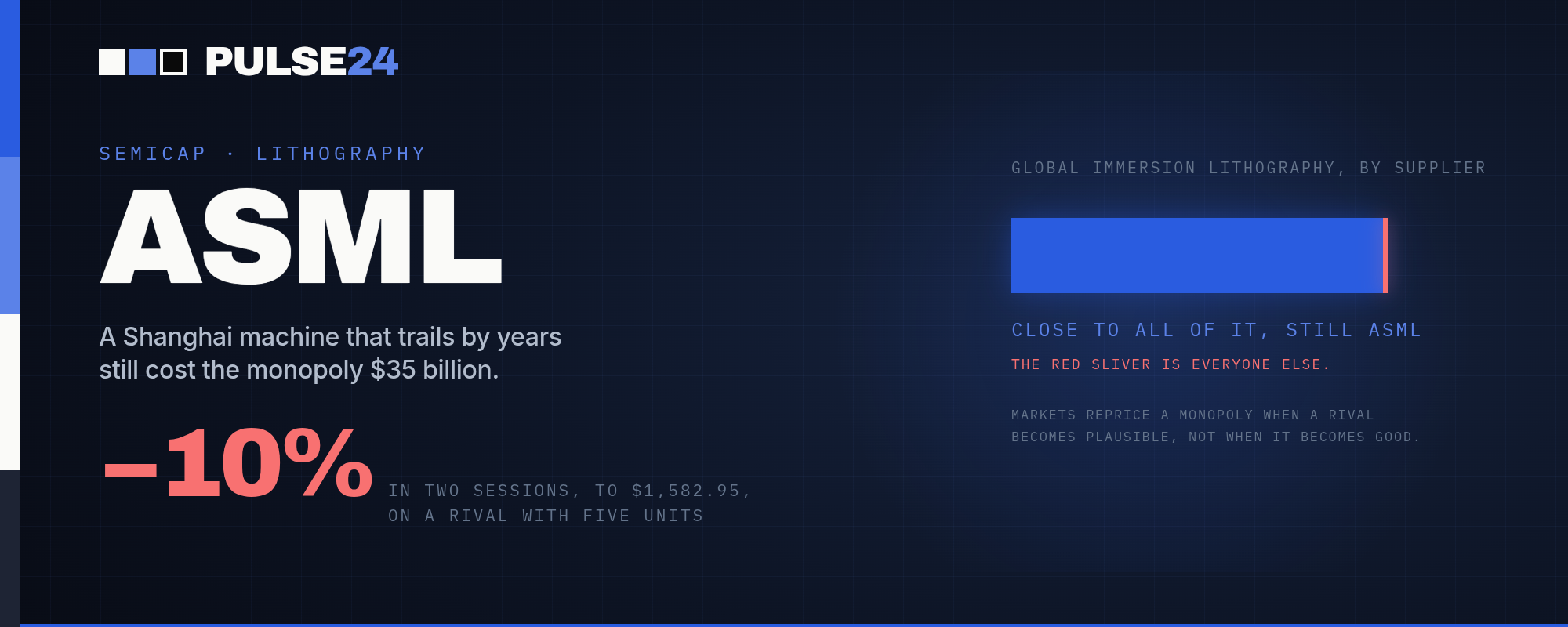
ASML Sank 10% in Two Days. China's First Homegrown Lithography Machine Is Why.
ASML lost more than $35 billion of market value in a single trading session after a state-backed Shanghai manufacturer confirmed it has started shipping China's first domestic immersion DUV lithography machines. The technology still trails Dutch equipment by years, but it chips away at the export control leverage the whole industry has relied on.
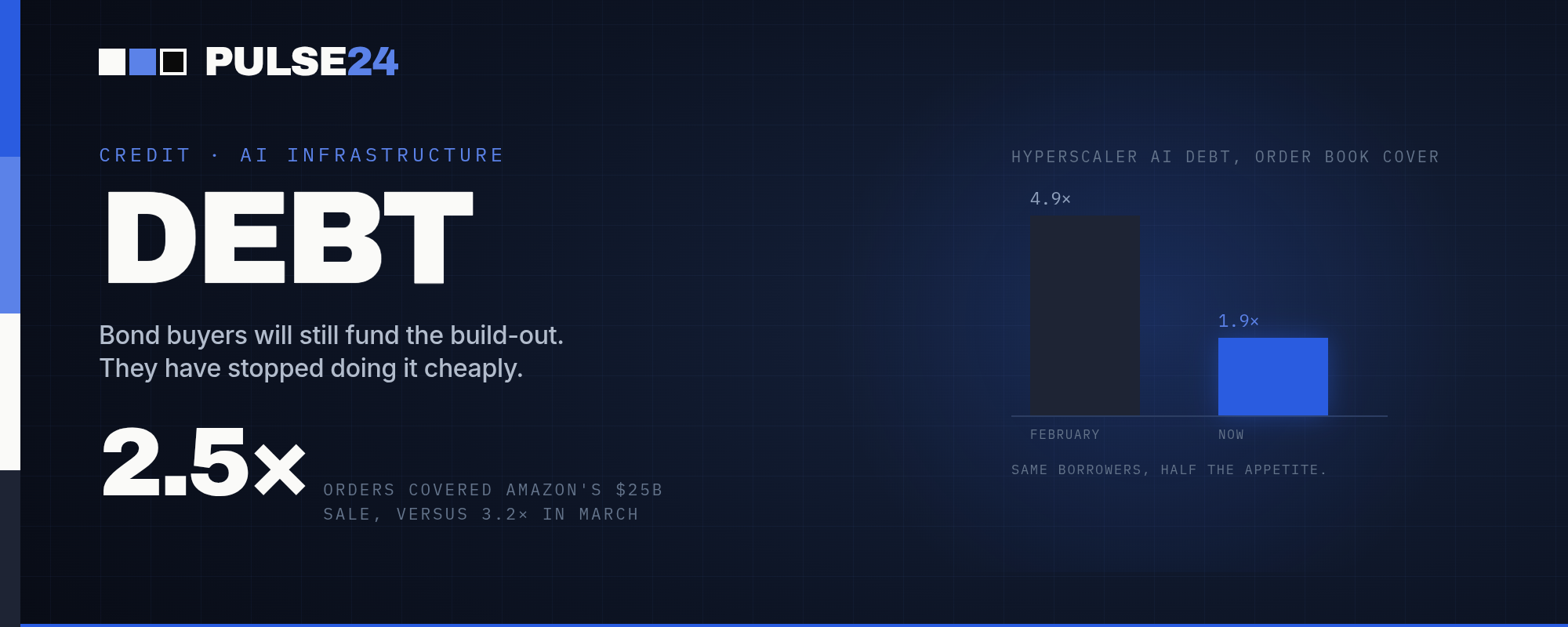
Amazon Had to Sweeten a $25 Billion Bond Sale This Month. Wall Street's Appetite for AI Debt Is Cooling Fast.
Amazon paid extra yield to get its $25 billion bond sale done this month, and across the broader hyperscaler market, order books that covered new AI debt nearly five times in February now cover less than two. That shift in the credit market is exposing a risk in the AI buildout that equities haven't fully priced in yet.
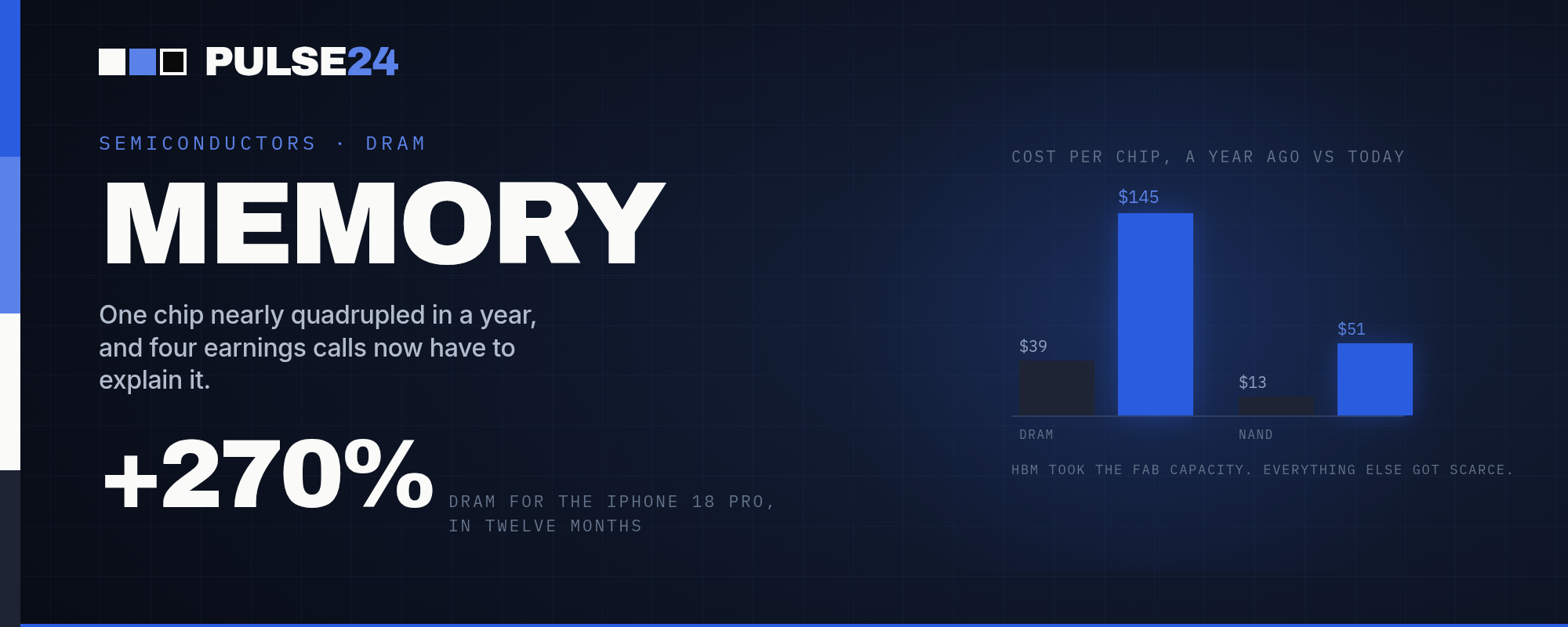
A Memory Chip That Cost $39 a Year Ago Now Costs $145. Microsoft, Meta, Apple and Amazon Report Earnings Into That Number This Week.
The DRAM chip inside an iPhone 18 Pro has nearly quadrupled in price this year, and Apple already raised Mac and iPad prices by up to $300 to cover it. Microsoft, Meta, Apple and Amazon all report earnings within 48 hours of each other this week, each one now having to explain how a memory shortage that SK Hynix says could last past 2030 is reshaping their AI budgets.
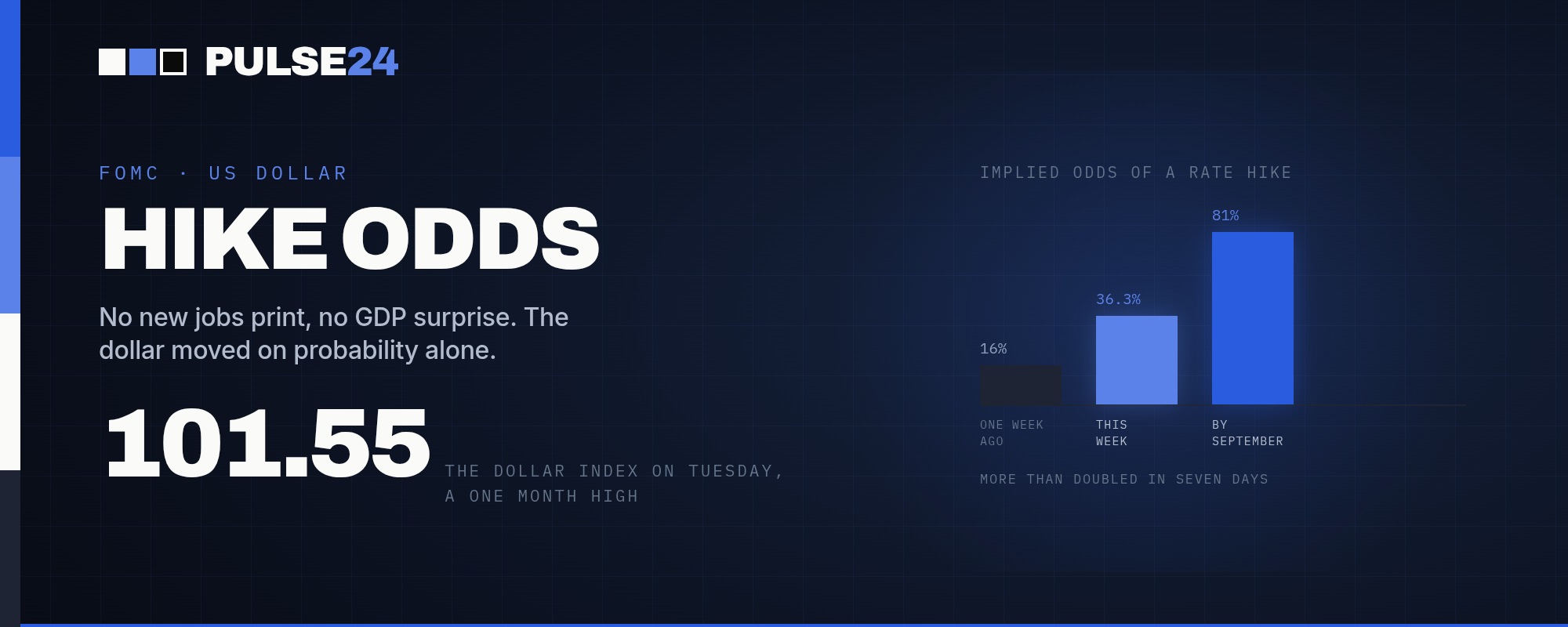
Fed Hike Odds Tripled in a Week, to 36%. The Dollar Just Hit a One-Month High.
Fed rate hike odds for this week's meeting have more than doubled in seven days, jumping from 16% to 36.3%, and the dollar just hit a one-month high in response. Inflation is still running at 3.7% against a 2% target, and traders now assign an 81% probability to a hike by September regardless of what happens Wednesday.
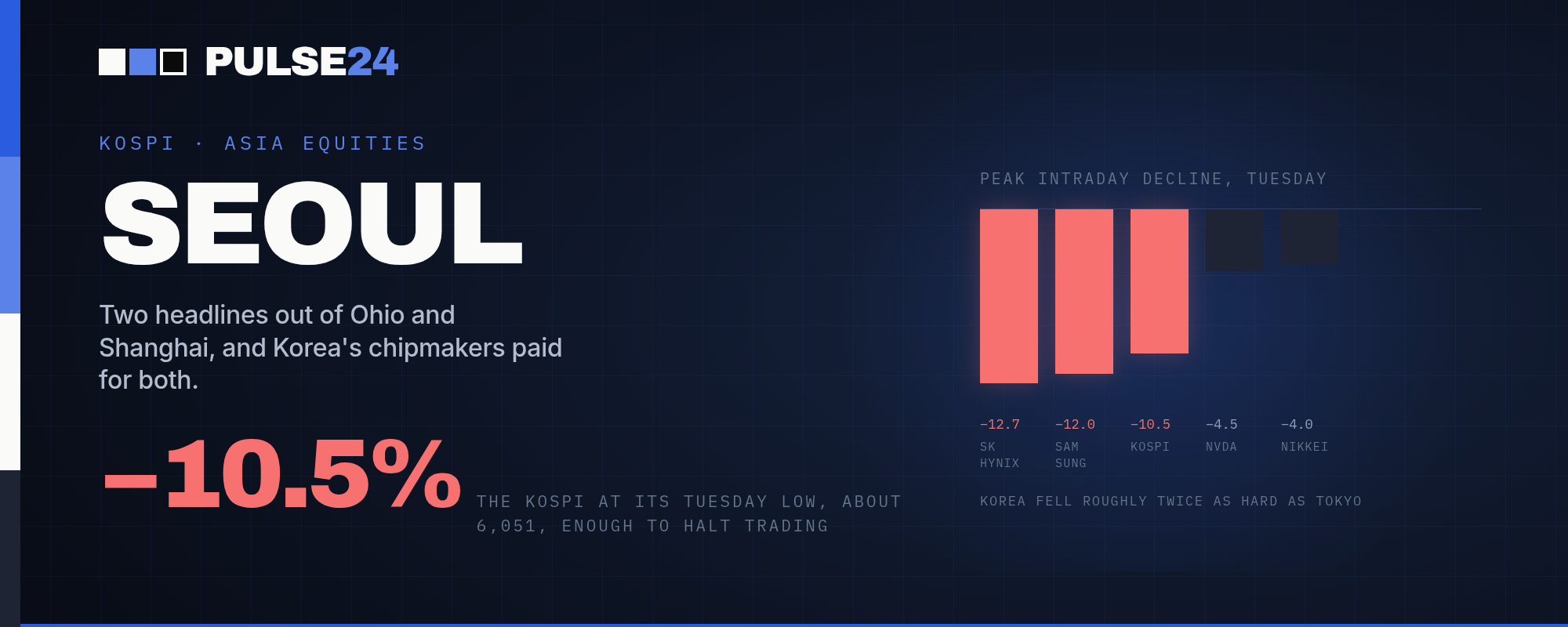
Kospi Sank 10% as Nvidia Fell 4.5%. A $250 Billion OpenAI Backstop and a Chinese IPO Are Why.
South Korea's Kospi sank as much as 10.5% and Japan's Nikkei fell 4% on Tuesday after a report that Nvidia may guarantee $250 billion of OpenAI's data center financing collided with a 466% Shanghai debut for Chinese chipmaker CXMT. Samsung and SK Hynix bore the brunt, two days before Microsoft, Meta, Apple and Amazon report earnings that will test how much further Wall Street's AI capex anxiety can run.
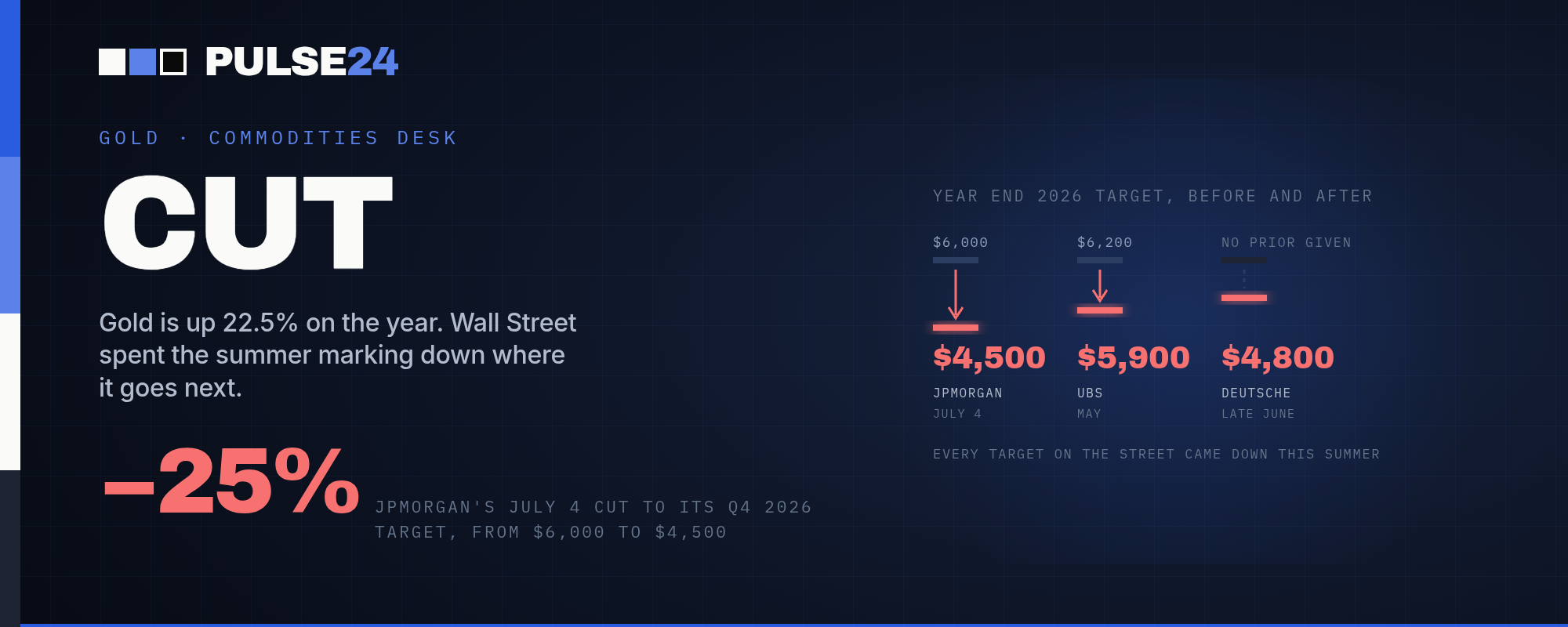
Gold Is Trading Near $4,098 an Ounce. JPMorgan Just Cut Its Target 25%, to $4,500.
Gold is trading near $4,098 an ounce, up 22.5% over the past year, but Wall Street's price targets have been sliding all summer. JPMorgan cut its Q4 2026 forecast 25% to $4,500 on July 4, and Deutsche Bank and UBS have trimmed their own numbers too, even as central banks keep buying at a record pace.
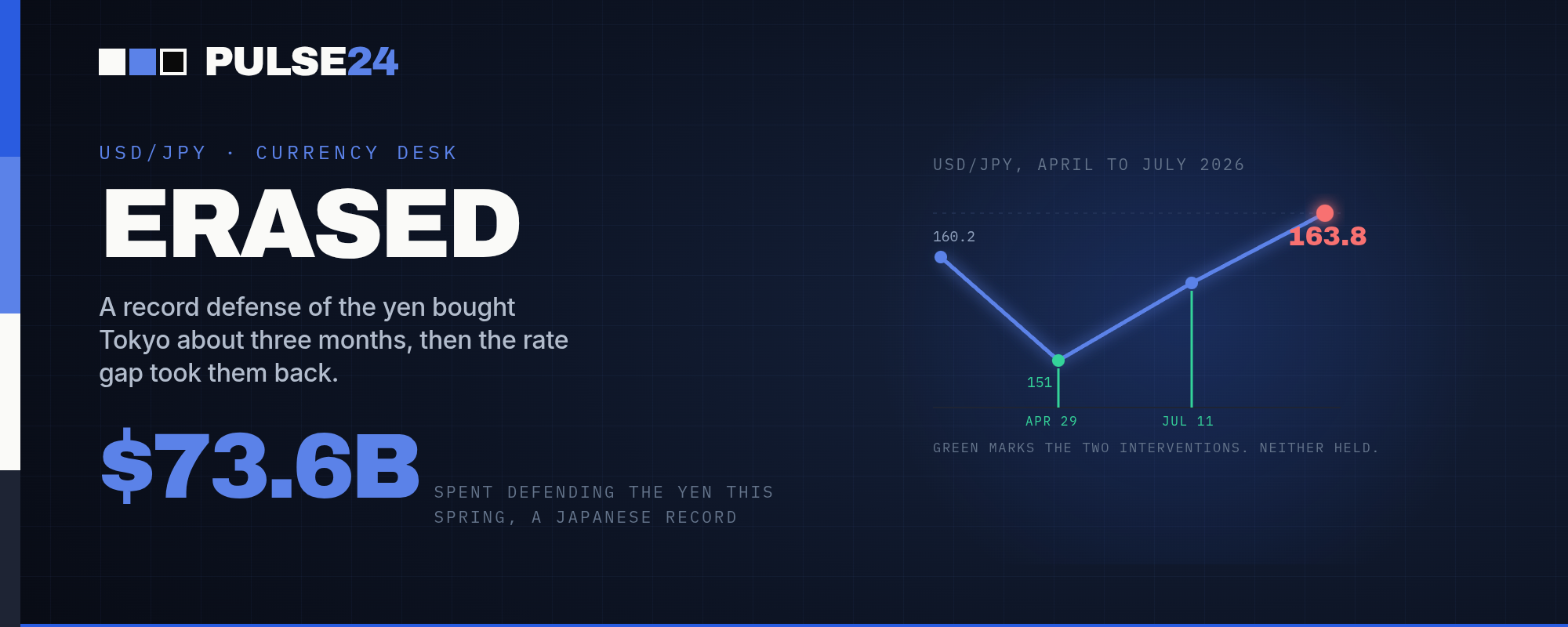
The Yen Slid Past 163 Again. Japan's Record $73.6 Billion Defense Already Wore Off.
USD/JPY is back above 163, erasing months of Japan's record-breaking currency intervention. The real story is a Fed-BOJ rate gap that no amount of dollar selling has managed to close.
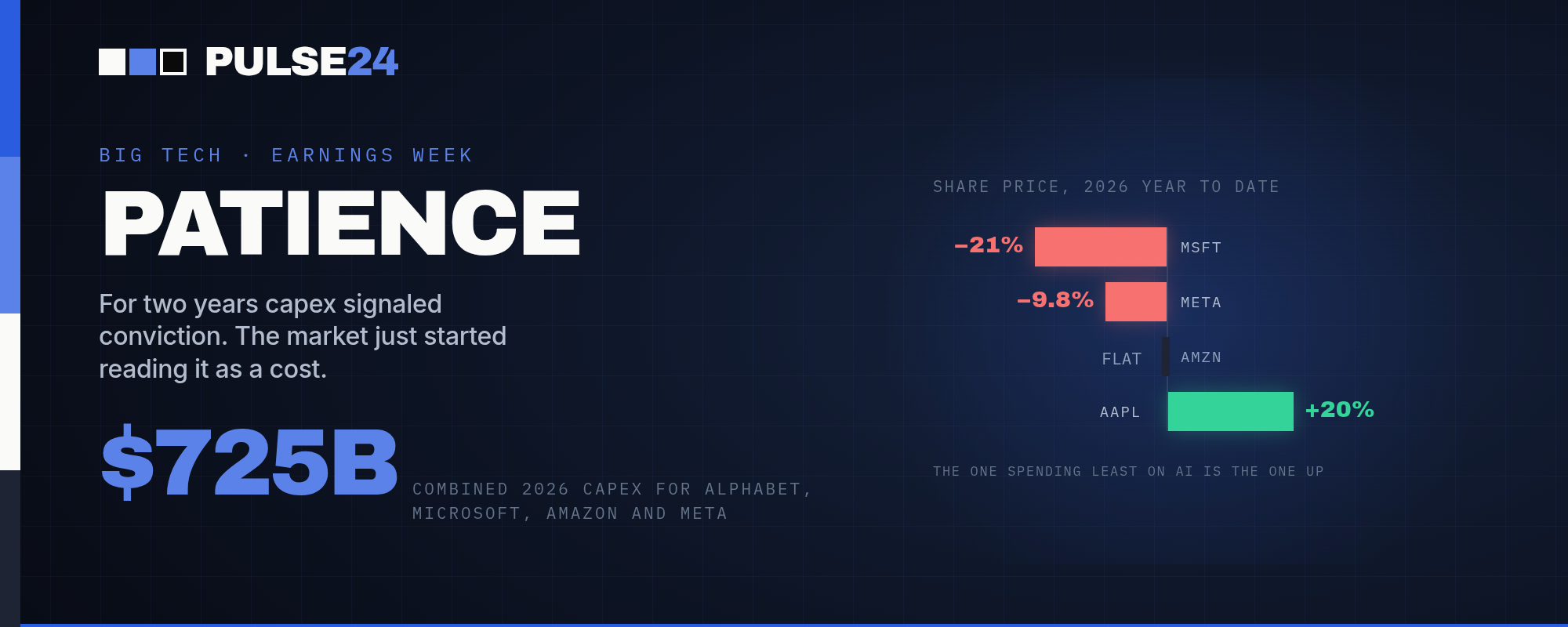
Big Tech Will Spend $725 Billion on AI This Year. Investors Just Decided That's Too Much.
Alphabet posted its first negative free cash flow since its 2004 IPO last week after record quarterly capex, and the market punished it with the Magnificent Seven's worst single day in over a year. Now Microsoft, Meta, Amazon and Apple report this week, and Wall Street wants to know if $725 billion in planned 2026 AI spending is still worth it.
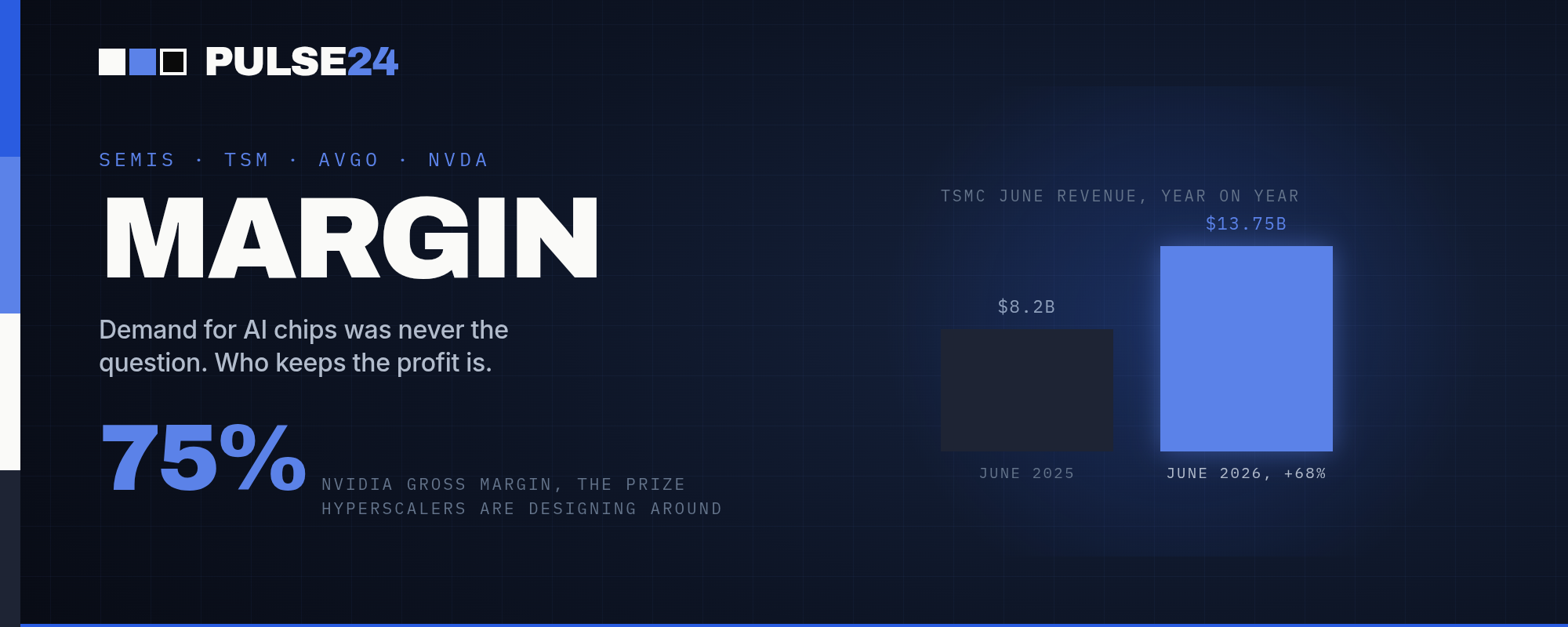
TSMC's Chip Sales Just Hit a Record $13.75 Billion. Broadcom Just Guided to $100 Billion That Isn't Nvidia's.
TSMC booked a record $13.75 billion in June sales, up 68% from a year earlier, proof AI chip demand hasn't cooled. Days earlier Broadcom's CEO guided AI chip revenue toward $100 billion by 2027, a number built almost entirely on custom silicon that hyperscalers are designing specifically to need less Nvidia.
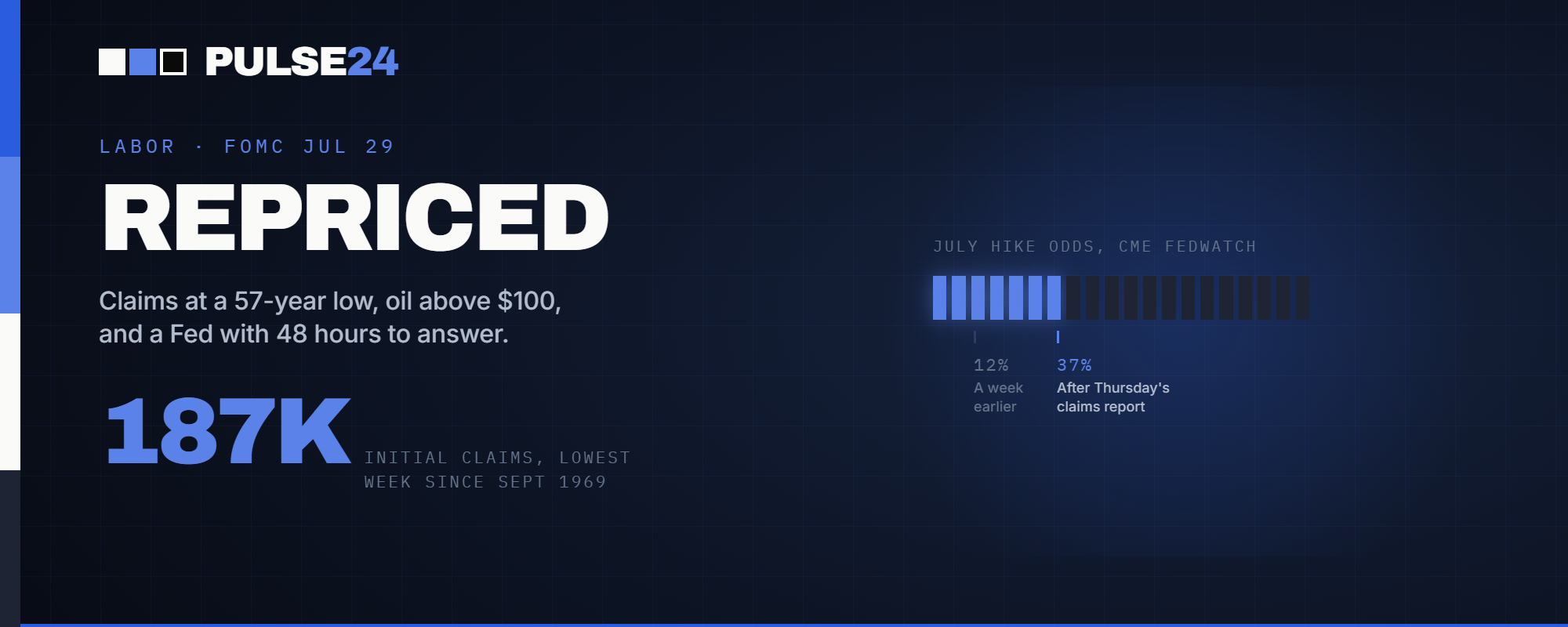
Jobless Claims Just Fell to Their Lowest Level Since 1969. The Fed Has 48 Hours to Decide What That Means.
Initial jobless claims just fell to their lowest level since 1969, and Fed rate-hike odds for this month's meeting tripled within days. A strong labor market and a live oil shock are pulling the central bank in the same uncomfortable direction.
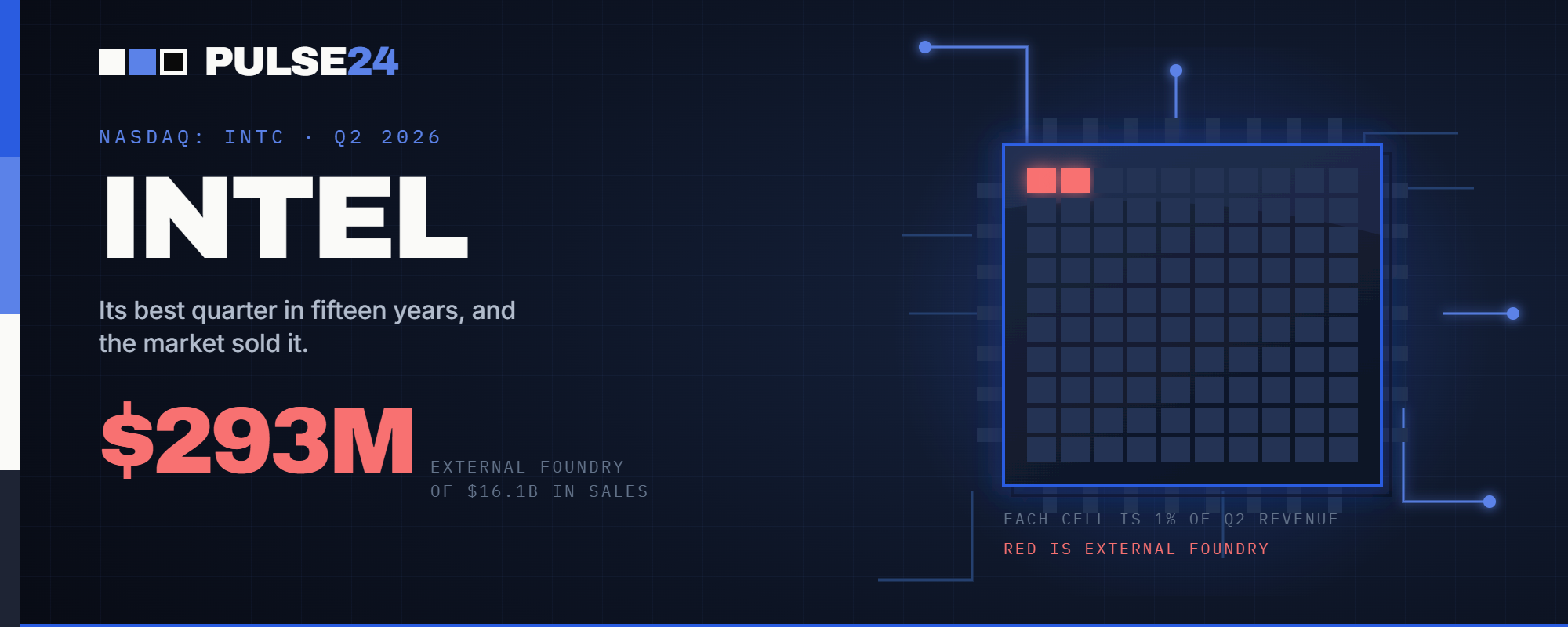
Intel Just Posted Its Best Quarter in 15 Years. Wall Street Sold It Anyway.
Intel's Q2 revenue grew 25% and beat guidance on a 59% jump in AI and data center sales. The stock popped 13% after hours, then gave it all back and more the next session as investors focused on foundry proof points instead of chip demand.
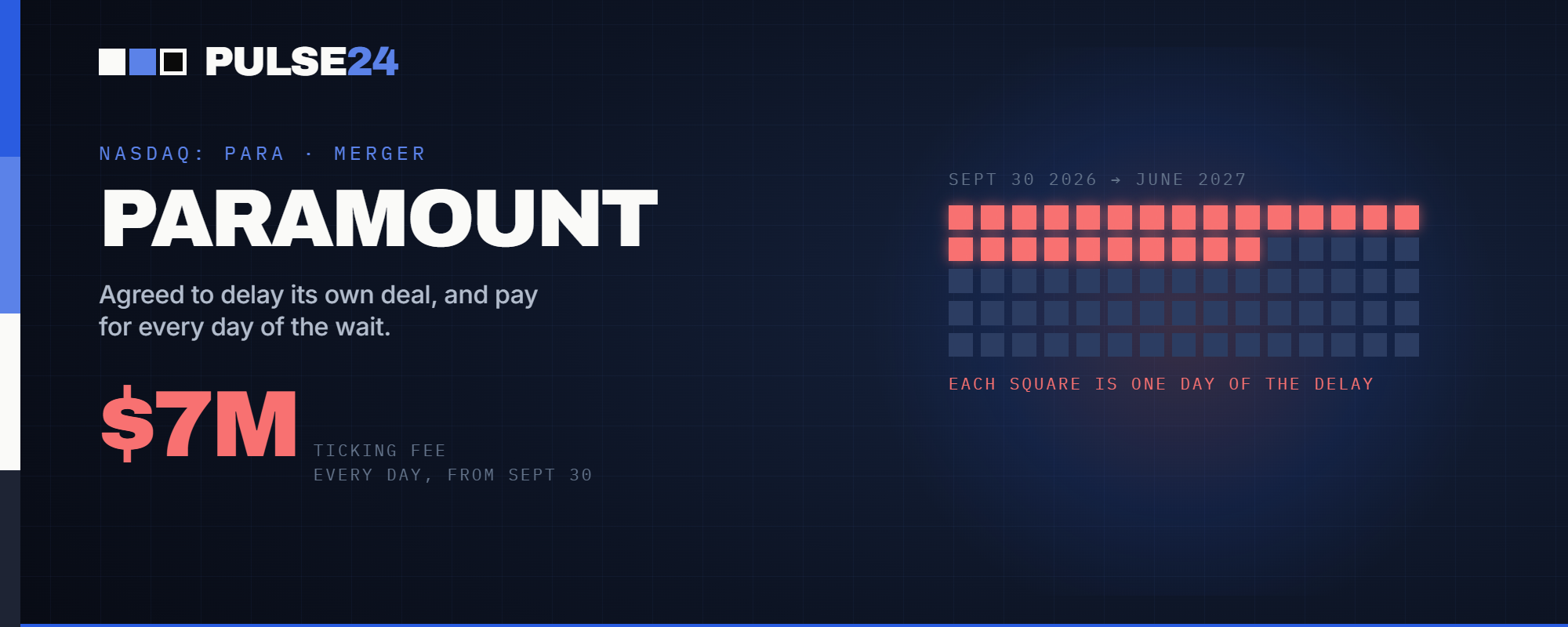
Paramount Just Agreed to Delay Its Own $110 Billion Merger. The Price Tag Is $7 Million a Day.
Twelve state attorneys general forced Paramount to push its $110 billion Warner Bros. Discovery merger to June 2027, a delay now costing the company roughly $650 million a quarter, and a preview of how aggressive state-level antitrust enforcement is reshaping the economics of every mega-deal in the pipeline.
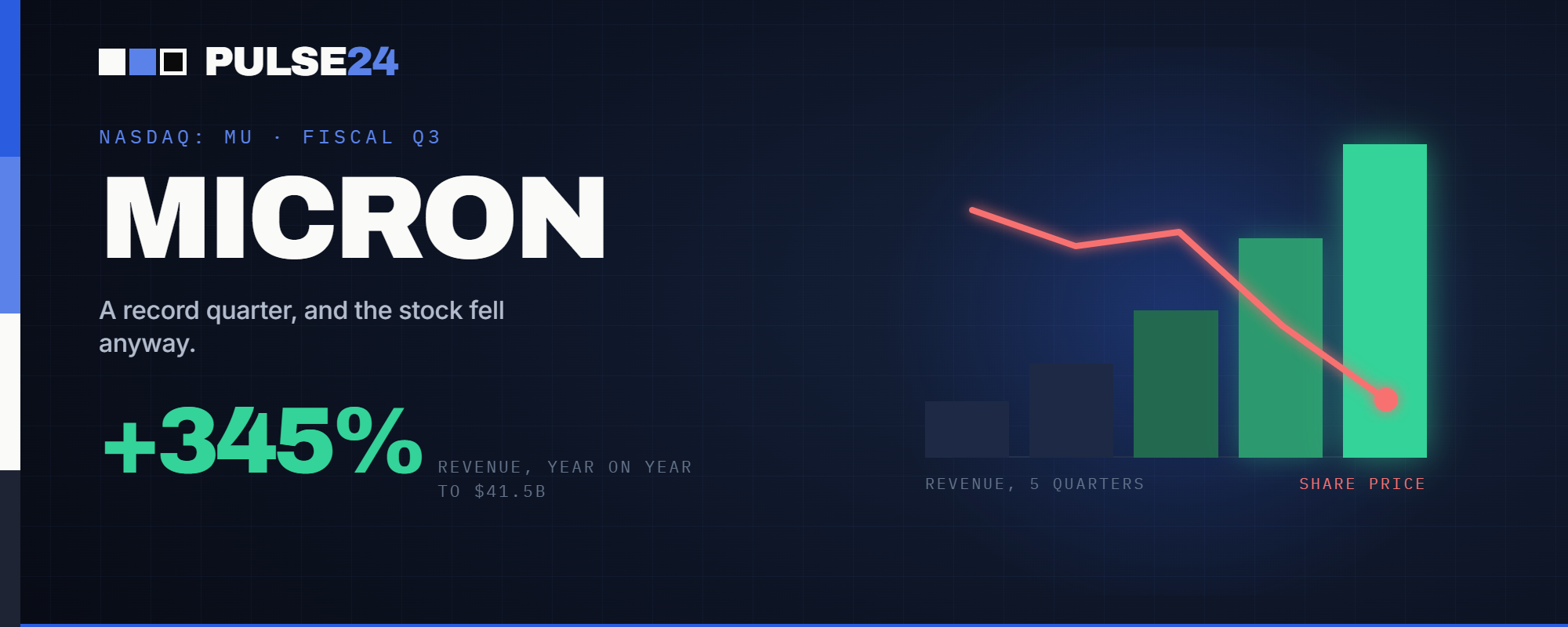
Micron's Revenue More Than Quadrupled. Its Stock Is Down 30% From Its Peak Anyway.
Micron just posted its best quarter in company history: revenue up 345.7% year-over-year, gross margins near 85%, record free cash flow, and its stock is down roughly 30% from its late-June peak anyway. Friday's Korea-led selloff dragged Micron, SanDisk, SK Hynix and Western Digital down together, and the gap between the numbers and the price is the real story.
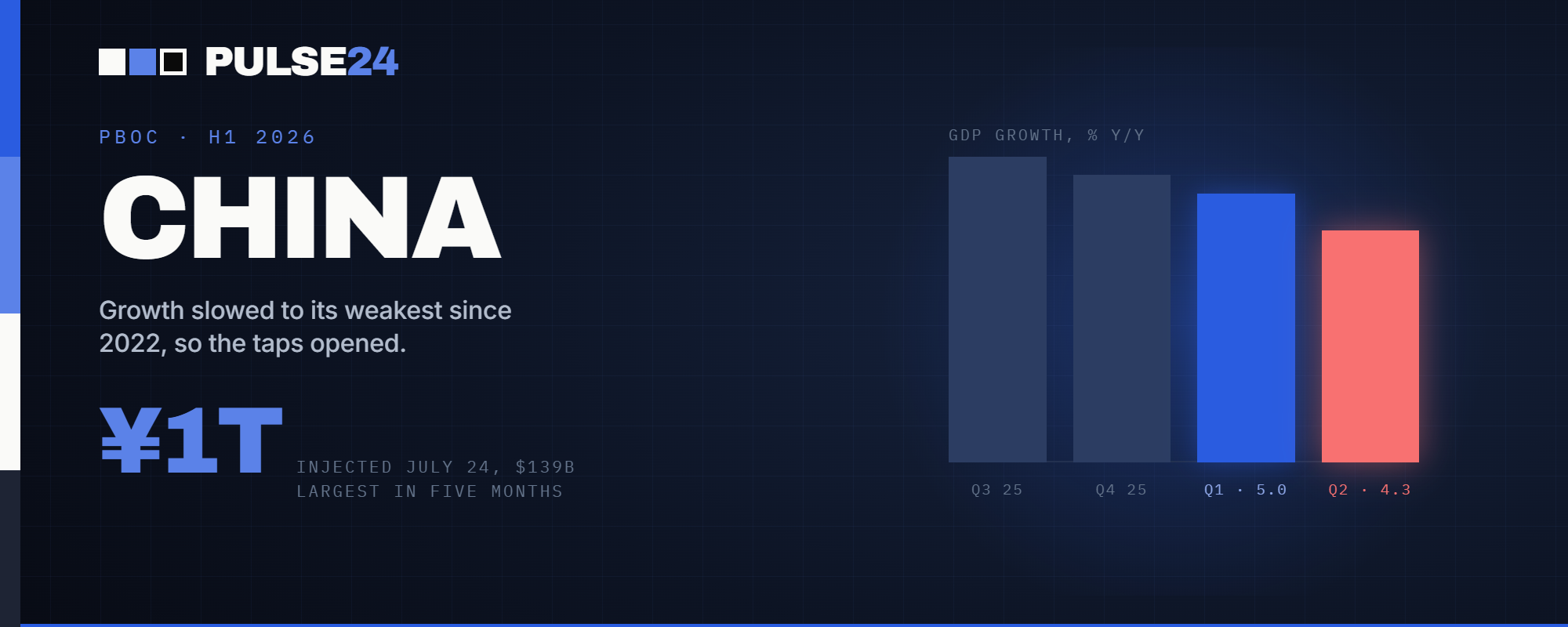
China Grew at Its Slowest Pace Since 2022. The PBOC Just Answered With $139 Billion.
China's economy grew just 4.3% in the second quarter, its weakest reading since late 2022, and the PBOC responded Friday with roughly 1 trillion yuan ($139 billion) in fresh liquidity, its biggest injection in five months. It's landing in the same week the Fed is leaning hawkish on oil-driven inflation, putting the world's two largest central banks on opposite paths at the same time.
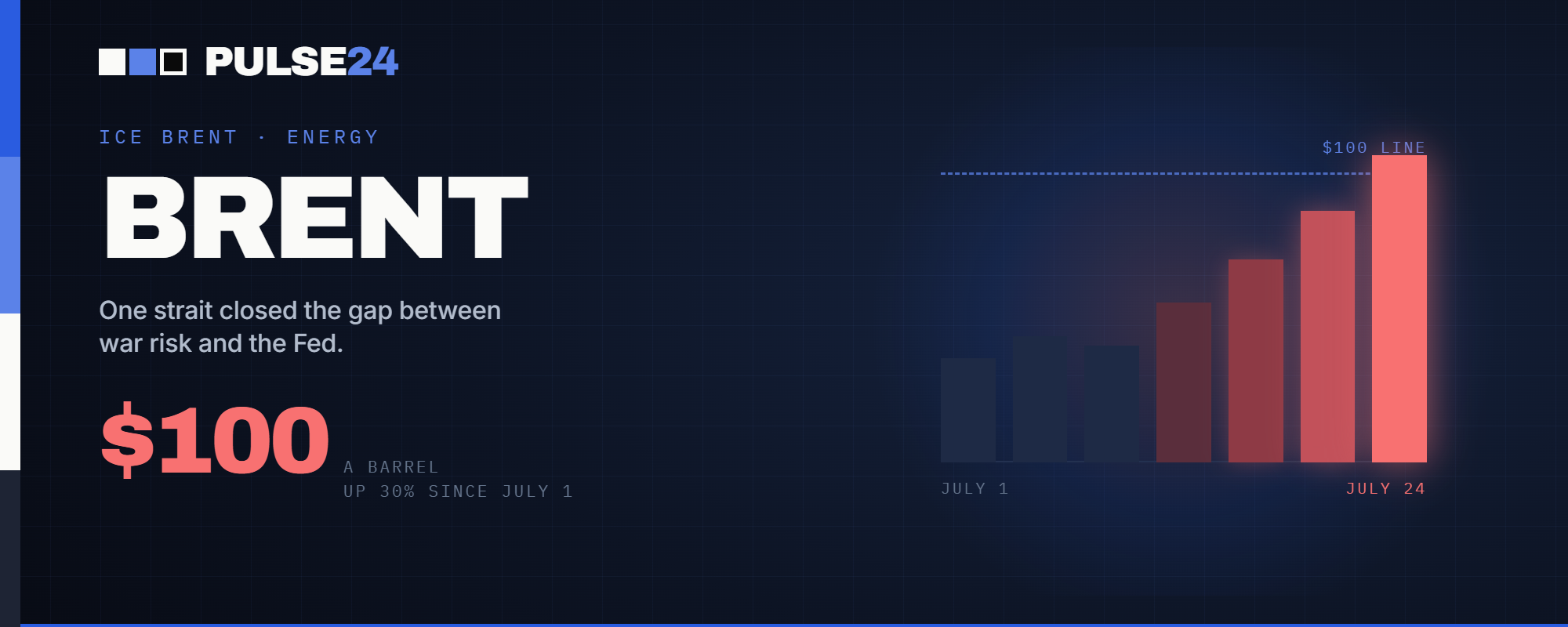
Brent Crude Broke $100. The Fed's Rate-Hike Odds Just Tripled With It.
Brent crude briefly crossed $100 a barrel this week as a Middle East conflict stretched past its third week of escalation, with attacks reaching the Red Sea, and the market-implied odds of a Fed rate hike at the July 29 meeting have roughly tripled in seven trading days. The connective tissue: an oil shock that hits inflation like a tariff would, landing on a Fed that already had less room than it looked like it had two weeks ago.
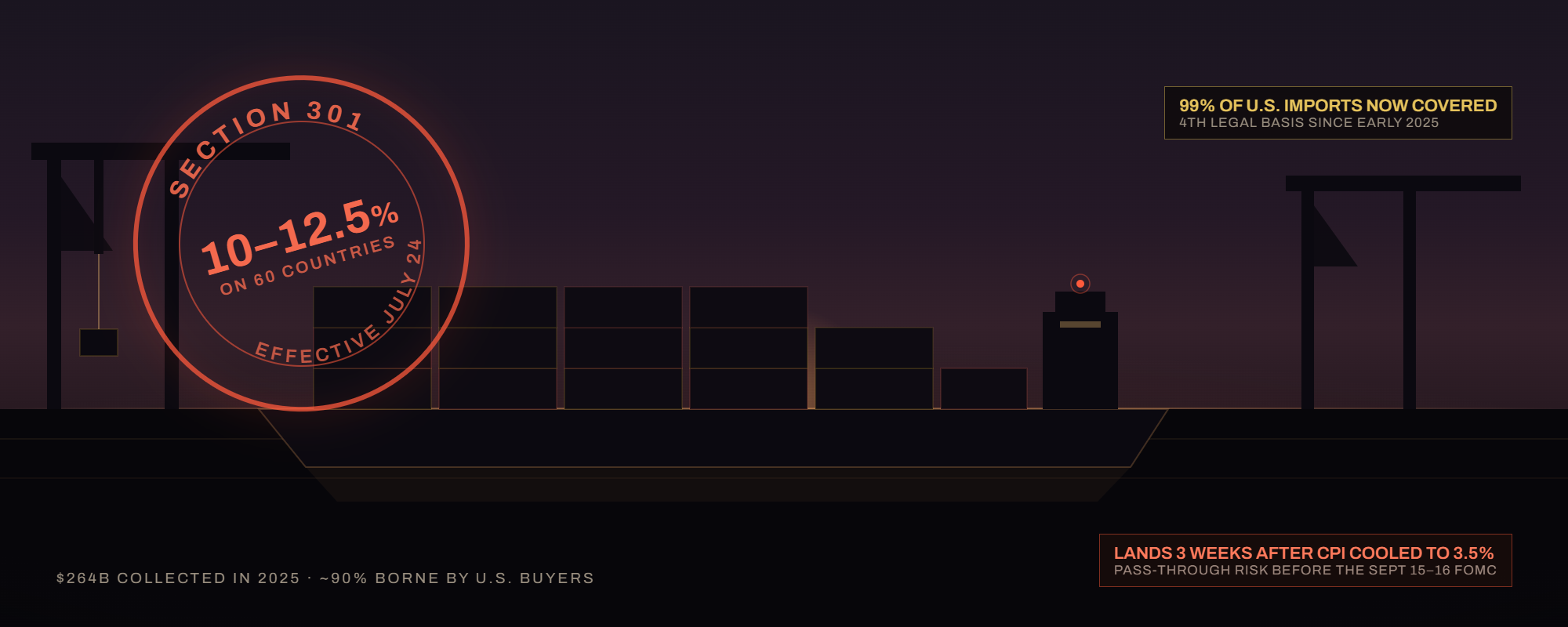
Trump's New Tariffs Just Hit 60 Countries. The Fed's Timing Problem Just Got Worse.
New Section 301 tariffs of 10 to 12.5 percent just landed on 60 countries covering nearly all U.S. imports, replacing the temporary duties that expired at midnight. The timing is the story: it hits right as June's cooler CPI print gave the Fed room to breathe.
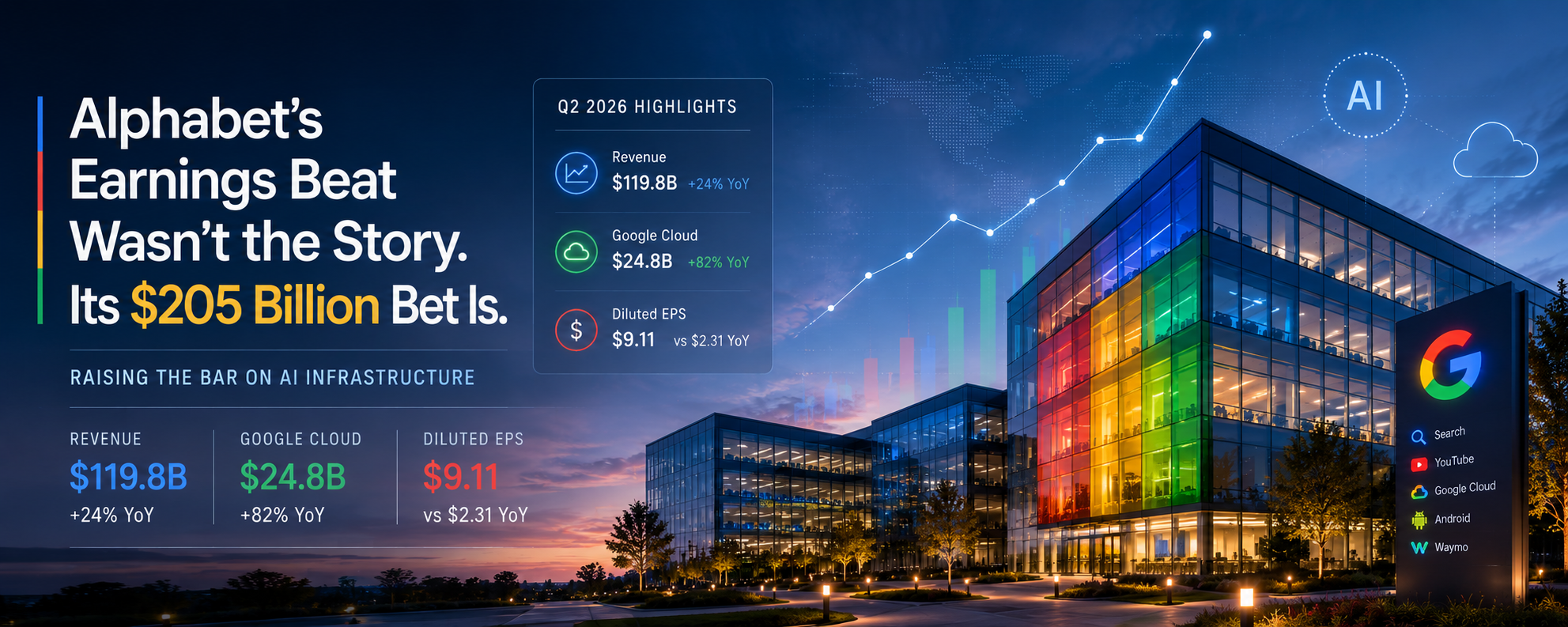
Alphabet's Earnings Beat Wasn't the Story. Its $205 Billion Bet Is.
Alphabet beat on revenue and posted a record EPS, and the stock still fell nearly 5 percent after hours. A $98 billion SpaceX windfall inflated the headline number. The real story is a capex bet that just got a lot bigger.
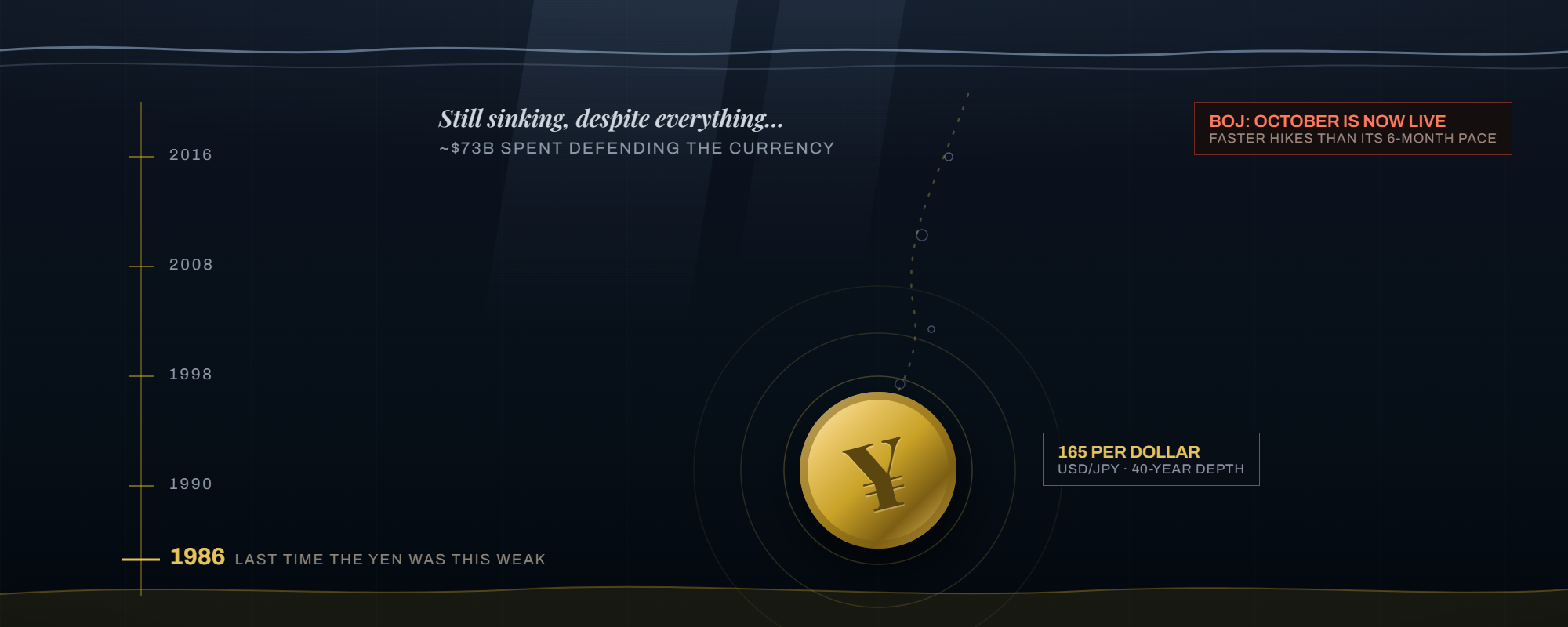
The Yen's 40-Year Low Just Forced the BOJ's Hand
The yen just hit a 40-year low against the dollar. Bloomberg sources say the BOJ is now open to hiking rates faster than its usual six-month pace, and that quiet shift matters more than the currency print itself.
New Zealand’s Faster Inflation Bolsters Case for More Rate Hikes
New Zealand's annual inflation has surged to its fastest pace in over two years, driven by fuel prices and cementing expectations for consecutive RBNZ rate hikes. This isn't a New Zealand story — it's a confirmation that commodity-driven inflation is forcing central banks globally into reactive tightening cycles, exposing just how far behind the curve rate-setters remain when supply-side shocks do the Fed's job for them. For readers: the RBNZ move reinforces the medium-term case for real assets as central banks prioritise inflation credibility over growth.
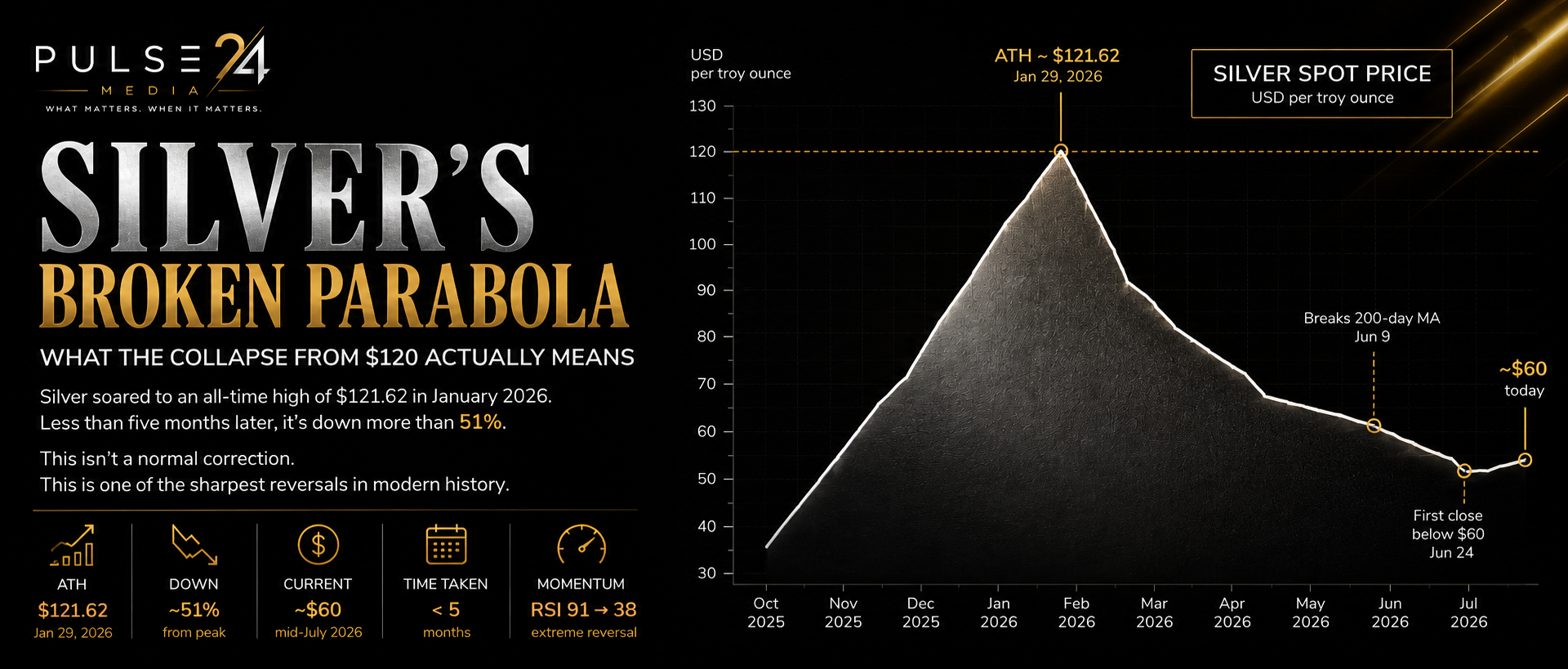
Silver's Broken Parabola: What Actually Changed
Silver has fallen roughly 51% from its January 2026 all-time high near $121.62, giving back nearly half of one of the fastest rallies any major asset has produced. The move isn't isolated profit-taking, it's a macro chain running from Middle East-driven oil prices through a hawkish Fed to a stronger dollar that weighs on gold, and silver amplifies every move gold makes. Bank targets clustering between $75 and $80 suggest the setup from here is consolidation, not capitulation.

Why Gold Isn't Rallying Despite a Geopolitical Crisis
Gold has matched the S&P 500 over the past decade. Yet the very geopolitical crisis that should be pushing it higher is doing the opposite. Understanding that paradox explains far more than just the gold price.
Brent Tops $85, Rate-Hike Bets Rise Before CPI: Markets Wrap
Brent crude topping $85 as the US-Iran standoff escalates is driving Treasury selloffs and repricing rate-hike expectations ahead of CPI, the oil move is the catalyst, but the real story is how geopolitical supply risk is doing the Fed's tightening work for it. The consensus frames this as an energy headline; it's actually a real-rates event, higher oil means stickier inflation, which extends the window of restrictive policy and pressures duration assets across the board. Readers holding long-duration bonds or rate-sensitive equities need to recalibrate: this isn't a short-term spike to fade, it's a structural reminder that energy geopolitics remain the most underpriced input in rate forecasting.
Fed Rate-Hike Bets Mount Before Inflation Data, Warsh Testimony
Bond traders are repricing July rate-hike probability higher ahead of CPI data and Fed Chair Warsh's congressional testimony, marking a sharp pivot in near-term rate expectations. The headline reads as hawkish momentum, the real story is what it reveals about how far the Fed remains behind the curve, forced into reactive positioning by inflation data rather than driving the narrative with forward credibility. If July hike bets continue to build, real rates move higher and the structural case for gold as a de-dollarisation hedge strengthens, not weakens.

AI Infrastructure Won the First Trade. Distribution Could Win the Second.
AI investing has mostly been a bet on who builds the infrastructure and who wins the model race. There's a quieter third layer, the companies that already own the audience, and the economics there work completely differently.
Traders braced for won volatility after blockbuster SK Hynix listing
SK Hynix's blockbuster listing is set to trigger repatriation of more than $26bn into South Korea over the coming month, creating a concentrated and predictable capital flow event that currency traders are now positioning around. The real story isn't the listing itself, it's what a $26bn forced inflow does to KRW liquidity dynamics at a moment when EM currency volatility is already elevated and the dollar's structural trajectory is contested. Traders long KRW vol into the repatriation window are playing a rare instance where the timing and magnitude of a flow shock are both known in advance.
Gold Drops as US-Iran Strikes Revive Inflation, Rate-Hike Risks
Gold fell following a fresh round of US-Iran strikes that drove energy prices higher and reignited rate-hike expectations. The headline reads as a safe-haven failure — the real story is that gold is behaving exactly as it should: not as a crisis hedge, but as a real-rate instrument, and rising energy-driven inflation that triggers rate-hike bets is precisely the environment that pressures it. Traders pricing gold as a geopolitical shelter will keep getting this trade wrong.
Samsung, SK Hynix and Leveraged ETFs Drive 70% of Korea Trading
Leveraged ETFs tied to Samsung and SK Hynix now account for over 70% of all trading value in South Korea's $4.3 trillion equity market, a concentration level that signals structural fragility, not just retail enthusiasm. The headline reads as a retail sentiment story , the real story is what happens to Korean market liquidity when semiconductor sentiment reverses: a single sector narrative now dictates the flow mechanics of an entire national exchange. When that unwind comes, it won't look like a correction; it will look like a drain.
Japan’s Long Bonds, Yen Rise on Push for More GPIF Investment
Japan's Finance Minister Satsuki Katayama signaled the government wants pension funds, led by the $1.5T GPIF, to rotate back into domestic assets, pushing long yields down and lifting the yen in the same session. This isn't a bond market technical; it's fiscal choreography, Japan engineering domestic demand for its own debt as foreign buyers grow selective and the BOJ's yield curve control era unwinds. For yen watchers, a structurally bid yen driven by repatriation flows is a different animal than one driven by rate differentials, the playbook shifts.
Why Young Investors Are Betting It All
A growing cohort of young investors are turning to high-risk, high-reward strategies as structural economic pressures, student debt, stagnant wages, collapsing job mobility, compress the perceived value of conventional wealth-building. The consensus frames this as recklessness; the real story is rational response to a broken risk-reward calculus, where the expected return on playing it safe has genuinely deteriorated. When the system no longer rewards patience, the house edge on a long shot starts to look competitive.
SK Hynix Debut Is a Bet That AI Breaks Boom-and-Bust Chip Cycle
SK Hynix's US listing, the largest ever by a foreign company, opened with a 13% first-day surge, pricing the market's conviction that AI demand has permanently restructured memory chip economics. The consensus reads this as an IPO win; the real signal is that institutional capital is now explicitly betting the HBM supercycle breaks the semiconductor industry's historic boom-bust rhythm, a structural claim, not a cyclical one. If that thesis holds, legacy valuation frameworks built around DRAM inventory cycles become the wrong tool for pricing this entire sector.
Top Fed official backs Kevin Warsh’s rethink of forward guidance
Fed Governor Christopher Waller has backed Kevin Warsh's push to overhaul the central bank's forward guidance framework, signaling a structural shift in how the Fed communicates policy intent to markets. This isn't a housekeeping update, it's an acknowledgment that forward guidance itself became a distortion mechanism, locking the Fed into trajectories that widened the gap between stated policy and economic reality, and that gap is exactly what kept real rates miscalibrated for too long. For markets, the implication is direct: the forward guidance premium built into long-duration assets needs repricing if the Fed is moving toward deliberate ambiguity.
Japan’s borrowing costs soar to 30-year high on debt fears
Japan's 30-year bond yield has surged to its highest level since 1996, driven by mounting investor concern over long-term fiscal sustainability and debt trajectory. This isn't a Japan-specific anomaly, it's the sovereign debt repricing cycle playing out in slow motion, the same force pressuring gilts and Treasuries as markets finally demand term premium for governments that spent the last decade treating zero rates as a permanent condition. For readers, the signal is clear: the era of cheap long-end borrowing for deficit-heavy sovereigns is closing, and that tightening in global duration is a headwind for risk assets that hasn't been fully priced.
Samsung Results Trigger Stock Rotation to Less Loved Sectors
Samsung's disappointing results triggered a sector rotation out of Asian tech, with investors locking in profits from a strong year-to-date chip rally and moving into lower-valuation, earnings-stable sectors. The headline reads as a Samsung story — the real story is that the AI-driven chip rally had priced in perfection, and any friction in the earnings narrative is enough to send capital hunting for margin of safety elsewhere. Investors rotating now are pricing a risk that the AI infrastructure buildout is uneven in who captures the value, and chipmakers are the most exposed to that repricing.
Goldman Cuts Yen Forecast to 165 Per Dollar, Likes Carry Trades
Goldman Sachs has cut its yen forecast to 165 per dollar over a 12-month horizon, citing persistent interest rate differentials between Japan and the US as the primary driver. This isn't a call on Japan, it's a call on the Fed's inability to cut fast enough to close the carry spread, which means the dollar's medium-term structural weakness thesis has a live counterweight that the consensus is underpricing. Carry trade positioning in yen pairs is now a direct function of how long the Fed stays restrictive, making every US inflation print a yen event.
Samsung High-Stakes Results to Set Mood for Chip Stock Investors
Samsung Electronics reports Tuesday in a results cycle that has become a referendum on AI infrastructure demand, not just a semiconductor earnings event. The consensus reads this as a Samsung story, the real read is whether memory and logic demand curves are holding shape beneath the noise of recent chip stock volatility, a question that reprices the entire stack from TSMC to SK Hynix to Nvidia's supply chain. If Samsung's numbers disappoint, the AI infrastructure trade doesn't get a patch; it gets a structural retest.
Investors Looking for Shelter From AI Storm Are Turning to India
Indian equities are drawing renewed investor interest as global AI-driven market turbulence pushes capital toward diversification away from concentrated tech exposure. The headline frames this as a refuge trade, but the real story is structural: India is capturing rotation flows not because it suddenly became attractive, but because the AI rally compressed into too few names, and the unwind is forcing allocators to rediscover markets they abandoned during the hype cycle. For readers, this is less a bullish India call and more a signal that the AI concentration trade is cracking at the edges.
Gold Rises Toward $4,200 as Weak Jobs Data Lowers Rate-Hike Odds
Gold pushed toward $4,200 as softer-than-expected US jobs data cut the probability of a Fed rate hike, extending a two-day rally built on rate expectations re-pricing. The headline frames this as a jobs story, the real story is that gold is pricing structural dollar weakness and de-dollarisation pressure, with rate odds merely providing the short-term trigger; the market keeps misreading gold as a rates trade when it is a real-returns and reserve-currency confidence trade. Positioning into gold here means understanding the macro floor has nothing to do with the Fed calendar.
Japan Cuts Gas in Favor of Coal as Hormuz Disruption Chokes LNG
Japan has shifted sharply toward coal-fired power generation as Strait of Hormuz disruptions choke LNG supply, forcing a direct fuel substitution with immediate emissions and pricing consequences. The headline frames this as a Japan energy story — the real story is that Hormuz disruption is now actively repricing the global LNG market and exposing how thin the margin between 'clean transition' and 'coal fallback' actually is for the world's largest LNG importers. Commodity traders watching thermal coal and spot LNG spreads have a live stress test playing out in real time.
Jersey Mike’s, Cumberland Farms Join Swelling IPO Pipeline in US
Jersey Mike's and Cumberland Farms have filed for IPOs, signaling that the US listings market is expanding beyond AI-adjacent names into consumer and convenience retail. The headline reads as routine pipeline news, the real story is that capital markets confidence is broad enough to absorb old-economy businesses alongside hyperscale infrastructure plays, which historically marks a mid-to-late cycle appetite shift, not an early one. Investors rotating attention from AI darlings to sandwich chains and gas stations should ask what that rotation is actually pricing in.
US economy undershoots forecasts with 57,000 jobs added in June
The US economy added just 57,000 jobs in June, sharply undershooting forecasts and snapping a three-month streak of labour market overperformance. This isn't a blip, it's the labour market finally confirming what real rates and credit conditions have been signalling for months: the Fed's restrictive stance is biting, and the soft-landing consensus is now on trial. If hiring continues to decelerate, the Fed's already-strained neutral rate calculus becomes politically and economically impossible to hold.
Refiner Profits Are Soaring in Sign of Lingering Hormuz Snarls
US crude refiner margins are surging to multi-year highs even as Strait of Hormuz shipments partially recover, signaling that the supply-chain disruption isn't resolved — it's just moved downstream. The consensus is reading the headline traffic data as normalisation; the real story is that fractured logistics and regional crude differentials are now baked into the refining spread itself, which is a structural shift, not a temporary spike. Elevated refiner margins mean energy inflation stays stickier at the consumer level longer than the crude price alone suggests.
How AI Creates Jobs
Despite a soft headline jobs print, granular hiring data — LinkedIn, Glassdoor, H-1B filings — shows the heaviest AI-investing firms expanding payrolls at both ends of the experience curve. Consensus reads this as a displacement story. The data reads as an acceleration story: AI adoption is a hiring accelerant, not a headcount ceiling, consistent with how general-purpose technologies have historically created more roles than they destroyed during their adoption phase. Investors pricing labour weakness as a Fed-cut trigger may be trading the headline while the structural story underneath runs the other way. Position note: this doesn't break Pulse24's deflationary-software thesis — it adds a third leg to it. Software gets cheaper to build; the people and power behind it don't, at least through adoption. Labour joins energy and rates as a medium-term inflationary channel sitting underneath a long-term deflationary trend