Pulse24 Original
Kevin Warsh Steps to the Jackson Hole Podium Friday for His First Speech as Fed Chair. The Inflation Report Landing Two Days Earlier Could Decide What He Says.
August 23, 2026
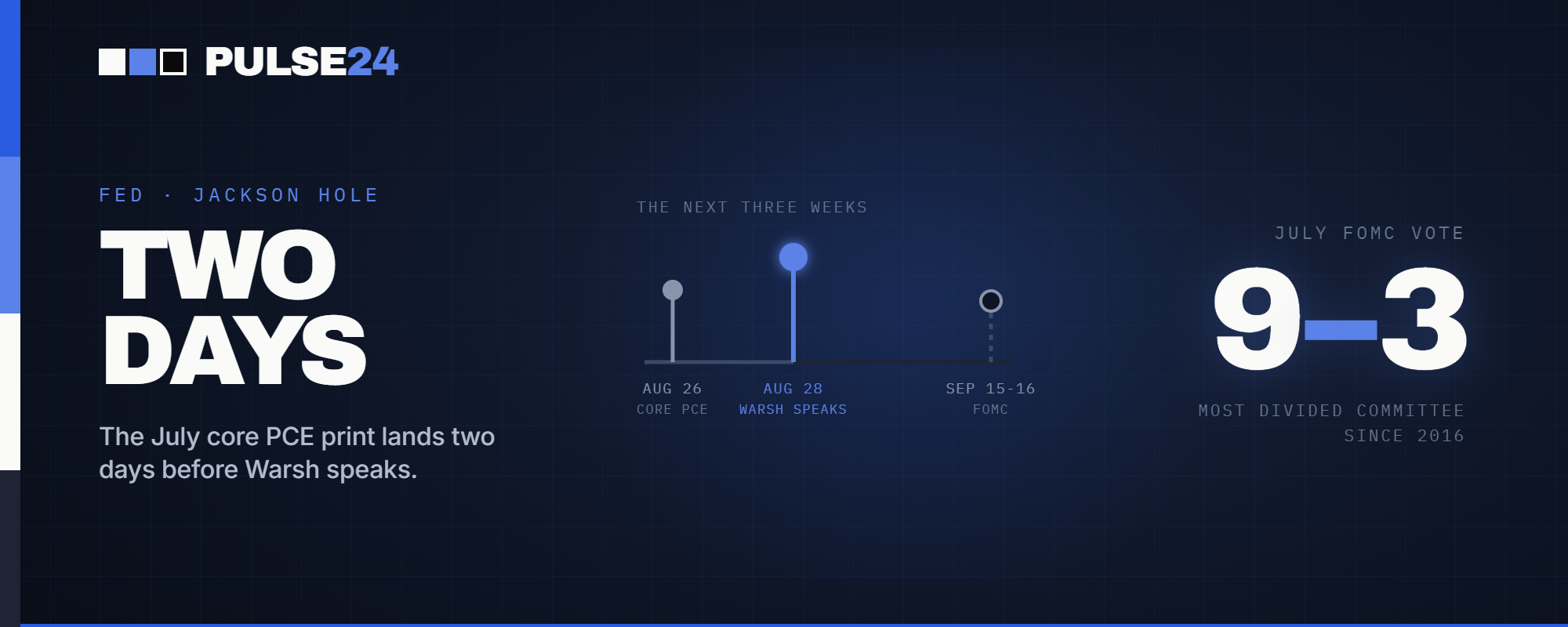
Kevin Warsh delivers his first Jackson Hole speech as Fed chair on Friday, two days after the July core PCE report lands and with September hike odds bouncing in the low-to-mid 30s. A single line item in July's PPI report, a spike in portfolio management fees, could be the difference between a dovish read and a much tougher one.
Kevin Warsh has not given a Jackson Hole speech as Federal Reserve chair before. That changes Friday, August 28, at roughly 10 a.m. Eastern, when he takes the podium in Wyoming for the first time since the Senate confirmed him in May. Two days earlier, on Wednesday, the Bureau of Economic Analysis releases the July core PCE reading, the inflation gauge the Fed has said it weighs most heavily. Markets have not had a 48-hour stretch this loaded with Fed signal since the July jobs report blew up rate expectations three weeks ago.
Start with why the timing matters this particular year. Warsh was sworn in during May, inheriting a Federal Open Market Committee that split 9 to 3 in July, the most divided vote since 2016. Three regional presidents pushed for a hike; the majority said no. He has not yet had to referee a meeting that fractured that badly, but Jackson Hole gives him a stage to signal which side of that fight he is leaning toward, days before he actually has to.
What Changed
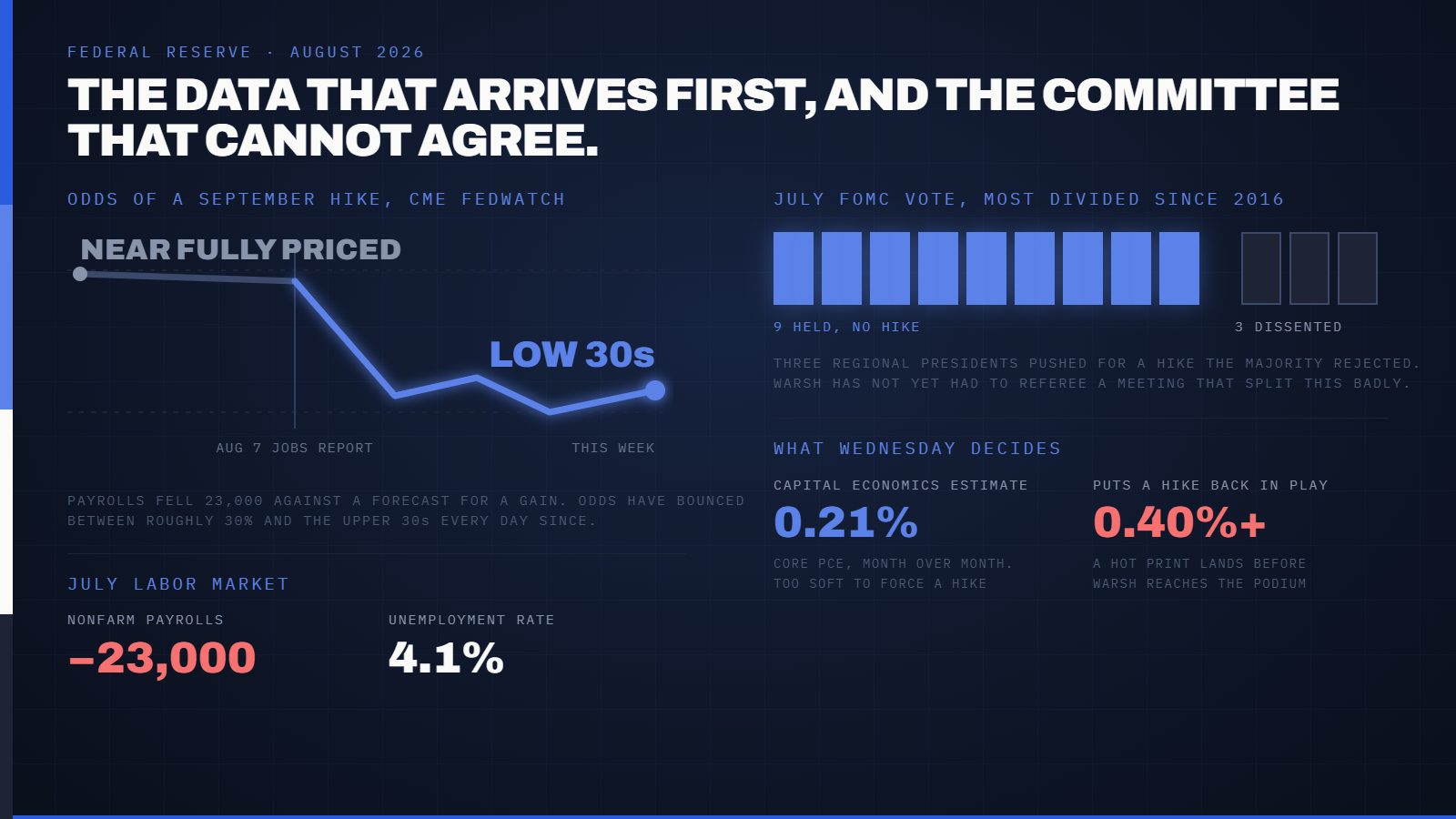
The immediate trigger for the current uncertainty was the July jobs report. Nonfarm payrolls fell by 23,000, the Bureau of Labor Statistics said on August 7, when economists had penciled in a gain. The unemployment rate held at 4.1%, technically little changed, but the payroll miss did the real damage to rate expectations. Traders had priced close to a full quarter-point hike by December as recently as a week before that report landed.
CME's FedWatch tool has swung around since, ranging from roughly 30% to the upper 30s for the odds of a September hike depending on the day and the data feeding it. Pulse24 covered the mechanics behind one of those swings after July's producer price report, when a spike in portfolio management fees threatened to distort the core PCE calculation the Fed actually targets. That distortion is still working its way through the system, and it is one reason economists are hedging their July core PCE estimates rather than calling the number with confidence.
Capital Economics is one of the shops doing exactly that. Stephen Brown, the firm's chief North America economist, estimates core PCE rose about 0.21% in July on a monthly basis. He has described that pace as too soft to create urgency among FOMC members for a September hike. If the number lands close to his estimate, Warsh walks into Jackson Hole two days later with room to sound patient without contradicting the data. If the fee-driven distortion pushes the print meaningfully higher, he walks in with a much narrower path.
Why It Matters
A first Jackson Hole speech from a new Fed chair is not just another data point on a crowded calendar. Ben Bernanke used his August 2010 remarks in Wyoming to lay the groundwork for a second round of quantitative easing that the Fed did not formally announce until that November, and traders who caught the signal early had months to position around it. Warsh is a former Fed governor himself, not a newcomer to the institution, and he is unlikely to preview policy that explicitly. But a speech from a chair five months into the job, delivered at the same podium where predecessors have moved markets before, gets parsed line by line regardless of how careful the language is.
The committee he is speaking for does not agree on much right now. A 9 to 3 vote is the kind of split that normally shows up in the minutes as a footnote; this one made the meeting itself the most divided since 2016. Warsh has to find language that acknowledges the hawks without validating a hike the majority already rejected, and that reassures the doves without sounding like he has picked a side before the committee meets again in September.
The bond market is not waiting for him to decide. The 30-year Treasury yield has been trading near its highest levels since 2007, and Treasury Secretary Scott Bessent's expanded bond buyback program has not been enough to pull long-end yields meaningfully lower. A Warsh speech that leans too dovish risks reigniting the inflation trade that pushed those yields there in the first place. One that leans too hawkish risks confirming the market's worst fear: that the three July dissenters were early rather than wrong.
What to Watch Next
Wednesday's core PCE print is the more testable of the two events, because economists have already staked out specific numbers. Brown's 0.21% estimate sits near the low end of the range Wall Street is publishing. A print at or below that level would likely keep September hike odds anchored in the low 30s, or push them lower still. A print running hot, close to 0.4% or above, would put a hike back in play before Warsh even reaches the podium.
Friday's speech itself is harder to trade around in advance, precisely because Warsh will have seen Wednesday's number before he writes his final draft. What matters more than any specific line is the reaction function he describes: how much weight he puts on a labor market that just posted its first payroll decline in months, versus a core inflation rate that remains well above the Fed's 2% target. The September 15-16 meeting is still three weeks past Jackson Hole, long enough for another jobs report to reshape the odds again before anyone actually has to vote.
The Pulse24 Take
None of this resolves cleanly in one direction, and that is probably the honest read. A committee that split 9 to 3 in July does not unify behind a single voice at a symposium in Wyoming, whatever that voice says on Friday. What Jackson Hole actually offers is a clearer sense of where the chair himself is leaning, filtered through five months on the job and a data set that keeps sending mixed signals.
Investors positioning around a September hike or a pause probably owe more attention to Wednesday's PCE print than to Friday's rhetoric; the number is the harder constraint, and Warsh cannot talk his way around it. But a first Jackson Hole speech from a sitting chair, delivered at the same podium where Bernanke once previewed a policy shift months ahead of the announcement, is not something Wall Street can afford to treat as background noise either. The market found that out the hard way in 2010, and it is not eager to be surprised the same way twice.
How we read the data
Curious how we get from raw data to a take like this? Our Trader's Toolkit walks through the tools we lean on.
Explore the Toolkit