Pulse24 Original
The Treasury Just Doubled Its Bond Buybacks to Cool a 5.3% Yield. Gold Jumped 3%, the Dollar Slipped, and Bitcoin Cleared $68,000 the Same Afternoon.
August 20, 2026
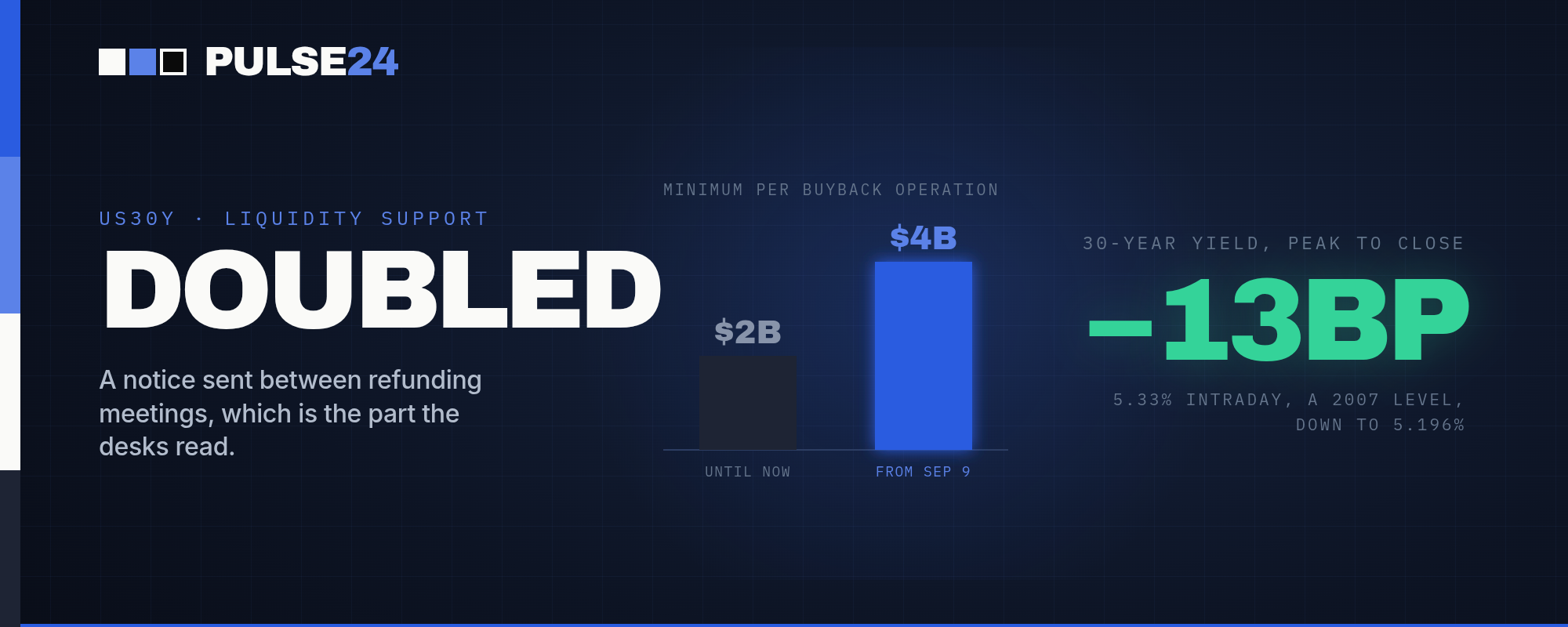
The Treasury just doubled the minimum size of its long-bond buybacks outside its normal schedule, and the 30-year yield reversed from a 19-year high within hours. Gold, the dollar, and Bitcoin all moved on the signal before markets had time to argue about the mechanics.
Treasury officials told bond dealers on Wednesday they would at least double the minimum size of the department's liquidity support buybacks for longer-dated debt, from $2 billion to $4 billion per operation. The notice arrived outside the normal quarterly refunding calendar. Within hours, the 30-year yield had reversed from a fresh 19-year high, and gold, the dollar, and Bitcoin all moved in response before most traders had finished reading the release.
What Changed
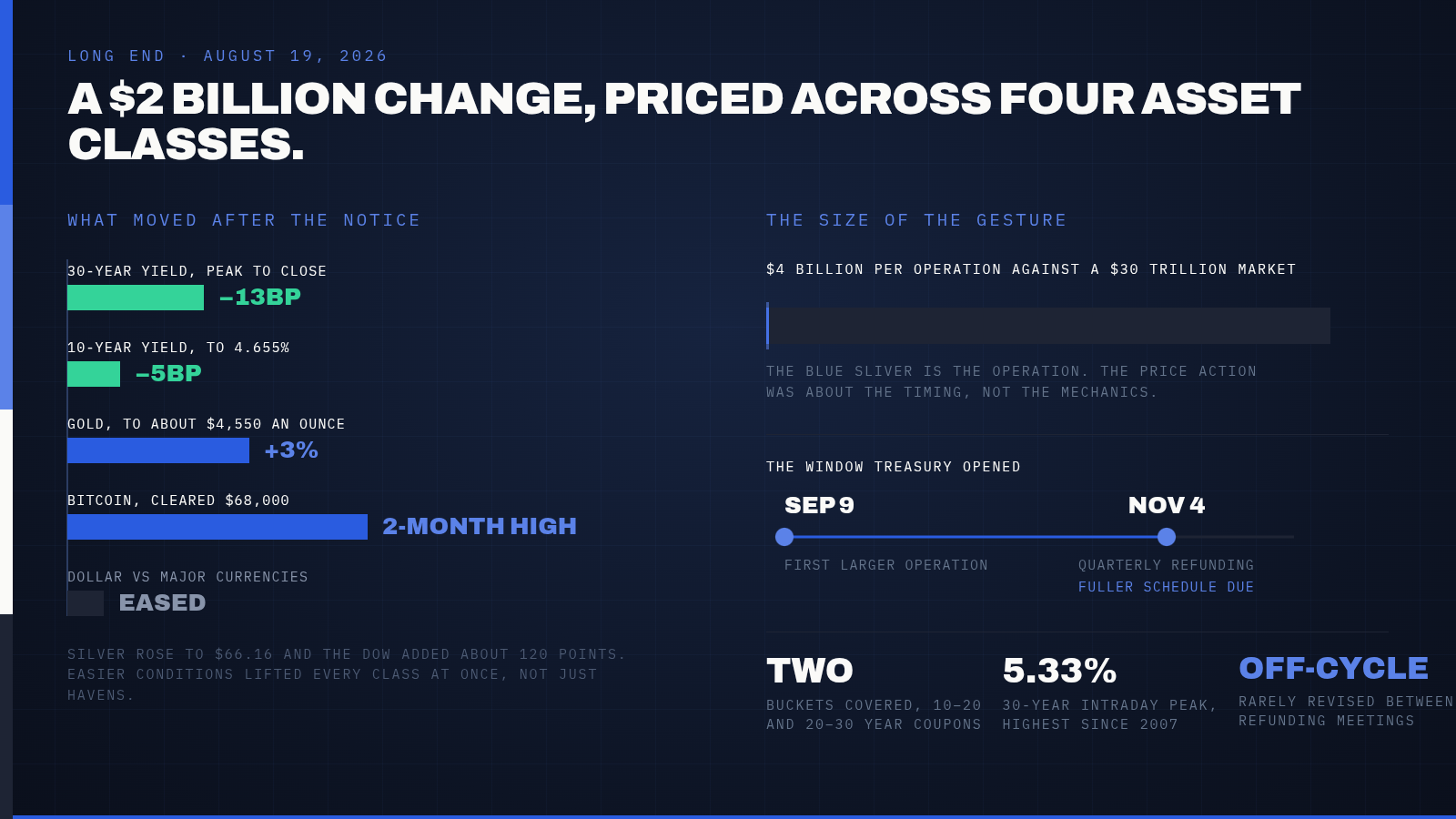
The new minimum applies to two maturity buckets, 10-to-20-year and 20-to-30-year nominal coupon securities, and runs from September 9 through November 4, when the next Quarterly Refunding announcement is due. Treasury framed the increase as a response to strong demand rather than distress, citing what it called the "significant volume of high-quality offers" it routinely receives in these operations and its "desire to provide greater liquidity support" at the long end.
The timing is what caught desks off guard. The 30-year yield had already hit 5.29% earlier this week, a level not seen since 2007, and kept climbing to an intraday high near 5.33% on Wednesday before the buyback news broke. That earlier move had already spilled into equities, dragging down memory-chip makers Western Digital and SanDisk the day before on no company-specific news at all. Jefferies chief U.S. economist Thomas Simons called the announcement unusual, noting Treasury doesn't normally revise buyback sizes between refunding meetings, a detail that told the market this was less about routine debt management and more about a line being drawn.
Why It Matters
Every corner of the market read the move as the same signal: Washington is uncomfortable with where long-term borrowing costs have drifted. The 10-year yield slid to 4.655%, down about 5 basis points, while the 30-year gave back roughly 13 basis points from its morning peak to close near 5.196%. Lower long rates mean a lower opportunity cost for holding assets that pay no yield at all, and gold and Bitcoin both took the invitation. Gold gained more than 3% to trade near $4,550 an ounce, its best level since early June, with silver rising alongside it to $66.16. Gold had already rallied nearly 8% in a week earlier this month as rate-hike odds faded, so Wednesday's jump extended a trend rather than starting one.
The dollar eased on the day against a basket of major currencies, and a softer dollar makes commodities priced in it cheaper for holders of other currencies, which reinforced the move in both metals. TD Securities pointed to a growing stagflation narrative behind the buying, the idea that slower growth paired with sticky inflation eventually forces real interest rates lower even if the Fed doesn't cut nominal rates quickly. Bitcoin, which had pulled apart from gold's direction as recently as two weeks ago, moved with it this time, climbing past $68,000 to its highest level in two months. Stocks rose too, with the Dow up about 120 points and the S&P 500 and Nasdaq each adding roughly 0.2%, evidence that easier financial conditions lifted nearly every asset class at once rather than just the safe-haven trade.
What To Watch Next
Treasury said it will lay out a fuller buyback schedule at the November 4 Quarterly Refunding, so the next real test is whether this was a one-time gesture or the start of a sustained pattern of leaning against long-end yields. Watch demand at upcoming 20-year and 30-year auctions closely. A soft auction so soon after this announcement would suggest the buyback alone isn't enough to offset the structural shift toward a private, price-sensitive buyer base that's been driving yields higher all year. Also worth tracking: whether the dollar's slide continues, since a sustained decline would keep supporting gold and Bitcoin even if yields stabilize, and how Fed officials characterize this fiscal intervention when they next speak publicly, given it edges into territory the central bank normally considers its own.
The Pulse24 Take
Four billion dollars is not a large number next to a Treasury market worth close to $30 trillion, so the price action Wednesday wasn't really about the mechanics of the operation itself. It was about what the timing revealed. Treasury moved between refunding meetings, something it rarely does, and markets across bonds, currencies, metals, and crypto all treated that as a tell that the 5.3% level on the 30-year had become uncomfortable for someone in Washington. That's a useful signal for investors trying to gauge how much further yields can realistically run before policy pushes back, but it's not a guarantee the pushback works. The structural buyer-base shift toward private, return-driven investors hasn't gone anywhere, and a modest increase in buyback size doesn't change who ultimately has to absorb a widening deficit's worth of new issuance. Wednesday bought the bond market a reprieve. Whether it bought more than a few weeks of one is the question worth watching heading into November.
How we read the data
Curious how we get from raw data to a take like this? Our Trader's Toolkit walks through the tools we lean on.
Explore the Toolkit