Pulse24 Original
The 30-Year Treasury Yield Just Hit 5.29%, Its Highest Level Since 2007. The Buyers Who Used to Set the Price Now Own Barely a Quarter of the Market.
August 18, 2026
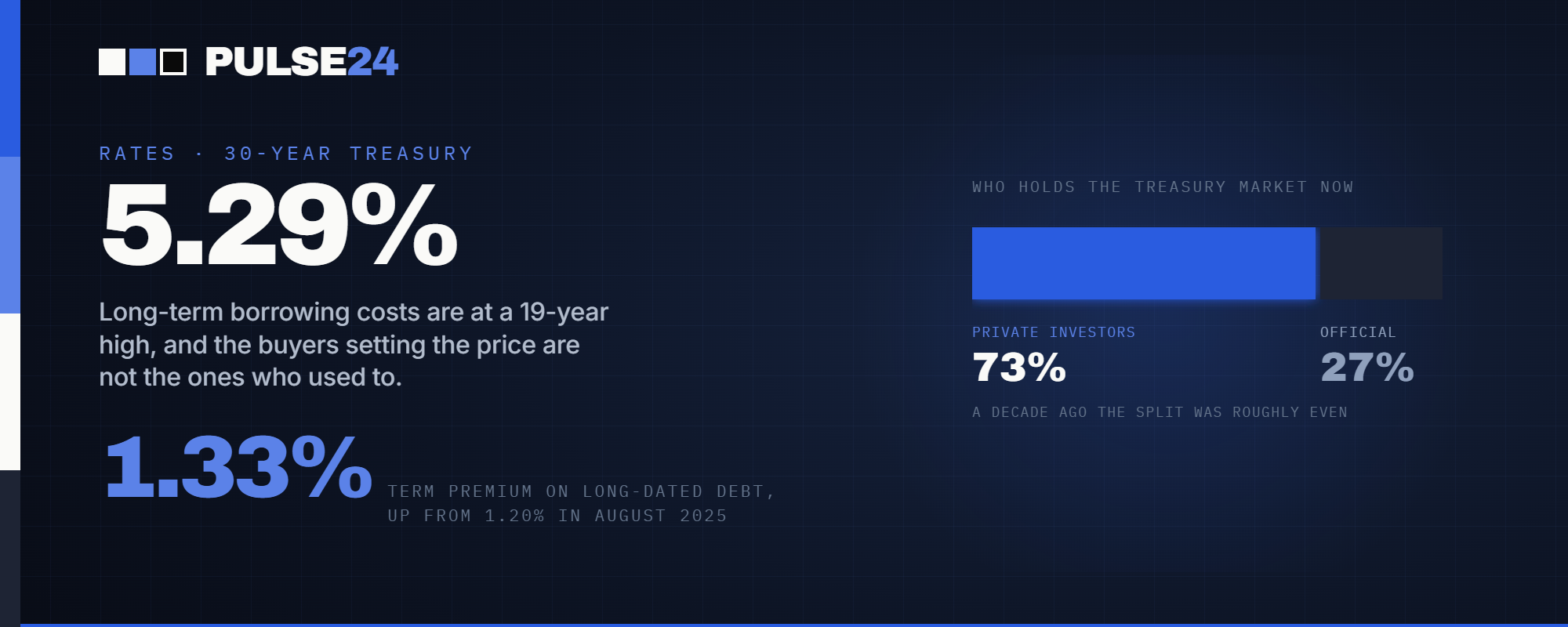
The 30-year Treasury yield just touched its highest level since 2007, and the Fed isn't really driving it anymore. A quiet shift in who buys U.S. government debt, from central banks to private investors, is pushing up the price of borrowing for three decades at a time.
The 30-year Treasury yield touched 5.29% on Monday, a level the bond market hasn't seen since 2007. Inflation isn't the culprit this time. July's CPI came in at 3.4%, matching every forecast on the Street and barely moving markets when it printed. What's actually pushing the long end higher is a quieter shift: who's left holding the debt has changed.
What Changed
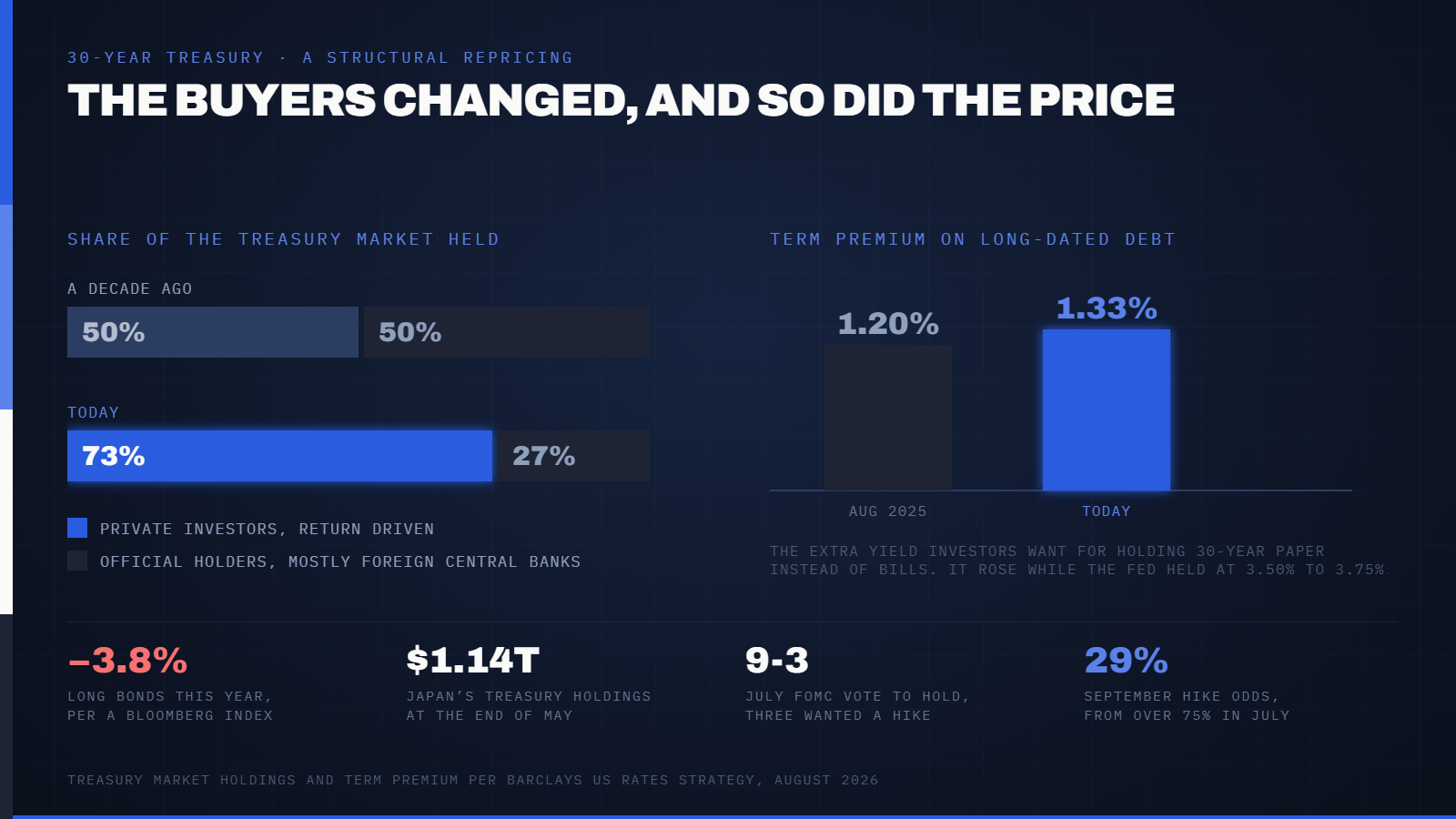
A decade ago, private investors and official institutions, mostly foreign central banks, split the Treasury market roughly 50/50. Today private buyers own about 73% of it, and official holders have slipped to 27%. Japan alone still holds an estimated $1.14 trillion in Treasuries as of the end of May, but that kind of price-insensitive, policy-driven buying has become the exception rather than the rule.
Private investors care about returns, not diplomatic relationships or reserve management. When the government floods the market with new long-dated debt, as it has been doing to fund a widening deficit, those buyers now demand a bigger yield concession to absorb it. Barclays calls this a structural shift, not a temporary wobble: "The buyer base for U.S. Treasuries has changed. The same scale of debt supply may require a larger yield concession to be digested by the market," the bank's head of U.S. rates strategy, Anshul Pradhan, wrote this week.
The math shows up in the term premium, the extra yield investors demand for the risk of holding long-term debt instead of rolling over short-term bills. That premium sat at 1.20% in August 2025. It's now 1.33%, and it's been climbing even as the Fed has held short-term rates steady at 3.50% to 3.75% since July, when the FOMC voted 9-3 to hold, with three officials pushing for a hike instead of a cut. Long bonds, as a Bloomberg long-duration index shows, are down 3.8% for the year.
This isn't happening in isolation either. Just four days earlier, a 30-year bond auction priced at the highest yield since 2001, while the 10-year sale a day before that found buyers with no trouble at all. The gap between how easily the market absorbs 10-year debt versus 30-year debt is itself a signal: demand is fine at the short-to-medium end, and it's the long end where the buyer base has genuinely thinned out.
Why It Matters
Higher 30-year yields ripple well past the bond market. Mortgage rates track the long end closely, so this keeps a lid on housing affordability at a moment when homebuilders have already cut prices for 15 straight months. Corporate borrowing costs rise too, and that lands hardest on the companies issuing the most debt right now, many of them financing AI infrastructure. Broadcom's AI financing vehicle alone could carry as much as $370 billion in debt by 2029, according to Bank of America, and it's one of several large issuers competing for the same shrinking pool of price-sensitive buyers.
There's also a feedback loop worth understanding. The federal government has to refinance existing debt and fund new deficits at these higher rates, which means more issuance, which puts further pressure on yields, which raises the government's own interest bill. Citadel Securities' Nohshad Shah framed the underlying tension bluntly: "This reflects a market view that policymakers tend to take the easier route when faced with difficult choices," he said, describing persistent inflation and debt growth as a systemic overhang for broader asset markets, not just bonds.
For equities, a rising long-term discount rate is a headwind for exactly the kind of long-duration growth stories that have carried this market, AI infrastructure names included. It doesn't mean stocks fall in a straight line, but it does mean the math behind today's valuations gets a little less forgiving with every basis point the 30-year adds.
What To Watch Next
Minutes from the Fed's July 28-29 meeting are due out this week, and they'll likely spell out the reasoning behind the 9-3 vote, including what the three dissenting officials wanted from a hike. Markets currently price the odds of a September rate hike at roughly 29% to 30%, down sharply from over 75% just a few weeks ago, so any hawkish language in those minutes could move the short end more than the long end.
Treasury's issuance calendar matters just as much as Fed commentary here. Barclays says the sell-off doesn't reverse without lower government debt issuance, reduced corporate borrowing, or a dramatic deceleration in economic activity, and none of those look imminent. Watch the pace of AI-linked corporate bond sales too. A growing share of AI data-center debt issued this year is already trading below its offering price, a sign the market's appetite for that supply isn't unlimited either.
The Pulse24 Take
The headline number here is the 19-year high, but the more durable story is underneath it. Bond markets are repricing who actually wants to hold America's debt and at what price, and that repricing doesn't reverse just because the Fed eventually cuts short-term rates. If the buyer base has genuinely shifted from price-insensitive foreign official holders to return-driven private investors, elevated term premiums could be a feature of this environment for a while, not a passing spike. Investors who assume 30-year yields will simply fall back once the Fed pivots may be underestimating how much of this move is structural rather than cyclical.
How we read the data
Curious how we get from raw data to a take like this? Our Trader's Toolkit walks through the tools we lean on.
Explore the Toolkit