Pulse24 Original
Bank of America Says Broadcom's AI Financing Vehicle Could Carry $370 Billion in Debt by 2029. Broadcom's Own Exposure Is Capped at $29 Billion.
August 15, 2026
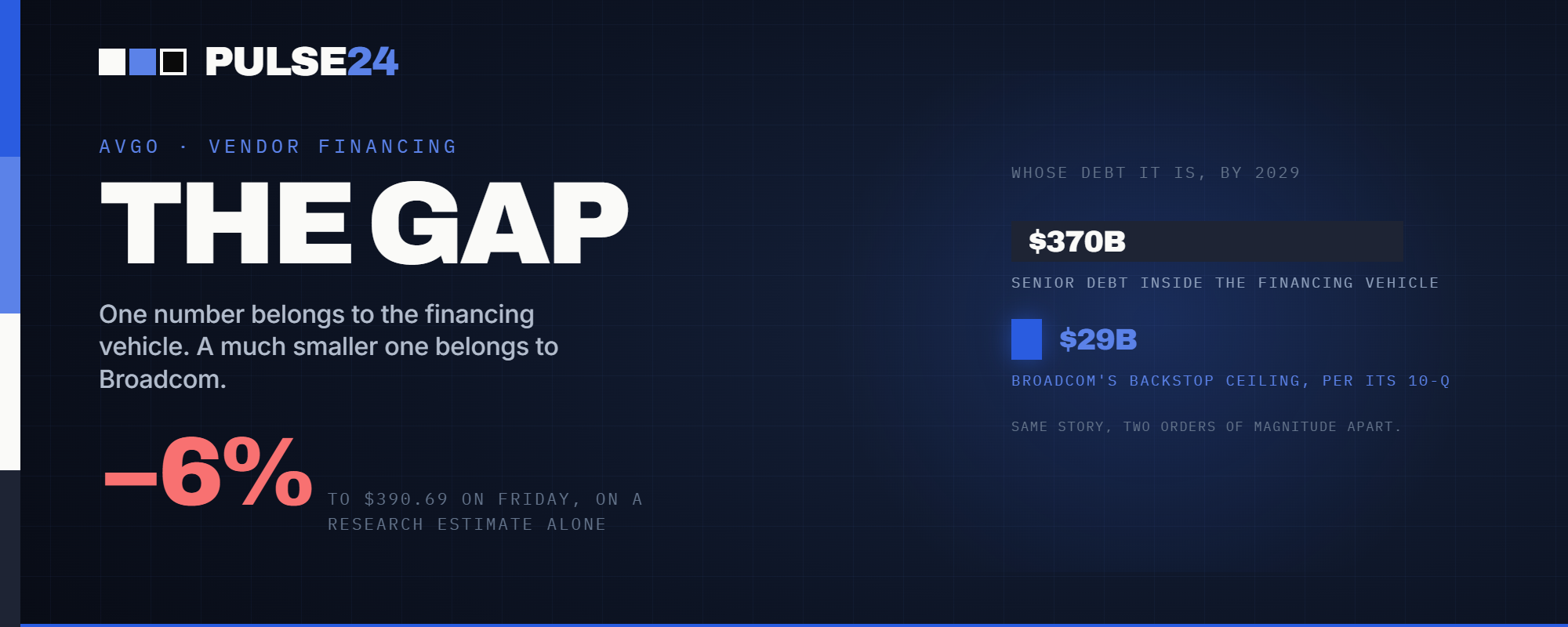
Bank of America put a $370 billion number on the debt inside Broadcom's AI chip financing vehicle, and the stock fell 6% on the estimate alone. The figure describes the financing platform's exposure, not Broadcom's own balance sheet, where the company's contractual downside is capped far lower.
Broadcom shares closed down 6% at $390.69 on Friday, capping a rough week for a stock that's still up sharply this year. The trigger wasn't an earnings miss or a guidance cut. It was a single number in a Bank of America research note: $370 billion, the amount of senior debt analyst Tom Curcuruto estimates Broadcom's AI chip-financing vehicle could carry by the middle of 2029.
What Changed
Bank of America's credit research team cut its recommendation on Broadcom's bonds to Marketweight from Overweight earlier in the week, flagging a financing structure the company had described only briefly on its own earnings calls. The vehicle, launched in June with Apollo and Blackstone funding an initial $35 billion phase, lets institutional investors buy the AI accelerators Broadcom builds for customers like Google, Meta, Anthropic and OpenAI, then lease that equipment back to them rather than making the customers pay upfront. It's the same basic structure Nvidia adopted at a larger scale in August, when it lined up more than $500 billion with six asset managers to help finance its own customers' AI buildout.
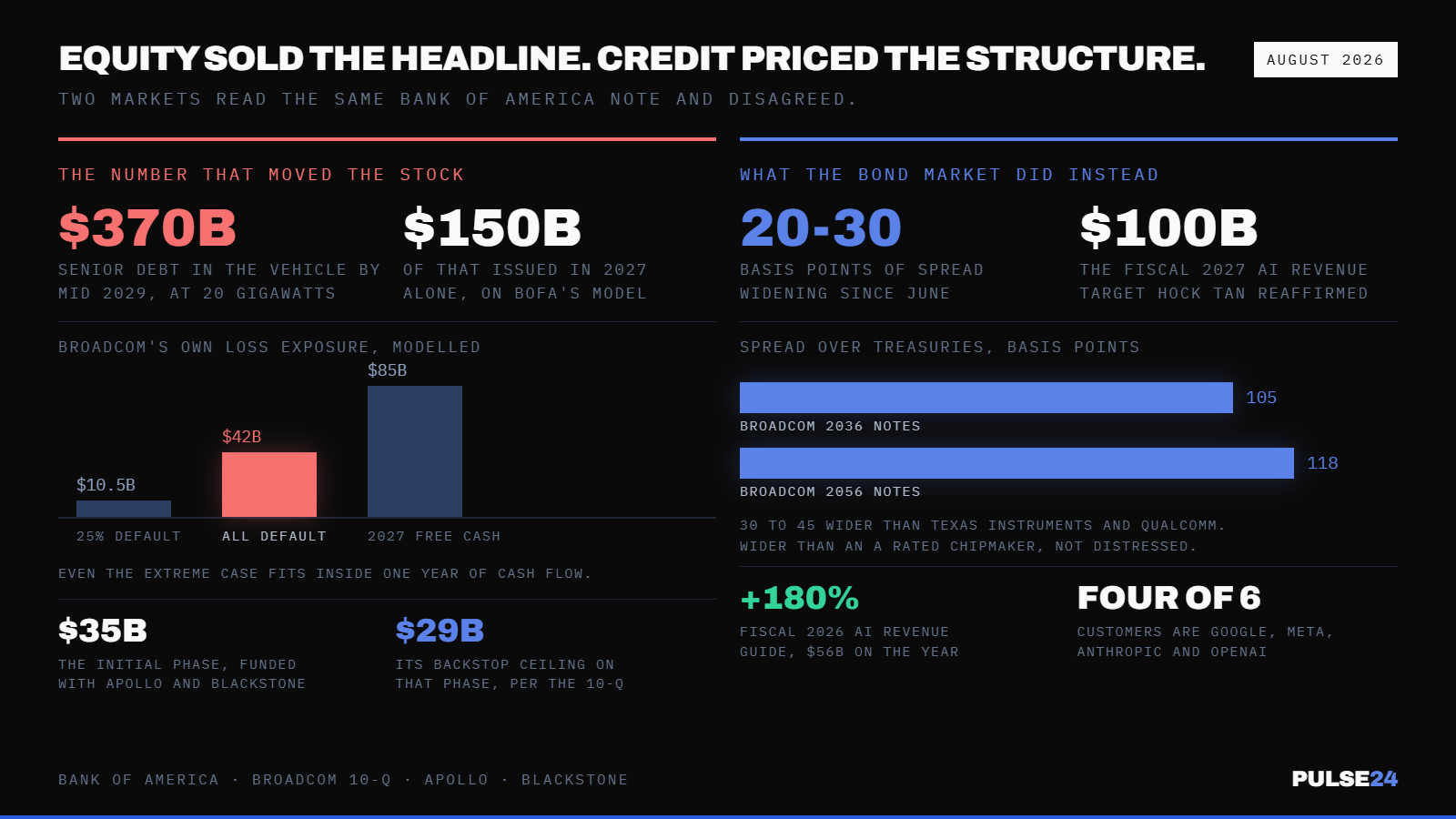
Curcuruto's math extrapolates that initial $35 billion deal out to the platform's full ambition, more than 20 gigawatts of compute capacity by 2028. At that scale, BofA estimates the vehicle's total residual value guarantee exposure, essentially the maximum the financing structure would owe if every leased chip had to be repossessed and resold, could reach $370 billion by mid-2029, with about $150 billion of that issued in 2027 alone. Compare that against the initial $35 billion transaction, where Broadcom's own 10-Q filing caps its maximum backstop exposure at $29 billion. Broadcom doesn't guarantee the vehicle's debt itself. It guarantees lease payments for five years, and only up to a ceiling.
Why It Matters
The distinction between the vehicle's total debt and Broadcom's actual exposure matters more than the headline number suggests. BofA's own modeling puts Broadcom's realistic loss exposure at the full 20-gigawatt scale between $10.5 billion, if a quarter of customers default, and $42 billion in a full-default scenario the bank itself calls extreme. Broadcom's projected free cash flow for fiscal 2027 alone is roughly $85 billion, more than enough to absorb even the worst case BofA modeled. Friday's selloff didn't seem to price in that nuance. Investors sold first and, judging by the size of the move against a relatively contained downside estimate, asked questions second.
Credit markets have not ignored the risk entirely, though their reaction has been calmer. Broadcom's 2036 bonds now trade at a spread of about 105 basis points over Treasuries, and its 2056 bonds at 118 basis points, both 30 to 45 basis points wider than comparable single-A semiconductor peers like Texas Instruments and Qualcomm. Spreads have widened 20 to 30 basis points since June. That's a real repricing, not a dramatic one, and it fits a pattern that's been building across AI infrastructure debt for months. CoreWeave had its own loan repriced to a 10.44% yield last month, with credit markets pricing close to even odds of default. Nearly 80% of AI data center bonds sold since early 2025 now trade below issue price. Broadcom's spreads are wider than a typical A-rated chipmaker's, not distressed.
The Concentration Problem Underneath the Debt
The debt question sits on top of a separate one: how much of Broadcom's AI growth depends on a handful of customers. Hock Tan reaffirmed in August that Broadcom expects fiscal 2027 AI semiconductor revenue to exceed $100 billion, up from $56 billion guided for fiscal 2026 and $10.8 billion booked in the second quarter alone, itself up from $8.4 billion in the first quarter. Google, Meta, Anthropic and OpenAI are four of the six customers carrying nearly all of that forecast. Anthropic alone placed a $10 billion chip order in December. The other two unnamed customers have put in a combined $6 billion so far. A financing vehicle backing that kind of customer concentration inherits the concentration risk along with the growth.
What to Watch Next
Watch whether Broadcom's bond spreads keep widening into its next earnings report, and whether the company gives more detail on how the financing platform scales past its current $35 billion phase. The 25% default scenario BofA modeled, a $10.5 billion hit, is the more realistic stress case to track, not the $42 billion extreme case that grabbed headlines Friday. Also worth watching: whether the platform's other backers, Apollo and Blackstone, say anything about how they're pricing the credit risk on their side of the lease, since Apollo's own chief economist has separately warned that AI data-center capex broadly is running at twice the pace of the 2000s housing boom.
The Pulse24 Take
A $370 billion number is built to grab attention, and it did its job on Friday. The figure that actually describes Broadcom's downside is smaller by an order of magnitude, and even BofA's own extreme case is a sum the company's free cash flow could absorb without much strain. None of that makes the financing structure risk-free. Vendor financing has a mixed history, and the AI buildout has leaned on it more heavily than is typical this early in an industry's growth curve.
What's more useful than picking a side on Friday's selloff is watching where the two markets diverge. Equity investors reacted to a scary headline number. Credit investors, who've had weeks to digest the structure, priced in a moderate widening, not a panic. When those two markets disagree this much about the same set of facts, the credit market's read tends to be the one worth trusting, if only because bondholders have less patience for optimism than shareholders do.
How we read the data
Curious how we get from raw data to a take like this? Our Trader's Toolkit walks through the tools we lean on.
Explore the Toolkit