Pulse24 Original
AI Data-Center Capex Is on Track to Hit 3% of GDP by 2027. Apollo's Top Economist Says It's Building at Twice the Pace of the Housing Boom.
August 9, 2026
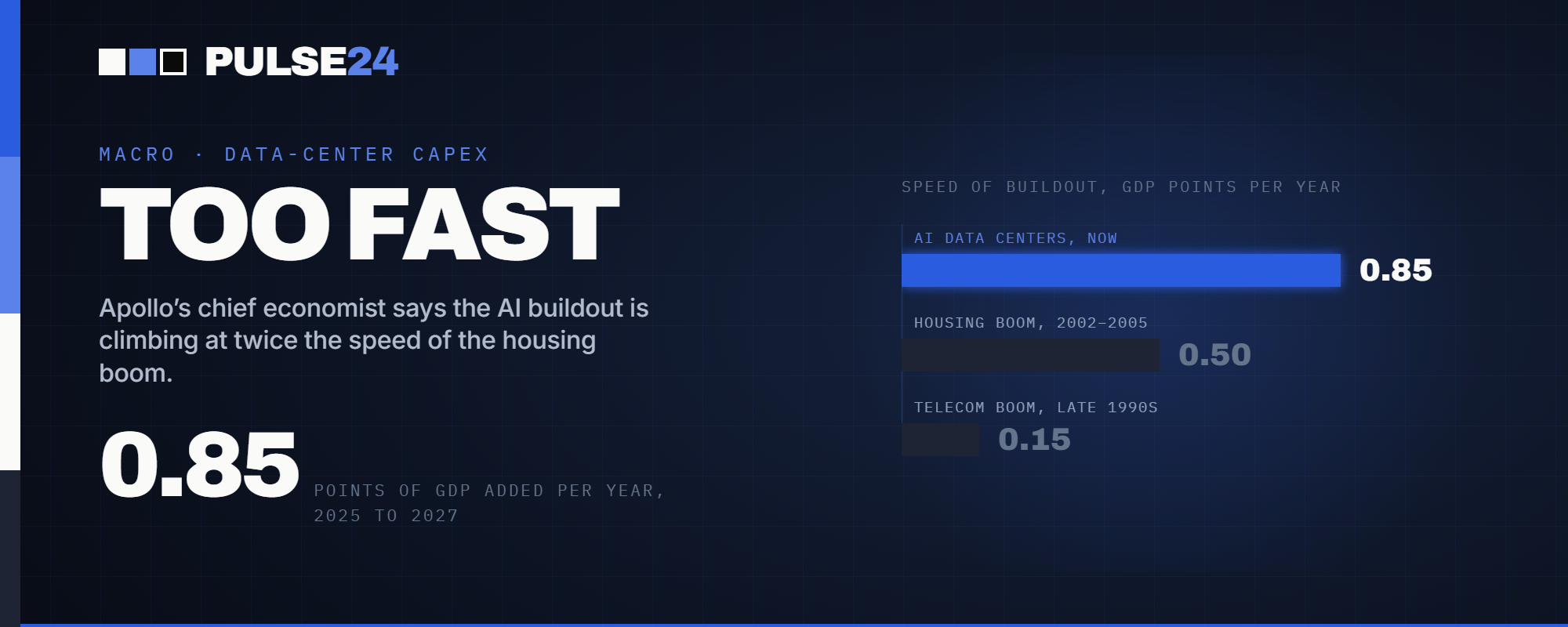
Data-center capex is on pace to hit roughly 3% of US GDP by 2027, according to Apollo's chief economist Torsten Slok, more than double where the late-1990s telecom boom peaked. He warns the buildout is moving nearly twice as fast as the 2000s housing boom did, which means it could unwind just as quickly if AI demand falls short.
Three percent. That's the share of US GDP that Apollo Global Management's chief economist, Torsten Slok, expects data-center construction to reach by 2027, up from 1.4% in 2025 and just 0.3% back in 2019. Hyperscaler capex guidance already points there, so the number itself isn't controversial. What makes it worth sitting with is the comparison Slok is drawing to the last two times the US economy built something at this scale.
The late-1990s telecom and fiber-optic buildout is the closest historical parallel to today's AI infrastructure race, and it peaked at 1.2% of GDP in 2000, right before the dot-com bust left a huge share of that freshly laid capacity unused for years. Data-center spending is on pace to run at more than double that peak. It's also getting there considerably faster.
The Pace Is the Real Story
Slok's data shows data-center capex climbing about 0.85 percentage points of GDP a year between 2025 and 2027. The 2002-2005 housing boom, by comparison, never grew faster than 0.5 points a year even at its peak, and telecom crept up at roughly 0.15 points a year during its late-1990s run. AI infrastructure spending is building at close to twice the pace of the housing boom and more than five times the pace of telecom, compressing into a few years what those cycles took the better part of a decade to build.
None of this means the AI buildout is doomed to repeat what happened to telecom or housing. Slok's own numbers show data-center capex still sits well below the housing boom's 2005 peak of 6.6% of GDP, so there's room for the current cycle to keep growing without matching history's biggest excess. His point is narrower and, in some ways, more useful: the speed of the buildup is itself the risk to watch, separate from whether the spending eventually proves justified. "A cycle that builds at 0.85 percentage points a year can unwind at a similar pace," Slok wrote, "and that, rather than the buildout itself, is the macro risk if AI demand disappoints."
Where the Money Is Actually Going
Alphabet, Microsoft, Meta and Amazon were already tracking toward a combined $725 billion in capex for 2026 as of the spring, up 77% from roughly $410 billion in 2025, according to widely cited analyst tallies. That combined number has kept climbing since, because all four companies raised their own guidance in the months that followed. Amazon raised its 2026 cash capex forecast to $220 billion from about $200 billion, pointing to higher memory costs. Microsoft is guiding to roughly $190 billion for the year, with about $25 billion of that increase tied to component price inflation rather than new capacity. Alphabet has raised its 2026 range to $195 billion to $205 billion, and Meta's guidance climbed to roughly $145 billion after starting the year at $115 billion to $135 billion.
Wall Street is split on what to make of it. Jefferies analyst Brent Thill dismissed the skeptics outright, arguing "the AI economy is healthy" and calling the bear case "garbage." Dec Mullarkey at SLC Management takes the opposite view, warning that a company like Meta risks turning from "a capital-light money machine" into "a capital-intensive incinerator" if the spending keeps escalating without matching revenue.
The stock market has already started drawing that same distinction on a company-by-company basis. SpaceX beat earnings estimates this quarter and its stock still fell as much as 8%, because its capex ran to more than double its revenue. Palantir beat estimates the same week and jumped more than 25%, because its growth doesn't carry a matching capex bill. The market isn't rewarding AI-linked growth on its own anymore. It's asking whether the spending behind that growth is under control.
Why This Isn't Just a Tech Story
A capex cycle running at 3% of GDP doesn't stay contained to a handful of stock tickers. Spending at that scale shows up directly in headline GDP growth while it's ramping, the same way housing did in the mid-2000s, which means a slowdown in the pace of AI capex would subtract from growth in a way a normal sector pullback wouldn't. Credit markets are already pricing some of that risk in narrower corners of the AI buildout. CoreWeave's debt was recently repriced to a 10.44% yield, a level the credit market treats as close to a coin flip on default, well before any broad slowdown in hyperscaler spending has actually shown up.
That's a single, leveraged infrastructure lender, not the four companies funding this buildout mostly out of their own cash flow. But it's an early signal of how quickly sentiment can shift once the market starts questioning whether spending and revenue are moving in the same direction. The broader debate over whether AI is ultimately inflationary or deflationary for the economy runs through the same question: does this capex eventually pay for itself through productivity gains and falling compute costs, or does it just add a large, volatile spending cycle on top of an economy that doesn't need one right now.
What to Watch Next
The next real test comes with fourth-quarter and full-year 2026 guidance from the four hyperscalers, typically delivered on their late-October and January earnings calls. Another raise that outpaces revenue growth would extend the pattern the market has already started punishing, while a guidance number that holds steady or slows, paired with evidence that cloud and AI-services revenue is catching up, would support Thill's healthy-economy case over Mullarkey's incinerator one. Watch credit spreads on AI-linked infrastructure debt too, since CoreWeave's repricing could turn out to be an isolated case or an early warning, and that distinction should become clearer as more AI infrastructure financing deals come to market over the next few quarters.
The Pulse24 Take
Slok isn't calling a bubble, and it's worth being precise about that. His numbers show plenty of room left before AI capex approaches anything like the housing boom's 2005 extreme, and the underlying demand for compute, chips and power is real in a way that a lot of the late-1990s dark fiber never was. What his research actually flags is a structural fact about fast cycles: the same speed that makes a buildout impressive on the way up is what makes it dangerous on the way down if the revenue doesn't arrive on schedule.
That's a different kind of risk than the one most headlines chase. It's not a prediction that AI spending is wasted, and it's not a guarantee that it isn't either. Think of it instead as a reminder that when four companies commit three-quarters of a trillion dollars in a single year, the pace of that commitment is itself something markets need to price, independent of whether the AI story eventually proves out. The next few earnings cycles, not any single data point, will show which way this one is heading.
How we read the data
Curious how we get from raw data to a take like this? Our Trader's Toolkit walks through the tools we lean on.
Explore the Toolkit