Pulse24 Original
SpaceX Beat Estimates and Fell 8%. Palantir Beat Estimates and Surged 25%. The Difference Is a Number Most Headlines Skip.
August 4, 2026
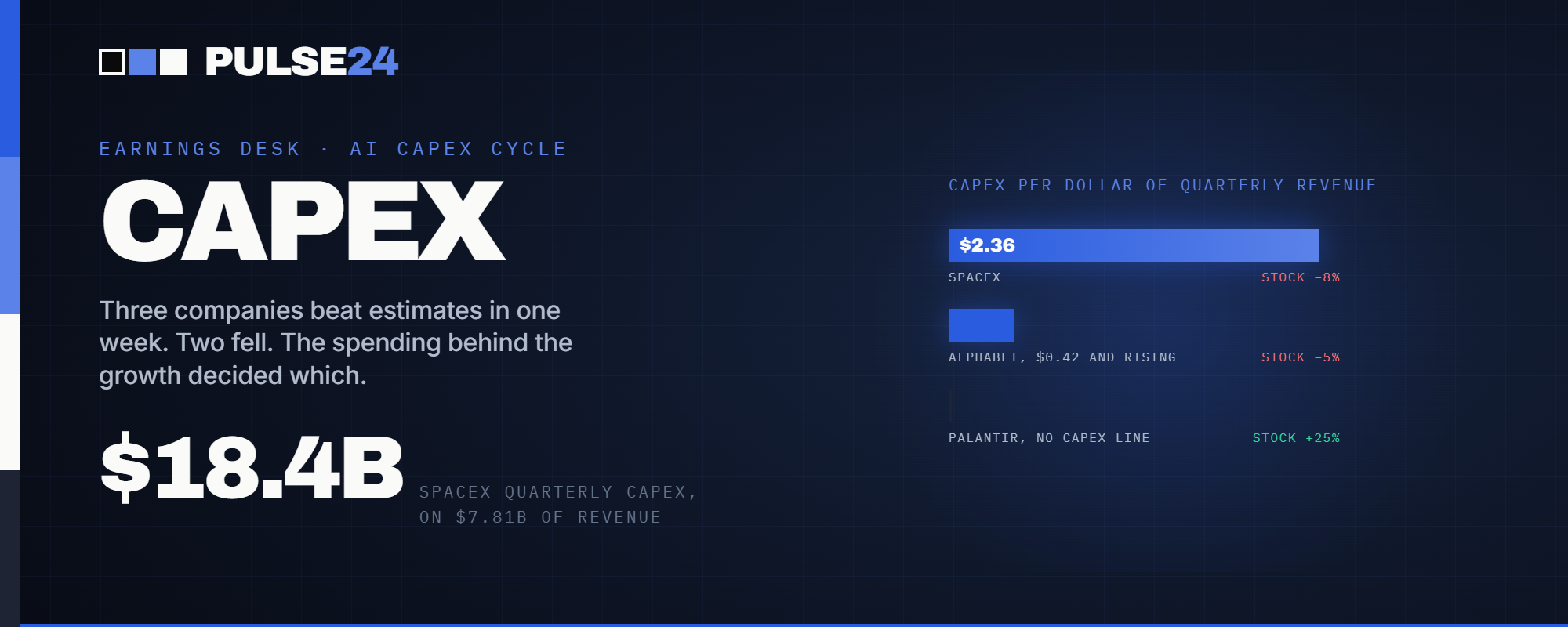
SpaceX beat Wall Street's estimates this earnings season and its stock fell. Palantir beat estimates the same week and surged 25%. The gap wasn't the size of either beat, it was what each company's capital spending is doing to its cash flow, a test worth applying to every AI-exposed earnings report from here on.
SpaceX beat Wall Street's revenue and profit estimates this week. Its stock fell as much as 8%. Four days earlier in the same earnings season, Alphabet beat its own estimates by an even wider margin. Its stock fell too. Then Palantir beat estimates by a similar magnitude, and its stock surged more than 25% the same day SpaceX was falling.
Three real companies, three real beats, three different markets. If the size of the beat isn't what's deciding the reaction, something else is, and it's worth naming, because it's going to keep happening.
This isn't a one-quarter phenomenon. Every AI-linked company still has to report quarterly for as long as this capex cycle runs. What follows is less a recap of this week and more a durable filter for reading whichever one reports next.
The Pattern, in Three Earnings Reports
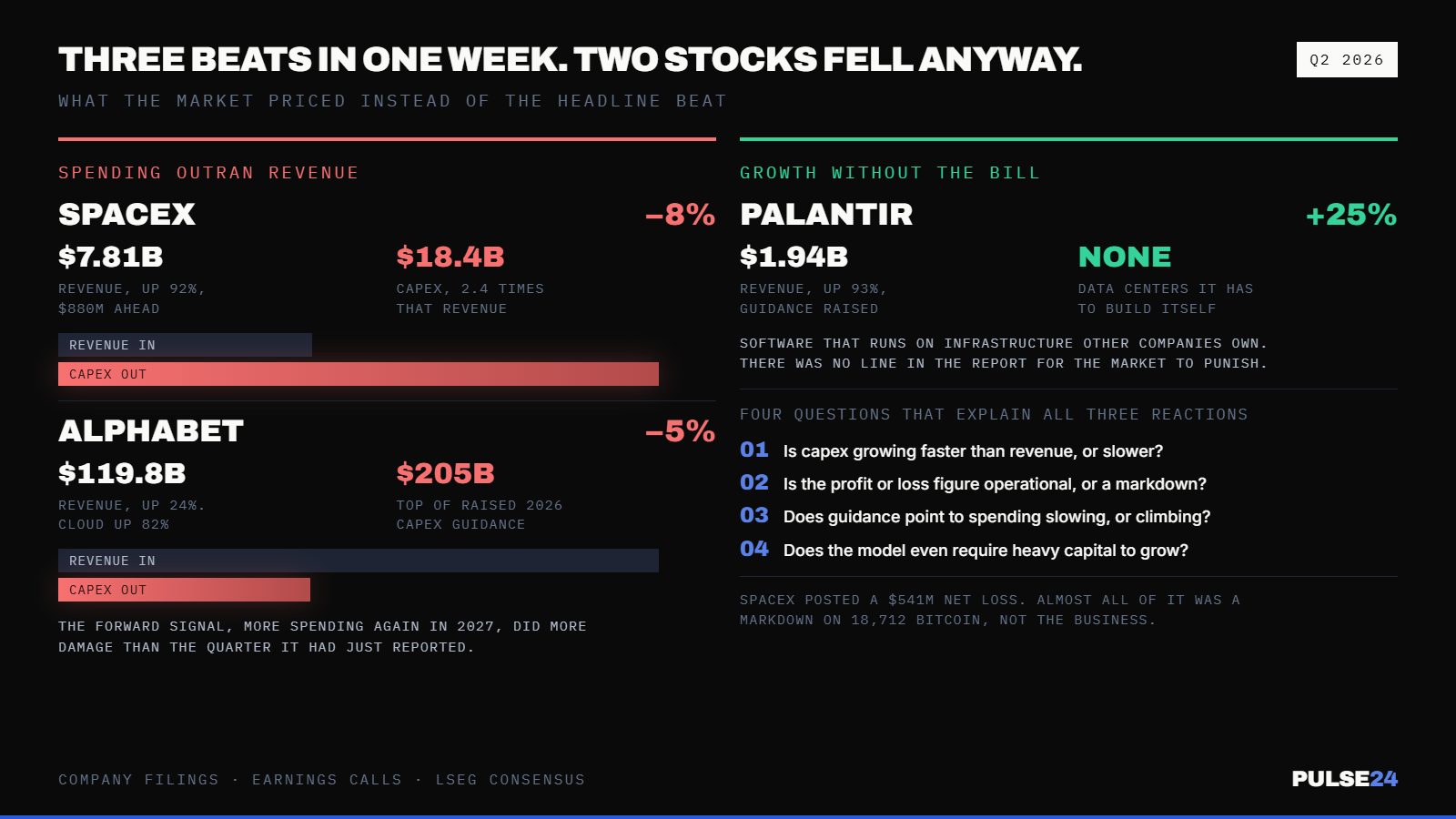
SpaceX reported its first quarterly results as a public company this week, and it beat expectations almost across the board. Revenue came in at $7.81 billion, up 92% year over year and about $880 million ahead of forecasts, and loss per share beat estimates too. The stock still fell as much as 8% in after-hours trading, because investors spent more time on a single line further down the filing than on the beat itself: about $18.4 billion in quarterly capital expenditures, more than double the revenue that came in the door. Renting out AI compute capacity, the way SpaceX's Colossus data centers do for customers like Anthropic and Google, is a different business from building rockets, with a different cost structure, and right now that cost structure is running well ahead of the revenue it's generating.
Alphabet told a similar story a couple of weeks earlier. Revenue grew 24% to $119.8 billion, Google Cloud grew 82%, and diluted earnings per share nearly quadrupled to $9.11. The stock fell almost 5% anyway, and not because of the SpaceX equity stake that had inflated that EPS figure by roughly $6. It fell because Alphabet raised its 2026 capex guidance and signaled more spending to come in 2027. Two beats, driven by genuinely strong underlying businesses, both marked lower for the same reason: spending accelerating faster than the market's patience for it.
Palantir broke the pattern the same day SpaceX reported. Revenue grew 93% to $1.94 billion, guidance for the rest of the year went up, and the stock closed up more than 25%. Palantir's growth came with no equivalent capex story attached, because Palantir doesn't build data centers or launch rockets. It sells software that runs on infrastructure other companies own. There was no line in its report for the market to punish.
The Four-Question Checklist
Four questions explain most of the gap between an earnings beat and a stock rally.
First: is capex growing faster than revenue, or slower? SpaceX's capex ran to more than double its quarterly revenue. Alphabet's capex guidance rose faster than its revenue growth rate. Both fell. When capex growth outpaces revenue growth, a beat on the income statement doesn't offset what's happening on the cash flow statement.
Second: is the profit or loss figure actually operational? SpaceX's $541 million net loss traced almost entirely to a bitcoin holdings markdown, not the underlying business, since the 18,712 bitcoin the company holds lost roughly a third of their value during the quarter. Alphabet's headline EPS was inflated by an accounting markup on its SpaceX stake, not operating income. Neither number, taken at face value, described the business underneath it. Strip out one-time and non-cash items before trusting the headline.
Third: what does guidance say about the direction of spending, not just this quarter's size? Alphabet's forward signal, that spending climbs again next year, did more damage than the quarter it had just reported. SpaceX offered no clearer signal that its AI capex would decelerate relative to revenue any time soon. Guidance pointing toward capex slowing relative to revenue tends to get rewarded. Guidance pointing the other way tends to get repriced lower, no matter how strong the quarter behind it was.
Fourth: does the business model actually require heavy capital spending to grow? Palantir's growth is close to costless to produce in capital terms, which is exactly why it wasn't held to the same standard as SpaceX or Alphabet. A software company and an infrastructure company can post the same revenue growth rate and face completely different markets, because one of them has to keep buying chips, power, and land to sustain it and the other doesn't.
Why This Framework Matters Beyond This Week
Big Tech's combined AI capex plans already drew a broader investor revolt in late July, and the tension between AI infrastructure spending and the revenue it's supposed to generate is the same dynamic playing out across the entire AI buildout, not just at these three companies. The four questions above aren't specific to SpaceX, Alphabet, or Palantir. They're a filter for the next AI-linked earnings report, and the one after that, for as long as this capex cycle runs.
What to Watch Next
AMD reported the same week, and every major AI-linked company still has to report at least one more quarter before this earnings season closes. Apply the same checklist each time: is capex outrunning revenue, is the profit or loss figure clean of one-time items, does guidance point toward capex decelerating or accelerating, and does the business model actually require the spending in the first place. SpaceX also has a nearer-term test of its own, a lockup expiration on August 6 that makes close to a billion insider and early-investor shares eligible to trade for the first time since its June IPO, a supply event unrelated to any of the four questions above but one that could move the stock regardless of how the fundamentals shake out.
The Pulse24 Take
It's tempting to read "beat estimates" as good news and "missed estimates" as bad news and stop there. This week showed why that's not enough. Three companies beat. Two fell. The one that didn't fall was the one whose growth wasn't attached to a capex number large enough to worry about.
None of this means heavy AI capex is automatically a mistake. SpaceX's AI compute business isn't hypothetical since the contracts already exist; the real question is whether today's spending catches up to tomorrow's revenue fast enough. Alphabet's cloud business, similarly, is compounding at a rate that would justify a great deal of spending if it keeps up. What it means is that the market has started pricing AI-linked earnings on a second axis beyond growth: whether the spending behind that growth is under control. That axis isn't going away as long as this capex cycle runs, and it's a more useful lens for the next earnings report than the headline beat or miss will be on its own.
How we read the data
Curious how we get from raw data to a take like this? Our Trader's Toolkit walks through the tools we lean on.
Explore the Toolkit