Pulse24 Original
Alphabet's Earnings Beat Wasn't the Story. Its $205 Billion Bet Is.
July 23, 2026
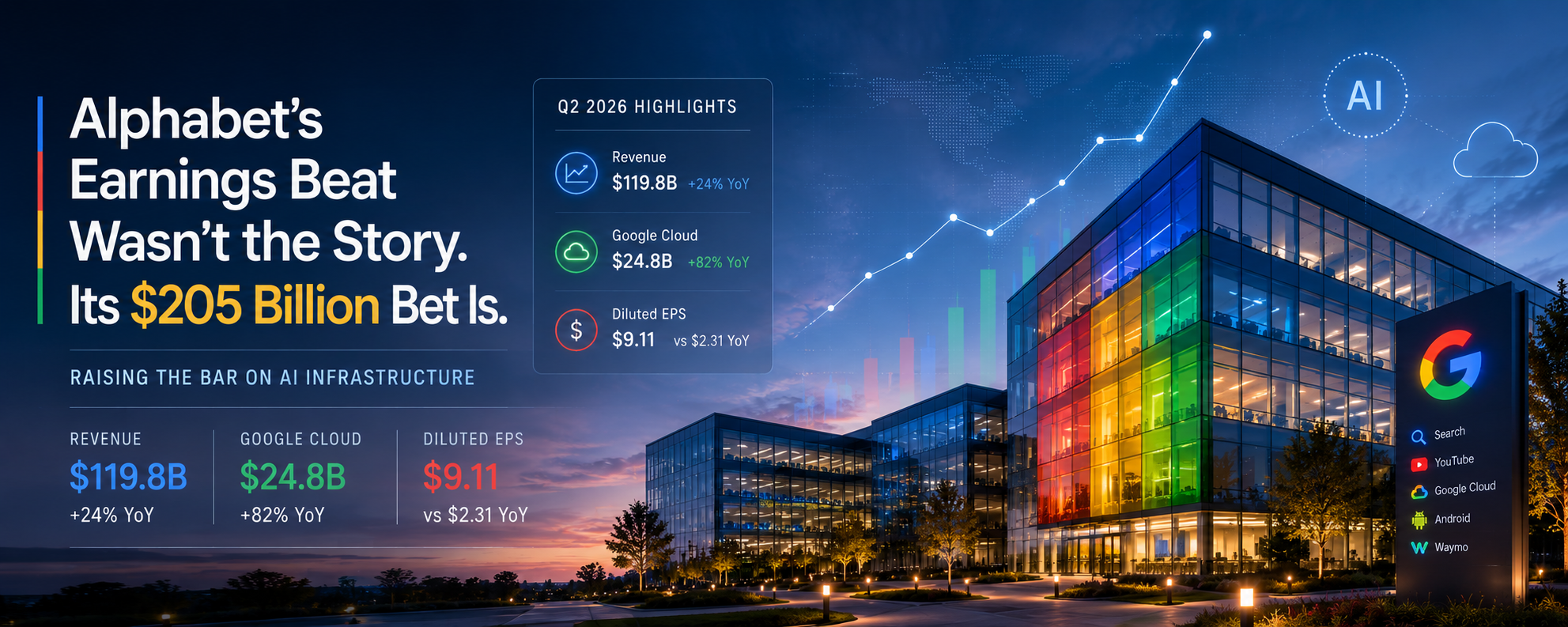
Alphabet beat on revenue and posted a record EPS, and the stock still fell nearly 5 percent after hours. A $98 billion SpaceX windfall inflated the headline number. The real story is a capex bet that just got a lot bigger.
Alphabet beat on revenue, crushed estimates on earnings per share, and its stock still fell nearly 5 percent after hours. That contradiction is the whole story of this quarter.
A company can report its best numbers in years and still tell investors something they don't want to hear.
Revenue came in at $119.8 billion for the second quarter, up 24 percent year over year. Google Cloud grew 82 percent to $24.8 billion, the fastest pace since the AI buildout began. Diluted EPS landed at $9.11, nearly four times last year's $2.31. On paper, this was one of the best quarters in Alphabet's history.
It wasn't, not in the way that headline number suggests. Alphabet booked a $98 billion net gain on equity securities this quarter, an unrealized markup on its minority stakes in private companies, and that single line added roughly $77 billion to net income and $6.26 to diluted EPS. Strip it out and adjusted earnings actually missed estimates.
Why a 2015 Bet on SpaceX Is Driving This Quarter's Headline Number
Google put $900 million into SpaceX back in 2015, a bet that looked speculative even by Silicon Valley standards at the time. SpaceX went public in June 2026 in the largest listing in Nasdaq's history, pricing at $135 a share and valuing the company near $2.1 trillion. Alphabet's stake, still roughly 6 percent, showed up on the books this quarter valued at $94.1 billion.
Google didn't earn that gain in the second quarter. Accounting rules just finally let it say so out loud.
Since 2018, companies have had to mark minority equity stakes to fair value every quarter and run the change straight through net income, whether or not any cash changes hands. That's the mechanism behind a single IPO adding more than six dollars to diluted EPS in one print. It also means $80 billion of that SpaceX stake is currently under a short-term lockup and can't be sold, and another $14.1 billion stays restricted through the third quarter of 2027. The number on the income statement is real. The cash isn't, not yet.
Why Wall Street Punished a Beat
The stock didn't drop because of the SpaceX gain. It dropped because of what management said about spending.
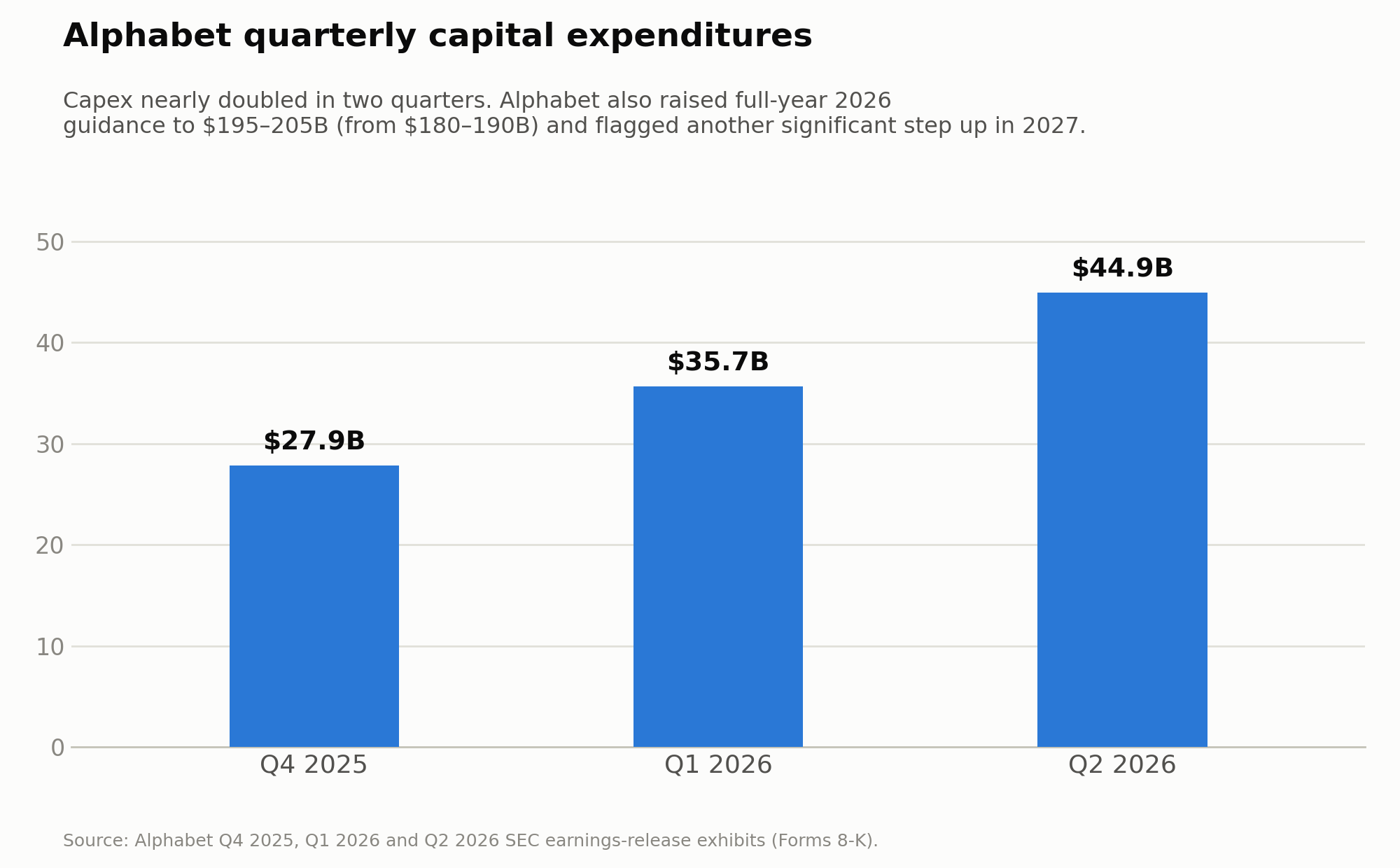
Alphabet raised its 2026 capital expenditure guidance to a range of $195 billion to $205 billion, up from $180 billion to $190 billion just one quarter earlier, and told investors to expect capex to increase significantly again in 2027. Quarterly capex has nearly doubled in two quarters: $27.9 billion in the fourth quarter of last year, $35.7 billion in the first quarter of this one, $44.9 billion now.
Cloud growth accelerating to 82 percent is exactly the kind of result that would justify heavier spending. But investors have been asking the same question of every hyperscaler this earnings season: at what point does AI infrastructure spending outrun the revenue it's supposed to generate, the exact question sitting underneath Pulse24's thesis that infrastructure won the AI trade's first act while distribution fights for the second. Alphabet didn't answer that question this quarter. It spent more and asked for patience.
What Investors Should Watch From Here
The headline EPS figure won't be a clean read next quarter either, not with other private stakes still sitting on Alphabet's balance sheet that could reprice the same way. The numbers that actually describe the business are Google Cloud's operating margin, not just its growth rate, and the ratio of capex to operating cash flow, the figure that decides whether this spending cycle is sustainable or just conviction.
Two SpaceX-specific dates are worth marking on a calendar rather than a headline. The bulk of that stake, roughly $80 billion, comes off its short-term lockup on a schedule tied to the IPO; the remaining $14.1 billion stays restricted until the third quarter of 2027. Whenever Alphabet actually converts any of that paper value into cash is a real, trackable capital-allocation decision. This quarter's accounting entry was not.
The Pulse24 Take
Investors should be unambiguously pleased about one thing: Google Cloud's 82 percent growth is an operating, cash-generating result, not an accounting artifact, and it's accelerating rather than leveling off.
What should make them cautious is simpler than the SpaceX story suggests. A hyperscaler that needs an eleven-year-old moonshot bet to make its quarter look historic is quietly telling you the core business alone didn't.
Alphabet spent this quarter proving two things that don't automatically fit together: that its AI infrastructure bet is working, and that it's getting a great deal more expensive to keep making that bet. Somewhere between $195 billion and $205 billion, the company is betting those two facts stay compatible through 2027. Nothing in this report proved they will. That's not a knock on the quarter. It's the actual homework the next four quarters are supposed to do.
How we read the data
Curious how we get from raw data to a take like this? Our Trader's Toolkit walks through the tools we lean on.
Explore the Toolkit