Pulse24 Original
The AI Inflation Debate Isn't About Whether. It's About When.
August 4, 2026
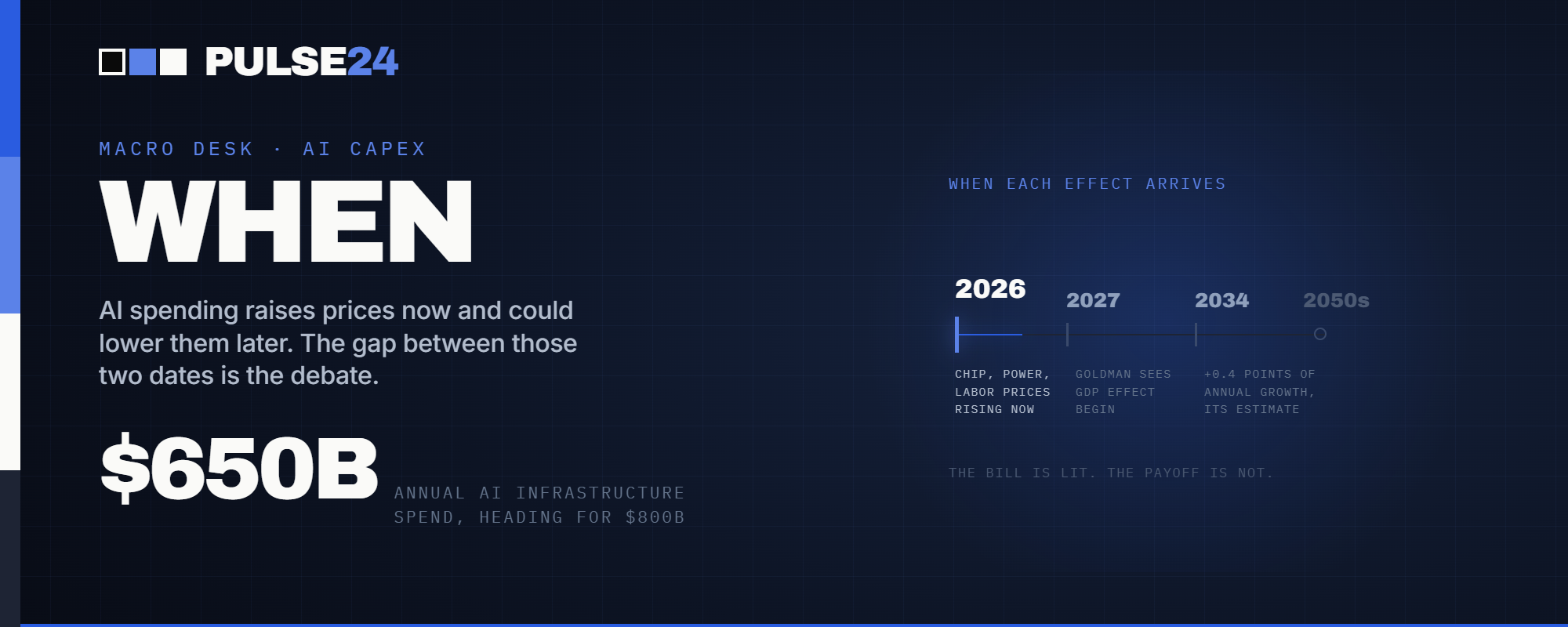
AI infrastructure spending is already pushing up prices for chips, power, and construction labor, and multiple Fed officials say so directly. Whether that spending eventually lowers prices instead depends on a productivity payoff that credible forecasts put anywhere between a decade and several decades away.
Ask an economist whether artificial intelligence will raise prices or lower them, and the honest answer is both, just not at the same time. That's not a hedge. It's the actual shape of the debate playing out inside the Federal Reserve, on Wall Street trading desks, and in academic papers right now, and it's worth understanding on its own terms rather than through whatever headline happens to be running this week.
The short answer
In the near term, building AI infrastructure is inflationary. Data centers need chips, electricity, land, construction labor, and grid capacity, and demand for all five is currently outrunning supply. In the longer run, if AI genuinely raises productivity the way earlier general-purpose technologies did, it should help hold prices down by letting the economy produce more without needing proportionally more labor or capital. The tension between those two timelines, not a simple yes-or-no answer, is the actual state of the research.
Why AI spending is inflationary right now
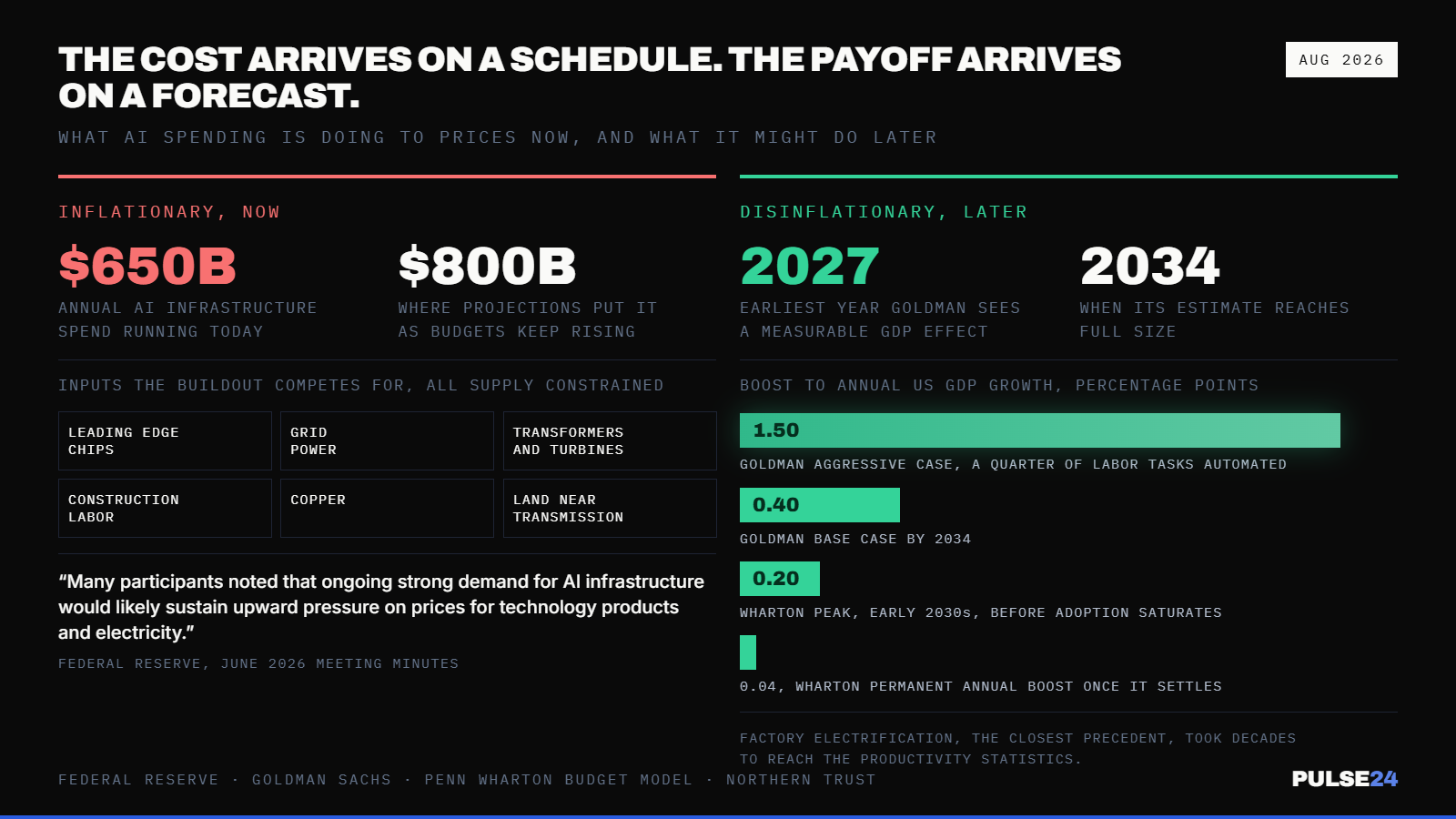
The scale of the buildout is the starting point. Annual AI infrastructure investment is running above $650 billion and has been projected to top $800 billion as hyperscalers keep raising their capital budgets, according to research cited by Northern Trust, a buildout Pulse24 has tracked as markets began pricing what AI infrastructure actually costs. That money is chasing a genuinely constrained set of inputs: leading-edge semiconductors, grid-connected power, transformers, skilled construction labor, copper, and land near existing transmission infrastructure. Texas has already moved to make data centers pay for their own power, a sign of how strained that specific input has become. When demand for a fixed set of inputs rises this fast, prices for those inputs rise too, and that shows up in the broader economy in ways that go beyond the tech sector itself.
Fed officials have said as much in public. Vice Chair Philip Jefferson has noted that "if stronger investment and consumption appear before productivity gains, AI could put upward pressure on inflation," and the Fed's own June 2026 meeting minutes recorded that "many participants noted that ongoing strong demand for AI infrastructure would likely sustain upward pressure on prices for technology products and electricity." Fed Chair Kevin Warsh, who took over the role in May 2026, has been direct about the near-term math: asked whether AI investment would raise measured prices over the following year, he said "I suspect it will." Apple has already raised prices on several products, citing rising memory and storage costs tied to the same memory chip supercycle squeezing every major device maker this earnings season.
Economist Diane Swonk has summarized the sequencing problem well: "The costs and the wealth effects are faster than productivity can be scaled." Companies are spending the money now. Whatever productivity gains that spending eventually produces show up later, if they show up at all.
Why AI could be disinflationary later
The case for AI eventually lowering prices rests on a more basic economic mechanism: productivity growth. If AI genuinely lets companies produce the same output with fewer labor hours or lower marginal costs, that expands the economy's supply capacity, and more supply chasing the same demand tends to push prices down, not up. Warsh has made a version of this argument too, distinguishing between a one-time price adjustment and a persistent inflation problem: "I don't view a one-time change in prices as necessarily being inflationary, because I think there's a supply response."
Northern Trust framed the relationship bluntly: today's "inflationary capital expenditure surge may be tomorrow's disinflationary supply shock," but only after it works through "the inflationary cost of building itself." That ordering matters. The bill for construction comes first. The efficiency gains, if they materialize, come after.
What economists are actually forecasting
The forecasts that exist are more modest than either the boosters or the skeptics in the AI debate tend to suggest, and they disagree with each other on timing more than on direction.
Goldman Sachs economists Joseph Briggs and Devesh Kodnani expect AI's measurable impact on US GDP to start showing up around 2027, building to a 0.4 percentage point boost to annual GDP growth by 2034. Their more aggressive productivity scenario, assuming AI automates roughly a quarter of labor tasks in advanced economies over a decade, puts the potential productivity boost at 1.5 percentage points a year. But they're explicitly cautious about timing, pointing to history: general-purpose technologies like electric motors and personal computers didn't show up in productivity statistics until they'd been adopted by roughly half of businesses, a process that historically took about a decade after the initial breakthrough.
The Penn Wharton Budget Model, using a more conservative adoption curve grounded in current evidence, projects generative AI will lift productivity and GDP levels by about 1.5% by 2035, growing to nearly 3% by 2055. The annual growth-rate effect peaks around 0.2 percentage points in the early 2030s, then fades as adoption saturates, eventually settling at a permanent boost of less than 0.04 percentage points a year. Wharton's own summary calls this "a material but not transformative macroeconomic effect," a notably more measured framing than most AI investment narratives assume.
The gap between Goldman's upper-bound scenario and Wharton's baseline is a useful way to think about the uncertainty here. Both are credible institutions using the same underlying research, and they still land in different places, because so much depends on assumptions about adoption speed that nobody can verify in advance.
The earnings side: how much of corporate growth is really AI
Three companies, Alphabet, Amazon, and Meta, account for roughly 70% of expected S&P 500 earnings growth this year while committing more than $500 billion to AI capex combined. That concentration matters because much of what looks like broad-based corporate strength in the headline numbers is still being driven by a handful of hyperscalers making the same bet, the kind of spending that pushed Meta's free cash flow to $784 million the same night Microsoft's Azure business topped $100 billion in revenue, and that showed up as a stock-price divergence between Apple and Amazon the week both reported earnings.
The timing is also murkier than the growth percentages suggest. Some of the most eye-catching earnings gains have come from unrealized gains on equity stakes in AI startups rather than operating profit, and there's a built-in accounting mismatch: data center spending gets depreciated over years, while the chipmakers and vendors selling into that spending book the revenue immediately. That can make the buildout look more profitable right now than it actually is, simply because the bill hasn't caught up with the profits it's generating for sellers. None of that makes the underlying business fake. It just means today's AI-linked earnings growth is a mix of real revenue, accounting timing, and financial engineering, not a single clean number.
The historical precedent, and why the timeline matters
Economists reaching for a comparison keep landing on the same one: electrification. Economic historian Paul David's research on factory electrification found that businesses spent decades installing electric motors before productivity statistics showed much benefit, because the real gains required redesigning entire factory floors around the new technology rather than just swapping out a power source. The infrastructure came first. The reorganization of work around it, which is where the actual efficiency gains lived, came much later.
If AI follows a similar pattern, and several of the economists cited above are explicitly modeling it that way, then the current phase of heavy capital spending without matching productivity gains isn't a sign that the technology has failed to deliver. It's closer to what the early, unglamorous middle of a general-purpose technology transition is supposed to look like, and whether today's AI capex is a bubble or an investment looks similar either way until the adoption curve plays out.
What to watch
If you're trying to judge which side of this debate is winning, watch four things: Fed communication on core services and technology-product inflation, since officials have flagged that segment as most exposed to AI-driven demand. Electricity and semiconductor price trends, the two inputs most directly tied to the buildout. The gap between capex growth and revenue growth at the companies doing the spending, since a widening gap means the bill is coming due faster than the payoff. And business adoption data outside the AI-native leaders, since every forecast above depends on adoption spreading well past today's front-runners before the productivity case can be tested for real.
The Pulse24 Take
AI isn't inflationary or deflationary in isolation. It's both, just on different timelines. The infrastructure buildout competes for real, physical, currently scarce resources today, and the productivity gains, if and when they materialize widely enough to expand the economy's supply capacity, show up later. The size of that later effect is genuinely uncertain, with credible estimates ranging from a modest 0.04 percentage points of permanent annual growth to a much larger 1.5 percentage points under aggressive adoption assumptions. The honest position, for investors and policymakers alike, is to expect the inflationary phase to show up in the data well before the disinflationary one does, and to treat any forecast claiming certainty about either side of that trade with real skepticism.
How we read the data
Curious how we get from raw data to a take like this? Our Trader's Toolkit walks through the tools we lean on.
Explore the Toolkit