Pulse24 Original
A Memory Chip That Cost $39 a Year Ago Now Costs $145. Microsoft, Meta, Apple and Amazon Report Earnings Into That Number This Week.
July 28, 2026
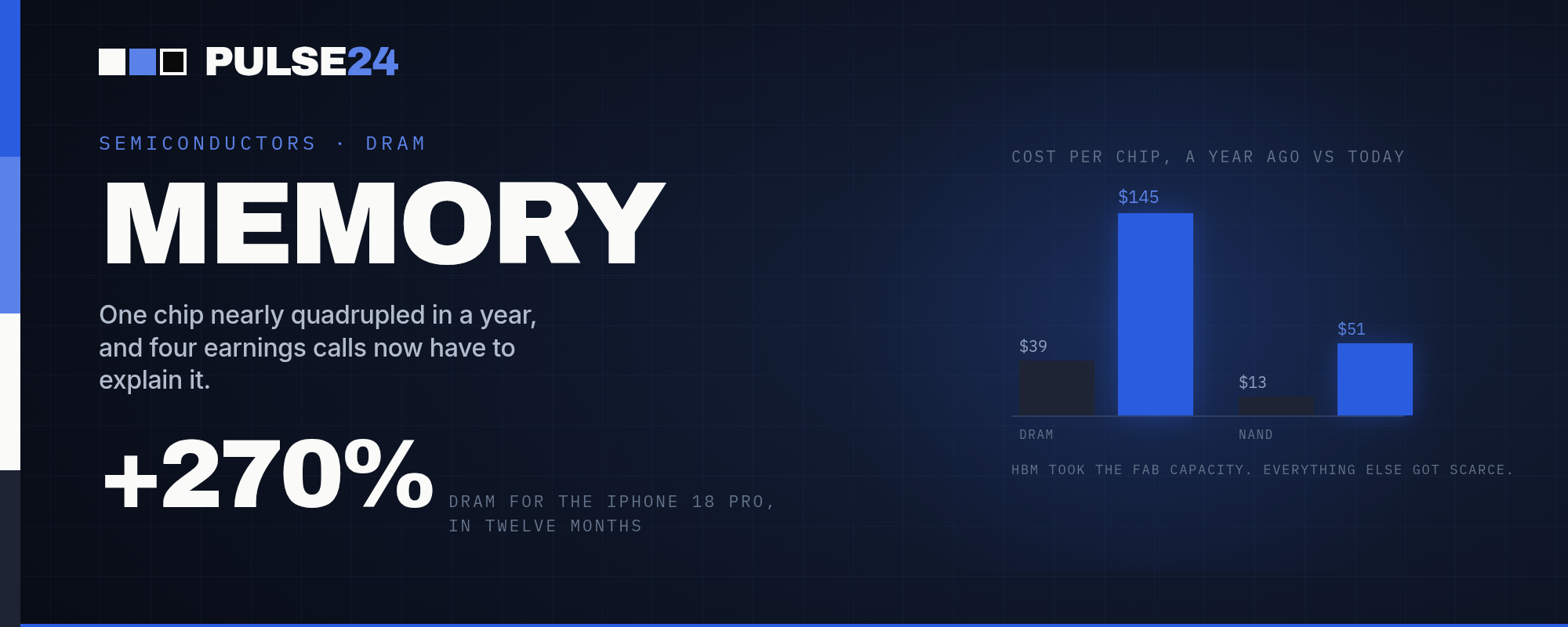
The DRAM chip inside an iPhone 18 Pro has nearly quadrupled in price this year, and Apple already raised Mac and iPad prices by up to $300 to cover it. Microsoft, Meta, Apple and Amazon all report earnings within 48 hours of each other this week, each one now having to explain how a memory shortage that SK Hynix says could last past 2030 is reshaping their AI budgets.
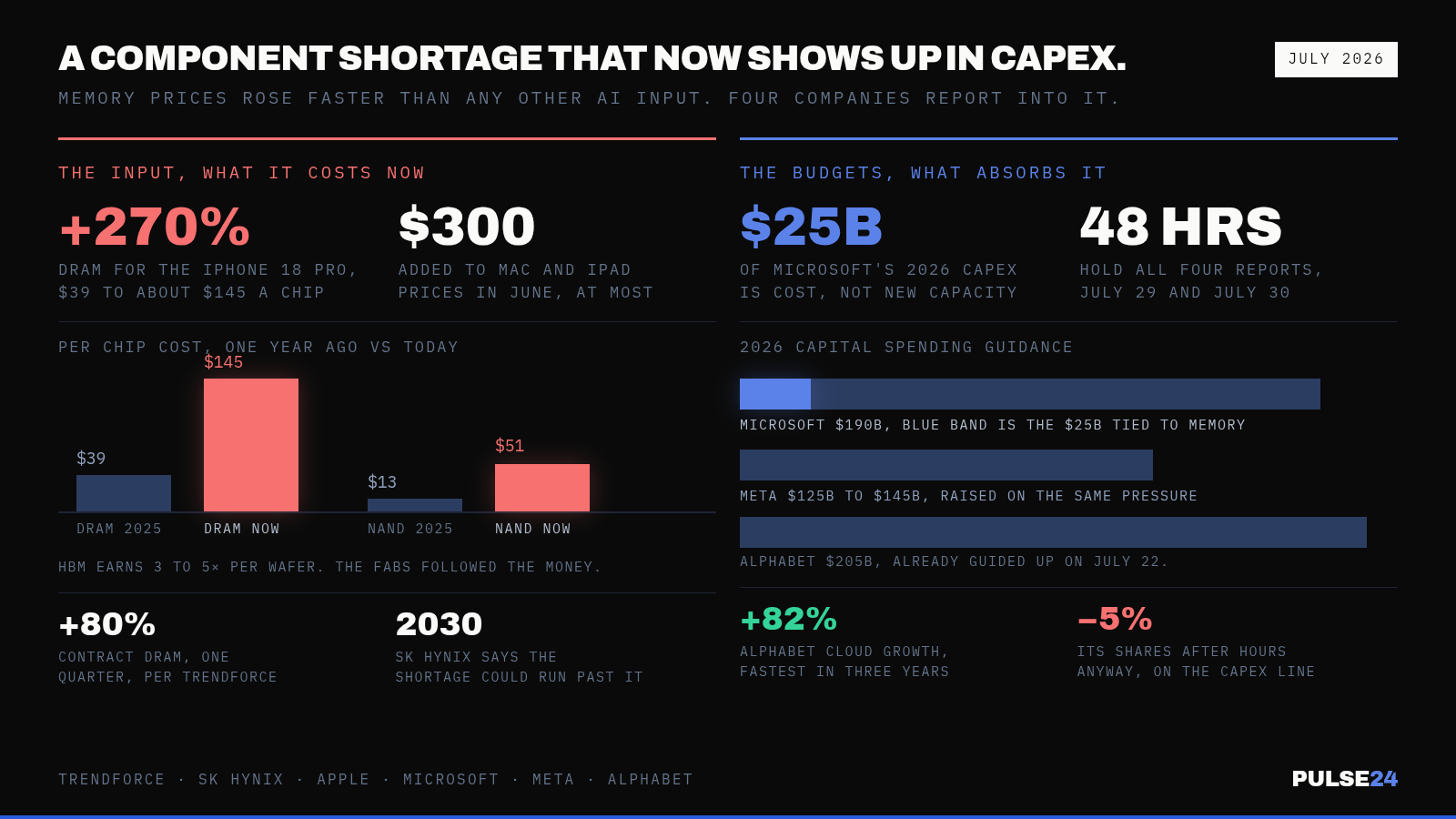
A single DRAM chip built for the iPhone 18 Pro cost Apple about $39 a year ago. Today it costs roughly $145, a jump of more than 270% on one component. Apple already raised Mac and iPad prices by as much as $300 in June because of the same shortage. This week, four of the companies most exposed to that shortage report earnings within 48 hours of each other, and each one has to explain what rising memory costs are doing to the hundreds of billions of dollars they're pouring into AI.
What Changed
Samsung, SK Hynix and Micron make most of the world's memory chips, and this year they've redirected as much fab capacity as they can toward high-bandwidth memory, the specialized chips that feed Nvidia's and AMD's AI accelerators. HBM earns three to five times the revenue per wafer that ordinary DRAM does, so the shift is a straightforward business decision for the chipmakers, the same dynamic that more than quadrupled Micron's revenue even as its stock fell 30% from its peak. The side effect is that the DRAM and NAND flash going into phones, laptops and hard drives are getting scarcer and pricier at the same time. TrendForce has tracked contract DRAM prices rising more than 80% in a single quarter at points this year, with some industry forecasts putting the full 2026 increase near 130%.
Tim Cook called it "a hundred-year flood" in June, telling investors he'd never seen a supply shock move this fast. Apple responded by raising Mac and iPad prices by up to $300 that same month, and multiple supply-chain reports since then suggest the iPhone 18 Pro, expected in September, could carry a price increase of its own once the phone ships.
Why It Matters
This isn't only a consumer-electronics story anymore. It's showing up directly in the capital budgets of the companies building AI infrastructure. Microsoft has said $25 billion of its roughly $190 billion 2026 capex is now tied to higher memory and chip prices rather than new capacity. Meta raised its 2026 spending guidance to a range of $125 billion to $145 billion, pointing to the same cost pressure. Amazon has leaned on its own custom Trainium chips to reduce how exposed it is to merchant memory pricing, an approach that so far has offset only part of the increase.
That backdrop matters this week because Microsoft and Meta report earnings on July 29, with Apple and Amazon following on July 30, all landing within roughly 48 hours of the Fed's rate decision on the same Wednesday. Alphabet already reported on July 22, posting cloud revenue growth of 82%, the fastest pace the division has posted in at least three years, and its shares still fell about 5% after hours once the company raised 2026 capex guidance to $205 billion. Strong growth on its own hasn't been enough this earnings season if the cost side of the AI build-out keeps climbing alongside it.
What to Watch Next
Watch whether Microsoft and Meta describe rising memory costs as temporary or structural on their calls this week. SK Hynix's chief executive said this month that the shortage could persist past 2030, a very different planning horizon than the supply-catches-up-next-year story that circulated earlier in 2026. Guidance on 2027 capex is worth watching too. If more companies start attributing spending increases specifically to component costs rather than added compute capacity, that's a sign the AI build-out is getting more expensive per unit of output, not simply bigger.
On the consumer side, watch whether PC and phone makers beyond Apple pass costs through more visibly heading into the holiday quarter. A shortage concentrated in DRAM and NAND tends to show up in retail prices broadly, not just at the premium end of the market.
The Pulse24 Take
The tension worth sitting with isn't AI spending against memory costs, as if they were two separate forces that happened to collide. The memory shortage is a direct consequence of the AI build-out succeeding. Every wafer Samsung or SK Hynix redirects toward HBM for Nvidia's GPUs is a wafer that isn't making ordinary DRAM, and that trade-off is what's pushing phone and laptop prices higher for everyone else. AI demand strains memory supply, memory prices climb, and the same AI infrastructure spending that created the strain now costs more to build. That's the loop, and it doesn't resolve just because a quarter goes well.
None of this means the AI capex story is broken. Alphabet's cloud business grew 82% last quarter and Microsoft's Azure has kept climbing too, so the demand side still looks real. What it does mean is that this week's earnings calls need to answer a sharper question than how much these companies are spending. They need to answer whether the return on that spending still clears the bar once the input costs are this much higher than they were a year ago, with SK Hynix now saying the shortage could run for another four years or more.
How we read the data
Curious how we get from raw data to a take like this? Our Trader's Toolkit walks through the tools we lean on.
Explore the Toolkit