Pulse24 Original
Micron's Revenue More Than Quadrupled. Its Stock Is Down 30% From Its Peak Anyway.
July 25, 2026
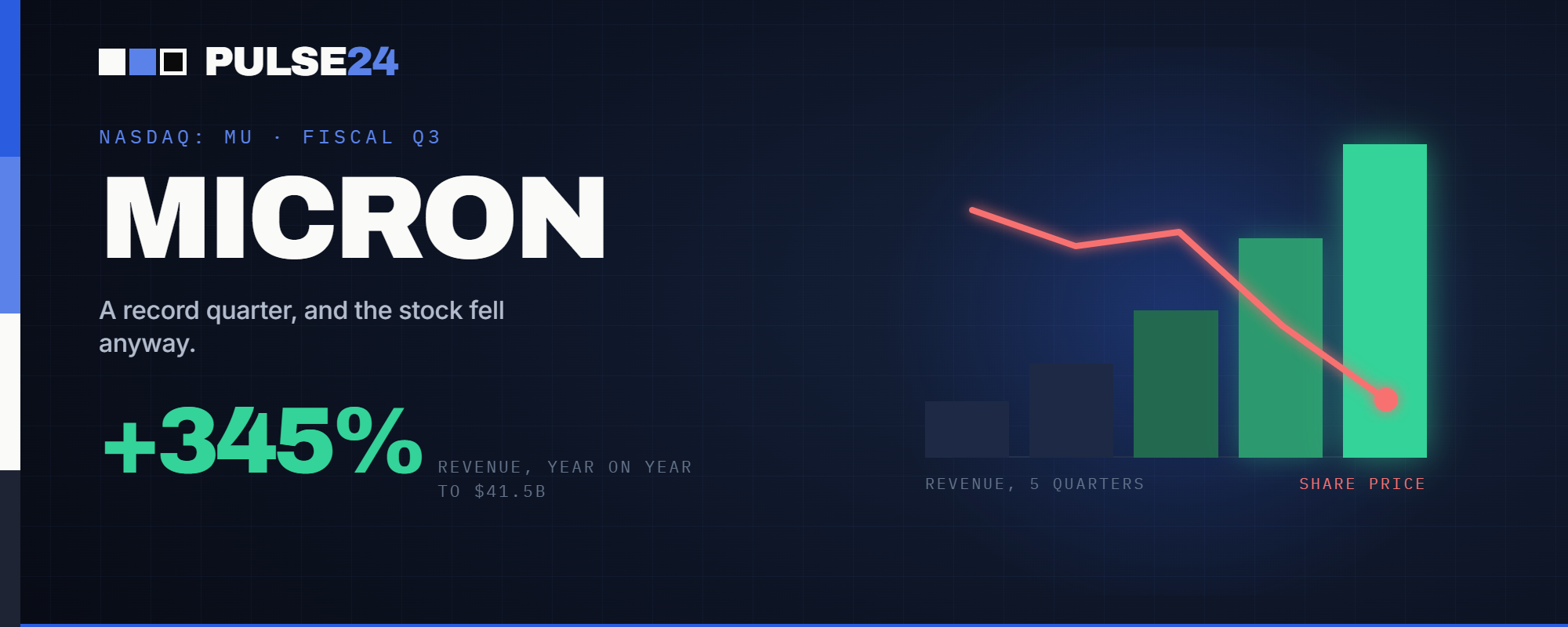
Micron just posted its best quarter in company history: revenue up 345.7% year-over-year, gross margins near 85%, record free cash flow, and its stock is down roughly 30% from its late-June peak anyway. Friday's Korea-led selloff dragged Micron, SanDisk, SK Hynix and Western Digital down together, and the gap between the numbers and the price is the real story.
What Changed
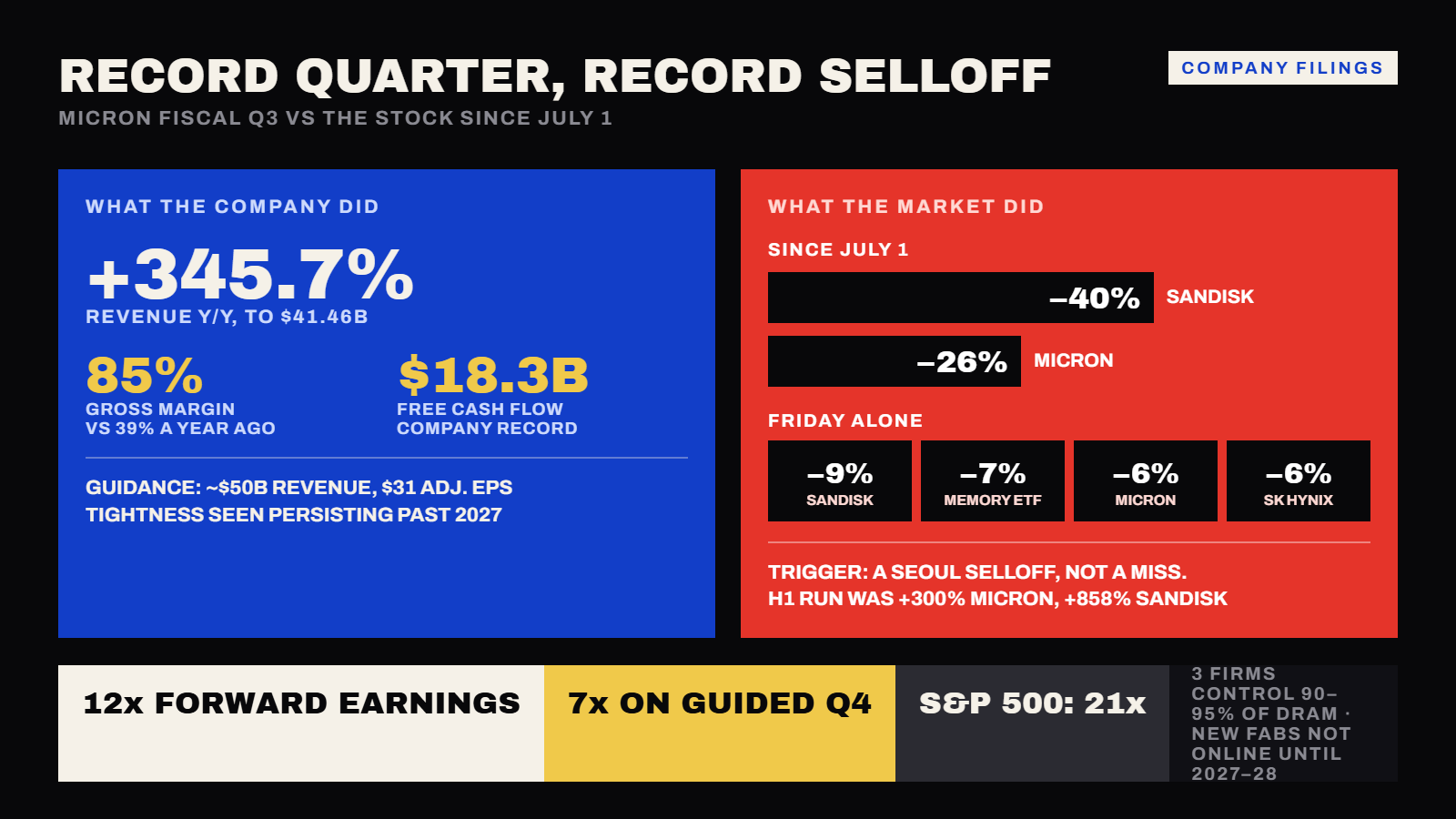
On Friday, memory chip stocks fell together in a way that had nothing to do with any of their own earnings. SK Hynix and Micron each dropped 6%, SanDisk fell 9%, Western Digital slid 6%, and the Roundhill Memory ETF, which tracks the group, lost 7% to close near $54. The trigger wasn't a warning or a miss. It was an overnight selloff in Seoul, where Samsung and SK Hynix led South Korea's KOSPI index lower, and U.S. names followed in sympathy because these stocks now trade as a single, tightly correlated basket.
That single session is really a smaller chapter in a bigger one. From its late-June peak, Micron is down roughly 30%, and SanDisk has fallen by a similar margin, even after both stocks had already delivered some of the best returns in the market this year. Micron's stock climbed more than 300% through the first half of 2026, and SanDisk was up 858% over the same stretch. Neither company did anything to justify giving that much back. Micron's most recent quarter was, by almost every measure, the best in its history.
The memory chip trade has been one of 2026's clearest AI-adjacent stories, the same AI infrastructure buildout we've been tracking as a distinct trade all year. Three companies, Samsung, SK Hynix, and Micron, control roughly 90-95% of global DRAM production, and none of them were prepared for how much memory AI infrastructure would actually consume. A high-end PC carries around 32 gigabytes of DRAM. A smartphone needs 8 to 12. Nvidia's Blackwell architecture integrates up to 192 gigabytes per chip. Multiply that gap by the number of AI accelerators hyperscalers are buying, and you get demand that simply didn't exist in the memory market's planning models three years ago.
High-bandwidth memory, the specialized DRAM that AI chips need, is expected to make up roughly a quarter of total DRAM wafer output this year, growing at close to 70% annually. Every wafer redirected to HBM is a wafer not making conventional memory for PCs and phones, which is part of why DRAM contract prices jumped more than 50% quarter-over-quarter earlier this year, with some product categories rising far more than that. That squeeze is what turned Micron and SanDisk into two of the best-performing large-cap stocks of the first half. Friday's selloff, and the broader slide since July 1, is the market testing whether that story still holds at these prices, not new evidence that it's broken.
Why It Matters
The gap between Micron's numbers and Micron's stock price is the real story here, more than any single day's decline. A company that just grew revenue more than fourfold, more than doubled its gross margin, and generated a record $18.3 billion in free cash flow in a single quarter is not a company in trouble. Management said as much directly, telling investors tightness in the memory market should last beyond 2027, which is a call for continued scarcity, not the early signs of a glut. If that guidance holds, a stock trading at roughly 6 times forward earnings isn't pricing in the numbers the company is actually putting up.
But markets don't just price a quarter, they price a path, and the path for memory has looked euphoric enough to invite exactly this kind of pullback. Stocks that ran 300% to 858% in six months carry embedded assumptions well beyond "the current quarter was good." Historically, memory has been one of the most cyclical corners of semiconductors: shortages draw in enormous capital spending, that spending eventually becomes supply, and supply eventually becomes a price war. New fabs from Samsung, SK Hynix, and Micron aren't expected to reach production until 2027 or 2028, which is exactly why the bulls argue this cycle looks different. It's also exactly the kind of two-year gap that makes a highly levered, highly correlated trade vulnerable to any headline that makes investors nervous about what happens once that capacity finally lands.
What to Watch Next
The clearest read on which side is right will come from Samsung's and SK Hynix's own upcoming results and any commentary on 2027 capacity plans, since a genuine change in the supply outlook would show up there before it shows up in Micron's numbers. Worth tracking alongside that: DRAM and NAND contract pricing trends into the fourth quarter, hyperscaler capital spending commentary as AI infrastructure earnings season continues, and whether the Roundhill Memory ETF stabilizes or keeps sliding, which would say more about how crowded this trade had become than about the chips themselves.
The Pulse24 Take
This reads less like memory chips breaking than like a trade getting tested. The fundamentals genuinely support the bull case right now: real scarcity, an oligopoly supply structure, a company on record saying the shortage extends past 2027, and a valuation that still looks inexpensive relative to the growth on the page. None of that guarantees the stock reaction was wrong, because a 300%-to-858% run in six months prices in a lot of future good news, and Friday's Korea-led selloff is a reminder of how quickly sentiment can reset once a trade gets that crowded.
What we'd watch for is whether the next leg of this trades on actual data, weaker guidance, softer contract pricing, capacity coming online faster than expected, or whether it keeps moving on sympathy and macro noise the way Friday did. Those are two very different stories. One says the AI memory shortage is starting to end. The other says a very good trade just got a very normal gut check after an abnormal run.
How we read the data
Curious how we get from raw data to a take like this? Our Trader's Toolkit walks through the tools we lean on.
Explore the Toolkit