Pulse24 Original
The Week Markets Started Pricing What AI Infrastructure Actually Costs
July 31, 2026
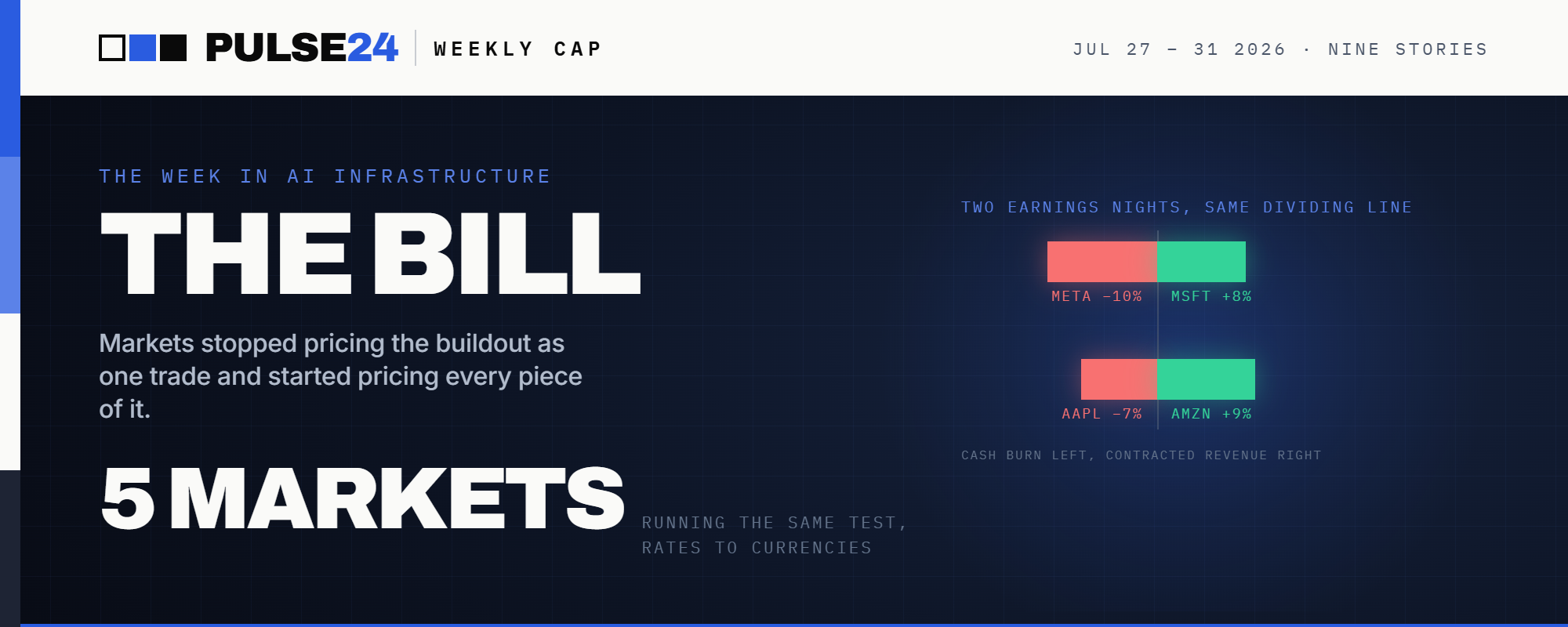
This week wasn't about the Fed, Microsoft, or Japan in isolation. It was about markets beginning to ask whether AI infrastructure is finally being judged on its returns rather than its ambition.
This week wasn't about the Fed, Microsoft, or Japan in isolation. It was about markets beginning to ask whether AI infrastructure is finally being judged on its returns rather than its ambition.
If you'd watched only Microsoft this week, you would have come away thinking the AI trade was alive and well. If you'd watched only Meta, reporting ninety minutes later on the same night, you'd probably have reached the opposite conclusion. Neither conclusion would have been quite right, and the same split showed up again the next night with Apple and Amazon.
Nine stories crossed our desk this week: a Fed vote, two earnings nights, a memory chip shortage, a fight over electric bills in Texas, a currency intervention in Tokyo. Read individually, they look like unrelated tickers. Read together, they're the same question asked five different ways. The AI infrastructure buildout has been running for two years on the assumption that spending now buys revenue later. This week, rates, equities, chips, utilities, and currencies all started pricing what happens if that assumption gets tested before the revenue shows up.
A Fed That Can't Agree With Itself
Start with the rate decision, because everything else this week reacted to it or ran alongside it. Going into Wednesday, a fifth straight hold looked close to automatic. Then hike odds tripled in two weeks, spiking to 38% on July 24 from just 10.7% on July 15, one of the fastest repricings of a single Fed meeting in recent memory, as S&P 500 volatility climbed to 10.2% against a historical norm closer to 7% or 8%. WTI crude near $82 a barrel, up 18% over the month, and jobless claims at their lowest level since 1969 gave inflation hawks and labor-market doves both something to point to.
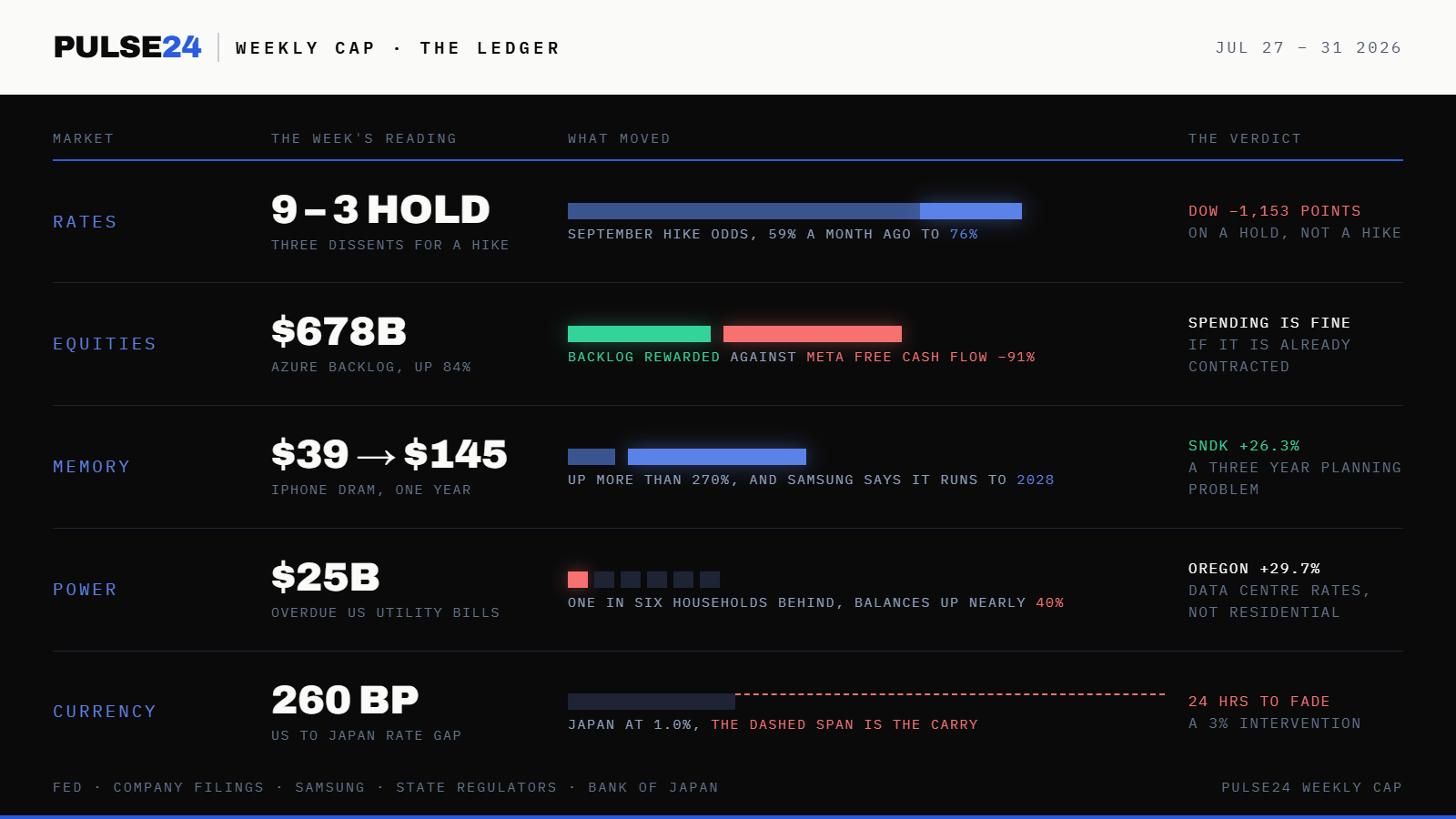
The committee ultimately held, 9 to 3, with Cleveland's Beth Hammack, Minneapolis's Neel Kashkari, and Dallas's Lorie Logan all voting for a hike instead. The Dow fell 1,153 points anyway, a 2.19% drop, because three dissents out of twelve is a wide margin for a Fed that has preferred near-unanimous decisions for most of the past two years. Chair Kevin Warsh has also stripped out the forward guidance and dot-plot commentary investors leaned on for a decade, so the market was left parsing a genuinely split committee with fewer of the usual signposts. September hike odds jumped to roughly 76% by Wednesday night, up from 59% a month earlier. That's the backdrop every other story this week landed against: a Fed that's more divided than it's been in years, at the exact moment the companies spending the most on AI infrastructure were about to report.
Same AI Spending, Opposite Stock Reactions, Twice in a Row
Microsoft and Meta reported within about ninety minutes of each other on Wednesday night. Azure crossed $100 billion in annual revenue for the first time, growing 43% in the quarter, ahead of the 40% analysts expected, and Microsoft's stock rose as much as 8% after hours. Its cloud backlog, the commercial remaining performance obligation, surged 84% to $678 billion, giving investors a number they could point to as demand converting into contracted future revenue.
Meta beat on revenue too, up 28% to $60.8 billion. But free cash flow collapsed to $784 million, down 91% from $8.55 billion a year earlier, after total costs jumped 55% to $42 billion including legal charges and severance layered on top of AI infrastructure spending. The stock fell as much as 10%. Meta also narrowed its 2026 capex guidance to $130 billion to $145 billion, on top of $50.9 billion already spent in the first half of the year.
Notice what the market actually rewarded here. It wasn't lower spending. It was visible evidence that spending was already turning into revenue, not just a promise that it eventually would.
The following night, the same split showed up again with different names attached. Apple's revenue rose 16% and EPS climbed 29%, and the stock still fell, because roughly $0.11 of that EPS growth came from a one-time tariff refund, Greater China revenue missed estimates, and the September-quarter guide came in soft. Amazon reported negative trailing-twelve-month free cash flow for the first time since 2023, at negative $7.6 billion, and raised its 2026 capex plan to roughly $220 billion from an earlier $200 billion. The stock jumped as much as 9% anyway, because AWS grew 37%, its fastest pace in 18 quarters, and management argued the company still won't have enough capacity to meet 2026 demand even after the bigger spending number.
Two nights, four companies, and the same dividing line each time: when AI spending shows up as backlog or contracted revenue, the market calls it investment. When it shows up mostly as cost and shrinking cash flow, the market calls it risk, no matter how strong the headline growth number looks next to it.
The Chips Behind the Spending Got a Lot More Expensive
Part of what's driving that cost side is a component most consumers never think about. DRAM built for the iPhone 18 Pro cost Apple about $39 a year ago and costs roughly $145 today, a jump of more than 270%, because Samsung, SK Hynix, and Micron have redirected fab capacity toward the high-bandwidth memory that feeds Nvidia and AMD's AI accelerators, which earns three to five times the revenue per wafer that ordinary DRAM does. Apple already raised Mac and iPad prices by as much as $300 in June. Tim Cook called it a hundred-year flood. Microsoft has tied $25 billion of its roughly $190 billion 2026 capex directly to higher memory costs rather than added capacity, and Meta pointed to the same pressure in its own guidance.
Then Thursday, memory and storage stocks surged together, with SanDisk closing up 26.29%, after Samsung reported a 1,810% jump in chip-division operating profit and said the shortage behind it would run through 2028, not ease next year as some had hoped. Micron clawed back nearly all of a four-session, almost 20% slide in a single morning. A shortage that stretches three more years is a different planning problem than one expected to resolve by next quarter, and Wall Street repriced accordingly: Melius Research took its Micron target from $1,100 to $2,200.
Someone Has to Pay for the Power, Too
The infrastructure itself needs electricity, and this week that stopped being an abstract line item too. Texas Governor Greg Abbott directed regulators in June to make data centers pay for their own grid infrastructure instead of spreading the cost across every ratepayer, and the state's utility commission responded this week with legislative proposals to that effect. Oregon had already approved a 29.7% rate increase for data center customers on July 7, while cutting residential rates 1.3% under the same decision.
The strain behind those moves is national. One in six US households is now behind on utility bills, owing a combined $25 billion, with overdue balances up nearly 40% over four years. Consumer electricity costs have climbed hardest exactly where data center buildouts are heaviest: up 94% in Washington, D.C. and 74% in Maryland since 2021. Utilities plan to spend roughly $240 billion in 2026 chasing AI-driven demand, and stocks tied to that demand have rallied hard on the assumption the buildout scales cheaply. Texas, Oregon, and now California's regulator testing the same question this month is the first sign that assumption is getting contested in public.
And Overseas, the Currency Plumbing Is Groaning
The clearest sign the AI buildout is now a global liquidity story, not just a US earnings story, showed up in the yen. USD/JPY has spent the better part of a year testing levels last seen in the mid-1980s, and Japan has now intervened at least three times in 2026 trying to defend it, spending a record $73.6 billion this spring including a single-day $40.8 billion intervention on April 29, then another $20.7 billion on July 11. None of it held for long; by late July the pair had slid back past 163.
Thursday brought a fourth attempt, and for a few hours it looked different. USD/JPY fell roughly 3% intraday, from above 163 to a low near 157.80, the sharpest one-day move since late 2022, as the Dollar Index slid to its weakest level since June 17 alongside a soft US GDP print (1.5% annualized versus 2.1% expected). The next morning, the Bank of Japan held its policy rate at 1.0% on an 8-1 vote but delivered its most hawkish inflation language yet, warning for the first time that underlying inflation could rise above its 2% target. By Friday, USD/JPY had climbed back above 160. Most of Thursday's move was gone within about 24 hours.
The reason intervention keeps fading the same way is arithmetic, not resolve. The US-Japan policy rate gap sits near 260 basis points even after four BOJ hikes since Japan exited negative rates in March 2024. That gap is what makes borrowing yen and holding dollar assets one of the more reliably profitable trades in global markets, and it's also part of what's funding leveraged positions in the same US technology and AI names driving everything else in this letter. When the yen snaps sharply, some of that funding comes under pressure. When it fades back just as fast, the pressure eases just as fast. Markets got a preview this week of what a sharper, more durable yen move could do to that funding chain, without the full consequences actually landing.
The Pulse24 Take
None of these nine stories is really about the ticker in its headline. They're about the same test being run in five markets at once: does AI infrastructure spending pay for itself fast enough to justify what it costs everyone connected to it, the companies funding it, the chip buyers competing for scarce supply, the households sharing a power grid with a new data center, and the currency markets financing the leverage underneath it. Microsoft answered that test one way this week. Meta answered it the other way, on the same night. Samsung's 2028 shortage guidance says the chip side won't resolve on any near-term timeline, Texas and Oregon are the first regulators to say the power side shouldn't default to whoever lives near a data center, and the yen is a reminder that a 260 basis point rate gap doesn't close just because Tokyo spends another few billion trying to make it look like it has.
None of this means the buildout is broken. Azure's backlog and AWS's growth are real demand signals, not just spending. It means the market stopped treating AI capital spending as one undifferentiated story sometime in the past ten days, and started pricing each piece of it, backlog against expense, contracted revenue against cash burn, on its own terms. That's a more demanding standard than this trade has operated under for most of the past two years.
The Question We're Watching
If Microsoft keeps proving AI spending converts into backlog while Meta keeps showing shrinking cash flow, investors may stop treating AI infrastructure as one trade and start pricing every company in it separately, on its own merits. That's what this newsletter will be tracking most closely, through Apple's next print in late October, Micron's September report on whether Samsung's 2028 call holds up, and whatever the BOJ and the Fed do next with the rate gap sitting underneath all of it.
How we read the data
Curious how we get from raw data to a take like this? Our Trader's Toolkit walks through the tools we lean on.
Explore the Toolkit