Pulse24 Original
Texas Moves to Make Data Centers Pay for Their Own Power. The Industry Already Owes $25 Billion in Unpaid Bills.
July 30, 2026
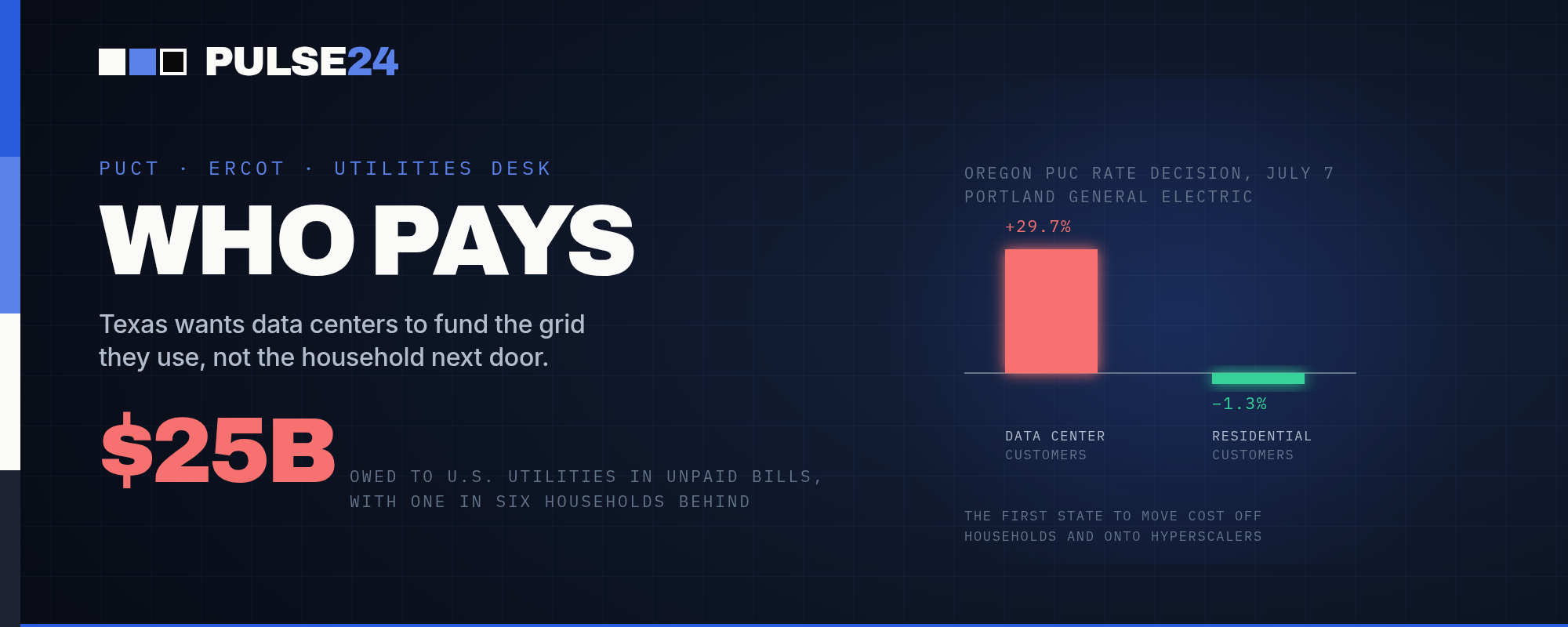
Texas regulators want AI data centers to cover the cost of the power infrastructure they use instead of spreading it across every ratepayer's bill, following Oregon's lead in approving a nearly 30% rate increase for data center customers while cutting residential rates. The move lands as the U.S. utility industry chases roughly $25 billion in unpaid bills and utility stocks tied to AI power demand keep rallying.
Texas utility regulators used this week to lay out a plan that's been building since June: making AI data centers pay for the power infrastructure they use, instead of folding that cost into every other ratepayer's electric bill. Public Utility Commission of Texas chairman Thomas Gleeson put it plainly in a letter responding to Governor Greg Abbott. "Texas should welcome responsible economic development," he wrote, "but it must do so in a manner that prioritizes affordability, reliability, and the interests of the residents who depend on the grid."
The letter answers a directive Abbott issued in June, ordering the PUCT and ERCOT to make sure new data centers lower, not raise, the bills of Texans connecting to the same grid, and to identify what authority the state already has to protect residents and their resources. Gleeson's response asks state lawmakers for three additional powers: letting regulators communicate directly with data center operators during grid emergencies instead of routing everything through utility companies, requiring data centers to register with the state, and extending the Lone Star Infrastructure Protection Act, a law that currently covers only power plants and transmission companies, to cover data centers as well.
What Changed
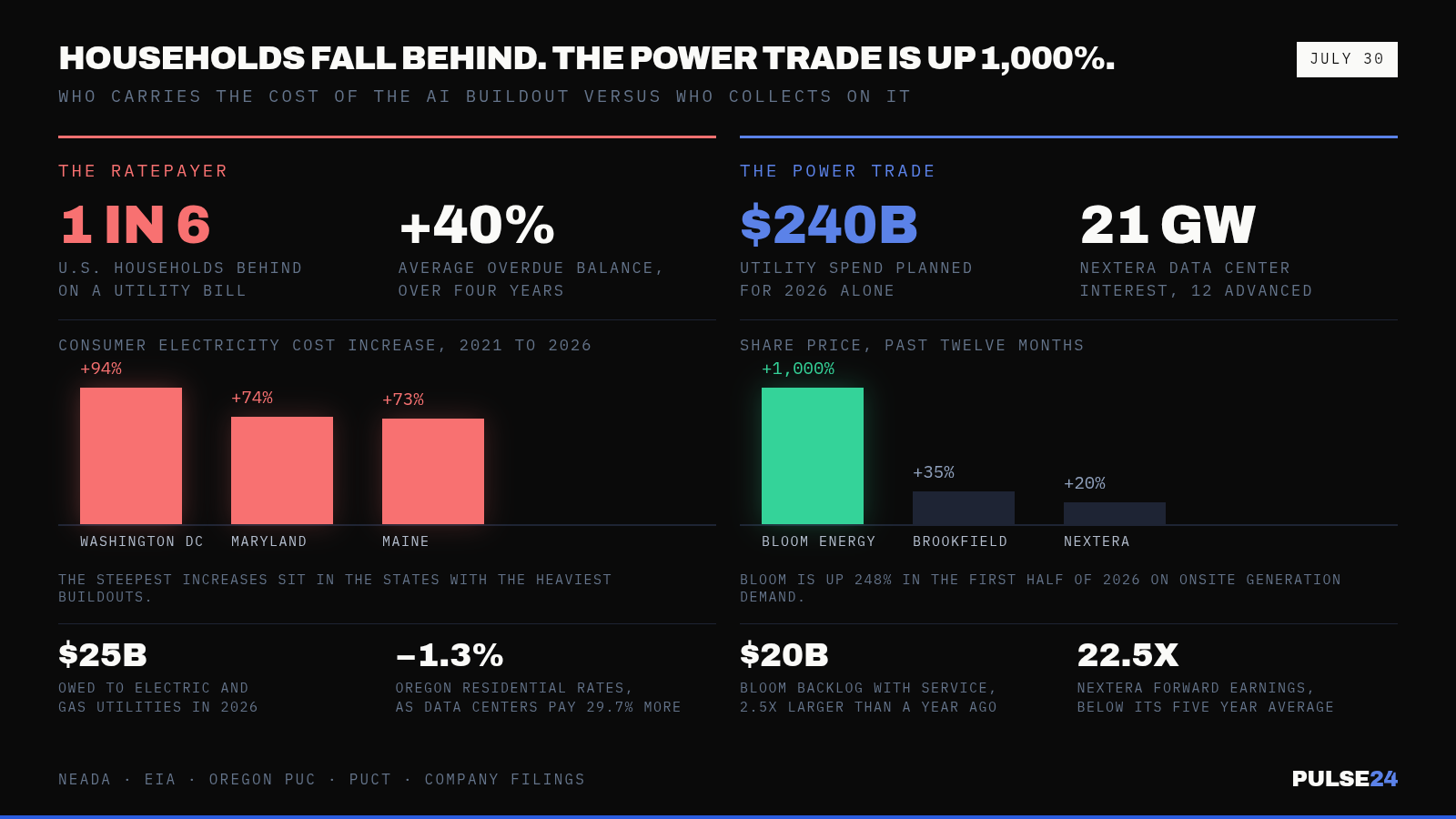
Texas isn't the first mover here, and it may not even be the most aggressive one. Oregon's Public Utility Commission unanimously approved a 29.7% rate increase for Portland General Electric's large data center customers on July 7, and under that same decision, residential rates are set to fall 1.3%, a direct transfer of cost from households to hyperscalers under the state's newer data center rate class. The strain shows up nationally too. One in six U.S. households is now behind on utility bills, owing a combined $25 billion to electric and gas utilities, with average overdue balances up nearly 40% over the past four years, according to National Energy Assistance Directors Association data. Consumer electricity costs have climbed hardest in the states with the heaviest data center buildouts: up 94% in Washington, D.C., 74% in Maryland, and 73% in Maine between 2021 and 2026, per a recent PolitiFact review of the underlying data.
None of this is happening because utilities suddenly mismanaged the grid. AI data center demand for electricity is simply growing faster than the grid was built to absorb. U.S. electricity consumption was essentially flat for nearly two decades before 2020, as population and economic growth were offset by efficiency gains, according to the U.S. Energy Information Administration. The EIA now projects consumption growing at an average of 1.7% a year from 2020 through 2026, well above that earlier flat trend, with commercial and industrial demand, the categories that include data centers, expanding fastest. Utilities are responding by planning to spend roughly $240 billion in 2026 alone on new generation and transmission. NextEra Energy, already the world's most valuable utility by market capitalization, said on its latest earnings call that it's fielding 21 gigawatts of large-load interest from data center developers in Florida, with 12 gigawatts of that already in advanced discussions and potential delivery starting in 2028.
Why It Matters
This is where AI capital spending stops being an abstract line in a capex table and starts showing up on a monthly bill. Every dollar a utility spends building transmission or generation to serve a data center eventually lands in a rate base, and regulators decide who shares that rate base. When households end up subsidizing infrastructure built mainly for a hyperscaler's server farm, the backlash is exactly what Texas and Oregon are now responding to. University of Texas energy researcher Joshua Rhodes framed the unresolved question regulators are working through: figuring out how large consumers of electricity end up paying for the infrastructure they need, "such that it doesn't fall on other folks."
It also matters for how markets price power stocks. Bloom Energy shares are up more than 1,000% over the past year, and roughly 248% in the first half of 2026 alone, on demand for the fuel cells data centers use to generate power onsite rather than wait years for a grid connection. Its backlog has grown to $6 billion in products and $20 billion including service contracts, 2.5 times larger than a year earlier. NextEra is up more than 20% over the past year and trades around 22.5 times forward earnings, below its own five-year average multiple, while Brookfield Renewable Partners has gained roughly 35%. Investors have rewarded almost anything that can plausibly supply power to AI infrastructure. Regulatory pushback that slows how fast data centers connect, or shifts more of the buildout cost onto the companies themselves, changes the assumptions sitting under those valuations.
What to Watch Next
Texas lawmakers haven't voted on Gleeson's proposals yet, and this fight is playing out state by state rather than through any single federal rule. California's utility regulator is running its own review of rate impacts from data centers and other large energy users, and more legislatures are expected to take up data center-specific rules when they next convene. Whichever states settle on a workable cost-allocation model first will likely become the template others borrow from, the way Oregon's rate decision is already being cited elsewhere.
The bigger swing factor is whether rising power costs start reading as a genuine inflation input rather than a regional nuisance. Electricity is a small slice of the CPI basket, but a multi-year increase concentrated in enough states adds up, especially with the Fed already fighting inflation that has stayed above its 2% target. If utility earnings keep beating estimates on data center demand while consumer electricity bills keep climbing in the same states, expect the political pressure on regulators, state and eventually federal, to keep building rather than fade.
The Pulse24 Take
The AI infrastructure buildout has mostly been framed as a story about chips, capex guidance, and cloud backlogs. Texas just added a more grounded chapter: someone has to pay for the power, and regulators are starting to decide it shouldn't default to the household next door to a new data center. That's a real constraint on how fast this buildout can scale, separate from GPU supply or capital availability.
For markets, the read-through isn't that AI power demand is going away. It's that the cost of serving it is becoming visible and contested in a way it wasn't twelve months ago. Utility and power stocks tied to data center demand have rallied hard on the assumption that this growth arrives cheaply and without friction. Texas, Oregon, and California are each testing that assumption in their own way, and the answer will show up first in state regulatory filings, well before it shows up in a quarterly earnings call.
How we read the data
Curious how we get from raw data to a take like this? Our Trader's Toolkit walks through the tools we lean on.
Explore the Toolkit