Pulse24 Original
SanDisk Soared 26% in a Single Session. Samsung's Warning About a Chip Shortage Through 2028 Is Why.
July 30, 2026
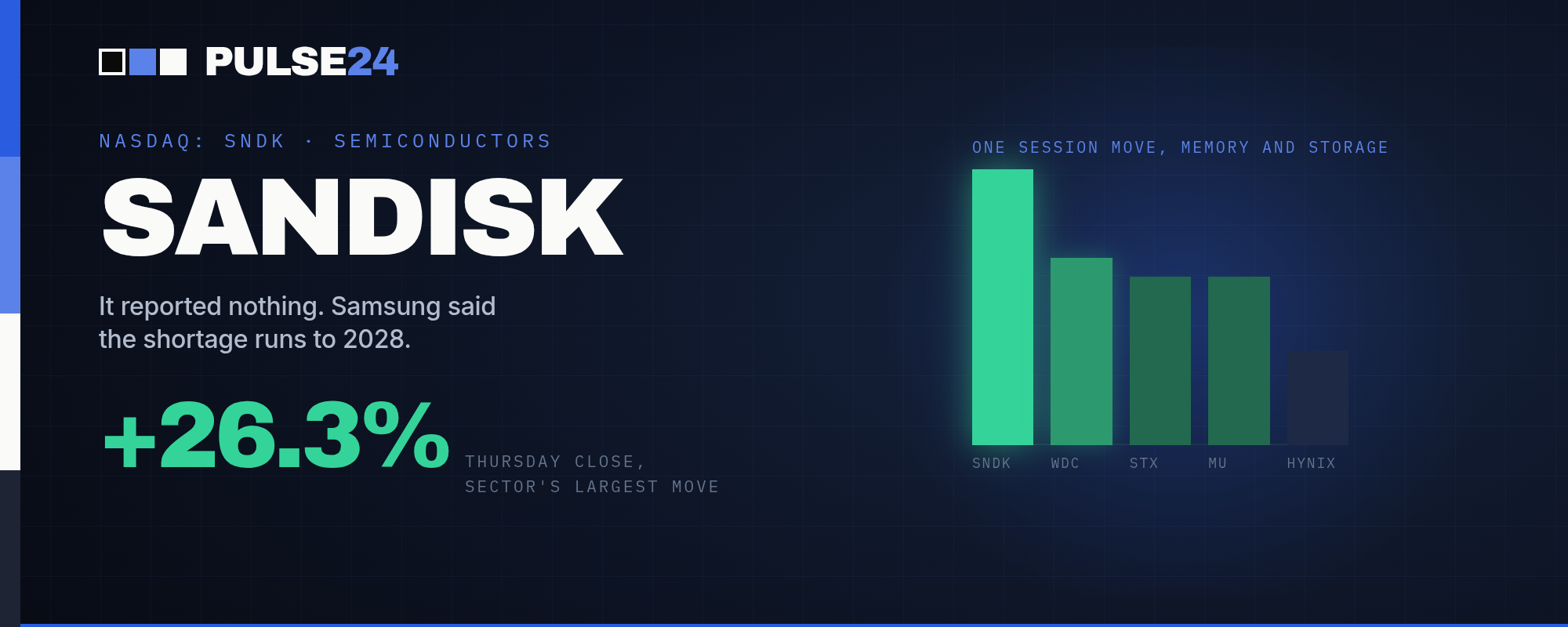
SanDisk led a memory chip rally Thursday, closing up 26.29% as Micron, SK Hynix and Western Digital surged alongside it, after Samsung said the shortage powering its record profit would run through 2028 and Microsoft's earnings eased fears that AI spending was outrunning cash flow.
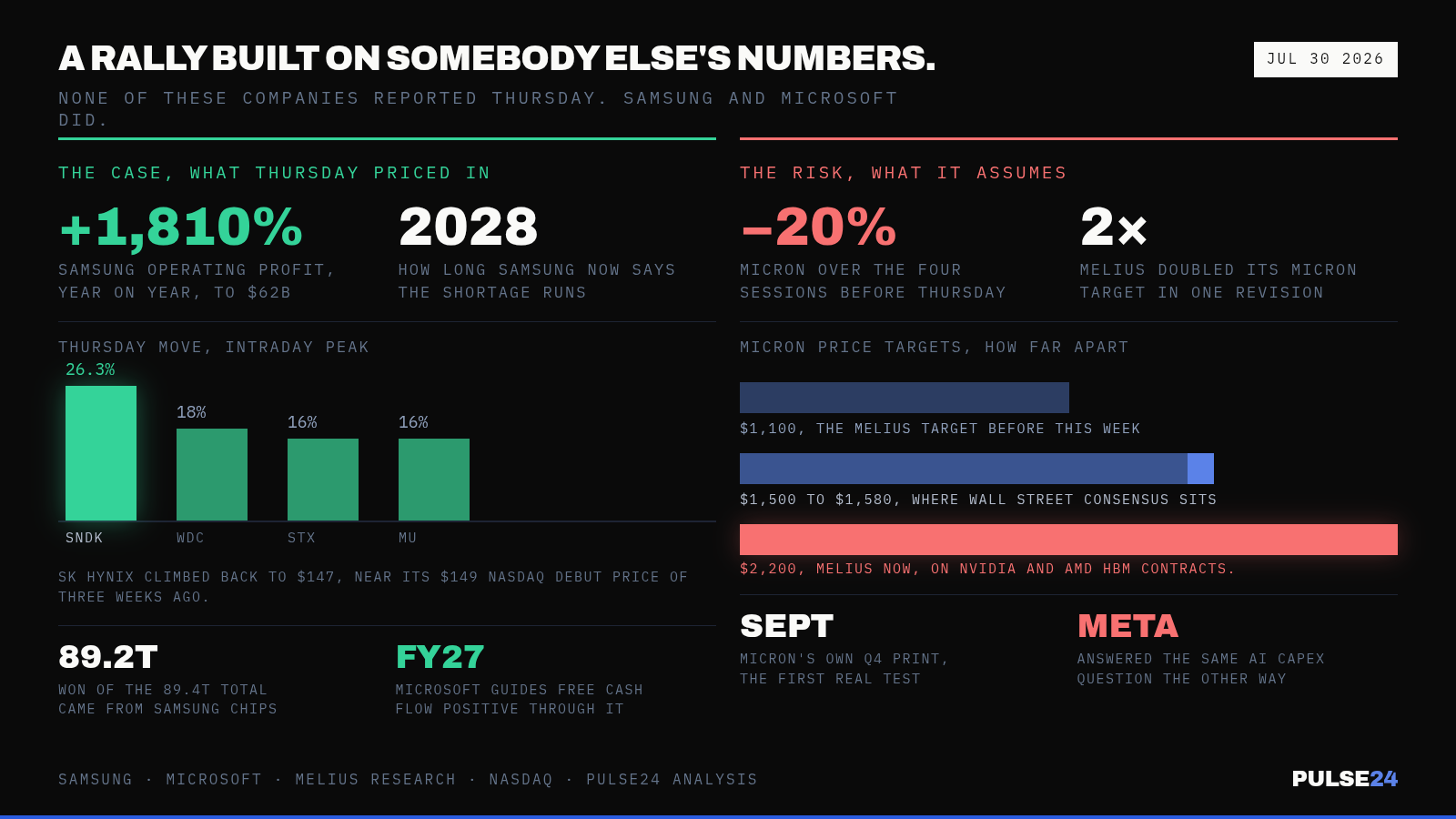
SanDisk closed Thursday up 26.29%, the single biggest move in a rally that swept across the memory chip sector. Western Digital gained as much as 18%. Seagate rose as much as 16%. SK Hynix, which only began trading its shares on the Nasdaq three weeks ago, climbed back to roughly $147, within a few dollars of the $149 price it set on its debut.
Micron, which had lost nearly 20% of its value over the prior four trading sessions, took almost all of that back in a single morning, spiking as much as 16%. None of these companies reported new earnings of their own Thursday. What moved them was someone else's math.
What Changed
That someone else was Samsung. The company's semiconductor division alone produced an operating profit of 89.2 trillion won, or roughly $62 billion, for the quarter, a figure that works out to a 1,810% jump from the same period last year. Samsung didn't stop at the number. The company told investors the shortage of memory chips behind that profit would persist through 2028, longer than it had previously signaled, because new production capacity coming online can't keep pace with demand from AI data centers.
Microsoft added the second piece. Its fiscal fourth quarter results, released Wednesday evening, showed capital expenditures coming in below what analysts had modeled, alongside guidance for free cash flow to stay positive through fiscal 2027. That mattered beyond Microsoft's own stock. Investors have spent this earnings season trying to work out whether AI infrastructure spending shows up as backlog and revenue, the way it did for Microsoft, or as a drag on cash flow, the way it did the same night for Meta. Microsoft's numbers argued for the first case, and memory makers, which sell the chips that fill those data centers, picked up the read-through.
Why It Matters
A shortage that stretches to 2028 is a different animal than one investors expected to ease by next year. Memory chips, especially the high-bandwidth memory used to feed AI accelerators, take years to plan and build new capacity for. Samsung, SK Hynix and Micron control most of that supply between them, and when the largest of the three says the crunch has years left to run, it changes how buyers, from cloud providers to smartphone makers, think about locking in supply now rather than waiting for prices to come down.
It also explains why price targets moved as fast as they did. Melius Research's Ben Reitzes raised his target on Micron to $2,200 from $1,100, pointing to multi-year, non-cancellable supply agreements the company has signed with Nvidia and AMD for high-bandwidth memory. Even the more conservative consensus, clustered closer to $1,500 to $1,580, implies significant upside from where the stock traded before Thursday's jump. Wall Street isn't only reacting to one good quarter. It's repricing how long this cycle runs.
What to Watch Next
Contract pricing talks for the next quarter of DRAM and NAND supply will be the next real signal. If buyers accept another round of price increases without much pushback, that confirms sellers still hold the leverage Samsung's guidance implies. If those negotiations turn contentious, it suggests some of Thursday's optimism got ahead of itself.
Micron reports its own fiscal fourth quarter results in September, and that print will show whether the company's actual numbers back up what Thursday's rally is pricing in. Between now and then, watch for other AI infrastructure names reporting earnings this quarter. Each one adds another data point to the same question Microsoft and Meta answered in opposite directions this week: is AI spending converting into demand analysts can measure, or just into cost?
The Pulse24 Take
Thursday's move is easy to read as pure enthusiasm, but the underlying logic is fairly simple. Supply is constrained, demand from AI infrastructure keeps climbing, and the company with the clearest view of both just said the imbalance runs another two years longer than expected. Markets tend to reprice quickly when a shortage timeline gets pushed out, and that's largely what happened here.
The risk sits in how much of the good news is already in the price. Micron's new targets assume the shortage holds, contract prices keep climbing, and none of the AI capital spending currently propping up demand for memory gets pulled back. Those are reasonable bets given what Samsung and Microsoft just said. They're still bets, and the four-session slide Micron shook off this week is a reminder that sentiment in this sector can turn as fast in the other direction.
How we read the data
Curious how we get from raw data to a take like this? Our Trader's Toolkit walks through the tools we lean on.
Explore the Toolkit