Pulse24 Original
The Yen Slid Past 163 Again. Japan's Record $73.6 Billion Defense Already Wore Off.
July 27, 2026
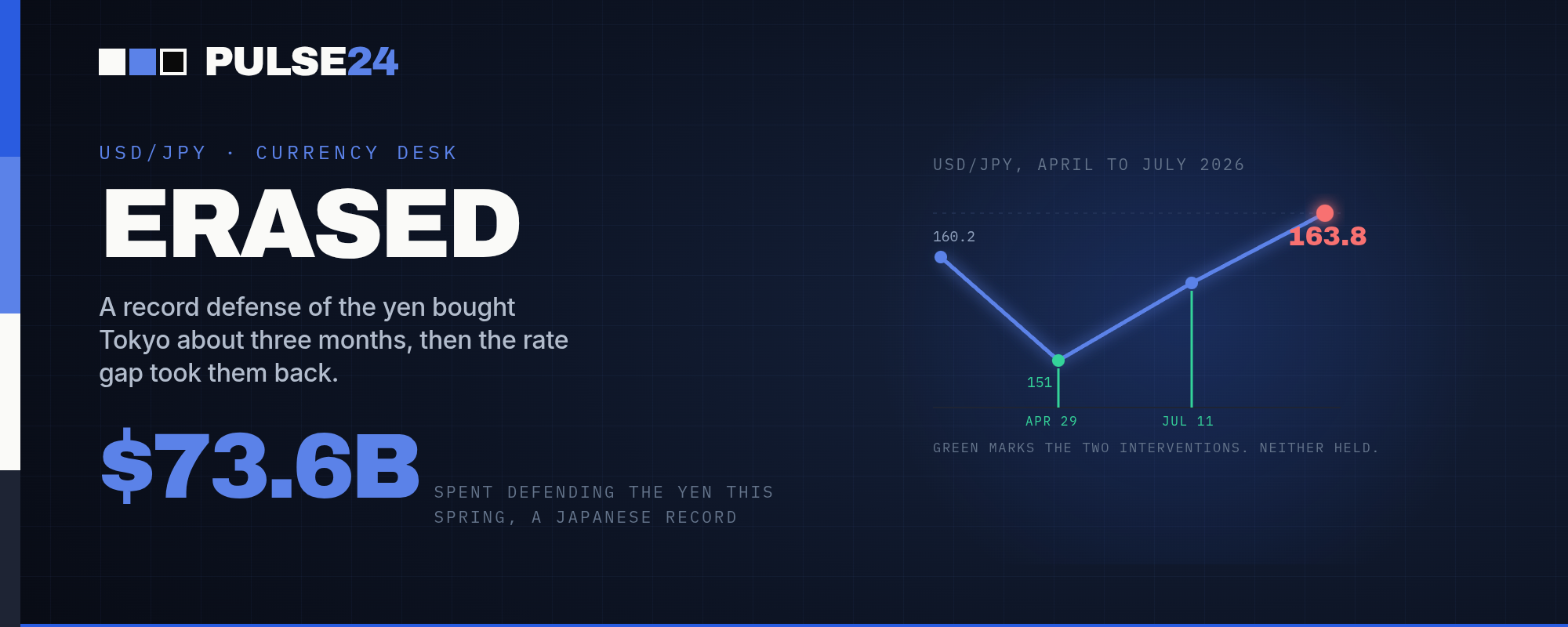
USD/JPY is back above 163, erasing months of Japan's record-breaking currency intervention. The real story is a Fed-BOJ rate gap that no amount of dollar selling has managed to close.
USD/JPY traded at 163.79 last Thursday, up another 0.43% on the day and deeper into territory the pair hasn't visited since the mid-1980s. Four decades of currency history, unwound in about eighteen months of policy divergence between Washington and Tokyo.
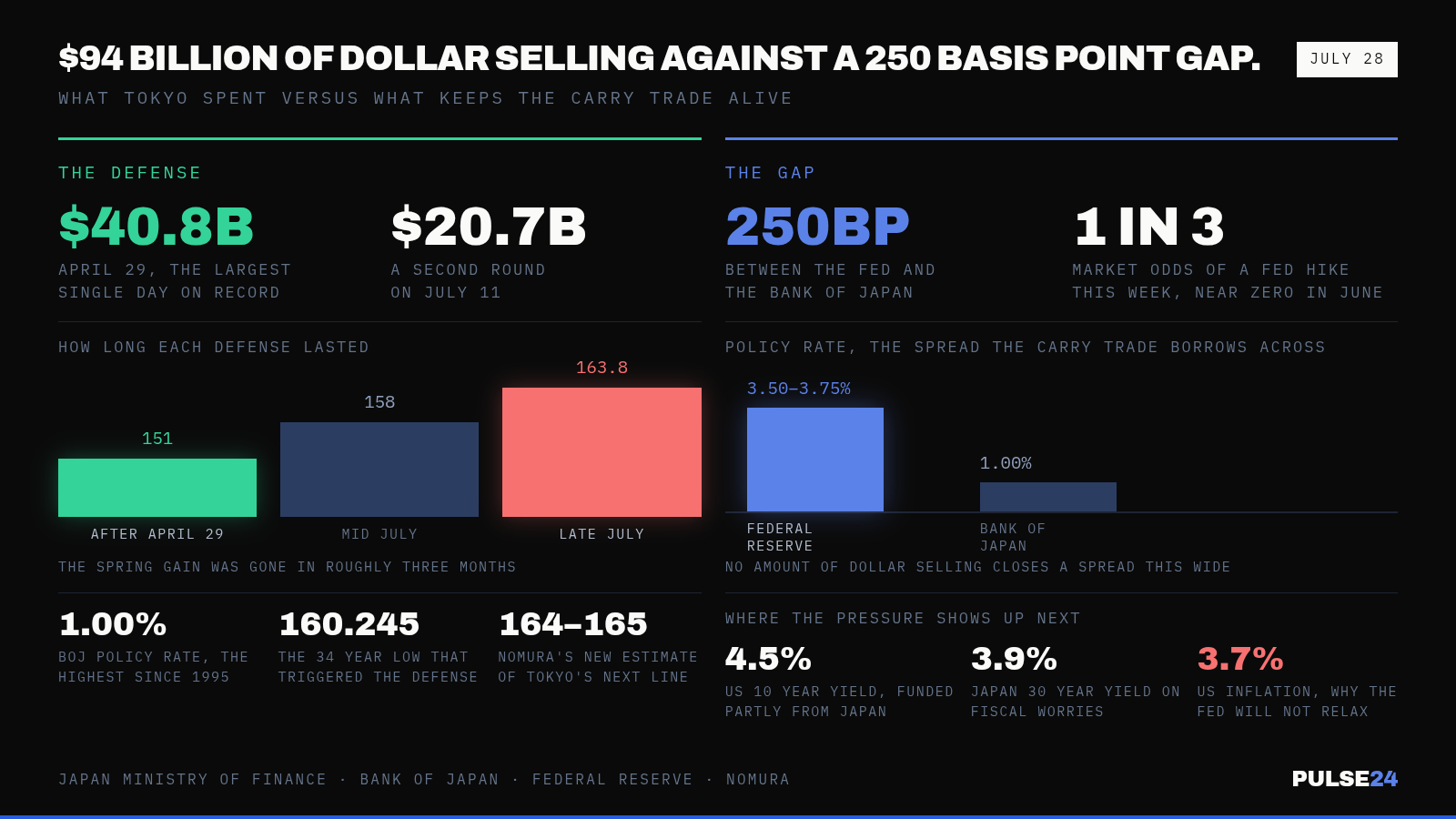
Tokyo has not been sitting still. This spring, Japan's Ministry of Finance spent a record $73.6 billion defending the currency, including a single-day intervention of roughly $40.8 billion on April 29, the largest one-day amount on record, after the yen sank to a 34-year low of 160.245 per dollar. The campaign briefly pushed the pair back into the low 150s. A second intervention worth $20.7 billion followed on July 11. None of it held. By late July, USD/JPY had slid past 163 again.
What Changed
The Bank of Japan did eventually act on rates, not just in the spot market. In June, after the yen's slide to a 40-year low forced its hand, it raised its policy rate to 1%, the highest level since 1995 and the clearest signal yet that the era of near zero borrowing costs in Japan is ending. On paper, that should have helped. In practice, a policy rate of 1% barely dents a gap this wide.
The Fed's target range sits at 3.50% to 3.75%, and there's no sign the committee is in a hurry to bring it down. That leaves close to 250 basis points between the two central banks, a spread wide enough that borrowing yen and holding dollar assets remains one of the more reliably profitable trades in global markets, intervention or not. Nomura now argues Tokyo's real tolerance has shifted higher too, from the 160 to 162 zone traders watched a few months ago to something closer to 164 or 165.
Why It Matters
A currency intervention that gets unwound within months isn't much of a defense. It functions more like a subsidy, cheap dollars for anyone patient enough to wait it out, funded out of Japan's foreign reserves. The deeper problem sits with fiscal policy as much as monetary policy. Prime Minister Sanae Takaichi's government has pushed for an ambitious spending program, and bond investors have responded by demanding more compensation to hold Japanese debt, which puts Tokyo in the odd position of wanting a stronger yen and a bigger deficit at the same time. Markets have generally sided with the arithmetic, not the wish.
The knock-on risk isn't confined to Tokyo. Japan is one of the largest foreign holders of US Treasuries, much of it stacked through the same carry trade that's punishing the yen now. The 10-year Treasury yield has pushed above 4.5%, and Japan's own 30-year government bond yield has climbed to roughly 3.9% on fiscal sustainability concerns, a reminder that Japanese investors have less certainty than usual about where to park capital. When a carry trade this large and this profitable eventually unwinds, whether through a faster than expected BOJ or a Fed that blinks, it tends to move fast and it tends to move well beyond the yen. August 2024 offered a preview, brief but sharp.
What to Watch Next
The Fed's two day meeting concludes Wednesday, and futures markets currently price roughly a one in three chance of a hike rather than a hold, up sharply from near zero odds a few weeks ago. Fed officials have pointed to inflation running near 3.7% year over year as the reason the committee can't relax, and a labor market that just posted its lowest jobless claims reading since 1969 has given the hawks another data point to lean on. Several have floated the idea that current policy may not be tight enough to bring it down. Any hike this week widens the rate gap further before Japan gets a chance to respond.
On the Japan side, watch 164 to 165 on USD/JPY as the level where Nomura and others expect the Ministry of Finance to step back in, and watch the BOJ's next policy meeting for any signal that a follow up hike is coming sooner rather than later. Oil prices matter here too, since Japan imports nearly all its energy and higher crude adds to the same inflation pressure that's forcing the BOJ's hand.
The Pulse24 Take
Currency intervention rarely fixes a problem that monetary policy created, and Japan's last few months are a fairly clean demonstration of that math. Spending a record $73.6 billion this spring, on top of another $20.7 billion in July, and watching the pair climb right back to where it started says more about the size of the rate gap than about the size of the intervention.
The more interesting question isn't whether Tokyo can hold 164 or 165. It's what happens once the gap driving this trade actually starts to close, whether that's the Fed cutting sooner than the market expects or the BOJ hiking faster than its own government wants. Carry trades built on a rate differential this wide tend to unwind quickly once the differential itself starts moving, and the last time that happened, in August 2024, it didn't stay confined to Japan for long.
How we read the data
Curious how we get from raw data to a take like this? Our Trader's Toolkit walks through the tools we lean on.
Explore the Toolkit