Pulse24 Original
Jobless Claims Just Fell to Their Lowest Level Since 1969. The Fed Has 48 Hours to Decide What That Means.
July 26, 2026
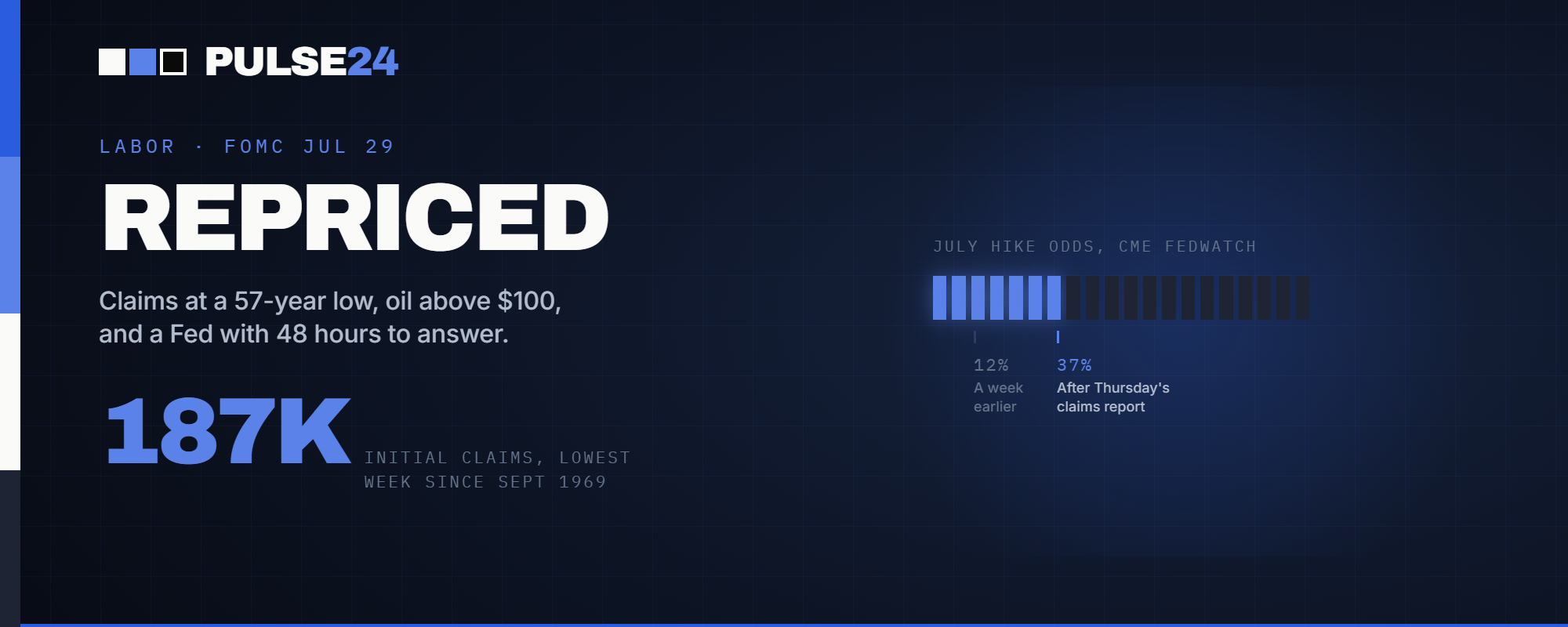
Initial jobless claims just fell to their lowest level since 1969, and Fed rate-hike odds for this month's meeting tripled within days. A strong labor market and a live oil shock are pulling the central bank in the same uncomfortable direction.
Kevin Warsh has two days to decide something nobody thought he would have to consider this month. On July 18, initial jobless claims fell to 187,000, the lowest weekly reading since September 1969, well below the 212,000 economists expected. Rate markets reacted immediately. The odds of a hike at this month's Federal Open Market Committee meeting, not a cut, jumped from roughly one in nine to better than one in three within days.
It is an unusual kind of good news. A hot labor market normally gets celebrated without much hesitation. This time it landed on top of an inflation problem that was already building and an oil shock still unfolding, pushing the Fed toward a decision almost nobody expected to be live when the FOMC meets on July 28 and 29.
Look at the last few weeks and the shift seems almost too fast to be real. A week before Thursday's report, CME's FedWatch tool had the probability of a July hike sitting near 12 percent, a number most traders were happy to round down to zero. By Friday it was north of 37 percent. Markets were not drifting toward a new consensus so much as getting blindsided and repricing in real time.
What Changed
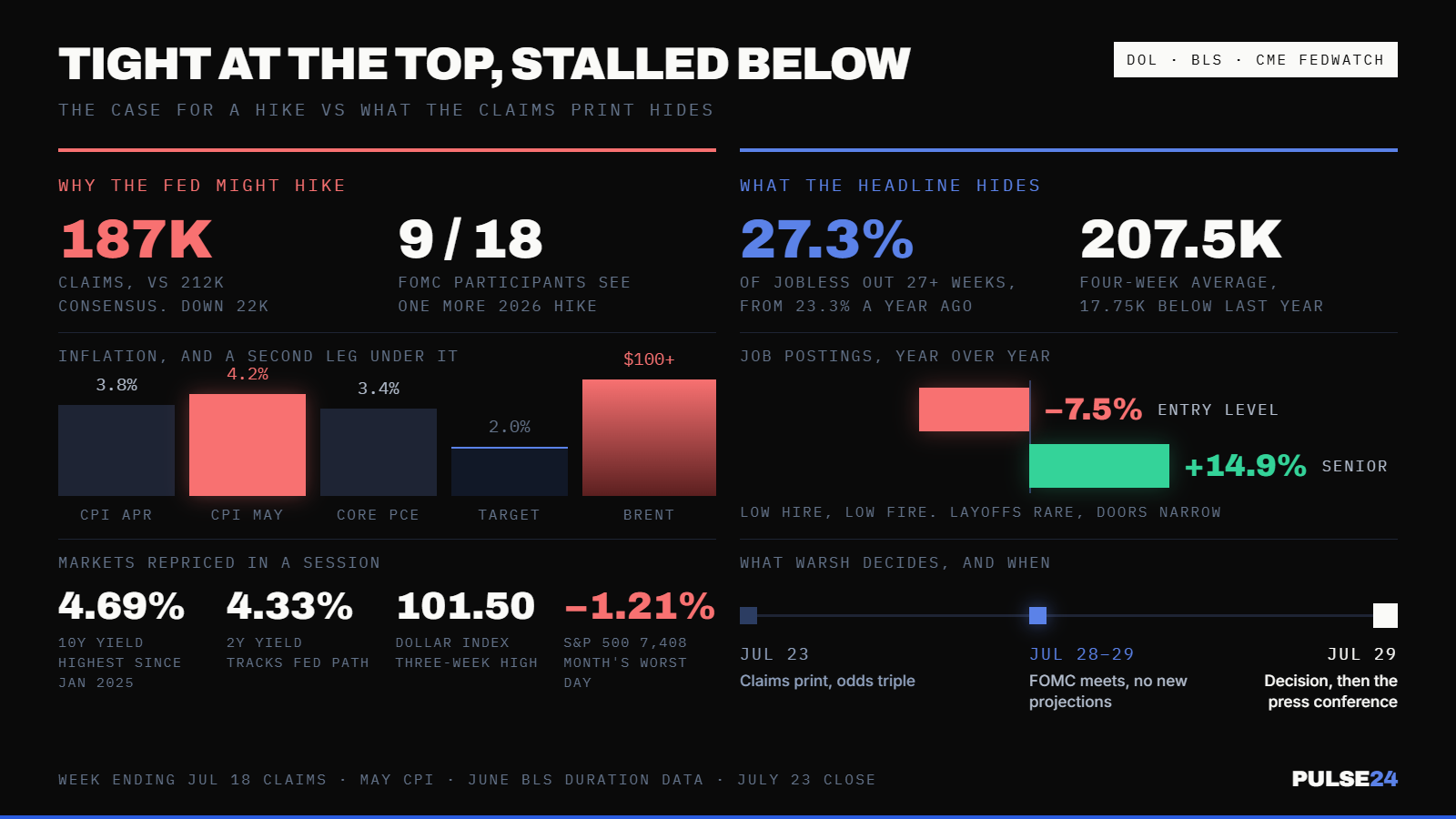
The Labor Department's release did more than beat expectations. Claims fell by 22,000 from the prior week's revised 209,000, versus a Reuters consensus of 212,000, a miss of more than 12% to the low side and the largest single-week decline in months. The four-week moving average, a smoother read on the underlying trend, slipped to 207,500, itself running roughly 17,750 below where it sat a year earlier.
It didn't arrive in a vacuum. Consumer prices had already climbed from 3.8% in April to 4.2% in May, the hottest reading in three years, and the Fed's preferred inflation gauge, core PCE, is running near 3.4% as of the latest reading, itself a three-year high, with policymakers' own June projections putting overall PCE inflation at 3.6% for 2026, still well above the central bank's 2% target. Add Brent crude's break above $100 a barrel. Saudi Arabia had already rerouted more than 70% of its crude exports through the Red Sea port of Yanbu after Iran closed the Strait of Hormuz earlier this spring amid the broader U.S., Israel, and Iran conflict, and Houthi attacks on tankers near the Bab el-Mandeb Strait are now threatening that alternate route too. The inflation story now has two independent legs holding it up instead of one.
Markets didn't wait for the FOMC to say anything. The 10-year Treasury yield touched 4.69%, its highest level since January 2025; the two-year note, which tracks Fed policy more directly, sits at 4.33%. The dollar index climbed to a three-week high near 101.50 on the revival of hawkish bets. Equities took it worse. The S&P 500 fell 1.21% on July 23 to 7,408.30, its sharpest one-day drop in a month, dragged lower by rate-sensitive growth names before stabilizing near 7,418 the next session.
Why It Matters
A hike here would be Kevin Warsh's second move as chair since taking the gavel in May, and it would mark the first time this cycle the Fed raised rates rather than debated when to start cutting them. That's a meaningful signal about how this Fed reads risk. Nine of the eighteen FOMC participants have already penciled in at least one more increase for 2026, evidence the committee is genuinely split rather than leaning toward the market's earlier assumption of easing.
The labor market underneath the headline number is more complicated than "57-year low" suggests. Entry-level job postings are down 7.5% year-over-year even as senior-level postings rose nearly 15%, and the share of the unemployed out of work 27 weeks or longer climbed to 27.3% in June, up from 23.3% a year earlier. Economists have started calling this a "low-hire, low-fire" labor market. Layoffs are genuinely rare, hiring is genuinely slow, and both show up as low claims even though they describe very different experiences depending on where someone sits in the job market. It is also, notably, not yet a story about AI displacing workers at scale. Despite persistent fears, the claims data continues to defy predictions of AI-driven layoffs.
For markets, the distinction between a strong economy and sticky inflation matters enormously. If the Fed is hiking because growth is genuinely overheating, that's a different regime than hiking because oil and supply shocks are pushing prices up faster than the economy is growing. The first argues for a Fed that can pause quickly once inflation cools on its own. The second argues for a central bank stuck fighting supply-side inflation with a demand-side tool, a mismatch that historically takes longer to resolve and does more damage to growth assets along the way.
What To Watch Next
The FOMC's decision lands July 29, with no fresh Summary of Economic Projections to lean on this time, which puts extra weight on how Warsh frames it in his press conference. Watch for three things: whether the committee actually moves or holds while signaling a hike later this year, whether Warsh treats this month's data as a one-off or the start of a trend, and whether the Red Sea shipping disruption escalates or fades, since Brent above $100 has been doing as much to move rate expectations as the labor data itself. A cooler PCE print before the meeting, or a de-escalation in the Middle East, could just as easily send this the other way.
The Pulse24 Take
A single week of claims data below consensus shouldn't rewrite anyone's view of the Fed on its own. But this isn't an isolated data point. It landed on top of an inflation trend that was already turning and an oil shock that's still live, and together they moved the probability of a hike from a rounding error to a real possibility inside a week. That's worth paying attention to, not because a hike is now the likely outcome, but because the range of outcomes the market has to price just got noticeably wider.
The more interesting story sits underneath the headline number. This is a labor market that's tight at the top and stalled at the entry level, low on layoffs and slow on hiring, defying both recession calls and AI-doom predictions at the same time. That's not an economy that fits neatly into "strong" or "weak." It's one the Fed, and anyone trying to read it, will have to hold two ideas about at once.
How we read the data
Curious how we get from raw data to a take like this? Our Trader's Toolkit walks through the tools we lean on.
Explore the Toolkit