Pulse24 Original
Brent Crude Broke $100. The Fed's Rate-Hike Odds Just Tripled With It.
July 24, 2026
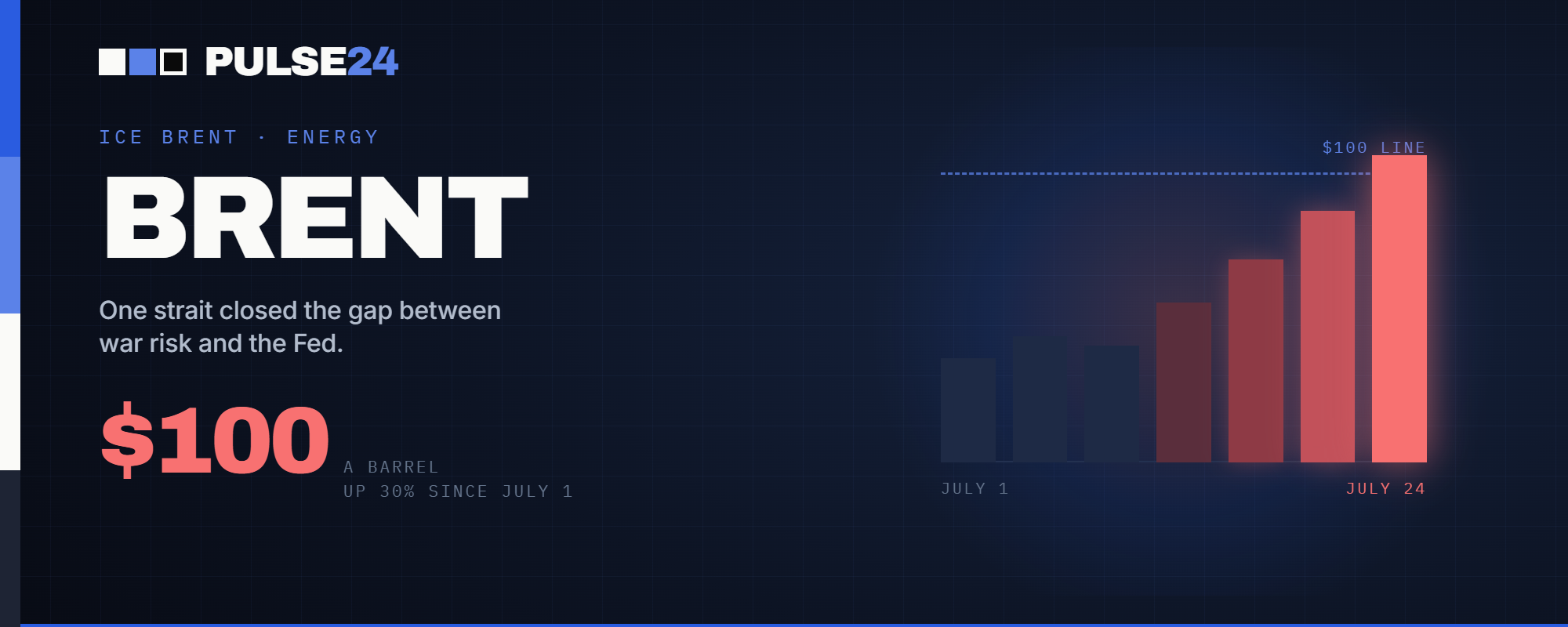
Brent crude briefly crossed $100 a barrel this week as a Middle East conflict stretched past its third week of escalation, with attacks reaching the Red Sea, and the market-implied odds of a Fed rate hike at the July 29 meeting have roughly tripled in seven trading days. The connective tissue: an oil shock that hits inflation like a tariff would, landing on a Fed that already had less room than it looked like it had two weeks ago.
What Changed
Brent crude crossed $100 a barrel on Thursday, and it did it without much fanfare. There was no single headline event and no surprise OPEC announcement, just the accumulated weight of three weeks of an oil-producing region at war. WTI followed close behind, trading near $85. Both benchmarks are up more than 30 percent since the start of July.
That's not a spike that arrived out of nowhere. A Middle East conflict that's been escalating for weeks has widened well beyond its original front, with the fighting spreading toward shipping lanes far from where it began. Tankers near the Strait of Hormuz have come under attack, and the Red Sea saw a fresh flare-up this week.
None of that guarantees the oil actually stops moving, and it doesn't need to. Prices move on what traders believe might happen, not just on what already has.
The mechanics of this spike matter almost as much as the headline number. Brent and WTI futures have pushed into steep backwardation, with near-term contracts trading more than $3 a barrel above longer-dated ones. That's the market signaling it's worried about supply right now, not in six months. Commercial storage is already thin, so there's no cushion of oversupply to lean on the way there was during past Middle East scares. The U.S. Strategic Petroleum Reserve, the traditional shock absorber, is sitting at levels analysts describe as historically constrained after years of drawdowns.
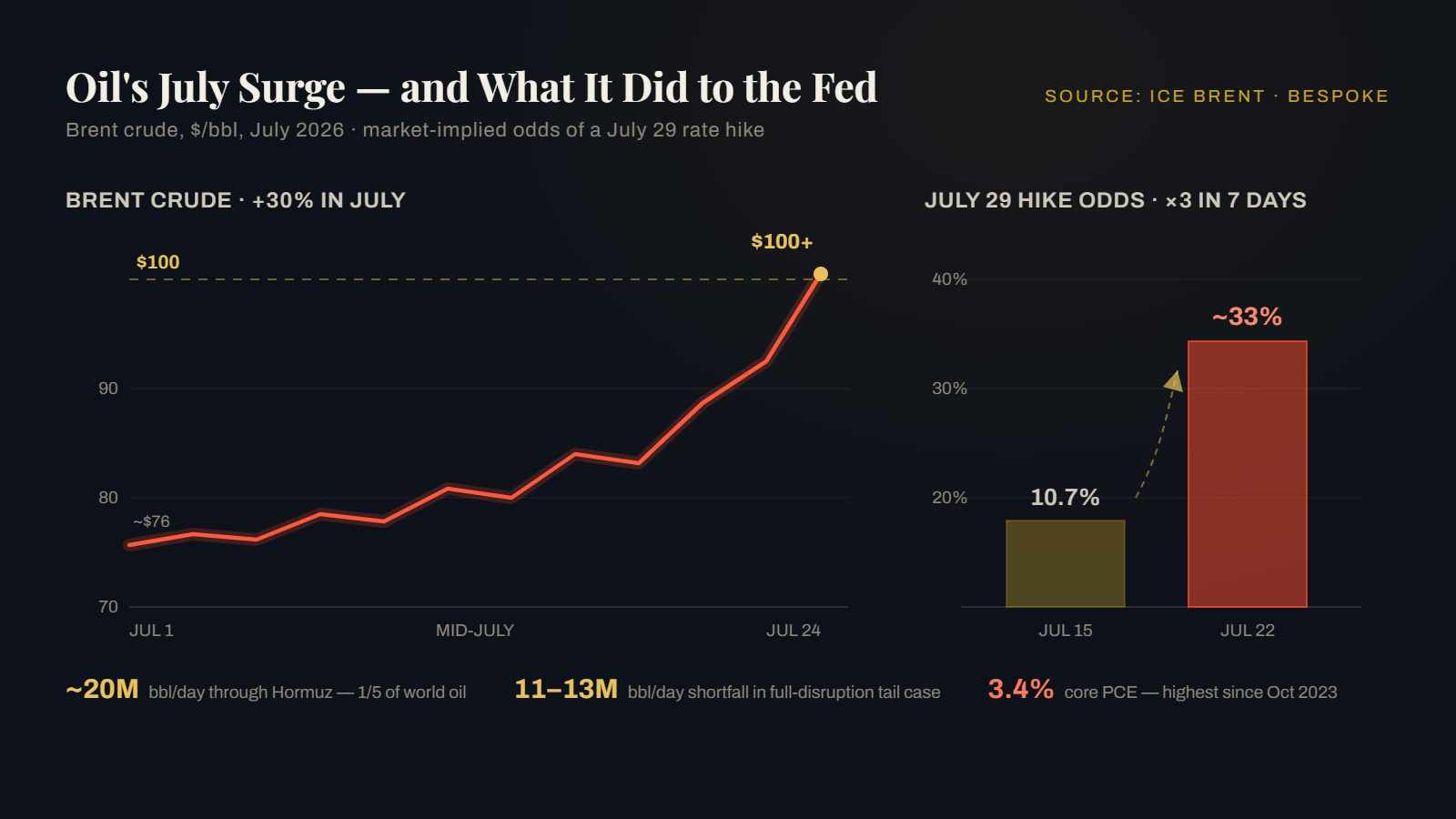
The Strait of Hormuz is why this feels different from an ordinary oil headline. Roughly a fifth of the world's daily oil consumption, close to 20 million barrels, moves through that single chokepoint. Analysts at Choice Institutional Equities estimate that a full disruption of Hormuz alongside the Bab el-Mandeb strait, the Red Sea route that's also come under attack, could pull roughly 18 million barrels a day of crude off the market. Even after rerouting and alternative supply kick in, that would leave the world short somewhere between 11 and 13 million barrels a day. Nobody is forecasting that full-disruption scenario as a base case, but markets don't price the base case alone. They price the tail risk too, and that tail got fatter this week.
There's a second supply story running in parallel that gets less attention. The Caspian Pipeline Consortium terminal on the Black Sea coast, which carries a large share of Central Asian crude exports, has also seen disruptions. It's a reminder that oil shocks rarely come from one source once a region destabilizes. Every adjacent piece of infrastructure gets repriced for risk at the same time.
Why It Matters
Oil at $100 doesn't stay in the energy sector. It shows up in the Fed's calculus almost immediately, and this week it did. Bespoke Investment Group's tracking of rate-hike odds for the July 29 FOMC meeting shows the market-implied probability climbing from 10.7 percent on July 15 to somewhere between 31.5 and 34.7 percent a week later, more than triple in seven trading days. Forbes framed the same shift more simply: markets are now pricing something close to a one-in-three chance the Fed hikes at a meeting where, two weeks earlier, a hike was barely on the table.
The inflation backdrop is doing a lot of the work here too, and oil isn't working alone: a new round of tariffs had already complicated the Fed's disinflation story earlier the same day Brent crossed $100. Core PCE, the Fed's preferred gauge, ran at 3.4 percent year-over-year in May, the highest reading since October 2023, and that was before this month's oil move had fully shown up in the data. An oil shock doesn't just add a one-time energy line item to the inflation basket. It works through diesel and jet fuel costs, into freight, and eventually into the price of nearly everything that gets shipped. If energy prices hold anywhere near current levels through August, the Fed will be looking at a fall inflation print that owes as much to the Strait of Hormuz as to anything happening in the domestic economy. A committee that's already leaning hawkish doesn't need much more than that to justify holding, or hiking, instead of cutting.
There's a specific vulnerability sitting underneath all of this. The AI infrastructure buildout that's carried much of this year's equity market has been financed substantially with debt, across data centers, chip capacity, and the power infrastructure to run them. That trade was built on an assumption about the cost of capital staying manageable. An oil-driven rate hike doesn't touch AI demand or chip performance at all, but it does touch the financing cost underneath the entire buildout. That's a different kind of risk than anything an earnings report could reveal.
What to Watch Next
A few threads are worth tracking. The most immediate is whether the Strait of Hormuz sees an actual sustained closure rather than the attacks-and-threats pattern of the past three weeks; tanker insurance rates and shipping delays tend to move before any government confirms a blockade outright. Close behind is the July 29 FOMC decision itself, and just as much the language Chair Warsh uses regardless of which way the vote lands. A hold delivered with hawkish language achieves nearly the same market effect as a hike would. Further out, watch whether OPEC+ or U.S. shale producers respond to $100 oil with actual production increases. Spikes this size have historically drawn out extra barrels within weeks, and that supply response has been the most reliable way this kind of shock unwinds.
The Pulse24 Take
Every inflation shock this cycle keeps arriving through a different door: tariffs in the spring, AI hardware pricing over the summer, now an oil-and-war shock in late July. The through-line matters more than any single headline. The Fed keeps getting handed fresh reasons to stay cautious right as the data was starting to give the doves some room to work with.
The rate-hike odds move is the more durable number to watch here, more than the oil price itself. Oil can retrace quickly if a ceasefire holds or supply from producers responds; it's done exactly that before in this same conflict. Rate-hike odds tripling in a week says something stickier: the market now believes the Fed's tolerance for absorbing supply-side inflation is thinner than it looked two weeks ago. That belief gets tested at the July 29 meeting. A surprise hike or a hold that reads as reluctant would both likely move markets more than current positioning accounts for.
How we read the data
Curious how we get from raw data to a take like this? Our Trader's Toolkit walks through the tools we lean on.
Explore the Toolkit