Pulse24 Original
Trump's New Tariffs Just Hit 60 Countries. The Fed's Timing Problem Just Got Worse.
July 24, 2026
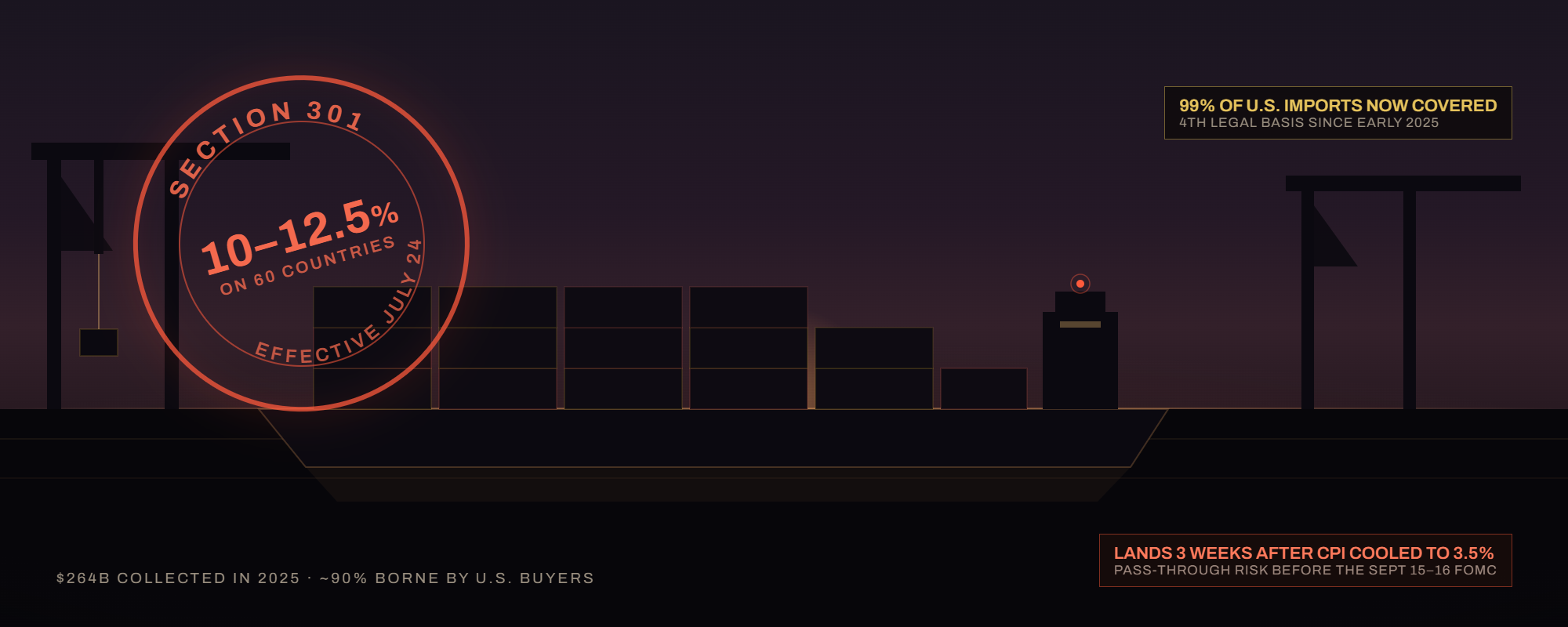
New Section 301 tariffs of 10 to 12.5 percent just landed on 60 countries covering nearly all U.S. imports, replacing the temporary duties that expired at midnight. The timing is the story: it hits right as June's cooler CPI print gave the Fed room to breathe.
At 12:01 a.m. Friday, a 10 percent tariff that touched almost every country the U.S. trades with quietly expired. Within hours, a new one replaced it, this time built to last.
That's not a typo or a rounding error. It's the fourth distinct legal foundation the administration has used to tax imports since early 2025, and this one was written under a legal framework the administration hopes will prove more durable in court.
The new duties run from 10 to 12.5 percent on 60 trading partners, a group the U.S. Trade Representative's office says accounts for roughly 99 percent of everything the country imports. India got a break, its rate cut from 12.5 to 10 percent after Washington judged its labor enforcement had improved. Oil, gas, fertilizer, and anything qualifying under the US-Mexico-Canada Agreement is carved out. Everything else pays.
What Actually Changed
The tariffs expiring Friday were never meant to be permanent. They arrived in February under Section 122 of the Trade Act of 1974 as a stopgap, thrown up fast after the administration shifted away from tariffs imposed under the earlier legal framework when court rulings cast significant doubt on that authority. In the consolidated cases Trump v. V.O.S. Selections, Inc. and Learning Resources, Inc. v. Trump, decided 6-3 on February 20, the Supreme Court concluded that the International Emergency Economic Powers Act did not provide the president with authority to impose tariffs in the manner used under the earlier policy. Section 122 caps emergency tariffs at 15 percent and 150 days. That clock ran out this week.
So the administration reached for Section 301 instead, a slower, more procedural tool built for a different purpose: punishing countries for unfair trade practices, one at a time, after an investigation. USTR Jamieson Greer's framing leans on forced labor enforcement. "The United States has had a forced labor import ban for nearly a century, and rigorously enforces it," he said. "It's well past time for our trading partners to do the same."
Whether that justification holds up to legal scrutiny is a genuinely open question. Section 301 has real precedent, but applying it to 60 countries at once, on a near-identical rate structure to the tariffs it's replacing, raises obvious questions about whether courts will view it as a distinct policy or as a continuation of the previous tariff regime. For now, though, the money moves regardless of how the argument eventually resolves. Tariff revenue ran to $264 billion in 2025, and several independent economic studies, including analysis from the New York Fed's Liberty Street Economics, estimate that roughly 90 percent of that cost has ultimately been borne by U.S. importers, businesses, and consumers, not by the exporting countries the tariffs target. Since January 2025, U.S. tariff policy has changed more than 50 times. Businesses that build supply chains for one tariff regime keep discovering they built for the wrong one.
Why It Matters
Here's the part that should actually interest anyone watching the Fed rather than the trade lawyers: the timing could not have landed at a more sensitive moment for inflation.
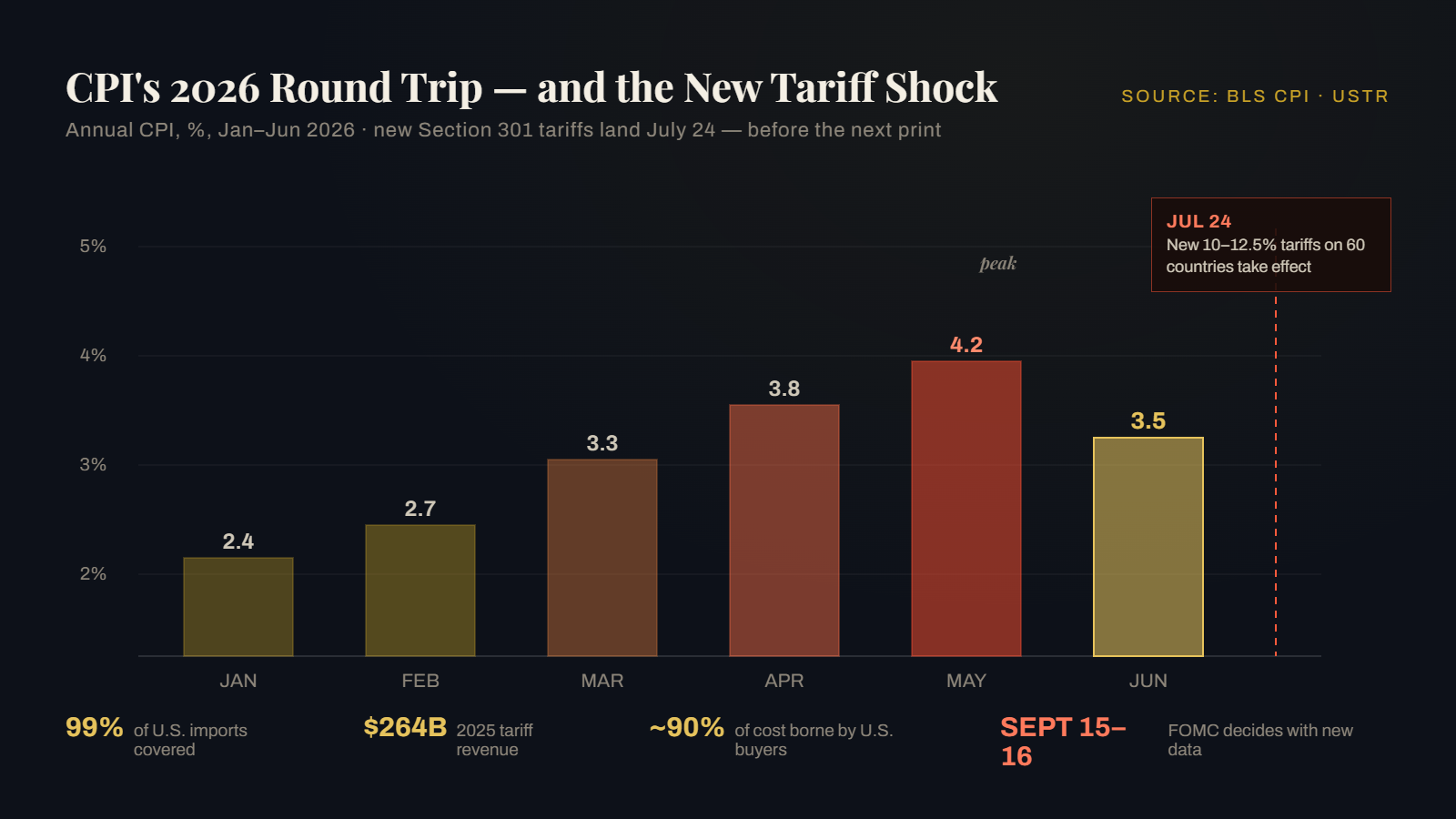
June's CPI print, released July 14, showed annual inflation cooling to 3.5 percent, down sharply from May's 4.2 percent and below the 3.8 percent economists had forecast. Core CPI eased to 2.6 percent from 2.9 percent. After a run of ugly numbers, 2.4 percent in January, climbing to 3.3 in March and 3.8 in April before peaking in May, June looked like the first real evidence that the earlier round of tariffs was starting to work its way out of the price data rather than into it.
A fresh tariff shock arriving three weeks later, on a base covering 99 percent of imports, complicates that story considerably. Tariff-driven price increases don't show up in CPI overnight; they move through supply chains over months as importers reprice inventory and pass costs downstream. If June marked the beginning of a disinflation trend, this week's tariffs are a plausible reason that trend stalls out before it goes much further, not because anyone intends it to, but because the mechanism is the same one that pushed CPI up earlier this year.
That puts the Federal Reserve in an uncomfortable spot. Chair Kevin Warsh has kept a hawkish line all summer, repeating that inflation remains "too high" even as the data softened. The rate-setting committee itself is reportedly split close to evenly, roughly half favoring another hike before year-end, the other half leaning toward holding steady or eventually cutting. A new tariff-driven price pressure, arriving before the committee's next meeting on September 15 and 16, gives the hawkish half a fresh data point to point to, right as the doves were gaining ground.
The dollar and yields are already telling a related story, even if tariffs aren't the only author of it. The dollar index has pulled back to around 100.59 after peaking near 101.40 in late June, cooling alongside softer inflation expectations. Meanwhile the 10-year Treasury yield has held near 4.0 to 4.1 percent, propped up less by tariff news than by crude oil pushing above $102 a barrel on Middle East tensions, a separate inflationary channel that's already doing some of the same work the new tariffs might do next. Equities noticed: the S&P 500 slid 1.2 percent Thursday to 7,408.30, the Nasdaq dropped 2.2 percent, and the Dow fell 1.0 percent, though that selloff was driven mostly by disappointing tech earnings and the oil-driven yield spike rather than the tariff news itself, which broke after the close.
What to Watch Next
A few things worth tracking over the coming weeks, roughly in order of how quickly they'll show up. First, corporate earnings calls: watch for language about "pricing actions" and "input costs," the phrases companies use when they're quietly passing tariff costs to customers rather than absorbing them. Second, July and August CPI prints. If the disinflation trend that showed up in June reverses, tariffs would likely be among the first factors economists point to, arriving roughly on the same one-to-three-month lag the last round did. Third, the September 15-16 FOMC meeting, where a Fed that was cautiously optimistic about disinflation now has a genuine reason to second-guess that read.
There's also a political clock running underneath all of this. Midterm elections land on November 3, and a tariff policy that raises consumer prices in the months beforehand is not the backdrop any incumbent party wants heading into a vote about the cost of living. That doesn't change the economics, but it shapes how much appetite Washington has to soften or delay enforcement if the price data turns ugly again.
The Pulse24 Take
The headline risk here isn't that tariffs went up. Thursday's equity selloff had almost nothing to do with trade policy. The real risk is subtler: this is a new inflationary impulse landing at the exact moment the Fed had its best evidence yet that the last one was fading.
Treat June's cooler CPI print as a data point, not a trend confirmed. The Fed has been burned before by declaring victory over inflation one print early, and a committee already split down the middle doesn't need much of an excuse to stay hawkish through September. If July and August CPI come in hot again, this week's tariffs will be the reason economists point to, and the doves on the committee will have lost their strongest argument just as it was starting to work.
The bigger structural story is the one running underneath the headline: a president using a third and now fourth legal mechanism to keep tariff policy in place after courts and expiration clocks keep taking the first ones away. Whether Section 301 survives its own legal test matters less to markets in the next six months than the fact that the effective tariff rate on U.S. imports keeps landing somewhere between 10 and 15 percent, almost no matter which statute is doing the work. Investors pricing a return to pre-2025 trade conditions are pricing a scenario that keeps not happening.
How we read the data
Curious how we get from raw data to a take like this? Our Trader's Toolkit walks through the tools we lean on.
Explore the Toolkit