Pulse24 Original
The Fed Held Rates at 3.50%-3.75% on a 9-3 Vote. The Dow Fell 1,153 Points Anyway.
July 30, 2026
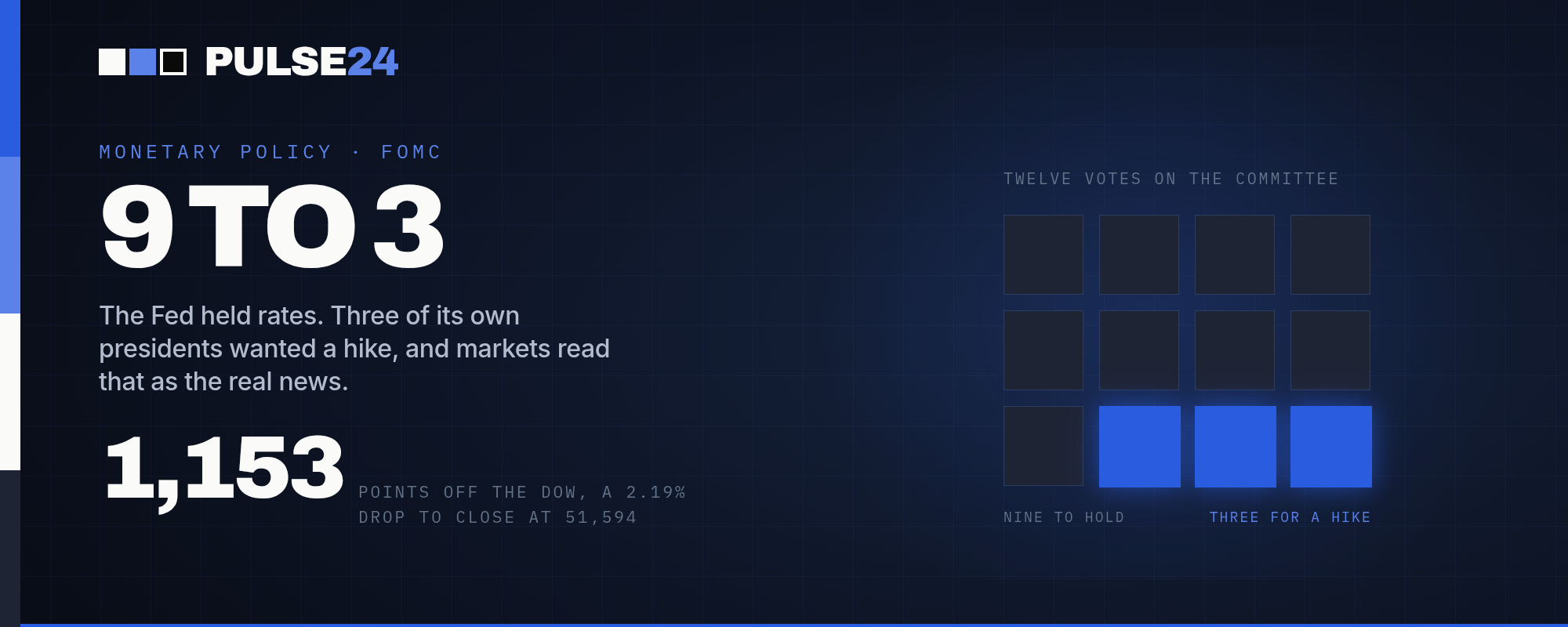
The Federal Reserve held its benchmark rate at 3.50% to 3.75% on Wednesday, but three policymakers voted for a hike instead, and Wall Street didn't shrug it off. The Dow fell 1,153 points as yields rose and traders pushed the odds of a September rate increase to roughly 76%.
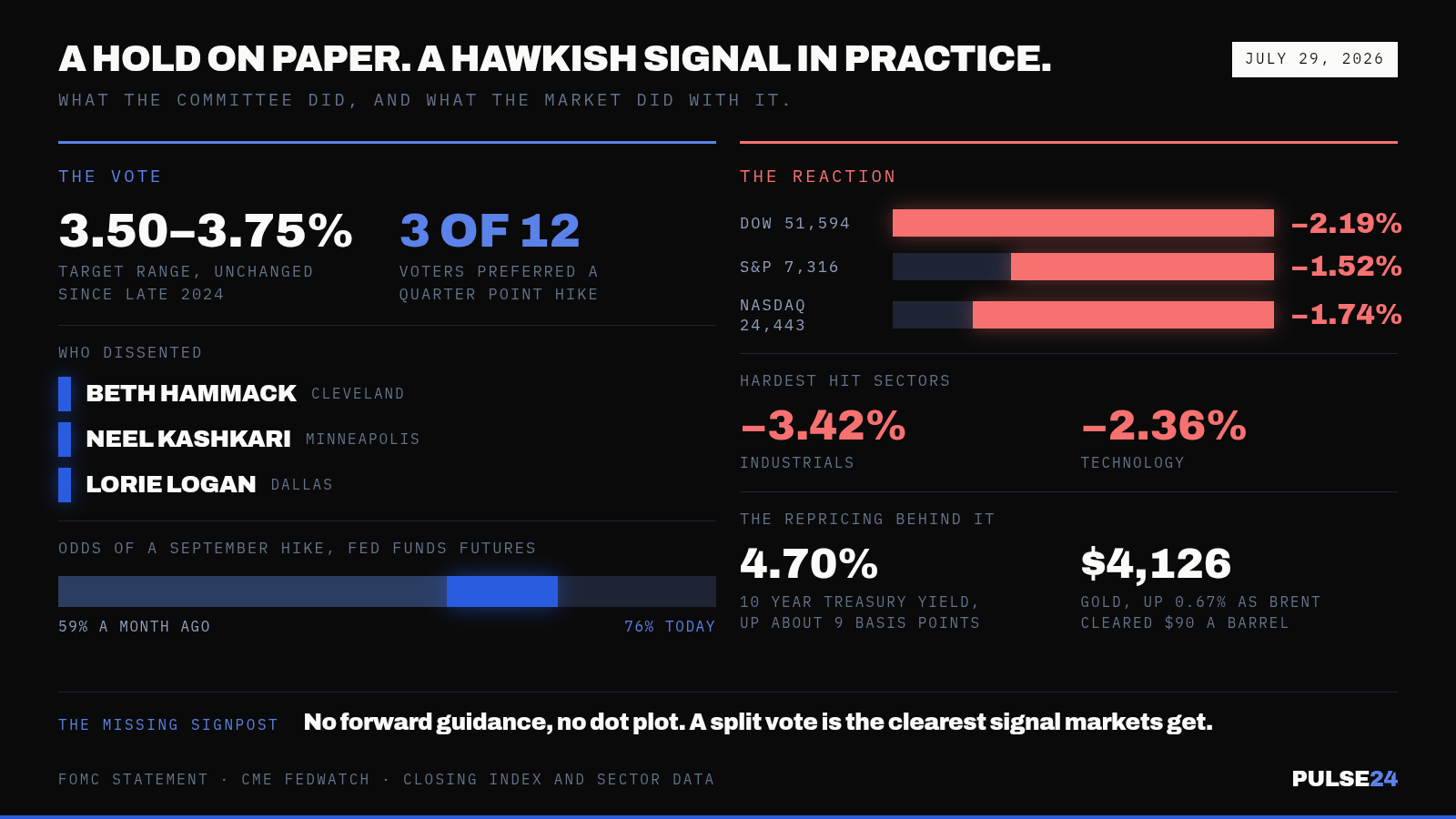
Three of the Federal Reserve's own policymakers wanted a rate hike on Wednesday. They didn't get one, but they came closer than markets expected. The Federal Open Market Committee voted 9 to 3 to hold its benchmark rate at 3.50% to 3.75%, with Cleveland Fed President Beth Hammack, Minneapolis Fed President Neel Kashkari, and Dallas Fed President Lorie Logan all preferring a quarter-point increase instead.
Wall Street didn't treat the hold as good news. The Dow Jones Industrial Average fell 1,153 points, a 2.19% drop, to close at 51,594. The S&P 500 slid 1.52% to 7,316, and the Nasdaq Composite lost 1.74% to 24,443. Technology shares fell 2.36% as a group, and industrials dropped even harder, down 3.42%.
What Changed
A hold, on its own, usually reads as friendly to stocks. This one didn't, because three dissents out of twelve voters is a wide margin for a Fed that has preferred near-unanimous decisions for most of the past two years. The rate hasn't moved since a run of quarter-point cuts ended in late 2024, and Wednesday's vote was the clearest signal yet that the committee's internal debate has shifted. A majority still wants to wait. A growing minority does not.
Chair Kevin Warsh added a second layer of uncertainty on top of the vote itself. He has been openly critical of forward guidance and the quarterly dot plot, arguing that both give markets a false sense of precision about where rates are headed. Since taking over, he's largely stopped using them. That leaves investors parsing a split vote with fewer of the usual signposts, at a moment when the split just got harder to ignore.
Crude oil didn't help the mood. Brent gained more than 7%, trading above $90 a barrel, as tensions in the Middle East flared back up. Gold rose too, up 0.67% to $4,126 an ounce, doing what it typically does when investors want a hedge against several sources of uncertainty at once rather than just one. None of that caused the equity selloff by itself, but it piled on top of a market already digesting a more hawkish Fed than it had priced in that morning.
Why It Matters
Rate decisions are rarely just about the decision. They're about what the vote reveals about the committee's reaction function, and Wednesday's 9-3 split reveals a Fed less patient than its public statements suggest. Inflation has stayed above the Fed's 2% target for years now, and Wednesday's policy statement pointed again to supply shocks in energy and other sectors keeping it there. Three policymakers apparently decided that's no longer a good enough reason to wait.
Higher yields matter beyond the bond market too. The 10-year's move to 4.70% raises the discount rate used to value future earnings, which weighs hardest on the stocks priced for the most growth years out. That's part of why technology led Wednesday's decline, and the timing is awkward: Microsoft, Meta, Apple, and Amazon all report earnings this week, and a chunk of the market's mood between now and Thursday will depend on whether their spending plans still look justified at a higher cost of capital. Chipmakers were already under pressure after soft results out of SK Hynix, and a rising-rate backdrop doesn't make that easier to shake off.
What to Watch Next
The next scheduled test comes at the Fed's September meeting, where futures markets now assign roughly a 76% probability to a rate hike, up sharply from 59% just a month ago. That's a big repricing for five weeks, and it means every inflation and employment report between now and then will carry outsized weight. A soft CPI print could pull the odds back down. A hot one could push the dissent count higher next time instead of lower.
Warsh's communication style is itself something to watch. Without forward guidance or a dot plot to anchor expectations, speeches from Fed officials between meetings are likely to move markets more than they used to, simply because they're a rare source of signal in an information vacuum the chair created on purpose. Investors would do well to pay closer attention to regional Fed president appearances over the next few weeks than they normally would.
The Pulse24 Take
The headline out of Wednesday's meeting was a hold. The more useful headline is that holding is getting harder to justify by a three-vote margin, and the chair running the meeting has chosen to make that harder to read rather than easier. Markets tend to dislike uncertainty more than they dislike bad news, and Wednesday's selloff looks like a repricing of uncertainty as much as a reaction to any single number in the statement.
None of this means a September hike is settled. Five weeks is a long time, and inflation data has surprised in both directions this cycle. But the distance between what the Fed just did and what three of its own members wanted to do has narrowed, and that distance is usually a better predictor of the next move than the vote everyone's focused on today.
How we read the data
Curious how we get from raw data to a take like this? Our Trader's Toolkit walks through the tools we lean on.
Explore the Toolkit