Pulse24 Original
S&P 500 Volatility Just Hit 10.2%, Well Above Its Historical Average. The Fed's Decision Lands This Afternoon.
July 29, 2026
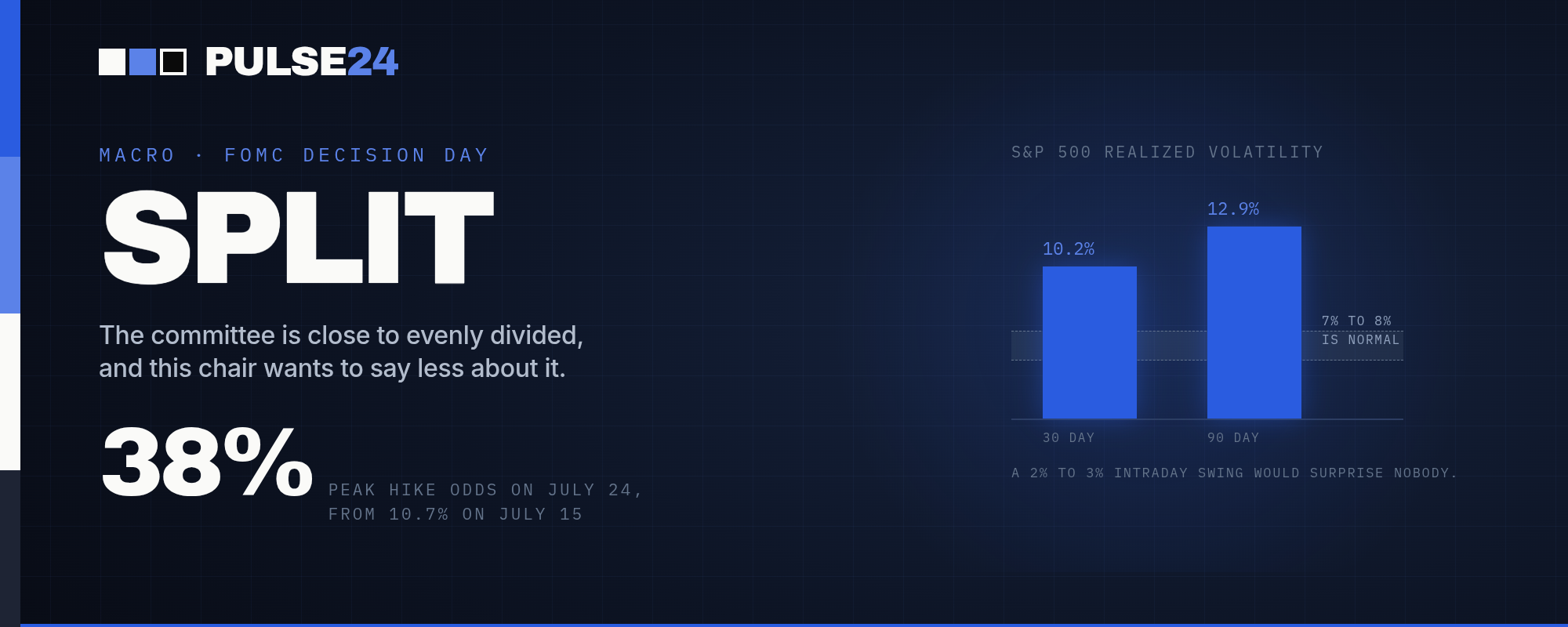
S&P 500 realized volatility has climbed to 10.2%, well above its historical range, as traders brace for a Fed decision due this afternoon from a chair who's pushing for less forward guidance. Hike odds spiked as high as 38% this week, up from just 11% two weeks earlier, with WTI crude up nearly 18% over the past month and the 10-year Treasury yield near 4.67% adding to the case for a hawkish surprise.
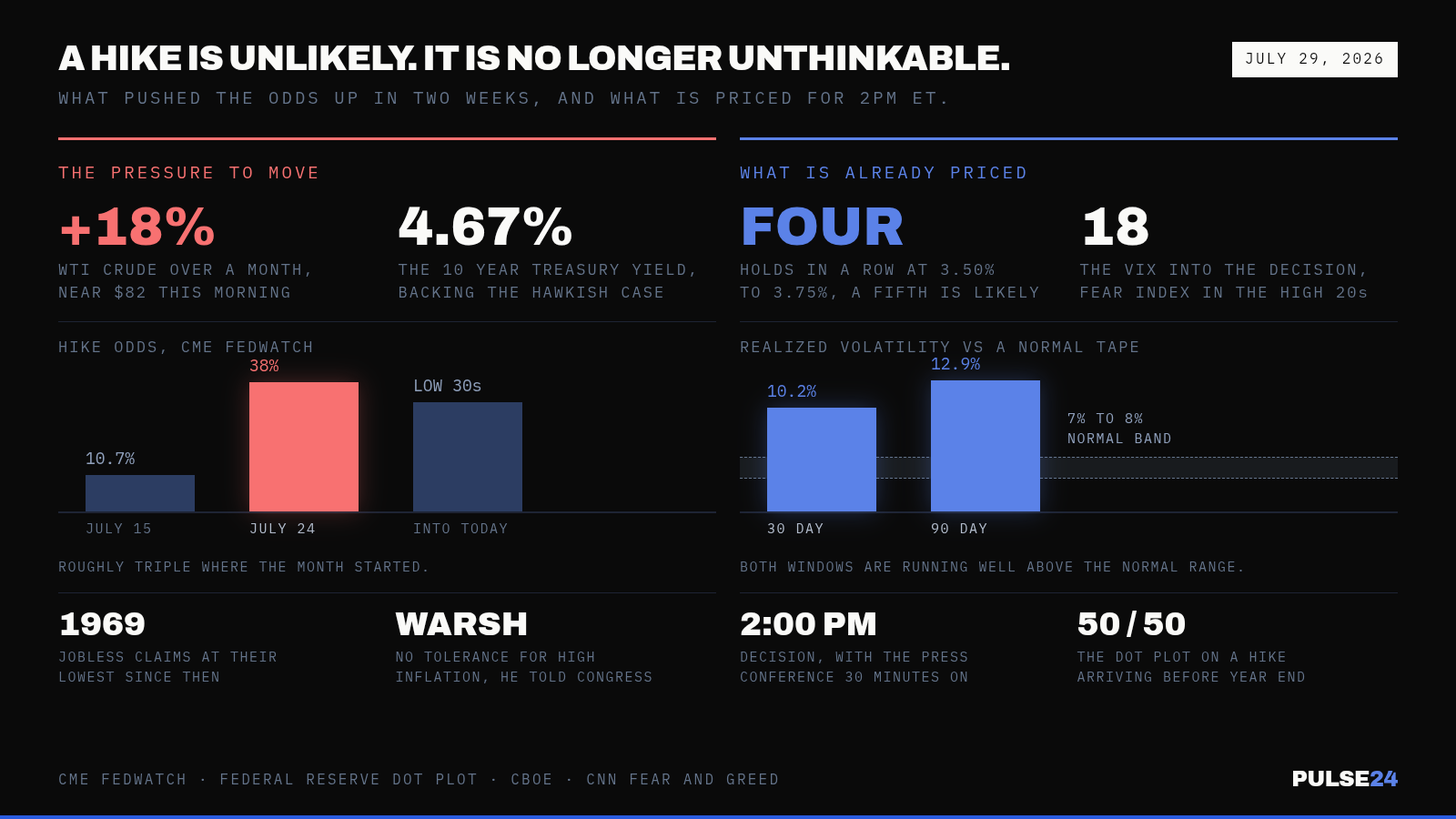
The Federal Reserve's benchmark rate has sat at 3.50% to 3.75% for four consecutive meetings. A fifth straight hold is the base case, but that streak is on the clock. A decision lands early this afternoon, and for the first time in months, nobody on Wall Street is treating the outcome as settled.
CME FedWatch pricing tells the story. Odds of a quarter-point hike spiked to 38% on July 24, up from just 10.7% on July 15, one of the fastest repricings of a single Fed meeting in recent memory. They've eased back into the low-to-mid 30s as the decision approaches, but that's still roughly triple where the month started. The CNN Fear and Greed Index has drifted down into the high 20s, solidly in fear territory.
What Changed
A month ago, holding rates steady looked close to automatic. Then hike odds tripled in a single week, to 36%, and the repricing kept going from there. The Fed's own dot plot, its clearest public signal of internal thinking, shows the committee split almost evenly on whether a hike happens before year end. That split reads less like a hawkish committee or a dovish one and more like a genuinely undecided one, which is rarer than it sounds this deep into a cycle.
Chair Kevin Warsh has added to the uncertainty rather than resolved it. He's told Congress he has no tolerance for high inflation and wants to make it a thing of the past, language that reads more hawkish than his predecessors typically used at this stage of a cycle. Warsh has also pushed to scale back the kind of detailed forward guidance investors leaned on for the past decade, and that alone means today's statement and press conference may leave more unsaid than markets are used to.
Why It Matters
The inflation case isn't hypothetical. WTI crude is trading near $82 a barrel this morning, up more than 3% on the day and up roughly 18% over the past month, even after pulling back from a spike toward $92 earlier in the week tied to supply concerns in the Middle East. Tariff pass-through and the sheer scale of AI infrastructure buildout have added their own upward pressure on prices. A near 18% monthly rise in crude, even net of the pullback, keeps the inflation side of the Fed's mandate a harder argument to wave away.
The labor market isn't giving the Fed cover to ignore any of it either. Jobless claims fell to their lowest level since 1969 in late July, a reading that argues against urgency on the employment side of the mandate. A resilient labor market gives an inflation hawk like Warsh more room to act without worrying a hike tips the economy into a downturn, since there's little sign of the kind of weakness that usually keeps a Fed chair cautious.
What to Watch Next
The decision itself is due around 2pm ET, with Warsh's press conference following about 30 minutes later. Statement language matters as much as the vote. Any shift in how the committee describes inflation risk, even without an actual rate move, would point toward where the median view is heading into September. A close vote or a public dissent would confirm just how divided the committee really is.
Cross-asset reaction is likely to say more than the headline number. A hold paired with hawkish language could push yields and the dollar higher while pressuring gold and rate-sensitive tech stocks. A hold with softer language, or any hike at all, could move markets in less predictable directions given how split expectations already are. With realized volatility already running well above normal, a 2% to 3% intraday swing in the S&P 500 wouldn't be surprising no matter what the Fed decides.
The Pulse24 Take
A hike happening today isn't really the story. Even at odds in the mid-30s, holding steady remains the more likely outcome by a wide margin. The faster story is how quickly the market went from treating a hike as a non-event to pricing real uncertainty around it, and how little clarity investors are likely to get once the decision actually lands.
A Fed chair who has openly said he wants less forward-looking guidance is, by design, going to leave more for markets to infer rather than be told outright. That's a shift in how this Fed communicates as much as a shift in what it ultimately decides. Investors who spent the last decade learning to parse dot plots and detailed forward guidance may need to get comfortable filling in more of the blanks themselves, starting this afternoon.
How we read the data
Curious how we get from raw data to a take like this? Our Trader's Toolkit walks through the tools we lean on.
Explore the Toolkit