Pulse24 Original
Japan's Yen Intervention Drove the Dollar's Worst Day Since 2022. A Day Later, USD/JPY Was Back Above 160.
July 31, 2026
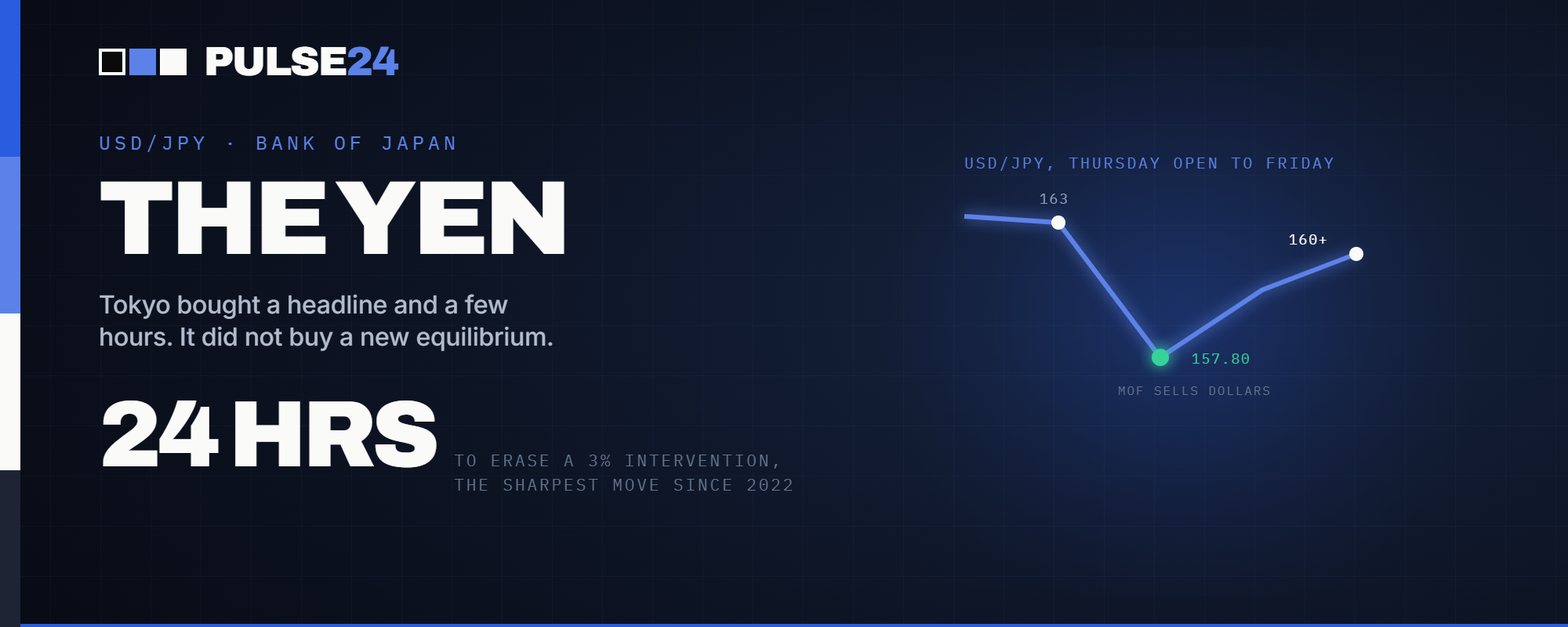
Japan's Ministry of Finance staged a suspected dollar-selling intervention on July 30 that pushed USD/JPY down roughly 3% in a single session, the yen's sharpest daily gain against the dollar since 2022. The Bank of Japan followed with a hawkish rate hold the next morning, but the pair had already climbed back above 160 by Friday, a sign that a 260 basis point rate gap with the US is still doing more work than Tokyo's intervention.
USD/JPY fell about 3% in a single trading session on Thursday, tumbling from above 163 to an intraday low near 157.80 after Japan's Ministry of Finance appeared to step into the market and sell dollars for yen. It was the pair's sharpest one-day move since late 2022, and for a few hours it looked like Tokyo had finally landed a blow that would stick.
It didn't stick, at least not for long. Less than a day after the Bank of Japan held its policy rate at 1.0% on an 8-1 vote and delivered an unusually hawkish inflation warning, USD/JPY had climbed back above 160. Most of Thursday's move was gone. Traders who spent the session testing how far Tokyo would push its checkbook came back the next morning to test how much of that intervention Tokyo could actually defend.
What Changed
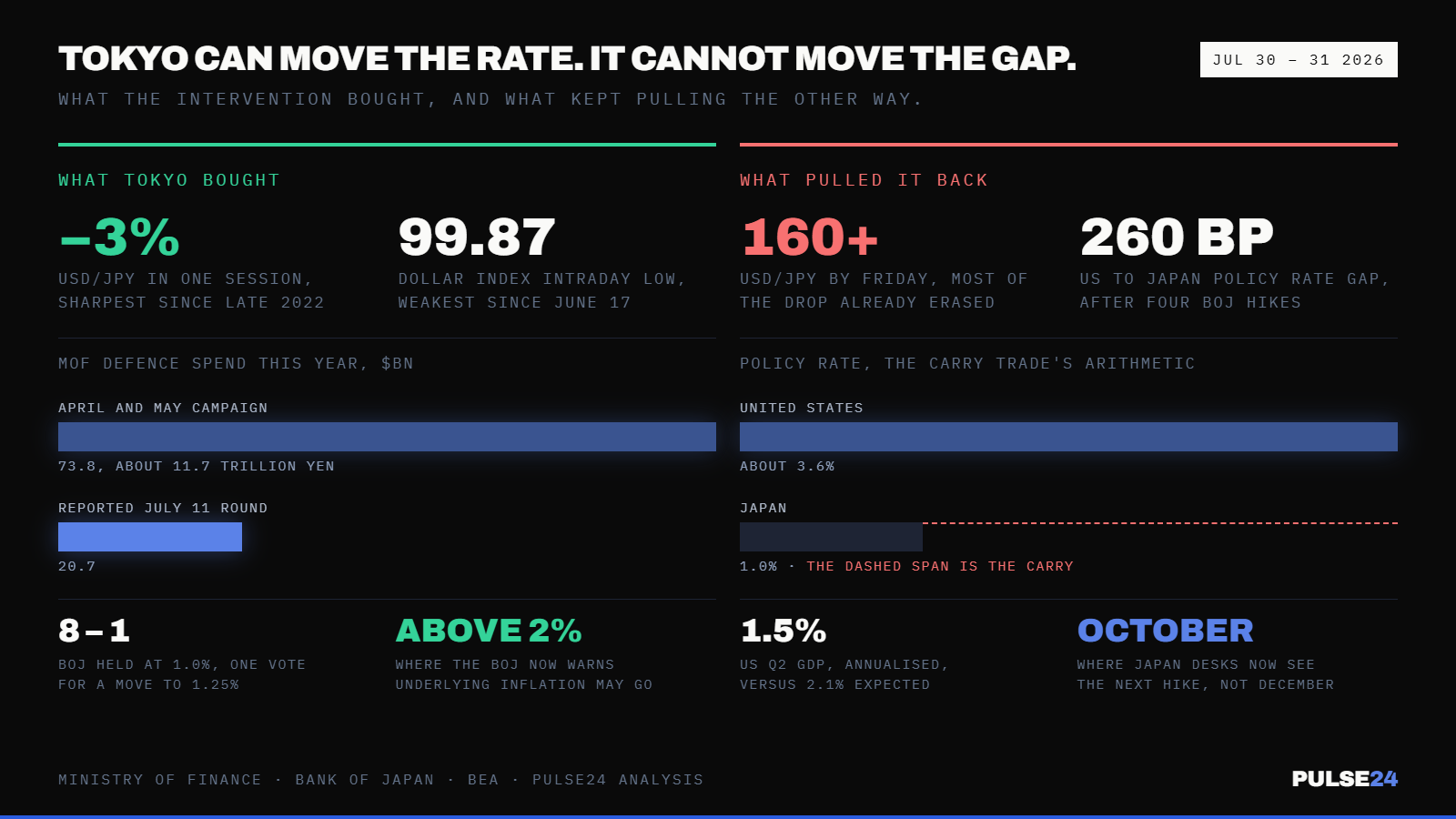
The intervention itself followed a familiar script. Japanese authorities have leaned on this tool repeatedly this year, spending roughly 11.7 trillion yen, close to $73.8 billion, defending the currency across an April and May campaign, and reportedly stepping in again for about $20.7 billion around July 11. Thursday's move fit that pattern: sell dollars, buy yen, do it during New York hours when liquidity is thin enough that a relatively modest order can move the tape. The Dollar Index dropped alongside the yen, sliding to an intraday low of 99.87, its weakest reading since June 17, as a separate release showing US second-quarter GDP growth of just 1.5% annualized, well below the 2.1% economists had penciled in, gave dollar bears a second reason to sell.
Then came the Bank of Japan's own decision Friday morning. The central bank held its policy rate at 1.0%, with eight of nine board members voting to hold and one dissenting in favor of a move to 1.25%. What got attention wasn't the vote itself. It was the language. For the first time, the BOJ's outlook report warned that underlying inflation could rise above its 2% target, a notably direct statement from an institution that has historically hedged its inflation commentary. Capital Economics economist Marcel Thieliant called the accompanying report hawkish, and the BOJ's own forecasts told a similar story: fiscal 2026 inflation was trimmed to 2.5% from 2.8% while growth for that year was lifted to 0.6%, and the fiscal 2027 inflation estimate was raised to 2.4% from 2.3%.
Why It Matters
The gap between Thursday's intervention and Friday's rebound is the real story here, more than either event on its own. Japan can move the exchange rate for an afternoon. What it can't easily do is close a roughly 260 basis point gap between US and Japanese policy rates, even after four BOJ hikes since the country exited negative rates in March 2024. That gap is what keeps the yen-funded carry trade profitable, and a carry trade that stays profitable keeps attracting the same flows that intervention is designed to interrupt. Selling dollars for a few hours doesn't change the arithmetic that makes borrowing in yen and investing in higher-yielding dollar assets worthwhile.
There's a liquidity angle underneath this too. The yen carry trade has become one of the funding sources behind leveraged positions in US technology and AI-linked names, which means a currency pair that looks like a foreign exchange story is also, quietly, a global liquidity story. When the yen spikes sharply, as it did briefly on Thursday, some of those funded positions come under pressure to unwind. When it fades back just as quickly, as it did by Friday, that pressure eases almost as fast as it appeared. A market watching for signs of stress in carry-trade-funded positioning got a preview of what a sharper, more durable yen move could do, without the full consequences actually landing.
What to Watch Next
The next real test is whether the BOJ follows Friday's hawkish language with an actual rate move. Some Japan-focused desks now see October as a more likely hike window than December, and a move that narrows the rate gap even modestly would do more for the yen than another round of intervention. Watch also whether Tokyo returns to the market if USD/JPY pushes back toward 163, since a third or fourth intervention within a single year would raise questions about how much firepower, and how much patience, the Ministry of Finance actually has left.
On the US side, Thursday's soft GDP print and the cooler 3.3% core PCE reading add to a dollar picture that's becoming genuinely two-sided rather than one-directional. That's a shift worth tracking alongside whatever comes next from the Fed, since a softening growth picture at home and a more hawkish Bank of Japan abroad are, for the first time in a while, pulling the rate differential in the same direction instead of opposite ones.
The Pulse24 Take
Currency intervention gets covered like a decisive action because it happens in a single, visible session. What Thursday and Friday showed is closer to the truth: it's more often a temporary offset against a trend that a rate differential is still driving. Japan bought itself a headline and a few hours of a stronger yen. It didn't buy itself a new equilibrium.
None of that makes the intervention pointless. Slowing a move can matter even when it doesn't reverse one, especially if it buys time for the rate gap to narrow through an October hike. But the speed of Friday's rebound is the more useful data point for anyone trying to gauge how much control Tokyo actually has right now. A currency defended by policy statements and periodic dollar sales is different from a currency defended by a genuinely competitive interest rate, and until the BOJ closes more of that 260 basis point gap, expect this pattern of a sharp move followed by a partial reversal to keep repeating.
How we read the data
Curious how we get from raw data to a take like this? Our Trader's Toolkit walks through the tools we lean on.
Explore the Toolkit