Pulse24 Original
Apple's Profit Jumped 29% and Its Stock Fell. Amazon's Free Cash Flow Went Negative and Its Stock Jumped 9%.
July 31, 2026
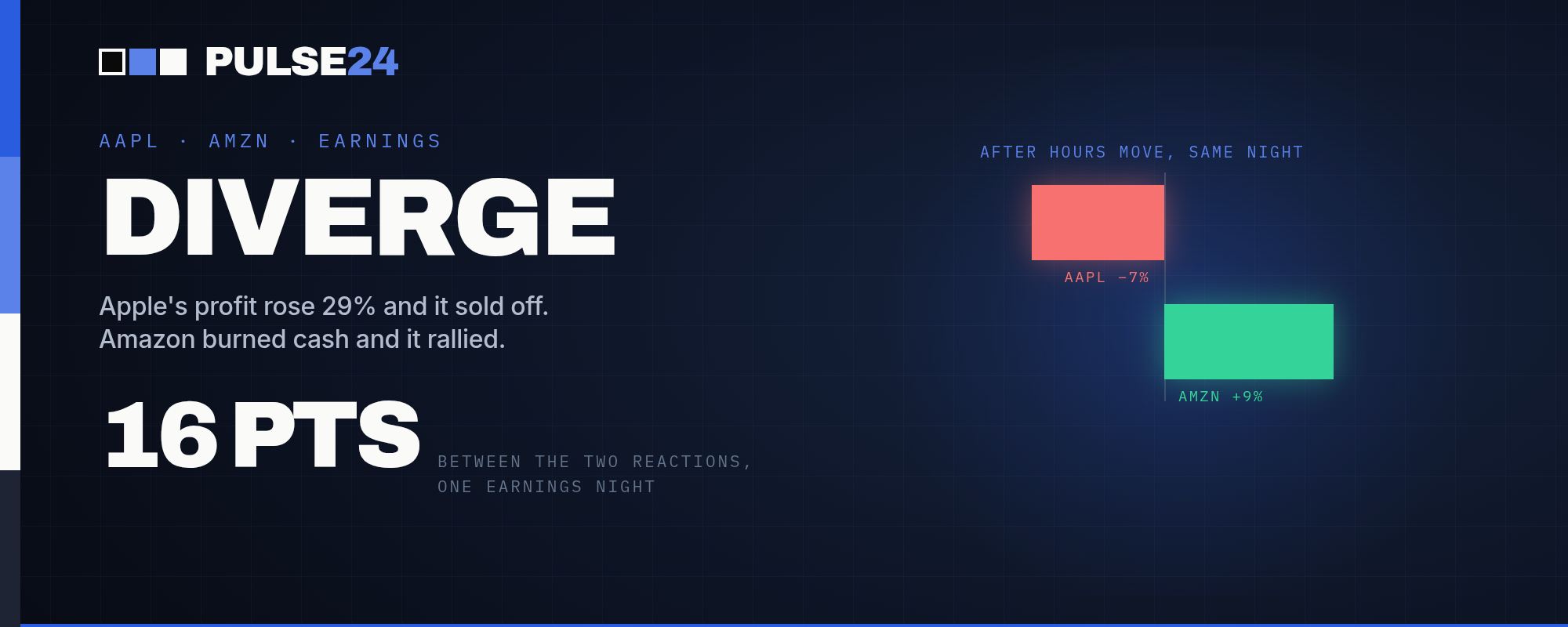
Apple grew revenue 16% and profit 29% last quarter, and its stock slipped anyway on a soft September-quarter outlook and a China miss. Amazon reported negative free cash flow for the first time since 2023 the same night, and its shares jumped as much as 9% after hours on accelerating cloud growth.
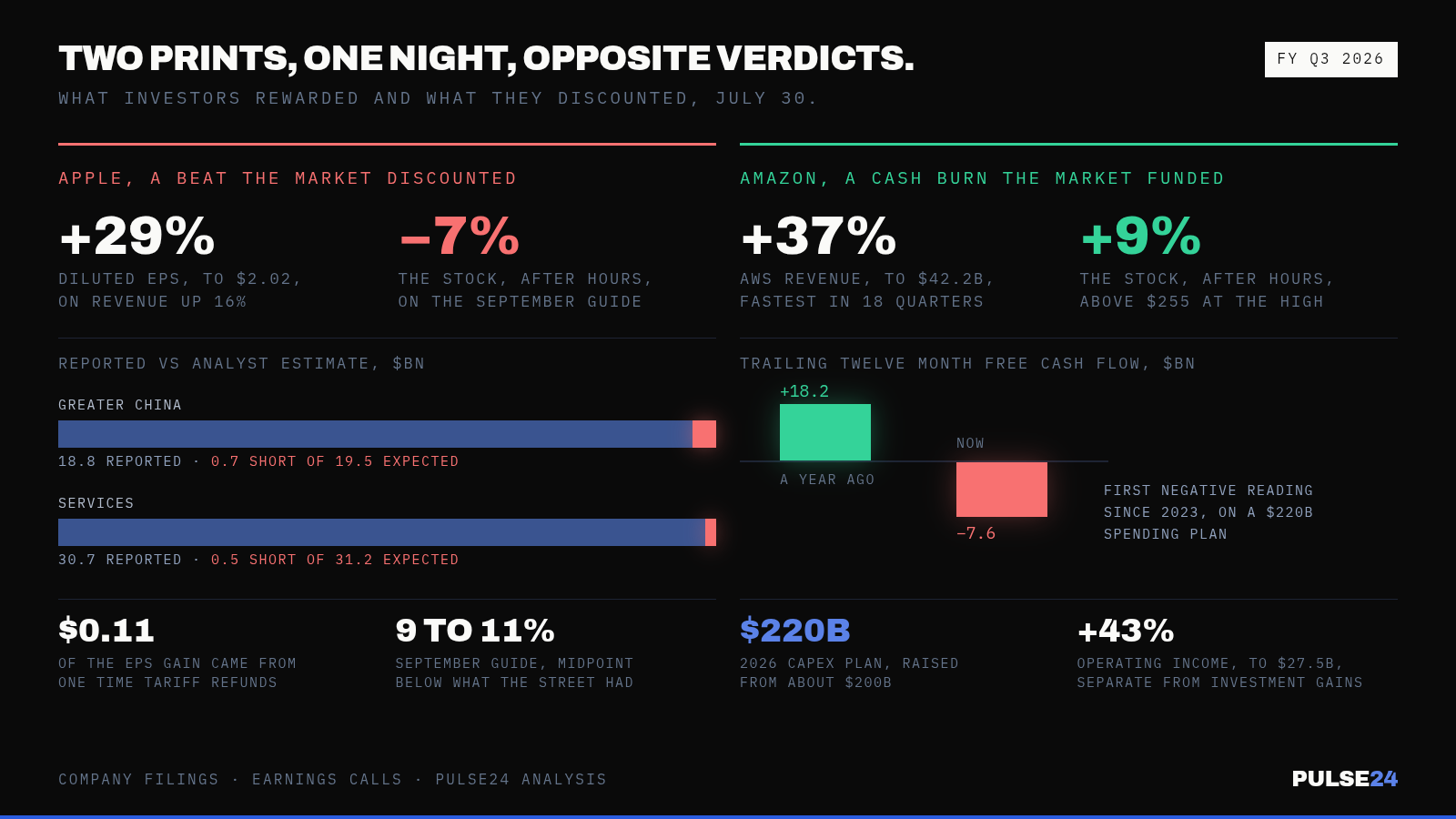
Apple reported $109.4 billion in fiscal third-quarter revenue on Thursday, up 16% from a year earlier, with diluted earnings per share climbing 29% to $2.02. The stock fell as much as 7% in after-hours trading anyway as investors zeroed in on a September-quarter forecast of 9% to 11% revenue growth, a range whose midpoint landed below what Wall Street had penciled in, and on Tim Cook's warning that memory chip supply constraints would limit hardware output in the quarter ahead.
A few hours earlier that same evening, Amazon posted a very different reaction to a very different set of numbers. AWS revenue grew 37% to $42.2 billion, the cloud unit's fastest pace in 18 quarters, while the company's trailing twelve-month free cash flow turned negative for the first time since 2023. Amazon shares jumped as much as 9% in after-hours trading, touching highs above $255. Two of the most closely watched companies in the market reported earnings on the same night, and investors sent them in opposite directions.
What Changed
Start with what looked strong on paper. Apple's headline numbers were, by most measures, a beat. iPhone revenue rose 21.7% to $54.3 billion, and net income climbed alongside the 29% EPS growth. But roughly $0.11 of that EPS gain, and about 2 percentage points of the 50.1% gross margin, came from one-time tariff refunds rather than the underlying business. Strip that out, and the quality of the beat looks thinner than the headline suggests. Greater China revenue came in at $18.8 billion, short of the roughly $19.5 billion analysts expected, and Services revenue of about $30.7 billion also missed estimates near $31.2 billion. None of those numbers are alarming in isolation. Together, alongside a forward guide below consensus, they were enough to send the stock lower on a day of double-digit profit growth. Tim Cook added another factor on the call, describing what he called a "100-year flood" in memory chip pricing, driven by AI infrastructure demand pulling on the same DRAM supply Apple needs for its hardware, and warning that supply constraints would limit iPhone, Mac and iPad output in the September quarter.
Amazon's story ran the opposite way. AWS's 37% growth was the segment's fastest pace in 18 quarters and beat what analysts had modeled for the unit. Operating income across the company rose 43% to $27.5 billion. Net income reached $62.6 billion, though more than $53 billion of that came from a non-operating gain tied to Amazon's investment in Anthropic rather than from running the business, a detail worth separating from the operating results. Free cash flow over the trailing twelve months fell to negative $7.6 billion from a positive $18.2 billion a year earlier, and Amazon told investors it now plans to spend roughly $220 billion on capital expenditures in 2026, up from an earlier estimate near $200 billion, citing higher memory chip costs on top of continued AI and cloud infrastructure buildout. Investors answered a widening cash burn and a bigger spending number by bidding the stock up as much as 9% anyway.
Why It Matters
The split says less about Apple and Amazon individually than about what the market is currently paying for. Apple's numbers were the more traditionally impressive quarter by most measures, and it still fell, because investors are discounting the quality of a profit boosted by a temporary tax refund and weighing a forecast that implies deceleration into the next quarter. Amazon's free cash flow went the wrong direction and its capex bill got bigger, and investors rewarded it, because the growth funding that spending is accelerating rather than slowing. The apparent contradiction has a simple explanation underneath it: cloud infrastructure demand and consumer hardware demand are being priced by two different sets of expectations right now.
It also lands in a specific moment for the AI capex debate. Alphabet's own report earlier this quarter unsettled investors enough that Amazon, Meta and Microsoft all faced heightened scrutiny on their spending plans heading into their own prints. Amazon's answer, that even after this spending increase the company still will not have enough capacity to meet all of the demand it sees in 2026, is the kind of forward demand signal that makes a widening cash flow gap look like a funded bet rather than an open-ended one. Apple doesn't have that same story to tell, because its capital intensity and its growth engine sit in a different place. The market is increasingly willing to look past near-term cash burn when there's demand visibility behind it, and increasingly less willing to give credit for a beat that leans on a one-time item.
What to Watch Next
Apple's next print, in late October, will show whether the September-quarter guidance was conservative positioning or an early signal of real deceleration in iPhone and China demand. Watch the gross margin line in particular for whether it holds without the tariff refund cushioning it, and whether the memory pricing pressure Cook described eases or gets worse into the holiday quarter. Amazon's bet that demand keeps outrunning capacity through 2026 will be tested against actual AWS bookings and utilization data as new data centers come online, and any sign that new capacity isn't converting into billed revenue as fast as expected would undercut the reasoning investors just used to reward the stock.
Memory chip costs are becoming a recurring line item across this earnings season, showing up in Amazon's capex guidance the same way they've shown up in supplier results from Samsung, SK Hynix and Micron. That thread ties hardware demand, AI infrastructure spending and consumer electronics margins into the same story. As more companies report through the rest of this quarter, each print adds a data point to the same question: is AI-driven spending converting into revenue investors can measure, or is it mostly showing up as cost.
The Pulse24 Take
The easy read on Thursday night is that Wall Street rewards growth and punishes disappointment, and that's true as far as it goes. A more useful read is that investors are pricing the durability of demand, not just the size of the number. Amazon got credit for spending more because it can point to reserved future capacity backing that spending. Apple didn't get the same credit for a strong quarter, because part of that strength wasn't going to repeat and the forward guide suggested growth was cooling.
That's a more demanding bar than simply beating or missing a consensus estimate, and it's worth watching whether other companies reporting this season get held to the same standard. A market willing to look past negative free cash flow when the growth story is intact, but unwilling to look past a soft guide even alongside 29% profit growth, is a market that has gotten more selective about what kind of growth it's actually paying for.
How we read the data
Curious how we get from raw data to a take like this? Our Trader's Toolkit walks through the tools we lean on.
Explore the Toolkit