Pulse24 Original
Big Tech Will Spend $725 Billion on AI This Year. Investors Just Decided That's Too Much.
July 27, 2026
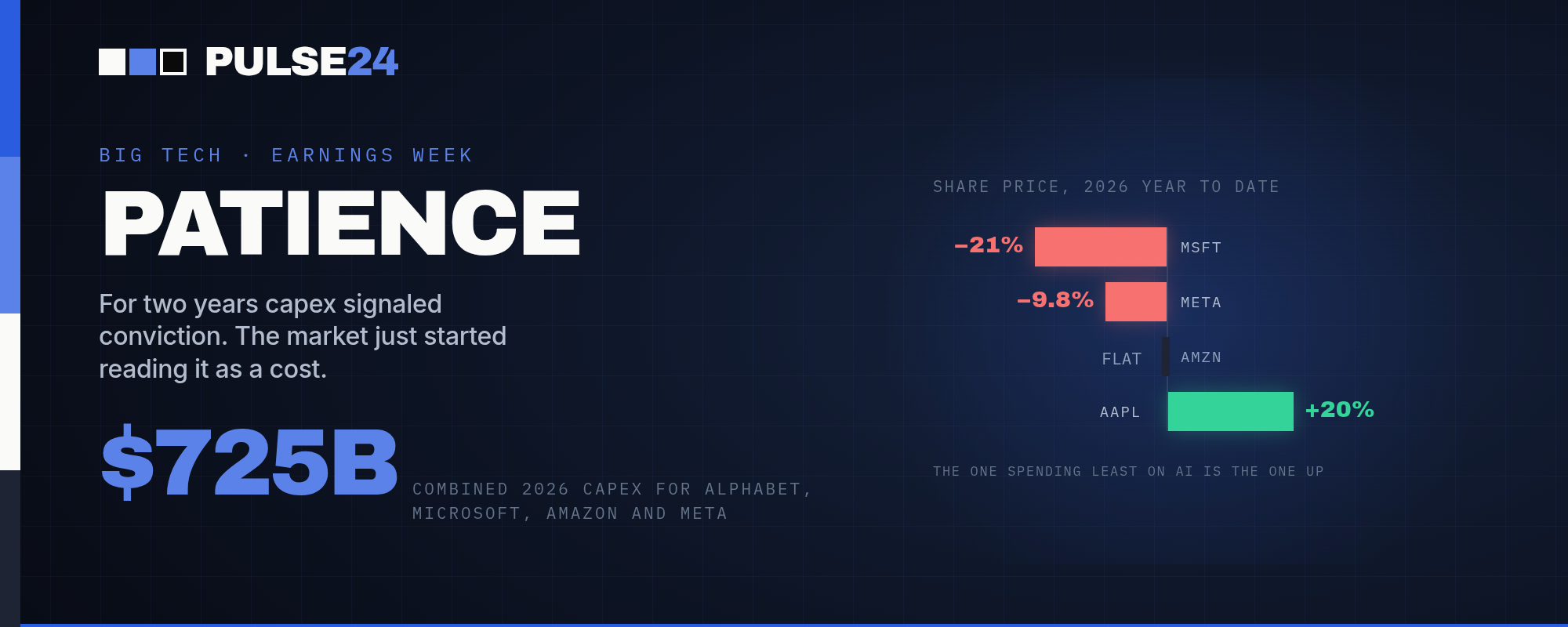
Alphabet posted its first negative free cash flow since its 2004 IPO last week after record quarterly capex, and the market punished it with the Magnificent Seven's worst single day in over a year. Now Microsoft, Meta, Amazon and Apple report this week, and Wall Street wants to know if $725 billion in planned 2026 AI spending is still worth it.
What Changed
Alphabet spent $44.9 billion in a single quarter chasing AI infrastructure, a record for any company over a three month stretch, and Wall Street's answer was to sell the stock down more than 7% in one session. That was Thursday. By the next trading day, the Magnificent Seven index had logged its worst day in over a year, down 4.8%, and the selling wasn't really about Alphabet's revenue or its cloud growth. It was about a number that used to be a badge of ambition and has quietly become a warning sign: capital expenditure.
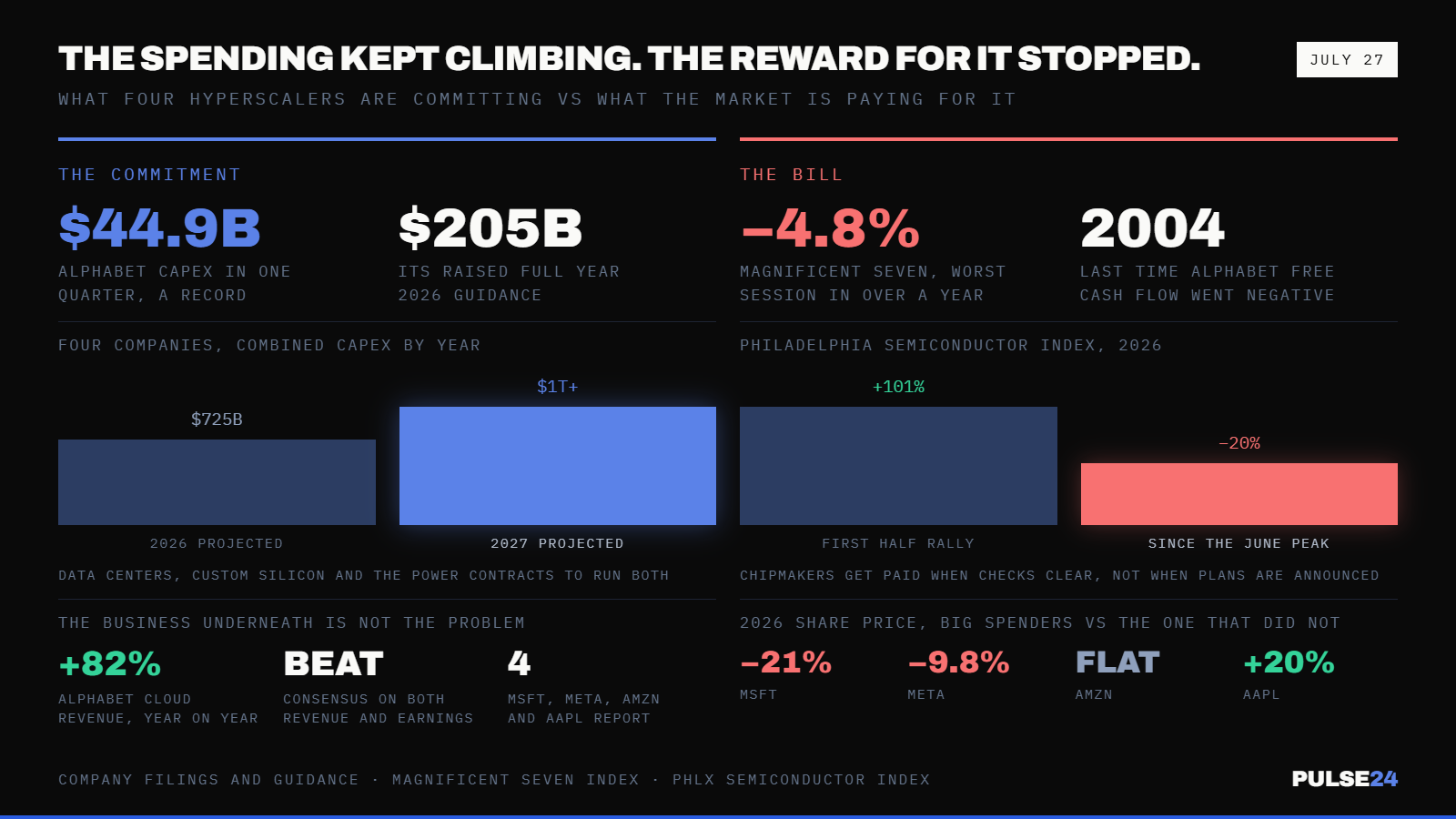
Alphabet's second quarter numbers were, by most conventional measures, strong. Cloud revenue surged 82% from a year earlier, and the company beat consensus on both revenue and earnings. None of that mattered much once investors saw the cash flow statement. Free cash flow turned negative for the first time since Alphabet's 2004 initial public offering, the direct result of raising full year capex guidance to $205 billion. A company that has spent two decades generating more cash than it could reasonably reinvest is now burning it, on data centers, custom chips and the power contracts needed to run both.
The reaction spread well beyond Alphabet's own stock. Microsoft shares are down roughly 21% for 2026, Meta has fallen about 9.8%, and Amazon is close to flat on the year, even as all three keep raising their own AI budgets. Apple is the outlier, up about 20% in 2026, largely because it has spent far less on AI infrastructure than its peers, a contrast that is itself becoming part of the market's argument. Combined, Alphabet, Microsoft, Amazon and Meta are projected to spend close to $725 billion on capex this year and top $1 trillion in 2027, sums that would have been unthinkable for any single industry cohort five years ago.
Jason Lemire, chief investment officer at Bold Wealth Partners, described the shift plainly: "People are really focused on capex, obsessed with it. It used to be the more the better, but now it is the less the better." That is a real reversal in how the market treats the same line item. For most of the past two years, bigger AI budgets signaled conviction and got rewarded with higher multiples. Now the same budgets raise questions about returns, debt and how long shareholders are expected to wait.
Why It Matters
The capex anxiety has already spilled into the chip trade that funds it. The Philadelphia Semiconductor Index rallied about 101% in the first half of 2026 on the strength of exactly this kind of spending, then fell roughly 20% from its June peak. Chipmakers don't generate revenue when hyperscalers merely plan to spend; they generate it when the checks actually clear, and a market that suddenly doubts whether Alphabet, Microsoft, Meta and Amazon will keep writing those checks at the same pace is repricing the whole supply chain at once, not just the four companies doing the spending.
There's a macro angle here too, and it's one worth tracking as one connected system rather than four earnings reports, the same lens behind Pulse24's thesis that AI infrastructure won the first trade while distribution could win the second. AI capex has grown large enough to move corporate bond issuance and equipment import data, not just tech sector multiples. Four companies spending close to three quarters of a trillion dollars in a single year is the kind of concentration that shows up in credit markets and even electricity demand forecasts. When investors start asking whether that spending pays for itself, they aren't just pricing four stocks. They're pricing a meaningful slice of this cycle's growth story.
What to Watch Next
Microsoft, Meta, Amazon and Apple all report earnings this week, and the numbers worth watching aren't revenue or EPS. Capex guidance for the back half of 2026 and into 2027 matters more than either, along with any commentary on free cash flow trajectory and depreciation schedules for AI hardware. Also worth tracking is whether any of the four say more about custom silicon, since in house chip projects are part of the same spending story and carry their own implications for Nvidia's pricing power over time. If even one of these four reports a capex number that beats Alphabet's trajectory without a credible path to returns, expect the semiconductor selloff to extend rather than stabilize.
The Pulse24 Take
None of this means AI infrastructure spending was a mistake, and it would be a stretch to call this a bubble popping based on one bad week for one index. What changed is simpler and more useful: the market's patience has a limit, and that limit apparently sits somewhere around a quarter with negative free cash flow. For two years, investors treated capex guidance like a growth metric. Now they're treating it like a cost, which is arguably the more accurate lens all along.
This week's earnings will show whether Alphabet's experience was a one off reaction to a single number, or the start of a genuine repricing of how the market values AI spending across the board. Either way, the companies involved have the balance sheets to keep spending regardless of what their stock does this week. The real question worth watching isn't whether they can afford to keep building. It's whether shareholders are willing to keep waiting for it to pay off.
How we read the data
Curious how we get from raw data to a take like this? Our Trader's Toolkit walks through the tools we lean on.
Explore the Toolkit