Pulse24 Original
The Dow Closed at a Record 53,178 Monday on the Widest Earnings Beat Since 2008. That Same Strength Is Pushing the Fed Toward a Hike, Not a Cut.
August 4, 2026
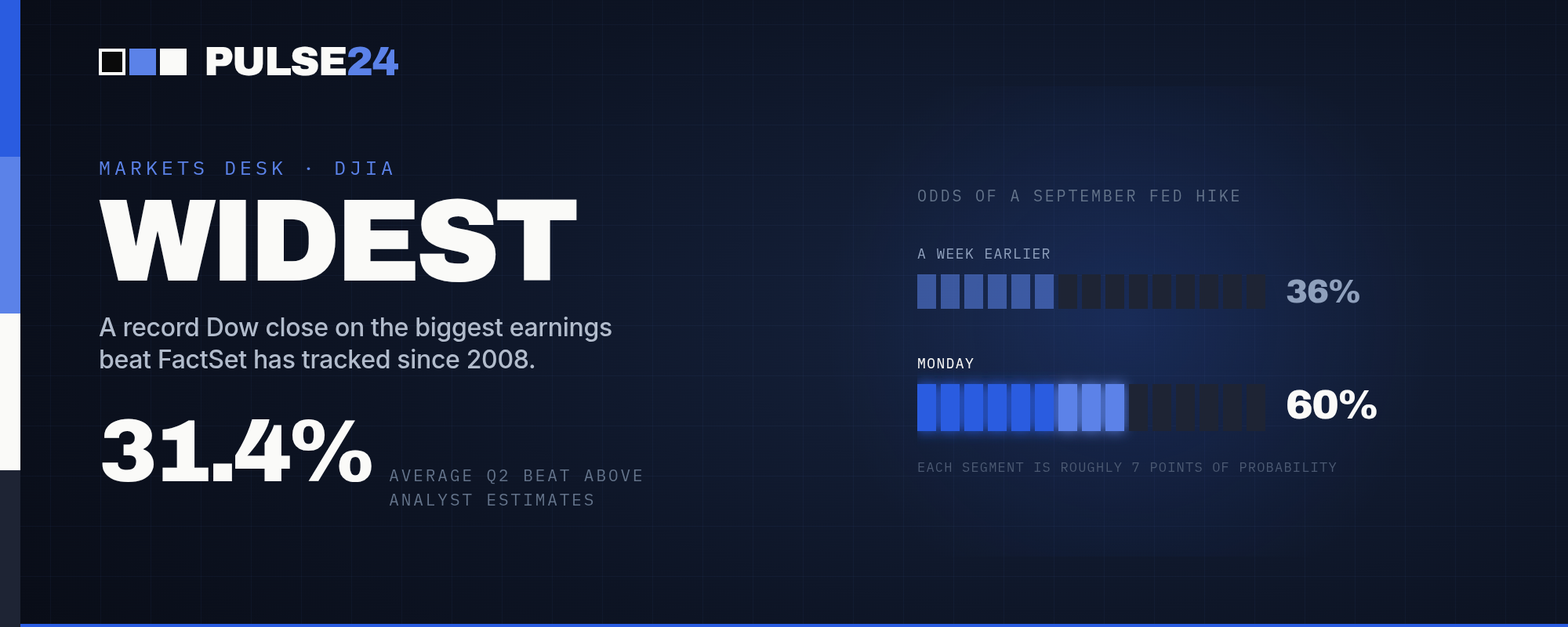
The Dow closed at a record 53,178 Monday as Q2 earnings delivered their widest beat margin since FactSet started tracking it in 2008. That same strength is now pushing Fed rate-hike odds for September to roughly 60%, not toward a cut.
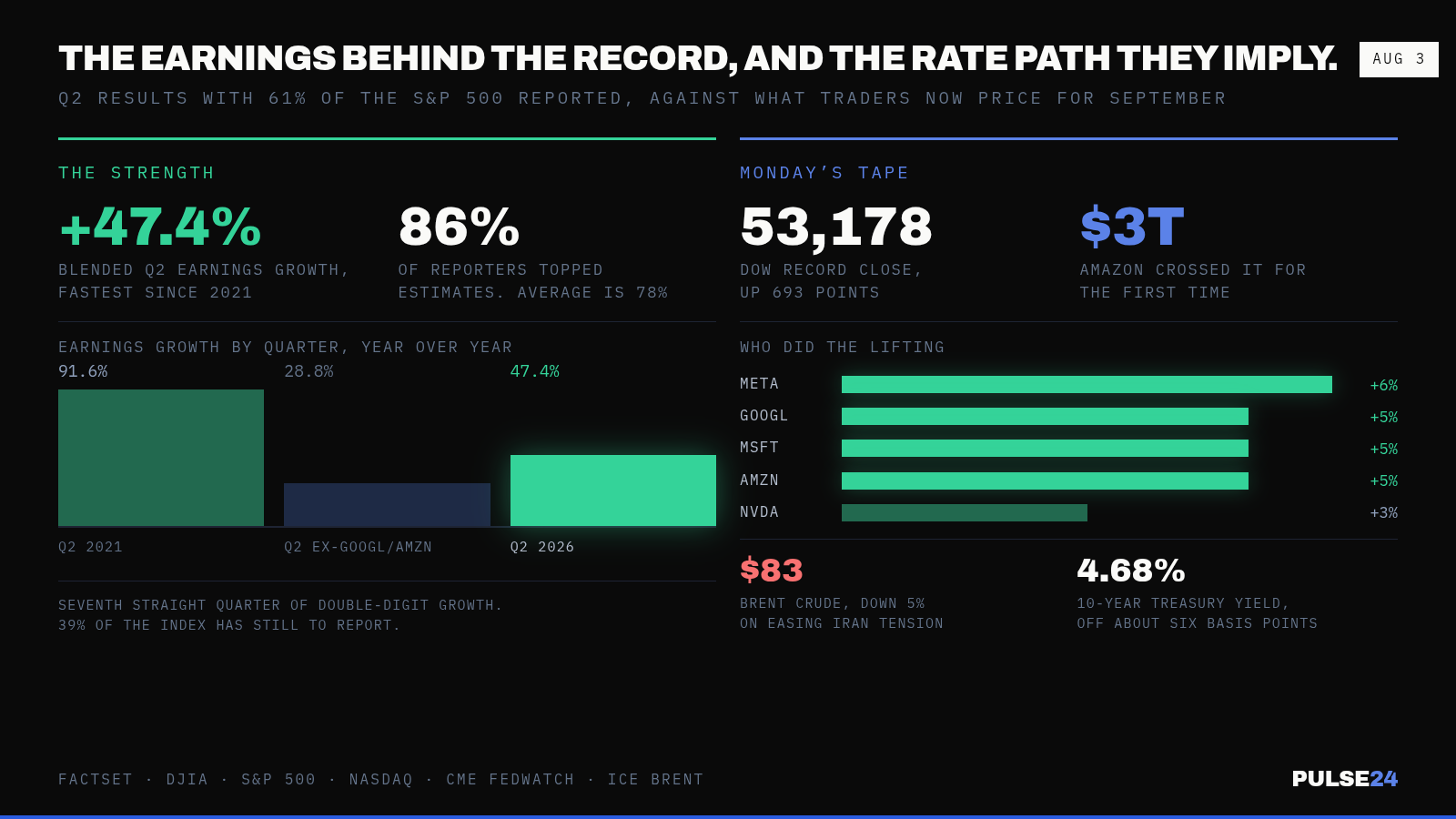
The Dow Jones Industrial Average closed at 53,178 on Monday, a record, after gaining 693 points in a single session, a 1.32% move for an index that isn't supposed to jump that much in a day it doesn't have to. The S&P 500 added 1.5%, and the Nasdaq climbed 2.1%. All three closed at their highest levels ever.
Meta climbed almost 6%. Alphabet and Microsoft each added about 5%. Amazon rose about 5% and crossed $3 trillion in market value for the first time, a threshold only a handful of companies have ever reached. Nvidia was the laggard of the group, up a comparatively modest 3%.
What Changed
Q2 earnings season is now more than halfway done, and it's turning into one of the best on record. With 61% of S&P 500 companies reporting by July 31, blended earnings growth reached 47.4% year over year, according to FactSet, the fastest pace since the 91.6% surge in the second quarter of 2021 and the seventh straight quarter of double-digit growth. Strip out Alphabet's and Amazon's outsized gains and the number falls to a still-strong 28.8%.
The beat rate is what stands out most. Of the companies that have reported, 86% topped analyst estimates, above the five-year average of 78% and the ten-year average of 76%. On average, those beats have landed 31.4% above what Wall Street expected, the widest gap FactSet has recorded since it began tracking the metric in 2008. Estimates weren't just beaten. They were beaten by a historic margin.
Communication services, home to Meta and Alphabet, was Monday's best-performing sector, up more than 4%. That's the same group whose spending drew scrutiny just days earlier, when Microsoft's Azure business topped $100 billion in revenue the same night Meta's free cash flow fell to $784 million on AI infrastructure costs. Investors appear to be looking past the cash burn and toward the revenue it's starting to generate.
Oil helped too, though not because of anything happening in the oil market itself. Brent crude fell about 5% to near $83 a barrel Monday, and West Texas Intermediate dropped more than 7% to about $79, after President Trump signaled the US was stepping back from further escalation involving Iran. Lower energy costs flow through to nearly every other price in the economy, and traders treated the pullback as a tailwind for the inflation outlook, at least for one day.
Why It Matters
A record-breaking rally built on real earnings growth should be reassuring on its own terms. But that same growth is part of why the market now leans toward a Fed hike instead of a cut. Traders are pricing roughly a 60% chance of at least a quarter-point hike at the September 15-16 meeting, up sharply from about one in three just a week earlier. An economy generating 47% earnings growth doesn't look like one that needs emergency rate cuts. It looks like one that might be running hot.
That's a different problem than the one investors spent most of July worrying about. Big Tech's AI spending drew an investor revolt in late July, with markets punishing companies for capital expenditure that hadn't yet shown a return. Monday's rally looks close to the opposite reaction: proof, in the form of actual reported revenue, that at least some of that spending is starting to pay off. Whether that's enough to keep the AI trade funded through another quarter of heavy capex is still an open question. What changed is that the market got real numbers instead of guidance.
The 10-year Treasury yield told a slightly different story, slipping about six basis points to roughly 4.68% even as hike odds rose. That's not necessarily a contradiction. Falling oil prices ease near-term inflation pressure, which can pull yields down, while stronger growth keeps the bar the Fed needs to clear before cutting rates higher. Bond and equity markets are reading the same data and drawing related but not identical conclusions.
What to Watch Next
AMD and SpaceX both report earnings after Tuesday's close, in what strategists have started calling expectations week. AMD's results will be one of the more direct tests of whether chip demand can keep validating the AI capex story, especially after weeks of volatility in Samsung and SK Hynix shares tied to the same underlying trade.
The bigger date on the calendar is September 15 and 16, when the Fed's Open Market Committee meets next. Between now and then, every inflation print and jobs report will get read through the lens of Monday's numbers, as evidence either that growth can continue without lower rates, or that it's strong enough to handle higher ones. Roughly 39% of the S&P 500 still has to report Q2 results, so there's a real chance this earnings season's growth rate moves again before it's final.
The Pulse24 Take
Records are easy to celebrate and easy to misread. The part of Monday's rally worth paying attention to isn't the index level. It's what's underneath it: a genuinely strong earnings season, with beat rates and surprise margins that haven't been this wide in years. That's a healthier foundation for a record high than momentum or multiple expansion alone would be.
Strength cuts both ways when the Fed is the one deciding what happens next, though. A market this good at generating earnings growth is also a market that's harder to justify cutting rates for. The same data that sent the Dow to a record on Monday is part of why traders now see a hike as more likely than a cut in September. Investors got the rally they wanted. They may also be getting the rate path they didn't.
None of this is settled. Oil could bounce back toward its highs, and one soft jobs report could flip the Fed conversation before September just as easily. What Monday actually proved is narrower than "everything is fine": corporate America, especially in AI and cloud, delivered real numbers that beat already-high expectations. What the market does with a stronger economy and a more hawkish Fed at the same time is the question this earnings season still has to answer.
How we read the data
Curious how we get from raw data to a take like this? Our Trader's Toolkit walks through the tools we lean on.
Explore the Toolkit