Pulse24 Original
This Isn't Earnings Week. It's Expectations Week.
August 2, 2026
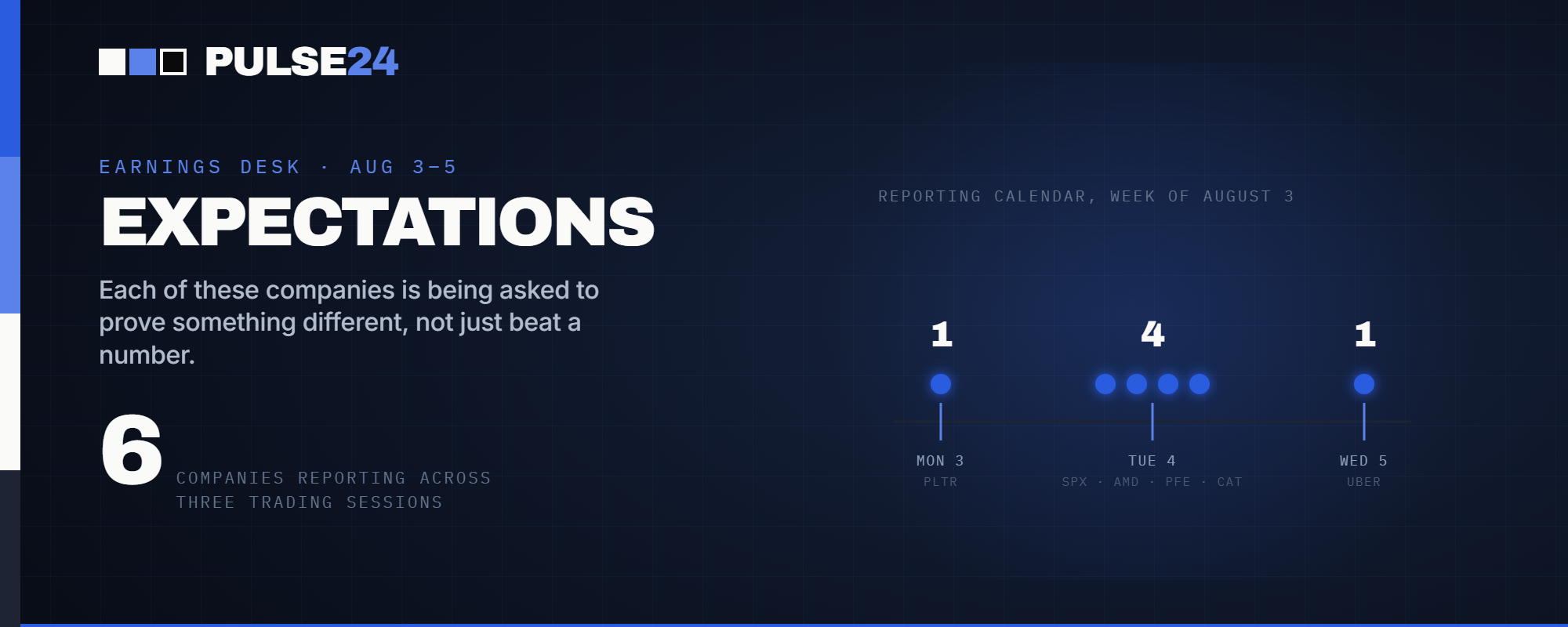
Six companies report between August 3 and 5, including SpaceX's first quarterly results as a public company, and each one is being asked to prove something different, not just beat a number. Here's what has to show up in each report, and what the numbers already say about how much room for error the market is giving them.
Six companies report between August 3 and August 5, and on paper they have almost nothing in common: a rocket company, two AI infrastructure bets, a pharma giant, a machinery maker, and a ride-hailing platform. Line them up, though, and each one is being asked to prove a different thing entirely, not just beat a number.
SpaceX has to justify a $1.5 trillion IPO valuation with zero earnings history behind it. AMD has to show its AI acceleration is arriving on the schedule it promised. Palantir has to prove last quarter's growth was a trend and not a peak. Pfizer has to prove stability is still worth paying for. Caterpillar has to prove the AI buildout still needs its generators, even as the market gets nervous about the buildout itself. Uber, the one name here that isn't an AI story at all, has to prove profitability can keep compounding without one.
Markets spent the first half of 2026 rewarding ambition. This week, the market starts asking for evidence.
SpaceX: A Report With No Precedent to Compare It To
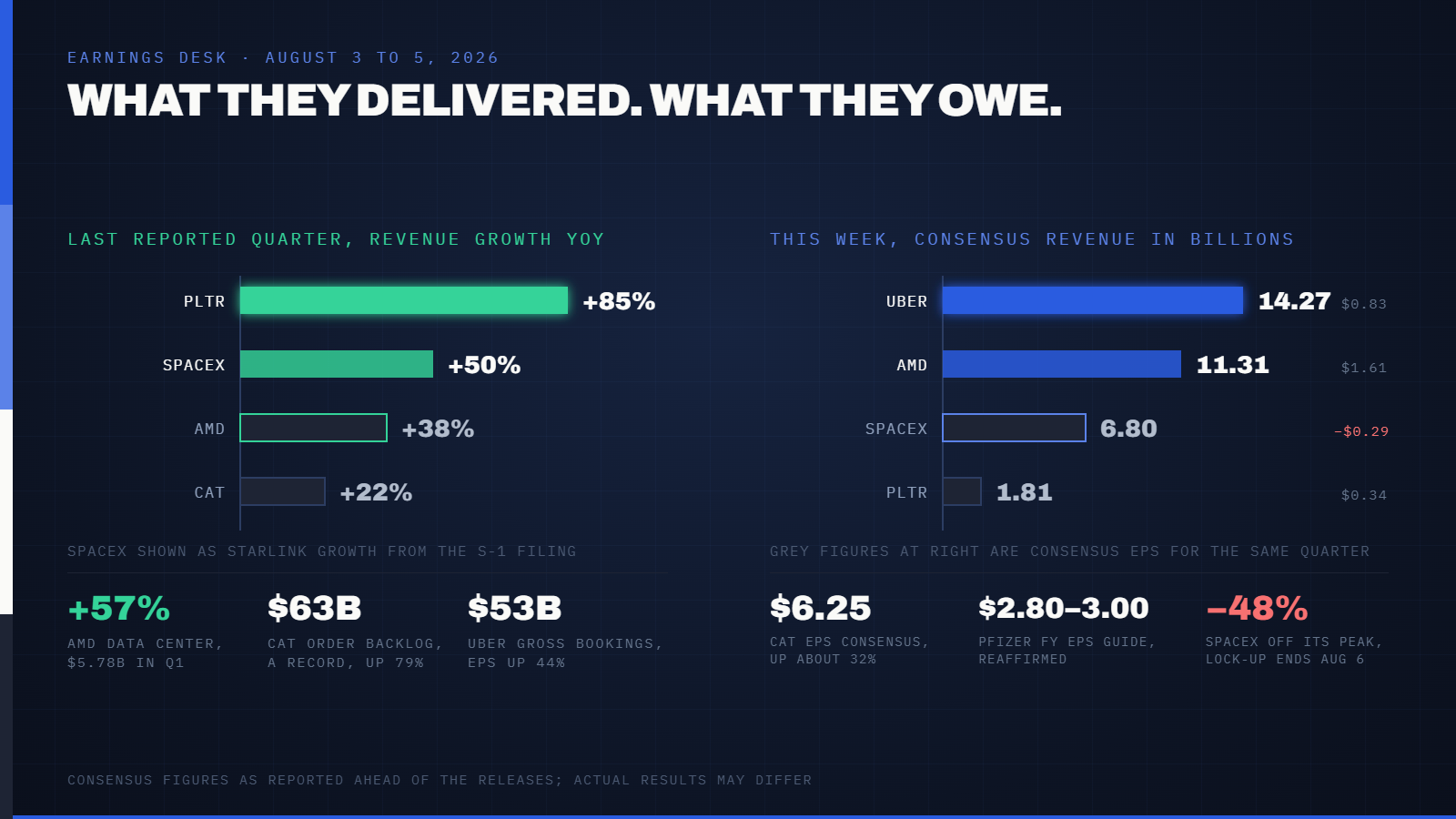
There isn't a "last quarter" to look back on here in the normal sense. SpaceX IPO'd in June at $135 a share, and everything the market currently knows about its financials comes from the S-1 filing: $19.3 billion in trailing 12-month revenue through March, Starlink driving roughly 61% of 2025's total ($11.4 billion) and growing near 50% year over year, a $2.6 billion operating loss for 2025 alongside a positive $6.6 billion in adjusted EBITDA. That last pairing is the pitch management has been making all along, that the heavy spending on Starship is funded by a genuinely profitable core business rather than by burning cash.
Tuesday's report, the company's first as a public company, is where that pitch gets tested with real numbers instead of a filing. Analysts are modeling around $6.8 billion in revenue and a per-share loss near $0.29. The complicating factor is timing: two trading days after the release, up to 20% of employee and early-investor shares unlock for the first time, and shares are already down to around $118 from a post-IPO peak of $225.64, a near-48% slide. At roughly 80 times trailing sales, the stock has essentially no room for a quarter that reads as anything less than confident, and no forward guidance has ever been given, so Tuesday will also be the first time the market hears management frame its own expectations rather than infer them from a prospectus.
AMD: Chasing Its Own Guidance
The market already believes AMD can grow. The question this week is whether the company can hit the number it set for itself three months ago, not whether growth exists at all.
That number is steep. First-quarter revenue came in at $10.25 billion, up 38% year over year, with data center revenue, the figure that actually moves the stock, up 57% to $5.78 billion and free cash flow at a record $2.57 billion. Off the back of that, AMD guided second-quarter revenue to roughly $11.2 billion. The Street now sits at $11.31 billion in revenue and $1.61 in EPS, more than triple the $0.48 posted a year ago.
AMD doesn't need another growth quarter. It needs proof the roadmap is arriving on schedule, that the MI350 and MI450 GPU lines are shipping at the pace built into that guide, on the same AI chip supply chain that already carried TSMC and Broadcom to record results, that gross margin holds near the 56% level management pointed to, and that EPYC server CPU demand keeps trending up against a newly resurgent Intel, since that's the less glamorous business the whole data center franchise sits on top of. Shares trade around $472 against a consensus target near $529, a gap that reflects how much of the AI story is already priced in.
Palantir: The Beat Wasn't the Problem Last Time
Palantir grew revenue 85% last quarter. The stock fell almost 6% anyway.
That reaction is the whole story going into Monday's report. At Palantir's multiple, a beat on its own hasn't been enough for a while; what the market wants is proof the growth rate is structural rather than a hot stretch. Consensus for this quarter sits at $1.81 billion in revenue and $0.34 in adjusted EPS, and several sell-side desks think that's light, modeling growth closer to 85% again, above the roughly 79% the company had guided to previously. A full-year guidance raise, from the low-70s percentage range toward 75% or higher, would be the clearest signal management sees the acceleration as durable. So would U.S. commercial revenue holding above 65% growth rather than cooling off from last quarter's milestone, when it crossed 100% growth for the first time.
The market has stopped paying simply for fast growth. Now it wants confidence the growth rate isn't peaking, and that shift shows up in the valuation: Palantir's forward price-to-earnings multiple has already compressed from north of 200 to around 80, even with analyst targets still clustered between $175 and $200. That's not a stock being punished. It's a stock being asked to keep proving itself every ninety days.
Pfizer: The Bar Is Just Consistency
Pfizer's ask this week is the least dramatic of the six. Beat estimates, hold guidance, keep executing. First-quarter revenue of $14.5 billion topped a $13.8 billion consensus, adjusted EPS of $0.75 beat $0.72, and management reaffirmed full-year guidance of $2.80 to $3.00 in adjusted EPS on $59.5 to $62.5 billion in revenue.
What matters Tuesday morning is the mix, oncology continuing to offset an aging COVID franchise and expiring patents, not the headline. Shares trade near $25, in a value-and-income range where the dividend does as much work as the growth story. "Good enough" simply means something different here than it does for AMD or Palantir this week.
Caterpillar: A Record Backlog Meeting a Tariff Bill
Caterpillar's first quarter had two storylines running at once. Revenue rose 22% to $17.4 billion and the order backlog hit a record $63 billion, up 79% year over year, powered by 22% growth in Power and Energy (largely generators and turbines feeding the same data center buildout now colliding with power constraints in Texas) and 38% growth in Construction Industries. At the same time, the company absorbed roughly $600 million in tariff costs and raised its full-year estimate to $2.2 to $2.4 billion, with another $700 million flagged for the second quarter alone.
Tuesday's report, before the open, is really a question of which storyline wins. Consensus EPS sits at $6.25, up about 32% from a year ago, but the more interesting test is whether Caterpillar can pass tariff costs through in pricing without slowing the order momentum behind that backlog, and whether Power and Energy keeps growing even as investors grow twitchy about the data center buildout after several analysts flagged New York's construction moratorium as a warning sign. The stock has already priced in some of that anxiety: CAT sits around $815, down from a 2026 high of $1,073, on six straight weeks of declines heading into the print, its longest losing streak in years. This has become as much a referendum on the AI power buildout thesis broadly as it is on Caterpillar's own numbers.
Uber: The One That Isn't an AI Story
Uber has mostly avoided becoming an AI stock, and that's precisely what makes its setup different from the other five names this week. There's no data center narrative propping the valuation up and no multiple compression risk tied to a GPU ramp. The bar is simpler and, in some ways, harder to dress up: keep growing bookings, keep converting that growth into profit, and don't let costs from the next big platform bet, autonomous vehicles, eat into either one.
Last quarter set that bar. Revenue technically missed estimates, but gross bookings blew past $53 billion and non-GAAP EPS rose 44%, enough that the stock rallied anyway, and management's own second-quarter guidance came in ahead of what analysts had modeled. Consensus for Wednesday's report, before the open, now sits at $14.27 billion in revenue and $0.83 in EPS, up from $0.63 a year ago, with estimates that have crept higher over the past 90 days as visibility improved. Watch gross bookings across Mobility and Delivery, trips per active user, and how much of the mix advertising now represents, since that's the highest-margin layer Uber has added to the business. Any comment on autonomous vehicle partnerships will draw outsized attention too, less for what it says about this quarter than for what it signals about how much Uber plans to spend chasing a category everyone else is spending on already.
The Test Underneath All Six
Every one of these companies is being asked to convert a story into a number. SpaceX has to convert an IPO narrative into an actual quarter. AMD and Caterpillar have to convert AI infrastructure demand into shipped product and passed-through pricing. Palantir has to convert a hot streak into a trend line. Pfizer has to convert stability into something that still counts as growth. Uber has to convert scale into margin without borrowing anyone else's story to do it.
Markets don't usually change what they reward overnight. They change it one earnings report at a time. By Friday, there should be a much clearer read on whether investors still want ambitious AI stories on faith, or whether they're starting to expect those stories to show up in the numbers.
How we read the data
Curious how we get from raw data to a take like this? Our Trader's Toolkit walks through the tools we lean on.
Explore the Toolkit