Pulse24 Original
TSMC's Chip Sales Just Hit a Record $13.75 Billion. Broadcom Just Guided to $100 Billion That Isn't Nvidia's.
July 27, 2026
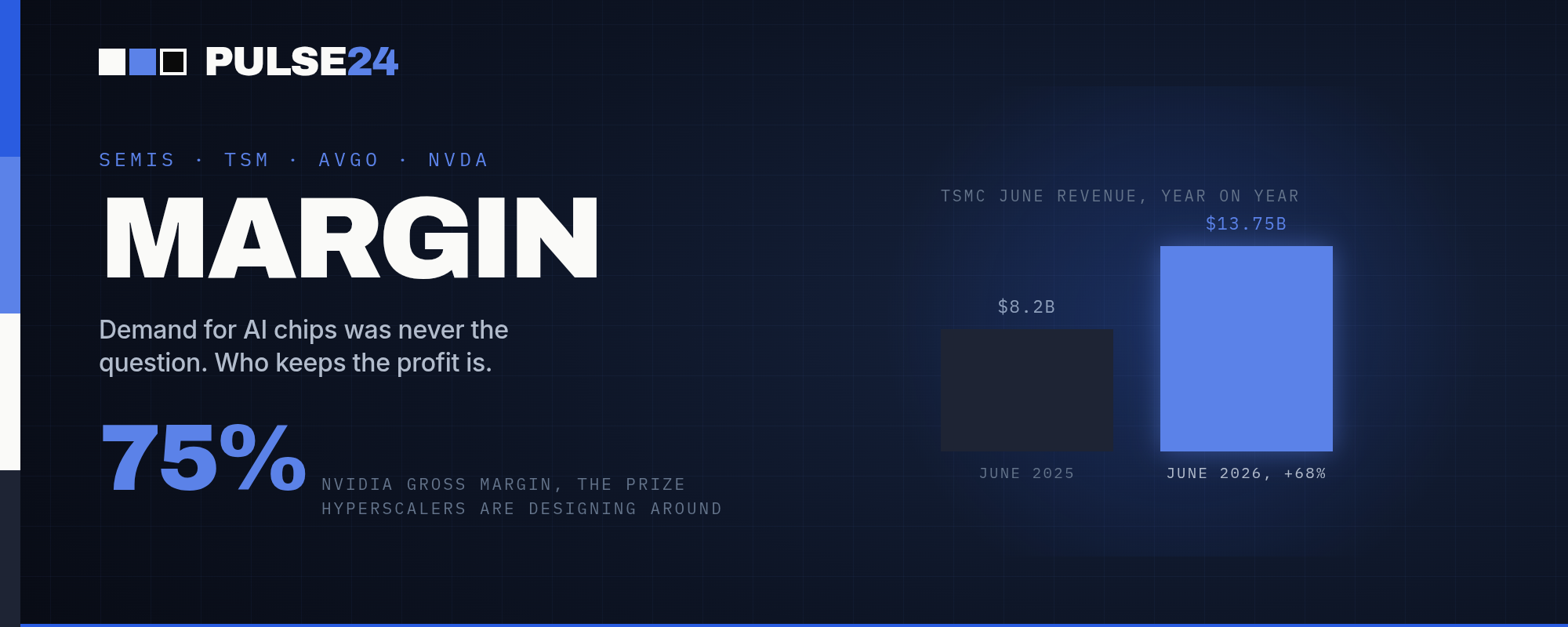
TSMC booked a record $13.75 billion in June sales, up 68% from a year earlier, proof AI chip demand hasn't cooled. Days earlier Broadcom's CEO guided AI chip revenue toward $100 billion by 2027, a number built almost entirely on custom silicon that hyperscalers are designing specifically to need less Nvidia.
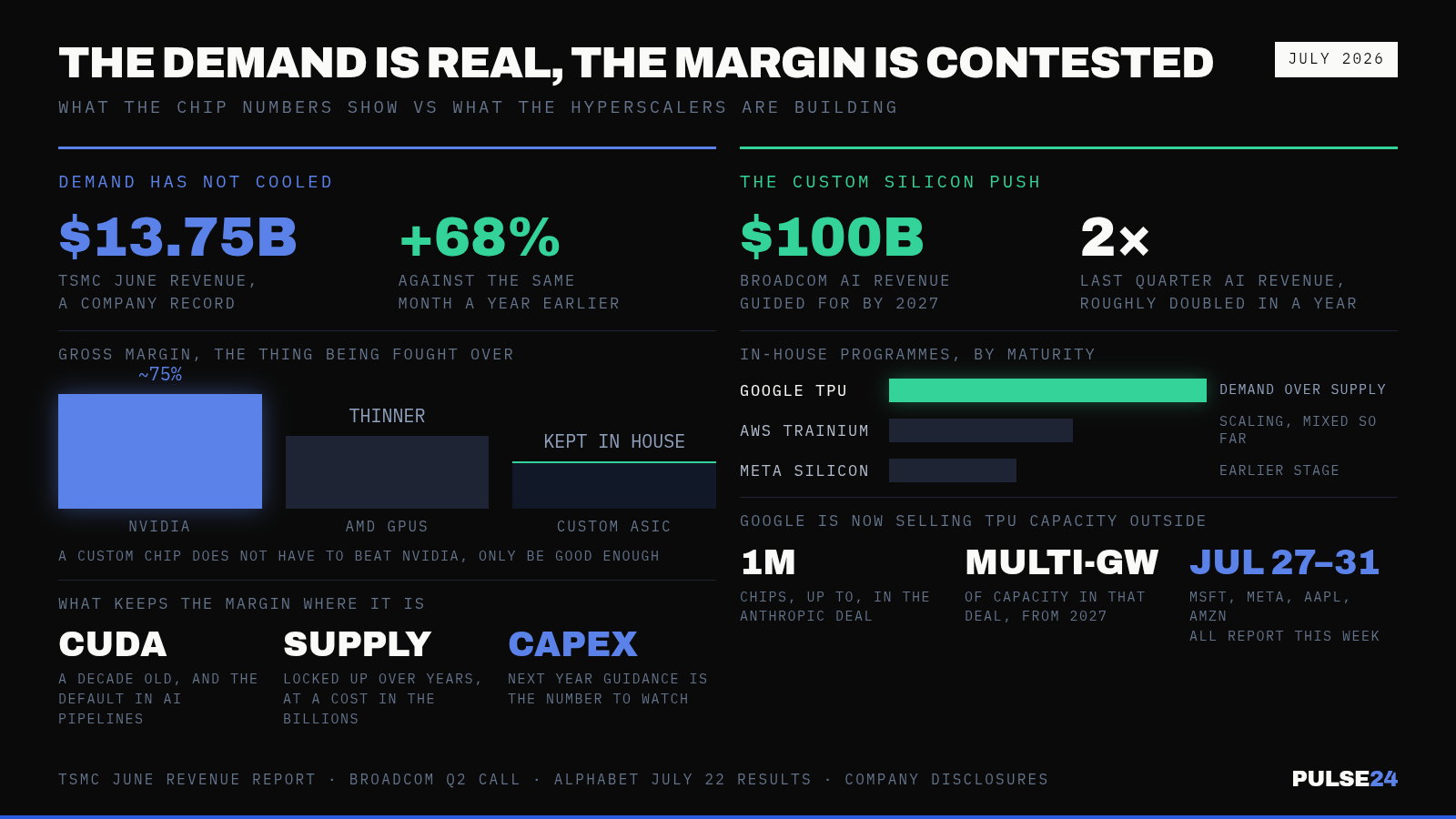
Taiwan Semiconductor closed the books on June with $13.75 billion in revenue, a company record and a 68% jump from the same month a year earlier. Demand for advanced chips isn't cooling. If anything, TSMC's order book looks tighter than it did in the spring.
Nine days earlier, Broadcom gave investors a different kind of number. The company's AI chip revenue roughly doubled year over year last quarter, and CEO Hock Tan told analysts the business is on pace for something "significantly above $100 billion" in AI-related sales by 2027. Almost none of that revenue comes from selling Nvidia-style GPUs. It comes from designing custom chips, application-specific silicon built to a hyperscaler's exact specifications, the kind Google uses to run much of its own AI workload instead of renting Nvidia's.
What Changed
Both numbers landed inside the same two-week stretch in July, and together they tell a more complicated story than either one alone. TSMC's record June confirms that physical demand for advanced chips, the kind that go into every flavor of AI accelerator, hasn't slowed at all. Wafer starts, advanced packaging capacity, and leading-edge output are all running close to their limits, the same leading-edge crunch Intel is trying to break into with its own foundry business, so far with only modest external customer wins.
Broadcom's guidance shows where the growth is actually landing. A few years ago, custom AI silicon was a side project inside a handful of hyperscalers. Now it's a $100 billion line item a public company is willing to put a number on three years out. Google's TPU line, built with Broadcom, is the most mature example. Google itself has said TPU demand is outstripping supply, with even older TPU generations still running near full utilization across its own infrastructure. Amazon's Trainium chips and Meta's in-house silicon are chasing the same playbook, with more mixed results so far, part of the same shift toward the distribution layer of the AI stack that could end up mattering as much as infrastructure itself.
Why It Matters
Nvidia's gross margin sits near 75%, a level few hardware companies anywhere come close to matching. Advanced Micro Devices, Nvidia's most direct GPU competitor, runs on noticeably thinner margins for comparable products. That gap isn't an accident. A decade-old software ecosystem, CUDA, is built into nearly every AI research pipeline and keeps developers locked into Nvidia's tools by default. A supply chain Nvidia spent years and tens of billions of dollars locking up helps too.
Custom chips don't need to out-engineer Nvidia to matter. They just need to be good enough for a hyperscaler's own workloads while letting that company keep the margin it would otherwise pay Nvidia for a GPU. That's the economics behind Broadcom's $100 billion figure, and it's why the conversation has shifted. Six months ago, investors mostly debated whether AI infrastructure spending was real. Now they're debating who captures the profit once it lands.
What to Watch Next
Microsoft, Meta, Apple, and Amazon all report earnings this week, from July 27 through July 31, and it's the closest thing markets get to a referendum on the AI capex debate. Revenue beats won't tell the full story on their own. Capital expenditure guidance for next year matters more, along with any fresh detail on each company's own chip programs.
Watch specifically for whether any of the four raises or trims its own data center spending plans. Alphabet already set the tone here: it reported on July 22 with a capex hike of its own, and Google has been selling TPU capacity to outside customers since it announced the shift back in April. Anthropic is already the biggest confirmed taker, with a deal for multiple gigawatts of TPU capacity, up to a million chips, starting in 2027. If this week's results from Microsoft, Meta, or Amazon add any hint of similar arrangements, that's the clearest sign yet that Google has moved from being one of Nvidia's biggest customers toward being one of its more credible competitors.
The Pulse24 Take
None of this means Nvidia is losing. Its order book is still enormous, its margins are still the envy of the industry, and nothing in TSMC's or Broadcom's numbers suggests hyperscalers are buying fewer GPUs this year. What's changed is the question investors are asking. A year ago, the debate centered on whether AI infrastructure spending was real. Now it centers on whether the companies footing that bill can build enough of their own chips to keep more of the return for themselves.
That's a slower, more structural fight than any single earnings beat or miss, and it won't resolve this week. But this week's results will show which way the wind is blowing, and TSMC's record June is a reminder that whatever happens to the margin split, somebody still has to build the chips in the first place.
How we read the data
Curious how we get from raw data to a take like this? Our Trader's Toolkit walks through the tools we lean on.
Explore the Toolkit