Pulse24 Original
Intel Just Posted Its Best Quarter in 15 Years. Wall Street Sold It Anyway.
July 25, 2026
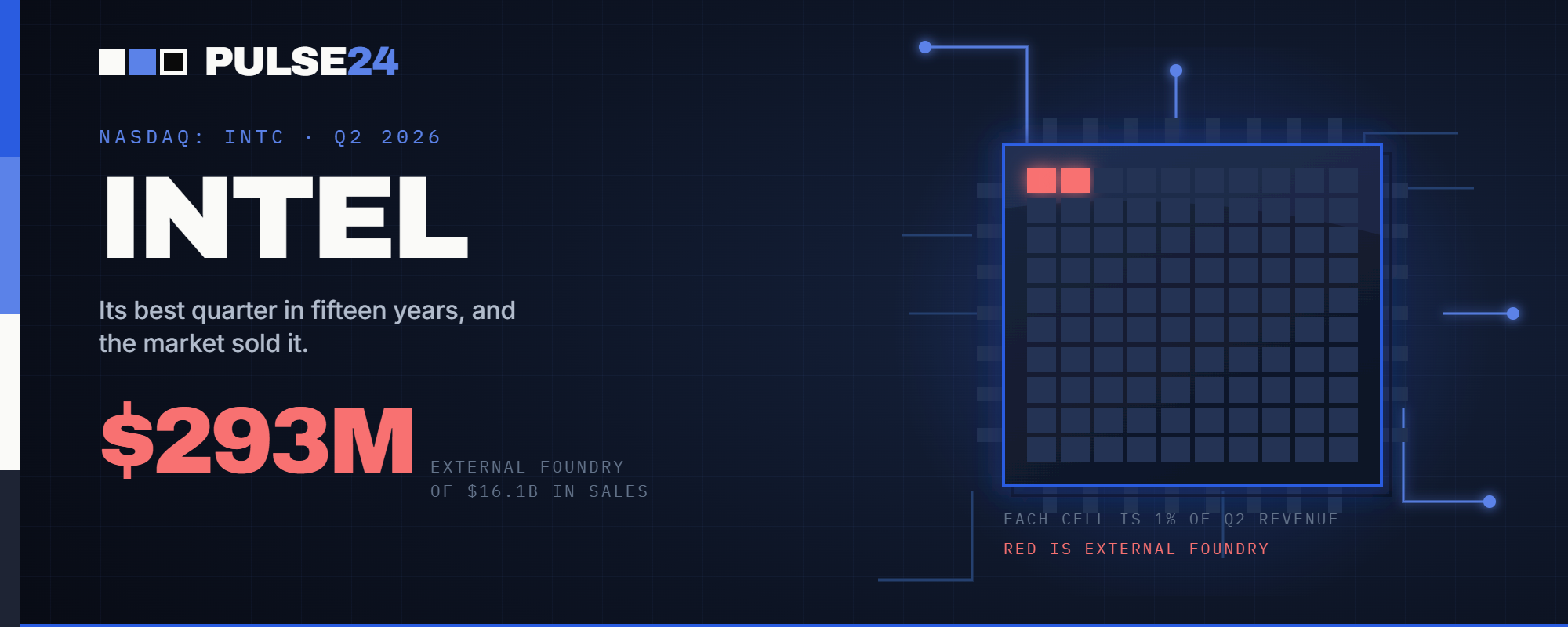
Intel's Q2 revenue grew 25% and beat guidance on a 59% jump in AI and data center sales. The stock popped 13% after hours, then gave it all back and more the next session as investors focused on foundry proof points instead of chip demand.
What Changed
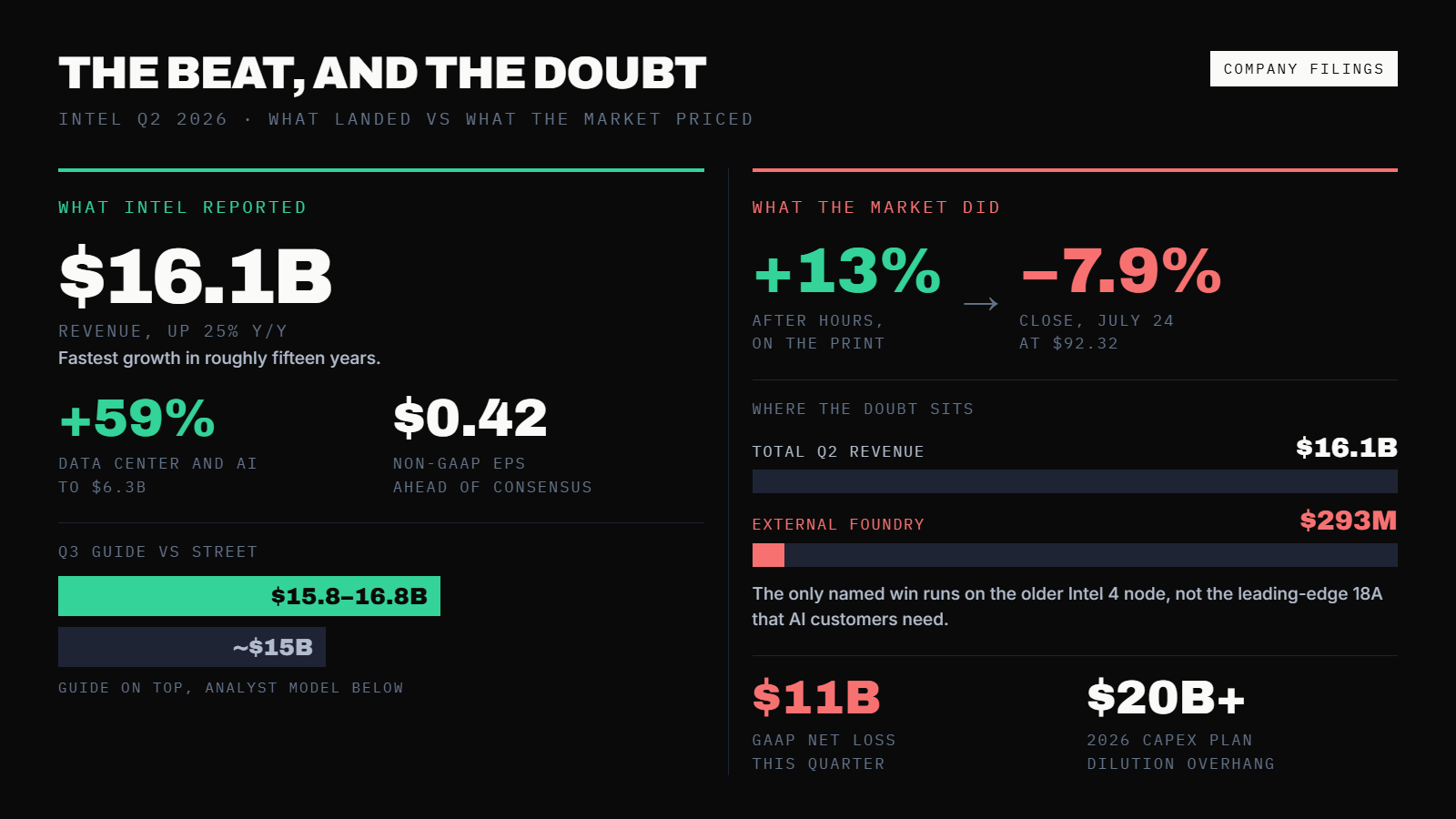
Intel walked into Thursday's earnings call carrying a stock that had already roughly tripled off its 2025 lows, and for about twenty minutes after the numbers hit the wire, that rally looked justified. Revenue of $16.1 billion beat estimates and marked Intel's fastest year-over-year growth in about fifteen years. The Data Center and AI segment, the unit investors care most about, grew 59% to $6.3 billion. Non-GAAP earnings of $0.42 a share cleared consensus, and the Q3 revenue guide of $15.8 billion to $16.8 billion sat well above the roughly $15 billion analysts had penciled in. Shares spiked as much as 13% in after-hours trading. CEO Lip-Bu Tan told investors, "AI is driving unprecedented demand for compute, and as we continue to execute, Intel is well-positioned," and for a company that spent much of the last two years explaining why it was losing ground to Nvidia and AMD, that was the headline management wanted.
It didn't hold. By the close of trading on July 24, Intel had fallen 7.89% to $92.32, a reversal that erased the entire after-hours pop and then some. The proximate causes were less about the quarter Intel just reported and more about the one it's still building toward. Investors zeroed in on the foundry business, the contract manufacturing arm Intel is betting its next decade on, and asked a question the earnings release didn't fully answer: will outside customers show up in volume, and on Intel's most advanced nodes. Foundry segment revenue came in at $5.8 billion, up 6% sequentially, with the operating loss narrowing but still there. External Foundry revenue, the piece that actually proves outside customers are paying Intel to build their chips, was just $293 million. The highest-profile named win so far, a deal with Fortinet announced two days before earnings to build the next generation of its FortiGate firewall chip at Intel's Fab 34 in Ireland, runs on the mature Intel 4 process, not the leading-edge 18A node that AI customers actually care about. Management said 18A output is exceeding its own internal volume targets and pointed to $30 billion in cash plus a $10 billion credit revolver as ample funding, while leaving the door open to tapping capital markets if the buildout needs more. None of it stopped the GAAP net loss from landing at $11 billion for the quarter, a real number attached to how much this bet currently costs.
Why It Matters
The Intel divergence is a cleaner version of a pattern that's shown up across this earnings season: the market no longer treats AI-related capex as an automatic pass. It wants the spending to convert into contracted revenue on a visible timeline, and it's willing to punish a beat-and-raise quarter that doesn't spell that out. Intel's stock move rhymes with what happened to Micron about a month earlier: a quadrupled year-over-year revenue print drove an initial pop before Micron shares slid roughly 30% over the following weeks on broader AI infrastructure and margin concerns, not the earnings print itself. Different chip companies, different timelines, but the same underlying question from investors: prove the spending turns into cash, not just backlog.
There's also a supply-chain diversification angle that matters beyond Intel's stock price. Every named customer Intel adds to its foundry roster, even one building on a mature node like Intel 4 rather than 18A, is a data point for companies that want a manufacturing option outside Taiwan for at least part of their chip needs. Fortinet's federal and critical-infrastructure customers have been pushing for exactly that kind of domestic manufacturing provenance, and Intel's win there is a proof of concept, not yet a volume business. The real test is whether that logic extends up to Intel's leading-edge nodes, where the AI chip customers with real pricing power actually sit. That's the piece Intel still has to prove, and it's why $293 million in external revenue landed as a bigger story than $16.1 billion in total revenue.
What to Watch Next
The next real test isn't another earnings call, it's whether Intel converts foundry interest into disclosed, priced production contracts on its leading-edge nodes. Watch for named customers signing onto 18A specifically, not just mature-node wins like the Fortinet deal, since that's the node segment investors are actually pricing. Watch Intel's balance sheet commentary too: the speculation about tapping capital markets to fund continued fab spending is the kind of overhang that won't clear until management addresses it directly, and either a confirmed capital raise or a clear statement ruling one out would move the stock more than another quarter of revenue growth.
Zoom out and this is a signal for the broader chip and AI infrastructure trade. If Intel's foundry ambitions keep drawing skepticism even as its core AI-driven demand accelerates, expect investors to keep drawing a hard line between AI revenue that's already landed and AI capex that's still a promise, across the rest of this earnings season.
The Pulse24 Take
Intel had the numbers to justify a straightforward win this week and got a selloff instead, which says more about where investor patience sits right now than anything in the press release. The AI demand side of Intel's business is real and it's accelerating; a 59% jump in Data Center and AI revenue isn't a rounding error. But that story is now competing with a foundry bet that's expensive, unproven at scale, and carrying an $11 billion quarterly net loss as its current price tag.
This is the same tension running through Alphabet's $205 billion capex commitment this earnings season: the AI infrastructure buildout is no longer getting a blank check just for showing up. Companies that can point to revenue landing now are being separated from companies still asking for patience, and Intel, oddly, is sitting in both camps at once. That's not a reason to write off the turnaround. It's a reason to watch the next two quarters of foundry disclosures more closely than the headline revenue number, because that's where this story actually gets decided.
How we read the data
Curious how we get from raw data to a take like this? Our Trader's Toolkit walks through the tools we lean on.
Explore the Toolkit