Pulse24 Original
Samsung and SK Hynix Each Fell Nearly 9% Monday, One Trading Day After Their Best Session Ever. Morgan Stanley Calls the Reversal a Buying Opportunity.
August 3, 2026
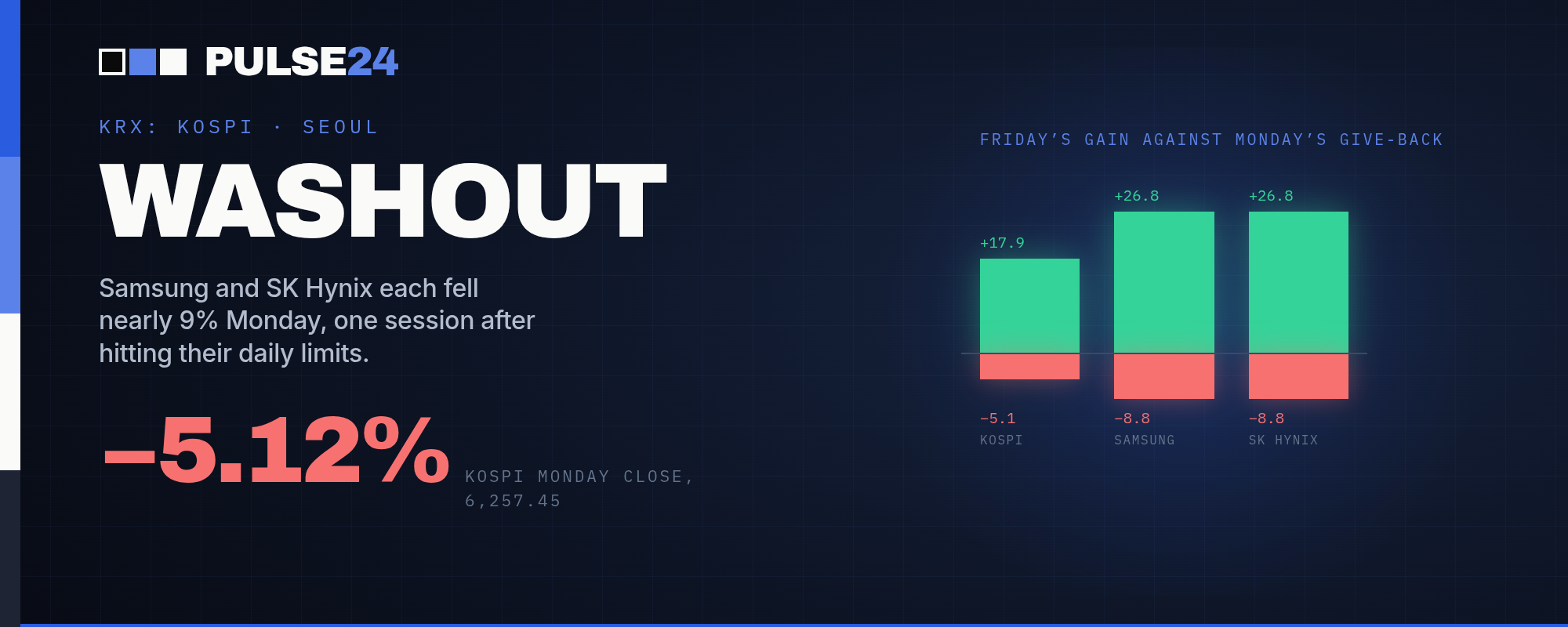
Korea's chipmakers gave back part of Friday's record rally on Monday, with Samsung and SK Hynix each falling nearly 9% and the Kospi dropping more than 5%. Morgan Stanley says the pullback is a technical washout, not a sign AI demand is cracking, and just raised its Kospi target to 9,000.
Samsung Electronics fell 8.76% in Seoul on Monday. SK Hynix dropped 8.79% right alongside it. A day earlier, both stocks had done the exact opposite, surging 26.81% to hit their daily price limits and helping drive South Korea's Kospi index to the biggest one-day gain in its history.
That kind of round trip, a record rally followed almost immediately by a sharp give-back, says less about memory chip demand than it does about how crowded this trade had gotten. Friday's surge was driven by optimism that AI data centers will keep outrunning chip supply for years. Monday's reversal is a reminder that conviction in that story is still thin enough to unwind in a single session.
What Changed
The Kospi fell 338.00 points, or 5.12%, to close at 6,257.45. Samsung Electronics ended the session at 239,500 won, down from Friday's 262,500 won. SK Hynix closed at 1,567,000 won, down from 1,718,000 won.
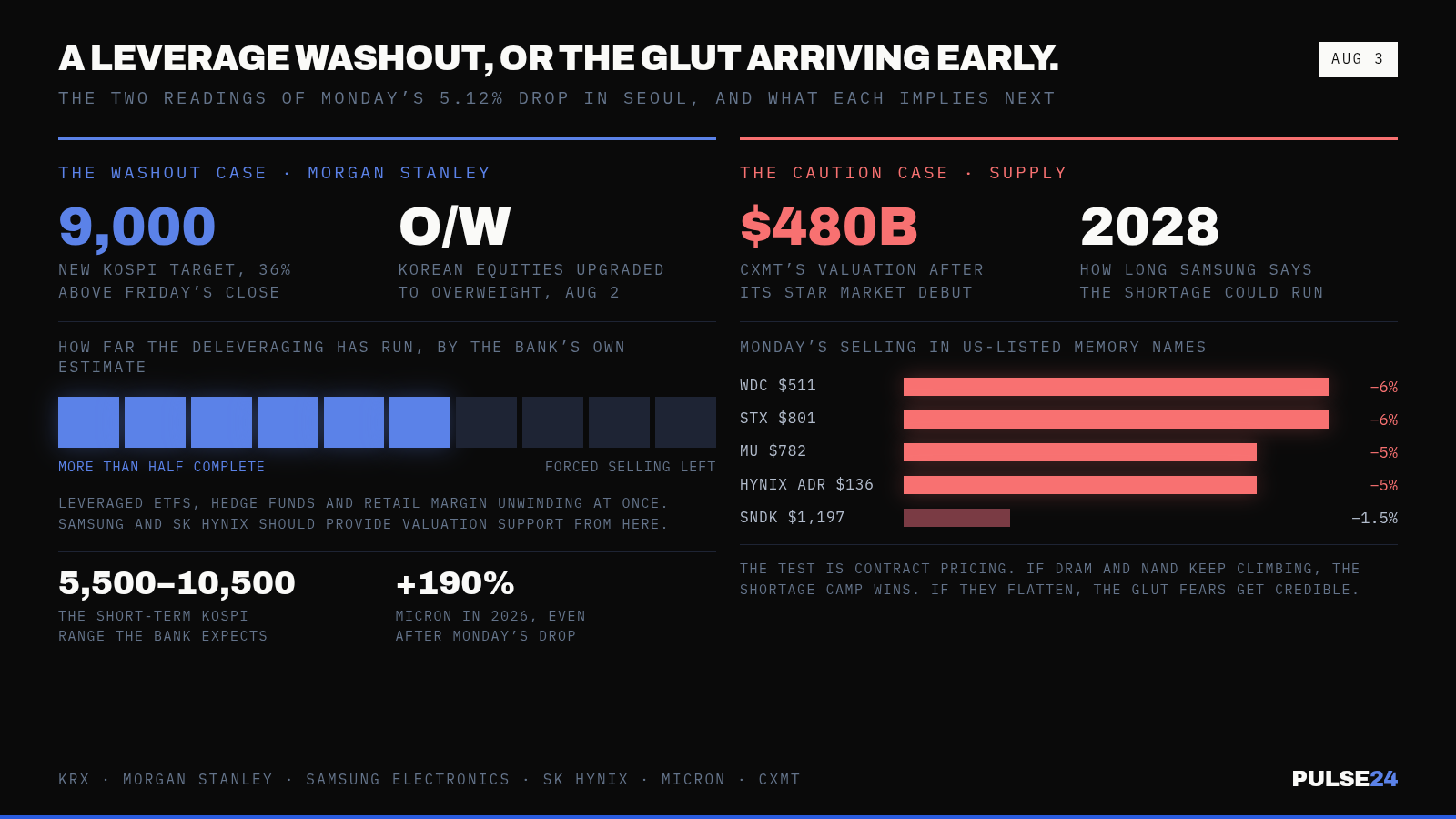
The selling carried over to memory stocks listed in the US. Micron Technology fell 5% to $782. Western Digital and Seagate Technology each dropped 6%, to $511 and $801. The SK Hynix American depositary receipt slid 5% to $136, while SanDisk held up better, off just 1.5% to $1,197.
None of this erased the gains these stocks have booked this year. Micron is still up roughly 190% in 2026, even after Monday's drop. The pullback looks more like profit-taking after an extraordinary run than the start of a new trend, at least so far.
Washout, Not Warning
Wall Street has spent the past several weeks arguing about whether the memory chip rally is built on real scarcity or thin positioning, and Monday's move landed right in the middle of that argument. Morgan Stanley's read was blunt. The firm called the decline "largely technical," attributing it to a "leverage washout" as leveraged ETFs, hedge funds and retail investors on margin all unwound positions at once. Strategist Daniel Blake wrote that the deleveraging process is now more than halfway complete, and that Samsung and SK Hynix should provide valuation support from here.
That framing matters because it draws a line between two very different explanations for a selloff: one where the crowd got ahead of itself and needs to clear out before the trend can resume, and another where the underlying story, AI-driven memory scarcity, was overstated to begin with. Morgan Stanley is betting on the first. The bank raised its Kospi target to 9,000, implying 36% upside from Friday's close, and pointed to the industrial and AI supercycle as still-intact demand drivers.
The Case for Caution
The skepticism side has its own case, and it doesn't require much digging. This whole run traces back to a scare in late July, when China's CXMT listed on Shanghai's STAR Market and surged to a $480 billion valuation, stoking fears that Chinese capacity would eventually flood the DRAM market just as Samsung and SK Hynix were being priced for scarcity. That story hasn't gone away simply because Korean stocks bounced hard on Friday.
Samsung itself has warned the memory shortage could persist into 2028, a forecast that cuts squarely against the oversupply thesis. Both narratives, shortage and glut, are still fighting for control of this trade on a week-to-week basis, and Monday's price action didn't settle which one is right.
What to Watch Next
The next real test is whether Monday's give-back stops here or keeps going. Morgan Stanley itself expects the Kospi to trade in a wide 5,500 to 10,500 range in the short term, which is another way of saying nobody is confident where this settles. Memory pricing data over the next few weeks should offer a cleaner signal than stock charts can: if DRAM and NAND contract prices keep climbing, that favors the shortage camp. If they flatten, the glut fears get more credible.
Also worth watching is how much of this volatility is coming from leverage rather than fresh information. Morgan Stanley's own estimate, that deleveraging is more than halfway done, implies more forced selling could still hit the tape even without any new bad news. That's a different kind of risk than a demand shock, but it can look identical on a stock chart.
The Pulse24 Take
Big, fast reversals like this one tend to get read as verdicts. They usually aren't. What happened in Seoul on Monday looks a lot more like positioning catching up with itself than like the market suddenly deciding AI demand for memory chips was a mistake. Samsung and SK Hynix didn't change their earnings outlook over the weekend. What changed was how many investors were holding the same crowded trade with borrowed money.
That distinction matters for how you read the next move too. A sharp drop with no new fundamental news behind it points toward more deleveraging, not a changed story. Fresh data on chip pricing or AI capex plans landing at the same time would be a different conversation entirely. Sorting out which one you're looking at is the whole game right now, and it's exactly the kind of judgment call that separates a washout from a warning.
How we read the data
Curious how we get from raw data to a take like this? Our Trader's Toolkit walks through the tools we lean on.
Explore the Toolkit