Pulse24 Original
Kospi Sank 10% as Nvidia Fell 4.5%. A $250 Billion OpenAI Backstop and a Chinese IPO Are Why.
July 28, 2026
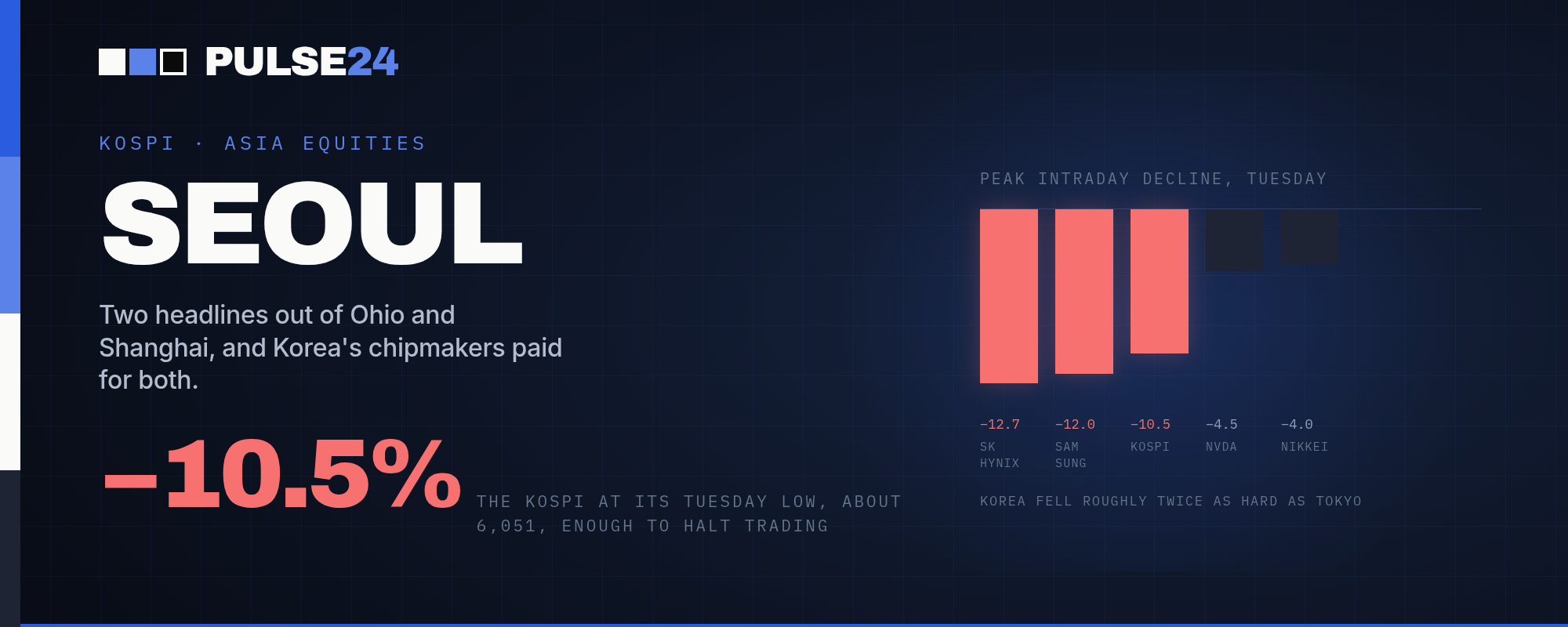
South Korea's Kospi sank as much as 10.5% and Japan's Nikkei fell 4% on Tuesday after a report that Nvidia may guarantee $250 billion of OpenAI's data center financing collided with a 466% Shanghai debut for Chinese chipmaker CXMT. Samsung and SK Hynix bore the brunt, two days before Microsoft, Meta, Apple and Amazon report earnings that will test how much further Wall Street's AI capex anxiety can run.
South Korea's Kospi index dropped as much as 10.5% on Tuesday, tripping a trading halt and pulling the benchmark to around 6,051, its lowest level since April. Samsung Electronics fell as much as 12%. SK Hynix fell as much as 12.7%, and its US-listed shares, priced at $149 in their Nasdaq debut, extended a slide below that level, dropping into the $140s. Japan's Nikkei 225 dropped 4% to about 62,350 in the same session.
None of this happened in a vacuum. Two stories broke Monday, within hours of each other, and both pointed at the same underlying question: who actually pays for the AI buildout, and what happens if the financing behind it turns out to be more circular than it looks.
What Changed
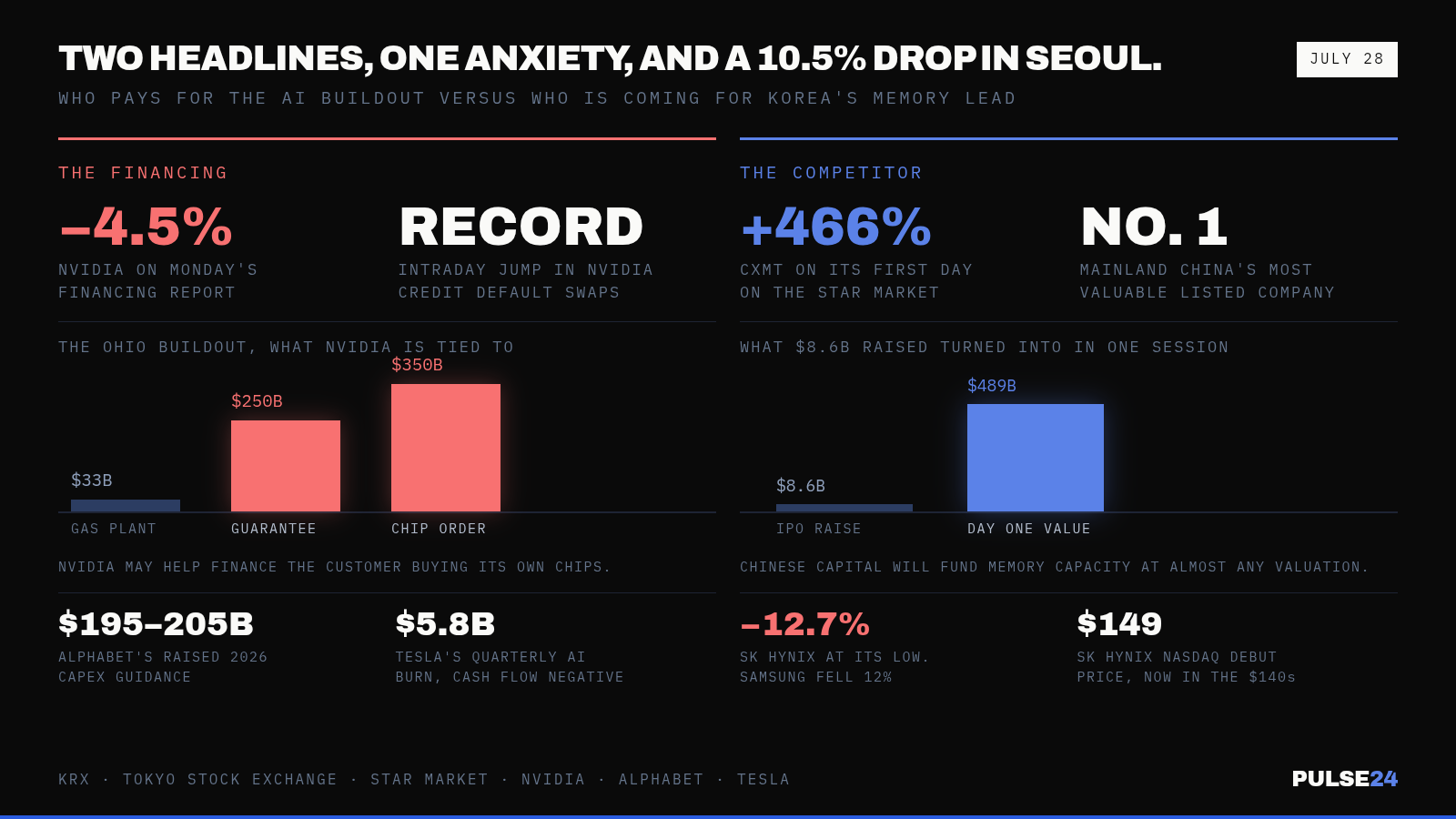
The first story involved Nvidia. Reports emerged Monday that the company is in talks to guarantee roughly $250 billion in financing for a data center OpenAI is building in southern Ohio, on a decommissioned uranium enrichment site, powered by a $33 billion natural gas plant built specifically for the project. Nvidia may also help finance OpenAI's purchase of $350 billion worth of Nvidia chips for the same buildout. Nvidia shares fell about 4.5% on the news, and credit default swaps on Nvidia's bonds recorded their largest intraday jump since that market began trading. The arrangement is a clean example of what critics call circular financing. Nvidia sells chips to OpenAI, helps finance OpenAI's ability to buy them, and in the process ties its own balance sheet to a customer that is still losing significant money.
The second story came out of Shanghai. ChangXin Memory Technologies, known as CXMT, went public on the STAR Market and closed its first day of trading up 466%, a debut that valued the company at roughly $489 billion and made it mainland China's most valuable listed company on day one. CXMT is a memory chipmaker, the same category Samsung and SK Hynix dominate globally, and a debut that dramatic told investors two things at once. Chinese capital markets are willing to fund memory chip capacity at almost any valuation, and Chinese producers are moving fast enough to be taken seriously as competitors rather than distant followers.
Why It Matters
Put those two stories together and Korea's chip stocks were exposed on both sides at once. Nvidia's financing arrangement raised doubts about how much of the AI spending boom rests on vendors financing their own customers rather than independent demand, a structure that works fine until either party hits a rough patch. CXMT's valuation raised a separate and more direct threat. If Chinese producers can raise this much capital this quickly, the multi-year head start Samsung and SK Hynix have enjoyed in high bandwidth memory looks less secure than it did a week ago. Korea's two largest chipmakers sit at the center of both worries, which is a big part of why the Kospi fell roughly twice as hard as Tokyo's Nikkei on the same day.
This also lands on top of a market that was already nervous about AI capex for a related but separate reason. Alphabet and Tesla both reported earnings last week, and both showed the same pattern of heavy AI spending pushing free cash flow negative. Alphabet posted its first negative free cash flow since its 2004 IPO after raising 2026 capex guidance to a range of $195 billion to $205 billion, and Tesla logged its first negative free cash flow in roughly two years after burning close to $5.8 billion on AI initiatives in a single quarter. Neither report directly caused Tuesday's move in Seoul and Tokyo, but both put AI spending under a microscope just as the Nvidia and CXMT stories broke, and jumpy markets tend to connect dots sitting right next to each other.
What to Watch Next
Microsoft and Meta report earnings Wednesday, the same day the Federal Reserve announces its own policy decision, and Apple and Amazon follow Thursday. Capex guidance will matter more than revenue or profit for all four. Alphabet's stock fell more than 7% on its capex number alone last week, and if Microsoft or Meta post a figure that raises the same doubts, this week's Asia selloff may end up looking like the opening move rather than an isolated event.
Also worth tracking is whether Nvidia's OpenAI arrangement gets finalized, and on what terms. A deal built on real collateral and diversified funding sources would read very differently than one that amounts to Nvidia underwriting its own demand. CXMT's valuation isn't going away either, and every future Samsung or SK Hynix earnings report will now get read partly through the lens of how fast Chinese memory capacity is actually growing, not just how strong that quarter's numbers look on their own.
The Pulse24 Take
Two headlines rarely move a national stock index 10% in one session. What made Tuesday different is that both stories, Nvidia's financing arrangement and CXMT's valuation, pointed at the same anxiety from different directions. The money funding the AI buildout may be more circular, more concentrated, or both, than investors assumed, and the competitive moat around the companies supplying it may be thinner than the last two years of stock charts suggested.
None of this proves the AI infrastructure trade is broken. Nvidia, Microsoft, Meta, Amazon, Apple and Alphabet are collectively still planning to spend close to three quarters of a trillion dollars this year on the bet that it isn't. What Tuesday did was compress a slower moving question, whether that spending pays for itself, into a one day answer nobody was ready to give. Wednesday and Thursday's earnings will start to supply a better one.
How we read the data
Curious how we get from raw data to a take like this? Our Trader's Toolkit walks through the tools we lean on.
Explore the Toolkit