Pulse24 Original
South Korea's Kospi Just Posted Its Biggest One-Day Gain Ever. SK Hynix Hitting Its Daily Limit for the First Time Is Why.
July 31, 2026
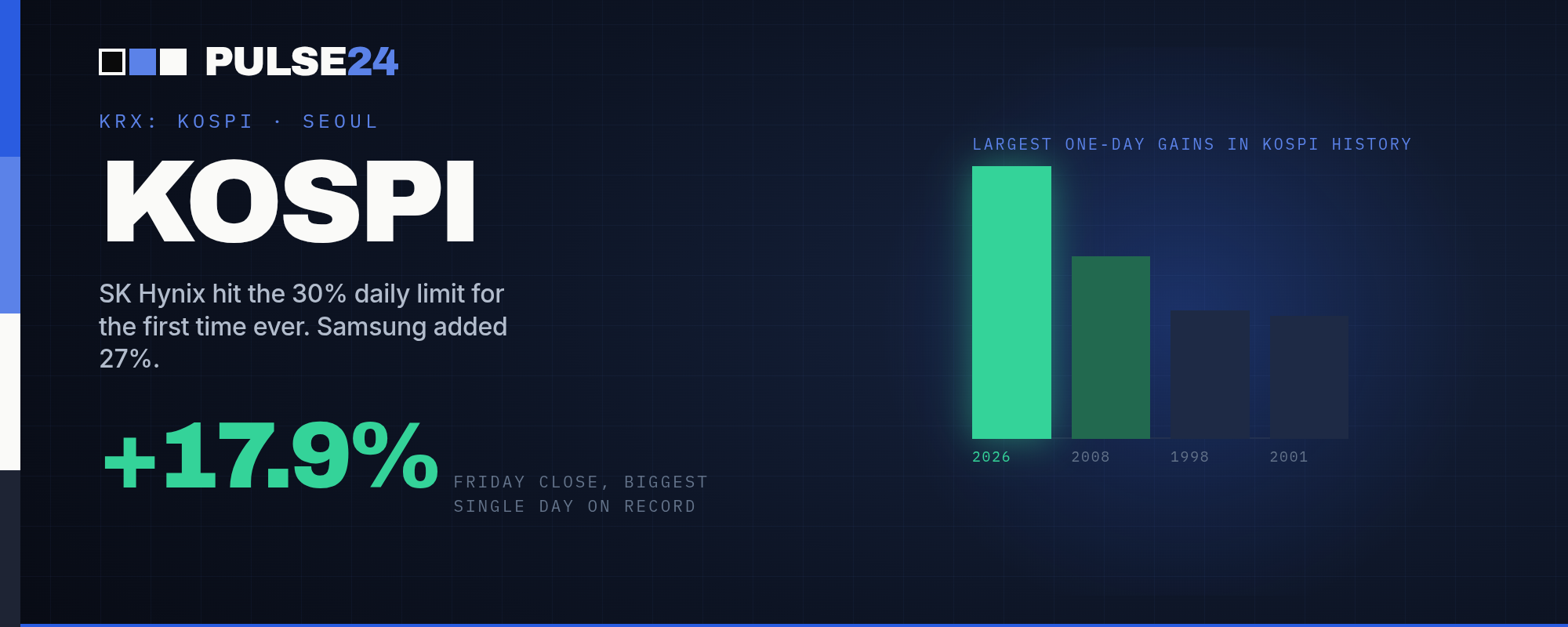
South Korea's Kospi just posted its biggest one-day gain in history, and SK Hynix hit a trading limit it had never touched before. Record chip earnings and a jump in exports turned a brutal month for AI stocks into one of the sharpest reversals markets have seen this year.
SK Hynix hit something Friday it had never hit before. The stock opened 28.37% higher at 1.697 million won and kept climbing until it slammed into the Korean exchange's 30% daily price limit, the maximum a single stock is allowed to move in one session. It had never happened to SK Hynix in the company's history.
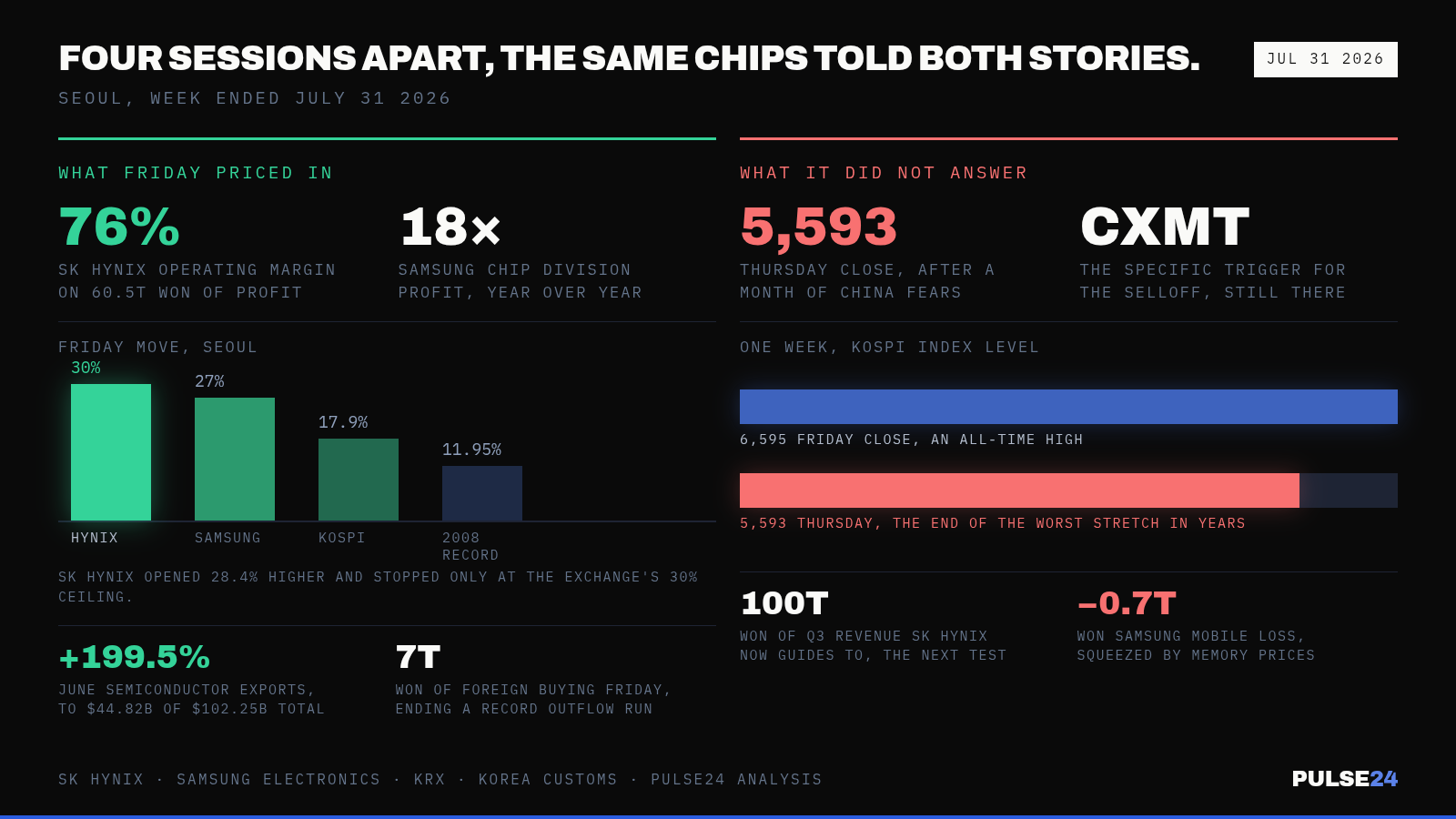
Samsung Electronics wasn't far behind, adding about 27%. Together the two chipmakers dragged the benchmark Kospi index up 17.9% to close near 6,595, the largest one-day percentage gain the index has ever recorded. The old record, an 11.95% jump, was set on October 30, 2008, in the middle of the global financial crisis.
What Changed
A day earlier, the story looked completely different. The Kospi closed at 5,593.56 on Thursday, the tail end of a stretch of selling driven by worry that Chinese memory makers, ChangXin Memory among them, were catching up faster than expected, and that years of pricing power for Samsung and SK Hynix might not hold. Nvidia's credit default swap spreads widened over the same stretch, a sign investors were pricing in more risk around the AI buildout generally, not just in Seoul. Thursday night on Wall Street changed the mood heading into Friday. Microsoft jumped about 15% on strong Azure cloud growth, its best single day since 2008, and Amazon and Meta both posted results that reinforced how much money hyperscalers are still committing to AI infrastructure.
Friday reversed that story with hard numbers instead of sentiment. SK Hynix reported second-quarter operating profit of 60.5 trillion won, about $43.7 billion, on revenue of 79.3 trillion won. That's a 76% operating margin, a level few chipmakers anywhere have ever posted. Pretax profit reached 122.7 trillion won, boosted further by gains from its Kioxia stake. The company said third-quarter revenue should top 100 trillion won for the first time, with operating profit landing somewhere around 80 trillion won.
Samsung's numbers told a similar story from the other side of the rivalry. Total operating profit reached 89.5 trillion won, up more than 18-fold from a year earlier and 56% from the prior quarter. Almost all of that came from the Device Solutions division, which posted 89.2 trillion won in operating profit on 127.5 trillion won in revenue as HBM4 and HBM4E memory hit a record share of the sales mix. Samsung's mobile division didn't share in the windfall. It posted a 700 billion won operating loss, squeezed by the same memory prices that made the chip division's quarter so strong.
Why It Matters
Memory chips sit at the center of the AI infrastructure debate right now, and this week showed both sides of it within four trading days. The selloff earlier in the week reflected a real question: is AI capital spending running ahead of what the economics can support, and can Chinese suppliers erode the pricing power that's made Samsung and SK Hynix so profitable? Friday's numbers didn't answer that question so much as push back the timeline for worrying about it. HBM4 yields have caught up to the prior generation, mass production has started, and both companies say demand commitments run through 2027 and beyond.
Corroborating demand showed up outside Korea too. Amazon's cloud unit, AWS, grew 37% year over year last quarter, and management said on the earnings call that it expects that pace of demand to hold through 2027. South Korea's own export data backs up the picture from the ground. June exports topped $100 billion for the first time in the country's history, up 70.9% year over year, and semiconductor exports alone nearly tripled to $44.82 billion.
None of this erases the earlier concern. Nvidia's five-year bond spreads were still elevated coming into the week, a reminder that financing costs for the AI buildout have crept higher even as memory earnings hit records. A single stock hitting a daily limit is also, by definition, a sign of thin and emotional positioning, not calm, orderly buying. Foreign investors were net buyers of more than 7 trillion won in Korean stocks on Friday alone, breaking a selling streak that had pushed the month's cumulative outflow toward a record, which suggests this wasn't just local retail chasing a bounce.
What to Watch Next
SK Hynix's Q3 guidance of 100 trillion won in revenue is the number to track first, since a miss there would reopen the valuation questions this week's rally just closed. DRAM and HBM pricing trends matter just as much, because they're the mechanism connecting Korean chip earnings to every AI infrastructure stock in the US. Beyond that, keep an eye on China's memory sector. CXMT's progress was the specific trigger for the prior selloff, and any sign it's moving faster than expected in high-bandwidth memory, not just standard DRAM, would matter more than another round of AI bubble commentary.
The Pulse24 Take
A month that saw the Kospi's steepest stretch of selling in years end with its best single day in history is a good reminder of how narrow and reflexive the AI trade has become. The same memory chips that triggered the fear are the ones that ended it, within the space of one earnings season. That's not necessarily bad news. Real profits and real export data are a better foundation for a rally than momentum alone. But a stock hitting a 30% limit for the first time in its history is not what calm, well-distributed buying looks like, and investors who chase Friday's move without asking what happens if Q3 guidance slips are taking on more risk than the headline number suggests.
How we read the data
Curious how we get from raw data to a take like this? Our Trader's Toolkit walks through the tools we lean on.
Explore the Toolkit