Pulse24 Original
CoreWeave's Loan Just Got Repriced to a 10.44% Yield. The Credit Market Is Pricing Close to a Coin Flip on Default.
August 7, 2026
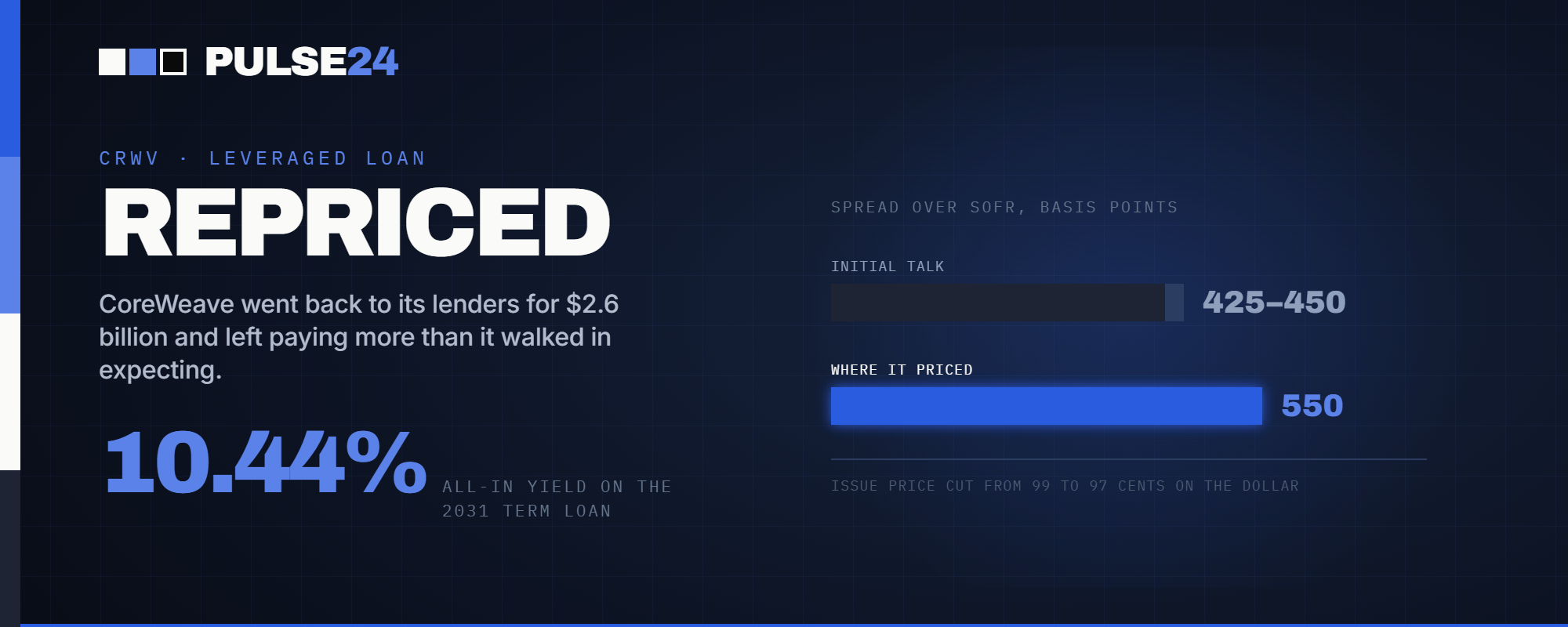
CoreWeave went back to lenders for a $2.6 billion loan and left with a 10.44% yield, tighter covenants, and a credit market pricing close to even odds of default within five years. It's the clearest sign yet that AI infrastructure's debt binge is starting to show real stress.
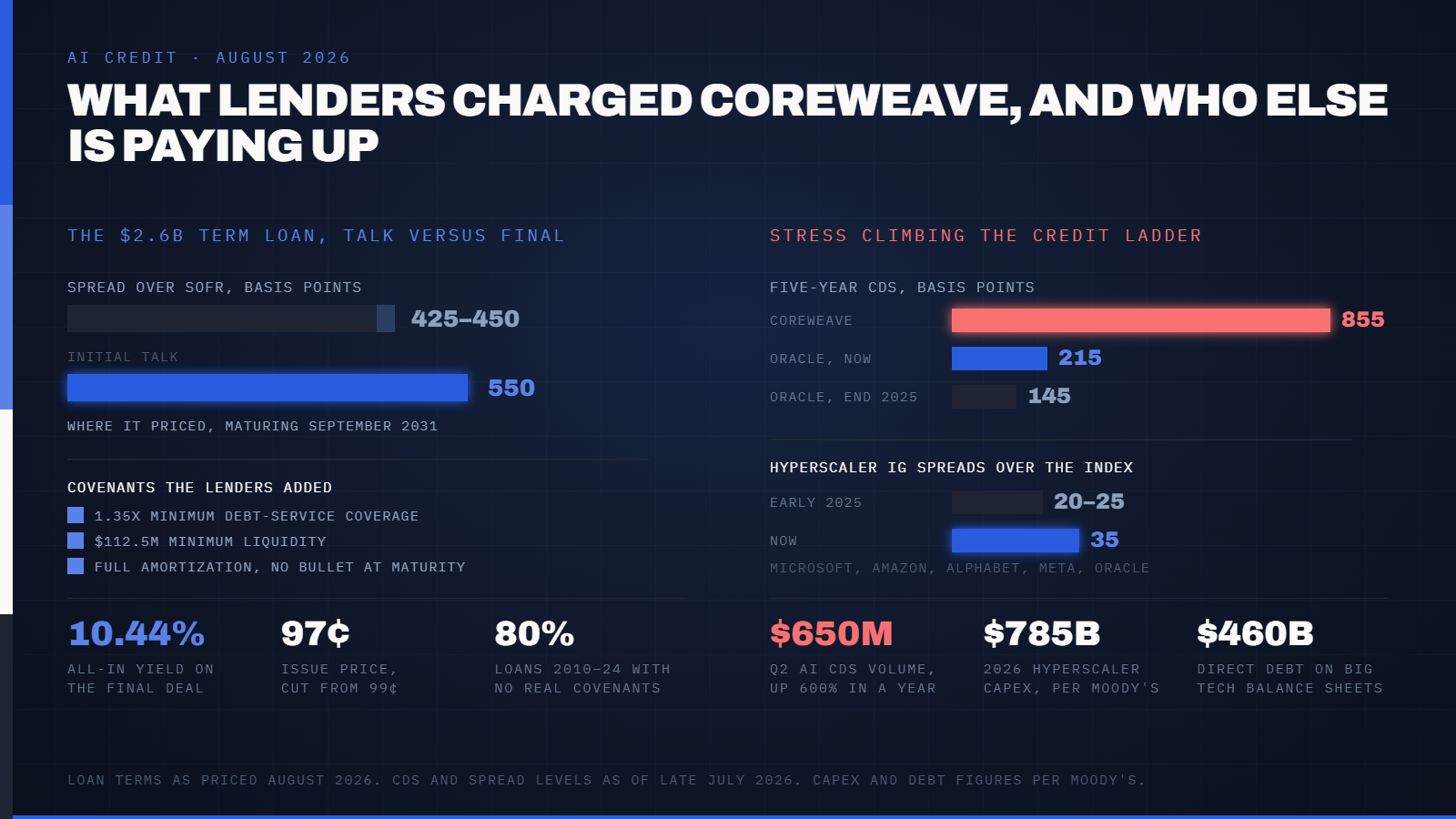
CoreWeave went back to its lenders this week for a $2.6 billion delayed-draw term loan and came away with worse terms than it walked in with. The loan, maturing in September 2031, priced at 550 basis points over SOFR, well above the 425 to 450 basis point range initial talks had suggested. The original issue discount slipped from 99 cents on the dollar to 97. Put together, the deal now carries an all-in yield of 10.44%, more than a full percentage point above where CoreWeave had hoped to land just weeks earlier.
Lenders didn't just charge more. They also rewrote the rules. The new loan carries a 1.35x minimum debt-service coverage ratio, a $112.5 million minimum liquidity requirement, and full amortization instead of a bullet repayment at maturity. More than 80% of leveraged loans issued between 2010 and 2024 came without meaningful covenants at all. CoreWeave just got the opposite of a covenant-light deal, in the one corner of the market that has spent two years pricing almost no risk into anything AI-adjacent.
The Coin Flip the Bond Market Is Already Pricing
Five-year credit default swaps on CoreWeave now trade near 855 basis points. Translate that into plain terms and the market is pricing something close to even odds of default over the next five years. That's not a stress-test scenario. It's where the contracts are actually changing hands. Trading volume in AI-linked CDS reached $650 million in the second quarter, up 20% from the prior quarter and roughly 600% from a year earlier. Credit traders have found a new instrument to express doubt in, and they're using it.
CoreWeave Isn't the Only One Getting Repriced
CoreWeave wasn't negotiating in a vacuum. The same week, Thoma Bravo-backed Proofpoint also had to sweeten the terms on its own loan, as investors priced in the risk that AI disrupts software margins, even though Proofpoint itself isn't an AI infrastructure company. Elsewhere in the same market, Prime Data Centers pushed back a planned $500 million Nordic bond sale rather than accept current pricing. Oracle's own CDS has widened from roughly 145 basis points at the end of 2025 to more than 215 basis points now, even though Oracle sits several rungs higher on the credit ladder than CoreWeave. Amazon, arguably the safest name in the entire AI infrastructure complex, raised $25 billion in a bond sale in early July and still had to dangle extra yield to pull buyers in, months after its AI and chip businesses each crossed $25 billion a year in run-rate revenue. When the strongest borrower in the group needs to pay up, that's a signal about the group, not just the borrower.
The Stress Is Climbing the Credit Ladder
Investment-grade bond spreads on the biggest hyperscalers, Microsoft, Amazon, Alphabet, Meta and Oracle, have widened from roughly 20 to 25 basis points over the broader investment-grade index in early 2025 to about 35 basis points now, after peaking closer to 50 basis points earlier this year. High-yield bonds tied to smaller data-center operators had been compressing for most of the first half of 2026, then started widening again in June and have continued wider through late July. None of these levels are alarming on their own. Together, they describe a credit complex where doubt is spreading from the riskiest names toward the safest ones, rather than staying contained at the bottom.
Why the Debt Side Matters More Than the Stock Side
The AI buildout has been funded overwhelmingly with borrowed money, not retained earnings. Moody's estimates combined hyperscaler capital spending will reach $785 billion in 2026 and climb toward $1 trillion in 2027, against $460 billion of direct debt already sitting on six major tech balance sheets and another $1.2 trillion in off-balance-sheet data-center lease commitments that don't show up as debt on a standard balance sheet at all. That's part of the broader shift we've been tracking, where markets have started pricing what AI infrastructure actually costs well beyond the headline capex number, from memory chip prices to who pays for the electricity, and now, to who's willing to lend against it. The strain isn't confined to Wall Street either. Data center operators already owe $25 billion in unpaid power bills nationally, a separate but related sign that the economics of building AI infrastructure faster than it can pay for itself are showing up in more places than credit default swaps.
What to Watch Next
The clearest near-term signal is whether more AI-linked borrowers postpone financing rather than accept current pricing, following the pattern several already set in late July. CoreWeave and Oracle's CDS levels are worth tracking directly, since both have been flagged for the most immediate ratings pressure within the sector. The more important test sits one rung up the ladder: whether investment-grade spreads on Microsoft, Amazon, Alphabet and Meta keep widening through the next earnings cycle. Stress in the highest-rated names would be a far bigger signal than anything happening in paper that was already priced for risk.
The Pulse24 Take
Equity markets have mostly treated AI infrastructure spending as an unambiguous good, rewarding bigger capex numbers with higher stock prices quarter after quarter. Credit markets don't have that luxury. A bondholder or a CDS trader gets paid the same whether a company grows 10% or 100%, provided it can service its debt, and more of them are now demanding proof rather than assuming it. CoreWeave's repricing doesn't mean the AI trade is broken. It means the cheapest, easiest money that funded the first wave of this buildout is gone, and what replaces it comes with covenants, higher yields, and lenders who actually read the footnotes.
How we read the data
Curious how we get from raw data to a take like this? Our Trader's Toolkit walks through the tools we lean on.
Explore the Toolkit