Pulse24 Original
Amazon Stock Surged 12% on Record Earnings. Its AI and Chip Businesses Just Crossed $25 Billion a Year Each.
July 31, 2026
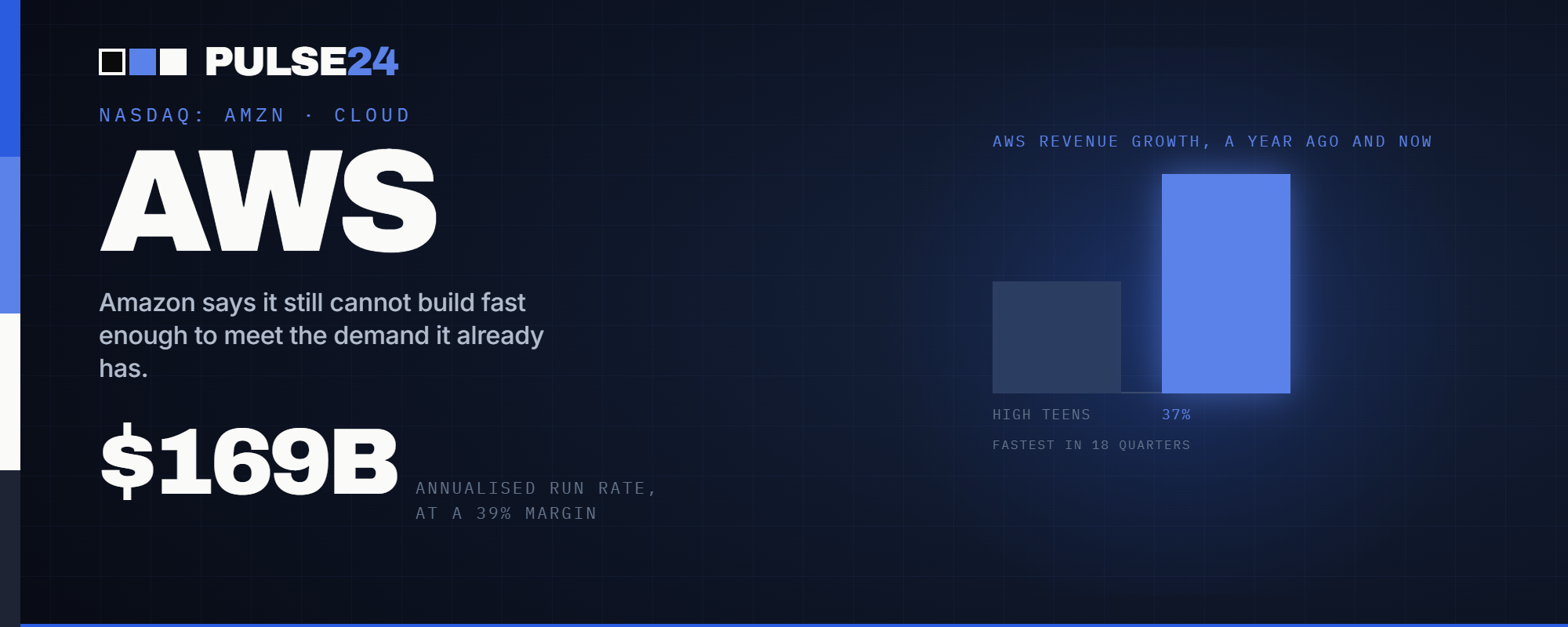
Amazon's stock jumped about 12% after its best quarter in years, with AWS growth accelerating to its fastest pace in 18 quarters and its AI and custom chip businesses both crossing $25 billion in annualized revenue. CEO Andy Jassy also raised 2026 capital spending to $220 billion and said Amazon still won't have enough capacity to meet demand through 2027.
Andy Jassy said something Thursday night that mattered more than any single number in Amazon's earnings report. Even after $220 billion in planned spending this year, he told analysts, Amazon still won't have enough capacity to meet the demand it's seeing in 2026, and he expects that dynamic to hold into 2027 too.
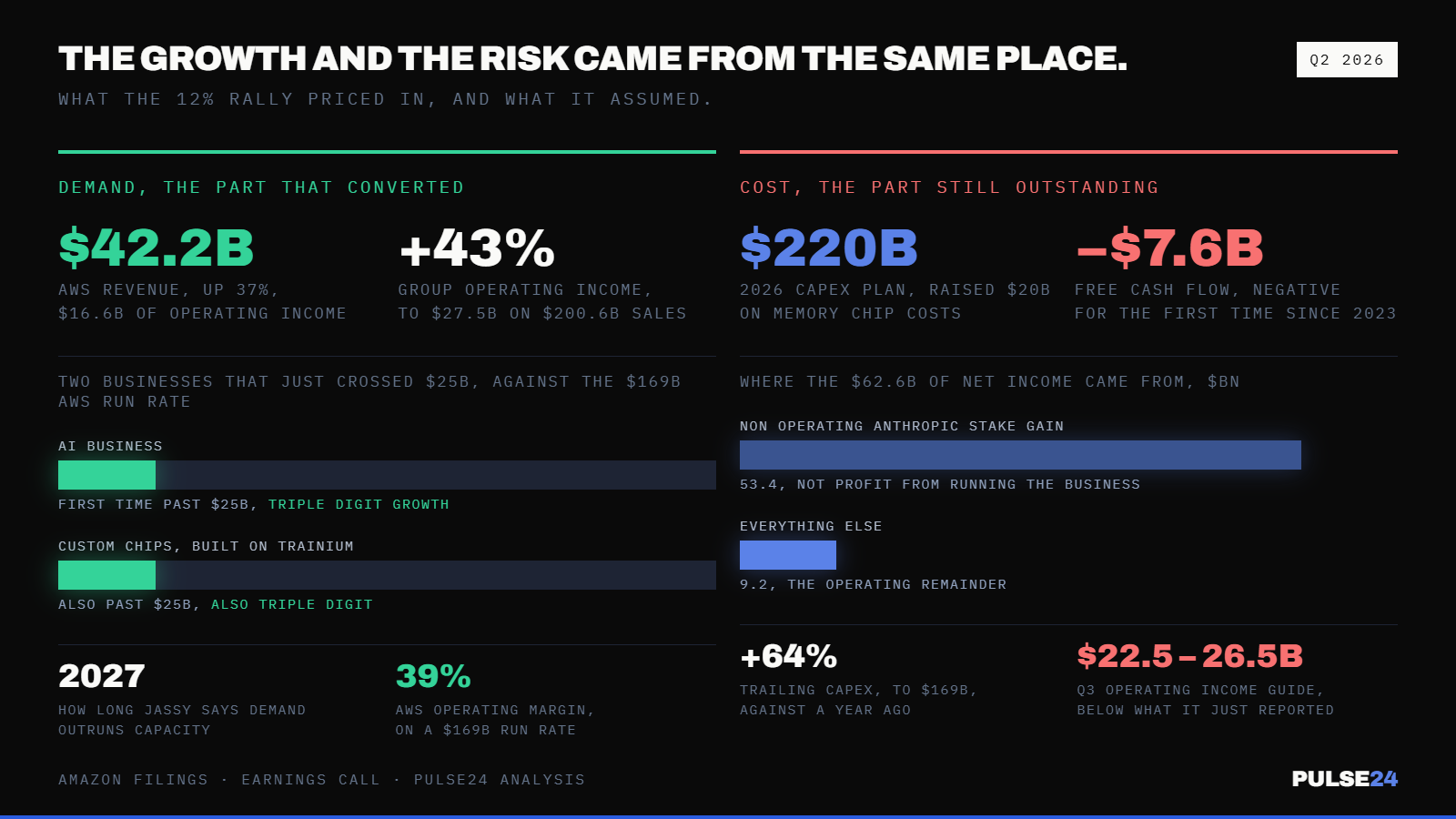
The market's answer came fast. Amazon's stock jumped about 12% Friday, one of its best earnings reactions in years, after a quarter that beat estimates on nearly every line. Revenue rose 20% to $200.6 billion and operating income climbed 43% to $27.5 billion, both a function of the actual business. Net income came in at $62.6 billion, or $5.75 a share, more than triple what Wall Street had modeled, though $53.4 billion of that figure was a non-operating gain tied to the rising value of Amazon's stake in Anthropic rather than profit from running the business.
What Changed
AWS was the headline. Cloud revenue grew 37% to $42.2 billion, the fastest pace in 18 quarters, and operating income for the division hit $16.6 billion on a 39% margin. Jassy described AWS as a $169 billion annualized run rate business at this point, a sharp acceleration from growth in the high teens as recently as last year.
The more interesting number sat underneath that headline. Amazon's AI business and its custom chip business each crossed $25 billion in annualized revenue for the first time, and both are growing at triple-digit percentages year over year. That's a meaningful shift. A year ago, Amazon's AI chip ambitions were mostly a story analysts told about the future. Now they're a line item large enough to move the whole company's growth rate.
None of this came free. Jassy raised Amazon's 2026 capital spending guidance to $220 billion, up $20 billion from the estimate management gave a few months ago, and pinned the increase specifically on higher memory chip costs. Trailing twelve month capex has already climbed to $169 billion, up 64% from a year earlier. Asked how Amazon plans to fund the increase, Jassy told analysts there was "nothing to share today," a reminder that the company has already tapped debt markets once this year to help cover the buildout.
Why It Matters
Amazon's results answer a question that's been hanging over the AI trade for months. Cloud providers have promised that AI spending would eventually show up in growth numbers, not just in capex charts. This quarter, it did. AWS's acceleration to a multi-year growth high, alongside two separate $25 billion AI-adjacent businesses, is some of the clearest evidence yet that the demand side of the AI buildout is real rather than just a forecast.
The capacity comment matters just as much as the revenue numbers. When a company says it can't build fast enough to meet the demand it already has, and expects that to still be true a year from now, it's telling investors the growth story has room to run past this earnings cycle. That's a different claim than promising a big number next quarter. It's a claim about the shape of the business for the next two years.
The caution sits right next to the excitement. Amazon posted negative free cash flow this quarter for the first time since 2023, a direct consequence of capex running well ahead of the cash coming in from the businesses it's funding. Guidance for the third quarter points to operating income between $22.5 billion and $26.5 billion, below the $27.5 billion Amazon just reported, which suggests management expects some of this quarter's momentum to ease rather than build further right away.
What to Watch Next
The $220 billion capex figure is worth tracking closely, since memory prices are still climbing and another revision isn't out of the question. Not every analyst has come around: UBS and Mizuho had already trimmed their price targets earlier in the week on rising capex concerns, and neither had raised them back as of Friday, even as Evercore ISI's Mark Mahaney called the quarter "the breakout the stock needed." The clearest test comes with Amazon's third-quarter report, when investors will see whether free cash flow stays negative or starts to recover as this quarter's AI investment begins converting into revenue.
The Pulse24 Take
This was one of the more unusual earnings reports of the year because the good news and the risk came from exactly the same place. Amazon is growing faster than it has in years because it's spending more than it ever has, and those two facts are directly connected rather than in conflict. The AI and chip businesses crossing $25 billion each are real evidence that customers are paying for this, not just that Amazon is building it. But a company that just told investors it can't meet its own demand for another year is also a company committing to spend at this pace for a while longer, and the market's 12% reaction assumes that bet keeps paying off. History with capital spending cycles this large suggests that's the part worth watching most closely, not the quarter that's already in the books.
How we read the data
Curious how we get from raw data to a take like this? Our Trader's Toolkit walks through the tools we lean on.
Explore the Toolkit