Pulse24 Original
Nvidia Just Lined Up $500 Billion to Fund AI's Buildout. Its Own Stock Fell $130 Billion the Same Day.
August 11, 2026
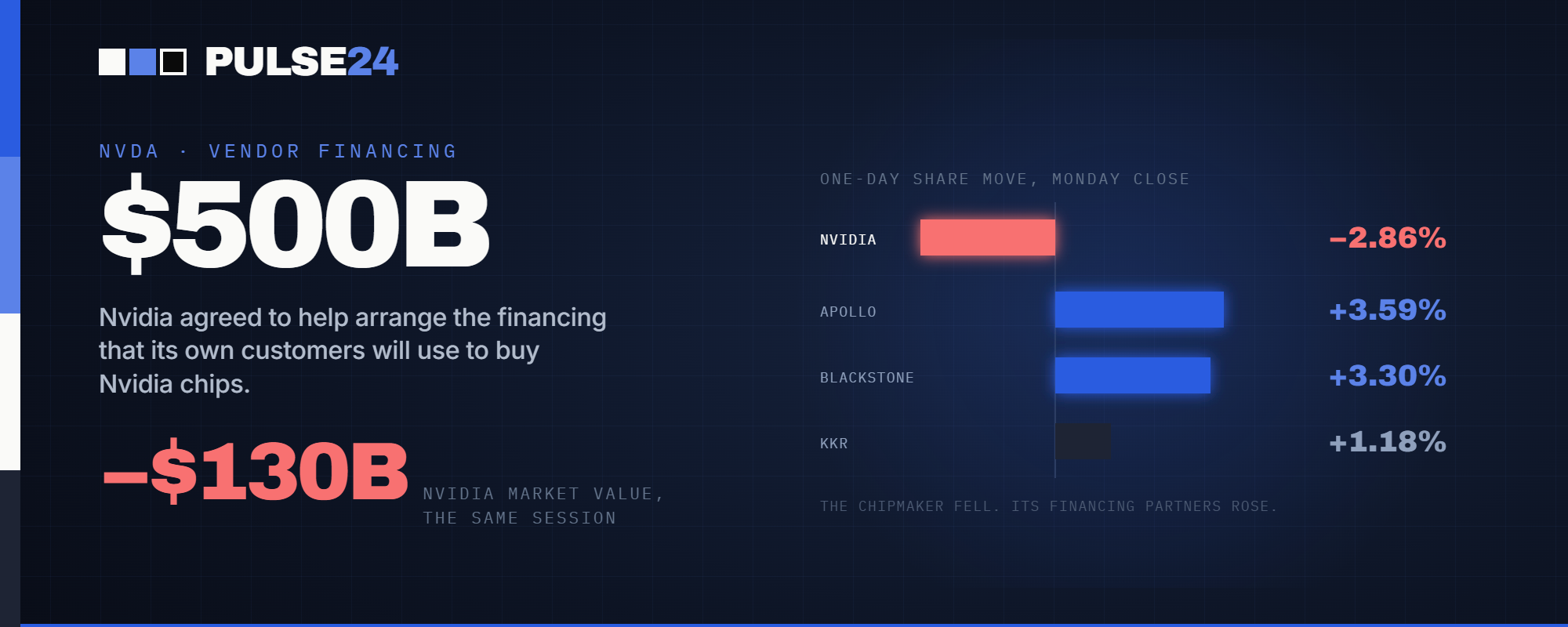
Nvidia agreed to help arrange more than $500 billion in financing for its own customers' AI infrastructure buildout on Monday, joining Apollo, BlackRock, Blackstone, Brookfield, Goldman Sachs and KKR. The stock lost $130 billion in market value the same day, as investors weighed what happens when a chipmaker starts financing the demand for its own chips.
Nvidia agreed on Monday to help arrange more than $500 billion in financing for the AI infrastructure buildout its own customers are racing to complete. By early afternoon, the stock had shed roughly $130 billion in market value, falling 2.86% to close at $217.55, just three trading days after closing at $223.96, up 8.4% from its level at the start of the month.
What Changed
Six of Wall Street's largest asset managers, Apollo, BlackRock, Blackstone, Brookfield, Goldman Sachs and KKR, signed memorandums of understanding with Nvidia on Monday to create dedicated capital pools that will mobilize more than $500 billion in third-party financing for chips, power generation and data centers, at rates the companies described as attractive for Nvidia's customers. CEO Jensen Huang called it a milestone, saying Nvidia "began by building chips" and is "now helping create a new class of productive, investable infrastructure: AI factories." His shorter version of the pitch was blunter: "In AI, compute is revenue."
Apollo's Jim Zelter and BlackRock's Larry Fink each backed the plan in separate statements. Zelter called modern compute "a scarce, mission-critical asset class with compelling investment characteristics," while Fink said the AI buildout "will require unprecedented investment and a skilled workforce to turn that investment into the infrastructure that will help power future growth." Investors read the announcement differently than the executives did. Nvidia's shares dropped as much as 3% intraday before closing down 2.86%, and Morningstar's Mike Coop offered one explanation, telling reporters the concentration building up in AI reminded him "quite a lot of 1999" and that the question of diversification "does need to be looked at seriously."
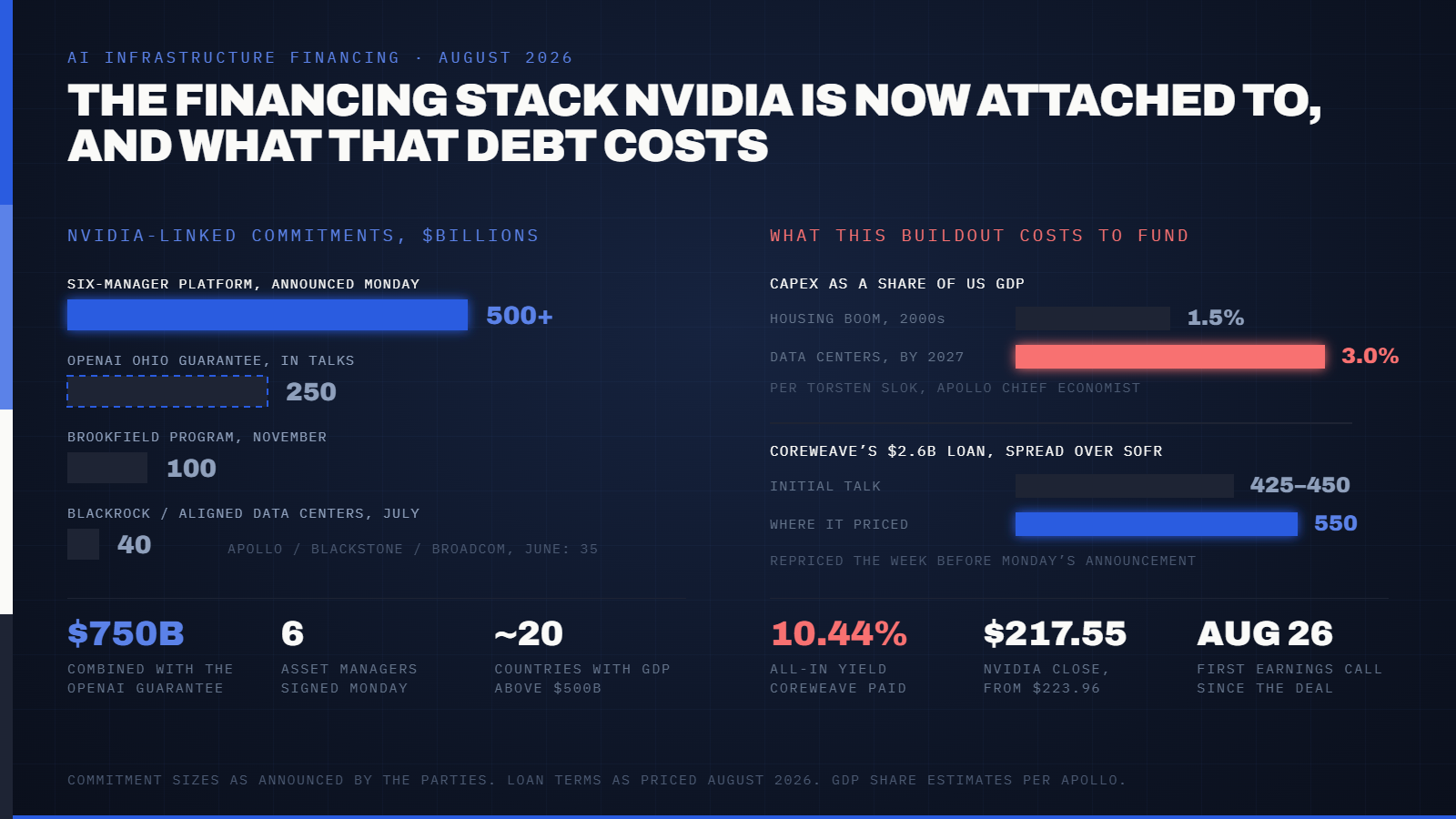
The announcement did not arrive in isolation. Nvidia has been in talks since late July to guarantee up to $250 billion of OpenAI's data center financing in Ohio, and it is unclear how much that arrangement overlaps with Monday's $500 billion figure. Smaller versions of the same structure have already been tested this year: Apollo, Blackstone and Broadcom launched a $35 billion AI financing platform in June aimed at more than 20 gigawatts of compute, Brookfield and Nvidia struck a $100 billion global AI infrastructure program in November, and BlackRock's infrastructure arm closed a roughly $40 billion acquisition of Aligned Data Centers in July. Monday's deal is simply the largest version yet of a pattern that has been building for most of 2026.
Why It Matters
The mechanics are what worry skeptics. Nvidia makes the chips that AI infrastructure needs, and it is now helping arrange the debt and equity that will buy more of those chips. When the company that sells the product also helps finance the purchase, the revenue and the demand for that revenue start to look like the same trade. Apollo's own chief economist, Torsten Slok, warned in early August that data center capex is on track to hit roughly 3% of US GDP by 2027, about twice the pace at which the 2000s housing boom expanded. That same firm is now one of six providing more capital for exactly the buildout its own economist flagged as historically fast.
Credit markets were already pricing in some of that risk before Monday's announcement. CoreWeave went back to lenders the previous week for a $2.6 billion loan and came away with a 10.44% yield and tighter covenants, terms that implied credit markets see close to even odds of default within five years. A $500 billion financing platform backed by six of the largest names in alternative asset management is a different animal than a single company's loan, but it is entering the same market, one where lenders have started demanding a real premium for AI-linked debt rather than treating it as a formality.
There's also a scale question that has nothing to do with circularity. Half a trillion dollars is larger than the annual GDP of all but about 20 countries. If even a fraction of that capital gets deployed into data centers and power generation over the next few years, it becomes a macro factor in its own right, showing up in industrial electricity demand, grid investment and regional labor markets, independent of whether any single AI company succeeds or fails.
What to Watch Next
Nvidia reports fiscal second quarter earnings on August 26, the first results call since this financing structure became public, and analysts will be listening for how management characterizes the deal's terms, particularly whether it involves Nvidia taking on direct credit exposure or simply helping arrange financing for others. Watch too for whether the $250 billion OpenAI guarantee gets folded into this larger platform or stays separate, since the combined total would approach $750 billion in Nvidia-linked financing commitments. Credit spreads on other AI infrastructure debt, the kind that pushed CoreWeave's loan to 10.44%, are a cleaner real time gauge of whether lenders are growing more comfortable with this trade or less.
The Pulse24 Take
Wall Street has seen vendor financing before, and it rarely ends the conversation the way its architects intend. Auto makers financed car buyers for decades without anyone calling it a scandal, and telecom equipment vendors did something similar in the late 1990s, right up until several of those financing arrangements collapsed alongside the telecom bust they had helped fund. The pattern is not proof that Nvidia's deal ends badly. It is a reason to watch the terms closely rather than take Monday's announcement at face value.
What makes this move genuinely interesting is Apollo's presence on both sides of the story within the space of two weeks, warning that the buildout is moving twice as fast as the housing boom, then joining five other firms to fund more of it. That is not necessarily contradictory. A firm can believe an industry is expanding too fast in aggregate while still concluding that a specific, well-structured piece of that expansion is a good investment. But it does mean the market got two signals from the same institution in quick succession, a caution and a commitment, and investors are left to decide which one carries more information. Nvidia's stock, for one day at least, sided with the caution.
How we read the data
Curious how we get from raw data to a take like this? Our Trader's Toolkit walks through the tools we lean on.
Explore the Toolkit