Pulse24 Original
Nearly 80% of AI Data Center Bonds Sold Since Early 2025 Now Trade Below Issue Price. Two Planned Deals Got Pulled From the Market This Summer Instead of Selling Into It.
August 12, 2026
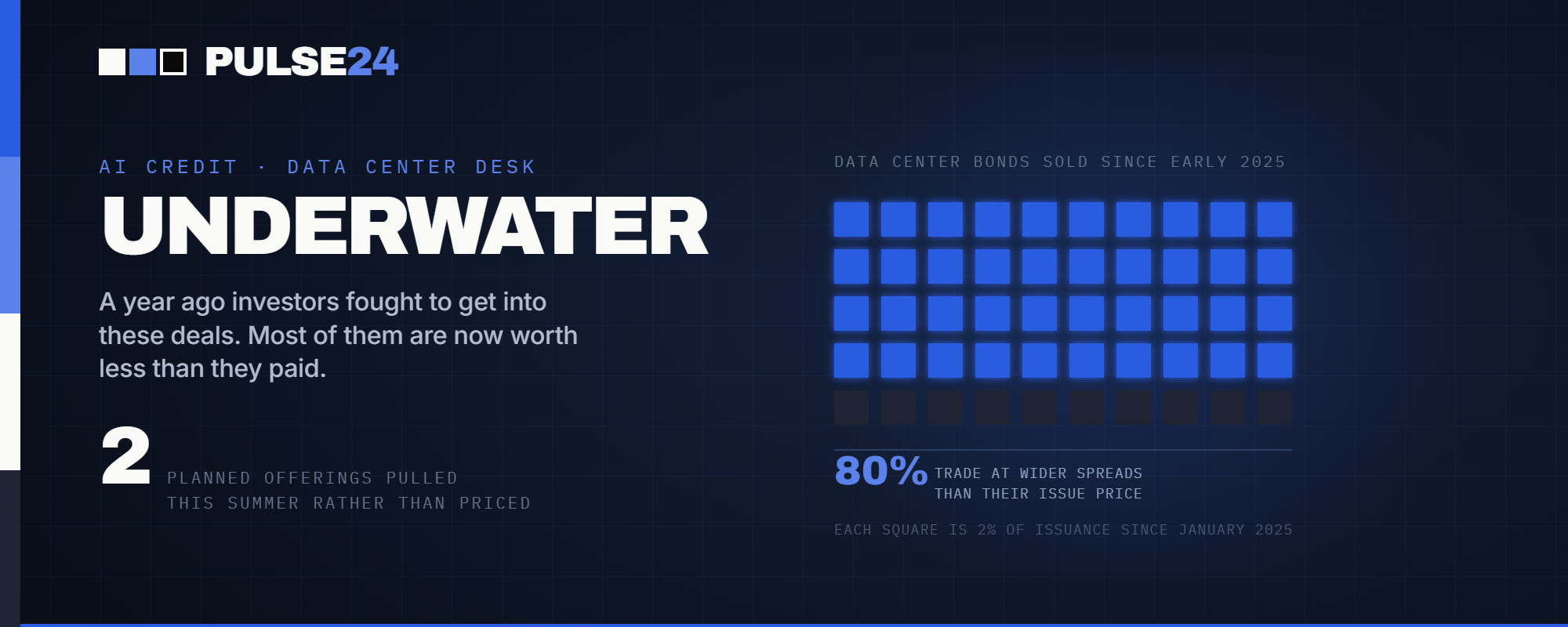
Nearly 80% of the bonds sold to finance AI data centers since early 2025 now trade below where they priced, and two planned offerings got pulled from the market this summer instead of testing it. Credit investors are starting to ask the question equity investors have mostly ignored.
Nearly 80% of the bonds sold to finance AI data centers since early 2025 are now trading below the price they were issued at, according to Bloomberg Law's Distress Watch column. That figure covers securities backing companies like Core Scientific, TeraWulf and Applied Digital, the operators renting out warehouse space and power to the AI boom. A year ago, investors were fighting to get into these deals. Now a growing share of them can't get out at a profit.
The shift shows up most clearly in two deals that never happened. Prime Data Centers pulled a planned bond sale over the summer rather than price it into a skeptical market. Pure Data Centres Group, backed by Oaktree Capital Management, scrapped a proposed €1 billion offering and went to a bank instead. Neither company defaulted on anything. They simply decided the bond market wasn't offering terms worth taking.
What Changed
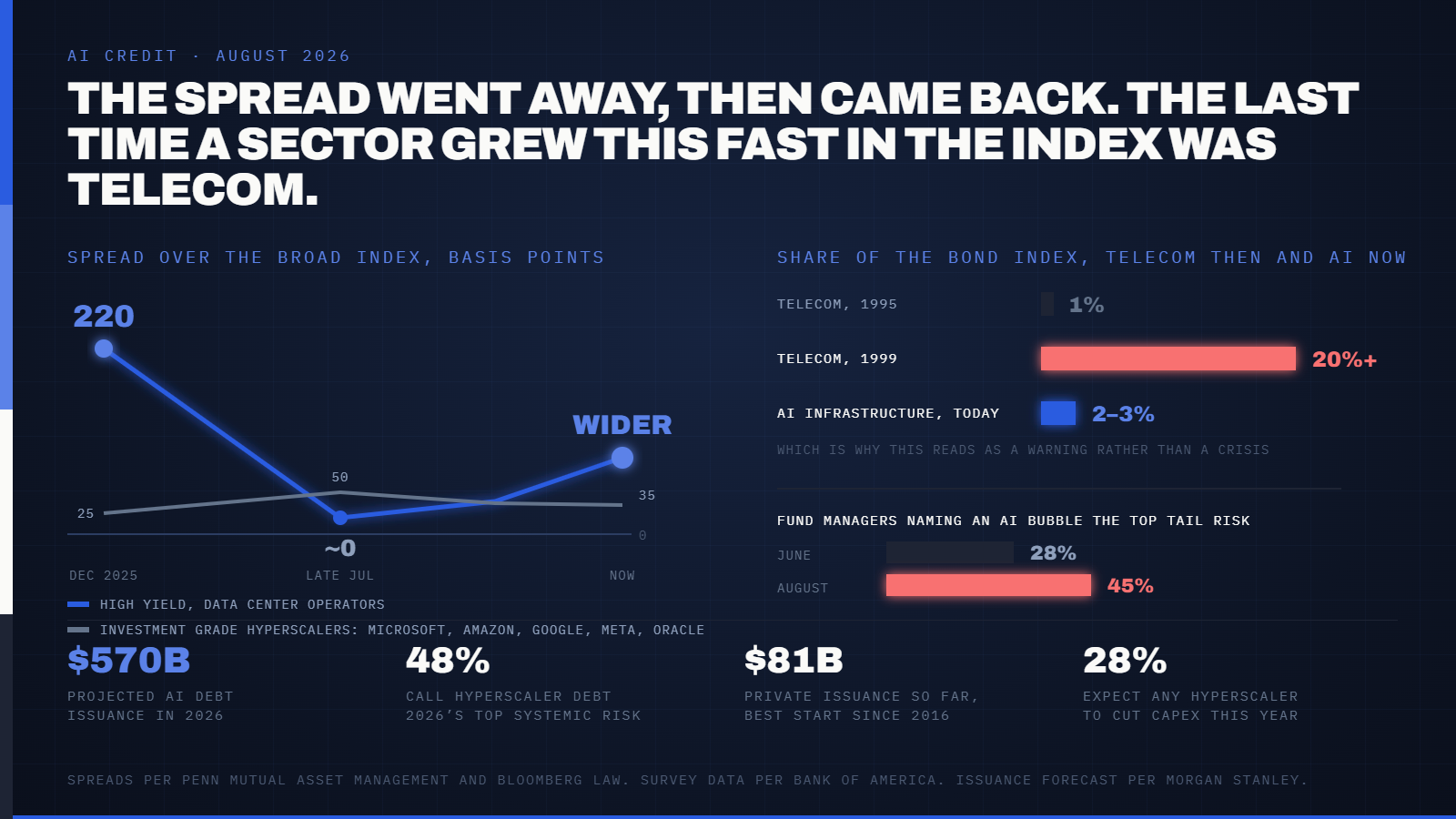
Data center bond spreads have moved in a wide arc over the past eight months. High-yield paper from data center operators peaked at roughly 220 basis points over the broader high-yield index in December 2025, according to Penn Mutual Asset Management. That premium almost vanished by late July 2026 as investors chased yield across the AI trade. Since June, though, the spread has started climbing back.
Investment-grade paper tells a similar story at smaller scale. Bonds from Microsoft, Amazon, Google, Meta and Oracle traded about 20 to 25 basis points wider than the broad investment-grade index through most of 2025. That gap widened to nearly 50 basis points earlier this year before settling around 35 basis points in July. The direction matters more than the level: credit investors are pricing in more risk than they were a few months ago, not less.
Why It Matters
Bank of America's latest fund manager survey found 48% of respondents now name AI hyperscaler debt as the most likely source of a systemic credit event in 2026. Forty-five percent called an AI bubble the biggest tail risk, up from 28% in June. PIMCO put it more bluntly, telling clients the default cycle is reasserting itself and warning of larger losses ahead in leveraged and private direct lending.
The sums involved are large enough to matter to the broader market, not just credit desks. Morgan Stanley projects global AI-related debt issuance will reach nearly $570 billion in 2026, more than four times the pace investors saw through May of last year. That is on top of the equity side of the buildout, Nvidia's own $500 billion financing push to fund AI's expansion, and an overall capex trajectory that Apollo's chief economist says is running at twice the pace of the 2000s housing boom. Penn Mutual's own research draws a direct line to the late 1990s, when telecom's weight in bond indexes rose from 1% in 1995 to over 20% by 1999, just ahead of the dot-com bust. AI infrastructure is still only 2% to 3% of public high-yield and investment-grade benchmarks today, which is exactly why the current stress reads as a warning rather than a crisis. There's still room for it to get worse before it's systemic.
This isn't hypothetical. CoreWeave's own loan was repriced to a 10.44% yield last month, with the credit market pricing close to a coin flip on default. That was one company. The Distress Watch data and the BofA survey suggest it's becoming a pattern, not an outlier.
What to Watch Next
Watch whether more data center operators follow Prime Data Centers and Pure Data Centres Group in pulling deals rather than pricing them at unfavorable terms. Private bond issuance has still reached roughly $81 billion this year, the strongest start since 2016, so the market hasn't closed. It has just gotten pickier. Hyperscaler capex guidance in the next round of earnings will also matter: only 28% of fund managers in the BofA survey expect a hyperscaler to announce capex cuts in 2026, which means the spending funding all this debt shows few signs of slowing on its own.
The Pulse24 Take
Equity investors have spent much of this year debating whether AI capital spending is overbuilt. Credit investors are having a quieter version of the same argument, and their verdict shows up in spreads rather than headlines. Widening credit spreads don't mean the AI buildout stops. Companies like Microsoft and Oracle can absorb a few dozen basis points of extra cost without blinking. What the spread widening does mean is that the cheapest, easiest phase of financing this buildout may be behind us. From here, the operators without a hyperscaler's balance sheet, the ones renting space and chips rather than owning the platform, are the ones who'll find out first whether the credit market still believes the growth story. Prime Data Centers and Pure Data Centres Group just found out. They won't be the last.
How we read the data
Curious how we get from raw data to a take like this? Our Trader's Toolkit walks through the tools we lean on.
Explore the Toolkit