Pulse24 Original
The US Just Paid the Highest Price for 30-Year Debt Since 2001. A Day Earlier, the 10-Year Auction Had No Trouble Finding Buyers.
August 15, 2026
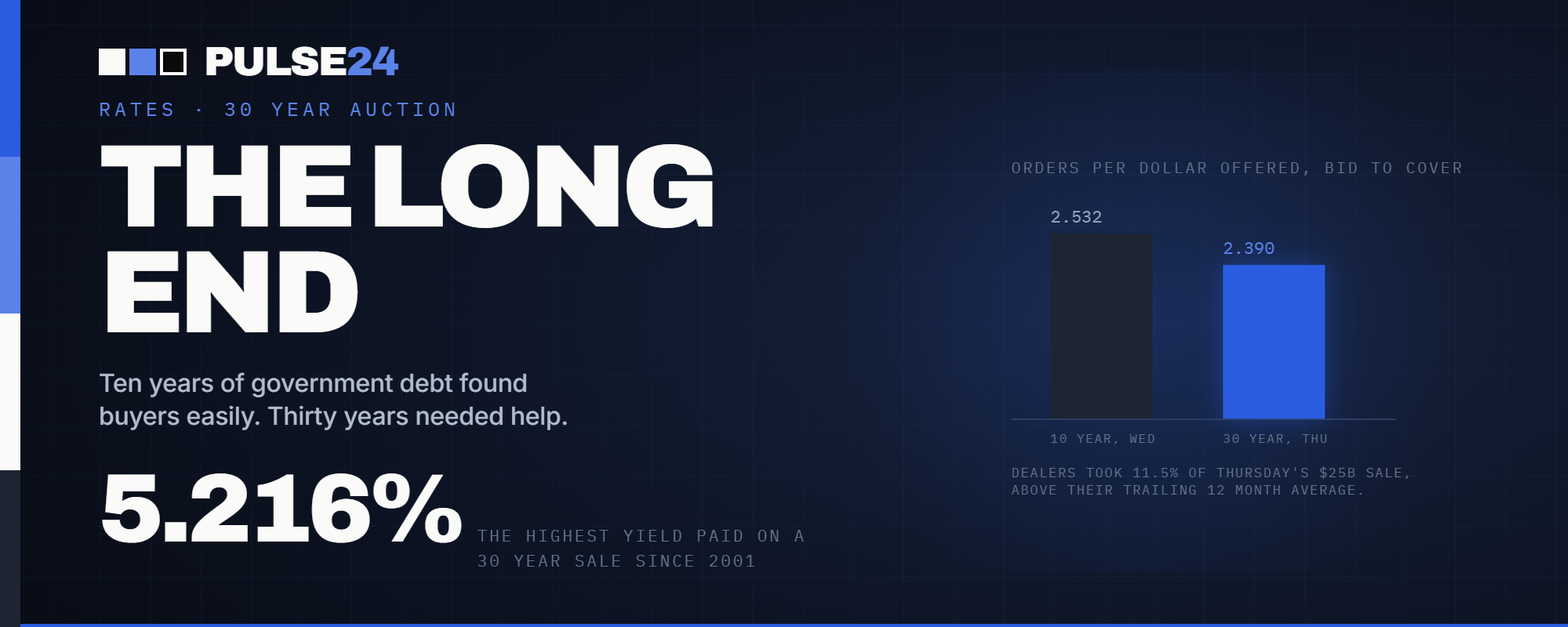
The Treasury paid its highest 30-year yield since 2001 on Thursday, and demand was noticeably weaker than the 10-year auction a day earlier. The gap says a lot about deficits, competition from AI-related corporate debt, and how much confidence the bond market has in the Fed's new chair.
Twenty-five billion dollars in new debt. That's what the US Treasury auctioned off on Thursday in 30-year bonds, at a yield of 5.216%, the highest rate paid on a 30-year sale since 2001. Twenty-five years is a long time for a number like that to hold, and bond investors just reset it.
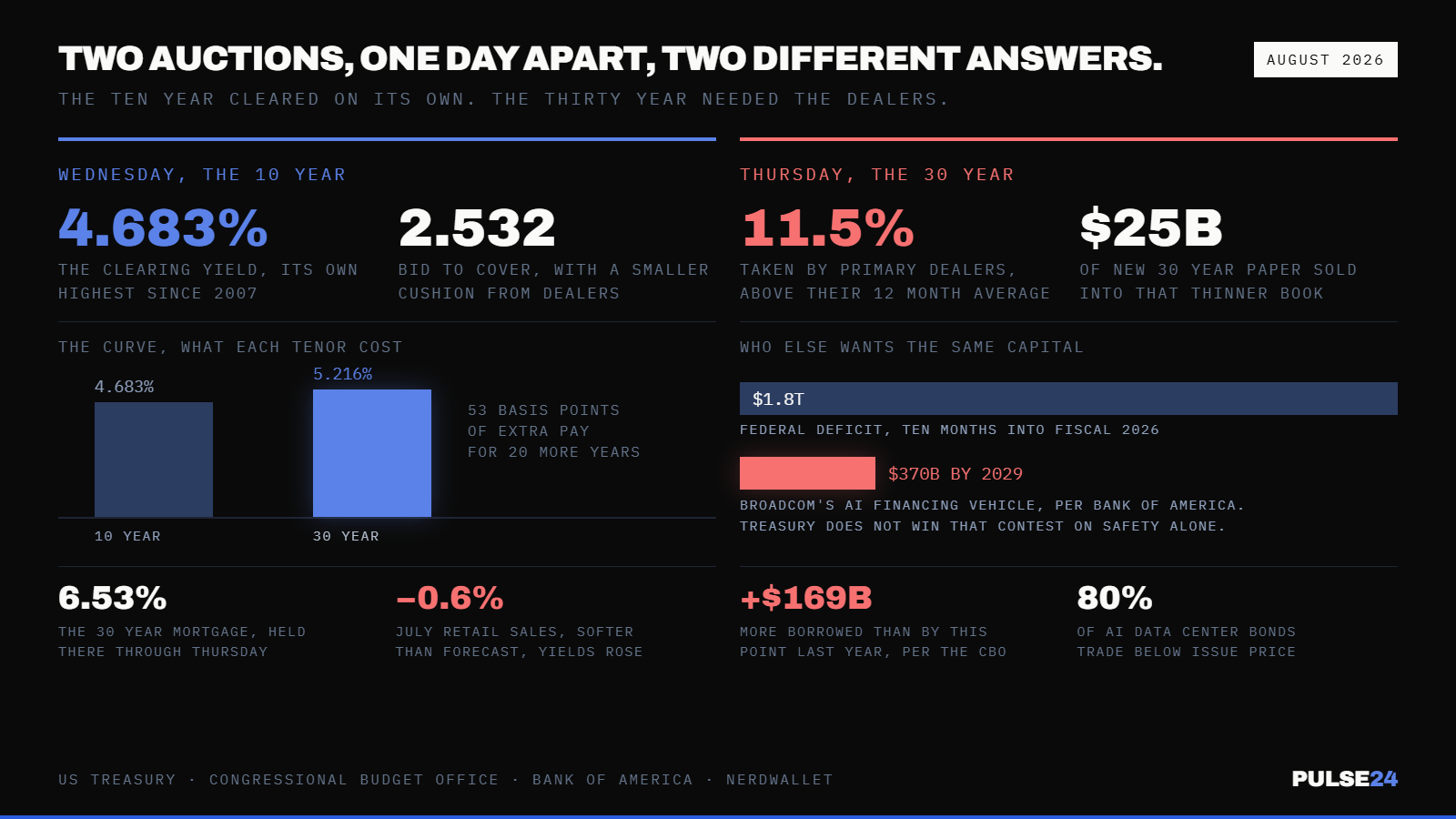
The yield told half the story. Demand told the rest. Primary dealers, the banks required to buy whatever the market leaves behind, ended up absorbing 11.5% of Thursday's sale, more than their trailing 12-month average. The bid-to-cover ratio landed at 2.39, meaning $2.39 in orders showed up for every dollar of bonds on offer. A day earlier, the Treasury's 10-year auction cleared at 4.683%, its own highest yield since 2007, but with sturdier demand: a 2.532 bid-to-cover ratio and a smaller cushion needed from dealers.
What Changed
Both auctions cleared. Neither failed outright, since Treasury auctions rarely do when there's always some price where buyers show up. But the gap between the 10-year Treasury sale and Thursday's 30-year sale is the kind of divergence that tends to matter more than either number alone. Investors were comfortable lending the government money for a decade at 4.683%. Lending it money for three decades required roughly 53 basis points more in extra annual compensation, and even then, the market needed extra help from primary dealers to clear.
None of this happened in a vacuum. The S&P 500 closed at 7,785.76 on Thursday, down a modest 0.17%, still capping a third straight weekly gain after breaking 7,800 for the first time earlier in the week. July retail sales fell 0.6% from June, softer than forecast, and consumer confidence eased too. Weaker consumer data usually argues for lower long-term yields, not higher ones. That it didn't work that way this time is itself worth noting.
Why It Matters
Two separate pressures are building at the long end of the Treasury curve, and they reinforce each other. The first is supply. The federal deficit has reached $1.8 trillion through the first ten months of fiscal 2026, according to the Congressional Budget Office, $169 billion more than the government had borrowed by the same point a year earlier. Every dollar of that gap gets financed somewhere, and a growing share of it is landing at the long end of the curve, where investors are now asking for a bigger premium to hold it.
The second is competition for the same pool of capital. AI infrastructure spending has turned into one of the largest sources of new corporate debt issuance in years. Bank of America flagged this week that Broadcom's AI financing vehicle alone could carry up to $370 billion in debt by 2029, and nearly 80% of AI data center bonds sold since early 2025 are trading below their issue price, a sign that corporate credit investors are demanding more compensation than they were a year ago too. When Treasury, hyperscalers and chipmakers are all competing to borrow from the same pool of investors in the same season, Treasury doesn't automatically win that competition just because it's the safer asset.
There's a Fed credibility angle underneath the auction numbers as well. Kevin Warsh was sworn in as Fed chair in May, and at least one prominent trade in the market right now is built around how his early tenure plays out. Ninety One portfolio manager Jason Borbora-Sheen has constructed a position that's long both 2-year and 30-year Treasuries while short the 10-year, a bet that cooling inflation eventually restores confidence in Warsh's approach even as the middle of the curve stays under pressure in the meantime. Betting on a recovery in credibility is a different wager than betting credibility is already secure, and how popular that trade has become says something about where sentiment sits today.
What to Watch Next
Future 30-year auctions will show whether Thursday was a one-time wobble or the start of a pattern. Bloomberg macro strategist Brendan Fagan has floated the idea that borrowing at multi-decade highs might simply become the norm rather than a spike that fades, and that view will get tested with each new sale. Watch the 10s30s spread specifically. If the gap between 10-year and 30-year yields keeps widening, that's the market pricing in extra compensation for the far end of the curve on its own terms, separate from whatever is happening with Fed policy in the middle of the curve.
Corporate credit is worth tracking alongside it. CoreWeave's loan got repriced to a 10.44% yield earlier this year, with credit markets pricing close to a coin flip on default. If AI-linked borrowers keep needing yields that high to find buyers, that's more evidence the entire market for long-duration debt, government and corporate alike, is repricing at once rather than experiencing a string of unrelated events.
The Pulse24 Take
A 5.216% yield on 30-year debt doesn't mean the Treasury market is broken. Auctions clear, one way or another, because there's always a price where buyers eventually show up. What actually matters is the price, and Thursday's price was steep enough that primary dealers had to step in more than usual to make the sale work. Every basis point higher raises the government's own interest bill, keeps mortgage rates parked near 6.53% regardless of what the Fed does with short-term rates, and makes capital more expensive for the same companies racing to build the AI infrastructure this publication covers most weeks. This is a slow-moving story rather than a single headline event, the kind markets have a habit of underpricing right up until the day they can't anymore.
How we read the data
Curious how we get from raw data to a take like this? Our Trader's Toolkit walks through the tools we lean on.
Explore the Toolkit