Pulse24 Original
The 10-Year Treasury Yield Is Back Above 4.7%, Matching a Level Last Seen in January 2025. September Rate Hike Odds Just Climbed Back to a Coin Flip.
August 11, 2026
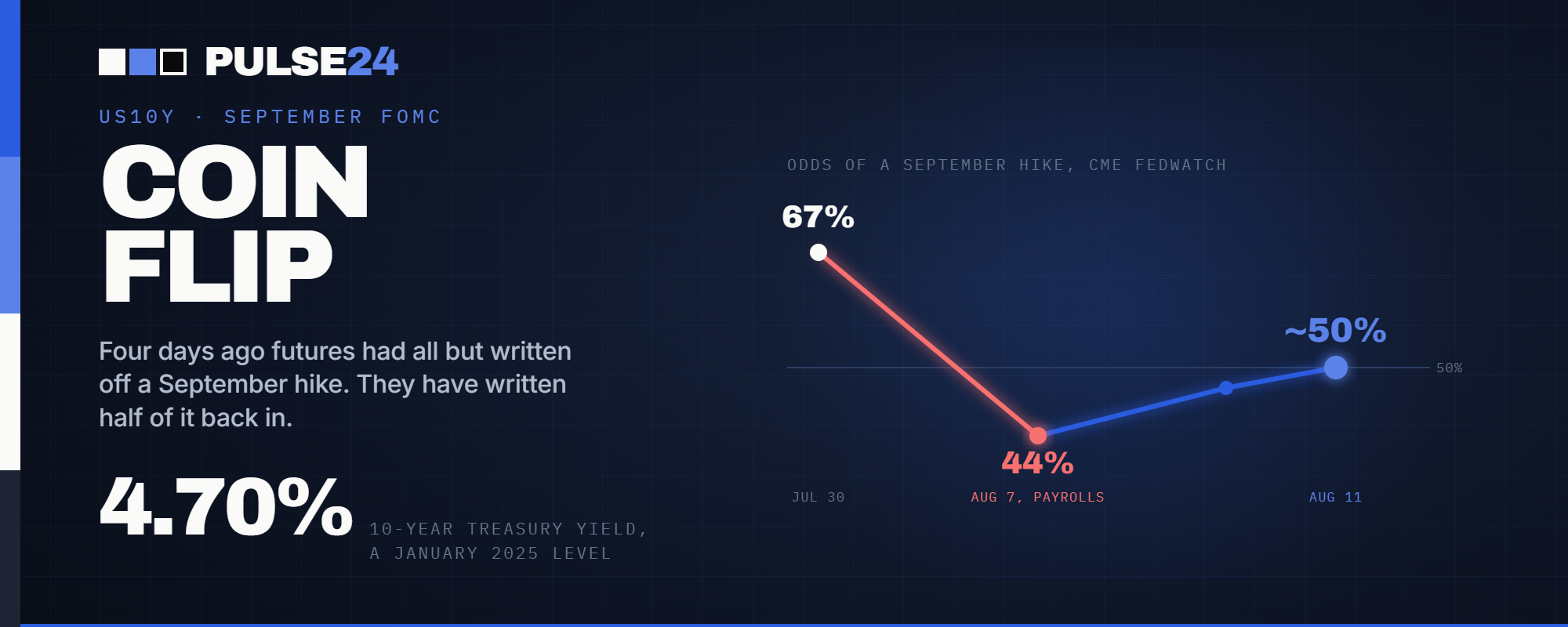
The 10-year Treasury yield climbed back above 4.70% Tuesday, matching territory last visited in January 2025, as a more hawkish push from Cleveland Fed President Beth Hammack and a fresh run-up in oil prices revived September rate hike bets that looked nearly dead a week ago. CME FedWatch now prices the odds of a hike close to a coin flip.
Four days ago, futures markets had all but priced out a September rate hike. On Tuesday, they priced roughly half of one back in.
The 10-year Treasury yield touched a level above 4.70% during the session, a mark the market has visited only twice in eighteen months, once in January 2025 and again for a single day in late July. It settled near 4.69% by the close. On its own, an eight basis point move over two sessions isn't dramatic. What makes it worth a second look is the round trip that got it there.
What Changed
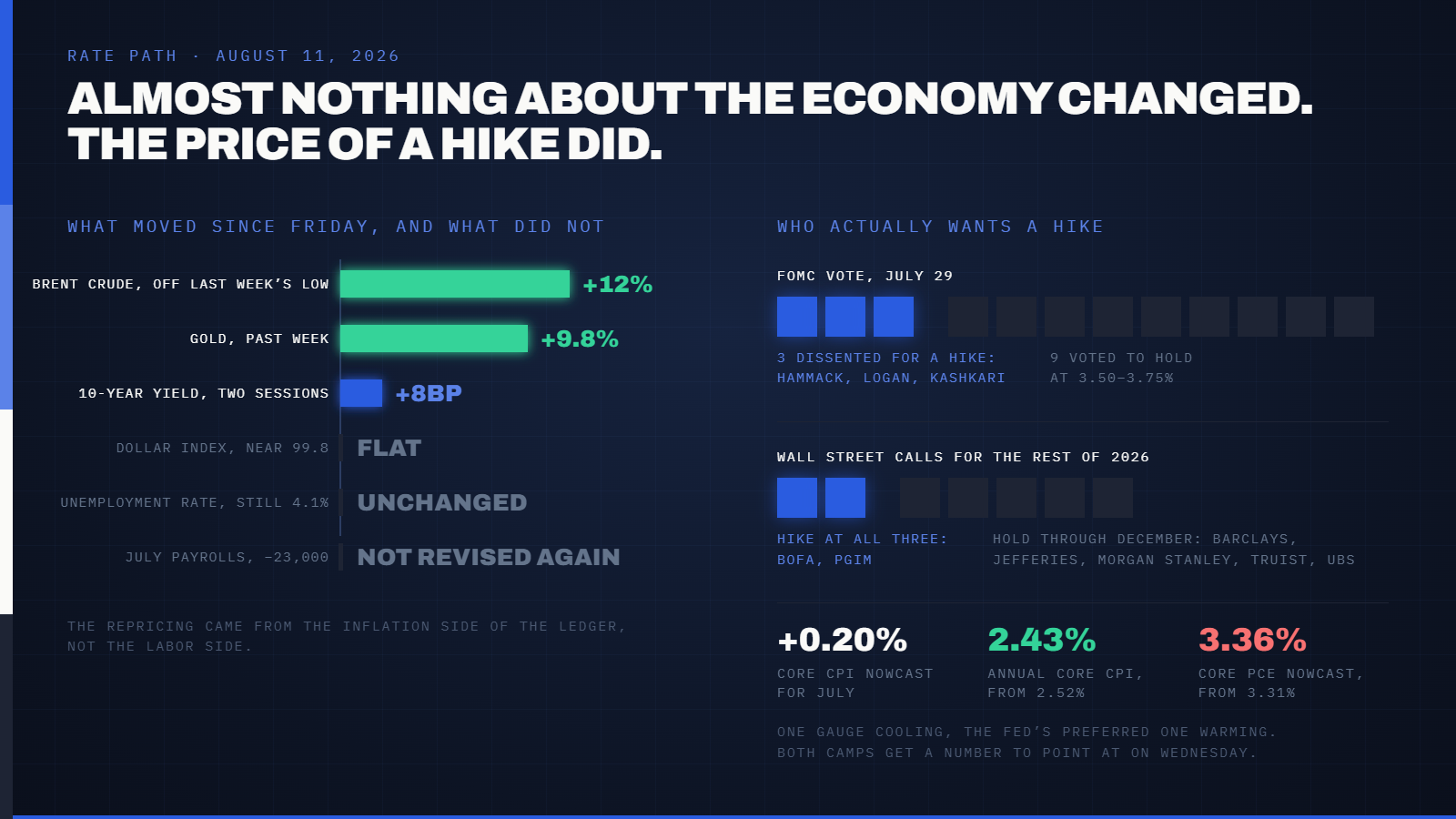
July payrolls fell by 23,000 against a forecast for an 80,000 gain, a report Pulse24 covered in detail last week. May and June were revised down by a combined 103,000 jobs, and the unemployment rate actually dipped to 4.1% from 4.2%, mostly because fewer people were looking for work. CME futures cut the odds of a September hike from around 67% the week before the report to roughly 44% within hours of its release. Bond yields fell in step, and gold rallied on the idea that the Fed's most hawkish members were about to lose the argument.
That trade has partly unwound since Monday. Brent crude has climbed more than 12% above last week's lows on renewed Middle East supply-risk concerns, a move that has little to do with Fed policy directly but everything to do with the inflation math the Fed has to solve. Higher energy costs feed into headline CPI within a month or two, and traders who had been comfortable assuming inflation would keep cooling on its own now have one more reason to doubt it.
Cleveland Fed President Beth Hammack, one of three officials who dissented in favor of a hike at the July meeting, went further than a single dissent in fresh comments this week. She said a lone quarter-point increase probably wouldn't do much for the economy and that the Fed may need to deliver an unspecified string of hikes rather than a token one. It is a notable shift in emphasis from someone who already voted against the majority once this year, and traders treated it as new information rather than a restatement of an old position.
Why It Matters
Markets had converged on a fairly clean story since Friday: labor market cooling, Fed on hold or cutting, yields drifting lower. That story now has competition. The Fed held its benchmark rate at 3.50% to 3.75% on July 29 by a 9-3 vote, and all three dissenters, Hammack, Dallas's Lorie Logan and Minneapolis's Neel Kashkari, wanted to raise rates rather than hold. A weak jobs report does not automatically change three people's minds if they believe inflation, not employment, is the bigger risk. Hammack's comments suggest at least one of them has not moved.
The dollar index has barely budged, sitting near 99.7 to 99.8 and essentially holding Monday's level, which tells you this is not primarily a currency story. It is a rates and inflation-expectations story. Higher long-term yields raise the cost of everything priced off them: mortgages, corporate borrowing, and the present value of future earnings that growth stocks depend on. The three major indexes all closed lower Tuesday, a modest move, but a directional one.
Gold's behavior is the more interesting wrinkle. The metal usually struggles when rate-hike odds rise, since higher real yields make a non-yielding asset less attractive to hold. Instead, gold rose 0.6% Tuesday to about $4,445 an ounce, its third consecutive close above $4,400 and a level 9.8% higher than a week ago. That suggests investors are treating this less as a story about the Fed tightening credibly and more as a story about inflation itself proving stickier than hoped, a scenario where gold can work as a hedge even if hike odds are rising alongside it.
What to Watch Next
July's CPI report lands Wednesday, and this time the stakes cut in both directions. The Cleveland Fed's Nowcasting model points to core CPI rising about 0.20% for the month, which would put the annual rate near 2.43%, a touch softer than June's 2.52%. But the same model has core PCE, the Fed's preferred gauge, ticking up to roughly 3.36% annually from 3.31%. A report that splits the difference gives both camps at the Fed something to point to, which is exactly the kind of ambiguity that tends to keep yields volatile rather than settle them.
The Fed's next meeting runs September 15 and 16. New Chair Kevin Warsh has said publicly that he wants the Fed to communicate less and let markets do more of the work pricing in policy, a departure from the heavy forward-guidance era that followed the 2008 crisis. That approach makes each data point matter more, not less, because there is no committee statement smoothing over the disagreement in the meantime. Wall Street itself is split on the outcome. Bank of America and PGIM expect hikes at all three of the Fed's remaining meetings this year, while Barclays, Jefferies, Morgan Stanley, Truist and UBS expect the Fed to hold steady through December.
The Pulse24 Take
The honest read here is that almost nothing about the underlying economy changed between Friday and Tuesday. Payrolls did not get revised again. The unemployment rate is still 4.1%. What changed is the inflation side of the ledger, mostly through an oil market moving on factors that have little to do with US monetary policy, plus one Fed official restating her position more forcefully than before. That is a thinner foundation than the move in yields might suggest.
Traders betting on a September hike are essentially betting that Wednesday's CPI print runs hot enough to pull more of the committee toward Hammack, Logan and Kashkari's side. The other side of that bet is a wager that the labor market data carries more weight than three hawkish votes and a bad week for oil. Both bets look reasonable right now, which is a way of saying this one genuinely is not settled. The CPI report due Wednesday will move that number more than anything said in the past four days, and it will do it in a matter of minutes rather than the slow grind that just played out.
How we read the data
Curious how we get from raw data to a take like this? Our Trader's Toolkit walks through the tools we lean on.
Explore the Toolkit