Pulse24 Original
July Payrolls Fell 23,000 Against a Forecast for an 80,000 Gain. The Fed's September Hike Odds Got Cut Nearly in Half Within Hours.
August 7, 2026
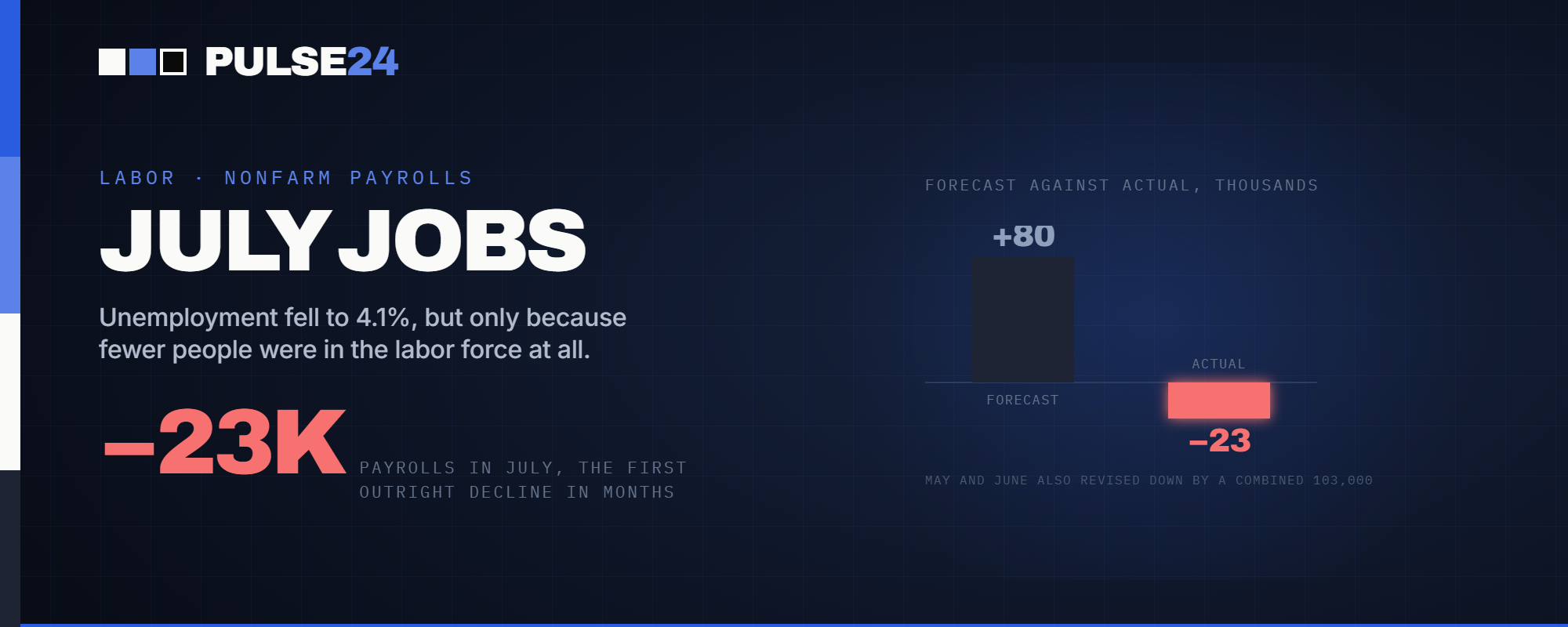
July payrolls fell by 23,000 against a forecast for an 80,000 gain, and traders cut the odds of a September Fed rate hike almost in half within hours of the release. The report's real story is in the details: unemployment fell to 4.1% because fewer people are working, not because more people found jobs.
Twenty-three thousand jobs vanished from US payrolls in July, well off the 80,000 gain economists had penciled in. It's the first outright monthly decline the labor market has posted in months. The miss landed less than a day after traders had been pricing better-than-even odds of a Federal Reserve rate hike in September, and by midmorning those odds had been cut nearly in half.
What Changed
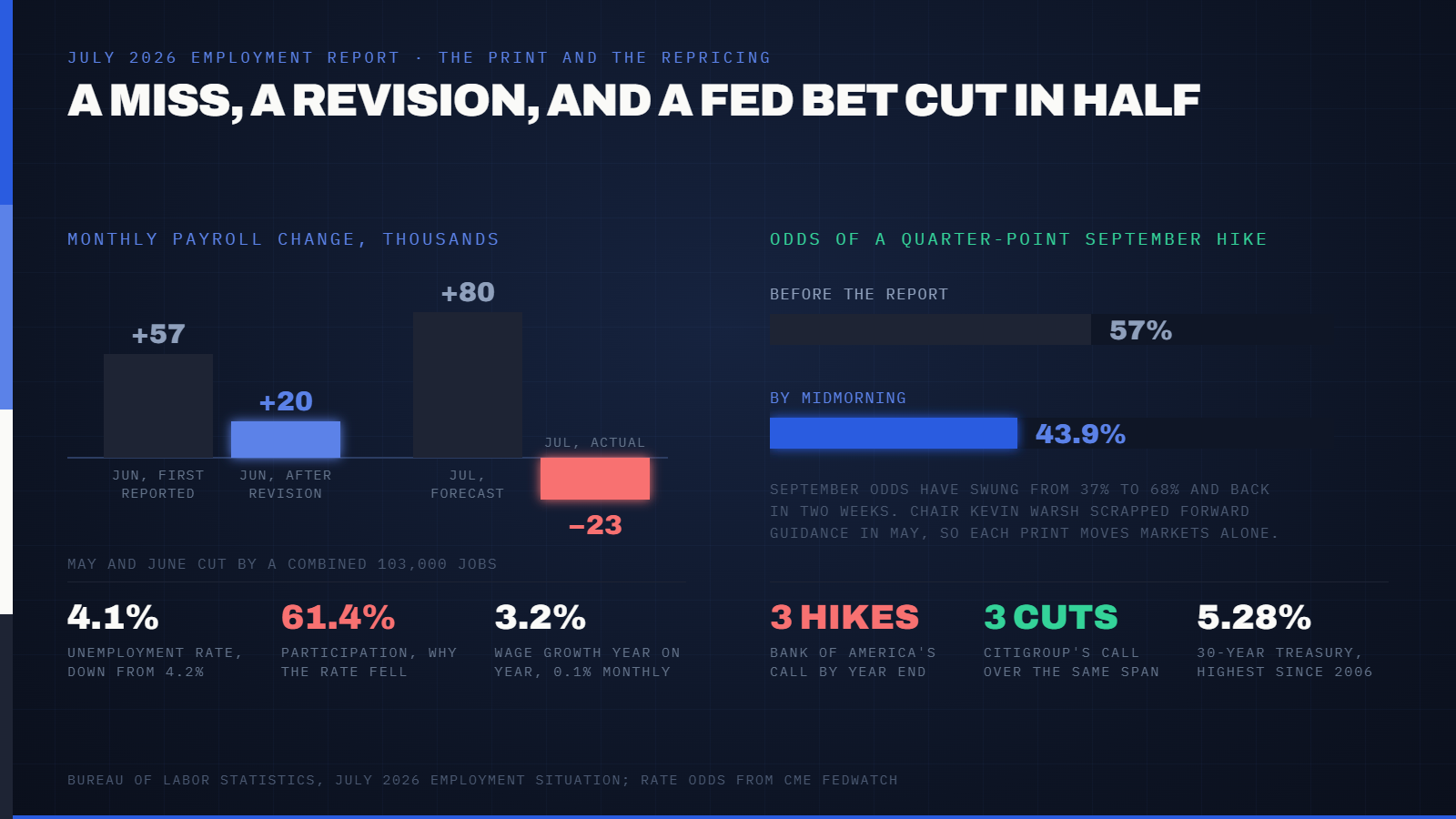
The headline number was bad enough on its own. Payrolls fell by 23,000 against a consensus estimate of roughly 80,000, a gap wide enough that even economists who'd expected softness were surprised by the direction, not just the size. Government data also showed May and June being revised down by a combined 103,000 jobs, with June's initially reported 57,000 gain cut all the way to 20,000. That kind of revision changes the story retroactively: a labor market that looked like it was cooling gently now looks like it stalled out weeks earlier than anyone realized.
The unemployment rate actually improved, ticking down to 4.1% from 4.2%. Normally that would read as good news, but the mechanics behind it tell a different story. Labor force participation slipped to 61.4%, meaning the rate fell partly because fewer people were working or actively looking for work, not because hiring picked up. Wage growth backs up that softer read: average hourly earnings rose just 0.1% for the month and 3.2% over the past year, a pace that gives the Fed little reason to worry about wage-driven inflation.
The report followed Wednesday's private payrolls miss, which had already put the labor market's direction in question, and it arrived two days after the factory employment data Pulse24 flagged as the release that could decide September. Both pointed the same way. Friday's number confirmed it with the government's own count, not a private estimate.
Why It Matters
Context matters more than usual here because of how the Fed is currently run. Chair Kevin Warsh, who took over in May, scrapped the central bank's forward guidance almost immediately, arguing the tool wasn't suited to the current moment. The result is a Fed that lets each data print move markets on its own, without a chair signaling in advance where policy is headed. September rate odds have swung from 37% to 68% and back again over the past two weeks alone, and Friday's jobs report just added another swing to that pattern.
That volatility shows up in bond yields too. The 30-year Treasury touched 5.28% earlier this week, its highest level since 2006, as traders priced in a real chance of tightening rather than easing. Some of that pressure has come from oil, with Brent crude trading near $83 a barrel on supply concerns tied to Middle East shipping risk, a factor that has kept inflation fears alive even as the labor market shows cracks. Friday's data pulled in the other direction: futures for the S&P 500 and Nasdaq pushed higher, Treasury yields fell, and the yield curve bull steepened as traders leaned back toward the case for a pause.
Wall Street's biggest banks aren't converging on an answer. Bank of America has stuck with a call for three quarter-point hikes by the end of the year, arguing sticky services inflation and tariff-related cost pressure will force the Fed's hand. Citigroup is on the opposite side, projecting three quarter-point cuts landing in October, December and January, and arguing that labor market weakness gives the Fed room to ease rather than tighten. It's a sharp reversal in tone from just a week earlier, when eurozone inflation data had both the ECB and the Fed looking like they were leaning toward tightening, not cutting. One weak jobs report doesn't settle that argument. If anything, it gives both camps new evidence to work with.
What to Watch Next
The next major test comes with inflation data due before the Fed's September meeting. If price growth stays contained, Friday's weak jobs numbers become the dominant story heading into the decision. If inflation surprises to the upside, largely on the back of oil and import costs, the Fed could still find itself leaning toward a hike despite a softening labor market, an awkward combination that would leave Warsh's committee choosing between two mandates pulling in opposite directions.
Also worth watching: whether August's jobs data confirms the July weakness or reverses it. A single month, even one with two months of downward revisions attached, isn't enough to declare a trend. But two in a row would be much harder for the Fed to look past, no matter how it is framing its policy path this cycle.
The Pulse24 Take
Markets like clean stories, and this one refuses to be clean. A weak jobs report should, in theory, make the case for a Fed pause or cut straightforward. But the same report that showed hiring stalling also showed wage growth cooling to a level that shouldn't scare anyone on the inflation side, while oil prices and shipping risk keep pulling in the opposite direction. Under a Fed chair who has chosen not to guide markets in advance, each of these releases is doing more work than it normally would, and traders are left rebuilding their rate expectations from scratch every few days. That is not a comfortable setup for anyone trying to position ahead of September. History offers a rough parallel in 2019, when the Fed cut rates as a defensive move against a slowing global economy even while the labor market still looked fine on paper, and drew criticism at the time for moving too early. Whether Warsh's Fed ends up making a similar call, or holds the line the way Bank of America expects, probably comes down to whichever data point lands right before the meeting. For now, the safest read is that September is genuinely up for grabs, and anyone who tells you otherwise is more confident than the data justifies.
How we read the data
Curious how we get from raw data to a take like this? Our Trader's Toolkit walks through the tools we lean on.
Explore the Toolkit