Pulse24 Original
Private Payrolls Grew by Just 44,000 in July, the Weakest Reading Since January. Gold Jumped 2.78% on the Miss, and a Fed Dissenter Says It Doesn't Change His Vote.
August 5, 2026
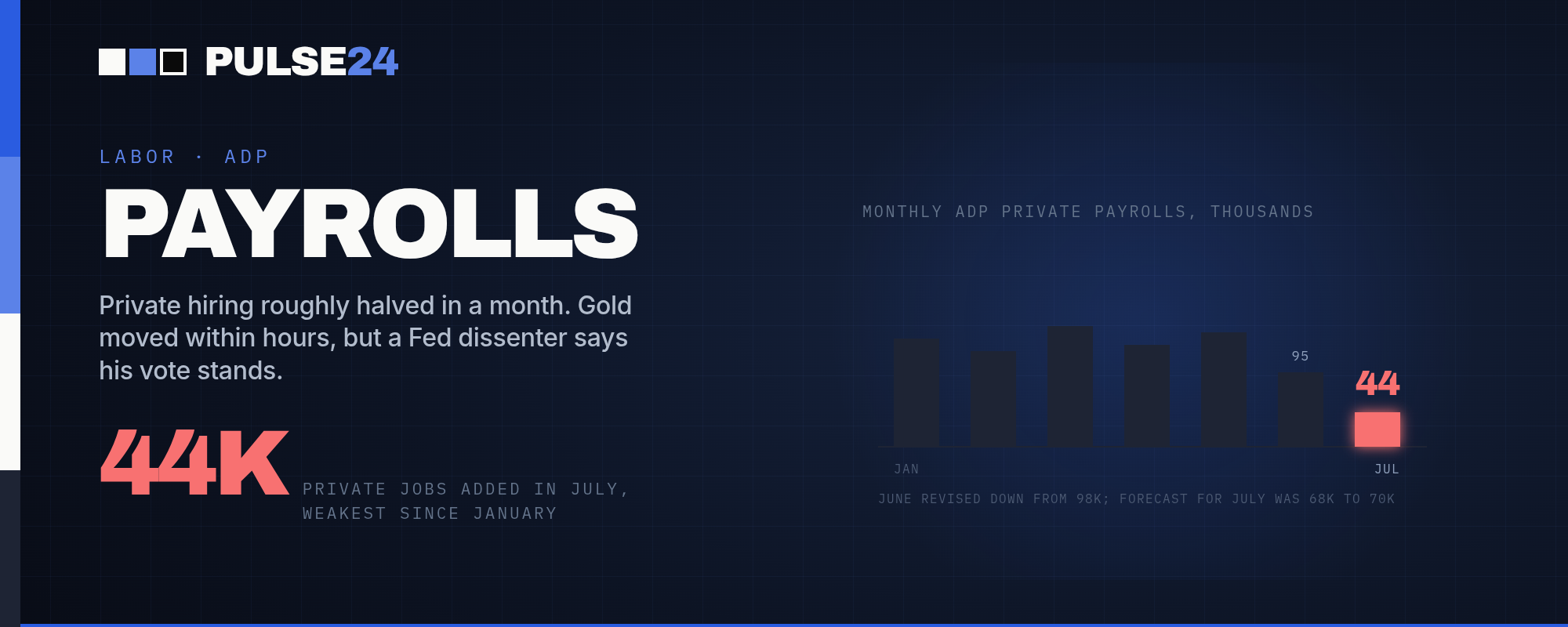
Private payrolls grew by just 44,000 in July, the weakest reading since January, and gold jumped 2.78% on the news. Fed dissenter Neel Kashkari says the soft data doesn't change his case for higher rates.
Private employers added 44,000 jobs in July, according to ADP data released Wednesday morning. Economists had penciled in somewhere between 68,000 and 70,000. June's total, first reported at 98,000, was revised down to 95,000, so the pace of hiring roughly halved from one month to the next.
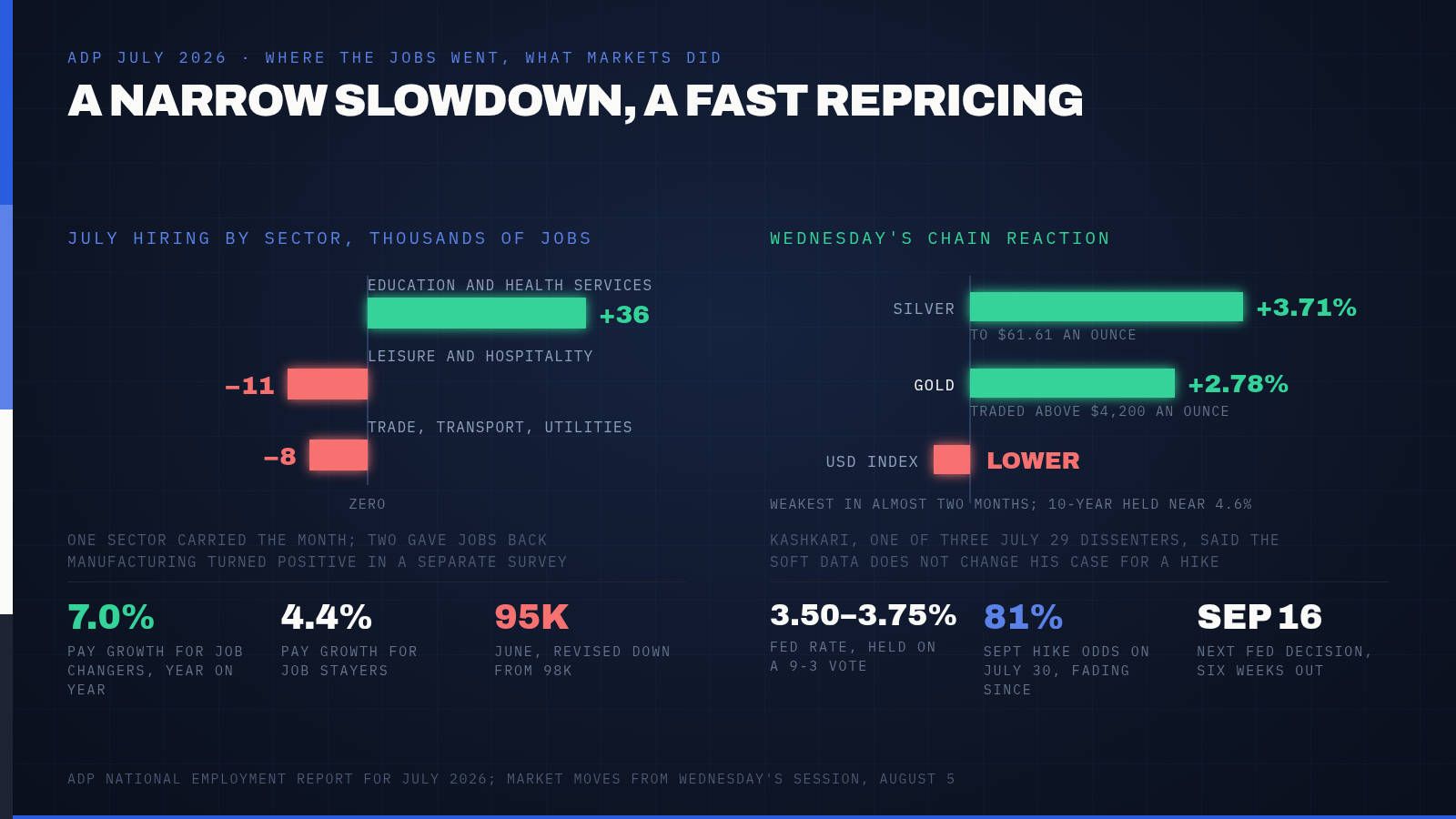
Gold moved first. Spot prices jumped as much as 2.78% and traded above $4,200 an ounce during the session, while silver climbed 3.71% to $61.61. The 10-year Treasury yield held close to 4.6%, and the dollar index slipped toward its weakest level in almost two months. Weak hiring data lowers the odds of a Fed rate hike, a softer rate outlook weighs on the dollar and Treasury yields, and a softer dollar tends to lift dollar-priced metals like gold and silver. Wednesday's trading ran through that entire chain in a matter of hours.
Why It Matters
The slowdown runs deeper than the headline number. Job-changers, people who switched employers in July, saw pay grow 7% year over year, the fastest pace since August 2025, according to ADP chief economist Nela Richardson. Job-stayers saw a milder 4.4% gain. That combination, fewer net jobs added but faster pay growth for workers who do move, points to a labor market where companies aren't hiring broadly but are still competing hard for specific skills. A separate report out earlier Wednesday showed manufacturing employment turning positive for the first time in 33 months, yet broader private hiring still came in soft. The gains were concentrated too: education and health services alone added 36,000 positions, while leisure and hospitality shed 11,000 jobs and trade, transportation and utilities lost another 8,000.
A Fed Divided
This data landed in the middle of an actual disagreement inside the Federal Reserve, not just a debate among outside economists. The Fed held its benchmark rate at 3.50% to 3.75% on July 29 by a 9-3 vote, one of the widest splits in years. All three dissenters, Cleveland's Beth Hammack, Dallas's Lorie Logan and Minneapolis's Neel Kashkari, wanted a quarter-point hike instead, arguing that five years of above-target inflation risks becoming entrenched if the Fed waits too long.
Kashkari repeated that view on Wednesday, saying it was time to start slowly raising rates. In his written dissent, he explained his reasoning this way: "I would rather tighten policy incrementally as we gather more data on the path of inflation and employment." He pointed to the 1970s as a reminder of what happens when a central bank waits too long to respond to persistent inflation. A soft jobs report, in his framing, is one data point among many, not a reason to abandon the case for higher rates.
That position looks increasingly out of step with where trading desks have been leaning. A record-setting Dow, built on the widest earnings beat since 2008, had traders pricing in a hike as recently as Monday, and CME futures showed an 81% probability of a September increase as of July 30. Accelerating inflation across the eurozone reinforced that same view just days earlier. Hike odds have since faded, helped along by diplomatic progress overseas and now, more directly, by a jobs report that came in well below forecast.
What to Watch Next
Friday brings the official July jobs report from the Bureau of Labor Statistics, the number that actually moves the September meeting. ADP and the government's payrolls count can diverge in a given month, sometimes sharply, so Wednesday's reading is a preview rather than a verdict. Three things are worth watching heading into Friday: whether the unemployment rate holds steady, whether wage growth stays hot enough to worry a hawk like Kashkari, and whether revisions to May and June hiring move in the same soft direction as ADP's own downward revision. The Fed's next decision lands September 16, six weeks out, which is plenty of time for this picture to shift again.
The Pulse24 Take
Wednesday's market reaction, gold higher, the dollar softer, yields little changed, amounts to a bet that the Fed's dissenters lose this argument. That bet could be right. A single soft ADP print, even a weak one, probably isn't enough on its own to flip a Fed where three officials were publicly pushing for higher rates a week ago. Kashkari's dissent is a useful reminder that policymakers aren't reading from the same script: some are more worried about inflation getting stuck above target than about a labor market that's cooling at the edges. Friday's jobs report is the real test. If it confirms the ADP slowdown, the case for a September hold gains real weight. If it doesn't, this week's gold rally and dollar slide could reverse just as fast as they showed up.
How we read the data
Curious how we get from raw data to a take like this? Our Trader's Toolkit walks through the tools we lean on.
Explore the Toolkit