Pulse24 Original
US Factory Employment Turned Positive for the First Time in 33 Months. The Jobs Report That Could Decide September Lands This Friday.
August 5, 2026
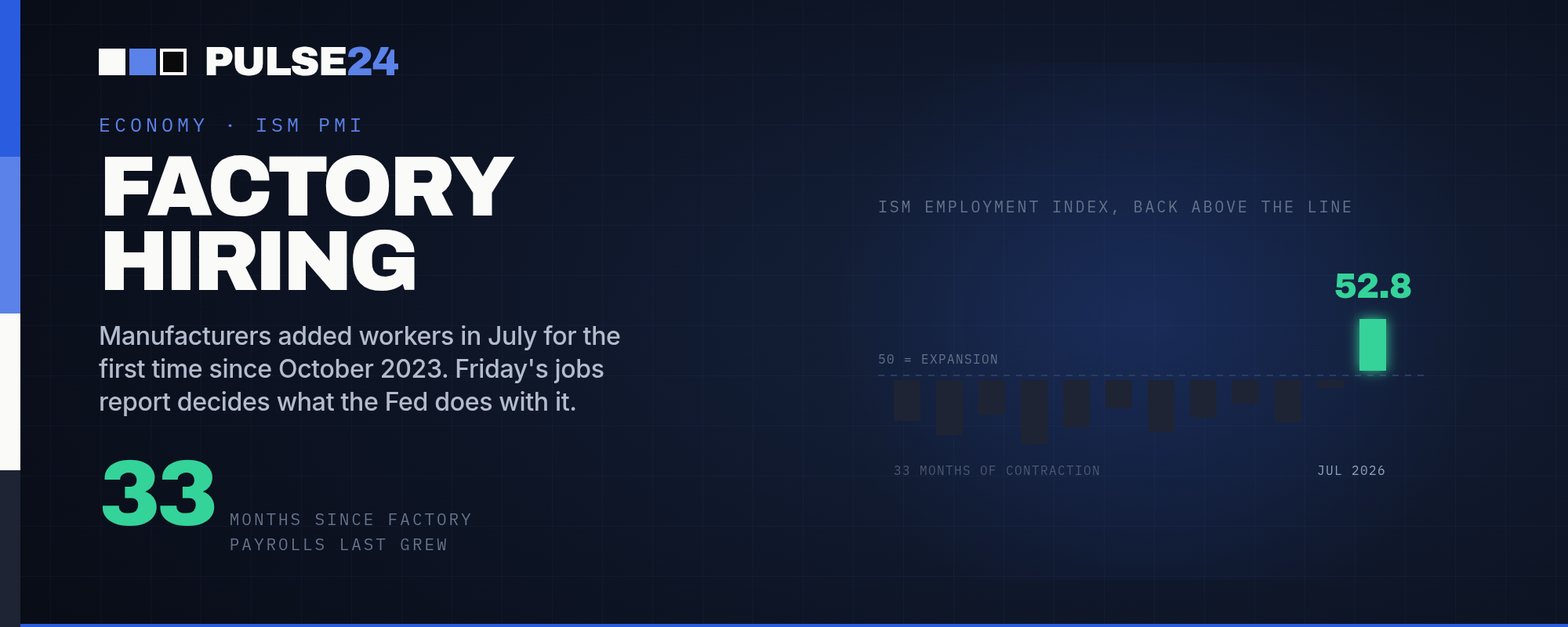
US manufacturing employment expanded in July for the first time since October 2023, and the ISM's factory index hit its best reading since 2022. The data lands four days before a jobs report that could tip the Fed toward its first hike in years.
Manufacturing employment in the United States grew in July for the first time since October 2023. That single line, buried inside Monday's ISM report, may end up mattering more to markets this week than the headline number sitting above it.
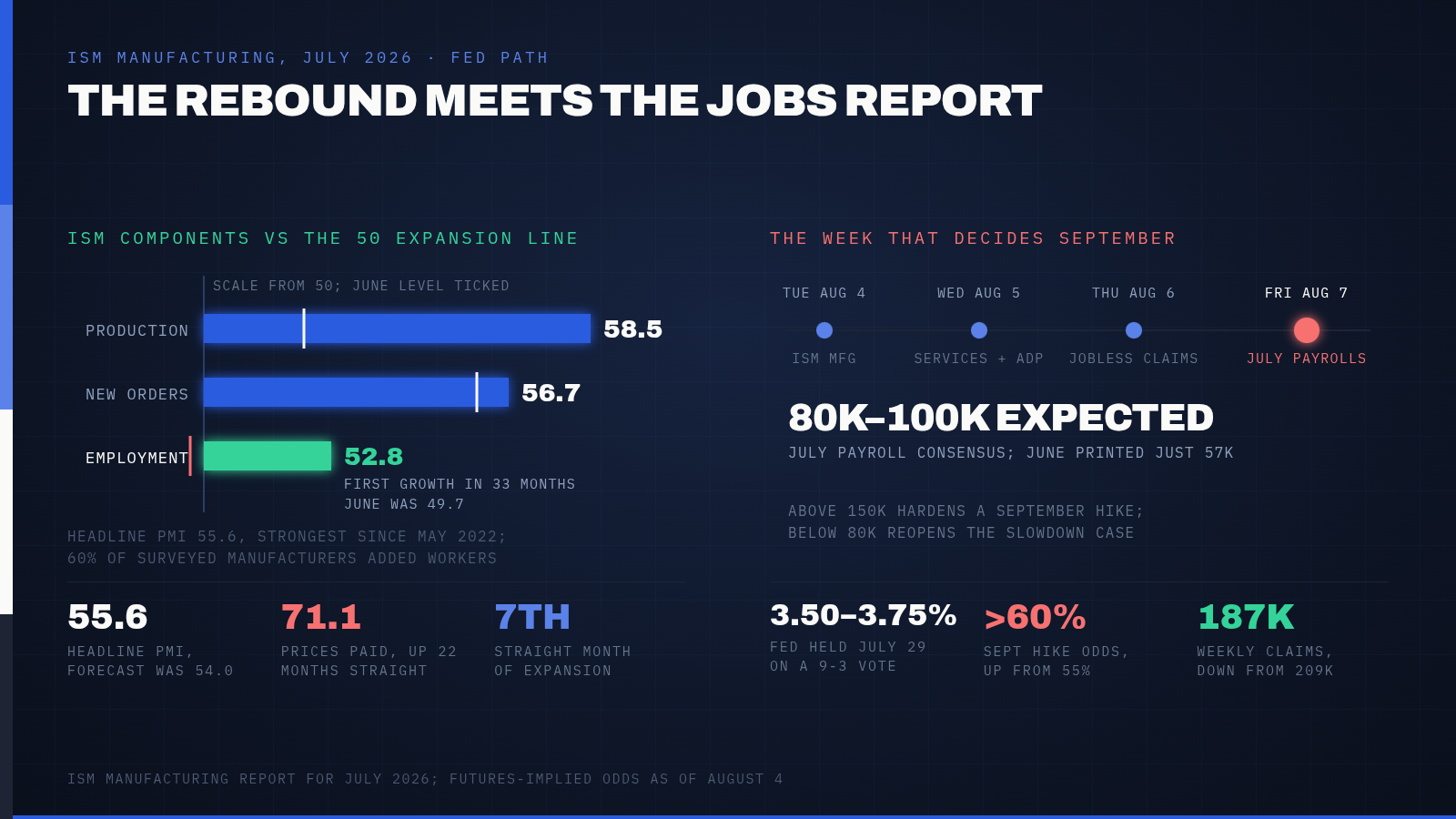
The Institute for Supply Management's Manufacturing PMI climbed to 55.6% in July, up from 53.3% in June and comfortably ahead of the 54.0% economists had penciled in. It's the highest reading since May 2022, and it marks the seventh straight month the factory sector has expanded after four months of contraction earlier this year.
What Changed
Three of the report's five weighted components moved together, which doesn't happen often. New orders rose to 56.7% from 56.0%, while production jumped to 58.5% from 52.2%, a 6.3 point swing that puts it at its highest level since November 2021. Employment crossed back above the 50% expansion line to 52.8%, up from 49.7%, after nearly three years of factories shedding or holding flat on headcount.
Sixty percent of the manufacturers ISM surveyed said they added workers in July. That's a meaningful shift for a sector that had been quietly bleeding jobs since the fall of 2023, even while headline GDP kept growing. Respondents pointed to demand from semiconductor makers, AI infrastructure buildouts, aerospace, and defense contractors, which lines up with what Pulse24 has been tracking all summer: the AI capital-spending cycle is starting to show up in hard economic data, not just corporate earnings calls.
Inflation pressure inside the report didn't disappear. The Prices Paid Index came in at 71.1%, down only 1.9 points from June's 73.0%. Raw material costs have now risen for 22 consecutive months. Growth and inflation moved in the same direction in the same report, and that combination tends to make a central bank's job harder, not easier.
Why It Matters
The Federal Reserve held its benchmark rate at 3.50% to 3.75% on July 29, its fifth straight hold. The vote wasn't unanimous. Three officials dissented in favor of raising rates immediately, a level of internal disagreement that hasn't shown up on the committee in years. Fed Chair Kevin Warsh, confirmed by the Senate in May, has repeatedly argued that prices are still running too hot to declare victory.
A strong ISM print with sticky prices gives that argument more weight. Traders have taken notice. The dollar index, which had just logged its worst weekly performance in three months after the US and Japan jointly intervened to support the yen, bounced off support this week and is testing resistance just under the 100 mark. Odds of a September rate hike, priced near 55% immediately after the Fed's July decision, have since climbed above 60% in futures markets.
That's a shift from where positioning stood for most of the summer, when a rate cut looked like the more likely outcome by year end. A factory sector adding workers for the first time in almost three years doesn't fit neatly into a slowdown story.
What to Watch Next
This week is unusually dense with labor market data, arriving right where the Fed needs an answer. ISM's Services PMI, which covers the much larger part of the economy, is due later today alongside ADP's private payrolls estimate. Weekly jobless claims land tomorrow. The most recent reading came in at 187,000, down sharply from a revised 209,000 the week before, with the four-week average near 207,500, a level still consistent with employers doing very little firing.
All of it builds toward Friday. The Bureau of Labor Statistics releases its July employment report on August 7, and the bar is unusually low after June's payrolls came in at just 57,000, roughly half what forecasters expected. Consensus for July sits near 80,000 to 100,000 new jobs, with unemployment expected around 4.2%. A print above 150,000 would likely harden September hike expectations further. Anything below 80,000 would reopen the argument that the labor market is softer than one strong manufacturing report suggests.
Markets rarely get this clean a test of two competing stories in the same week: an economy strong enough to need higher rates, or one where a single sector's rebound is masking softness elsewhere. Friday should start to answer which one is closer to right.
The Pulse24 Take
One month of factory data rarely settles a debate about where an economy is headed, and it's worth staying cautious about reading too much into a single Employment Index reading after 33 months of contraction. Surveys like ISM's are diffusion indexes built on sentiment, not hard payroll counts, and they can move sharply on shifting expectations alone.
Still, the direction of travel is notable. Production, orders, and hiring all improved together, in a report where price pressure barely eased. That combination is why the Fed's internal vote looks less like a formality and more like a genuine argument over what happens in September. Anyone positioned for an easing cycle this year may want to treat Friday's jobs report as the tiebreaker it's shaping up to be, rather than just another data point on the calendar.
How we read the data
Curious how we get from raw data to a take like this? Our Trader's Toolkit walks through the tools we lean on.
Explore the Toolkit