Pulse24 Original
The US and Japan Jointly Bought Yen for the First Time Since 1998. The Dollar Dropped From a 40-Year High to Around 156.
August 3, 2026
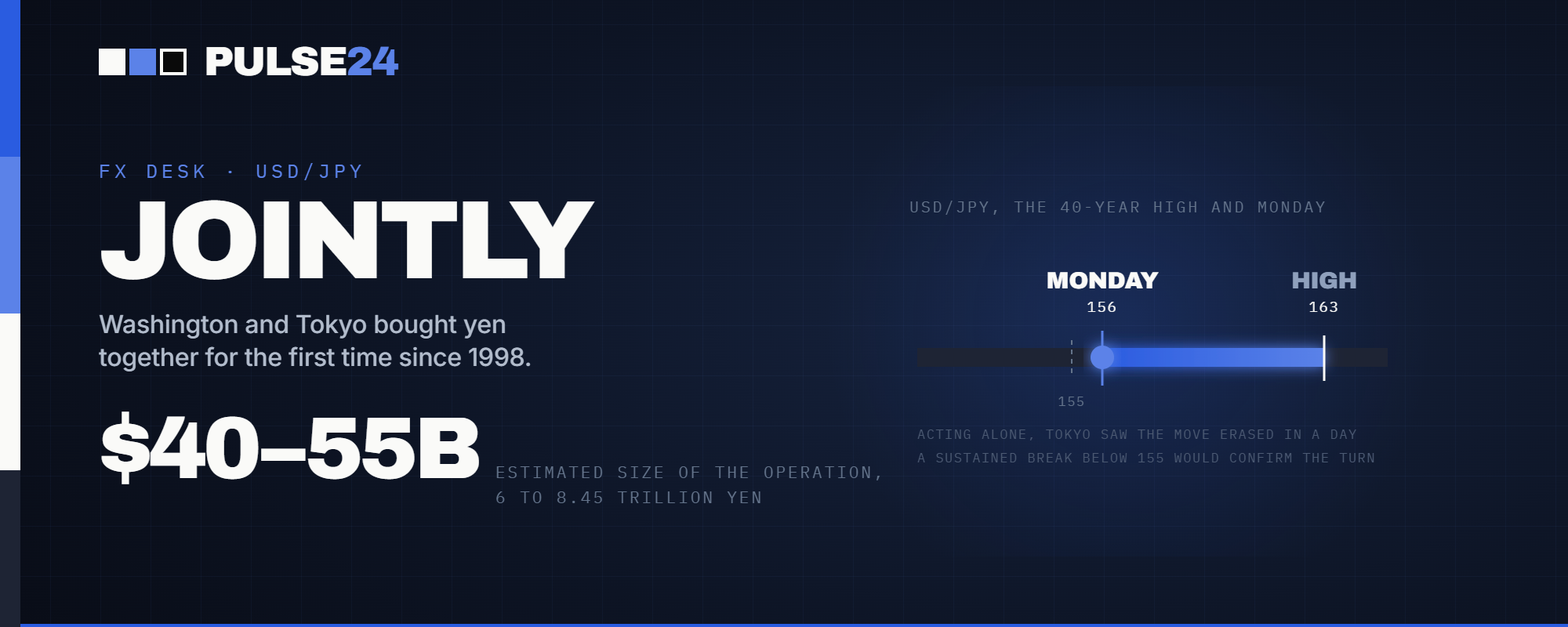
The US Treasury and Japan's Ministry of Finance jointly bought yen for the first time since 1998, pulling the dollar back from a 40-year high above 163 to around 156. Here's why two governments stepped into a market they normally leave alone, and what would actually make it stick.
The Federal Reserve Bank of New York sold euros and bought yen late last week, working through Goldman Sachs and Morgan Stanley on behalf of the US Treasury. Japan's Ministry of Finance ran the same trade on its side of the Pacific. Together, that made it the first time Washington and Tokyo have jointly bought yen since 1998, when Robert Rubin and Eisuke Sakakibara ran a similar operation during the Asian financial crisis.
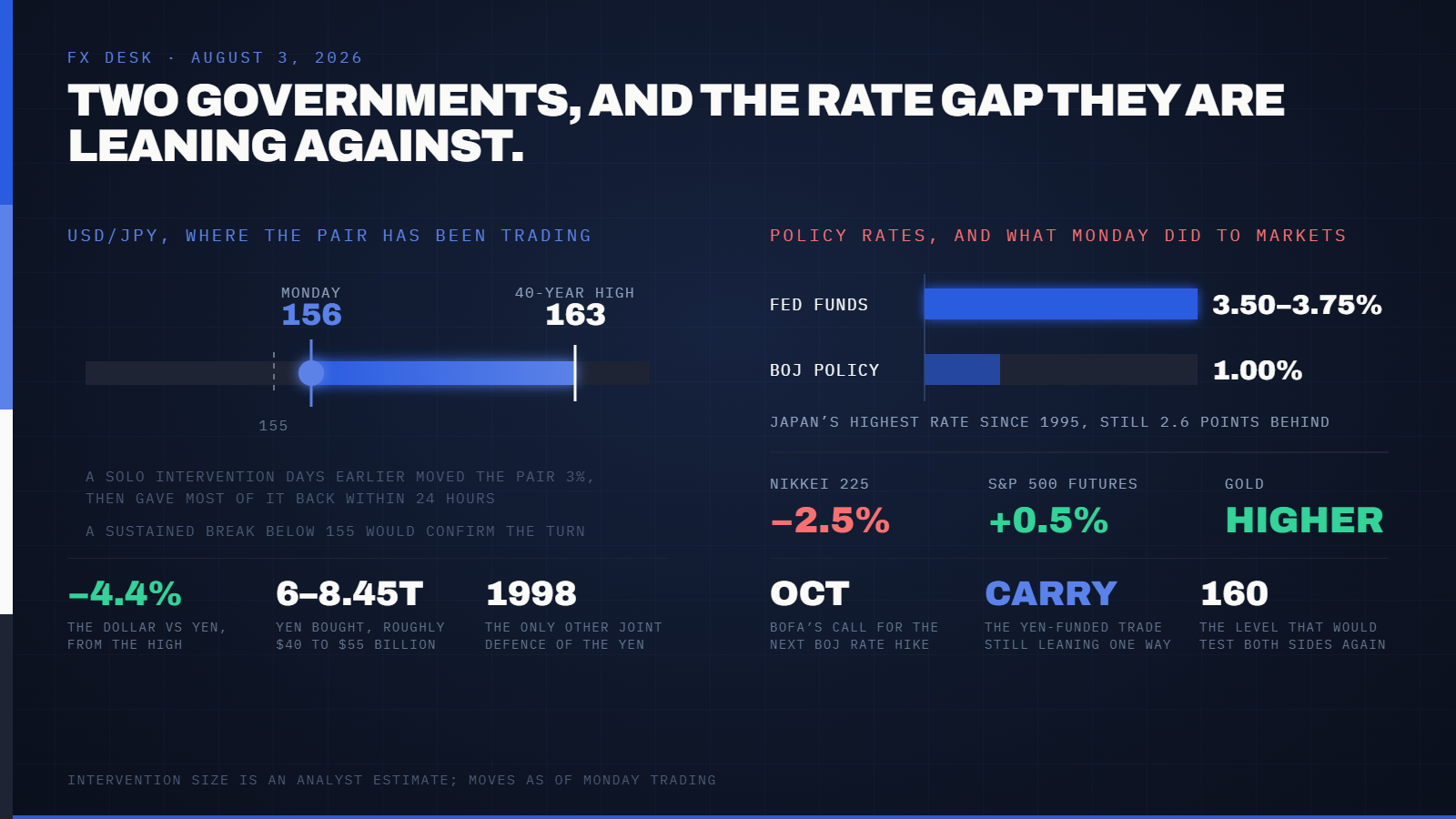
Neither government confirmed it right away. The dollar had just pushed to a fresh 40-year high above 163 yen, and traders spent the weekend piecing together price action that SPI Asset Management's Stephen Innes later described as carrying "all the familiar fingerprints" of official buying. By Monday, Japan's finance minister Satsuki Katayama put the speculation to rest, confirming the ministry had "purchased yen in coordination with the US Treasury Department." The pair had already dropped to around 156 by then, one of the sharpest multi-day moves in the currency this year.
What Changed
This isn't Japan's first attempt to defend the currency this year, and it isn't even the first time it's tried in the past two weeks. Days earlier, a suspected solo intervention by Japan's Ministry of Finance had knocked the pair down about 3% in a single session, only for USD/JPY to erase most of that move within 24 hours once a hawkish Bank of Japan rate hold failed to close the underlying gap with US rates. Tokyo had already spent heavily defending the currency earlier this year too, and watched the yen slide past 163 again anyway. Acting alone clearly wasn't enough. This time Washington joined the trade directly, and both sides went out of their way to say so publicly, which is itself the bigger signal.
Why the Yen Broke
The interest rate gap is still doing most of the work. The Bank of Japan raised its policy rate to 1% in June, the highest since 1995, but that's a modest move next to a Federal Reserve that investors increasingly expect to hike rather than cut before year end. Oil has added to the pressure too; crude's volatility this year has widened Japan's import bill in a country that sources nearly all its energy from abroad. Underneath both of those sits the yen-funded carry trade, where investors borrow cheaply in yen to buy higher-yielding assets elsewhere, a flow that keeps leaning on the currency in one direction regardless of what any single data point says. Prime Minister Sanae Takaichi's proposed sales tax cuts didn't help either, raising fresh questions about Japan's fiscal path just as the currency was already under pressure.
The Market's First Reaction
Japan's Nikkei 225 fell as much as 2.5% on Monday even as the yen strengthened. A stronger currency makes Japanese exporters less competitive abroad, so relief for households paying more for imported energy and food becomes a headache for the automakers and chipmakers that sell into the US and Europe. S&P 500 futures moved the other way, adding about half a percent, and gold ticked higher too, both signs traders read the intervention as calming rather than destabilizing for broader risk appetite. MUFG's Michael Wan called the joint action "historic and significant," adding it could help clear out crowded bets against the yen that had built up over months.
What to Watch Next
Bank of America now expects the Bank of Japan to hike again in October, with growing odds the move comes even sooner. If that happens, the rate gap that dragged the yen down in the first place starts closing on its own, which would matter more for the currency's path than any further intervention. Also worth tracking is whether the dollar's broader strength, which has been climbing alongside firming Fed hike expectations, cools now that two governments have shown they're willing to lean against it directly. A sustained break below 155 would be the clearest sign yet that the carry trade many investors have leaned on for years is genuinely losing steam rather than just catching its breath.
The Pulse24 Take
Currency intervention buys time more often than it buys a fix. The last time Washington and Tokyo did this together, in 1998, it took the better part of a year and a real narrowing of interest rate differentials before the yen found a durable floor. What's different this time is the language both sides used afterward: explicit, on the record commitments to do it again, which tends to matter more to markets than the actual yen figures on the day. Traders test resolve, not press releases, so the more useful signal will come the first time the pair drifts back toward 160 and the world finds out whether Washington and Tokyo show up a second time. Until then, this looks like a ceiling on how fast the yen can weaken rather than a floor under how strong it can get.
How we read the data
Curious how we get from raw data to a take like this? Our Trader's Toolkit walks through the tools we lean on.
Explore the Toolkit