Pulse24 Original
Eurozone Inflation Climbed to 2.9% in July. The ECB and the Fed Are Now Both Leaning Toward a Hike, Not a Cut.
August 2, 2026
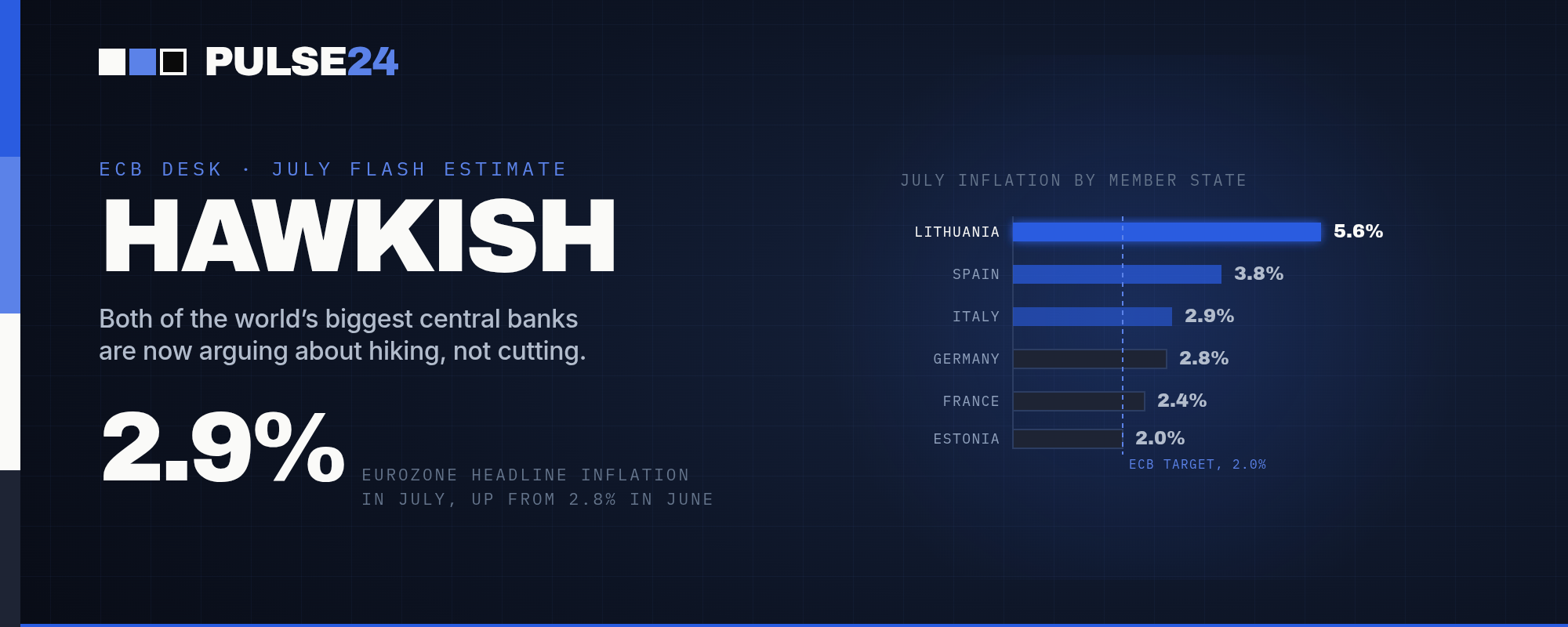
Eurozone inflation accelerated to 2.9% in July and the ECB left its September meeting wide open for a rate hike. That comes a week after the Fed held rates on a 9-3 vote, with three officials pushing for a hike instead of a cut.
Eurozone inflation accelerated to 2.9% in July, up from 2.8% in June, according to Eurostat's flash estimate released Friday. Core inflation, which strips out food and energy, rose to 2.5% from 2.4% over the same stretch. Neither number is heading toward the European Central Bank's 2% target. Both are heading away from it.
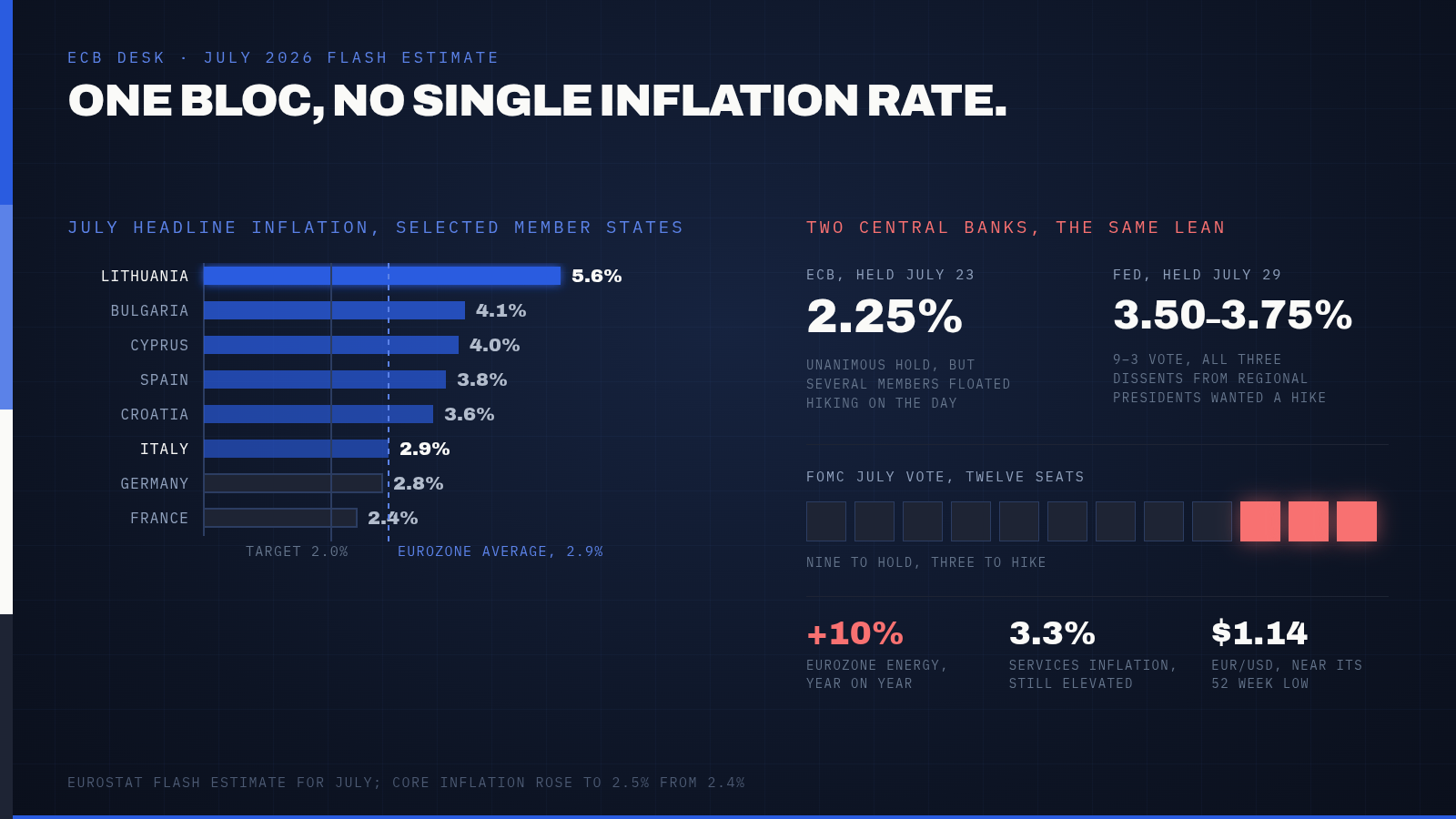
That matters because of what happened eight days earlier. On July 23, the ECB held its benchmark deposit rate at 2.25%, but Christine Lagarde told reporters afterward that several Governing Council members had already floated the idea of hiking then and there. The vote to hold was unanimous. The appetite to wait wasn't.
Lagarde's framing was that the ECB needed more data before deciding whether persistent price pressure was structural or temporary. July's inflation report is exactly the kind of data she was waiting for, and it points toward the less comfortable answer.
What Changed
Energy costs are doing most of the damage. Eurozone energy prices rose 10% year over year in July, and services inflation held at an elevated 3.3%. Brent crude closed the month near $87.93 a barrel, roughly 23% higher than where it started July, driven by tightening global supply and a run of falling US crude inventories. When oil moves that fast, it works through diesel, jet fuel, and electricity prices within weeks, not quarters.
The pain isn't even across the currency bloc. Lithuania posted the eurozone's highest July reading at 5.6%, with Bulgaria at 4.1%, Cyprus at 4.0%, Spain at 3.8%, and Croatia at 3.6%. At the other end, Estonia sat right at the ECB's 2% target, France came in at 2.4%, and Malta at 2.1%. Germany, the bloc's largest economy, printed 2.8%. Italy matched the eurozone average at 2.9%.
Why It Matters
The ECB isn't the only central bank suddenly talking about hiking instead of cutting. The Federal Reserve held its own rate at 3.50% to 3.75% on July 29 in a 9-3 vote, with three regional bank presidents dissenting because they wanted to go higher, not lower. A month ago, most trading desks were still positioned for the Fed's next move to be a cut. Now two of the world's most important central banks are each leaving room for one more hike.
That combination should, in theory, be good for both currencies. It hasn't worked out that way for the euro. EUR/USD is trading near $1.14, close to the bottom of its 52-week range of $1.13 to $1.21, even with the ECB signaling it might tighten. One reason is that the Fed's own hawkish lean is doing the same job for the dollar, canceling out much of the euro's expected advantage. Traders have also learned, across several ECB meetings this year, to wait for the actual vote before repricing the currency at all.
Longer-dated bonds are telling a related story. The move higher in inflation expectations has coincided with a broader repricing at the long end of global yield curves, the same dynamic that pushed the 30-year Treasury yield to its highest level since 2007 earlier this week. When the world's two largest currency blocs both flirt with tightening at the same time, term premium tends to rise everywhere at once, not just in the currency where the hike talk started.
What to Watch Next
The ECB's Governing Council meets again in September, and Lagarde has already said staff will run deeper scenario analysis on energy prices before then. A second month of accelerating inflation would make a hold much harder to justify. The Fed's own September meeting, scheduled for the 15th and 16th, now carries similar stakes, especially if this month's US inflation and jobs data extend the case the July dissenters were already making.
Watch the euro specifically for a shift in behavior. If EUR/USD starts climbing even modestly on hawkish ECB commentary, that would suggest the market is finally pricing the hike case rather than waiting to see it confirmed. Until then, treat the current calm in currency markets as indecision, not agreement.
The Pulse24 Take
Six months ago, the consensus trade was simple: inflation was cooling, central banks would start cutting, and the only real debate was timing. That consensus is fraying in two places at once. The ECB left its September meeting deliberately open after a report that gave the hawks more ammunition, not less. The Fed did something similar a week earlier, holding rates while three of its own officials voted the other way.
Neither institution has committed to anything yet, and that hesitation is the point. Data-dependent central banks can look indecisive right up until the moment they aren't. What changed this week isn't a rate path so much as a certainty: the case for cutting rates, which looked settled back in the spring, no longer looks settled at all.
How we read the data
Curious how we get from raw data to a take like this? Our Trader's Toolkit walks through the tools we lean on.
Explore the Toolkit