Pulse24 Original
The 30-Year Treasury Yield Topped 5.2%, Its Highest Since 2007. The Nasdaq Just Logged Its Second Correction of the Year.
August 1, 2026
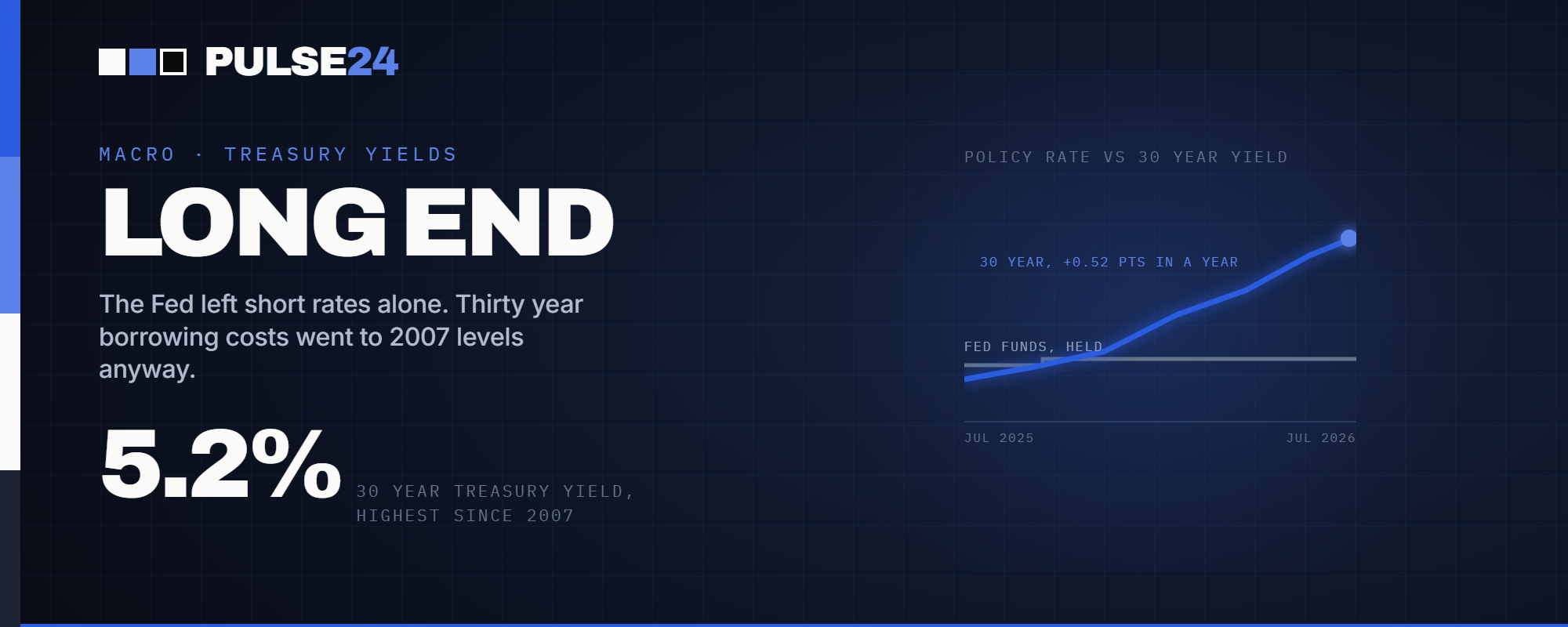
The 30-year Treasury yield just climbed to territory it hasn't touched since 2007, and two days after the Fed's divided vote to hold rates, the Nasdaq confirmed its second correction of 2026. Here's why long-term borrowing costs and short-term policy are telling two different stories right now.
Five days after the Federal Reserve left its benchmark rate unchanged, the bond market delivered its own verdict. The 30-year Treasury yield pushed above 5.2% this week, territory it hasn't occupied since 2007, back when the housing bubble was still inflating rather than bursting. Short-term rates didn't move. Long-term borrowing costs did anyway, and that gap is the story.
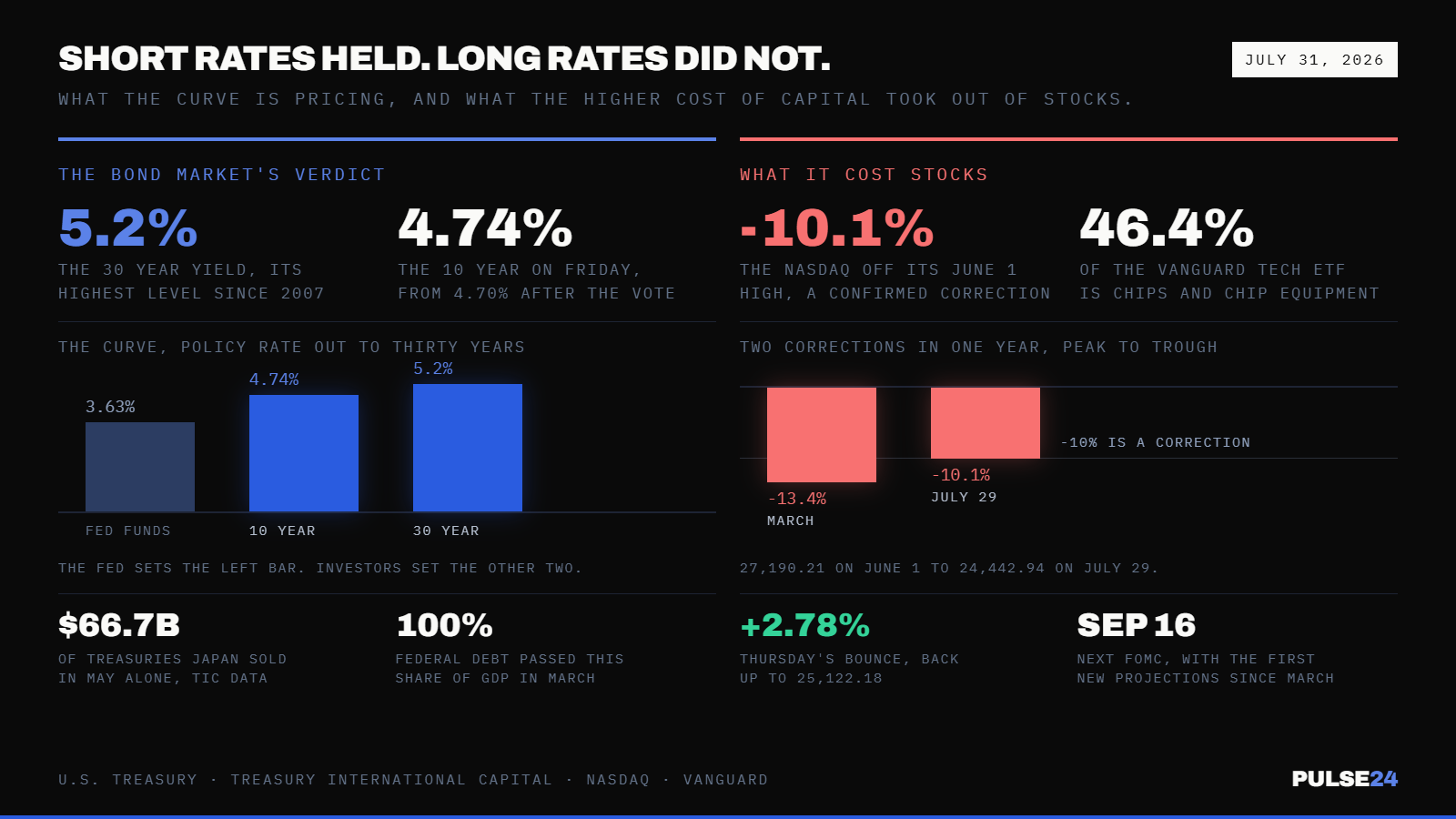
The move didn't happen in isolation. The Fed's divided 9-3 vote to hold rates steady already rattled stocks on Wednesday, sending the Dow down 1,153 points. What's changed since then is where the pressure has migrated. The 10-year yield, which sat at 4.70% right after the vote, climbed further to 4.74% by Friday. The 30-year moved even more, and that's the part investors should be watching.
What Changed
Bond yields at the long end of the curve aren't set meeting by meeting. They're set by what investors think will happen to inflation, growth, and government borrowing over the next three decades, and lately the answer has gotten less comfortable. U.S. federal debt passed 100% of GDP in March, and nobody in Washington has put forward a credible plan to bring that ratio down anytime soon. Investors buying a bond that matures in 2056 are pricing in that uncertainty every single day.
Add to that a Fed chair whose own words are working against him. Kevin Warsh has spent two months promising to restore price stability, then voted to hold rates steady anyway while three of his own regional bank presidents, Cleveland's Beth Hammack, Minneapolis's Neel Kashkari, and Dallas's Lorie Logan, pushed for a hike instead. Kashkari's dissent in particular caught markets off guard. When the chair talks tough but the vote doesn't match the talk, bond traders tend to demand a higher return for the mismatch, and that's a reasonable description of what's happening at the long end of the curve right now.
Currency policy piled on top of that. Japan's own yen intervention rattled the dollar earlier this week, and on July 31 the U.S. Treasury took the unusual step of intervening directly too, arranging for the New York Fed to sell euros and buy yen after Treasury Secretary Scott Bessent called the yen undervalued. It was the first direct U.S. intervention in the yen market in more than two decades. The dollar index slid to about 99.96, its lowest level in six weeks. That connects back to the Treasury market because Japan has funded earlier rounds of yen defense largely by selling U.S. Treasuries rather than spending down cash reserves, to the tune of $66.7 billion in May alone, according to Treasury International Capital data. A foreign government adding to the supply of Treasuries for sale is its own source of upward pressure on yields, on top of, not separate from, the credibility questions raised by Wednesday's Fed vote.
Why It Matters
Rising long-term yields don't stay confined to the Treasury market. They set the floor for mortgage rates, corporate bond pricing, and the discount rate Wall Street uses to value future earnings, which is exactly why growth stocks felt this first. The Nasdaq Composite closed at 24,442.94 on July 29, down 10.1% from its June 1 peak of 27,190.21. That qualifies as the index's second correction of the year, following a 13.4% drop in March from an October 2025 high.
Chip and memory stocks did more than their share of the damage. Semiconductors, semiconductor equipment, and related materials made up 46.4% of the Vanguard Information Technology ETF as of the end of June, a concentration that amplified the recent slide the same way it amplified the gains that got these stocks there in the first place. The index did bounce 2.78% on Thursday, to 25,122.18, proof the selling isn't one directional. But corrections rarely resolve in a single session, and this one is still working through a market adjusting to a higher cost of capital across the board, not just in chips.
What to Watch Next
Two dates matter most from here. The July jobs report lands August 7, and after a run of labor data the Fed has leaned on to justify patience, a weak number would complicate the case for staying on hold. A strong one would only add to the argument that Kashkari, Hammack, and Logan were early rather than wrong.
The bigger event is the September 15 to 16 FOMC meeting, where the committee will also update its economic projections for the first time since March. Fed funds futures already moved sharply toward pricing in a hike there in the days after Wednesday's vote. If the 30-year yield keeps climbing between now and then, expect the conversation to shift from whether the Fed hikes in September to how it explains not having hiked sooner.
Also worth watching: whether Tokyo or Washington intervenes again if the yen slips back toward 163. Another round of Japanese Treasury sales to fund that kind of defense would add fresh supply to a bond market already digesting a 19-year high at the long end, layering a currency story directly onto the yield story.
The Pulse24 Take
A Fed that holds rates while its own bond market pushes long-term yields to a 19-year high is sending two different signals at once, and markets are currently trading on the second one. Short-term policy says patience. Long-term borrowing costs say patience has a cost, and that cost is now showing up in mortgage quotes, corporate financing, and a second Nasdaq correction inside the same calendar year.
None of this means the Fed is behind, exactly. Warsh's committee held for reasons it laid out clearly on Wednesday, and cooling inflation data earlier this summer gave that hold some cover. But credibility in central banking is built over years and spent in weeks, and the bond market's current pricing suggests investors want more proof than a paragraph in a policy statement. The next two data points, a jobs report and a Fed meeting, will tell us whether that skepticism fades or hardens into something the Fed can't hold through much longer.
How we read the data
Curious how we get from raw data to a take like this? Our Trader's Toolkit walks through the tools we lean on.
Explore the Toolkit