Pulse24 Original
Western Digital Fell 7% and SanDisk Dropped 9% in a Session With No News About Memory Chips at All. A 30-Year Treasury Yield Near Its Highest Level Since 2007 Was the Real Trigger.
August 19, 2026
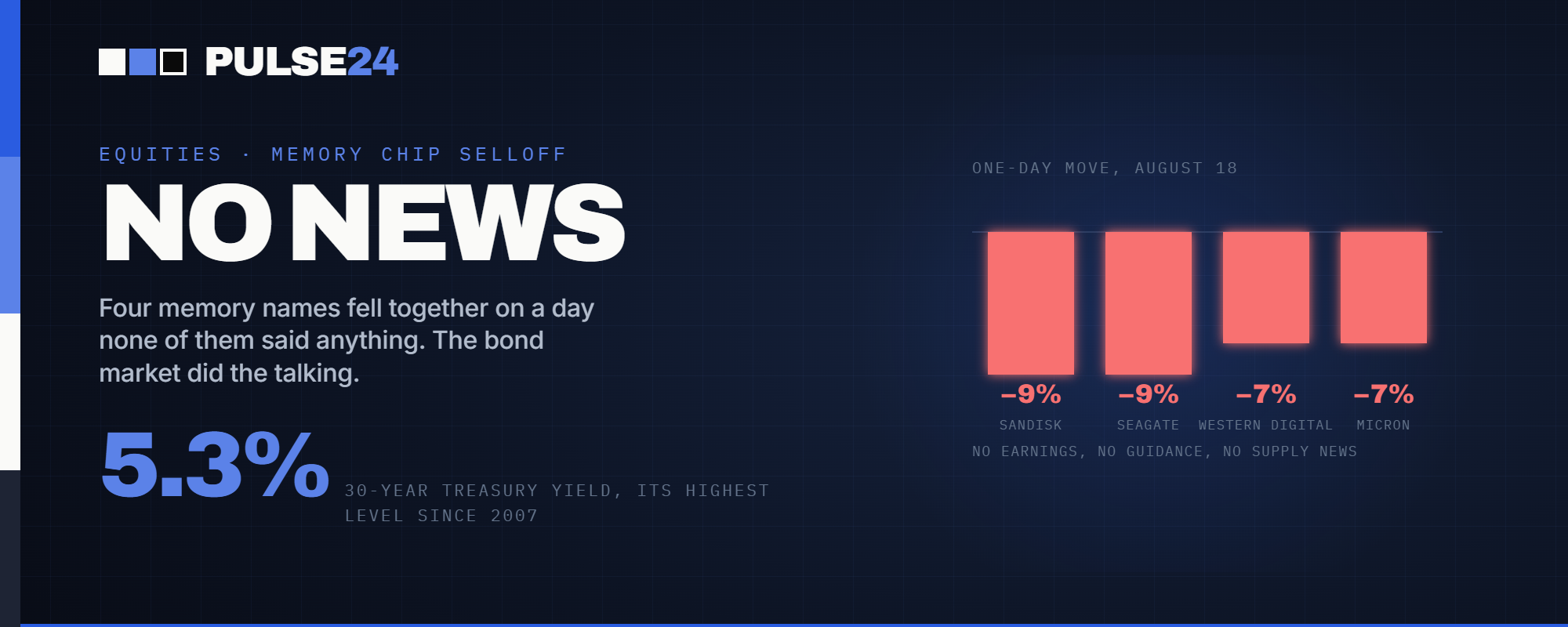
Memory chip stocks lost billions in value on August 18 with no company-specific news behind the move. The real trigger was a 30-year Treasury yield pushing toward its highest level since 2007, a reminder that even AI's hottest trade isn't immune to rising rates.
Western Digital dropped 7% on August 18. SanDisk fell 9%. Micron slid 7%. Seagate lost 9% right alongside them. None of the four put out an earnings report, a guidance cut, or a word about supply or demand that day. The chips themselves didn't change. What changed was the price investors are willing to pay for owning them.
What Changed
The trigger sat in the bond market, not the chip market. The 30-year Treasury yield pushed above 5.3% that day, its highest level since 2007, continuing a climb that has been building for weeks. Higher long-term yields raise the discount rate applied to a company's future earnings, and that math hits hardest the stocks whose value depends most on results still years away. Memory chipmakers, priced for a multi-year AI buildout rather than this quarter's numbers, sit near the top of that list.
Nothing about memory pricing or demand moved that day. Contracts, orders, and inventory levels were untouched. What moved was the risk-free rate everyone else's valuation gets measured against, and when that rate rises fast enough, even a sector with genuinely strong fundamentals can get repriced in an afternoon.
Why It Matters
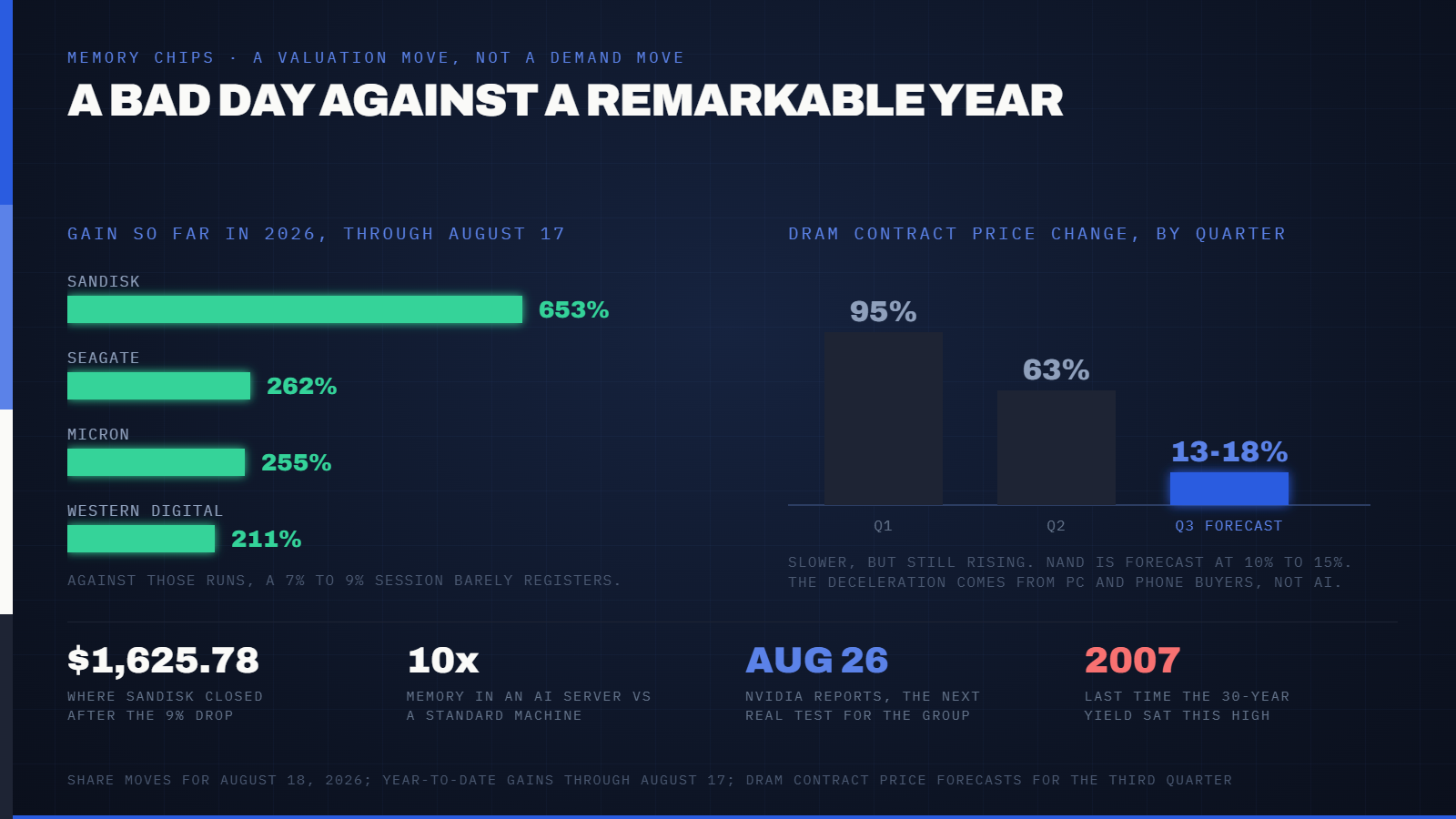
The size of this year's run is what makes the reaction sting. Western Digital is still up 211% in 2026 through August 17, SanDisk has climbed 653%, Micron is up 255%, and Seagate has gained 262%. Gains of that size don't happen on fundamentals alone; they happen when a story becomes crowded, and crowded trades are the ones most sensitive to a change in the cost of money. A 7% to 9% pullback looks alarming in isolation, but against those year-to-date numbers it barely registers as a dent.
It's also a reminder of how quickly sentiment can flip within the same theme. Just weeks earlier, Marvell, FormFactor, and Applied Materials jumped nearly 6% in a single day after Anthropic told investors its revenue had grown 14-fold to $11.5 billion, evidence that the AI infrastructure story still has real demand behind it. The same category of stock can rally hard on a demand signal and fall hard on a rate signal within the same month, which says less about the companies than about how leveraged their valuations have become to macro variables outside their control.
What's Actually Happening With Memory
Strip out the yield move and the underlying memory market still looks tight. DRAM prices rose as much as 63% last quarter, on top of a 95% jump the one before it, driven by AI servers that can use up to ten times the memory of a standard machine. Forecasts for the third quarter call for DRAM contract prices to rise another 13% to 18% and NAND 10% to 15%, both real increases, just smaller ones than the roughly 60% jumps recorded in the second quarter.
That deceleration is coming from the consumer side, where PC and phone makers are running out of room to absorb higher input costs, not from the AI side, where server demand is still setting the pace. Enterprise buyers building AI infrastructure remain the industry's priority, which is part of why meaningful price relief for consumer electronics still looks some way off. Supply is tight because demand is real, and August 18 didn't change that math at all.
What to Watch Next
The next real test isn't another Treasury auction, it's earnings. Nvidia reports its fiscal second-quarter results on August 26, and given how tightly memory stocks now trade with the broader AI infrastructure story, a strong print there could do more to steady this group than any pullback in yields. Watch the 30-year yield too. If it keeps climbing past 5.3%, the discount-rate pressure on long-duration growth stories won't stop at memory chips; it spreads to anything else priced on distant earnings. Also worth tracking is whether DRAM and NAND contract pricing for the fourth quarter comes in anywhere near the third quarter's projected pace. If it does, the fundamentals case for this trade stays intact even if the stock charts stay choppy.
The Pulse24 Take
A stock falling on no news isn't always noise. Sometimes it's the clearest signal available, because it strips away the story and shows exactly what price investors are putting on risk-free money right now. Memory chips didn't get less useful on August 18, and AI servers didn't suddenly need less of them. What got more expensive was the wait for those earnings to show up, because a 30-year Treasury yield near a 19-year high makes patience cost more than it used to. That's a valuation story. The fundamentals underneath it barely moved. The two get confused constantly in a trade that has run this far this fast, and investors holding these names don't need the DRAM cycle to turn to get hurt again. They just need yields to keep climbing. Worth remembering the next time a 200%-plus gain looks unshakeable.
How we read the data
Curious how we get from raw data to a take like this? Our Trader's Toolkit walks through the tools we lean on.
Explore the Toolkit