Pulse24 Original
DRAM Prices Rose as Much as 63% Last Quarter, on Top of a 95% Jump the Quarter Before. AI Servers Use Up to 10 Times the Memory of a Normal One, and Consumer Electronics Are Now Absorbing the Bill.
August 10, 2026
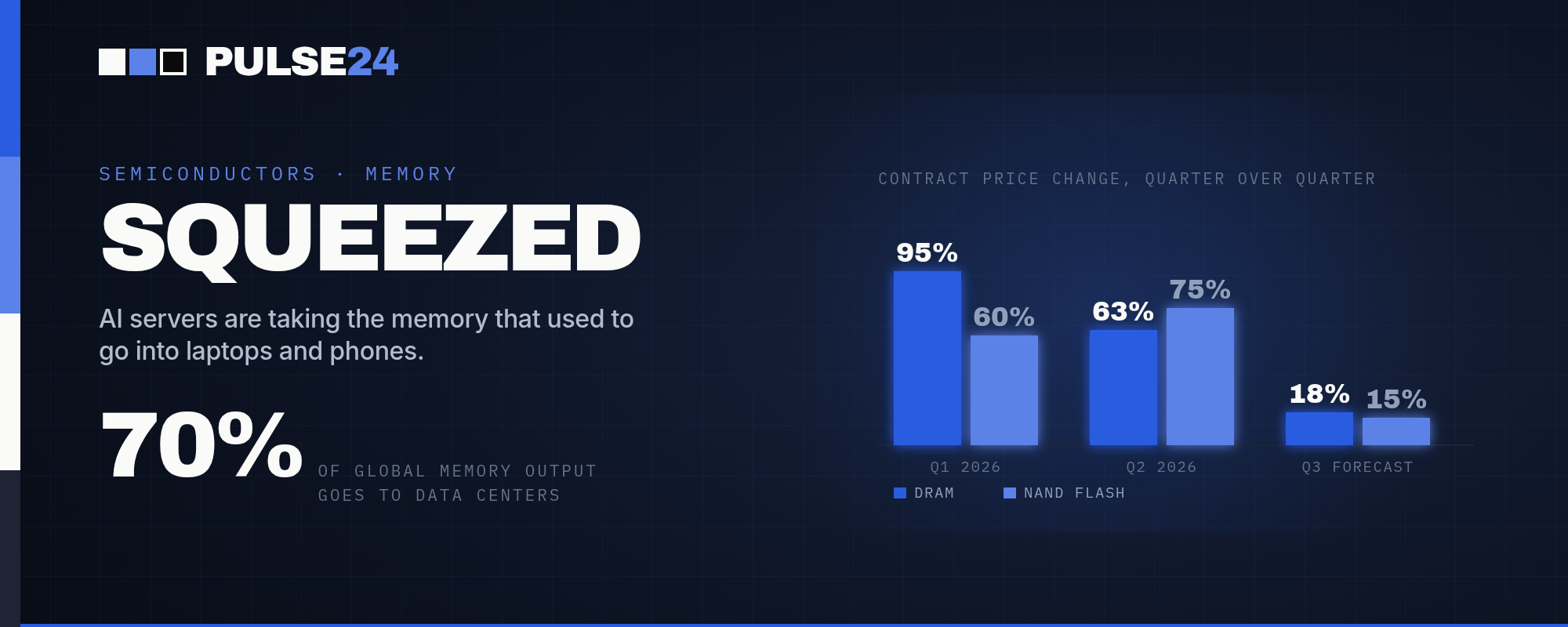
Memory chip prices have now risen for three straight quarters, and Goldman Sachs calls the shortage behind it the worst since 2011. AI servers consume up to ten times the DRAM of a normal machine, and that appetite is now showing up in laptop and phone price tags.
Framework, the laptop maker known for letting customers build and repair their own machines, quietly stopped selling standalone RAM modules this summer. The company said scalpers had been buying up inventory and reselling it at a markup. That's an unusual problem for a hardware company to have in 2026, and it's a small, visible symptom of something much bigger moving through the global memory market.
Contract prices for DRAM, the memory chips used in nearly every computer, phone, and server, rose between 58% and 63% quarter over quarter in Q2 2026, according to TrendForce. NAND flash, the storage chips inside solid-state drives, jumped even harder: 70% to 75% in the same three months. Both figures follow an even sharper Q1, when DRAM jumped 90% to 95% and NAND climbed roughly 60%. Goldman Sachs has called the resulting shortage the most severe in fifteen years, with supply deficits not seen since 2011.
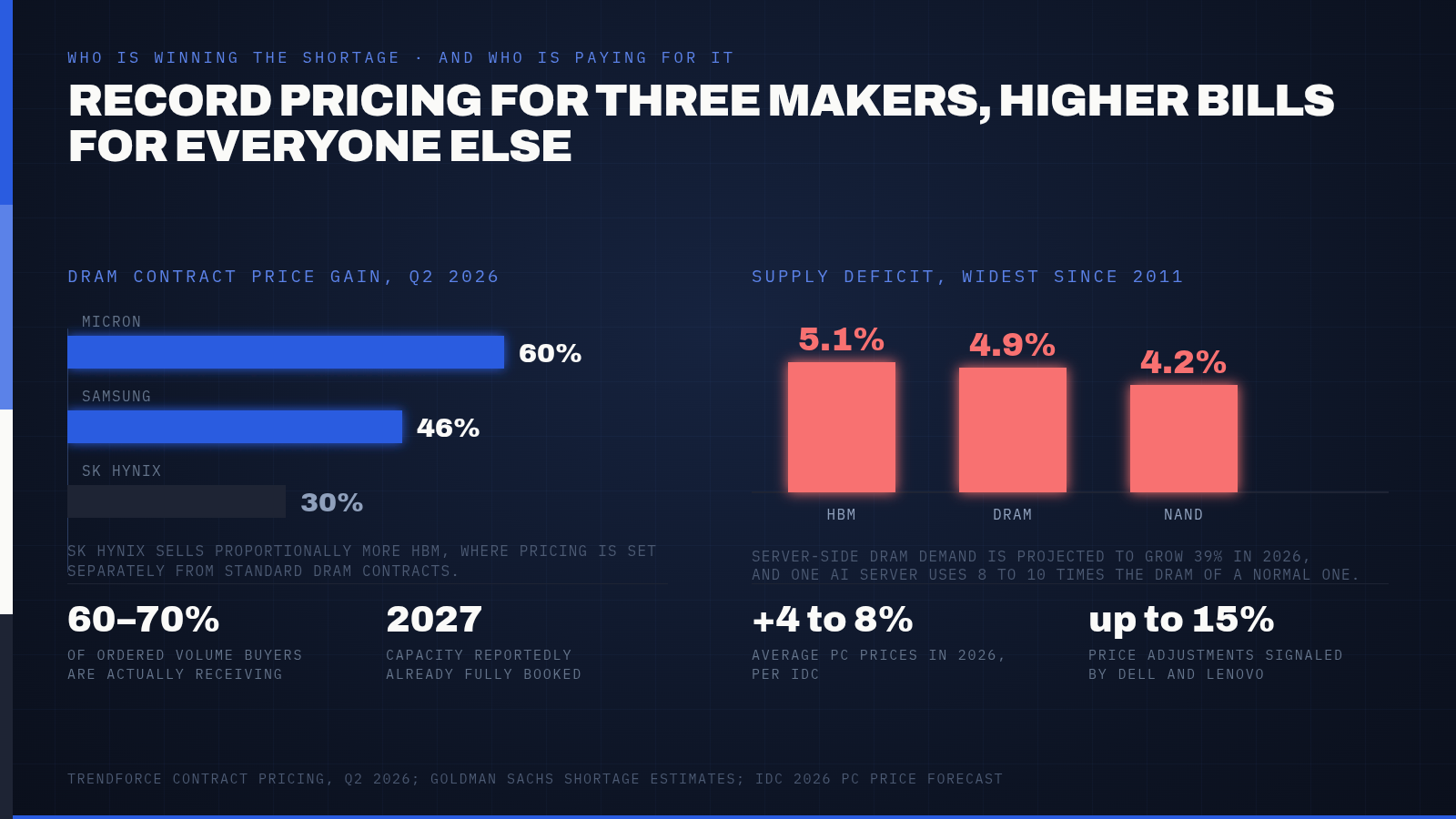
AI data centers are the driver here, not a factory fire or an export ban. A single AI server requires somewhere between 8 and 10 times the DRAM of a traditional server, plus more than triple the NAND flash for local storage. Samsung, SK Hynix, and Micron control most of global memory production, and all three have redirected capacity toward high-bandwidth memory, the specialized chips that feed AI accelerators like Nvidia's GPUs, at the expense of the ordinary DDR5 modules that go into laptops and phones.
Global server-side DRAM demand is projected to grow 39% in 2026, and SK Group chairman Chey Tae-won has projected AI semiconductor demand could rise another 60% to 100% in 2027 from 2026 levels. Data centers are already projected to consume roughly 70% of global memory chip production this year. Every gigabyte redirected toward a data center is a gigabyte that doesn't reach a consumer laptop.
Why It Matters
For the memory makers, this is the best pricing environment in years. Samsung's DRAM contract prices rose 44% to 46% in the quarter, Micron's climbed more than 60%, and SK Hynix, which just reported a 557% profit jump built largely on HBM sales, still posted a substantial 30% gain. Samsung's DRAM market share climbed to roughly 39% and Micron's to about 25%, while capacity for 2027 is reportedly already fully booked and buyers are receiving only 60% to 70% of the volumes they ordered. None of that pricing power has translated into calm stock charts: Samsung and SK Hynix each fell nearly 9% one trading day after their best session ever, a reminder that even a historic pricing cycle doesn't move in a straight line.
For everyone else, the pinch is showing up at checkout. IDC's latest forecast puts 2026 average PC price increases at 4% to 8%, with a more pessimistic scenario running higher still. Dell and Lenovo have both signaled price adjustments of up to 15% on some models. Framework isn't the only company improvising: some PC vendors are now selling pre-built systems without any memory installed at all, leaving buyers to source RAM wherever they can find it.
The pattern fits into a broader question Pulse24 has tracked before, whether AI investment nets out as inflationary or deflationary for the wider economy. Memory prices are one of the clearest, most literal examples of the inflationary side of that ledger so far: a boom in one corner of the tech economy raising costs in a completely unrelated one, the family laptop or phone upgrade.
What to Watch Next
TrendForce expects the pace of increases to slow in Q3 2026, with DRAM contract prices projected to rise 13% to 18% quarter over quarter and NAND 10% to 15%, down from the 60%-plus jumps of Q2. Slower isn't the same as reversing. Prices are still climbing, just not doubling in a single quarter anymore.
Three things are worth watching from here. Consumer electronics manufacturers may start passing more of the cost increase directly to shoppers as the holiday shopping season approaches, rather than absorbing it the way many have so far. Samsung, SK Hynix, and Micron have shown no sign of shifting meaningful capacity back toward standard DDR5 production while HBM margins remain this attractive, and that calculus would need to change for consumer supply to loosen. And electronics have historically been a mildly deflationary category within the official CPI basket, so a sustained memory shortage is one more place the Fed's inflation read could come in hotter than expected.
The Pulse24 Take
Memory chips are about as unglamorous as technology gets, but this cycle is a clean illustration of how AI capital spending ripples through the economy in ways that have little to do with chatbots or coding assistants. A shortage that started with GPU-hungry data centers is now showing up in the price of a laptop bought for homework or spreadsheets, and that's a more direct and traceable inflation channel than most of the AI-and-the-economy debate tends to acknowledge.
The bull case for the memory makers isn't complicated. Samsung, SK Hynix, and Micron are enjoying pricing power they haven't seen in over a decade, order books are full into 2027, and none of the three have much incentive to add standard DRAM capacity while HBM commands premium margins. The risk sits on the other side of the trade. Consumer electronics demand is price-sensitive, and IDC has already flagged that higher PC prices could dent unit shipments, which would eventually cool the very demand memory makers are counting on. Shortages that get priced in aggressively enough have a way of correcting themselves within a few quarters, and the deceleration TrendForce is already forecasting for Q3 hints that the sharpest part of this move may be behind us rather than ahead.
How we read the data
Curious how we get from raw data to a take like this? Our Trader's Toolkit walks through the tools we lean on.
Explore the Toolkit