Pulse24 Original
SK Hynix's Profit Jumped 557%. The Stock Fell Anyway, and It Still Trades at Just 5 Times Next Year's Earnings.
August 8, 2026
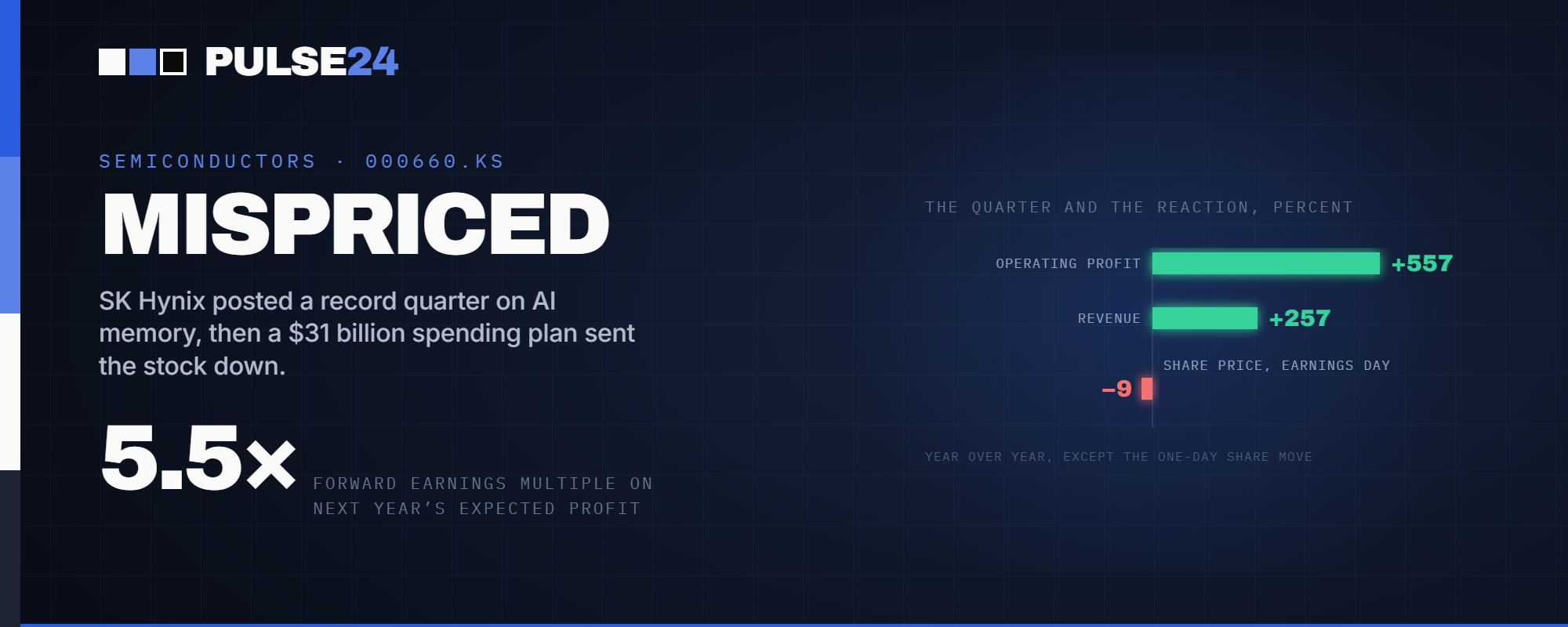
SK Hynix's operating profit jumped 557% last quarter on the AI memory boom, but the stock fell on the news anyway after the company unveiled a $31 billion spending plan. Even after a partial rebound, shares still trade at roughly 5 times next year's expected earnings.
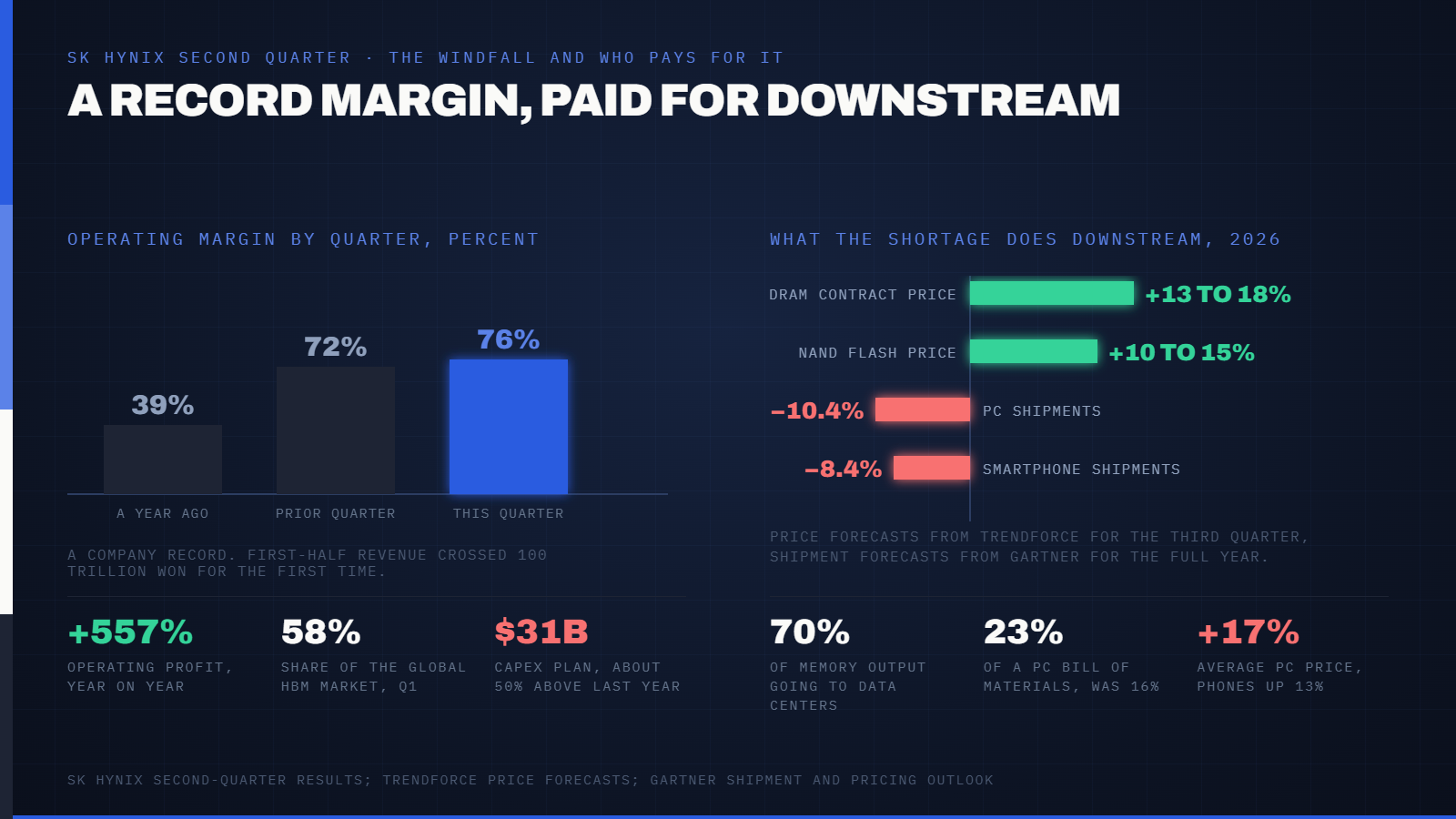
SK Hynix's operating profit jumped 557% in the second quarter to roughly $42 billion, on revenue that rose 257% to about $55 billion. Operating margin hit a record 76%, up from 72% the prior quarter and nearly double the margin the company posted a year earlier. First-half revenue crossed 100 trillion South Korean won for the first time in the company's history.
SK Hynix's stock fell about 9% the day the results landed, even after the company reported record revenue and its highest-ever operating margin. Investors focused instead on a $31 billion capital spending plan for the year, roughly 50% higher than a year earlier, and on revenue that came in below Wall Street's estimate despite the enormous year-over-year growth. Shares have since stabilized near $138, still about 29% below their 52-week high of $194.80, and the stock trades at a forward price-to-earnings ratio of roughly 5.5. A company posting numbers like these would typically command a premium multiple. Instead, the market is pricing SK Hynix like its best days are already behind it.
Why the Chip Market Looks Nothing Like a Normal Cycle
SK Hynix held 58% of the global high-bandwidth memory market in the first quarter of 2026, the chip variety that sits inside Nvidia's AI accelerators and commands far higher margins than ordinary consumer DRAM. That mix shift explains the profit numbers. It also explains why memory has become one of the tightest links in the AI supply chain. Data centers are projected to consume roughly 70% of global memory chip production in 2026, up sharply from before the AI buildout began, and manufacturers have reallocated fab capacity toward the higher-margin AI product at the expense of everything else.
The Shortage Is Showing Up in Consumer Prices Now
DRAM contract prices are forecast to rise another 13% to 18% in the third quarter, with NAND flash up 10% to 15% over the same stretch, according to TrendForce, as consumer electronics makers hit what the research firm calls an affordability limit. Gartner expects the fallout to show up directly in shipments: PC shipments down 10.4% in 2026 and smartphone shipments down 8.4%, alongside average PC prices up 17% and smartphone prices up 13% compared with last year. Memory now accounts for roughly 23% of a PC's bill of materials, up from 16% in 2025. Qualcomm beat revenue estimates by $270 million last quarter and still watched its stock fall 43% from May's high, with rising memory costs cited as a direct factor squeezing its margins. SK Hynix's windfall and Qualcomm's squeeze are the same shortage, viewed from opposite ends of the supply chain.
Why the Valuation Doesn't Match the Results
SK Hynix's own executives have made bold claims about how long this lasts. Chief Executive Kwak Noh-Jung said in July that the shortage could persist beyond 2030. Investors are not fully buying it. The company's own plan to spend at least $31 billion on capital expenditures this year, about 50% more than last year, is largely what spooked the stock on earnings day: more supply eventually competing for the same demand. Rising capacity commitments from Samsung add to that concern. Memory has been a brutally cyclical business for three decades, and a forward multiple of roughly 5 is the market's way of saying it expects this cycle to end the way the others did, with prices falling faster than anyone budgeted for. Long-term supply agreements with AI customers do offer more structural support than past cycles had, which is the main argument for why this time could look different. The stock price suggests most investors aren't ready to bet on it.
What to Watch Next
Samsung and Micron report their own results in the coming weeks, and their commentary on 2027 capacity plans will matter more than this quarter's numbers. Watch whether TrendForce's projected deceleration in DRAM pricing actually holds, since a sharper slowdown would validate the market's skepticism while a reacceleration would argue the multiple is simply too cheap. On the consumer side, holiday-quarter PC and smartphone shipment data will show whether the affordability limit is a temporary pause or a lasting drag on demand.
The Pulse24 Take
There are two ways to read a stock that just posted a 557% profit jump and fell on the news anyway. One is that the market is wrong, and SK Hynix is being punished for a spending plan that will eventually pay for itself. The other is that investors have learned to distrust AI-cycle numbers that look too good, whether it's a coin-flip default price on CoreWeave's debt or a memory maker's forward earnings multiple sitting in the single digits despite triple-digit growth. We've flagged that same skepticism showing up in credit markets before: investors funding the AI buildout are increasingly demanding proof, not projections. SK Hynix's numbers are proof of demand today. What the stock price is really asking is whether that demand still shows up in 2027, after the $31 billion of new capacity the company just committed to actually arrives.
How we read the data
Curious how we get from raw data to a take like this? Our Trader's Toolkit walks through the tools we lean on.
Explore the Toolkit