Pulse24 Original
Qualcomm Beat Revenue Estimates by $270 Million. Its Stock Is Down 43% From May's High Anyway, and Memory Costs Are Why.
August 1, 2026
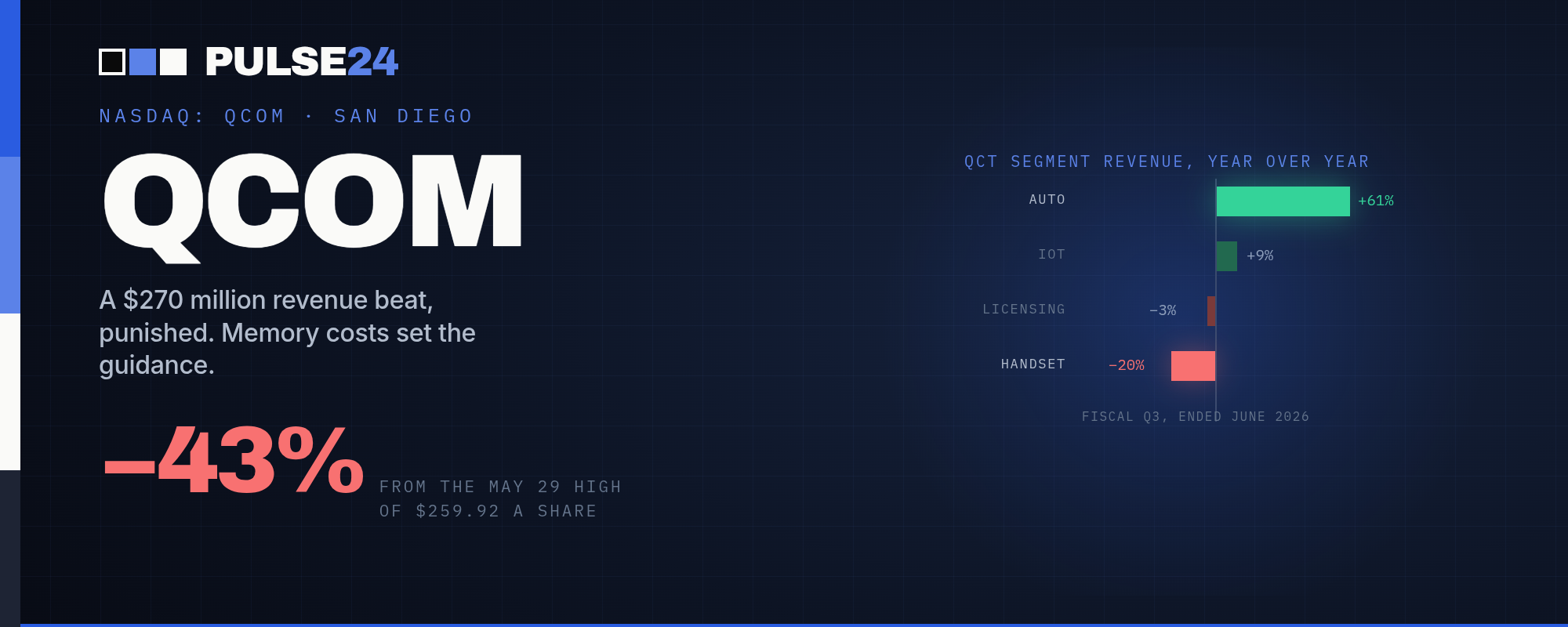
Qualcomm beat revenue estimates and grew automotive chip sales 61% in a single quarter, and its stock still fell nearly 8% in after-hours trading and now sits 43% below its May high. Rising memory costs and a shrinking Apple contract explain both moves.
What Changed
Qualcomm reported fiscal third-quarter revenue of $9.947 billion after Wednesday's close, ahead of Wall Street's roughly $9.68 billion consensus by about $270 million. Non-GAAP earnings per share came in at $2.21, a couple cents short of the $2.23 analysts wanted, and that small miss did more damage to the stock than the revenue beat did any good. Shares fell nearly 8% in after-hours trading immediately after the report, then kept sliding through the next two sessions, closing July 31 at $147.61. That's down roughly 5% from the $155.57 close on report day and about 43% below the $259.92 all-time high the stock touched on May 29.
The QCT chip division, which makes up the bulk of Qualcomm's business, posted revenue of $8.504 billion, down 5% year over year. Inside that number sits the real story. Handset revenue fell 20% to $5.086 billion. Automotive revenue jumped 61% to a record $1.588 billion, its 23rd consecutive quarter of double-digit growth. Internet of Things revenue rose 9% to $1.83 billion. Licensing revenue, the QTL segment, slipped 3% to $1.278 billion.
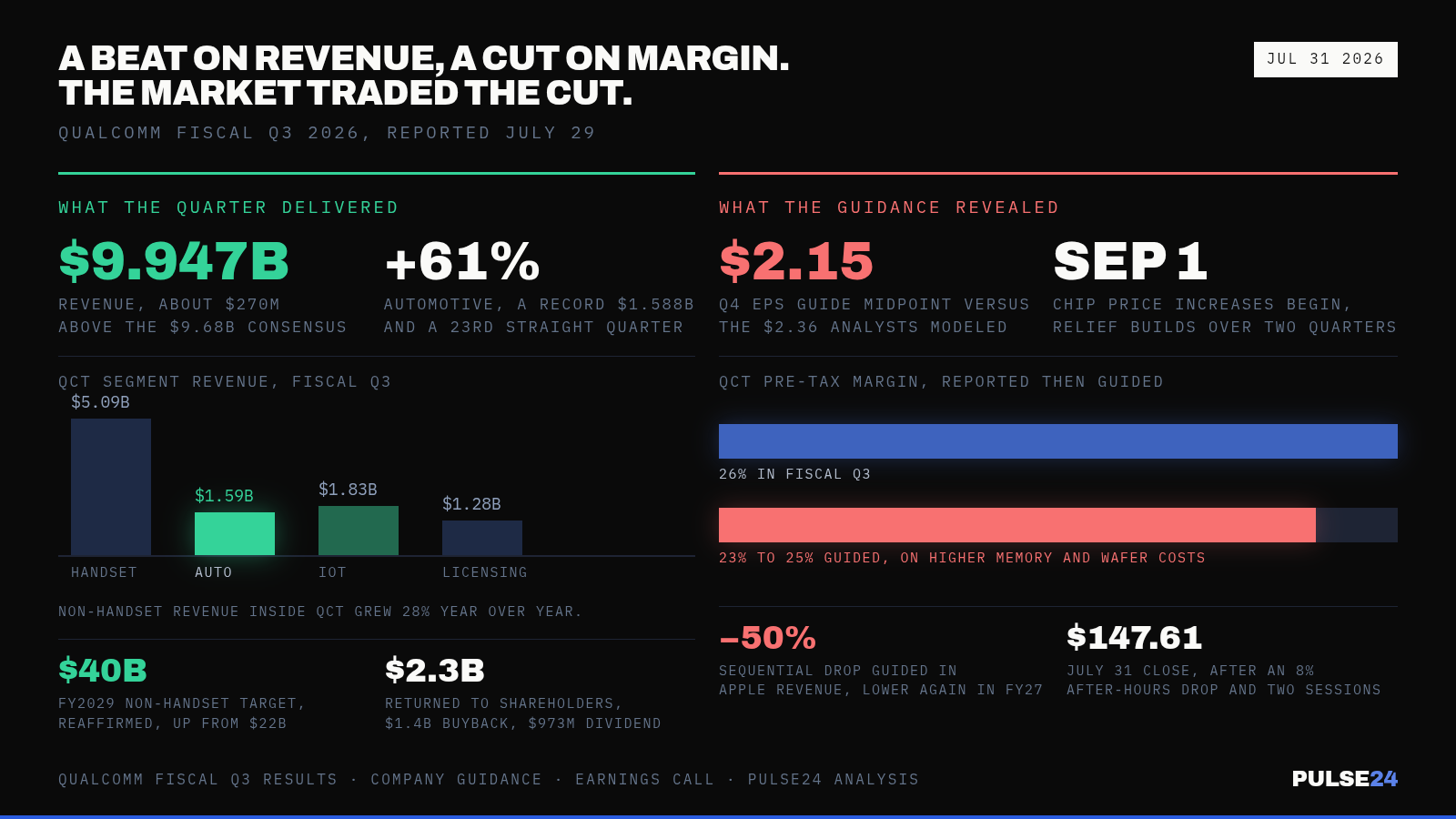
What spooked investors wasn't the mix of winners and losers so much as the guidance attached to it. Qualcomm's Q4 outlook calls for total revenue of $9.7 billion to $10.5 billion, roughly in line with what analysts expected, but non-GAAP earnings per share of $2.05 to $2.25 came in well under the $2.36 consensus. CFO Akash Palkhiwala said total non-handset revenue inside QCT grew 28% year over year, "underscoring the continued execution of our diversification strategy," but that framing didn't stop the sell-off. Margins are the reason. QCT's pre-tax margin is guided to narrow to 23% to 25%, down from 26%, as the company works through higher costs for memory, wafers, assembly, testing and packaging.
Why It Matters
Qualcomm is now living through the same memory cost spike that has already moved SanDisk 26% higher on Samsung's warning of a chip shortage through 2028 and that pushed one commodity memory chip's price from $39 to $145 in a year heading into this earnings season. For memory makers, that price spike has been a windfall. For a buyer of memory like Qualcomm, it's the opposite: an input cost problem that management says it can only offset gradually. Amon put it plainly on the call: "We're just passing through big cost increases that we have." Price increases on Qualcomm's own chips begin September 1, but relief is expected to build over two quarters rather than show up immediately, which is exactly the kind of lag that makes a Q4 guidance cut look worse than a one-quarter blip.
The Apple piece compounds it. Qualcomm's Q4 handset guidance assumes Android growth largely offsets what the company described as roughly a 50% sequential decline in Apple-related revenue, with management flagging that Apple's business would be "much lower" again in fiscal 2027. Qualcomm's share of the next iPhone's modem business is coming in materially below the 20% Wall Street had built into its models, a continuation of Apple's multi-year push to bring modem chip design in-house. That's a slower-moving, more structural headwind than a single bad quarter, and it lands in the same report as Apple's own quarter, where profit rose 29% even as the stock fell, a reminder that Apple's supply chain doesn't always move in the same direction as Apple's own stock.
Not every part of the report supported the bearish read. Automotive chips are now a $1.588 billion quarterly business growing 61% a year, and Bob O'Donnell of TECHnalysis Research noted that "the good news longer term is the company is quickly pivoting to non-handset revenues." Qualcomm backed that up by reaffirming the fiscal 2029 non-handset revenue target it raised at its June investor day, to $40 billion from roughly $22 billion previously, with automotive and IoT combined targeted above $24 billion, data center above $15 billion, and industrial, networking and robotics around $8 billion. The company also returned $2.3 billion to shareholders in the quarter, split between $1.4 billion in buybacks and $973 million in dividends. None of that offset Wall Street's focus on near-term margins, but it's the case management is making for why this quarter's guidance cut isn't the whole story.
What to Watch Next
The September 1 price increases are the first concrete test of whether Qualcomm can pass costs through faster than memory and component prices keep rising. If margins stabilize by the fiscal Q1 report, the current guidance cut will look like a transition quarter. If they don't, the market will treat it as evidence the memory supercycle is squeezing chip buyers harder than management expects. Apple's own product roadmap is the other variable worth tracking, since every additional data point on modem share for the next iPhone cycle will move Qualcomm's non-handset math one way or the other. And with automotive now a genuine growth engine rather than a side project, its trajectory into fiscal 2027 will say a lot about whether Qualcomm's diversification story is ahead of schedule or just keeping pace with the handset business it's trying to outgrow.
The Pulse24 Take
A revenue beat that gets punished harder than a miss usually says more about what's coming than what already happened, and that's the case here. Qualcomm's Q3 wasn't a bad quarter on its own terms. It was a quarter where margin guidance revealed the company is on the paying end of the same memory shortage that's been a tailwind for chipmakers elsewhere, at the same time its most important customer relationship keeps shrinking. Those two pressures landing together is why the stock is down 43% from a May high that already priced in a much smoother diversification path.
The more interesting number here might not be the 43% drawdown at all. It's the 61% automotive growth and the $40 billion 2029 target sitting right next to it. Qualcomm is trying to prove it can become a different kind of company before the handset business it's leaving behind fully catches down to it. September's price increases and the next couple of quarters of QCT margin data will show whether that transition is on schedule or whether memory costs and Apple's retreat are moving faster than the diversification can offset.
How we read the data
Curious how we get from raw data to a take like this? Our Trader's Toolkit walks through the tools we lean on.
Explore the Toolkit