Pulse24 Original
Marvell, FormFactor, and Applied Materials Jumped Nearly 6% in a Day, and None of Them Reported Earnings. Anthropic Just Told Investors Its Revenue Grew 14-Fold to $11.5 Billion.
August 18, 2026
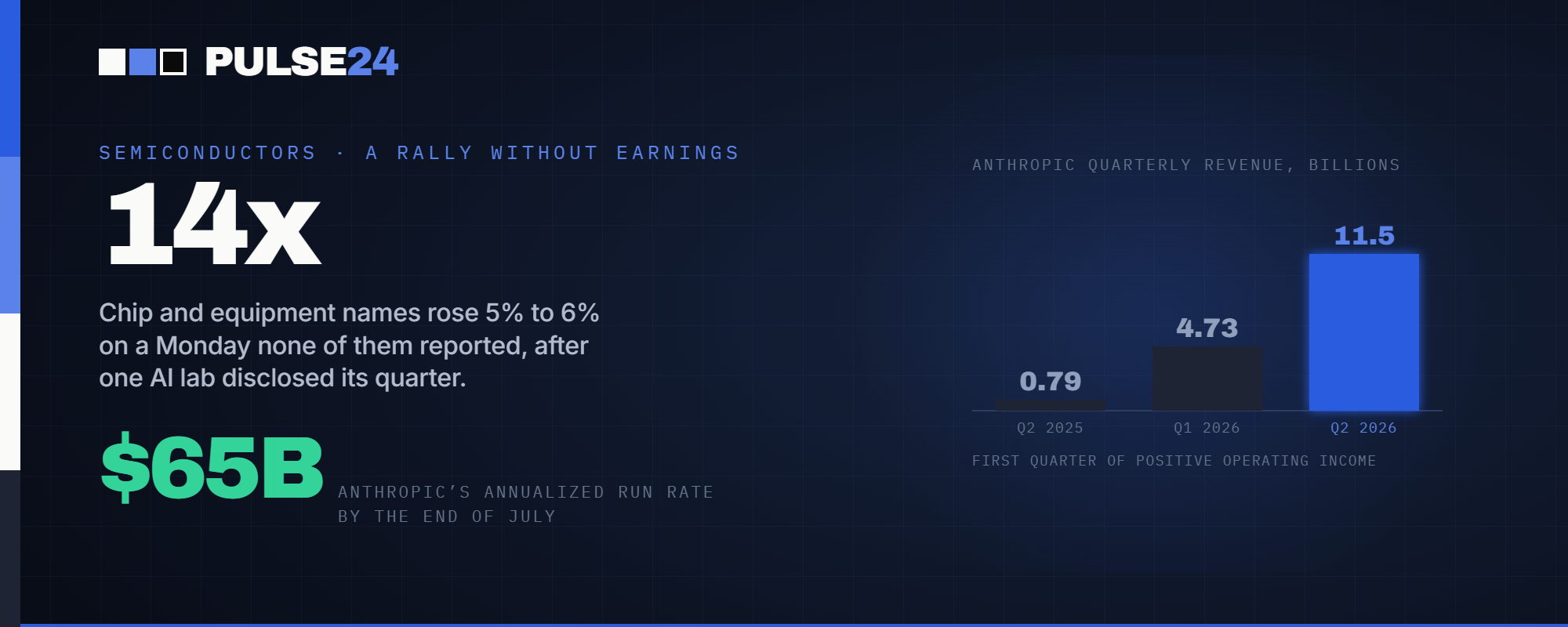
Marvell, FormFactor, and Applied Materials all jumped between 5% and 6% Monday without reporting anything about their own businesses. Two catalysts, Anthropic's blockbuster revenue disclosure and a White House push to keep Apple away from Chinese memory chips, explain why, and where the read could go wrong.
Marvell gained 5.8% on Monday, and FormFactor added 5.4%. Applied Materials, a company that makes none of the products either of those two ship, climbed 5.9% the same day. None of the three had earnings, a product launch, or an analyst upgrade tied to their own business that morning.
The move traces back to a single number Bloomberg published two days earlier. Anthropic's second quarter revenue crossed $11.5 billion, more than 14 times the $787 million the company reported in the same quarter a year ago. Anthropic also told investors it posted positive adjusted operating income for the first time, a milestone that matters to anyone pricing the infrastructure layer underneath the AI trade rather than the model companies themselves.
What Changed
Anthropic shared the numbers with prospective investors ahead of a planned initial public offering this fall, working with Morgan Stanley, Goldman Sachs, and JPMorgan on a listing the company has filed for confidentially. Revenue climbed from $4.73 billion in the first quarter of 2026 to more than $11.5 billion in the second. By the end of July, the company's annualized run rate had already surpassed $65 billion, roughly sevenfold higher than where it stood at the end of 2025. Reuters reported this week that bankers are using a 2028 revenue forecast of $190 billion to $200 billion to build the valuation case, benchmarking against companies like Palantir and SpaceX that trade at 40 to 50 times forward revenue.
A second, unrelated catalyst landed in the same window. Commerce Secretary Howard Lutnick told Apple the administration "does not approve" of the company sourcing memory chips from China's ChangXin Memory Technologies and Yangtze Memory Technologies, according to reporting this week. Apple had reportedly been testing DRAM from CXMT and NAND from YMTC after memory prices climbed roughly 29% this year on AI data center demand. CXMT sits on the Pentagon's list of Chinese military-linked companies, which gives the administration's objection a national security label alongside the industrial policy one. Lutnick said the position had been communicated to Apple "very clearly."
The Lutnick comments moved a different slice of the memory trade than the Anthropic news did. Micron rose 5.9%, SK Hynix gained 5.6%, and SanDisk jumped 8.9%, all names that stand to keep Apple's business, and its pricing power, if Chinese suppliers stay locked out of a customer that size. Bank of America reiterated a buy rating on Micron this week with a $1,550 price target, arguing the stock could reach fiscal 2030 earnings near $236 per share against a Wall Street consensus closer to $136.
Why It Matters
Two stories with almost nothing in common except timing did the same thing to two different baskets of stocks: raised conviction that AI infrastructure spending is real, durable, and still under-owned. Anthropic's number is a demand signal. A single AI lab growing revenue fourteenfold in a year while flipping to positive operating income makes the case that AI is a genuine, revenue-generating business rather than a subsidized science project, and that argument flows straight through to the chipmakers, equipment vendors, and memory suppliers building the infrastructure underneath it.
The Apple story is about supply, not demand. Washington is trying to keep a scarce input, leading-edge memory, inside a supply chain it controls, even as prices rise and buyers look for cheaper alternatives. That's consistent with a trend Pulse24 has covered before: the DRAM and NAND price surge tied to AI server demand set up exactly this kind of standoff, where a buyer with enormous purchasing power tries to route around tight supply and gets told not to.
Applied Materials remains roughly 26% below the near-$723 peak it hit in June, even after Monday's gain, a reminder that this rally sits on top of a stock that has already round-tripped through a great deal of AI-cycle enthusiasm this year. That volatility is part of a broader pattern in how markets are pricing the AI infrastructure buildout as a single trade. Any data point that strengthens conviction in one layer, whether it's a foundation model's income statement or a cabinet secretary's phone call, tends to get capitalized across the others.
What to Watch Next
Anthropic's IPO filing, if and when it becomes public, will show whether the $190 billion to $200 billion 2028 revenue forecast holds up to scrutiny outside a private fundraising deck. That forecast implies growth rates well beyond anything Anthropic has posted so far, and the gap between a fundraising projection and an audited prospectus is usually where skepticism shows up first.
Watch Micron's next quarterly report and any follow-up from Apple on its sourcing plans. If Apple confirms it is dropping CXMT and YMTC as suppliers, that is a durable win for Micron and SK Hynix. If the administration's objection turns out softer than reported, or Apple finds a workaround, some of Monday's gains could unwind.
Keep an eye on memory pricing itself. DRAM contract prices have already risen sharply this year on AI server demand, and removing two large Chinese suppliers from Apple's option set takes out a source of price competition, not just a geopolitical talking point.
The Pulse24 Take
The instinct to read Monday's rally as one AI story is understandable, but it helps to be precise about which AI story. Anthropic's revenue jump says something about demand for AI products. The Apple memory chip decision says something about who gets to supply the hardware underneath that demand, and at what price. Treating the two as a single narrative makes the rally feel more unified than it is, and unified narratives tend to unwind hardest when one leg turns out softer than the other.
None of this makes the move wrong. A foundation model company crossing $11.5 billion in quarterly revenue with positive operating income is a measured result, not a projection. But measured results and IPO-deck forecasts don't carry the same weight, and the $190 billion 2028 target is very much the latter. Investors buying chip and memory stocks on the back of that number are underwriting a forecast three years out, not the figure Anthropic actually reported this week. That distinction tends to matter most exactly when it gets ignored.
How we read the data
Curious how we get from raw data to a take like this? Our Trader's Toolkit walks through the tools we lean on.
Explore the Toolkit