Pulse24 Original
TSMC's August Revenue Surged 53% to a Record $16.35 Billion. Wall Street Sent the Stock Down 1.7% Anyway.
September 11, 2026
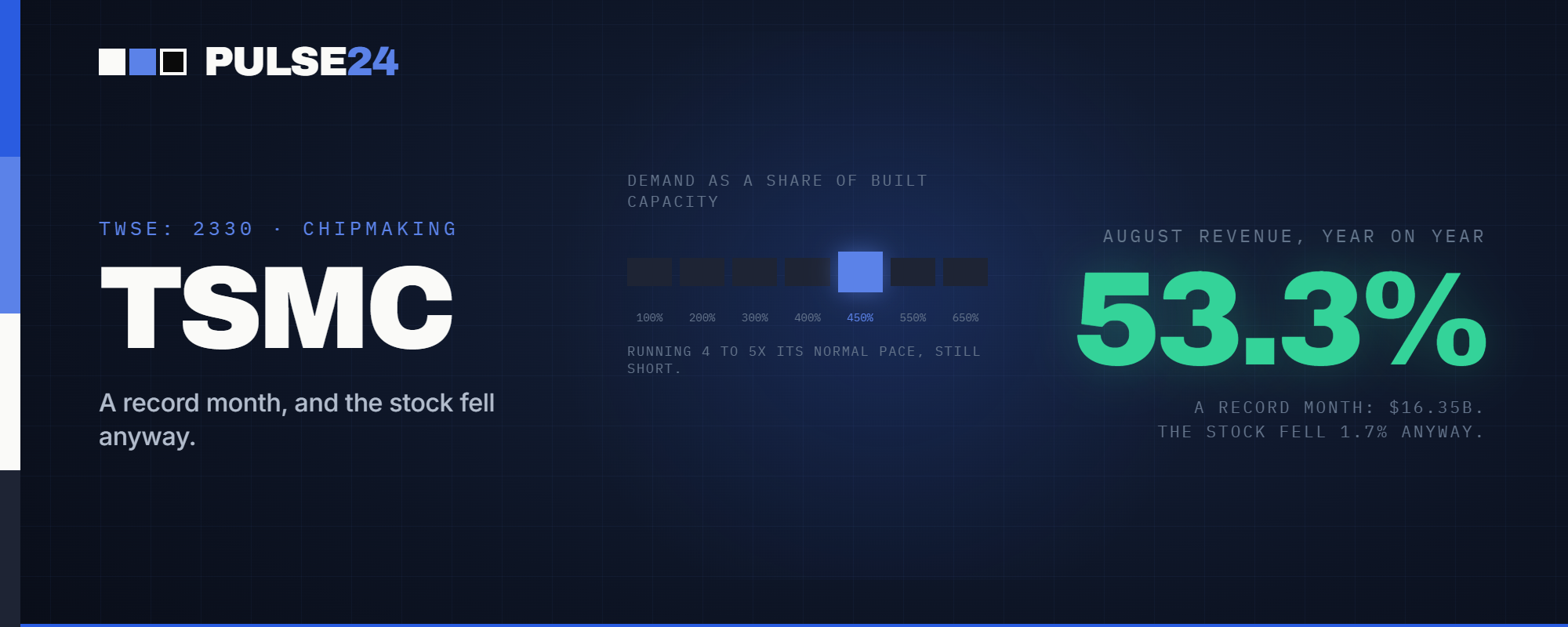
Taiwan Semiconductor booked its best August ever on runaway AI chip demand, yet the stock slipped the same day the numbers landed. The gap between the headline growth and the market's shrug says more about expectations than about the chip cycle.
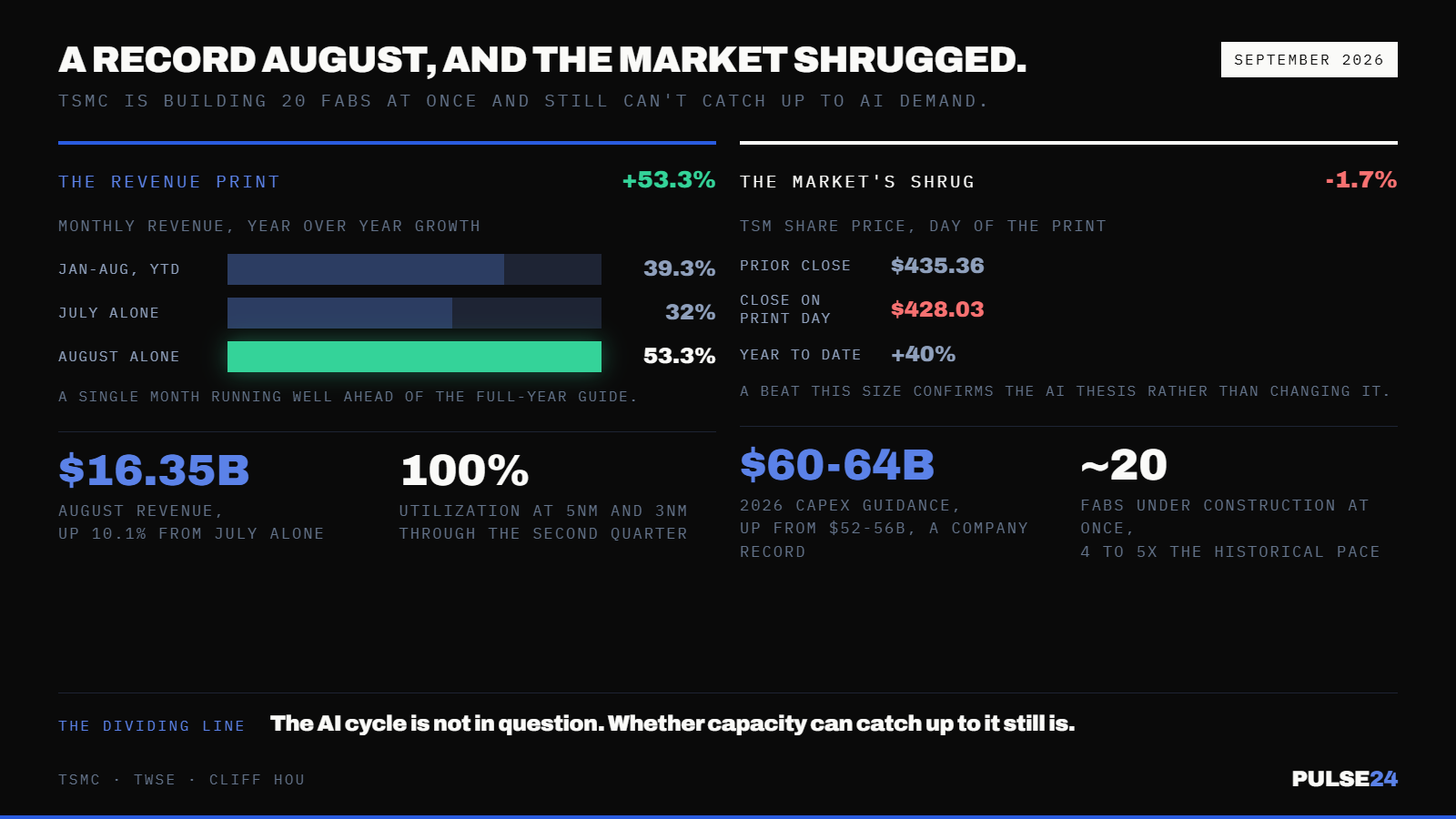
NT$514.81 billion. That's what Taiwan Semiconductor Manufacturing Company booked in August alone, a monthly haul of roughly $16.35 billion and a 53.3% jump from the same month a year ago. Revenue also climbed 10.1% from July, an acceleration that's unusual this deep into an AI buildout that's already three years old.
Cliff Hou, TSMC's deputy co-chief operating officer, put it plainly when asked about capacity earlier this month: "Right now you're almost 4x or 5x, trying to catch up, but still you cannot meet demand." He wasn't talking about a single product line. Advanced nodes at 5-nanometer and 3-nanometer ran at 100% utilization through the second quarter, and the company's packaging lines, the step that turns a finished chip into something a customer can actually ship, are reportedly tighter still.
What Changed
TSMC's current guidance calls for full-year 2026 revenue growth of slightly more than 40% in dollar terms, itself an upgrade from an initial call for growth above 30%. Through August, the company is running at 39.3% for the year to date, right around that revised pace. But August itself came in at 53.3%, well ahead of both figures. A single month running that far above the annual target usually means one of two things: either demand pulled forward unusually hard into late summer, or management's guidance is about to look conservative again when TSMC reports full third-quarter results in October.
The company isn't waiting to find out. Capital spending for 2026 has been lifted to a range of $60 billion to $64 billion, up from an initial guide of $52 billion to $56 billion, funding roughly 20 fabs under construction or equipping at once, a pace TSMC says is four to five times its historical norm. Some of that money is chasing a problem Pulse24 covered earlier this week: a six-inch photomask bottleneck at ASML's most expensive lithography machine that TSMC and Samsung moved to fix, while Intel has so far stayed out of the arrangement. TSMC has also been racing to replace copper wiring with light-based interconnects inside its newest AI chips, a bet Nvidia backed with roughly $4 billion of its own money.
Why It Matters
A 53% revenue jump would normally be the kind of number that sends a stock higher. Instead, TSM closed down 1.68% at $428.03 on the day the figures were released, slipping from a previous close of $435.36. Some of that came from the broader market, which pulled back the same session as oil prices jumped to a four-month high and traders reassessed the odds of a Federal Reserve rate move later in September. But part of it is simpler than that: when a company has already rallied roughly 40% this year on the assumption that AI demand keeps running hot, a beat this size confirms the thesis rather than changing it. There's less room for a single data point to move the price when the market was already positioned for growth this strong.
The more durable story is what the revenue says about the rest of the chip supply chain. TSMC telling customers it's running 400% to 500% short of demand ripples outward: equipment makers pick up more orders, memory and packaging suppliers gain pricing power, and every company designing AI silicon, from Nvidia to the custom-chip programs at the big cloud providers, ends up competing for a slice of capacity that isn't growing nearly as fast as demand is.
What to Watch Next
TSMC reports third-quarter results in mid-October, and the guidance update that comes with it matters more than usual after a month this strong. Watch whether management raises the full-year growth target beyond "slightly more than 40%," and listen for any commentary on when the current wave of fab construction actually starts adding usable capacity, since building the buildings is one thing and qualifying them for volume production is another. Also worth tracking: whether the stock's muted reaction to a genuinely strong print becomes a pattern across the rest of the AI chip supply chain this earnings season, or whether TSMC's size and central role in that supply chain make it an outlier.
The Pulse24 Take
53.3% growth, a record month, more than $16 billion in revenue from one company in 30 days: that part of the story is easy to tell. The harder part is one investors already knew, that TSMC has been capacity-constrained for months and everyone selling AI hardware has priced that fact in. A market that shrugs off a beat this large isn't questioning whether the AI cycle is real, the order backlog and the fab construction pace already answer that. What's still genuinely uncertain is whether the industry can build capacity fast enough to keep today's pricing power intact once those 20 new fabs actually come online.
How we read the data
Curious how we get from raw data to a take like this? Our Trader's Toolkit walks through the tools we lean on.
Explore the Toolkit