Pulse24 Original
IREN's AI Cloud Business Overtook Bitcoin Mining for the First Time. A $639 Million Writedown Erased the Celebration.
August 30, 2026
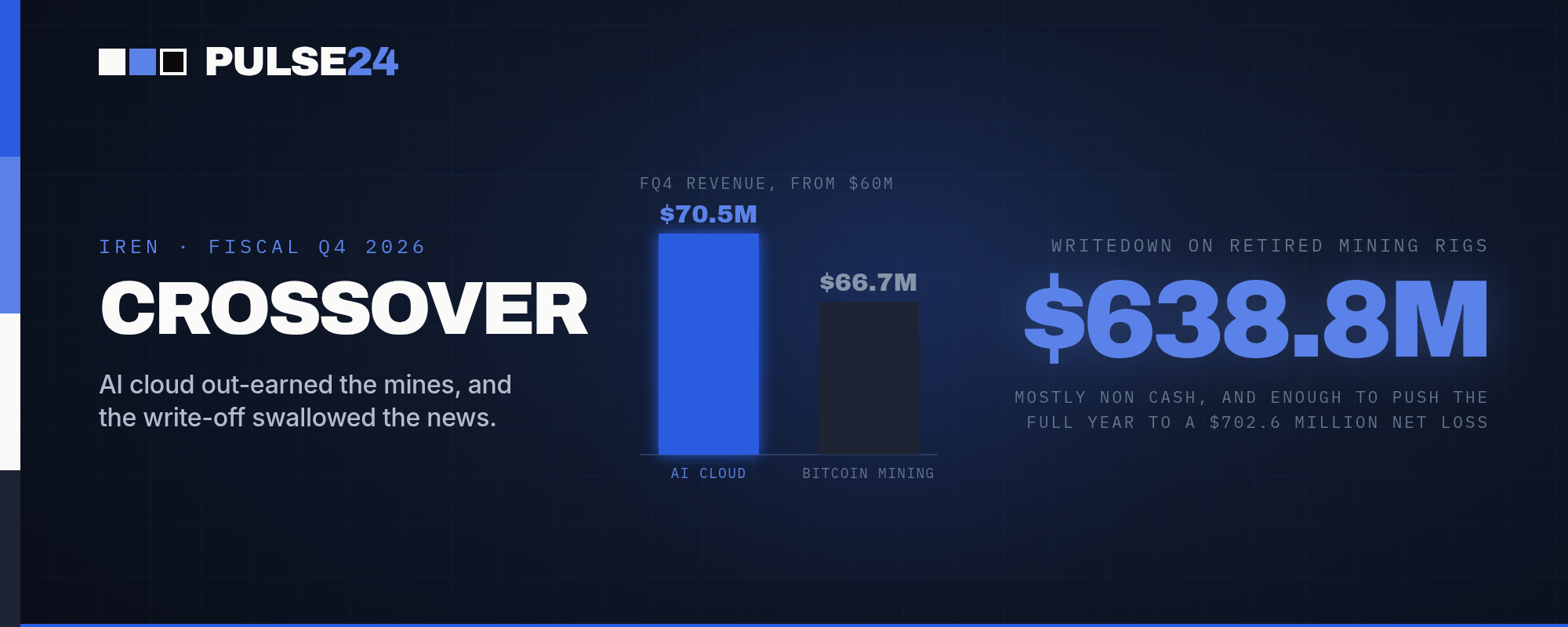
IREN's AI cloud business finally out-earned its Bitcoin mines last quarter, a milestone years in the making. Wall Street responded by knocking about 12% off the stock in a single session over a $639 million writedown.
Seventy million dollars. That is roughly what IREN's AI cloud division earned in the quarter that ended June 30, edging past the $66.7 million its Bitcoin mining operation pulled in over the same three months. It is the first time in the Australian company's history that artificial intelligence infrastructure has out-earned the crypto business it was originally built on.
The market did not celebrate. IREN shares dropped from Thursday's close of $40.53 to $35.45 by Friday's close, a 12.5% decline, after the company also reported a $702.6 million net loss for the full fiscal year, driven almost entirely by a $638.8 million writedown on older mining hardware being torn out to make room for Nvidia GPUs.
What Changed
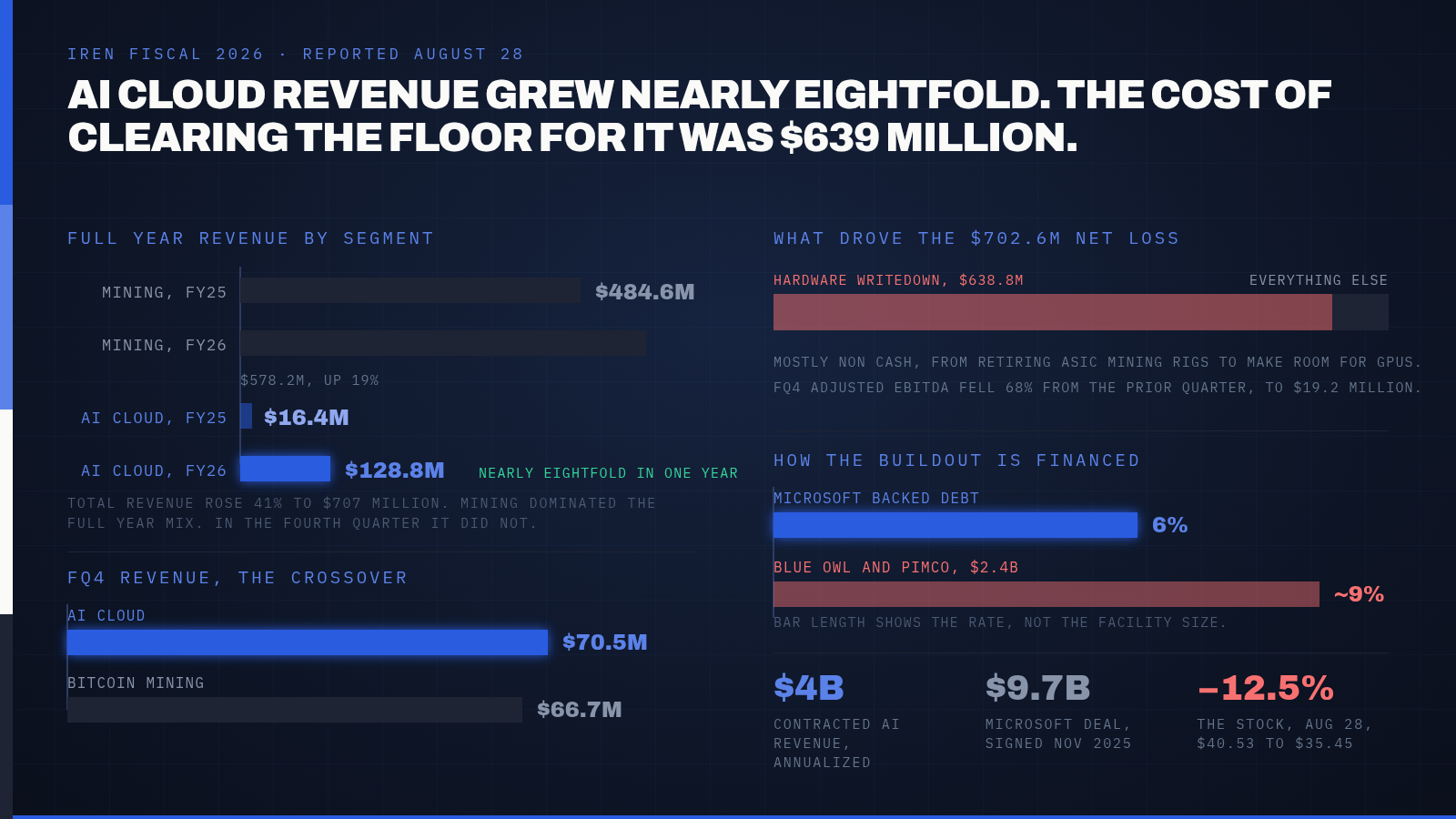
IREN's fiscal 2026 revenue climbed 41% to $707 million from $501 million the year before. Inside that total, AI cloud services revenue jumped nearly eightfold, from $16.4 million to $128.8 million, while Bitcoin mining revenue grew a more modest 19%, from $484.6 million to $578.2 million. For the year, mining still dominated the mix. For the quarter, it did not: AI cloud brought in $70.5 million against mining's $66.7 million, more than doubling from the prior quarter and crossing over for the first time.
The loss came almost entirely from one source. Retiring the older mining rigs that once filled IREN's data halls triggered $638.8 million in asset impairments, most of it non-cash, as the company converts sites originally built for Bitcoin's ASIC chips into facilities that can carry the power density and liquid cooling GPUs need. Adjusted EBITDA for the full year came in at $245.7 million, down modestly from $269.7 million a year earlier, but the fourth-quarter figure alone fell 68% from the prior quarter to $19.2 million as the transition costs bunched up.
The AI side of the business is not standing still while this plays out. On August 17, ten days before earnings, IREN switched on Horizon 1, a 50-megawatt cluster of Nvidia GB300 NVL72 chips at its Childress, Texas campus, the first of four planned deployments under a five-year, $9.7 billion contract with Microsoft signed in November 2025. IREN says Horizon 1 achieved Nvidia's Exemplar Cloud certification, and the remaining three phases, another 150 megawatts combined, are due later this year.
Why It Matters
Growth alone did not buy IREN much patience from investors, and the reason has to do with how the buildout is being paid for. The company has arranged $3.6 billion of GPU financing tied directly to the Microsoft contract at a 6% weighted-average rate, the kind of pricing a blue-chip counterparty makes possible. A second pool, $2.8 billion including a $2.4 billion facility from Blue Owl Capital and PIMCO, carries a rate near 9%. That gap is the market's own estimate of how much riskier debt looks once there is no hyperscaler standing behind it, and it echoes the same question Pulse24 raised when Broadcom's and Oracle's cost of insuring their own debt hit record levels earlier this week.
IREN says it has already contracted $4 billion of annualized revenue against its 2026 AI capacity, effectively selling the year out before it is finished. What is actually running today is far smaller: operating annualized revenue stood at $1 billion as of August 26. That gap, between revenue that is signed and revenue that is billing, is the same gap lenders are pricing when they charge 9% instead of 6%, and it mirrors the structural question Pulse24 flagged around JPMorgan's debt package for the data center startup Volta: contracted revenue is not the same asset as cash revenue, and the market is starting to price the difference rather than assume it away.
The reaction elsewhere in the sector tells its own story. TeraWulf closed down 6.9% and Applied Digital fell 7.7% the same day, and Core Scientific, another former Bitcoin miner pivoting toward AI hosting, fell by a similar margin. None of the three had announced anything new of their own. The broader Global X Data Center & Digital Infrastructure ETF, which holds a wider mix of established operators alongside these crypto-miner-turned-AI-cloud names, slipped a milder 1.75%. That gap points to something specific: the sympathy selling concentrated in the small handful of former Bitcoin miners now chasing the same AI cloud pivot as IREN, all of which trade at steep multiples on AI cloud revenue that is still mostly promised rather than booked. When one of them books an outsized writedown, the market seems to treat it as a preview of what the others might eventually report too.
What to Watch Next
The next test is execution speed. IREN has 150 megawatts of Horizon capacity left to deliver this year on top of the 50 it just switched on, and every megawatt that comes online late pushes back the date when contracted revenue turns into operating revenue that can service the 9% debt. Watch the pace of that rollout as closely as the headline numbers.
Also worth watching: whether TeraWulf, Applied Digital, Core Scientific, and other former Bitcoin miners now chasing the same AI pivot report writedowns of their own when their quarters land. Friday's sympathy selloff suggests the market is already pricing in the possibility. A clean quarter from any of these names, without a comparable impairment, would be the first real evidence that IREN's charge was company-specific after all.
The Pulse24 Take
There is a version of this story that is straightforwardly bullish: a company built to mine Bitcoin just proved its AI business can out-earn that legacy operation, years ahead of when most analysts expected the crossover. There is another version that is more cautious: getting there cost $639 million in writedowns, and roughly a third of the debt funding the next phase is priced at 9% because lenders are not fully convinced the transition is finished.
Both versions are true at once, and that tension, not a verdict either way, is the more useful takeaway. The AI infrastructure buildout keeps generating stories like this one, real revenue growth sitting next to real financing costs, with the market increasingly willing to punish the messy parts even when the underlying trend is intact. That is a more measured reaction than blanket enthusiasm would be, and probably a healthier one for anyone trying to figure out which of these companies survive the transition they are all attempting at once.
How we read the data
Curious how we get from raw data to a take like this? Our Trader's Toolkit walks through the tools we lean on.
Explore the Toolkit