Pulse24 Original
Broadcom's Cost to Insure Its Own Debt Hit a Record 122 Basis Points This Week. Oracle's Sits Higher Still, Near 203, as Both Chase the Same AI Buildout.
August 26, 2026
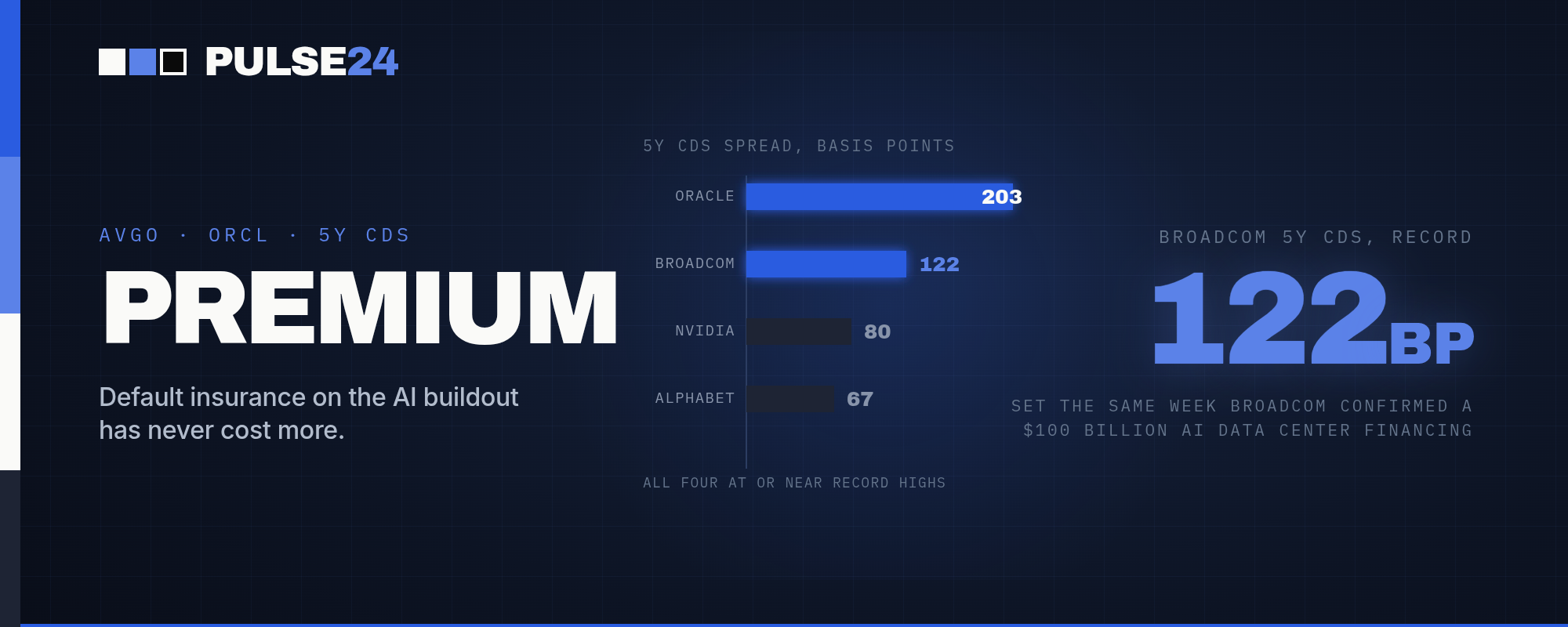
Broadcom's credit default swaps hit a record 122 basis points this week, and Oracle's sit even higher, near 203. The derivatives market is pricing real risk into the AI buildout that the rest of the credit market isn't seeing yet.
A five-year contract to insure $10 million of Broadcom's debt against default now costs about $122,000 a year. That premium has never been higher for Broadcom, and it reached a record the same week the company confirmed plans to raise as much as $100 billion in fresh financing, most of it routed through a special purpose vehicle rather than Broadcom's own balance sheet, to build data centers for the AI boom.
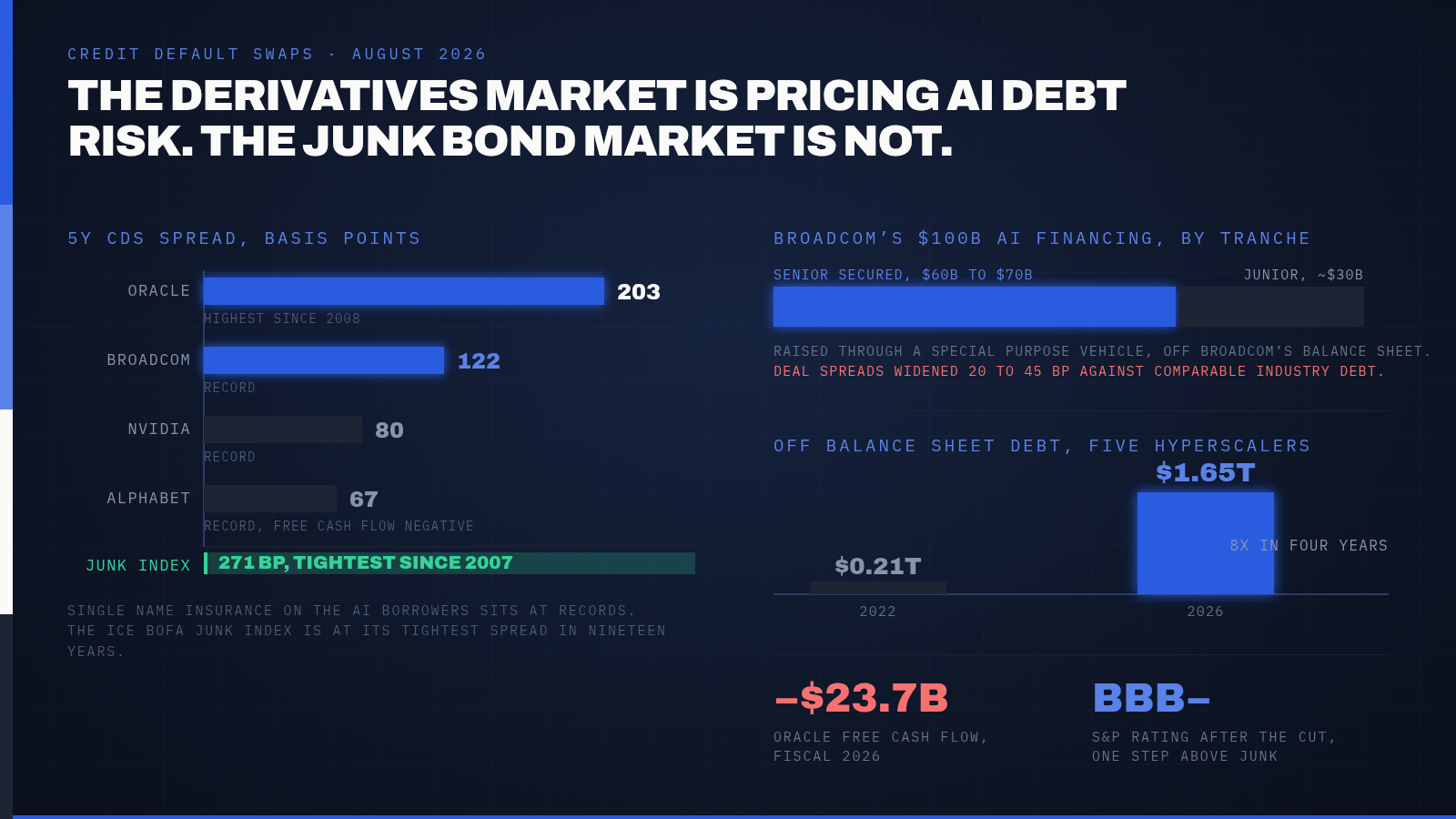
Oracle's insurance costs even more. Its five-year credit default swap sits near 203 basis points, the highest level since the 2008 financial crisis, after S&P Global cut Oracle's credit rating a notch to BBB-, one step above junk. The agency pointed to a fiscal 2026 in which Oracle posted negative free cash flow of $23.7 billion against roughly $130 billion in total debt, and said plainly that it had underestimated how much capital Oracle's AI buildout would actually require.
Alphabet joined the list too. Its CDS touched a record near 67 basis points after a quarter in which free cash flow turned negative, a shift few analysts had priced in a few months earlier. Nvidia's own default insurance has climbed into the high 70s and low 80s in basis points, also a record, even though Nvidia carries far less debt than either Oracle or Broadcom relative to its size.
What Changed
Broadcom's deal shows how this financing actually works. Roughly $60 billion to $70 billion of the package is senior secured debt raised through the special purpose vehicle, a separate legal entity that keeps the borrowing off Broadcom's own books, with another $30 billion or so in junior tranches layered on top. Bank of America analysts flagged the structure directly, noting that the contingent liabilities tied to the vehicle still represent real exposure for Broadcom even though they won't appear on its balance sheet in the usual way. Bond spreads on the deal widened 20 to 45 basis points against comparable industry debt, a sign that buyers are already demanding a premium for the risk.
Customer concentration is a big part of that risk. The vehicle's revenue depends heavily on lease payments from a small number of AI labs, and Anthropic, whose revenue Pulse24 covered growing 14-fold to $11.5 billion this year, is among the largest counterparties. If AI chip demand cools even modestly, the vehicle's ability to service $100 billion in debt gets tested fast, and Broadcom would likely be the one left holding the exposure.
Oracle's stress runs through a different channel entirely. The company committed to an unprecedented data center construction program to compete for AI cloud contracts, spending that S&P said had "consistently" exceeded what the agency had modeled, a rare admission that a rating agency was behind the curve on how fast this buildout was moving.
Why It Matters
None of this shows up if you only look at the broad credit market. The ICE BofA high-yield index recently touched its tightest spread since 2007, a sign that investors as a whole are demanding very little extra compensation for corporate default risk. Put the two data points side by side and a narrower story emerges. Credit markets are not broadly stressed. The pocket of borrowers financing the AI buildout directly is being priced in a different world entirely.
That divergence matters because credit default swaps tend to move before headlines do. They're priced by investors whose only job is estimating default probability, which makes a spike in the cost of insuring debt a different kind of signal than a single day's stock selloff, the kind Broadcom shares saw this week on a separate story about a Google warrant complicating its exclusivity arrangement with the search giant.
The $1.65 trillion figure is the other half of the story. That's the estimated pile of off-balance-sheet and otherwise hidden debt sitting across Alphabet, Amazon, Meta, Microsoft, and Oracle combined, roughly eight times what it was four years ago. A separate report Pulse24 covered found nine tech giants collectively carrying $3 trillion in commitments their balance sheets don't show, a companion data point pointing at the same structural shift: AI capex is increasingly financed in ways that keep it out of the numbers investors are used to scrutinizing.
What to Watch Next
Nvidia's earnings today are the nearest test of whether investors still believe AI revenue can outrun AI debt. Nvidia's own $105 billion guarantee for OpenAI's Ohio data center is itself part of the financing web this story is about. A strong beat with confident guidance would likely ease pressure on CDS spreads across the sector. A disappointing quarter, even a modest one against sky-high expectations, could push spreads on Broadcom, Oracle, and their peers higher still.
Watch whether other rating agencies follow S&P's lead on Oracle. Moody's has kept a negative outlook rather than downgrading outright, and a second cut would confirm that credit analysts, not just bond traders, are recalibrating how much risk the AI buildout carries. Watch too whether this stress stays contained to single names or starts showing up in the broader high-yield index. As long as junk spreads hold near 271 basis points, this remains a story about specific balance sheets rather than the credit market as a whole.
The Pulse24 Take
A credit default swap is not a prediction of bankruptcy. It's an insurance price, and insurance prices rise well before anything actually goes wrong, often for reasons that never fully materialize. Treat these numbers as an early warning gauge, not a verdict.
What's genuinely new here is the gap. Insuring against a broad basket of junk-rated companies has rarely been cheaper. Doing the same for a handful of investment-grade companies underwriting the AI buildout has rarely been more expensive, not since before the financial crisis. Both facts are true at once, and reconciling them is the real work for anyone trying to gauge whether this cycle ends in a soft landing or something rougher.
For readers building a mental model of this cycle, the useful takeaway here is awareness, not alarm. These risks show up in the derivatives and ratings world well before they would surface on a quarterly earnings call. Watching CDS spreads on Broadcom, Oracle, and their peers over the next few months may prove a better real-time gauge of the AI buildout's health than watching the stocks themselves.
How we read the data
Curious how we get from raw data to a take like this? Our Trader's Toolkit walks through the tools we lean on.
Explore the Toolkit